REVIEW 4 major objections 5 minor 26 references
A modular pipeline for suction bin picking keeps 79% pick success on hard novel-object scenes, where end-to-end learned baselines fall to under 30%.
Reviewed by Pith at T0; open to challenge. T0 means a machine referee read the full paper against a public rubric. the ladder, T0–T4 →
T0 review · deepseek-v4-flash
2026-08-01 17:03 UTC pith:AWJZHX6Y
load-bearing objection Plausible modular bin-picking system, but the headline success-rate claim is unverifiable as reported because Table I has no trial counts, error bars, or significance tests. the 4 major comments →
Seg2Grasp: A Robust Modular Suction Grasping in Bin Picking
The pith
A machine-rendered reading of the paper's core claim, the machinery that carries it, and where it could break.
Core claim
On its own terms, the paper's central discovery is that a grasp policy need not be learned end-to-end to handle novel objects: a pretrained class-agnostic Mask Transformer produces object masks, a plain geometric scorer picks the suction point via a weighted combination of surface-angle alignment, distance to the mask centroid, and count of coplanar inlier points, and a fine-tuned open-vocabulary Mask-CLIP labels the object. In the hardest of three test levels, this combination reached 0.79 pick success, 0.86 object success, and 0.83 segmentation success, while the two end-to-end baselines fell to 0.28–0.31 on the same metrics. The paper interprets this as evidence that modular decomposition
What carries the argument
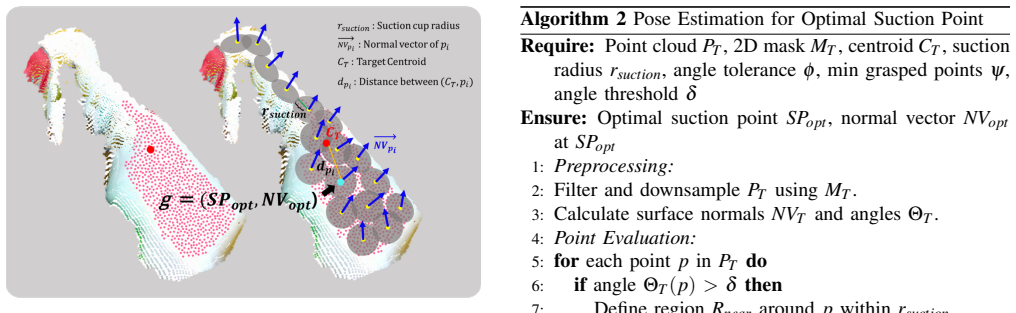
The load-bearing objects are the class-agnostic mask proposals from a Mask Transformer, the RANSAC planar-fitting filter that selects the target object as the mask whose planar-inlier centroid has the highest z-coordinate, and a geometric suction-point scorer. The scorer evaluates candidate points by three normalized metrics—surface angle, distance from the mask centroid, and count of points compatible with the suction cup within an angle tolerance—combined through a weighted sum, and returns the point and its normal. These two mechanisms, plus a mask-prompt-tuned CLIP classifier, are what carry the argument; they replace learned grasp quality prediction with explicit geometric reasoning.
Load-bearing premise
The pipeline assumes that the object whose planar inlier centroid sits highest in the bin is the best next suction target; if that object is small, curved, unstable, or not actually suctionable, every grasp and label downstream is based on a bad choice.
What would settle it
Put a bin where the topmost object is a small sphere resting on a large flat box, and run the pipeline repeatedly with a suction gripper sized for the box: if the robot keeps attempting the sphere and failing rather than shifting to the box, the target-selection heuristic is the culprit. A controlled comparison of pick success when the topmost object is suctionable versus not would settle the claim's dependence on this heuristic.
If this is right
- If correct, suction bin picking can be deployed on unseen object sets without collecting grasp training data for each new product.
- The modular design lets each component be swapped or fine-tuned independently—e.g., a better segmenter or a different gripper—without retraining the whole system.
- Open-vocabulary classification means the same hardware can be redirected to new sorting categories by changing text prompts rather than re-labeling data.
- The high performance under camera-height and bin-type variation suggests the pipeline is robust to the sensor and fixture changes common on real factory lines.
Where Pith is reading between the lines
- The paper's target-selection heuristic—pick the mask whose RANSAC inlier centroid is highest—works when the topmost object is the easiest suction target, but a small or curved object on top would be selected anyway; a learned or heuristic selection that also scored grasp feasibility might do even better.
- The claimed advantage is only as strong as the baselines' training matches; a comparison with a modern end-to-end grasp model trained on the same novel object distribution would be needed to confirm the modularity effect is the cause, not just the specific baselines' weaknesses.
- The classification module's top-1 accuracy of 73.8% implies that, in a full picking task, roughly one in four objects may be mislabeled; the paper does not address how downstream placement or user confidence would handle those errors.
Editorial analysis
A structured set of objections, weighed in public.
Referee Report
Summary. The paper proposes Seg2Grasp, a modular bin-picking system composed of (1) a class-agnostic Mask2Former-style segmentation module over depth-weighted RGB input, (2) a geometric suction-point scoring module that uses surface normals, planar RANSAC filtering, and a weighted score to select the most elevated object and the best suction point, and (3) a fine-tuned Mask-CLIP classification module. The central claim is that this modular pipeline achieves substantially higher physical pick success than end-to-end baselines (DexNet 4.0 and SuctionNet), especially under 'HARD' conditions with complex, novel objects (Table I: 0.79 vs 0.28/0.29). The paper also reports robustness to camera-height and bin-type changes and improved mask-based classification accuracy for Mask-CLIP over CLIP.
Significance. If the experimental claims are reliable, the paper makes a useful contribution: it demonstrates that a modular, class-agnostic segmentation plus geometric suction scoring can outperform learned end-to-end grasp planners on novel cluttered scenes, which is a practically relevant result for industrial bin picking. The use of real-robot experiments across multiple environmental variations is a strength, and the proposed pipeline is transparent and does not depend on a fitted circular prediction. The Mask-CLIP fine-tuning idea is reasonable. However, the significance is currently limited by the lack of statistical grounding for the headline comparison and by the in-distribution evaluation of the classification module; the stated 'open-vocabulary' advantage is not demonstrated beyond the 53 training/evaluation categories.
major comments (4)
- [Section V.B.1, Table I] The central claim rests on the HARD-row success rates (0.79 vs 0.28/0.29), but the paper reports no number of trials per condition, no variance, confidence intervals, or significance tests. The text states that conditions were 'adjusted to provide the best possible performance' for each method, which makes the comparison protocol unclear and potentially unfair to the baselines. Without trial counts or a common protocol specification, the headline advantage is not statistically established. Please provide N_t for each row, per-condition results, and a significance test or confidence intervals.
- [Section V.C and Table II] The open-vocabulary classification evaluation is in-distribution: the Mask-CLIP model is fine-tuned on 90% of the 53-category mask dataset and evaluated on the remaining 10% of the same categories. This measures closed-set accuracy, not open-vocabulary generalization to unseen categories. The claim that Seg2Grasp can handle 'objects without prior explicit knowledge' is therefore not supported by Table II. An evaluation with held-out categories (ideally object classes unseen in fine-tuning) is needed to justify the open-vocabulary claim. Additionally, the classification module is not integrated into the physical grasp experiments, so its effect on overall system performance is unmeasured.
- [Algorithm 1 and Section IV.A] Target selection is determined solely by the mask whose RANSAC planar-inlier centroid has the highest z-coordinate (T=argmax_i z_i). The paper provides no analysis of when this topmost-object heuristic fails, e.g., when the most elevated object is small, curved, unstable, or not accessible to the vacuum gripper. Since every downstream grasp and classification step depends on this choice, a failure characterization or at least an ablative comparison (e.g., random target selection, area-based selection) is necessary to establish that this heuristic is not a major source of errors in the reported success rates.
- [Algorithm 2 and Eq. (2)] The grasp scoring function in Eq. (2) depends on weights w_theta, w_d, w_g and thresholds (phi, psi, delta, r_suction, RANSAC tolerance epsilon), none of which are specified in the paper or in an appendix. Without these parameters the algorithm is not reproducible, and because the reported success rates are the paper's central evidence, the parameter values (and any tuning process) should be disclosed. If the weights were hand-tuned on the test scenes, the comparison with untuned baselines would be confounded.
minor comments (5)
- [Section V.B.2 and Fig. 6(b)] The camera-height experiments report only qualitative text ('successfully picking only 10 to 15 objects') and the figure appears to lack axes and numeric values. Please provide a table with per-condition counts and success rates for each method.
- [Section V.B.3 and Fig. 6(c)] The bin-variation experiments are described without quantitative success-rate numbers; Fig. 6(c) should include explicit performance values or a companion table. As written, the claim that Seg2Grasp 'consistently achieved high success rates' is not quantitatively supported.
- [Section IV.A, Eq. (1)] The input fusion S_C * S'_D is described as 'product' of color and inverted depth; it would help to clarify whether this is element-wise multiplication after rescaling both to [0,1] and whether any gamma correction is applied.
- [General] Several hyperparameters are given (learning rate, epochs), but the number of RANSAC iterations in Algorithm 1 and the number of candidate points sampled in Algorithm 2 are omitted. Please include these for reproducibility.
- [Table I] The sr entry for DexNet 4.0 is listed as '-'. Since DexNet 4.0 does not perform segmentation, this is understandable, but the paper should state this explicitly in the caption or text.
Circularity Check
No significant circularity: the central claims rest on physical robot experiments and hand-designed scoring, not on fitted outputs or self-citation chains.
full rationale
Seg2Grasp's central result, the pick success rate in Table I, is measured by physical robot grasping outcomes (pr=Ng/Nt) rather than by an equation fitted to those outcomes. The grasping score in Eq. (2) is presented as a hand-designed weighted combination of normalized geometric criteria (surface angle, distance to centroid, point count); the paper reports no fitting of the weights w_theta, w_d, w_g to the experimental success data, so no 'prediction' reduces to a fitted constant. Algorithm 1's target selection T=argmax_i(z_i) is an explicit heuristic for choosing the most elevated mask centroid, not a derived output. The classification module fine-tunes Mask-CLIP on a 53-category dataset and evaluates on the same category distribution, which is a standard supervised evaluation rather than a circular reduction; the paper does not claim out-of-distribution category generalization from that table. References are to external prior work (Mask2Former, UOAIS-Net, OVSeg, DexNet, SuctionNet, OpenCLIP) and none is a self-citation by the present authors invoked as load-bearing proof. The absence of trial counts, variance, or significance tests in Table I is a serious evidence-quality concern, but that is a missing-support issue, not circularity. No step in the derivation chain is equivalent to its inputs by construction, so the appropriate finding is no significant circularity.
Axiom & Free-Parameter Ledger
free parameters (3)
- grasp scoring weights w_θ, w_d, w_g =
not reported
- grasping thresholds and geometry: φ, ψ, δ, r_suction, RANSAC tolerance ε =
not reported
- training hyperparameters of segmentation and classification =
lr=1e-4, batch=4, 5 epochs (segmentation); 10 epochs ViT-L/14 (classification)
axioms (6)
- domain assumption Mask2Former trained on UOAIS-SIM (synthetic) transfers to real bin scenes, including novel objects
- domain assumption The mask whose RANSAC planar inlier centroid has highest z is the most accessible target
- domain assumption Surface normals from a single Azure Kinect view at heights up to 150 cm are accurate enough to score suction candidates
- ad hoc to paper Fine-tuned Mask-CLIP retains open-vocabulary capability beyond the 53 fine-tuning categories
- ad hoc to paper Weighted score combination in Eq. (2) with unspecified weights defines a valid objective for suction grasp success
- standard math Standard math: RANSAC plane fitting and point-cloud normal estimation behave as expected
read the original abstract
Current bin picking methods that rely heavily on end-to-end learning often falter when confronted with unfamiliar or complex objects in unstructured environments. To overcome these limitations, we introduce Seg2Grasp, a modular pipeline designed for robust suction grasping in dynamic and cluttered bin scenarios. Seg2Grasp is built on a three-step process: Segmentation, Grasping, and Classification. The Segmentation module employs a Transformer-based model to generate class-agnostic object masks from RGB-D images, ensuring accurate detection across various conditions. The Grasping module uses surface normals and mask proposals to determine the optimal suction points, enhancing grasp success. Finally, the Classification module leverages fine-tuned open-vocabulary Mask-CLIP for precise object identification, enabling versatile handling of diverse objects. Real-world robotic experiments demonstrate that Seg2Grasp outperforms existing methods in success rates and adaptability, establishing it as a powerful tool for automated bin picking in industrial settings.
Figures




Reference graph
Works this paper leans on
-
[1]
J. Mahler, J. Liang, S. Niyaz, M. Laskey, R. Doan, X. Liu, J. A. Ojea, and K. Goldberg, “Dex-net 2.0: Deep learning to plan robust grasps with synthetic point clouds and analytic grasp metrics,”arXiv preprint arXiv:1703.09312, 2017
Pith/arXiv arXiv 2017
-
[2]
Dex- net 3.0: Computing robust vacuum suction grasp targets in point clouds using a new analytic model and deep learning,
J. Mahler, M. Matl, X. Liu, A. Li, D. Gealy, and K. Goldberg, “Dex- net 3.0: Computing robust vacuum suction grasp targets in point clouds using a new analytic model and deep learning,” in2018 IEEE International Conference on robotics and automation (ICRA). IEEE, 2018, pp. 5620–5627
2018
-
[3]
Learning ambidextrous robot grasping policies,
J. Mahler, M. Matl, V . Satish, M. Danielczuk, B. DeRose, S. McKinley, and K. Goldberg, “Learning ambidextrous robot grasping policies,” Science Robotics, vol. 4, no. 26, p. eaau4984, 2019
2019
-
[4]
Suctionnet-1billion: A large- scale benchmark for suction grasping,
H. Cao, H.-S. Fang, W. Liu, and C. Lu, “Suctionnet-1billion: A large- scale benchmark for suction grasping,”IEEE Robotics and Automation Letters, vol. 6, no. 4, pp. 8718–8725, 2021
2021
-
[5]
Robotic pick-and-place of novel objects in clutter with multi-affordance grasping and cross-domain image matching,
A. Zeng, S. Song, K.-T. Yu, E. Donlon, F. R. Hogan, M. Bauza, D. Ma, O. Taylor, M. Liu, E. Romo,et al., “Robotic pick-and-place of novel objects in clutter with multi-affordance grasping and cross-domain image matching,”The International Journal of Robotics Research, vol. 41, no. 7, pp. 690–705, 2022
2022
-
[6]
Real-time 3d segmentation of cluttered scenes for robot grasping,
A. ¨Uckermann, R. Haschke, and H. Ritter, “Real-time 3d segmentation of cluttered scenes for robot grasping,” in2012 12th IEEE-RAS International Conference on Humanoid Robots (Humanoids 2012). IEEE, 2012, pp. 198–203
2012
-
[7]
Review of learning-based robotic manipulation in cluttered environments,
M. Q. Mohammed, L. C. Kwek, S. C. Chua, A. Al-Dhaqm, S. Na- havandi, T. A. E. Eisa, M. F. Miskon, M. N. Al-Mhiqani, A. Ali, M. Abaker,et al., “Review of learning-based robotic manipulation in cluttered environments,”Sensors, vol. 22, no. 20, p. 7938, 2022
2022
-
[8]
Deformable detr: Deformable transformers for end-to-end object detection,
X. Zhu, W. Su, L. Lu, B. Li, X. Wang, and J. Dai, “Deformable detr: Deformable transformers for end-to-end object detection,”arXiv preprint arXiv:2010.04159, 2020
Pith/arXiv arXiv 2010
-
[9]
Masked-attention mask transformer for universal image segmenta- tion,
B. Cheng, I. Misra, A. G. Schwing, A. Kirillov, and R. Girdhar, “Masked-attention mask transformer for universal image segmenta- tion,” inProceedings of the IEEE/CVF conference on computer vision and pattern recognition, 2022, pp. 1290–1299
2022
-
[10]
Conditional convolutions for instance segmentation,
Z. Tian, C. Shen, and H. Chen, “Conditional convolutions for instance segmentation,” inComputer Vision–ECCV 2020: 16th European Con- ference, Glasgow, UK, August 23–28, 2020, Proceedings, Part I 16. Springer, 2020, pp. 282–298
2020
-
[11]
The best of both modes: Separately leveraging rgb and depth for unseen object instance segmentation,
C. Xie, Y . Xiang, A. Mousavian, and D. Fox, “The best of both modes: Separately leveraging rgb and depth for unseen object instance segmentation,” inConference on robot learning. PMLR, 2020, pp. 1369–1378
2020
-
[12]
Unseen object instance segmentation for robotic environments,
——, “Unseen object instance segmentation for robotic environments,” IEEE Transactions on Robotics, vol. 37, no. 5, pp. 1343–1359, 2021
2021
-
[13]
Learning rgb-d feature embeddings for unseen object instance segmentation,
Y . Xiang, C. Xie, A. Mousavian, and D. Fox, “Learning rgb-d feature embeddings for unseen object instance segmentation,” inConference on Robot Learning. PMLR, 2021, pp. 461–470
2021
-
[14]
Unseen object amodal instance segmentation via hierarchical occlusion mod- eling,
S. Back, J. Lee, T. Kim, S. Noh, R. Kang, S. Bak, and K. Lee, “Unseen object amodal instance segmentation via hierarchical occlusion mod- eling,” in2022 International Conference on Robotics and Automation (ICRA). IEEE, 2022, pp. 5085–5092
2022
-
[15]
Mean shift mask transformer for unseen object instance segmentation,
Y . Lu, Y . Chen, N. Ruozzi, and Y . Xiang, “Mean shift mask transformer for unseen object instance segmentation,”arXiv preprint arXiv:2211.11679, 2022
Pith/arXiv arXiv 2022
-
[16]
Bin picking approaches based on deep learning techniques: A state-of-the- art survey,
A. Cordeiro, L. F. Rocha, C. Costa, P. Costa, and M. F. Silva, “Bin picking approaches based on deep learning techniques: A state-of-the- art survey,” in2022 IEEE International Conference on Autonomous Robot Systems and Competitions (ICARSC), 2022, pp. 110–117
2022
-
[17]
Gripping point determination for bin picking using heuristic search,
F. Spenrath and A. Pott, “Gripping point determination for bin picking using heuristic search,”Procedia CIRP, vol. 62, pp. 606–611, 2017
2017
-
[18]
Ppr- net: point-wise pose regression network for instance segmentation and 6d pose estimation in bin-picking scenarios,
Z. Dong, S. Liu, T. Zhou, H. Cheng, L. Zeng, X. Yu, and H. Liu, “Ppr- net: point-wise pose regression network for instance segmentation and 6d pose estimation in bin-picking scenarios,” in2019 IEEE/RSJ International Conference on Intelligent Robots and Systems (IROS). IEEE, 2019, pp. 1773–1780
2019
-
[19]
A sim-to-real object recognition and localization framework for industrial robotic bin picking,
X. Li, R. Cao, Y . Feng, K. Chen, B. Yang, C.-W. Fu, Y . Li, Q. Dou, Y .-H. Liu, and P.-A. Heng, “A sim-to-real object recognition and localization framework for industrial robotic bin picking,”IEEE Robotics and Automation Letters, vol. 7, no. 2, pp. 3961–3968, 2022
2022
-
[20]
A cnn-based grasp planning method for random picking of unknown objects with a vacuum gripper,
H. Zhang, J. Peeters, E. Demeester, and K. Kellens, “A cnn-based grasp planning method for random picking of unknown objects with a vacuum gripper,”Journal of Intelligent & Robotic Systems, vol. 103, pp. 1–19, 2021
2021
-
[21]
Model-free grasping with multi-suction cup grippers for robotic bin picking,
P. Schillinger, M. Gabriel, A. Kuss, H. Ziesche, and N. A. Vien, “Model-free grasping with multi-suction cup grippers for robotic bin picking,” in2023 IEEE/RSJ International Conference on Intelligent Robots and Systems (IROS). IEEE, 2023, pp. 3107–3113
2023
-
[22]
Survey on 6d pose estimation of rigid object,
J. Chen, L. Zhang, Y . Liu, and C. Xu, “Survey on 6d pose estimation of rigid object,” in2020 39th Chinese Control Conference (CCC). IEEE, 2020, pp. 7440–7445
2020
-
[23]
Learning transferable visual models from natural language supervision,
A. Radford, J. W. Kim, C. Hallacy, A. Ramesh, G. Goh, S. Agarwal, G. Sastry, A. Askell, P. Mishkin, J. Clark,et al., “Learning transferable visual models from natural language supervision,” inInternational conference on machine learning. PMLR, 2021, pp. 8748–8763
2021
-
[24]
Open-vocabulary semantic segmentation with mask-adapted clip,
F. Liang, B. Wu, X. Dai, K. Li, Y . Zhao, H. Zhang, P. Zhang, P. Vajda, and D. Marculescu, “Open-vocabulary semantic segmentation with mask-adapted clip,” inProceedings of the IEEE/CVF Conference on Computer Vision and Pattern Recognition, 2023, pp. 7061–7070
2023
-
[25]
Korea, The Open AI Dataset Project
AI-Hub, S. Korea, The Open AI Dataset Project. All data information can be accessed through ‘www.aihub.or.kr’
-
[26]
G. Ilharco, M. Wortsman, R. Wightman, C. Gordon, N. Carlini, R. Taori, A. Dave, V . Shankar, H. Namkoong, J. Miller, H. Hajishirzi, A. Farhadi, and L. Schmidt, “Openclip,” July 2021. [Online]. Available: https://doi.org/10.5281/zenodo.5143773
discussion (0)
Sign in with ORCID, Apple, or X to comment. Anyone can read and Pith papers without signing in.