REVIEW 3 major objections 4 minor 23 references
Expressive voice-assistant speech does not need a stronger TTS engine; it needs a Harness layer that reduces style control to closed-set selection among recorded prompt tools, and the paper's experiments show this routing approach beats dir
Reviewed by Pith at T0; open to challenge. T0 means a machine referee read the full paper against a public rubric. the ladder, T0–T4 →
T0 review · deepseek-v4-flash
2026-08-01 16:38 UTC pith:DWYOMFUM
load-bearing objection A plausible TTS control layer with a confounded synthesis evaluation: the win margins don't isolate the router, and the authors need ablations plus human or at least varied-prompt comparisons. the 3 major comments →
Harness TTS: Towards Context-Aware Expressive Speech Synthesis with Harness Layer
The pith
A machine-rendered reading of the paper's core claim, the machinery that carries it, and where it could break.
Core claim
The paper tries to establish that style control in text-to-speech can be externalized and made reliable by reformulating it as closed-set prompt-tool routing. A registry stores style prompt audios, each described by discrete tags (speed, volume, emotion) and a free-text caption. A text-only LLM planner receives a structured observation built from five prioritized fields — explicit instruction, implicit intent, scenario, user profile, and system default — and ranks candidate tools, with explicit user requirements overriding lower-priority context. The selected prompt audio then conditions an unmodified prompt-based TTS executor. The claimed result is that this arrangement outperforms direct i
What carries the argument
The central mechanism is the Harness layer itself, instantiated as a lightweight LLM-based router. Three load-bearing pieces carry the argument: the tool registry, a small, speaker-specific set of style prompt audios with dual-annotation metadata; the observation schema, which organizes contextual signals into five decision fields with a fixed priority order so that conflicting requirements resolve predictably; and the closed-set routing interface, which converts unbounded style generation into the selection of an audio ID. The work performed by this mechanism is the separation of contextual decision-making from acoustic generation, making stylistic choices auditable, bounded, and stable wit
Load-bearing premise
The central claim stands or falls on whether LLM-generated test cases, teacher labels, and preference judgments are a faithful proxy for how humans perceive style and naturalness, which the paper's own limitations section says remains unvalidated.
What would settle it
A human A/B listening study using the same 135 instruction utterances, pitting Harness-generated speech against direct-instruction speech: if untrained listeners do not show preference margins near the reported 13.8–35.6-point gaps, the synthesis claim does not transfer to real users.
If this is right
- Existing prompt-based TTS engines gain context-aware style control without any retraining of the generator.
- Every stylistic choice becomes auditable: the selected tool ID and prompt audio explain why a given utterance sounded the way it did.
- Real-time interaction remains feasible, because synthesis only needs the first tool ID and the planner emits it in under 50 ms.
- High-level scenario instructions (such as 'bedtime story' or 'news broadcast') can be realized by matching a preset tool or composing acoustic axes, which direct instruction conditioning handled poorly in the experiments.
- The fixed priority policy gives system designers a predictable conflict-resolution rule: explicit instructions always override contextual signals.
Where Pith is reading between the lines
- The closed-set registry caps expressive range: any style not represented by a recorded prompt tool is unavailable, so the practical ceiling moves from the generator to the curation of the prompt library; a natural extension is per-user or dynamically growing registries.
- Because the Harness condition supplies the planner with a longer, structured observation while the Instruct condition receives only a bare instruction, part of the win-rate gap may come from the LLM judge rewarding richer textual context rather than the audio itself — a human listening test is the direct check.
- The harness pattern is not TTS-specific: any generative model whose output style is currently controlled by free-form prompting could be wrapped in the same priority-aware tool-selection layer, inheriting the same auditability benefits.
Editorial analysis
A structured set of objections, weighed in public.
Referee Report
Summary. The paper proposes Harness TTS, an external control layer for prompt-based TTS. It constructs a tool registry of style prompt audios with structured metadata, and uses a lightweight LLM planner to route multi-source observations (system defaults, user profile, scenario, implicit cues, explicit instructions) to a tool according to a priority policy. The selected prompt audio then conditions a zero-shot TTS engine. The paper evaluates routing accuracy against Gemini-generated teacher labels, planner latency, and synthesis quality measured by a Gemini preference judge plus UTMOSv2 and speaker similarity, comparing Harness against instruction-only control on CosyVoice3 and VoxCPM2. The reported results favor Harness on routing accuracy, latency, instruction-following win rates, and naturalness.
Significance. If the findings hold, the paper offers a practical, auditable way to add context-aware style control to existing TTS systems without retraining. Strengths include the explicit priority hierarchy, interpretable tool IDs, a realistic latency measurement setup with vLLM, and an honest limitations section that acknowledges the lack of human validation. However, because the evaluation is entirely LLM-generated and the synthesis comparison confounds planner routing with reference-audio choice, human validation and targeted ablations are needed before the central synthesis claim can be accepted.
major comments (3)
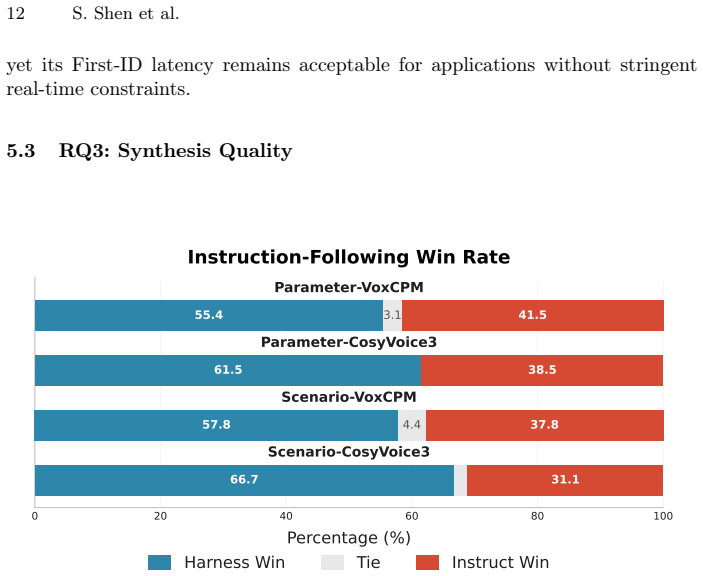
- [§4.2, Fig. 3] The central claim that Harness improves instruction following over Instruct is not established because the comparison changes two variables simultaneously: the planner's routing decision and the prompt audio. Both CosyVoice3 and VoxCPM2 are zero-shot TTS models that condition on reference audio. In the Harness condition the executor always receives a style-matched prompt audio selected by the planner; in the Instruct condition it receives the instruction text plus a single default reference clip. The 13.8–35.6 point win margins in Fig. 3 could therefore be driven entirely by the acoustic benefits of a matched reference, not by the planner's routing. I request ablations that isolate the planner: e.g., Harness vs. random-prompt selection, retrieval-prompt selection, and oracle-prompt selection (the best possible prompt for the instruction), all with the same executor and the same registry.
- [§4.1, §4.2, §6] The evaluation loop is entirely LLM-based: Gemini-2.5-Pro generates test cases and teacher labels (§4.1), Gemini-3.1-Pro judges synthesis preferences (§4.2), and §6 acknowledges that metrics 'await subjective validation' and that all test data are generated by LLMs. The T-* routing metrics measure agreement with a Gemini teacher, not ground-truth correctness; implicit and conflict subsets are especially vulnerable to teacher bias. Likewise, the Inst. win% is a pairwise preference by an LLM judge that may favor longer, structured, or otherwise distinctive outputs. For a paper whose contribution is practical voice-assistant behavior, at least one human listening test (e.g., MOS for style match and naturalness on a sample of the 135 cases) and a report of inter-annotator agreement are necessary. Without them, the headline margins are not evidence about human perception.
- [§5.3] The synthesis results are reported as point estimates without confidence intervals or significance tests. Figure 3 reports win rates over 135 test cases per backend (27 tags × 5 utterances), and Fig. 4 reports UTMOSv2 means with no variability. Many margins are sizable, but 'consistently achieves' requires statistical support; please report bootstrap CIs or pairwise significance tests (e.g., Wilcoxon signed-rank on per-tag scores). This is especially important because the win-rate differences are the paper's central quantitative claim.
minor comments (4)
- [Fig. 3 / Abstract] Margin arithmetic: the abstract states CosyVoice3 margins of 23.1–35.6, but the figure shows 61.5 vs. 38.5 for the parameter subset (margin 23.0); the VoxCPM2 parameter margin reads 13.9 (55.4 vs. 41.5) rather than 13.8. Please align numbers or clarify rounding.
- [§3.2, §4.1] The routing task uses a simulated 42-tool registry while the synthesis task uses a 25-clip voice library. The relationship between the two registries and how tools map to audio clips should be stated explicitly.
- [General] No code, data, or audio samples are released; release would substantially help reproducibility, especially for the LLM-judge evaluation.
- [Table 5 / Abstract] The abstract's 'standard mode' is not defined in the text; clarify that it corresponds to the w/o CoT setting and cite the P95 First-ID latency of 41.2 ms.
Circularity Check
No circular derivation; evaluation is transparently LLM-based and self-acknowledged, not a fit renamed as prediction.
full rationale
Harness TTS proposes an external routing layer for prompt-based TTS and evaluates it with routing and synthesis experiments. There is no formal derivation chain whose output reduces to its inputs: no fitted parameters are renamed as predictions, no equations are self-referential, and no load-bearing proof is imported solely from the authors' prior work. The routing metrics are explicitly teacher-aligned, with the paper stating 'We report teacher-alignment metrics, prefixed with T- to indicate that the reference is the teacher model rather than human labels' (Section 4.1), so the reported Top-1 accuracies are openly agreement-with-Gemini numbers, not disguised human judgments. The synthesis win-rate metric is likewise defined as Gemini preference: 'Instruction Following Win Rate (Inst. win%) uses Gemini-3.1-Pro to assess how well the synthesized speech follows the style instruction' (Section 4.2). Section 6 explicitly acknowledges the limitation: 'our evaluation relies on LLM-based teachers and judges rather than human annotations; thus, the reported metrics should be interpreted as automated benchmarks that await subjective validation' and 'all test data are generated by LLMs rather than collected from real-world user logs.' This is a validity limitation, but not circularity: the claims are about performance on these automated benchmarks, and the benchmark is not presented as an independent human ground truth. The potential confound that Harness always supplies a style-matched prompt audio while Instruct uses a default reference is a real attribution concern for the end-to-end synthesis comparison, but it is an ablation/experimental-design issue, not a case where the output is identical to the input by construction. Citations to harness engineering are inspirational ('Drawing inspiration from harness engineering...' [21]) and do not carry the burden of proof for the empirical results. Overall, no specific circular step can be exhibited from the paper's own equations or definitions, so the circularity score is 0.
Axiom & Free-Parameter Ledger
free parameters (1)
- Priority hierarchy integer weights =
explicit=5, implicit=4, scene=3, user_profile=2, system_default=1
axioms (3)
- domain assumption The fixed priority policy (explicit overrides implicit over scene over profile over default) is the correct normative rule for voice assistants.
- domain assumption A closed-set registry of 42 routing tools (or 25 synthesis tools) is sufficient to represent the expressive needs of real interactions.
- domain assumption Gemini teacher/judge outputs are a valid proxy for human routing labels and synthesis preference.
Cite this review
Pith. "Pith review of Harness TTS: Towards Context-Aware Expressive Speech Synthesis with Harness Layer." pith.science (2026). https://pith.science/paper/DWYOMFUM
@misc{pith2026260717900,
  author       = {Pith},
  title        = {Pith review of: Harness TTS: Towards Context-Aware Expressive Speech Synthesis with Harness Layer},
  year         = {2026},
  howpublished = {\url{https://pith.science/paper/DWYOMFUM}},
  note         = {Machine review of arXiv:2607.17900}
}
read the original abstract
Expressive speech synthesis for voice assistants requires flexible style control that adapts to explicit requests and broader interaction context. We propose Harness TTS, a lightweight control layer that wraps around a TTS engine to externalize and govern its expressive behavior. It reformulates style control as closed-set prompt-tool routing: offline, a compact registry of stylistic prompt tools is constructed with structured metadata; online, an LLM planner selects the appropriate tool based on a priority-aware observation schema, and the TTS executor synthesizes speech using the corresponding prompt audio. We evaluate Harness TTS on both routing and synthesis tasks. In routing, Qwen3-4B achieves Top-1 accuracies of 74.3%, 43.0%, and 64.6% on explicit, implicit, and conflict subsets. For synthesis, experiments on CosyVoice3 and VoxCPM2 show that Harness TTS outperforms instruction-only control, achieving higher instruction-following win rates (margins of 23.1-35.6 points on CosyVoice3 and 13.8-20.0 points on VoxCPM2) and improving UTMOSv2 scores by 0.11-0.38. Moreover, the 4B planner delivers its first tool recommendation in under 50 ms in standard mode, introducing negligible latency for real-time interaction. These results demonstrate that equipping TTS engines with a dedicated Harness layer offers a practical, auditable, and context-aware solution for voice assistant expression control.
Figures



Reference graph
Works this paper leans on
-
[1]
In: 2024 IEEE Spoken Language Technology Workshop (SLT)
Baba, K., Nakata, W., Saito, Y., Saruwatari, H.: The t05 system for the voice- mos challenge 2024: Transfer learning from deep image classifier to naturalness mos prediction of high-quality synthetic speech. In: 2024 IEEE Spoken Language Technology Workshop (SLT). pp. 818–824. IEEE (2024)
2024
-
[2]
IEEE Transactions on Audio, Speech and Language Processing33, 705–718 (2025)
Chen, S., Wang, C., Wu, Y., Zhang, Z., Zhou, L., Liu, S., Chen, Z., Liu, Y., Wang, H., Li, J., He, L., Zhao, S., Wei, F.: Neural codec language models are zero-shot text to speech synthesizers. IEEE Transactions on Audio, Speech and Language Processing33, 705–718 (2025). https://doi.org/10.1109/TASLPRO.2025.3530270
arXiv 2025
-
[3]
arXiv preprint arXiv:2507.06261 (2025)
Comanici, G., Bieber, E., Schaekermann, M., Pasupat, I., Sachdeva, N., Dhillon, I., Blistein, M., Ram, O., Zhang, D., Rosen, E., et al.: Gemini 2.5: Pushing the frontier with advanced reasoning, multimodality, long context, and next generation agentic capabilities. arXiv preprint arXiv:2507.06261 (2025)
Pith/arXiv arXiv 2025
-
[4]
arXiv preprint arXiv:2505.17589 (2025)
Du, Z., Gao, C., Wang, Y., Yu, F., Zhao, T., Wang, H., Lv, X., Wang, H., Ni, C., Shi, X., et al.: Cosyvoice 3: Towards in-the-wild speech generation via scaling-up and post-training. arXiv preprint arXiv:2505.17589 (2025)
Pith/arXiv arXiv 2025
-
[5]
arXiv preprint arXiv:2412.10117 (2024)
Du, Z., Wang, Y., Chen, Q., Shi, X., Lv, X., Zhao, T., Gao, Z., Yang, Y., Gao, C., Wang, H., et al.: Cosyvoice 2: Scalable streaming speech synthesis with large language models. arXiv preprint arXiv:2412.10117 (2024)
Pith/arXiv arXiv 2024
-
[6]
In: ICASSP 2023-2023 IEEE International Confer- ence on Acoustics, Speech and Signal Processing (ICASSP)
Guo, Z., Leng, Y., Wu, Y., Zhao, S., Tan, X.: Prompttts: Controllable text-to- speech with text descriptions. In: ICASSP 2023-2023 IEEE International Confer- ence on Acoustics, Speech and Signal Processing (ICASSP). pp. 1–5. IEEE (2023)
2023
-
[7]
In: 2024 IEEE 14th International Symposium on Chinese Spoken Language Processing (ISCSLP)
Hu, Y., Liu, R., Gao, G., Li, H.: Fctalker: Fine and coarse grained context modeling for expressive conversational speech synthesis. In: 2024 IEEE 14th International Symposium on Chinese Spoken Language Processing (ISCSLP). pp. 299–303. IEEE (2024)
2024
-
[8]
In: International Conference on Learning Representations
Jiang, Z., Liu, J., Ren, Y., He, J., Ye, Z., Ji, S., Yang, Q., Zhang, C., Wei, P., Wang, C., et al.: Mega-tts 2: Boosting prompting mechanisms for zero-shot speech synthesis. In: International Conference on Learning Representations. vol. 2024, pp. 57919–57939 (2024) Harness TTS 15
2024
-
[9]
In: Proceedings of the 29th symposium on operating systems prin- ciples
Kwon, W., Li, Z., Zhuang, S., Sheng, Y., Zheng, L., Yu, C.H., Gonzalez, J., Zhang, H., Stoica, I.: Efficient memory management for large language model serving with pagedattention. In: Proceedings of the 29th symposium on operating systems prin- ciples. pp. 611–626 (2023)
2023
-
[10]
Advances in neural information processing systems36, 14005–14034 (2023)
Le, M., Vyas, A., Shi, B., Karrer, B., Sari, L., Moritz, R., Williamson, M., Manohar, V., Adi, Y., Mahadeokar, J., et al.: Voicebox: Text-guided multilingual universal speech generation at scale. Advances in neural information processing systems36, 14005–14034 (2023)
2023
-
[11]
arXiv preprint arXiv:2601.01459 (2026)
Ren, Y., Yi, J., Tao, J., Sun, H., Wen, Z., Gu, H., Xu, L., Bai, Y.: Ov-instructtts: Towards open-vocabulary instruct text-to-speech. arXiv preprint arXiv:2601.01459 (2026)
arXiv 2026
-
[12]
In: International conference on learning representations
Shen, K., Ju, Z., Tan, X., Liu, E., Leng, Y., He, L., Qin, T., Bian, J., et al.: Natu- ralspeech 2: Latent diffusion models are natural and zero-shot speech and singing synthesizers. In: International conference on learning representations. vol. 2024, pp. 698–722 (2024)
2024
-
[13]
arXiv preprint arXiv:2604.08363 (2026)
Su, X., Sun, Z., Jia, P., Gao, J.: Captalk: Unified voice design for single-utterance and dialogue speech generation. arXiv preprint arXiv:2604.08363 (2026)
Pith/arXiv arXiv 2026
-
[14]
Wang, H., Liang, C., Wang, S., Chen, Z., Zhang, B., Xiang, X., Deng, Y., Qian, Y.: Wespeaker: A research and production oriented speaker embedding learning toolkit.In:ICASSP2023-2023IEEEInternationalConferenceonAcoustics,Speech and Signal Processing (ICASSP). pp. 1–5. IEEE (2023)
2023
-
[15]
Advances in neural information processing systems35, 24824–24837 (2022)
Wei, J., Wang, X., Schuurmans, D., Bosma, M., Xia, F., Chi, E., Le, Q.V., Zhou, D., et al.: Chain-of-thought prompting elicits reasoning in large language models. Advances in neural information processing systems35, 24824–24837 (2022)
2022
-
[16]
In: ICASSP 2023-2023 IEEE International Conference on Acoustics, Speech and Signal Processing (ICASSP)
Xue, J., Deng, Y., Wang, F., Li, Y., Gao, Y., Tao, J., Sun, J., Liang, J.: M 2- ctts: End-to-end multi-scale multi-modal conversational text-to-speech synthesis. In: ICASSP 2023-2023 IEEE International Conference on Acoustics, Speech and Signal Processing (ICASSP). pp. 1–5. IEEE (2023)
2023
-
[17]
arXiv preprint arXiv:2606.21933 (2026)
Xue, W., Feng, J., Zhang, S., Wang, Y., Yang, R., Liu, B., Xue, L., Cheng, S., Pan, J., Bian, W., et al.: Iscslp 2026 cot-tts challenge: Chain-of-thought reasoning for context-aware text-to-speech. arXiv preprint arXiv:2606.21933 (2026)
Pith/arXiv arXiv 2026
-
[18]
arXiv preprint arXiv:2505.09388 (2025)
Yang, A., Li, A., Yang, B., Zhang, B., Hui, B., Zheng, B., Yu, B., Gao, C., Huang, C., Lv, C., et al.: Qwen3 technical report. arXiv preprint arXiv:2505.09388 (2025)
Pith/arXiv arXiv 2025
-
[19]
IEEE/ACM Transactions on Audio, Speech, and Language Processing32, 2913–2925 (2024)
Yang, D., Liu, S., Huang, R., Weng, C., Meng, H.: Instructtts: Modelling expres- sive tts in discrete latent space with natural language style prompt. IEEE/ACM Transactions on Audio, Speech, and Language Processing32, 2913–2925 (2024)
2024
-
[20]
arXiv preprint arXiv:2506.05176 (2025)
Zhang, Y., Li, M., Long, D., Zhang, X., Lin, H., Yang, B., Xie, P., Yang, A., Liu, D., Lin, J., et al.: Qwen3 embedding: Advancing text embedding and reranking through foundation models. arXiv preprint arXiv:2506.05176 (2025)
Pith/arXiv arXiv 2025
-
[21]
arXiv preprint arXiv:2604.08224 (2026)
Zhou, C., Chai, H., Chen, W., Guo, Z., Shan, R., Song, Y., Xu, T., Yang, Y., Yu, A., Zhang, W., et al.: Externalization in llm agents: A unified review of memory, skills, protocols and harness engineering. arXiv preprint arXiv:2604.08224 (2026)
Pith/arXiv arXiv 2026
-
[22]
In: Proceedings of the AAAI Conference on Artificial Intelligence
Zhou, S., Zhou, Y., He, Y., Zhou, X., Wang, J., Deng, W., Shu, J.: Indextts2: A breakthrough in emotionally expressive and duration-controlled auto-regressive zero-shot text-to-speech. In: Proceedings of the AAAI Conference on Artificial Intelligence. vol. 40, pp. 35139–35148 (2026)
2026
-
[23]
arXiv preprint arXiv:2606.06928 (2026)
Zhou, Y., Zeng, G., Liu, X., Li, X., Yu, R., Gui, J., Wu, J., Wang, Z., Shen, X., Ye, R., et al.: Voxcpm2 technical report. arXiv preprint arXiv:2606.06928 (2026)
Pith/arXiv arXiv 2026
discussion (0)
Sign in with ORCID, Apple, or X to comment. Anyone can read and Pith papers without signing in.