REVIEW 4 major objections 4 minor 50 references
The paper argues that the parallel mass splittings of the four narrow Xi_c and four narrow Omega_c states reveal one underlying heavy-quark multiplet, assigning quantum numbers 1/2-, 3/2-, 3/2-, 5/2- in succession, and reads Omega_c(3119) a
Reviewed by Pith at T0; open to challenge. T0 means a machine referee read the full paper against a public rubric. the ladder, T0–T4 →
T0 review · deepseek-v4-flash
2026-08-01 16:36 UTC pith:TJCFTU3R
load-bearing objection A plausible HQET interpretation of the excited Ξ_c and Ω_c spectra, but the assignments lean on a mixing angle fit to the very states being classified and on sum-rule splittings that do not actually match the pattern they claim to anchor. the 4 major comments →
Quantum numbers of excited Xi_c^prime and Ω_c baryons and the P-wave Sigma_c spectrum
The pith
A machine-rendered reading of the paper's core claim, the machinery that carries it, and where it could break.
Core claim
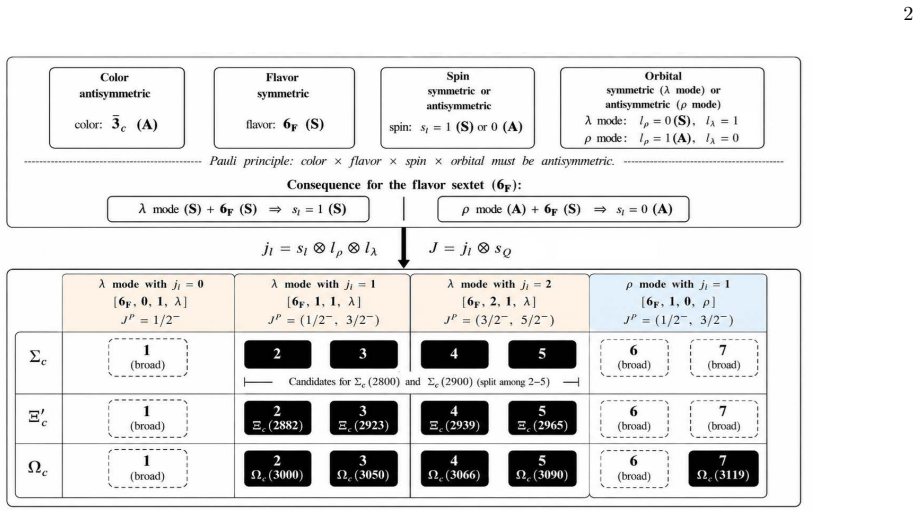
The central claim is that the visible spectrum of excited charmed baryons is not a one-to-one image of the seven-state HQET level scheme in each flavor sector; strong decays, kinematic thresholds, and finite-charm-quark mixing act as a filter. For the flavor sextet, HQET allows seven P-wave states per sector, organized into four multiplets: [6F(0,1,lambda)] with J^P=1/2-, [6F(1,1,lambda)] with (1/2-,3/2-), [6F(2,1,lambda)] with (3/2-,5/2-), and [6F(1,0,rho)] with (1/2-,3/2-). The paper's key result is that the parallel splittings of Xi_c(2882,2923,2939,2965) and Omega_c(3000,3050,3066,3090) select the level ordering 1/2-, 3/2-_L, 3/2-_H, 5/2- within the lambda-mode multiplets, with the two 3
What carries the argument
The load-bearing object is the HQET classification of P-wave charmed baryons in the flavor sextet, which reduces every state to a multiplet label [6F(J^P), j_l, s_l, rho/lambda], where lambda means orbital excitation between the charm quark and the light-quark pair and rho means orbital excitation between the two light quarks. The calculations use the mass formula m_{B,J}=m_c+barLambda_B-(1/(2m_c))(K_B+d_{J,j_l} C_mag Sigma_B) from QCD sum rules, together with the observation that splittings within a multiplet are far more stable than absolute masses because common uncertainties cancel. The 3/2- mixing angle theta=(37 +/- 5) degrees between the two lambda-mode doublets, fixed from the Xi_c a
Load-bearing premise
The whole assignment rests on the assumption that mass splittings within a heavy-quark multiplet are much more stable than absolute masses because theoretical uncertainties cancel; if that cancellation is weaker than assumed, the level ordering that fixes the quantum numbers could change.
What would settle it
A lattice QCD calculation of the negative-parity Xi_c and Omega_c spectrum, with explicit spin-parity identification, would falsify the ladder if any of the four-plus-four states emerges with different J^P or a different level ordering.
If this is right
- The observed states Xi_c(2882), Xi_c(2923), Xi_c(2939), Xi_c(2965) and Omega_c(3000), Omega_c(3050), Omega_c(3066), Omega_c(3090) are lambda-mode excitations with J^P = 1/2-, 3/2-, 3/2-, 5/2- respectively.
- Omega_c(3119) is predominantly a rho-mode 3/2- state; its narrow width is explained by a closed S-wave Xi*_c Kbar channel, with a small mixing admixture opening the Xi_c Kbar decay.
- Of the seven allowed P-wave states in each flavor sector, only four Sigma_c, four Xi'_c, and five Omega_c states are expected to be experimentally resolvable; the rest are broad enough to escape detection as peaks.
- The observed Sigma_c(2800) and Sigma_c(2900) structures are not single resonances but overlapping P-wave components; future amplitude analyses of the Lambda_c pi spectrum can resolve their spin-parity and partial-wave content.
- The same 3/2- mixing angle of about 37 degrees applies to the Sigma_c sector, so the predicted four Sigma_c states have fixed relative masses and widths within the framework.
Where Pith is reading between the lines
- If the mass-splitting cancellation is as good as assumed, the same multiplet ordering should reappear in bottom baryons with splittings reduced by roughly m_c/m_b; measuring excited Xi_b or Omega_b states would test this directly.
- The paper's filter picture implies that counting observed states gives a biased census of underlying multiplets; future searches should expect broad companions near narrow states rather than assuming each peak is a single state.
- The predicted broad Omega_c states, such as a 1/2- rho-mode near 3.11 GeV with a width around 260 MeV decaying to Xi'_c Kbar, are directly searchable in existing collider data and would check the assignment without new experiments.
- If the four Sigma_c states overlap as claimed, re-fitting the Lambda_c pi invariant-mass spectrum with interfering resonances of the predicted masses and widths should improve the description of current data; this is a testable re-analysis.
Editorial analysis
A structured set of objections, weighed in public.
Referee Report
Summary. The paper studies the P-wave charmed baryons in the SU(3) flavor-sextet representation using QCD sum rules and light-cone sum rules within heavy quark effective theory (HQET). It assigns the observed narrow states Ξc(2882), Ξc(2923), Ξc(2939), Ξc(2965) and Ωc(3000), Ωc(3050), Ωc(3066), Ωc(3090) to the successive λ-mode HQET multiplets with J^P = 1/2^-, 3/2^-, 3/2^-, 5/2^-, and tentatively identifies Ωc(3119) as a predominantly ρ-mode 3/2^- excitation. It further predicts four resolvable P-wave Σc states that may overlap inside the Σc(2800) and Σc(2900) structures.
Significance. If the assigned quantum numbers are correct, the paper would provide a coherent multiplet organization for several recently observed narrow charmed baryons and concrete predictions for future amplitude analyses of the Σc sector. The parallel mass-splitting pattern in Eq. (4) is a real empirical observation, and applying the same framework consistently to three flavor sectors is a useful strategy. The paper also gives explicit width predictions and decay modes. However, the central claim that the assignments are 'determined' by the theoretical results is not supported as presented, because the mixing angle is fitted to the very states being assigned and the mass-splitting stability is asserted rather than demonstrated.
major comments (4)
- [Mass spectra, decay properties, and mixing; Eq. (10)] The quantum-number assignments are not an independent prediction. The mixing angle θ = 37° ± 5° is determined from the masses and decay properties of Ξc(2923), Ξc(2939), Ωc(3050), and Ωc(3066) — precisely the states that Eq. (10) then assigns to |3/2^-⟩_L and |3/2^-⟩_H. The subsequent width agreement for these states is therefore partly constructed, not a test. An independent determination of θ (e.g., from a QCD sum-rule calculation of the off-diagonal correlator) or an explicit reframing of the assignments as consistency checks rather than determinations is needed.
- [Table I and Eq. (4)] The assertion that mass splittings within a multiplet are significantly more stable because common uncertainties cancel is not demonstrated. The central consecutive Ωc splittings from Table I are 31, 14, and 55 MeV, compared with the observed 50, 16, and 24 MeV; the final predicted splitting is more than twice the observed value. Since the absolute masses carry 100–230 MeV uncertainties, the sum-rule masses do not independently reproduce the parallel pattern that anchors Eq. (10). The pattern is used as an input, not derived.
- [Mass spectra, decay properties, and mixing; Table I] The small mixing angles θ′ and θ″ are introduced ad hoc to open otherwise forbidden decay channels (entries marked ≠0). These angles are not constrained by any calculation or independent data, yet they are load-bearing for the viability of some assignments; for example, the Ωc(3119) → Ξc Kbar amplitude appears only through such mixing. The paper should either quantify these angles or demonstrate that the assignments are insensitive to their values.
- [Table I] Most predicted widths are consistent with zero at the 1σ level (e.g., Ωc(3050): 1.3^{+2.6}_{-1.0} MeV; Ωc(3066): 3.7^{+7.3}_{-2.9} MeV; Ξc(2923): 9^{+16}_{-7} MeV). The statement that the decay properties 'support' the assignments is therefore too strong; at this precision the widths do not discriminate among alternative J^P assignments. The paper should quantify the discriminating power of the width predictions, or temper the claim.
minor comments (4)
- [Introduction, p. 2] Typo: 'difficult' should be 'difficult'.
- [References, [34]] Reference [34] has 'QCD rum rule approach' in the title; it should be 'QCD sum rule approach'.
- [Eq. (5)] The notation jl = lρ ⊗ lλ ⊗ sl denotes angular-momentum addition, not a direct product of operators; consider using ⊕ or clarifying the standard addition rule.
- [Fig. 1] The figure caption mentions solid and dashed boxes for narrow and broad states, but the text does not describe the figure contents in sufficient detail for the reader to follow the classification without the figure. A brief description in the text would improve readability.
Circularity Check
Mixing-angle fit to the very states being classified and unconstrained small admixtures make part of the J^P-assignment support circular.
specific steps
-
fitted input called prediction
[Section 'Mass spectra, decay properties, and mixing', Eqs. (8)-(10)]
"We determine a common mixing angle from the masses and decay properties of Ξc(2923), Ξc(2939), Ωc(3050), and Ωc(3066), and obtain θ = 37 ◦ ± 5◦. ... The same mixing pattern is then applied to the corresponding J P = 3/2− Σc states."
Equation (10) then identifies Ξc(2923)/Ωc(3050) with |3/2−⟩_L and Ξc(2939)/Ωc(3066) with |3/2−⟩_H, the very states used to fix θ. The same section cites the resulting 'predicted total widths are consistent with experiment' as support for these assignments, but θ was adjusted to the masses and decay properties of these four resonances. The 3/2− pair assignment and its width agreement are therefore consequences of the fit rather than independent checks.
-
other
[Section 'Mass spectra, decay properties, and mixing', Table I footnote and Eq. (11)]
"Small admixtures among other configurations with the same flavor and J P , parameterized by the small mixing angles θ′ and θ′′ in Table I, are also allowed at finite charm-quark mass. Although they have little influence on the mass spectra and total widths, they can generate otherwise vanishing or strongly suppressed decay amplitudes, thereby reconciling the dominant configuration assignments with the experimentally observed channels."
The table marks channels 'opened by such mixing' (≠0), and these nonzero amplitudes are used to explain why Ωc(3119) is narrow while observable, and why other states are broad. Because θ′ and θ′′ are unconstrained and chosen to open exactly the needed channels, the claimed agreement with observed channels is built into the model rather than supplying independent confirmation of the assignments.
full rationale
The empirical parallel mass-splitting pattern in Eq. (4) is real input, not a derived prediction, and the Σc predictions genuinely transfer a mixing angle to a sector not used in the fit. The self-citations to the authors' previous QCD sum-rule papers are standard method citations, not a load-bearing uniqueness chain. However, the central 3/2− pair assignment is circular in an important part: θ is fixed from the masses and decay properties of Ξc(2923), Ξc(2939), Ωc(3050), and Ωc(3066), and then the same states are assigned to the mixed 3/2− levels, with their width agreement cited as support. That support is not independent. The small angles θ′ and θ″ are similarly introduced ad hoc to open otherwise vanishing decay channels and are then used to explain observed widths and narrowness, so those agreements are also by construction. Additionally, the central masses in Table I do not reproduce the anchor pattern well (e.g., Ωc consecutive splittings 31, 14, 55 MeV versus observed 50, 16, 24 MeV); this is a correctness concern rather than circularity, but it means the assignments rely heavily on the empirical pattern plus fitted θ. Overall, there is partial circularity in the validation chain, warranting a score of 6.
Axiom & Free-Parameter Ledger
free parameters (3)
- Mixing angle θ =
37° ± 5°
- Mixing angles θ′, θ″ =
≈ 0°
- Sum-rule parameters (Borel mass, continuum threshold, m_c, condensates) =
not quoted (from [9,10,32,34])
axioms (5)
- domain assumption Heavy-quark effective theory: the charm quark's spin decouples and Eq. (7) (m_{B,J} = m_c + Λ̄_B − (1/2m_c)(K_B + d_{J,j_l} C_mag Σ_B)) gives the mass including 1/m_c kinetic and chromomagnetic corrections.
- domain assumption QCD sum-rule quark-hadron duality: two-point correlation functions, after Borel transformation and continuum subtraction, determine masses and decay couplings.
- ad hoc to paper Only the two λ-mode J^P=3/2^- states [6F,1,1,λ] and [6F,2,1,λ] mix significantly; other mixings θ′,θ″ are small.
- domain assumption SU(3) flavor symmetry: the same mixing angle θ applies to Σ_c, Ξ_c′, and Ω_c sectors.
- domain assumption Mass splittings within an HQET multiplet are significantly more stable than absolute masses because common theoretical uncertainties cancel.
read the original abstract
Recent precision measurements of excited heavy baryons, combined with systematic theoretical studies, make it possible to resolve the fine structure of their spectra. We calculate the masses and strong-decay properties of the $P$-wave charmed baryons using QCD sum rules and light-cone sum rules within heavy quark effective theory (HQET). Although seven states are allowed in each flavor sector, we find that only four $\Sigma_c$, four $\Xi_c^\prime$, and five $\Omega_c$ states are expected to be experimentally resolvable. The similar mass-splitting patterns of $\Xi_c(2882)$, $\Xi_c(2923)$, $\Xi_c(2939)$, and $\Xi_c(2965)$ and of $\Omega_c(3000)$, $\Omega_c(3050)$, $\Omega_c(3066)$, and $\Omega_c(3090)$, together with our theoretical results, lead to the successive quantum-number assignments $J^P=1/2^-,3/2^-,3/2^-$, and $5/2^-$. We tentatively interpret $\Omega_c(3119)$ as a predominantly $\rho$-mode excitation with $J^P=3/2^-$. We also predict the masses, widths, and dominant decay modes of four resolvable $P$-wave $\Sigma_c$ states, which may overlap within the observed $\Sigma_c(2800)$ and $\Sigma_c(2900)$ structures. Precision spectroscopy of the narrow $\Xi_c$ and $\Omega_c$ states thus provides a route to resolving the $P$-wave $\Sigma_c$ spectrum.
Figures
Reference graph
Works this paper leans on
-
[1]
J. G. Korner, M. Kramer, D. Pirjol, Heavy baryons, Prog. Part. Nucl. Phys. 33 (1994) 787–868. arXiv:hep-ph/ 9406359, doi:10.1016/0146-6410(94)90053-1
-
[2]
A. V. Manohar, M. B. Wise, Heavy quark physics, Cam- bridge University Press, 2007
2007
-
[3]
Neubert, Heavy quark symmetry, Phys
M. Neubert, Heavy quark symmetry, Phys. Rept. 245 (1994) 259–396. arXiv:hep-ph/9306320, doi:10.1016/ 0370-1573(94)90091-4
Pith/arXiv arXiv 1994
-
[4]
Cheng, Charmed baryons circa 2015, Front
H.-Y. Cheng, Charmed baryons circa 2015, Front. Phys. (Beijing) 10 (6) (2015) 101406. doi:10.1007/ s11467-015-0483-z
2015
-
[5]
H.-X. Chen, W. Chen, X. Liu, Y.-R. Liu, S.-L. Zhu, A re- view of the open charm and open bottom systems, Rept. Prog. Phys. 80 (7) (2017) 076201. arXiv:1609.08928, doi:10.1088/1361-6633/aa6420
Pith/arXiv arXiv 2017
-
[6]
H.-X. Chen, W. Chen, X. Liu, Y.-R. Liu, S.-L. Zhu, An updated review of the new hadron states, Rept. Prog. Phys. 86 (2) (2023) 026201. arXiv:2204.02649, doi: 10.1088/1361-6633/aca3b6
Pith/arXiv arXiv 2023
-
[7]
Cheng, Charmed baryon physics circa 2021, Chin
H.-Y. Cheng, Charmed baryon physics circa 2021, Chin. J. Phys. 78 (2022) 324–362. arXiv:2109.01216, doi: 10.1016/j.cjph.2022.06.021
Pith/arXiv arXiv 2021
-
[8]
V. Crede, J. Yelton, 70 years of hyperon spectroscopy: a review of strange Ξ, Ω baryons, and the spectrum of charmed and bottom baryons, Rept. Prog. Phys. 87 (10) (2024) 106301. arXiv:2502.08815, doi:10.1088/ 1361-6633/ad7610
Pith/arXiv arXiv 2024
-
[9]
H.-X. Chen, W. Chen, Q. Mao, A. Hosaka, X. Liu, S.- L. Zhu, P-wave charmed baryons from QCD sum rules, Phys. Rev. D 91 (5) (2015) 054034. arXiv:1502.01103, doi:10.1103/PhysRevD.91.054034
Pith/arXiv arXiv 2015
-
[10]
H.-M. Yang, H.-X. Chen, P -wave charmed baryons of the SU (3) flavor 6F , Phys. Rev. D 104 (3) (2021) 034037. arXiv:2106.15488, doi:10.1103/PhysRevD. 104.034037
Pith/arXiv arXiv 2021
-
[11]
Mizuk, et al., Observation of an Isotriplet of Excited Charmed Baryons Decaying to Λ+ c π, Phys
R. Mizuk, et al., Observation of an Isotriplet of Excited Charmed Baryons Decaying to Λ+ c π, Phys. Rev. Lett. 94 (2005) 122002. arXiv:hep-ex/0412069, doi:10.1103/ PhysRevLett.94.122002
Pith/arXiv arXiv 2005
-
[12]
Aaij, et al., Observation of new excited Σ0 c states in the B− → Λ+ c ¯pπ− decay (7 2026)
R. Aaij, et al., Observation of new excited Σ0 c states in the B− → Λ+ c ¯pπ− decay (7 2026). arXiv:2607.10595
arXiv 2026
-
[13]
Aaij, et al., Observation of New Ξ0 c Baryons De- caying to Λ+ c K −, Phys
R. Aaij, et al., Observation of New Ξ0 c Baryons De- caying to Λ+ c K −, Phys. Rev. Lett. 124 (22) (2020) 222001. arXiv:2003.13649, doi:10.1103/PhysRevLett. 124.222001
arXiv 2020
-
[14]
Aaij, et al., Study of the B− → Λ+ c ¯Λ− c K − decay, Phys
R. Aaij, et al., Study of the B− → Λ+ c ¯Λ− c K − decay, Phys. Rev. D 108 (2023) 012020. arXiv:2211.00812, doi:10. 1103/PhysRevD.108.012020
Pith/arXiv arXiv 2023
-
[15]
Aaij, et al., Observation of five new narrow Ω0 c states decaying to Ξ+ c K −, Phys
R. Aaij, et al., Observation of five new narrow Ω0 c states decaying to Ξ+ c K −, Phys. Rev. Lett. 118 (18) (2017) 182001. arXiv:1703.04639, doi:10.1103/PhysRevLett. 118.182001
Pith/arXiv arXiv 2017
-
[16]
Aaij, et al., Observation of excited Ω0 c baryons in Ω− b → Ξ+ c K −π−decays, Phys
R. Aaij, et al., Observation of excited Ω0 c baryons in Ω− b → Ξ+ c K −π−decays, Phys. Rev. D 104 (9) (2021) L091102. arXiv:2107.03419, doi:10.1103/PhysRevD. 104.L091102
arXiv 2021
-
[17]
Aaij, et al., Observation of New Ω0 c States Decaying to the Ξ+ c K − Final State, Phys
R. Aaij, et al., Observation of New Ω0 c States Decaying to the Ξ+ c K − Final State, Phys. Rev. Lett. 131 (13) (2023) 131902. arXiv:2302.04733, doi:10.1103/PhysRevLett. 131.131902
Pith/arXiv arXiv 2023
-
[18]
Navas, et al., Review of particle physics, Phys
S. Navas, et al., Review of particle physics, Phys. Rev. D 110 (3) (2024) 030001. doi:10.1103/PhysRevD.110. 030001
-
[19]
L. A. Copley, N. Isgur, G. Karl, Charmed baryons in a quark model with hyperfine interactions, Phys. Rev. D 20 (1979) 768, [Erratum: Phys.Rev.D 23, 817 (1981)]. doi:10.1103/PhysRevD.20.768
-
[20]
D. Ebert, R. N. Faustov, V. O. Galkin, Spectroscopy and Regge trajectories of heavy baryons in the relativistic quark-diquark picture, Phys. Rev. D 84 (2011) 014025. arXiv:1105.0583, doi:10.1103/PhysRevD.84.014025
Pith/arXiv arXiv 2011
-
[21]
T. Yoshida, E. Hiyama, A. Hosaka, M. Oka, K. Sadato, Spectrum of heavy baryons in the quark model, Phys. Rev. D 92 (11) (2015) 114029. arXiv:1510.01067, doi: 10.1103/PhysRevD.92.114029
Pith/arXiv arXiv 2015
-
[22]
K.-L. Wang, Y.-X. Yao, X.-H. Zhong, Q. Zhao, Strong and radiative decays of the low-lying S- and P -wave singly heavy baryons, Phys. Rev. D 96 (11) (2017) 116016. arXiv:1709.04268, doi:10.1103/PhysRevD.96. 116016
Pith/arXiv arXiv 2017
-
[23]
Q.-F. Lü, Canonical interpretations of the newly ob- served Ξc(2923)0, Ξc(2939)0, and Ξc(2965)0 resonances, 6 Eur. Phys. J. C 80 (10) (2020) 921. arXiv:2004.02374, doi:10.1140/epjc/s10052-020-08488-5
Pith/arXiv arXiv 2020
-
[24]
X.-Z. Weng, W.-Z. Deng, S.-L. Zhu, Heavy baryons in the relativized quark model with chromodynamics, Phys. Rev. D 110 (5) (2024) 056052. arXiv:2405.19039, doi: 10.1103/PhysRevD.110.056052
Pith/arXiv arXiv 2024
-
[25]
M. Padmanath, R. G. Edwards, N. Mathur, M. Peardon, Excited-state spectroscopy of singly, doubly and triply- charmed baryons from lattice QCD (11 2013). arXiv: 1311.4806
Pith/arXiv arXiv 2013
-
[26]
M. Padmanath, N. Mathur, Quantum Numbers of Re- cently Discovered Ω0 c Baryons from Lattice QCD, Phys. Rev. Lett. 119 (4) (2017) 042001. arXiv:1704.00259, doi:10.1103/PhysRevLett.119.042001
Pith/arXiv arXiv 2017
-
[27]
H. Bahtiyar, K. U. Can, G. Erkol, P. Gubler, M. Oka, T. T. Takahashi, Charmed baryon spectrum from lattice QCD near the physical point, Phys. Rev. D 102 (5) (2020) 054513. arXiv:2004.08999, doi:10.1103/PhysRevD. 102.054513
Pith/arXiv arXiv 2020
-
[28]
H.-Y. Cheng, C.-K. Chua, Strong Decays of Charmed Baryons in Heavy Hadron Chiral Perturbation Theory: An Update, Phys. Rev. D 92 (7) (2015) 074014. arXiv: 1508.05653, doi:10.1103/PhysRevD.92.074014
Pith/arXiv arXiv 2015
-
[29]
B. Chen, X. Liu, New Ω0 c baryons discovered by LHCb as the members of 1P and 2S states, Phys. Rev. D 96 (9) (2017) 094015. arXiv:1704.02583, doi:10.1103/ PhysRevD.96.094015
Pith/arXiv arXiv 2017
-
[30]
Z. Zhao, D.-D. Ye, A. Zhang, Hadronic decay prop- erties of newly observed Ωc baryons, Phys. Rev. D 95 (11) (2017) 114024. arXiv:1704.02688, doi:10.1103/ PhysRevD.95.114024
Pith/arXiv arXiv 2017
-
[31]
D.-D. Ye, Z. Zhao, A. Zhang, Study of P -wave ex- citations of observed charmed strange baryons, Phys. Rev. D 96 (11) (2017) 114009. arXiv:1709.00689, doi: 10.1103/PhysRevD.96.114009
Pith/arXiv arXiv 2017
-
[32]
H.-X. Chen, Q. Mao, W. Chen, A. Hosaka, X. Liu, S.-L. Zhu, Decay properties of P -wave charmed baryons from light-cone QCD sum rules, Phys. Rev. D 95 (9) (2017) 094008. arXiv:1703.07703, doi:10.1103/PhysRevD.95. 094008
Pith/arXiv arXiv 2017
-
[33]
Wang, Analysis of Ωc(3000) , Ωc(3050) , Ωc(3066) , Ωc(3090) and Ωc(3119) with QCD sum rules, Eur
Z.-G. Wang, Analysis of Ωc(3000) , Ωc(3050) , Ωc(3066) , Ωc(3090) and Ωc(3119) with QCD sum rules, Eur. Phys. J. C 77 (5) (2017) 325. arXiv:1704.01854, doi:10.1140/ epjc/s10052-017-4895-5
Pith/arXiv arXiv 2017
-
[34]
H.-M. Yang, H.-X. Chen, Q. Mao, Excited Ξ0 c baryons within the QCD rum rule approach, Phys. Rev. D 102 (2020) 114009. arXiv:2004.00531, doi:10.1103/ PhysRevD.102.114009
Pith/arXiv arXiv 2020
-
[35]
J.-H. Pan, J. Pan, Investigation of the mass spectra of singly heavy baryons ΣQ, Ξ′ Q, and ΩQ(Q = c, b) in the Regge trajectory model, Phys. Rev. D 109 (7) (2024) 076010. arXiv:2308.11769, doi:10.1103/PhysRevD. 109.076010
Pith/arXiv arXiv 2024
-
[36]
P. Jakhad, J. Oudichhya, K. Gandhi, A. K. Rai, Iden- tification of newly observed singly charmed baryons using the relativistic flux tube model, Phys. Rev. D 108 (1) (2023) 014011. arXiv:2306.06349, doi:10.1103/ PhysRevD.108.014011
Pith/arXiv arXiv 2023
-
[37]
Z.-Y. Li, G.-L. Yu, Z.-G. Wang, J.-Z. Gu, Heavy- quark dominance and fine structure of excited heavy baryons ΣQ, Ξ′ Q and ΩQ, Eur. Phys. J. C 84 (12) (2024) 1310. arXiv:2405.16162, doi:10.1140/epjc/ s10052-024-13706-5
Pith/arXiv arXiv 2024
-
[38]
Eichten, B
E. Eichten, B. R. Hill, An effective field theory for the calculation of matrix elements involving heavy quarks, Phys. Lett. B 234 (1990) 511–516. doi:10.1016/ 0370-2693(90)92049-O
1990
-
[39]
Grinstein, The static quark effective theory, Nucl
B. Grinstein, The static quark effective theory, Nucl. Phys. B 339 (1990) 253–268. doi:10.1016/ 0550-3213(90)90349-I
1990
-
[40]
A. F. Falk, H. Georgi, B. Grinstein, M. B. Wise, Heavy meson form factors from QCD, Nucl. Phys. B 343 (1990) 1–13. doi:10.1016/0550-3213(90)90591-Z
-
[41]
M. A. Shifman, A. I. Vainshtein, V. I. Zakharov, QCD and resonance physics. theoretical foundations, Nucl. Phys. B 147 (1979) 385–447. doi:10.1016/ 0550-3213(79)90022-1
1979
-
[42]
M. A. Shifman, A. I. Vainshtein, V. I. Zakharov, QCD and Resonance Physics: Applications, Nucl. Phys. B 147 (1979) 448–518. doi:10.1016/0550-3213(79)90023-3
-
[43]
L. J. Reinders, H. Rubinstein, S. Yazaki, Hadron Prop- erties from QCD Sum Rules, Phys. Rept. 127 (1985) 1. doi:10.1016/0370-1573(85)90065-1
-
[44]
P. Colangelo, A. Khodjamirian, QCD sum rules, a modern perspective (2000) 1495–1576 arXiv:hep-ph/ 0010175, doi:10.1142/9789812810458_0033
-
[45]
P. Gubler, D. Satow, Recent Progress in QCD Conden- sate Evaluations and Sum Rules, Prog. Part. Nucl. Phys. 106 (2019) 1–67. arXiv:1812.00385, doi:10.1016/j. ppnp.2019.02.005
Pith/arXiv arXiv 2019
-
[46]
V. M. Braun, I. E. Filyanov, QCD sum rules in exclusive kinematics and pion wave function, Z. Phys. C 44 (1989)
1989
-
[47]
I. I. Balitsky, V. M. Braun, A. V. Kolesnichenko, Ra- diative Decay Σ+ → pγ in Quantum Chromodynam- ics, Nucl. Phys. B 312 (1989) 509–550. doi:10.1016/ 0550-3213(89)90570-1
1989
-
[48]
V. L. Chernyak, I. R. Zhitnitsky, B-meson exclusive de- cays into baryons, Nucl. Phys. B 345 (1990) 137–172. doi:10.1016/0550-3213(90)90612-H
-
[49]
P. Ball, Theoretical update of pseudoscalar meson dis- tribution amplitudes of higher twist: The Nonsinglet case, JHEP 01 (1999) 010. arXiv:hep-ph/9812375, doi: 10.1088/1126-6708/1999/01/010
Pith/arXiv arXiv 1999
-
[157]
doi:10.1007/BF01548594
discussion (0)
Sign in with ORCID, Apple, or X to comment. Anyone can read and Pith papers without signing in.