REVIEW 3 major objections 5 minor 38 references
An online Gaussian process with a memory subset can update a radio map incrementally from streaming measurements at per-batch cost that does not grow with history, matching or improving reconstruction accuracy relative to batch processing.
Reviewed by Pith at T0; open to challenge. T0 means a machine referee read the full paper against a public rubric. the ladder, T0–T4 →
T0 review · deepseek-v4-flash
2026-08-01 16:31 UTC pith:XLULB52Z
load-bearing objection Useful incremental contribution to online GP radio-map updating, but the dynamic claim is only tested on a static map, and the missing code and error bars keep me from endorsing it at face value. the 3 major comments →
Radio Map Updating from Streaming Spectrum Measurements via Memory-Based Online Gaussian Processes
The pith
A machine-rendered reading of the paper's core claim, the machinery that carries it, and where it could break.
Core claim
On the paper's own terms, the discovery is that a sparse variational Gaussian process can be updated online from streaming RSS measurements by minimizing a hybrid objective that couples an online evidence lower bound with a pseudo-batch bound built from a memory subset of previous measurements. The optimal variational distribution at each update has a closed Gaussian form, and the update cost is O((Nn+NM)M^2), independent of the number of batches that have arrived. The paper further claims that GOIPS — which adds inducing points in unrepresented grid cells and removes kernel-redundant ones — yields a more informative inducing set and improves both RMSE and runtime. Simulations in campus and
What carries the argument
M-OSVGP is the central object: a streaming sparse variational GP whose update minimizes a hybrid objective with weighting coefficients balancing the previous posterior approximation and a memory subset of historical measurements. The closed-form optimal variational distribution is a Gaussian combining current observations, memory observations, and a transformed previous posterior, and the paper provides numerically stable forms that avoid large-matrix inversions. GOIPS is the supporting mechanism: a grid-partitioned inducer that adds a new point only if its grid cell is unoccupied or its maximum kernel similarity to existing inducing points falls below a density-adaptive threshold, and prune
Load-bearing premise
The load-bearing premise is that the radio map itself is fixed while measurements stream in; if the propagation environment changes between batches (moving emitters, new obstacles, seasonal fading), old measurements become stale and the online update reproduces an outdated map.
What would settle it
In a scenario where the true map changes partway through the stream, such as an emitter's position shifting after batch five, compare the online method's reconstructed RSS at the old and new emitter locations against a batch GP retrained on all data. If the online map does not track the change and its RMSE at the affected region stays well above the batch model's, the fixed-map assumption is violated and the updating claim fails outside static environments.
If this is right
- Radio maps can be maintained continuously from sensor streams without reprocessing all accumulated measurements at every update.
- Per-batch runtime stays bounded by the current batch plus the memory size, so long-running deployments do not slow down as data accumulate.
- The memory objective gives a practical defense against catastrophic forgetting in streaming GP inference, producing uncertainty estimates close to batch processing.
- GOIPS can be detached and used as a plug-in to improve the speed and accuracy of other inducing-point GP methods.
- Reconstruction accuracy improves by up to about 4.9% RMSE over a batch sparse GP baseline in the campus scenario, with larger margins over online baselines.
Where Pith is reading between the lines
- Editorial extension: the fixed-map assumption limits the method to spatial data accumulation; a natural next step is adding time-decay or change-point detection so memory and inducing points adapt to a moving emitter or evolving propagation environment.
- Editorial extension: the same hybrid-memory online variational recipe could transfer to other streaming spatial GP tasks, such as environmental monitoring or coverage mapping, wherever the latent field is static over the observation window.
- Editorial extension: the memory subset in the paper is sampled randomly; using a coreset or diversity-aware selection for the memory could further stabilize the sensitivity to the objective's weighting coefficients.
- Editorial extension: GOIPS introduces grid size and acceptance threshold as new hyperparameters; the paper's results suggest an intermediate grid size is best, so an adaptive grid schedule is a testable improvement.
Editorial analysis
A structured set of objections, weighed in public.
Referee Report
Summary. The paper proposes an online sparse variational Gaussian process framework, M-OSVGP, for updating radio maps from streaming RSS measurements. The method builds on streaming SVGP by adding a memory subset of previous measurements and a hybrid objective that weights contributions from the current batch, the previous variational posterior, and the memory. It also introduces GOIPS, a grid-assisted online inducing point selection algorithm that adds/removes inducing points based on spatial coverage and kernel similarity, and demonstrates M-OSVGP-GOIPS as an extension. The experiments use two synthetic WinProp scenarios (campus and urban) and compare against KNN, IDW, SVGP, SSVGP, and Memory-DGP in terms of RMSE, cumulative runtime, and NLPD. The paper reports consistent improvements in accuracy and efficiency for its proposed methods.
Significance. If the reported results are robust, the method offers a practically useful way to maintain radio maps without repeated batch recomputation, with the added benefit of uncertainty quantification. The appendices give a detailed and transparent derivation of the online variational update, following the standard streaming SVGP machinery. The main algorithmic novelty is GOIPS, and the paper shows that it can be plugged into other sparse GP baselines. However, the empirical evidence is currently limited: all experiments are on a static map, no error bars or statistical tests are reported, no code is released, and the hyperparameters are tuned on the same scenarios used for the headline comparisons. The methodological contribution is incremental, being an adaptation of existing streaming GP methods to the radio-map setting.
major comments (3)
- [Section II / V-A] The model in Eq. (1), ψ = f(x) + ε, has no time index: the latent radio map f is fixed. In the simulations (Section V-A), batches are random samples from a single static WinProp ground truth, so 'updating' is demonstrated only as spatial accumulation. Yet the Introduction promises to 'update the radio map dynamically over time.' The hybrid objective (20) and the optimal variational form (22) anchor the new posterior to the previous posterior and to the memory subset, with no forgetting, time-decay, or change-point mechanism. If propagation conditions change between batches (emitter moved, new obstacle, seasonal fading), the update will be biased toward a stale map. This is a load-bearing gap between the stated claims and the evaluated scenario. Please either explicitly scope the claims to stationary environments or add a non-stationary experiment and a mechanism for discarding stale info
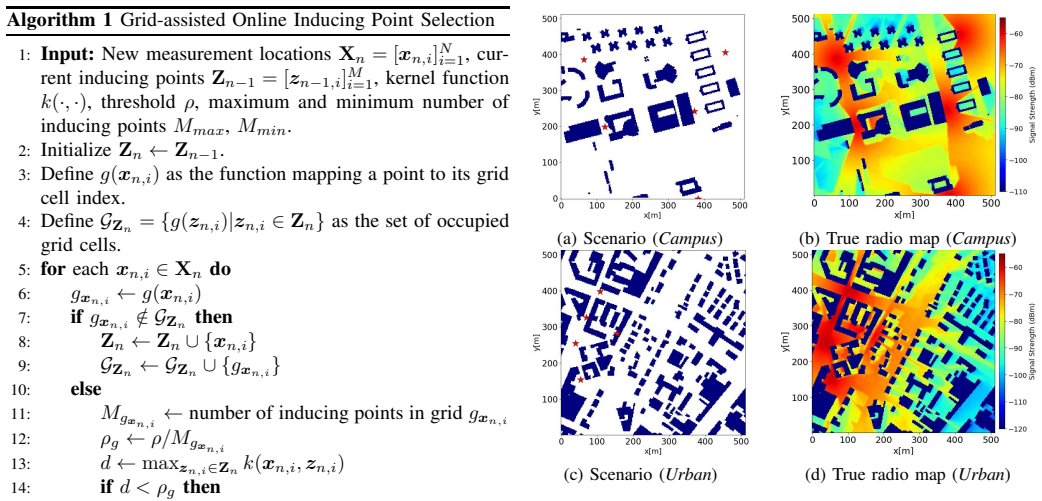
- [Algorithm 1] The removal loop in Algorithm 1 (lines 19-28) can fail to terminate. The while condition is |Zn| > Mmin, but the only exit within the loop is the removal of a point from Zrem. If Zrem is empty — which occurs whenever no inducing point has overlap count Ci > 1 — the loop continues forever with no break or fallback. This is not a pathological corner case: it happens whenever the inducing set is spatially spread out relative to the threshold ρ while still exceeding Mmin. The pseudocode needs an explicit fallback rule (e.g., remove the lowest-overlap point, randomly remove any point, or cap the number of iterations).
- [Section V-B / V-C] The empirical comparison is missing error bars, confidence intervals, and statistical tests. Results are averaged over 30 independent runs (Section V-A), but Fig. 3 and the cited percentage gains do not report variance. Some claimed improvements are small (e.g., up to 4.3% RMSE reduction over SSVGP in the campus scenario), so it is unclear whether the ordering is significant. Additionally, the hyperparameters µ1, µ2, NM, Mmax/Mmin, grid size, and ρ are tuned on the same scenario used for the headline comparison (Section V-C, Figs. 5-6), with fixed values µ1=µ2=1 and NM=500 selected from that tuning. This is parameter fitting rather than a predictive evaluation. Please add standard deviations/error bars and significance tests, and show sensitivity on held-out scenarios or separate train/validation splits.
minor comments (5)
- [Algorithm 1, line 22] The notation 'BD [Kij > ρ]' is undefined; it appears to be an indicator function. Please define it explicitly.
- [Section V-B] In the first paragraph of Section V-B, 'the baseline M-OSVGP' should probably read 'the proposed M-OSVGP.'
- [Section II] The grid G is described as having dimensions H×W, but H and W are not defined. Please specify their meaning.
- [Equations (23) and (39)] There are typesetting issues in the block matrices (e.g., missing parentheses or scaling) that make the equations hard to read. Please proofread the LaTeX.
- [Figure 4] The visual comparison of reconstructed maps would be more informative if accompanied by a difference map or per-method RMSE annotations, since the differences are otherwise hard to judge.
Circularity Check
No substantive circularity: the online-GP derivation is self-contained and the reported accuracy/uncertainty numbers are held-out evaluations; only a non-load-bearing preliminary-version self-citation appears.
full rationale
The derivation chain is not circular. M-OSVGP's hybrid objective (Eq. 20) is explicitly built on the external SSVGP variational bound [33] and augmented with a memory pseudo-batch; the optimal variational distribution (Eqs. 21-23) follows from standard variational calculus and Gaussian completion, not from assuming the prediction. RMSE and NLPD are evaluated on non-measured grid points X*_n against a WinProp ground truth (Section V), so the central accuracy and uncertainty results are independent of the fitted model parameters rather than fitted quantities renamed as predictions. The only self-citation, footnote [1] to the authors' MLSP workshop paper, is a preliminary-version acknowledgement and carries no load-bearing argument; no uniqueness theorem or ansatz is imported from author-only prior work. The strongest caveat is a scope limitation: Eq. (1) models a static f(x), so the 'online updating' experiments exercise spatial accumulation rather than temporal non-stationarity. That is a correctness/validity concern, not a circularity, because the evaluation remains independent of the model's fitted inputs. Hand-set and explored hyperparameters (mu1, mu2, NM, M, grid size) are parameter tuning, which per the rules is not circular reasoning.
Axiom & Free-Parameter Ledger
free parameters (6)
- µ1, µ2 (hybrid objective weights) =
µ1=µ2=1 (default); best values vary (e.g., µ1=1, µ2=2 at batch 6; µ1=1, µ2=1 at batch 10)
- Memory subset size NM =
500
- Number of inducing points M / Mmax / Mmin =
M=300, Mmax=350, Mmin=250
- GOIPS grid size and acceptance threshold ρ =
grid 25×25 m, ρ=0.9
- Retention proportion of previous inducing points =
70% previous / 30% new
- Kernel hyperparameters (amplitudes, lengthscales, noise variance) =
Learned by optimizing (24) on training batches
axioms (5)
- domain assumption The latent RSS field f(x) is a stationary GP with known mean/kernel family and i.i.d. Gaussian noise (Eqs. (1)-(2)).
- domain assumption The radio map is static over the streaming period; measurements are additional samples of the same f(x), not a time-varying field.
- ad hoc to paper The previous variational posterior q_{n-1}(f) is a good approximation of the true posterior p(f|ψ_{1:n-1}) (Eq. (15)), enabling the recursive update (16).
- standard math A set of M inducing points and the distribution q(u)=N(mu, Su) is a sufficient variational family; the conditional predictive p(f_{≠u}|u) is exact under the GP prior.
- domain assumption The WinProp Dominant Path Model simulation scenarios are representative of real campus/urban radio environments.
read the original abstract
Radio maps, which estimate spatial radio-frequency characteristics from spectrum measurements, are essential for applications such as spectrum management and network planning. With the continuous arrival of spectrum measurements, conventional batch processing methods for radio map reconstruction become computationally prohibitive, as they require reprocessing all accumulated measurements for each radio map update. To address this, we propose a memory-based online sparse variational Gaussian process (M-OSVGP) method that efficiently updates radio maps from streaming spectrum measurements. Our method employs sparse variational inference and updates the posterior online by minimizing a hybrid objective that integrates newly received measurements and a memory subset of previous ones to mitigate catastrophic forgetting. To further improve posterior approximation as measurements accumulate over spatially diverse regions, we extend M-OSVGP with a grid-assisted online inducing point selection (GOIPS) algorithm. GOIPS dynamically adapts the number and locations of inducing points based on measurement density and spatial correlation, providing a more informative inducing set while maintaining computational efficiency. Extensive simulations demonstrate the effectiveness of our proposed methods in reconstruction accuracy, computational efficiency, and uncertainty quantification, compared to existing batch and online baselines across various scenarios.
Figures



Reference graph
Works this paper leans on
-
[1]
Online Gaussian proces s for dynamic radio map updating,
Y . Deng, B. Zhou, F. Li, and Q. Wu, “Online Gaussian proces s for dynamic radio map updating,” in IEEE International W orkshop on Machine Learning for Signal Processing , Istanbul, Turkey, 2025
2025
-
[2]
Engineering radio ma ps for wireless resource management,
S. Bi, J. Lyu, Z. Ding, and R. Zhang, “Engineering radio ma ps for wireless resource management,” IEEE Wireless Commun., vol. 26, no. 2, pp. 133–141, 2019
2019
-
[3]
A tutorial on environment-aware communicati ons via channel knowledge map for 6G,
Y . Zeng, J. Chen, J. Xu, D. Wu, X. Xu, S. Jin, X. Gao, D. Gesbe rt, S. Cui, and R. Zhang, “A tutorial on environment-aware communicati ons via channel knowledge map for 6G,” IEEE Commun. Surv. Tutor ., vol. 26, no. 3, pp. 1478–1519, 2024
2024
-
[4]
Radio map estimation: A data-dr iven approach to spectrum cartography,
D. Romero and S.-J. Kim, “Radio map estimation: A data-dr iven approach to spectrum cartography,” IEEE Signal Process. Mag. , vol. 39, no. 6, pp. 53–72, 2022
2022
-
[5]
Radio map-based 3D path planning f or cellular- connected UA V,
S. Zhang and R. Zhang, “Radio map-based 3D path planning f or cellular- connected UA V,” IEEE Trans. Wireless Commun. , vol. 20, no. 3, pp. 1975–1989, 2020
1975
-
[6]
Sec ure split offloading and trajectory design for uav-assisted multi-ex it collaborative dnn inference,
M. Wu, H. Wu, W. Lu, Z. Ning, L. Guo, and A. Jamalipour, “Sec ure split offloading and trajectory design for uav-assisted multi-ex it collaborative dnn inference,” IEEE Trans. Mob. Comput. , pp. 1–15, 2026
2026
-
[7]
Secu rity- aware designs of multi-uav deployment, task offloading and s ervice placement in edge computing networks,
M. Wu, H. Wu, W. Lu, L. Guo, I. Lee, and A. Jamalipour, “Secu rity- aware designs of multi-uav deployment, task offloading and s ervice placement in edge computing networks,” IEEE Trans. Mob. Comput. , vol. 24, no. 10, pp. 11 046–11 060, 2025
2025
-
[8]
3d ra dio map-based gps spoofing detection and mitigation for cellular-connect ed uavs,
Y . Dang, A. Karakoc, S. Norshahida, and R. J¨ antti, “3d ra dio map-based gps spoofing detection and mitigation for cellular-connect ed uavs,” IEEE Trans. Mach. Learn. Commun. Netw. , vol. 1, pp. 313–327, 2023
2023
-
[9]
Open-set recognition of communication jamming using raw i/q data wit h domain adaptation,
J. Li, Z. Du, B. Zhou, W. Wang, Q. Wu, and W. Saad, “Open-set recognition of communication jamming using raw i/q data wit h domain adaptation,” IEEE Trans. Commun. , vol. 74, pp. 6508–6522, 2026
2026
-
[10]
Unimodality-constrained matrix factorization for non-parametric source localization,
J. Chen and U. Mitra, “Unimodality-constrained matrix factorization for non-parametric source localization,” IEEE Trans. Signal Process. , vol. 67, no. 9, pp. 2371–2386, 2019
2019
-
[11]
Real-ti me outdoor localization using radio maps: A deep learning approach,
C ¸ . Y apar, R. Levie, G. Kutyniok, and G. Caire, “Real-ti me outdoor localization using radio maps: A deep learning approach,” IEEE Trans. Wireless Commun., vol. 22, no. 12, pp. 9703–9717, 2023
2023
-
[12]
Radio map assisted multi- UA V target searching,
C. He, Y . Dong, and Z. J. Wang, “Radio map assisted multi- UA V target searching,” IEEE Trans. Wireless Commun. , vol. 22, no. 7, pp. 4698– 4711, 2023
2023
-
[13]
Propagation prediction mode ls for wireless communication systems,
M. F. Iskander and Z. Y un, “Propagation prediction mode ls for wireless communication systems,” IEEE Trans. Microw. Theory Tech. , vol. 50, no. 3, pp. 662–673, 2002
2002
-
[14]
Dominant path prediction model for urban scenarios,
R. Wahl, G. W¨ olfle, P . Wertz, P . Wildbolz, and F. Landstorfer, “Dominant path prediction model for urban scenarios,” in 14th IST Mobile and Wireless Communications Summit , Dresden, German, 2005
2005
-
[15]
Ray traci ng accelera- tion using total variation norm minimization for radio map s imulation,
N. Suga, R. Sasaki, M. Osawa, and T. Furukawa, “Ray traci ng accelera- tion using total variation norm minimization for radio map s imulation,” vol. 10, no. 3, pp. 522–526, 2021
2021
-
[16]
Nearest neighbor pattern classifi cation,
T. Cover and P . Hart, “Nearest neighbor pattern classifi cation,” IEEE Trans. Inf. Theory , vol. 13, no. 1, pp. 21–27, 1967
1967
-
[17]
Chiles and P
J.-P . Chiles and P . Delfiner, Geostatistics: modeling spatial uncertainty . John Wiley & Sons, 2012
2012
-
[18]
Kriging-based interference powe r constraint: Integrated design of the radio environment map and transmis sion power,
K. Sato and T. Fujii, “Kriging-based interference powe r constraint: Integrated design of the radio environment map and transmis sion power,” IEEE Trans. on Cogn. Commun. Netw. , vol. 3, no. 1, pp. 13–25, 2017
2017
-
[19]
Bayesian active learning for sample efficient 5G radio map reconstruction,
K. D. Polyzos, A. Sadeghi, W. Y e, S. Sleder, K. Houssou, J . Calder, Z.-L. Zhang, and G. B. Giannakis, “Bayesian active learning for sample efficient 5G radio map reconstruction,” IEEE Trans. Wireless Commun. , 2024
2024
-
[20]
Propagation map reconstruction via interpolation assisted matrix completion,
H. Sun and J. Chen, “Propagation map reconstruction via interpolation assisted matrix completion,” IEEE Trans. Signal Process. , vol. 70, pp. 6154–6169, 2022
2022
-
[21]
Spectr um cartography via coupled block-term tensor decomposition,
G. Zhang, X. Fu, J. Wang, X.-L. Zhao, and M. Hong, “Spectr um cartography via coupled block-term tensor decomposition, ” IEEE Trans. Signal Process. , vol. 68, pp. 3660–3675, 2020
2020
-
[22]
Integrated interpolation and block -term tensor decomposition for spectrum map construction,
H. Sun and J. Chen, “Integrated interpolation and block -term tensor decomposition for spectrum map construction,” IEEE Trans. Signal Process., vol. 72, pp. 3896–3911, 2024
2024
-
[23]
Radioun et: Fast radio map estimation with convolutional neural networks,
R. Levie, C ¸ . Y apar, G. Kutyniok, and G. Caire, “Radioun et: Fast radio map estimation with convolutional neural networks,” IEEE Trans. Wireless Commun., vol. 20, no. 6, pp. 4001–4015, 2021
2021
-
[24]
Deep completion autoencoder s for radio map estimation,
Y . Teganya and D. Romero, “Deep completion autoencoder s for radio map estimation,” IEEE Trans. Wireless Commun. , vol. 21, no. 3, pp. 1710–1724, 2021
2021
-
[25]
Partial convolutiona l based-radio map reconstruction for urban environments with inaccessib le areas,
F. Li, Y . Deng, B. Zhou, and Q. Wu, “Partial convolutiona l based-radio map reconstruction for urban environments with inaccessib le areas,” in 2024 IEEE International Conference on Acoustics, Speech an d Signal Processing (ICASSP), Seoul, South Korea, 2024
2024
-
[26]
Wifi-diff usion: Achieving fine-grained wifi radio map estimation with ultra- low sam- pling rate by diffusion models,
Z. Liu, S. Zhang, Q. Liu, H. Zhang, and L. Song, “Wifi-diff usion: Achieving fine-grained wifi radio map estimation with ultra- low sam- pling rate by diffusion models,” IEEE J. Sel. Areas Commun. , vol. 43, no. 11, pp. 3796–3812, 2025
2025
-
[27]
A fine-gra ined 3d radio map construction paradigm with ultra-low sampling ra tes by large generative models,
Z. Liu, Q. Liu, S. Zhang, H. Zhang, and L. Song, “A fine-gra ined 3d radio map construction paradigm with ultra-low sampling ra tes by large generative models,” IEEE J. Sel. Areas Commun. , vol. 44, pp. 4397– 4413, 2026
2026
-
[28]
An online radio map up date scheme for wifi fingerprint-based localization,
B. Huang, Z. Xu, B. Jia, and G. Mao, “An online radio map up date scheme for wifi fingerprint-based localization,” IEEE Internet Things J. , vol. 6, no. 4, pp. 6909–6918, 2019
2019
-
[29]
GSMAC: GAN-b ased signal map construction with active crowdsourcing,
Y . Zhao, C. Liu, K. Zhu, S. Zhang, and J. Wu, “GSMAC: GAN-b ased signal map construction with active crowdsourcing,” IEEE Trans. Mobile Comput., vol. 22, no. 4, pp. 2190–2204, 2021
2021
-
[30]
Kernel-based adaptive online reconstruction o f coverage maps with side information,
M. Kasparick, R. L. Cavalcante, S. V alentin, S. Sta´ ncz ak, and M. Y ukawa, “Kernel-based adaptive online reconstruction o f coverage maps with side information,” IEEE Trans. V eh. Technol., vol. 65, no. 7, pp. 5461–5473, 2015
2015
-
[31]
Dual-kernel on line re- construction of power maps,
R. Nikbakht, A. Jonsson, and A. Lozano, “Dual-kernel on line re- construction of power maps,” in 2018 IEEE Global Communications Conference (GLOBECOM) , Abu Dhabi, UAE, 2018
2018
-
[32]
V ariational learning of inducing variabl es in sparse Gaussian processes,
M. Titsias, “V ariational learning of inducing variabl es in sparse Gaussian processes,” in Artificial Intelligence and Statistics (AISTATS) , Clearwater Beach, Florida, USA, 2009
2009
-
[33]
Streaming sparse Gaussian process approximations,
T. D. Bui, C. Nguyen, and R. E. Turner, “Streaming sparse Gaussian process approximations,” in Advances in Neural Information Processing Systems (NeurIPS) , Long Beach, CA, USA, 2017
2017
-
[34]
M emory- based dual Gaussian processes for sequential learning,
P . E. Chang, P . V erma, S. John, A. Solin, and M. E. Khan, “M emory- based dual Gaussian processes for sequential learning,” in International Conference on Machine Learning (ICML) , Honolulu, HI, USA, 2023
2023
-
[35]
C. K. Williams and C. E. Rasmussen, Gaussian processes for machine learning. MIT press Cambridge, MA, 2006
2006
-
[36]
Recent advances in data-driven wireless communication us ing Gaussian processes: a comprehensive survey,
K. Chen, Q. Kong, Y . Dai, Y . Xu, F. Yin, L. Xu, and S. Cui, “Recent advances in data-driven wireless communication us ing Gaussian processes: a comprehensive survey,” China Commun., vol. 19, no. 1, pp. 218–237, 2022
2022
-
[37]
Adaptive inducing points selection for Gaussian processes,
T. Galy-Fajou and M. Opper, “Adaptive inducing points selection for Gaussian processes,” 2021. [Online]. Availa ble: https://arxiv.org/abs/2107.10066
Pith/arXiv arXiv 2021
-
[38]
Wave propagation a nd radio network planning software winprop added to the electromagn etic solver package feko,
R. Hoppe, G. W¨ olfle, and U. Jakobus, “Wave propagation a nd radio network planning software winprop added to the electromagn etic solver package feko,” in 2017 International Applied Computational Electro- magnetics Society Symposium (ACES) , Firenze, Italy, 2017. APPENDIX A. Derivation of the Online ELBO in (18) By using the factorized form of the variat...
2017
discussion (0)
Sign in with ORCID, Apple, or X to comment. Anyone can read and Pith papers without signing in.