REVIEW 4 major objections 5 minor 112 references
RoboHarness claims that independently developed robot policies — a vision-language-action model, an RL-trained controller, and a task-and-motion planner — can be composed zero-shot by a memory-driven harness that routes subtasks and stabili
Reviewed by Pith at T0; open to challenge. T0 means a machine referee read the full paper against a public rubric. the ladder, T0–T4 →
T0 review · deepseek-v4-flash
2026-08-01 16:12 UTC pith:T2QQT3RC
load-bearing objection Genuinely new orchestration idea with a concretely specified Memory Bridge, but the paper's own protocol contradicts its zero-shot claim — treat Table 2 as measuring in-task adaptation, not zero-shot composition. the 4 major comments →
RoboHarness: Memory-Driven Orchestration of Heterogeneous Robot Policies for Long-Horizon Planning
The pith
A machine-rendered reading of the paper's core claim, the machinery that carries it, and where it could break.
Core claim
RoboHarness claims that heterogeneous robot policies — independently developed VLAs, RL policies, and TAMP planners — can be composed zero-shot by treating them as agentic skills, and that the orchestration bottleneck is the uncertain capability boundary between them, not the policies themselves. The central mechanism is the Memory Bridge: it retrieves the next policy's successful trajectories, builds a local progress estimator f_score,t over robot states, declares a support region R_conf,t of states near retrieved memory, and plans a bridge trajectory that lands the robot in that region before handoff. On LIBERO-LoHo, reported progress/success is 97.5/95.2 versus 55.3/6.4 for the best singl
What carries the argument
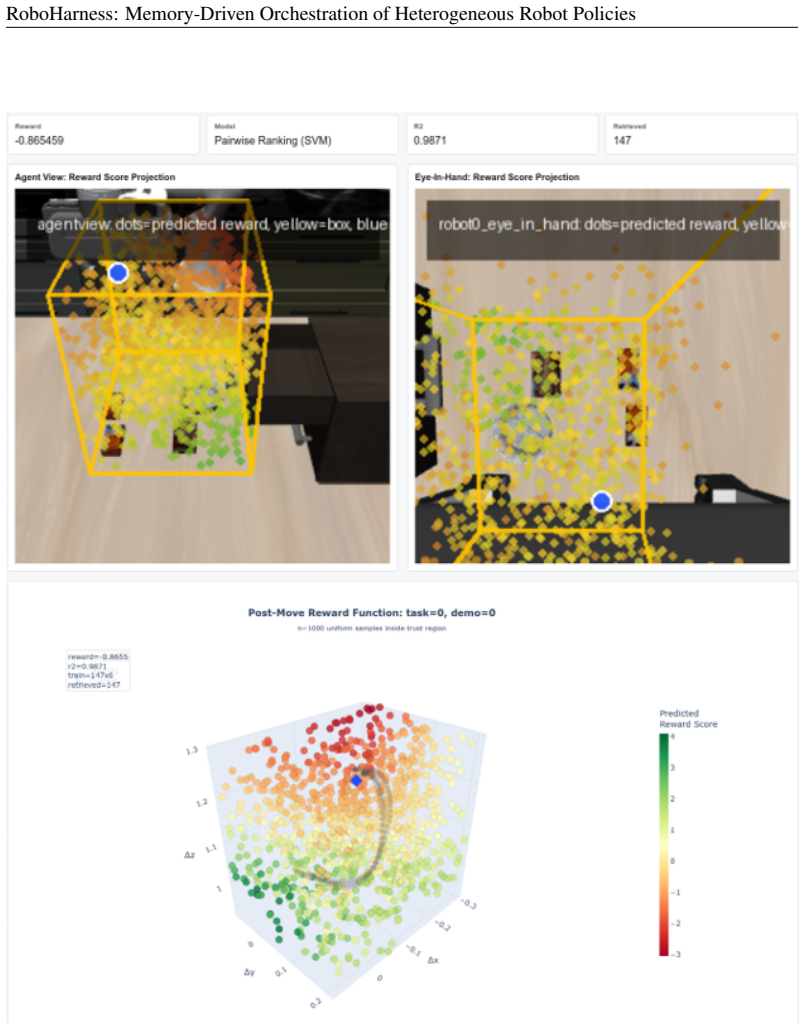
The Memory Bridge is a plug-and-play chaining technique that turns policy handoff into a retrieval-and-scoring problem. Given a handoff, it retrieves top-K anchor nodes from the next policy's memory bank, expands each anchor along its trajectory into robot-state/temporal-offset pairs, fits a lightweight progress estimator f_score,t, defines a support region R_conf,t = {s : distance to expanded memory ≤ ϵ}, and selects a handoff target that maximizes f_score,t minus motion cost inside that region, generating a bridge trajectory with an off-the-shelf motion planner. Supporting this are three auxiliary skill groups — understanding skills (uncertainty, visual/semantic context, state-policy compa
Load-bearing premise
The memory bank for each policy must already contain enough successful trajectories from that policy's execution regime for retrieval to characterize its in-distribution state region; sparse, unrepresentative, or task-contaminated memory would break both routing and every handoff.
What would settle it
Give each policy a memory bank built only from trajectories of a different LIBERO split (e.g., only LIBERO-Object trajectories for all policies) and run LIBERO-LoHo; if success drops to near single-policy baselines, the reported gains depend on in-distribution memory rather than the orchestration mechanism. A second direct check is to measure the fraction of bridge-accepted handoff states within R_conf,t that still fail under the next policy.
If this is right
- Independently trained robot policies become plug-and-play components: a developer can add a new policy with a memory bank and a policy card, and the harness routes around it without retraining the stack.
- Long-horizon performance shifts from the policy to the orchestration layer: the strongest single constituent policy improves from 6.4% to 95.2% success on LIBERO-LoHo under the harness, suggesting coordination, not single-policy capability, is the limiting factor.
- The support-region constraint makes the system decline handoffs into states unsupported by memory, a testable property: bridge acceptance should correlate with downstream policy success.
- Robustness behavior is adaptive rather than fixed: routing ratios shift with perturbation type, so capability characterization can be learned online from execution evidence instead of being hand-specified.
Where Pith is reading between the lines
- A decisive test of the framework is to seed each policy's memory bank with trajectories from unrelated tasks and then run LIBERO-LoHo: if success collapses to near single-policy baselines, the reported gains depend on distribution-matched memory rather than on the orchestration mechanism itself.
- The 'zero-shot' label should be read as 'no joint training of policies' rather than 'no prior experience with the task'; the paper does not specify how memory is initialized or whether evaluation trajectories leak into it, so a fair reader should treat the claim as conditional on memory coverage.
- The same orchestration principle should extend beyond tabletop manipulation to navigation, mobile manipulation, and MPC-vs-learned-policy settings, since the framework never touches policy internals — it only needs a state-space definition and per-policy memory banks.
- If capability boundaries are learned reliably online, a natural next step is to have the harness propose new decomposed skills or flag subtasks outside all policies' support, a capability the paper gestures at in its limitations but does not develop.
Editorial analysis
A structured set of objections, weighed in public.
Referee Report
Summary. RoboHarness is an orchestration framework that composes heterogeneous robot policies (a π0.5 VLA, an OpenVLA-OFT RL policy, and a TAMP planner) through an LLM-based coding agent, auxiliary understanding/memory/self-evolution skills, and a Memory Bridge that constructs handoff trajectories between policies. The paper claims strong performance on LIBERO, LIBERO-Plus, LIBERO-LoHo, 500 custom simulated tasks, and 135 real-robot trials, with the central claim being zero-shot long-horizon planning via capability-aware routing and stable inter-policy handoffs without joint retraining.
Significance. If the empirical claims are supported, the paper addresses a genuine and timely problem: composing independently developed robot policies with different interfaces and capability boundaries. The Memory Bridge is a conceptually interesting mechanism for handling inter-policy distribution shift, and the breadth of the experimental effort is commendable. However, the central zero-shot claim is not adequately supported by the current evaluation protocol, and several load-bearing details of the method remain unspecified. The framework's significance therefore depends on whether these issues can be resolved with additional experiments and analysis.
major comments (4)
- [Sec. 3, Sec. 4.2.1, Sec. 4.3, Table 2] The zero-shot claim is contradicted by the evaluation protocol. Sec. 3 defines zero-shot as solving unseen compositions 'without task-specific joint training,' but Sec. 4.3 states that self-evolution updates are 'retained across evaluation episodes, allowing RoboHarness to accumulate experience and progressively adapt,' and Sec. 4.2.1 says memory is 'continuously updated after each rollout.' Thus the averages in Table 2 likely reflect within-evaluation adaptation rather than zero-shot performance, and the frozen baselines are not compared on equal footing. The paper must report first-episode performance with empty memory, or explicitly separate an adaptation phase from a zero-shot phase.
- [Sec. 4.2.2] The Memory Bridge cannot operate from an empty memory: the progress estimator f_score,t and the support region R_conf,t are constructed entirely from retrieved anchor nodes (N_t = RetrieveM(gt+1, ot)). The paper never specifies how the first handoff is performed when M is empty, nor whether M is pre-populated and, if so, with what data. If the memory contains successful trajectories of the evaluation tasks or earlier episodes of the same tasks, the headline results in Table 2 are not evidence of zero-shot orchestration. A cold-start procedure or explicit memory initialization must be described.
- [Tables 1, 2; Figure 4; Sec. 8] The central quantitative claims lack statistical support. No table or figure reports error bars, number of seeds, or number of evaluation episodes per task. Robot policies are stochastic, and differences such as 97.5 vs. 98.7 (Table 1) or 95.2% success (Table 2) may be within noise. The real-robot results (Sec. 8) report percentages from only 15 trials per condition without confidence intervals. The authors should provide variance estimates or, at minimum, full trial counts for every reported number.
- [Sec. 5.2] Baseline comparisons are not controlled. The paper states that evaluation results were 'obtained from the benchmark evaluation of Huang et al. (2026a) and Zhang et al. (2026)' rather than from runs under the identical protocol used for RoboHarness. Differences in task splits, observation inputs, seeds, or evaluation code can materially affect success rates. The authors must either re-run all baselines under the same conditions or clearly state which numbers are copied and justify why the comparison is valid.
minor comments (5)
- [Sec. 5.1] Typographical error: 'In addition, we designed In addition, we designed 500...' appears in the simulated benchmarks paragraph.
- [Sec. 11.1.1] Wording error: 'There are 10 total classes for of the tasks' should be corrected.
- [Figure 5 caption] Capitalization is inconsistent: 'Overall success Rate' should be 'Overall success rate.'
- [Sec. 4.2, equations] The paper introduces several free parameters (epsilon, lambda_motion, l, Delta_t, K_text, K_vis, encoder fusion weights) but provides no sensitivity analysis. A brief study on at least the most sensitive parameters (e.g., support threshold epsilon and retrieval counts) would substantially strengthen the robustness claims.
- [Sec. 9] The limitation that 'capability characterization and Memory Bridge construction rely on accumulated execution evidence and may be unreliable when a policy is newly introduced or relevant experience is sparse' is in direct tension with the zero-shot claim. This tension should be addressed explicitly in the main text, not only in the limitations section.
Circularity Check
Zero-shot claim is undermined by the evaluation protocol: memory and self-evolution updates are retained across evaluation episodes, so Table 2 may reflect in-task accumulation; the Memory Bridge also steers toward the next policy's own stored successful trajectories by construction.
specific steps
-
other
[Section 3 (Problem Definition) vs. Section 4.3 (Self-Evolution Skills) and Section 4.2.1 (Memory Management)]
"zero-shot refers to solving previously unseen long-horizon task compositions without task-specific joint training of the constituent policies or their orchestration ... Validated updates are retained across evaluation episodes, allowing RoboHarness to accumulate experience and progressively adapt to new tasks, objects, scenes, and environments ... Both the linked-node trajectories and the execution statistics are continuously updated after each rollout."
The paper defines zero-shot as no task-specific training of the policies or their orchestration, yet the evaluation protocol explicitly retains memory and self-evolution updates across evaluation episodes so that RoboHarness can 'accumulate experience and progressively adapt to new tasks.' Later evaluation episodes can therefore use earlier episodes' successful rollouts as memory and tuned orchestration parameters. Under the paper's own definition, the aggregate results in Table 2 are not a zero-shot measurement: the orchestration and memory have been task-specifically adapted during the evaluation, so the claimed 'zero-shot long-horizon planning' outcome is partly an in-task adaptation result by construction.
-
other
[Section 4.2.2 (Memory Bridge), progress estimator and handoff-target equations]
"These pairs are used to train a lightweight progress estimator f_score,t ... RoboHarness selects the handoff target robot state s*_t = arg max_s [f_score,t(s) − λ_motion C_motion(s_t,s)] ... s.t. s ∈ R_conf,t ∩ S_plan,t and f_score,t(s) ≥ 0."
The progress estimator f_score,t is fit to temporal offsets of retrieved successful trajectories of the incoming policy, and the support region R_conf,t is the epsilon-neighborhood of those same memory states. The handoff target is therefore, by construction, a state near a previously successful state of the next policy at or after the retrieved anchor. The resulting 'in-distribution' execution of the next policy is not an independent prediction of cross-policy transfer; it reduces to re-entering the next policy's stored successful distribution. The paper itself concedes the load-bearing dependence in Section 9: Memory Bridge construction 'may be unreliable when a policy is newly introduced or relevant experience is sparse.'
full rationale
This is an empirical systems paper rather than a formal derivation, so the classic circular-fit pattern does not apply in the usual sense: the orchestration mechanisms (decomposition, routing, and bridging) are implemented and measured against external policy checkpoints and benchmarks, and the real-robot trials provide independent content. However, the headline 'zero-shot' claim is weakened by the paper's own protocol. The Memory Bridge constructs its support region and progress function exclusively from retrieved successful trajectories of the next policy, making a stable handoff partially self-referential: success at a handoff is defined in terms of re-entering that policy's stored execution distribution. More importantly, memory banks and self-evolution updates are retained across evaluation episodes, explicitly allowing task-specific accumulation, which conflicts with the paper's Section 3 definition of zero-shot as 'without task-specific joint training of the constituent policies or their orchestration.' The reported LIBERO-LoHo numbers may therefore include adaptation from earlier evaluation episodes on the same tasks. These issues are load-bearing for the central scientific claim, so the score is 4: the system has independent empirical content, but the zero-shot evaluation is not established and the handoff mechanism is self-referential in a way the paper itself acknowledges in Section 9.
Axiom & Free-Parameter Ledger
free parameters (6)
- support threshold epsilon =
not reported
- motion cost weight lambda_motion =
not reported
- temporal horizon l and node interval Delta_t =
not reported
- retrieval counts K_text and K_vis =
not reported
- visual encoder fusion weights =
not reported
- parameter-tuning grid bins =
not reported
axioms (4)
- domain assumption Each policy's stored successful trajectories represent its in-distribution execution region accurately enough for routing and bridging.
- domain assumption The GPT-5.5 coding agent can reliably interpret understanding-skill outputs and produce correct decomposition, routing, and bridge-planning decisions.
- domain assumption LIBERO-LoHo and the 500 custom tasks require genuinely heterogeneous policies, so success reflects orchestration rather than one dominant policy.
- domain assumption Evaluation baselines from Huang et al. (2026a) and Zhang et al. (2026) are measured under the same protocol as RoboHarness.
read the original abstract
Long-horizon robotic tasks require diverse capabilities that no single policy can reliably provide. Heterogeneous policies offer complementary strengths, but orchestrating them requires reasoning over uncertain capability boundaries and cross-policy distribution mismatch, which are largely overlooked by existing planning methods built on homogeneous, predefined skills with fixed applicability. We propose RoboHarness, a unified framework that encapsulates independently developed robot control systems as reusable agentic skills. Although instantiated in this work with VLAs, RL policies, and task-and-motion planning (TAMP) systems, RoboHarness is designed as a general framework compatible with a broader range of robot policies, such as navigation policies, model predictive controllers, and world-action models. RoboHarness uses multi-modal execution memory and online evidence to characterize policy capability boundaries for capability-aware decomposition and routing. To stabilize policy handoffs, its Memory Bridge retrieves execution trajectories associated with the next policy, estimates its in-distribution state region, and guides the robot toward that region without joint policy retraining. Extensive experiments on three public benchmarks, 500 customized tasks, and 135 real-robot experiments demonstrate effective capability-aware routing and stable policy orchestration, yielding substantial improvements in zero-shot long-horizon planning and out-of-distribution robustness.
Figures


Reference graph
Works this paper leans on
-
[1]
Bai, Shuai and Cai, Yuxuan and Chen, Ruizhe and Chen, Keqin and Chen, Xionghui and Cheng, Zesen and Deng, Lianghao and Ding, Wei and Gao, Chang and Ge, Chunjiang and Ge, Wenbin and Guo, Zhifang and Huang, Qidong and Huang, Jie and Huang, Fei and Hui, Binyuan and Jiang, Shutong and Li, Zhaohai and Li, Mingsheng and Li, Mei and Li, Kaixin and Lin, Zicheng a...
-
[2]
PDDLStream : Integrating symbolic planners and blackbox samplers via optimistic adaptive planning
Garrett, Caelan Reed and Lozano-Pérez, Tomás and Kaelbling, Leslie Pack. PDDLStream : Integrating symbolic planners and blackbox samplers via optimistic adaptive planning. Proc. Int. Conf. Autom. Plan. Sched
-
[3]
From Pixels to Predicates: Learning Symbolic World Models via Pretrained Vision-Language Models , journal=
Ashay Athalye and Nishanth Kumar and Tom Silver and Yichao Liang and Jiuguang Wang and Tomás Lozano-Pérez and Leslie Pack Kaelbling , year =. From Pixels to Predicates: Learning Symbolic World Models via Pretrained Vision-Language Models , journal=
-
[4]
Leveraging Pre-trained Large Language Models to Construct and Utilize World Models for Model-based Task Planning , year =
Guan, Lin and Valmeekam, Karthik and Sreedharan, Sarath and Kambhampati, Subbarao , booktitle =. Leveraging Pre-trained Large Language Models to Construct and Utilize World Models for Model-based Task Planning , year =
-
[5]
PDDL-the planning domain definition language , author=
-
[6]
LLM3: Large Language Model-based Task and Motion Planning with Motion Failure Reasoning , author=. Proc. IEEE/RSJ Int. Conf. on Intelligent Robots and Systems , year=
-
[7]
PR ompt Optimization in Multi-Step Tasks ( PROMST ): Integrating Human Feedback and Heuristic-based Sampling
Chen, Yongchao and Arkin, Jacob and Hao, Yilun and Zhang, Yang and Roy, Nicholas and Fan, Chuchu. PR ompt Optimization in Multi-Step Tasks ( PROMST ): Integrating Human Feedback and Heuristic-based Sampling. Proc. Conf. Empirical Methods in Natural Language Processing. 2024
2024
-
[8]
Proceedings of the 34th International Conference on Machine Learning , year =
Constrained Policy Optimization , author =. Proceedings of the 34th International Conference on Machine Learning , year =
-
[9]
RoboVQA: Multimodal Long-Horizon Reasoning for Robotics , author=. Proc. IEEE Int. Conf. on Robotics and Automation , year=
-
[10]
Interactive Task Planning with Language Models , author=. Proc. 2nd Workshop on Language and Robot Learning , year=
-
[11]
PaLM - E : An embodied multimodal language model
Driess, Danny and Xia, F and Sajjadi, Mehdi S M and Lynch, Corey and Chowdhery, Aakanksha and Ichter, Brian and Wahid, Ayzaan and Tompson, Jonathan and Vuong, Q and Yu, Tianhe and Huang, Wenlong and Chebotar, Yevgen and Sermanet, P and Duckworth, Daniel and Levine, S and Vanhoucke, Vincent and Hausman, Karol and Toussaint, Marc and Greff, Klaus and Zeng, ...
-
[12]
Inner Monologue: Embodied Reasoning through Planning with Language Models , author =. Proc. Conf. on Robot Learning , year =
-
[13]
Language Models as Zero-Shot Planners: Extracting Actionable Knowledge for Embodied Agents , author =. Proc. Int. Conf. on Machine Learning , year =
-
[14]
Guiding Long-Horizon Task and Motion Planning with Vision Language Models , year=
Yang, Zhutian and Garrett, Caelan and Fox, Dieter and Lozano-Pérez, Tomás and Kaelbling, Leslie Pack , booktitle=. Guiding Long-Horizon Task and Motion Planning with Vision Language Models , year=
-
[15]
LLM -A*: Large Language Model Enhanced Incremental Heuristic Search on Path Planning
Meng, Silin and Wang, Yiwei and Yang, Cheng-Fu and Peng, Nanyun and Chang, Kai-Wei. LLM -A*: Large Language Model Enhanced Incremental Heuristic Search on Path Planning. Findings of the Assoc. for Comput. Linguistics: EMNLP 2024. 2024
2024
-
[16]
Generalized planning in pddl domains with pretrained large language models
Silver, Tom and Dan, Soham and Srinivas, Kavitha and Tenenbaum, Joshua B and Kaelbling, Leslie and Katz, Michael. Generalized planning in pddl domains with pretrained large language models. Proc. AAAI Conf. on Artificial Intelligence
-
[17]
Tree-Planner: Efficient close-loop task planning with Large Language Models
Hu, Mengkang and Mu, Yao and Yu, Xinmiao and Ding, Mingyu and Wu, Shiguang and Shao, Wenqi and Chen, Qiguang and Wang, Bin and Qiao, Yu and Luo, Ping. Tree-Planner: Efficient close-loop task planning with Large Language Models. arXiv preprint arXiv:2310.08582
-
[18]
Thirty-seventh Conference on Neural Information Processing Systems , year=
Large Language Models as Commonsense Knowledge for Large-Scale Task Planning , author=. Thirty-seventh Conference on Neural Information Processing Systems , year=
-
[19]
VisualPredicator : Learning abstract world models with Neuro-Symbolic Predicates for robot planning
Liang, Yichao and Kumar, Nishanth and Tang, Hao and Weller, Adrian and Tenenbaum, Joshua B and Silver, Tom and Henriques, João F and Ellis, Kevin. VisualPredicator : Learning abstract world models with Neuro-Symbolic Predicates for robot planning. arXiv preprint arXiv:2410.23156
-
[20]
Automated Planning Domain Inference for Task and Motion Planning , booktitle=
Huang, Jinbang and Tao, Allen and Marco, Rozilyn and Bogdanovic, Miroslav and Kelly, Jonathan and Shkurti, Florian , year=. Automated Planning Domain Inference for Task and Motion Planning , booktitle=
-
[21]
One demo is all it takes: Planning Domain Derivation with LLMs from A single demonstration
Huang, Jinbang and Xiao, Yixin and Zhang, Zhanguang and Coates, Mark and Hao, Jianye and Zhang, Yingxue. One demo is all it takes: Planning Domain Derivation with LLMs from A single demonstration. arXiv preprint at arXiv:2505.18382
-
[22]
2024 , booktitle =
Oswald, James and Srinivas, Kavitha and Kokel, Harsha and Lee, Junkyu and Katz, Michael and Sohrabi, Shirin , title =. 2024 , booktitle =
2024
-
[23]
Learning Efficient Abstract Planning Models that Choose What to Predict , author =. Proc. Conf. on Robot Learning , year =
-
[24]
Predicate Invention for Bilevel Planning
Silver, Tom and Chitnis, Rohan and Kumar, Nishanth and McClinton, Willie and Lozano-Pérez, Tomás and Kaelbling, Leslie and Tenenbaum, Joshua B. Predicate Invention for Bilevel Planning. Proc. AAAI Conf. on Artificial Intelligence
-
[25]
LLM+P : Empowering large language models with optimal planning proficiency
Liu, Bo and Jiang, Yuqian and Zhang, Xiaohan and Liu, Qiang and Zhang, Shiqi and Biswas, Joydeep and Stone, Peter. LLM+P : Empowering large language models with optimal planning proficiency. arXiv preprint arXiv:2304.11477
-
[26]
2024 IEEE International conference on robotics and automation (ICRA) , year=
Autotamp: Autoregressive task and motion planning with llms as translators and checkers , author=. 2024 IEEE International conference on robotics and automation (ICRA) , year=
2024
-
[27]
Learning to Search in Task and Motion Planning With Streams
Khodeir, Mohamed and Agro, Ben and Shkurti, Florian. Learning to Search in Task and Motion Planning With Streams. IEEE Robotics and Automation Letters
-
[28]
arXiv preprint arXiv:2410.21276 , year=
Gpt-4o system card , author=. arXiv preprint arXiv:2410.21276 , year=
-
[29]
Learning adaptive planning representations with natural language guidance , author=
-
[30]
8th Annual Conference on Robot Learning , year=
Learning Compositional Behaviors from Demonstration and Language , author=. 8th Annual Conference on Robot Learning , year=
-
[31]
2025 IEEE International Conference on Robotics and Automation (ICRA) , year=
CLIMB: Language-Guided Continual Learning for Task Planning with Iterative Model Building , author=. 2025 IEEE International Conference on Robotics and Automation (ICRA) , year=
2025
-
[32]
Language Models can infer action semantics for symbolic planners from environment feedback
Zhu, Wang and Singh, Ishika and Jia, Robin and Thomason, Jesse. Language Models can infer action semantics for symbolic planners from environment feedback. arXiv [cs.AI]
-
[33]
Robotics: Science and Systems (RSS) , year =
InterPreT: Interactive Predicate Learning from Language Feedback for Generalizable Task Planning , author=. Robotics: Science and Systems (RSS) , year =
-
[34]
Proceedings of The 7th Conference on Robot Learning , pages =
Imitating Task and Motion Planning with Visuomotor Transformers , author =. Proceedings of The 7th Conference on Robot Learning , pages =
-
[35]
Eric Zelikman and Yuhuai Wu and Jesse Mu and Noah Goodman , booktitle=
-
[36]
2023 , journal =
Scaling Relationship on Learning Mathematical Reasoning with Large Language Models , author=. 2023 , journal =
2023
-
[37]
Yuxuan Tong and Xiwen Zhang and Rui Wang and Ruidong Wu and Junxian He , booktitle=
-
[38]
Self-training meets consistency: Improving LLMs’ reasoning with consistency-driven rationale evaluation
Lee, Jaehyeok and Sakaguchi, Keisuke and Bak, Jinyeong. Self-training meets consistency: Improving LLMs’ reasoning with consistency-driven rationale evaluation. Proceedings of the 2025 Conference of the Nations of the Americas Chapter of the Association for Computational Linguistics: Human Language Technologies (Volume 1: Long Papers)
2025
-
[39]
V-STaR: Training verifiers for self-taught reasoners
Arian Hosseini and Xingdi Yuan and Nikolay Malkin and Aaron Courville and Alessandro Sordoni and Rishabh Agarwal. V-STaR: Training verifiers for self-taught reasoners. Proceedings of the 2024 Conference on Language Modeling. 2024
2024
-
[40]
Language Models are Few-Shot Learners , author =. Proc. Adv. Neural Inf. Proc. Systems , year =
-
[41]
and Le, Quoc V
Wei, Jason and Wang, Xuezhi and Schuurmans, Dale and Bosma, Maarten and Ichter, Brian and Xia, Fei and Chi, Ed H. and Le, Quoc V. and Zhou, Denny , title =. 2022 , booktitle =
2022
-
[42]
Large Language Models are Zero-Shot Reasoners , author =. Proc. Adv. Neural Inf. Proc. Systems , year =
-
[43]
International Conference on Learning Representations (ICLR) , year =
Self-Consistency Improves Chain of Thought Reasoning in Language Models , author =. International Conference on Learning Representations (ICLR) , year =
-
[44]
Tree of Thoughts: Deliberate Problem Solving with Large Language Models , author=. Proc. Adv. Neural Inf. Proc. Systems , year=
-
[45]
arXiv preprint arXiv:2110.14168 , year=
Training verifiers to solve math word problems , author=. arXiv preprint arXiv:2110.14168 , year=
-
[46]
Training Language Models to Follow Instructions with Human Feedback , author =. Proc. Adv. Neural Inf. Proc. Systems , year =
-
[47]
8th Annual Conference on Robot Learning , year=
Robotic Control via Embodied Chain-of-Thought Reasoning , author=. 8th Annual Conference on Robot Learning , year=
-
[48]
2021 IEEE/RSJ International Conference on Intelligent Robots and Systems (IROS) , year=
Automated Generation of Robotic Planning Domains from Observations , author=. 2021 IEEE/RSJ International Conference on Intelligent Robots and Systems (IROS) , year=
2021
-
[49]
P roof W riter: Generating Implications, Proofs, and Abductive Statements over Natural Language
Tafjord, Oyvind and Dalvi, Bhavana and Clark, Peter. P roof W riter: Generating Implications, Proofs, and Abductive Statements over Natural Language. Findings of the Association for Computational Linguistics: ACL-IJCNLP 2021. 2021
2021
-
[50]
Chain of Thoughtlessness? An Analysis of CoT in Planning , author=. Proc. Adv. Neural Inf. Proc. Systems , year=
-
[51]
Annual Meeting of the Association for Computational Linguistics , year=
Faithful Logical Reasoning via Symbolic Chain-of-Thought , author=. Annual Meeting of the Association for Computational Linguistics , year=
-
[52]
Logic- LM : Empowering Large Language Models with Symbolic Solvers for Faithful Logical Reasoning
Pan, Liangming and Albalak, Alon and Wang, Xinyi and Wang, William. Logic- LM : Empowering Large Language Models with Symbolic Solvers for Faithful Logical Reasoning. Findings of the Association for Computational Linguistics: EMNLP 2023. 2023
2023
-
[53]
FOLIO : Natural Language Reasoning with First-Order Logic
Han, Simeng and Schoelkopf, Hailey and Zhao, Yilun and Qi, Zhenting and Riddell, Martin and Zhou, Wenfei and Coady, James and Peng, David and Qiao, Yujie and Benson, Luke and Sun, Lucy and Wardle-Solano, Alexander and Szab \'o , Hannah and Zubova, Ekaterina and Burtell, Matthew and Fan, Jonathan and Liu, Yixin and Wong, Brian and Sailor, Malcolm and Ni, A...
2024
-
[54]
LINC: A Neurosymbolic Approach for Logical Reasoning by Combining Language Models with First-Order Logic Provers , booktitle=
Olausson, Theo and Gu, Alex and Lipkin, Ben and Zhang, Cedegao and Solar-Lezama, Armando and Tenenbaum, Joshua and Levy, Roger , year=. LINC: A Neurosymbolic Approach for Logical Reasoning by Combining Language Models with First-Order Logic Provers , booktitle=
-
[55]
Proceedings of the 2023 IEEE International Conference on Robotics and Automation (ICRA) , year =
Jiayi Pan and Glen Chou and Dmitry Berenson , title =. Proceedings of the 2023 IEEE International Conference on Robotics and Automation (ICRA) , year =
2023
-
[56]
Thirty-seventh Conference on Neural Information Processing Systems Datasets and Benchmarks Track , year=
PlanBench: An Extensible Benchmark for Evaluating Large Language Models on Planning and Reasoning about Change , author=. Thirty-seventh Conference on Neural Information Processing Systems Datasets and Benchmarks Track , year=
-
[57]
The FF planning system: Fast plan generation through heuristic search
Hoffmann, J and Nebel, B. The FF planning system: Fast plan generation through heuristic search. arXiv [cs.AI]
-
[58]
and Khashabi, Daniel and Hajishirzi, Hannaneh
Wang, Yizhong and Kordi, Yeganeh and Mishra, Swaroop and Liu, Alisa and Smith, Noah A. and Khashabi, Daniel and Hajishirzi, Hannaneh. Self-Instruct: Aligning Language Models with Self-Generated Instructions. Proceedings of the 61st Annual Meeting of the Association for Computational Linguistics (Volume 1: Long Papers). 2023
2023
-
[59]
Qwen3 Technical Report , author = "Yang, An and Li, Anfeng and Yang, Baosong and Zhang, Beichen and Hui, Binyuan and Zheng, Bo and Yu, Bowen and Gao, Chang and Huang, Chengen and Lv, Chenxu and Zheng, Chujie and Liu, Dayiheng and Zhou, Fan and Huang, Fei and Hu, Feng and Ge, Hao and Wei, Haoran and Lin, Huan and Tang, Jialong and Yang, Jian and Tu, Jianho...
-
[60]
Gemma Team. Gemma 3 Technical Report. arXiv preprint arXiv:2503.19786. 2025
Pith/arXiv arXiv 2025
-
[61]
arXiv preprint arXiv:2601.08584 , year =
Ministral 3 , author =. arXiv preprint arXiv:2601.08584 , year =
-
[62]
Distilling the knowledge in a neural network
Hinton, Geoffrey and Vinyals, Oriol and Dean, Jeff. Distilling the knowledge in a neural network. arXiv preprint arXiv:1503.02531
-
[63]
_0 : A vision-language-action flow model for general robot control
Black, Kevin and Brown, Noah and Driess, Danny and Esmail, Adnan and Equi, Michael and Finn, Chelsea and Fusai, Niccolo and Groom, Lachy and Hausman, Karol and Ichter, Brian and others , journal=. _0 : A vision-language-action flow model for general robot control
-
[64]
Leveraging Language-based Representations for Better Solving Symbol-related Problems with Large Language Models
Wang, Yile and Cheng, Sijie and Sun, Zixin and Li, Peng and Liu, Yang. Leveraging Language-based Representations for Better Solving Symbol-related Problems with Large Language Models. Proceedings of the 31st International Conference on Computational Linguistics. 2025
2025
-
[65]
Language Models can be Deductive Solvers
Feng, Jiazhan and Xu, Ruochen and Hao, Junheng and Sharma, Hiteshi and Shen, Yelong and Zhao, Dongyan and Chen, Weizhu. Language Models can be Deductive Solvers. Findings of the Association for Computational Linguistics: NAACL 2024. 2024
2024
-
[66]
Hierarchical Deep Reinforcement Learning: Integrating Temporal Abstraction and Intrinsic Motivation , volume =
Kulkarni, Tejas D and Narasimhan, Karthik and Saeedi, Ardavan and Tenenbaum, Josh , booktitle =. Hierarchical Deep Reinforcement Learning: Integrating Temporal Abstraction and Intrinsic Motivation , volume =
-
[67]
Proximal Policy Optimization Algorithms
Schulman, John and Wolski, Filip and Dhariwal, Prafulla and Radford, Alec and Klimov, Oleg. Proximal Policy Optimization Algorithms. arXiv [cs.LG]
-
[68]
arXiv preprint arXiv:2402.03300 , year=
Deepseekmath: Pushing the limits of mathematical reasoning in open language models , author=. arXiv preprint arXiv:2402.03300 , year=
-
[69]
Deep Reinforcement Learning from Human Preferences , volume =
Christiano, Paul F and Leike, Jan and Brown, Tom and Martic, Miljan and Legg, Shane and Amodei, Dario , booktitle =. Deep Reinforcement Learning from Human Preferences , volume =
-
[70]
Thirty-seventh Conference on Neural Information Processing Systems , year=
Direct Preference Optimization: Your Language Model is Secretly a Reward Model , author=. Thirty-seventh Conference on Neural Information Processing Systems , year=
-
[71]
9th Annual Conference on Robot Learning , year=
Distilling On-device Language Models for Robot Planning with Minimal Human Intervention , author=. 9th Annual Conference on Robot Learning , year=
-
[72]
Proceedings of the International Conference on Automated Planning and Scheduling , year=
Chasing progress, not perfection: Revisiting strategies for end-to-end llm plan generation , author=. Proceedings of the International Conference on Automated Planning and Scheduling , year=
-
[73]
arXiv preprint arXiv:2305.16151 , year=
Understanding the capabilities of large language models for automated planning , author=. arXiv preprint arXiv:2305.16151 , year=
-
[74]
2026 , journal=
Self-CriTeach: LLM Self-Teaching and Self-Critiquing for Improving Robotic Planning via Automated Domain Generation , author=. 2026 , journal=
2026
-
[75]
UniDomain: Pretraining a Unified PDDL Domain from Real-World Demonstrations for Generalizable Robot Task Planning , year =
Ye, Haoming and Xiao, Yunxiao and Lu, Cewu and Cai, Panpan , booktitle =. UniDomain: Pretraining a Unified PDDL Domain from Real-World Demonstrations for Generalizable Robot Task Planning , year =
-
[76]
arXiv preprint arXiv:2605.02881 , year=
Molmoact2: Action reasoning models for real-world deployment , author=. arXiv preprint arXiv:2605.02881 , year=
-
[77]
arXiv preprint arXiv:2510.10274 , year=
X-vla: Soft-prompted transformer as scalable cross-embodiment vision-language-action model , author=. arXiv preprint arXiv:2510.10274 , year=
-
[78]
arXiv preprint arXiv:2510.06710 , year=
Rlinf-vla: A unified and efficient framework for vla+ rl training , author=. arXiv preprint arXiv:2510.06710 , year=
-
[79]
Intelligence, Physical and Amin, Ali and Aniceto, Raichelle and Balakrishna, Ashwin and Black, Kevin and Conley, Ken and Connors, Grace and Darpinian, James and Dhabalia, Karan and DiCarlo, Jared and others , journal=. ^
-
[80]
2011 IEEE international conference on robotics and automation , year=
Hierarchical task and motion planning in the now , author=. 2011 IEEE international conference on robotics and automation , year=
2011
discussion (0)
Sign in with ORCID, Apple, or X to comment. Anyone can read and Pith papers without signing in.