REVIEW 3 major objections 5 minor 75 references
This paper constructs the periodic directed landscape, proves it unique in law, and shows exponential LPP and periodic ASEP converge to it, giving a universal scaling limit for KPZ models on a ring.
Reviewed by Pith at T0; open to challenge. T0 means a machine referee read the full paper against a public rubric. the ladder, T0–T4 →
T0 review · deepseek-v4-flash
2026-08-01 15:59 UTC pith:QMFJBP23
load-bearing objection Major periodic-KPZ construction with a concrete gap in the central Cauchy argument that needs a fix before the existence claim is solid. the 3 major comments →
Periodic directed landscape
The pith
A machine-rendered reading of the paper's core claim, the machinery that carries it, and where it could break.
Core claim
The paper's central claim is the construction and characterization of a random continuous function L^per on (T×R)^2_↑, called the periodic directed landscape, which is the unique (in law) continuous random function satisfying three properties: local agreement with the full-space directed landscape, independent increments over disjoint time intervals, and a metric composition law of the form L^per(x,s;y,t) = sup_z [L^per(x,s;z,u) + L^per(z,u;y,t)]. The paper proves this object is the scaling limit of periodic exponential LPP, that it gives the variational representation of the periodic KPZ fixed point, and that coupled periodic ASEPs converge to coupled periodic KPZ fixed points driven by thi
What carries the argument
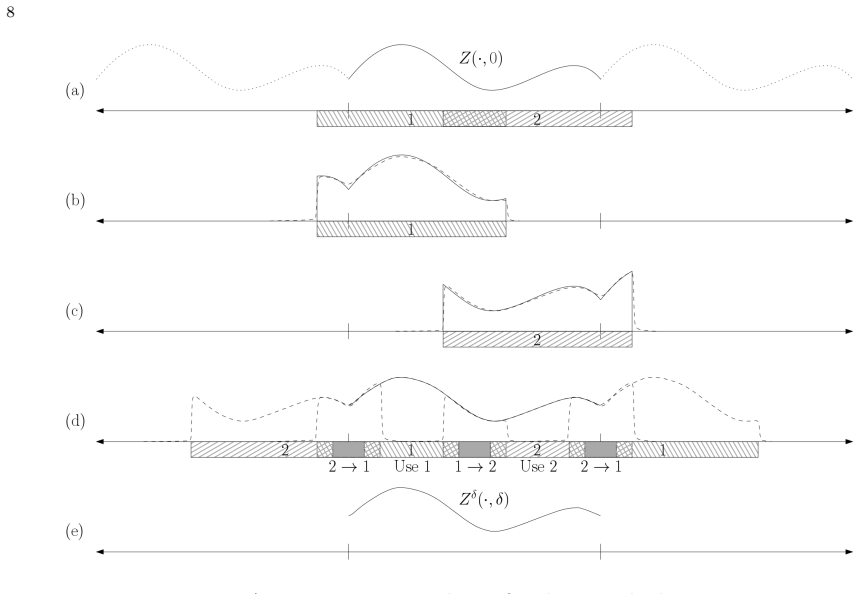
The core mechanism is a gluing construction that builds the periodic landscape from full-space directed landscapes. For each small time interval, two full-space landscapes are coupled to agree (with high probability) on short, well-separated rectangles in space-time (Lemma 2.8), then the landscapes are patched together via a metric composition law that propagates the values across time steps. The construction yields a dyadic sequence of 'patched directed landscapes' whose laws form a Cauchy sequence in a weighted total-variation metric; the periodic directed landscape is the unique limit. The proof relies on quantitative control of geodesic transversal fluctuations (e.g., Proposition 2.5) to
Load-bearing premise
The entire gluing construction rests on Lemma 2.8, which asserts that two full-space directed landscapes can be coupled to agree on specific short, well-separated rectangles with probability at least 1 − C exp(−c n²); if this exponential rate fails, the union bound over time steps breaks and the patched landscapes may not converge.
What would settle it
Compute (or rigorously bound) the total-variation distance between the restrictions of two independent full-space directed landscapes to the rectangles O^{i,1}_n and O^{i,3}_n at separation scale n^{2/3}; if the distance decays slower than exp(−c n²), the gluing construction collapses. A concrete test would be a numerical simulation of two independent directed landscapes on rectangles of width 1/4 and height 1/n for large n, measuring the probability that their values agree after optimal coupling, and checking whether this probability is consistent with an exp(−c n²) lower bound.
If this is right
- The variational formula h^per(h0;y,t) = sup_x [h0(x) + L^per(x,0;y,t)] provides a continuous Markov process description of the periodic KPZ fixed point, resolving the Baik–Liao–Liu conjecture.
- Convergence of periodic ASEP to the same periodic directed landscape yields the q-independence of the scaling limit: any limit theorem known for periodic TASEP now holds for periodic ASEP.
- Local agreement of L^per with the full-space directed landscape implies the periodic KPZ fixed point approximates the full-space KPZ fixed point at small times, confirming the BL24 conjecture on periodic-to-full-space convergence.
- The construction extends to general period length p by scaling, giving the p-periodic directed landscape for any p>0.
- The gluing technique is model-agnostic and can be reused: any full-space model known to converge to the directed landscape (or KPZ fixed point) can be converted into a periodic limiting object, provided one has appropriate geodesic or second-class-particle fluctuation bounds.
Where Pith is reading between the lines
- The gluing framework presented here should apply directly to other full-space KPZ models, such as the KPZ stochastic PDE, the log-gamma polymer, or the stochastic six-vertex model, to produce their periodic scaling limits with only modest additional estimates.
- The same construction could define a 'directed landscape' on more general space-time manifolds, including intervals and surfaces with boundary, by chopping the domain into full-space (or half-space) patches and gluing them back together.
- The exponential-in-n^2 coupling rate is likely not sharp; if a slower rate were sufficient, the approach might extend to settings where full-space convergence holds with only polynomial error probabilities.
- The periodic directed landscape provides a natural random directed metric on the torus; studying its geodesics and their winding behavior may lead to rigorous mixing-time results for periodic ASEP, as the paper suggests.
Editorial analysis
A structured set of objections, weighed in public.
Referee Report
Summary. The paper constructs a random field L^per on (T×R)^2_↑, called the periodic directed landscape, by gluing restrictions of full-space directed landscapes on short space-time rectangles. It proves that this field is the unique-in-law continuous random function satisfying local agreement with the full-space directed landscape, independent increments on disjoint time intervals, and the metric composition law (Theorem 2.20). It then proves that periodic exponential last passage percolation converges to L^per (Theorem 3.18), identifies the Baik–Liao–Liu periodic KPZ fixed point with the variational formula sup_x[h_0^per(x)+L^per(x,0;y,t)] (Theorem 4.5), and proves that periodic ASEPs under the basic coupling converge jointly to periodic KPZ fixed points coupled through the same L^per (Theorem 5.9). The central tool is a gluing procedure for full-space directed landscapes and their prelimits, developed in Section 2 and used for all three convergence theorems.
Significance. If the construction is valid, this is a major advance: it supplies the conjectured periodic scaling limit for the KPZ universality class, proves its uniqueness and universality across periodic LPP and periodic ASEP, and resolves conjectures from BLL26 and BL24. The paper is also methodologically valuable: the gluing framework is modular, deliberately avoids circular dependence between the existence result and the convergence proofs, and uses a hierarchy of quantitative estimates (geodesic fluctuation bounds, moderate deviations, second-class-particle estimates). The explicit care to prove the LPP convergence (Theorem 3.18) without using the continuity or characterization theorems is a real strength, as is the transparency about deferred proofs in the appendices. However, the existence step contains a specific gap that must be repaired before the surrounding results can be accepted.
major comments (3)
- [§2.4, Eq. (2.87)] The Cauchy-sequence proof in Proposition 2.18 is not valid as written. The displayed chain bounds W*(ν_{2^n},ν_{2^ℓ}) by 2^{-n+2} + Σ_{i=n}^{ℓ-1} Σ_{j=1}^{i+1} 2^{-j} C exp(-c i^{-1/16}). But exp(-c i^{-1/16}) tends to 1 as i→∞, not to 0. The double sum is therefore at least c(ℓ-n) for large ℓ, which diverges; the final bound C_0 exp(-c_0 n^{-1/16}) does not follow. Since Proposition 2.18 is the step that produces the limit object L^per, this is load-bearing. The likely repair is to substitute the actual rate from Lemma 2.16, C exp(-c δ^{-1/32}), with a δ matched to the index j in the definition of W* (or to the set D_{δ_j}); the proof as written does not perform this matching.
- [§2.4, Theorem 2.20 (uniqueness)] The uniqueness argument is terse in a load-bearing spot: after Eq. (2.96), the proof asserts that Lemma 2.15 and Lemma 2.16 can be iterated to obtain the same geodesic-fluctuation control for the limiting objects L^per and \tilde L^per. Since L^per is obtained as a limit point in W*, not as a pathwise limit of the patched landscapes, this iteration requires a Borel–Cantelli argument along the dyadic coupling sequence. The intended argument is plausible, but it should be written out, because the uniqueness conclusion ('any random field satisfying (i'), (ii), (iii) must be a periodic directed landscape') depends on it.
- [§1.2 and Theorem B] The informal Theorem B states uniqueness under (1) local agreement, (2) independent increments, and (3) metric composition. The precise uniqueness statement, Theorem 2.20(i'), requires a quantitative local-agreement rate α>2 and restricts to continuous fields. Without the rate, the announced 'unique' characterization is not what is proved. The introduction should either state the quantitative assumptions or note that the informal statement is a compressed version of Theorem 2.20.
minor comments (5)
- [§2.4, Eq. (2.84)] The notation δ_n = n^{-1/16} is introduced just before Proposition 2.18, but in the proof the same symbol δ appears to be reused for a different scale in the application of Lemma 2.16. Please disambiguate the two scales; this would also make the error in Eq. (2.87) easier to spot.
- [§2.1, Lemma 2.8] The proof of Lemma 2.8 cites HP24 Lemma 3.2 'on the event X ≤ 1/8 n^{2/3}'. After the scale change, the separation between the rectangles is of order n^{2/3}. A short sentence explaining why the failure probability becomes C exp(-c n^2) would help the reader verify that the imported estimate is used with the correct exponent.
- [§2.4, Lemma 2.17] The proof of completeness of (M(C_per_up), W*) is shortened by an appeal to 'Proposition 6 in [GS84]' for completeness in total variation. Since W* is a weighted sum of total-variation distances, this is fine, but a direct proof would be more self-contained.
- [§3.5, Theorem 3.18] The theorem states convergence 'in the sense of uniform convergence on compact sets'. Because the periodic directed landscape is only known to be upper semi-continuous at that point in the argument, the topology on the space of upper semi-continuous functions should be specified. This is a presentation issue, not a mathematical one, since Proposition 2.19 later upgrades the limit to continuous.
- [Appendix A and B] Several load-bearing moderate-deviation estimates (Lemmas 3.9, 3.10, 3.14, Proposition 3.12, and the second-class-particle bounds in Section 5) are deferred. The paper is long, but a brief summary of the proof strategy for at least Lemmas 3.9 and 3.10 in the main text would improve readability.
Circularity Check
No circularity: gluing construction and convergence proofs reduce to external full-space benchmarks, not to the target claims.
full rationale
The paper's derivation chain is not circular. The periodic directed landscape is constructed by gluing full-space directed landscapes, with the load-bearing coupling Lemma 2.8 imported from external approximate-independence results ([HP24], [Dau24]) rather than from the target object. The convergence of periodic LPP (Theorem 3.18) is proved by coupling periodic LPP to full-space LPP and to the patched landscapes, not by assuming the limit. The identification of the periodic KPZ fixed point (Theorem 4.5) is a genuine convergence proof: periodic TASEP is embedded in periodic LPP and the limit is shown to be sup_x h0(x)+L^per, with the BLL26 formulas used only to state the target, not as an input to the proof. The periodic ASEP convergence (Theorem 5.9) uses full-space ASEP convergence from [ACH24a] and patched couplings; this is an external (though same-author) benchmark with independent content, so it does not amount to self-citation circularity. The uniqueness/characterization Theorem 2.20 is proved within the paper rather than imported from prior work. No fitted parameter is renamed as a prediction. The most serious issue I see is non-circular: the dyadic Cauchy bound in Proposition 2.18, inequality (2.87), appears to use a rate exp(-c i^{-1/16}) that does not decay as i grows, which would make the displayed chain fail; this is a correctness gap in the existence argument, not a reduction-by-construction, and therefore does not raise the circularity score.
Axiom & Free-Parameter Ledger
free parameters (2)
- dyadic patch-scale exponent 1/16 (δ_n = n^{−1/16}, eq. (2.84)) =
1/16
- gluing geometry constants (1/8, 3/8, 5/8, 9/8, 1/16, 1/32) =
rational constants (1/8, 1/16, etc.)
axioms (10)
- standard math Existence, uniqueness, and basic properties of the full-space directed landscape (Definition 2.1; local Airy sheet structure, metric composition, geodesics, modulus of continuity).
- standard math Full-space exponential LPP converges to the directed landscape under KPZ scaling (Theorem 3.5).
- standard math Approximate independence of the directed landscape on distant, short rectangles (Lemma 2.8).
- standard math Geodesic transversal-fluctuation bounds for the full-space directed landscape (Proposition 2.5).
- standard math Full-space coupled ASEP converges to coupled KPZ fixed points (Theorem 5.6).
- standard math Moderate deviations for periodic LPP geodesic transversal fluctuations (Lemmas 3.9, 3.10, 3.14; Proposition 3.12).
- domain assumption Second-class particle moderate-deviation bounds for the (extended) ASEP couplings (Proposition 5.14).
- domain assumption Filling fraction non-degeneracy: a ≤ lim inf k/N ≤ lim sup k/N ≤ 1−a for some a > 0 (eq. (3.32)).
- domain assumption Initial particle configurations sandwiched stochastically between Bernoulli(ρ ± C N^{−1/2}) measures (eq. (5.20)).
- domain assumption The periodic KPZ fixed point of [BLL26] exists as the TASEP scaling limit with explicit finite-dimensional distribution formulas (Theorem 4.2).
invented entities (3)
-
Periodic directed landscape L^per
independent evidence
-
Unwrapped/wrapped patched directed landscapes L̄_n, L_n
independent evidence
-
Patched KPZ fixed point h^{(n)}
independent evidence
read the original abstract
We construct the periodic directed landscape, which is the conjectured scaling limit for periodic models in the Kardar-Parisi-Zhang universality class. We establish the convergence of periodic exponential last passage percolation to the periodic directed landscape. Moreover, we confirm conjectures by Baik, Liao and Liu on the local structure of the periodic KPZ fixed point, and establish the convergence of periodic ASEPs to periodic KPZ fixed points, coupled according to the same periodic directed landscape. Our main tool to construct the periodic directed landscape (and prove convergence to it) is a technique for gluing full-space directed landscapes (and their prelimits), which is of independent interest.
Figures




Reference graph
Works this paper leans on
-
[1]
Colored line ensembles for stochastic vertex models
Amol Aggarwal and Alexei Borodin. Colored line ensembles for stochastic vertex models. Selecta Mathematica , 30(5):105, Nov 2024
2024
-
[2]
The ASEP speed process
Amol Aggarwal, Ivan Corwin, and Promit Ghosal. The ASEP speed process . Advances in Mathematics , 422:109004, 2022
2022
-
[3]
KPZ fixed point convergence of the ASEP and stochastic six-vertex models
Amol Aggarwal, Ivan Corwin, and Milind Hegde. KPZ fixed point convergence of the ASEP and stochastic six-vertex models . Preprint, https://arxiv.org/abs/2412.18117 , 2024
Pith/arXiv arXiv 2024
-
[4]
Scaling limit of the colored ASEP and stochastic six-vertex models
Amol Aggarwal, Ivan Corwin, and Milind Hegde. Scaling limit of the colored ASEP and stochastic six-vertex models . Preprint, https://arxiv.org/abs/2403.01341 , 2024
Pith/arXiv arXiv 2024
-
[5]
Strong characterization for the A iry line ensemble
Amol Aggarwal and Jiaoyang Huang. Strong characterization for the A iry line ensemble. Invent. Math. , 243(2):293--605, 2026
2026
-
[6]
Fluctuations for the T oda lattice
Amol Aggarwal and Matthew Nicoletti. Fluctuations for the T oda lattice. Preprint, https://arxiv.org/abs/2604.14346 , 2026
Pith/arXiv arXiv 2026
-
[7]
KPZ limit theorems
Jinho Baik. KPZ limit theorems . In Proceedings of the 2022 International Congress of Mathematicians . EMS Press, 2022
2022
-
[8]
Stochastic six-vertex model in a half-quadrant and half-line open asymmetric simple exclusion process
Guillaume Barraquand, Alexei Borodin, Ivan Corwin, and Michael Wheeler. Stochastic six-vertex model in a half-quadrant and half-line open asymmetric simple exclusion process. Duke Mathematical Journal , 167(13):2457–2529, 2018
2018
-
[9]
The stochastic heat equation: Feynman-Kac formula and intermittence
Lorenzo Bertini and Nicoletta Cancrini. The stochastic heat equation: Feynman-Kac formula and intermittence . Journal of Statistical Physics , 78(5):1377--1401, Mar 1995
1995
-
[10]
On the distribution of the length of the longest increasing subsequence of random permutations
Jinho Baik, Percy Deift, and Kurt Johansson. On the distribution of the length of the longest increasing subsequence of random permutations. Journal of the American Mathematical Society , 12(4):1119--1178, 1999
1999
-
[11]
Stochastic Burgers and KPZ Equations from Particle Systems
Lorenzo Bertini and Giambattista Giacomin. Stochastic Burgers and KPZ Equations from Particle Systems . Communications in Mathematical Physics , 183(3):571--607, Feb 1997
1997
-
[12]
Hausdorff dimensions for shared endpoints of disjoint geodesics in the directed landscape
Erik Bates, Shirshendu Ganguly, and Alan Hammond. Hausdorff dimensions for shared endpoints of disjoint geodesics in the directed landscape. Electronic Journal of Probability , 27:1--44, 2022
2022
-
[13]
Bahadoran, H
C. Bahadoran, H. Guiol, K. Ravishankar, and E. Saada. Euler hydrodynamics of one-dimensional attractive particle systems . The Annals of Probability , 34(4):1339 -- 1369, 2006
2006
-
[14]
Nonexistence of bigeodesics in integrable models of last passage percolation
Riddhipratim Basu, Christopher Hoffman, and Allan Sly. Nonexistence of bigeodesics in integrable models of last passage percolation. Communications in Mathematical Physics , pages 1--30, 2021
2021
-
[15]
TASEP on a ring in sub-relaxation time scale
Jinho Baik and Zhipeng Liu. TASEP on a ring in sub-relaxation time scale . Journal of Statistical Physics , 165(6):1051–1085, 2016
2016
-
[16]
Fluctuations of TASEP on a ring in relaxation time scale
Jinho Baik and Zhipeng Liu. Fluctuations of TASEP on a ring in relaxation time scale . Communications on Pure and Applied Mathematics , 71(4):747–813, 2018
2018
-
[17]
Multipoint distribution of periodic TASEP
Jinho Baik and Zhipeng Liu. Multipoint distribution of periodic TASEP . Journal of the American Mathematical Society , 32(3):609–674, 2019
2019
-
[18]
Periodic TASEP with general initial conditions
Jinho Baik and Zhipeng Liu. Periodic TASEP with general initial conditions . Probability Theory and Related Fields , 179(3-4):1047–1144, 2021
2021
-
[19]
Pinched-up periodic KPZ fixed point
Jinho Baik and Zhipeng Liu. Pinched-up periodic KPZ fixed point . Preprint, https://arxiv.org/abs/2403.01624 , 2024
Pith/arXiv arXiv 2024
-
[20]
Large Time Cumulants of the KPZ Equation on an Interval: G
Guillaume Barraquand and Pierre Le Doussal. Large Time Cumulants of the KPZ Equation on an Interval: G. Barraquand, P. Le Doussal . Journal of Statistical Physics , 192(8):111, 2025
2025
-
[21]
Periodic KPZ fixed point with general initial conditions
Jinho Baik, Yuchen Liao, and Zhipeng Liu. Periodic KPZ fixed point with general initial conditions . Preprint, https://arxiv.org/abs/2603.01964 , 2026
Pith/arXiv arXiv 2026
-
[22]
Limiting one-point distribution of periodic TASEP
Jinho Baik, Zhipeng Liu, and Guilherme LF Silva. Limiting one-point distribution of periodic TASEP . Annales de l'Institut henri poincare (B) probabilites et statistiques , 58:248–302, 2022
2022
-
[23]
Coalescence of geodesics in exactly solvable models of last passage percolation
Riddhipratim Basu, Sourav Sarkar, and Allan Sly. Coalescence of geodesics in exactly solvable models of last passage percolation. Journal of Mathematical Physics , 60(9):093301, 22, 2019
2019
-
[24]
Periodic Pitman Transforms and Jointly Invariant Measures
Ivan Corwin, Yu Gu, and Evan Sorensen. Periodic Pitman Transforms and Jointly Invariant Measures . Communications in Mathematical Physics , 407(3):49, Feb 2026
2026
-
[25]
The Kardar-Parisi-Zhang equation and universality class
Ivan Corwin. The Kardar-Parisi-Zhang equation and universality class . Random Matrices Theory Appl. , 1(1):1130001, 76, 2012
2012
-
[26]
Non-uniqueness times for the maximizer of the KPZ fixed point
Duncan Dauvergne. Non-uniqueness times for the maximizer of the KPZ fixed point . Advances in Mathematics , 442:109550, 2024
2024
-
[27]
Jan de Gier, Richard Kenyon, and Samuel S. Watson. Limit shapes for the asymmetric five vertex model. Communications in Mathematical Physics , 385(2):793--836, Jul 2021
2021
-
[28]
The directed landscape
Duncan Dauvergne, Janosch Ortmann, and Bálint Virág. The directed landscape. Acta Mathematica , 229(2):201–285, 2022
2022
-
[29]
The scaling limit of the longest increasing subsequence
Duncan Dauvergne and Bálint Virág. The scaling limit of the longest increasing subsequence. Preprint, https://arxiv.org/abs/2104.08210 , 2021
Pith/arXiv arXiv 2021
-
[30]
The directed landscape from Brownian motion
Duncan Dauvergne and Balint Virag. The directed landscape from Brownian motion . Preprint, https://arxiv.org/abs/2405.00194 , 2024
Pith/arXiv arXiv 2024
-
[31]
Characterization of the directed landscape from the KPZ fixed point
Duncan Dauvergne and Lingfu Zhang. Characterization of the directed landscape from the KPZ fixed point . Preprint, https://arxiv.org/abs/2412.13032 , 2024
Pith/arXiv arXiv 2024
-
[32]
The directed landscape in half-space
Duncan Dauvergne and Lingfu Zhang. The directed landscape in half-space. Preprint, https://arxiv.org/abs/2604.10020 , 2026
Pith/arXiv arXiv 2026
-
[33]
Khanin, A
Weinan E, K. Khanin, A. Mazel, and Ya. Sinai. Invariant Measures for Burgers Equation with Stochastic Forcing . Annals of Mathematics , 151(3):877--960, 2000
2000
-
[34]
Mixing times and cutoff for the TASEP in the high and low density phase
Dor Elboim and Dominik Schmid. Mixing times and cutoff for the TASEP in the high and low density phase . Probability and Mathematical Physics , 5(2):413–459, 2024
2024
-
[35]
Mixing times for the open ASEP at the triple point
Patrik L Ferrari and Dominik Schmid. Mixing times for the open ASEP at the triple point . Preprint, https://arxiv.org/abs/2501.03951 , 2025
Pith/arXiv arXiv 2025
-
[36]
Some recent progress on the periodic KPZ equation
Yu Gu and Tomasz Komorowski. Some recent progress on the periodic KPZ equation . Stochastics and Partial Differential Equations: Analysis and Computations , Jan 2025
2025
-
[37]
Solutions in the large for nonlinear hyperbolic systems of equations
James Glimm. Solutions in the large for nonlinear hyperbolic systems of equations. Comm. Pure Appl. Math. , 18:697--715, 1965
1965
-
[38]
Mixing times for the simple exclusion process with open boundaries
Nina Gantert, Evita Nestoridi, and Dominik Schmid. Mixing times for the simple exclusion process with open boundaries. Annals of Applied Probability , 33(2):1172–1212, 2023
2023
-
[39]
Givens and Rae Michael Shortt
Clark R. Givens and Rae Michael Shortt. A class of Wasserstein metrics for probability distributions. Michigan Mathematical Journal , 31(2):231 -- 240, 1984
1984
-
[40]
Six-vertex model, roughened surfaces, and an asymmetric spin hamiltonian
Leh-Hun Gwa and Herbert Spohn. Six-vertex model, roughened surfaces, and an asymmetric spin hamiltonian. Phys. Rev. Lett. , 68:725--728, Feb 1992
1992
-
[41]
Shirshendu Ganguly and Lingfu Zhang. Fractal geometry of the space-time difference profile in the directed landscape via construction of geodesic local times. Preprint, https://arxiv.org/abs/2204.01674 , 2022
Pith/arXiv arXiv 2022
-
[42]
A patchwork quilt sewn from brownian fabric: Regularity of polymer weight profiles in brownian last passage percolation
Alan Hammond. A patchwork quilt sewn from brownian fabric: Regularity of polymer weight profiles in brownian last passage percolation. Forum of Mathematics, Pi , 7:e2, 2019
2019
-
[43]
Boundary current fluctuations for the half space ASEP and six vertex model
Jimmy He. Boundary current fluctuations for the half space ASEP and six vertex model . Proceedings of the London Mathematical Society , 128(2):e12585, 2024
2024
-
[44]
The directed landscape is a black noise
Zoe Himwich and Shalin Parekh. The directed landscape is a black noise. preprint, https://arxiv.org/abs/2404.16801 , 2024
Pith/arXiv arXiv 2024
-
[45]
Shape fluctuations and random matrices
Kurt Johansson. Shape fluctuations and random matrices. Communications in Mathematical Physics , 209(2):437–476, 2000
2000
-
[46]
Discrete polynuclear growth and determinantal processes
Kurt Johansson. Discrete polynuclear growth and determinantal processes. Communications in Mathematical Physics , 242(1-2):277--329, 2003
2003
-
[47]
Dynamic scaling of growing interfaces
Mehran Kardar, Giorgio Parisi, and Yi-Cheng Zhang. Dynamic scaling of growing interfaces. Phys. Rev. Lett. , 56:889--892, Mar 1986
1986
-
[48]
Multi-point distribution of discrete time periodic tasep
Yuchen Liao. Multi-point distribution of discrete time periodic tasep. Probability Theory and Related Fields , 182(3):1053--1131, Apr 2022
2022
-
[49]
Elliott H. Lieb. Residual entropy of square ice. Phys. Rev. , 162:162--172, Oct 1967
1967
-
[50]
Thomas M. Liggett. Ergodic theorems for the asymmetric simple exclusion process. Transactions of the American Mathematical Society , 213:237--261, 1975
1975
-
[51]
Thomas M. Liggett. Interacting Particle Systems . Classics in mathematics. Springer-Verlag, Berlin, 2005
2005
-
[52]
Multipoint distribution of TASEP
Zhipeng Liu. Multipoint distribution of TASEP . The Annals of Probability , 50(4):1255--1321, 2022
2022
-
[53]
Small deviations for beta ensembles
Michel Ledoux and Brian Rider. Small deviations for beta ensembles. Electronic Journal of Probability , 15:no. 41, 1319–1343, 2010
2010
-
[54]
Contour integral formulas for PushASEP on the ring
Jhih-Huang Li and Axel Saenz. Contour integral formulas for PushASEP on the ring . The Annals of Probability , 53(4):1434 -- 1490, 2025
2025
-
[55]
Integral Formulas of ASEP and q-TAZRP on a Ring
Zhipeng Liu, Axel Saenz, and Dong Wang. Integral Formulas of ASEP and q-TAZRP on a Ring . Communications in Mathematical Physics , 379(1):261--325, Oct 2020
2020
-
[56]
Melenk and I
J.M. Melenk and I. Babuška. The partition of unity finite element method: Basic theory and applications. Computer Methods in Applied Mechanics and Engineering , 139(1):289--314, 1996
1996
-
[57]
MacDonald, Julian H
Carolyn T. MacDonald, Julian H. Gibbs, and Allen C. Pipkin. Kinetics of biopolymerization on nucleic acid templates. Biopolymers , 6(1):1--25, 1968
1968
-
[58]
The KPZ fixed point
Konstantin Matetski, Jeremy Quastel, and Daniel Remenik. The KPZ fixed point . Acta Mathematica , 227(1):115--203, 2021
2021
-
[59]
One-sided reflected Brownian motions and the KPZ fixed point
Mihai Nica, Jeremy Quastel, and Daniel Remenik. One-sided reflected Brownian motions and the KPZ fixed point . In Forum of Mathematics, Sigma , volume 8, page e63. Cambridge University Press, 2020
2020
-
[60]
Current fluctuations and large deviations for periodic tasep on the relaxation scale
Sylvain Prolhac. Current fluctuations and large deviations for periodic tasep on the relaxation scale. Journal of Statistical Mechanics: Theory and Experiment , 2015(11):P11028, nov 2015
2015
-
[61]
Riemann surface for TASEP with periodic boundaries
Sylvain Prolhac. Riemann surface for TASEP with periodic boundaries . Journal of Physics A: Mathematical and Theoretical , 53(44):445003, oct 2020
2020
-
[62]
Scale invariance of the PNG droplet and the A iry process
Michael Pr\"ahofer and Herbert Spohn. Scale invariance of the PNG droplet and the A iry process. Journal of Statistical Physics , 108(5--6):1071--1106, 2002
2002
-
[63]
Can extra updates delay mixing? Communications in Mathematical Physics , 323(3):1007--1016, 2013
Yuval Peres and Peter Winkler. Can extra updates delay mixing? Communications in Mathematical Physics , 323(3):1007--1016, 2013
2013
-
[64]
The One-Dimensional KPZ Equation and Its Universality Class
Jeremy Quastel and Herbert Spohn. The One-Dimensional KPZ Equation and Its Universality Class . Journal of Statistical Physics , 160(4):965--984, Aug 2015
2015
-
[65]
Nonequilibrium behaviour of a many particle process: density profile and local equilibria
Herman Rost. Nonequilibrium behaviour of a many particle process: density profile and local equilibria. Z. Wahrsch. Verw. Gebiete , 58(1):41–53, 1981
1981
-
[66]
Beta ensembles, stochastic Airy spectrum, and a diffusion
Jose Ramirez, Brian Rider, and B \'a lint Vir \'a g. Beta ensembles, stochastic Airy spectrum, and a diffusion . Journal of the American Mathematical Society , 24(4):919--944, 2011
2011
-
[67]
Sch \"u tz
Gunter M. Sch \"u tz. Exact solution of the master equation for the asymmetric exclusion process. Journal of Statistical Physics , 88(1):427--445, Jul 1997
1997
-
[68]
Mixing times for the TASEP in the maximal current phase
Dominik Schmid. Mixing times for the TASEP in the maximal current phase . Annals of Probability , 51(4):1342--1379, 2023
2023
-
[69]
Systems of conservations laws 1
Denis Serre. Systems of conservations laws 1 . Cambridge University Press, 1999
1999
-
[70]
Interaction of Markov processes
Frank Spitzer. Interaction of Markov processes . Advances in Mathematics , 5(2):246--290, 1970
1970
-
[71]
Mixing times for the TASEP on the circle
Dominik Schmid and Allan Sly. Mixing times for the TASEP on the circle . Probability Theory and Related Fields , pages 1--73, 2026
2026
-
[72]
Tracy and Harold Widom
Craig A. Tracy and Harold Widom. Asymptotics in ASEP with step initial condition. Communications in Mathematical Physics , 290(1):129--154, 2009
2009
-
[73]
The KPZ equation and the directed landscape
Xuan Wu. The KPZ equation and the directed landscape . The Annals of Probability , 54(3):1212--1257, 2026
2026
-
[74]
Xincheng Zhang. TASEP in half-space . Preprint, https://arxiv.org/abs/2409.09974 , 2025
Pith/arXiv arXiv 2025
-
[75]
Convergence from the Log-Gamma Polymer to the Directed Landscape
Xinyi Zhang. Convergence from the Log-Gamma Polymer to the Directed Landscape . Preprint, https://arxiv.org/abs/2505.05685 , 2025
arXiv 2025
discussion (0)
Sign in with ORCID, Apple, or X to comment. Anyone can read and Pith papers without signing in.