REVIEW 4 major objections 5 minor 41 references
In finetuning, the benefit of manifold-constrained hyper-connections comes from input-dependent read/write routing, not from learned residual mixing.
Reviewed by Pith at T0; open to challenge. T0 means a machine referee read the full paper against a public rubric. the ladder, T0–T4 →
T0 review · deepseek-v4-flash
2026-08-01 15:53 UTC pith:PNC6Z4E5
load-bearing objection A genuine first application of mHC to PEFT with a plausible mechanistic finding, but the evidence is single-seed and the warm-start attribution needs numbers before I'd fully believe it. the 4 major comments →
Manifold-Constrained Hyper-Connections for Parameter-Efficient Finetuning
The pith
A machine-rendered reading of the paper's core claim, the machinery that carries it, and where it could break.
Core claim
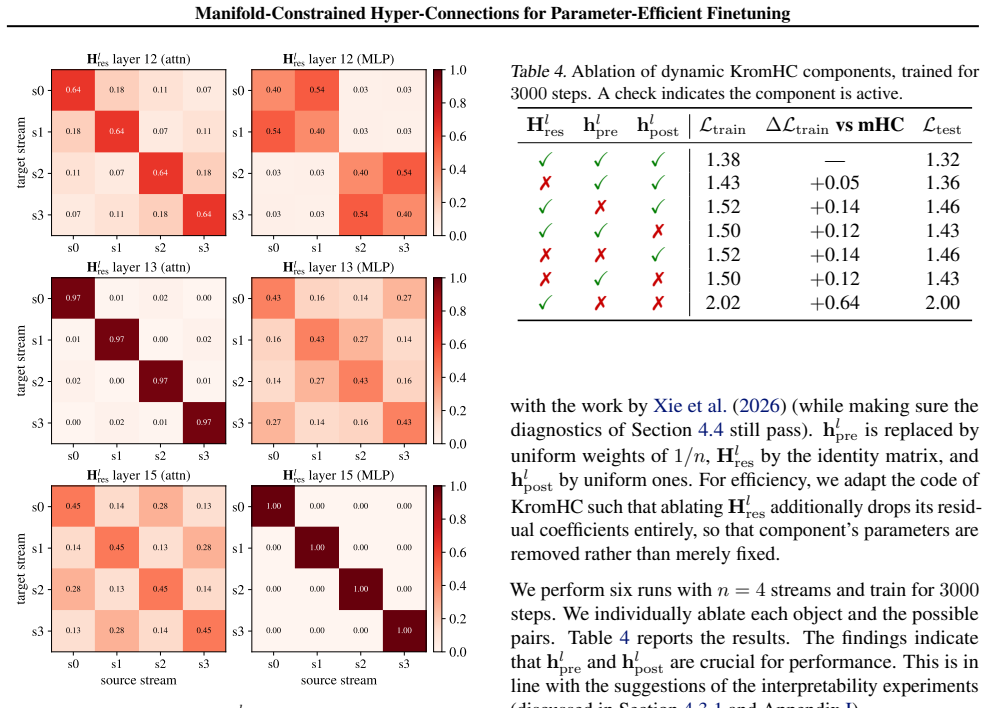
The central claim is that in frozen-backbone finetuning, mHC's useful capacity is concentrated in its input-dependent read/write routing (the gates h_pre and h_post), not in the learned depth-wise residual mixing matrix H_res. Evidence: learned H_res moves toward near-identity in later layers, ablating or fixing H_res to identity improves or preserves loss while removing parameters, and this pattern holds across three parameterisations (Sinkhorn, mHC-lite, and KromHC) at both 1B and 7B scale. The paper concludes that finetuning should preserve the pretrained residual pathway and use residual routing mainly to modulate how pretrained representations are read from and written back to the strea
What carries the argument
The central object is the mHC wrapper: a module that replaces a single residual connection with n parallel residual streams, a doubly stochastic mixing matrix H_res constrained to the Birkhoff polytope (via Sinkhorn projection, Birkhoff-von Neumann decomposition, or Kronecker factors), and sigmoid read/write gates h_pre and h_post. The doubly stochastic constraint keeps repeated products of the mixing matrix bounded, so the residual signal does not amplify or vanish over depth. The identity-preserving variant fixes H_res = I, turning the module into pure input-dependent read/write routing, which the paper shows is the component that carries the finetuning gains.
Load-bearing premise
The entire attribution rests on the warm-start property: at initialization the mHC wrapper is numerically equivalent to the frozen backbone within about 1% per sub-layer, and the paper only verifies this at initialization and for early gradients, not for the full training trajectory; if the per-layer deviation compounds over 16–32 wrapped sub-layers during training, the model may drift from the pretrained minimum and the loss or benchmark gains could stem from that drift rath
What would settle it
Train an mHC-wrapped model while recording, at each training step, the maximum per-layer L2 deviation between the wrapped model's hidden states and the vanilla frozen backbone's hidden states. If the cumulative deviation grows above the bf16 rounding tolerance (roughly 1% per sub-layer) before the language-modelling loss improvement appears, the improvement would be attributable to the perturbation rather than the routing. Alternatively, remove the read/write gates while keeping learned H_res; if loss still improves, the identity-preservation conclusion is wrong.
If this is right
- Residual routing is a distinct, complementary PEFT axis: it changes how pretrained representations move through the model rather than changing weights or activations.
- Combining mHC with LoRA can beat LoRA alone at matched trainable parameter budgets, improving language-modelling loss (e.g., static mHC n=16 + LoRA r=8 reduces test loss from 1.28 to 1.21 on the 1B backbone) and giving task-dependent benchmark gains at 1B and 7B scale.
- Fixing the residual mixing matrix to identity removes up to 8.39M trainable parameters (at n=16 on the 1B model) while improving test loss, making identity-preserving mHC the parameter-efficient default.
- Standalone mHC is competitive on some knowledge and multiple-choice tasks (best PIQA at n=2, best TriviaQA at n=4) but does not consistently outperform LoRA or VeRA; its value is as a complement, not a replacement.
- The identity-preservation result holds across all tested mHC parameterisations and scales to the 7B model, suggesting it is a general property of finetuning rather than an artefact of one implementation.
Where Pith is reading between the lines
- If the identity-preservation result generalizes across architectures, then any PEFT method that learns transformations on the residual stream will face the same pressure toward identity; this could be tested by applying mHC to a post-norm Transformer or to a different model family.
- The 'residual memory' hypothesis—that finetuning should modulate access to a pretrained residual pathway rather than rewrite it—predicts that methods constraining residual-stream perturbations will generalize better under distribution shift; this is an extension the paper does not test.
- The combination results suggest LoRA rank and residual routing occupy different capacity niches; a reader might reasonably expect mHC to complement other PEFT methods such as VeRA or (IA)3 in similar ways, but that is speculative beyond the paper's experiments.
- The reported carbon cost of the study (~99.45 kgCO2eq) suggests mHC experiments on this setup are comparatively cheap, making broader sweeps across seeds, datasets, and architectures feasible; that implication is ours, not the paper's.
Editorial analysis
A structured set of objections, weighed in public.
Referee Report
Summary. The paper proposes manifold-constrained hyper-connections (mHC) as a parameter-efficient finetuning method for frozen Transformers. The authors wrap each attention/MLP sub-layer of OLMo-2-1B and OLMo-2-7B with static or dynamic residual-routing modules, comparing Sinkhorn-based mHC with mHC-lite and KromHC parameterizations. The central claim is that, in finetuning, the learned residual mixing matrix H_res tends to move toward the identity, and that fixing H_res=I_n improves or preserves language-modelling loss while reducing trainable parameters; hence mHC's benefit comes mainly from input-dependent read/write routing via h_pre and h_post. As a standalone method mHC does not consistently beat LoRA, but at matched parameter budgets mHC+LoRA combinations yield small loss improvements and task-dependent benchmark gains.
Significance. If the identity-preservation result holds, the paper identifies a distinct and practically useful PEFT axis—residual routing—and provides a strong motivation for simplifying mHC in the finetuning setting by dropping H_res entirely. The study is systematic in several respects: it includes multiple mHC parameterizations, ablations of each routing component, matched parameter-budget comparisons with LoRA, evaluations on eight benchmarks, scaling from 1B to 7B, and public code. These are genuine strengths. However, the headline quantitative claims are supported by small loss differences from single-seed runs, and the mechanistic attribution depends on an empirically underdocumented warm-start property.
major comments (4)
- [§3.3 Diagnostics, §4.3.3, Appendix B/C] The central mechanistic claim—that the advantage of mHCidentity comes from learned routing rather than from differences in initialization perturbation—requires that the wrapped and vanilla models start at the same function. Appendix C states that symmetry-breaking noise breaks exact equivalence, that the single-sublayer deviation is 'roughly 1%', and that final logits remain close, but no measured cumulative deviation, initial loss gap, or early gradient norm is reported. A 1% per-sublayer perturbation can compound over 32 wrapped sublayers. Please report the actual final-logit cosine/total-variation distance at initialization, the initial loss gap, and the gradient norms for each variant; without these numbers the learned-H_res vs. mHCidentity comparison is not cleanly attributable.
- [Tables 3, 5, 8, 9] All main results are single-seed. Key claims rest on small gaps: Table 5 reports ΔLtest of only -0.01 and -0.02 for n=2 and n=4, and Table 8 reports Ltest 0.980 vs. 0.981 for the 7B combination. With no seeds or error bars, these differences are not distinguishable from noise, and the benchmark deltas in Table 6 and Table 9 are similarly within plausible run-to-run variation. Please provide at least 3-5 seeds for the load-bearing comparisons, or state clearly which conclusions are provisional.
- [Appendix F; §4.3.3] Two post-hoc choices affect the interpretation. The 20k-step training cutoff was chosen after observing LoRA's curve (Appendix F), and the mHCidentity variant was selected after observing that trained H_res matrices converge to identity (§4.3.3). This creates a selection bias: the reported comparisons are, in part, the result of inspecting the same validation signals that define the final claim. The authors should either provide a pre-specified evaluation protocol or quantify how sensitive the conclusions are to the cutoff and to the post-hoc selection of identity routing.
- [Appendix H.1] The initialization ablation that addresses the warm-start concern is run for only 3,000 steps. This is too short to establish that the choice of H_res initialization is irrelevant to the 20k-step results reported in Table 5. If the identity advantage is instead caused by learned-H_res runs starting with a larger effective perturbation, the initialization ablation would not detect it. Extend at least the identity/uniform/noise initialization comparison to the full training length, or report the perturbation magnitude over the whole trajectory.
minor comments (5)
- [Appendix C] Typo: 'Altough' should be 'Although'.
- [Appendix B] The sentence 'This property was tested by checking whether the vanilla OLMo and mHC-wrapped OLMo model’s final logits are sufficiently numerically close' is duplicated verbatim.
- [§5] The phrase 'LoRA en VeRA' mixes English and Dutch; should be 'LoRA and VeRA'.
- [§4.1] The sentence 'KromHC is both the most parameter-efficient and the performs the best too' is ungrammatical. Also, 'Similarily' is a typo.
- [§3.1 and Appendix H.3] The main text says the final readout adds n softmax parameters, while Appendix H.3 says a mean readout is used and a softmax was tested as an ablation. Please clarify which readout is used in the main experiments.
Circularity Check
No significant circularity; the identity-preservation claim is tested on fresh configurations, with only one non-load-bearing self-citation.
full rationale
The paper is empirical rather than derivational. Its central mechanistic claim — that fixing H_res to identity improves finetuning and that mHC's benefit comes mainly from h_pre/h_post routing — is supported by an interpretability observation (Section 4.3.1, Fig. 3) followed by fresh training runs with H_res := I_n (Section 4.3.3, Table 5) and by component ablations (Section 4.3.2, Table 4). These are new configurations, not re-statements of fitted values: learned-H_res and identity-H_res runs have different parameterizations, parameter counts, and training dynamics, so the comparison is not forced by construction. The only self-citation (Oldenburg et al., 2024, Section 3.4) concerns per-method learning rates in joint optimization and is not load-bearing; removing it would not change any claim. The initialization-equivalence condition (Appendices B and C) is an experimental assumption used for attribution, and its approximate verification ("roughly 1%" per sub-layer, bf16-level) could be more thorough, but this is a robustness/measurement gap, not a circular reduction: the paper does not define 'benefit of routing' in terms of that same 1% tolerance. No uniqueness theorem, ansatz-via-citation, or renaming of a known result occurs. Score 1 reflects only the presence of one minor, non-load-bearing self-citation; otherwise the derivation chain is self-contained against external baselines and held-out benchmarks.
Axiom & Free-Parameter Ledger
free parameters (5)
- Expansion rate n =
4 (default); 2, 8, 16 varied
- Dynamic KromHC learning rate =
1e-3
- Training length =
20,000 steps
- Symmetry-breaking noise / dropout =
Gaussian σ=10^-2; Bernoulli p=0.1 on H_res
- Sinkhorn iterations / epsilon =
20 iterations; ε=1e-6
axioms (6)
- standard math Sinkhorn-Knopp iteration converges to a doubly stochastic matrix for positive matrices; 20 iterations suffice in practice.
- standard math Birkhoff-von Neumann theorem: every doubly stochastic matrix is a convex combination of permutation matrices.
- standard math Kronecker product of doubly stochastic matrices is doubly stochastic.
- ad hoc to paper The mHC wrapper at initialization is functionally equivalent to the frozen backbone within numerical tolerance (~1% per sub-layer deviation).
- domain assumption OLMo-2 applies pre-norm-style additive updates (Eq. 18) where the residual stream is unnormalized; wrapping each sub-layer with mHC preserves this interface.
- domain assumption Tulu-3 SFT mixture is not part of OLMo-2's pre-training data.
read the original abstract
Most parameter-efficient finetuning (PEFT) methods adapt weights or activations, thus leaving one of the key Transformer components unchanged: residual connections. This paper investigates Manifold-Constrained Hyper-Connections (mHC), a generalisation of residual connections, as a novel PEFT approach, wrapping frozen OLMo-2 backbones with learned residual routing modules. We find that mHC can finetune frozen Transformers, but that its role differs fundamentally from the original pre-training setting: in finetuning, fixing the residual mixing matrix to identity often improves performance. As a standalone PEFT method, mHC does not consistently outperform LoRA. However, at matched trainable parameter budgets, mHC+LoRA combinations improve language-modelling loss and show task-dependent benchmark gains at both 1B and 7B scale. Overall, our results identify residual routing as a distinct and promising novel PEFT axis.
Figures




Reference graph
Works this paper leans on
-
[6]
Dua, D., Wang, Y ., Dasigi, P., Stanovsky, G., Singh, S., and Gardner, M
URL https://arxiv.org/abs/2604.02309. Dua, D., Wang, Y ., Dasigi, P., Stanovsky, G., Singh, S., and Gardner, M. DROP: A reading comprehension bench- mark requiring discrete reasoning over paragraphs,
-
[7]
URLhttps://arxiv.org/abs/1903.00161. Gao, L., Tow, J., Abbasi, B., Biderman, S., Black, S., DiPofi, A., Foster, C., Golding, L., Hsu, J., Le Noac’h, A., Li, H., McDonell, K., Muennighoff, N., Ociepa, C., Phang, J., Reynolds, L., Schoelkopf, H., Skowron, A., Sutawika, L., Tang, E., Thite, A., Wang, B., Wang, K., and Zou, A. A framework for few-shot languag...
Pith/arXiv arXiv 1903
-
[8]
URL https://arxiv. org/abs/2403.14608. He, K., Zhang, X., Ren, S., and Sun, J. Deep residual learning for image recognition,
-
[10]
URL https://arxiv.org/abs/ 1902.00751. Hu, E. J., Shen, Y ., Wallis, P., Allen-Zhu, Z., Li, Y ., Wang, S., Wang, L., and Chen, W. LoRA: Low-rank adap- tation of large language models,
Pith/arXiv arXiv 1902
-
[11]
URL https: //arxiv.org/abs/2106.09685. Joshi, M., Choi, E., Weld, D. S., and Zettlemoyer, L. TriviaQA: A large scale distantly supervised challenge dataset for reading comprehension,
-
[13]
ISSN 1091-6490. doi: 10.1073/pnas.1611835114. URL http://dx.doi. org/10.1073/pnas.1611835114. Kopiczko, D. J., Blankevoort, T., and Asano, Y . M. VeRA: Vector-based random matrix adaptation,
-
[14]
Lacoste, A., Luccioni, A., Schmidt, V ., and Dandres, T
URL https://arxiv.org/abs/2310.11454. Lacoste, A., Luccioni, A., Schmidt, V ., and Dandres, T. CodeCarbon,
-
[16]
Liu, H., Tam, D., Muqeeth, M., Mohta, J., Huang, T., Bansal, M., and Raffel, C
URL https://arxiv.org/abs/2104.08691. Liu, H., Tam, D., Muqeeth, M., Mohta, J., Huang, T., Bansal, M., and Raffel, C. Few-shot parameter-efficient fine-tuning is better and cheaper than in-context learn- ing,
-
[17]
URLhttps://arxiv.org/abs/2603.20896. Loshchilov, I. and Hutter, F. Decoupled weight decay regu- larization,
-
[18]
URL https://arxiv.org/abs/ 1711.05101. Lyubinin, A. Tbp-mhc: full expressivity for manifold- constrained hyper connections through transportation polytopes,
-
[19]
Modi, S., Vishwakarma, R., Rajeev, R., Parikh, T., Patel, K., and Diamond, H
URL https://arxiv.org/abs/ 2605.21724. Modi, S., Vishwakarma, R., Rajeev, R., Parikh, T., Patel, K., and Diamond, H. Sparse selective hyper-connections: A unified framework for stable and efficient deep residual learning. InSoutheastCon 2026, pp. 1–7,
Pith/arXiv arXiv 2026
-
[20]
doi: 10.1109/SoutheastCon63549.2026.11476522. Nowtricity. CO2 emissions per kwh in the netherlands, May
arXiv 2026
-
[21]
Forecasting smog clouds with deep learning: A proof-of-concept
Oldenburg, V ., Cardenas-Cartagena, J., and Valdenegro- Toro, M. Forecasting smog clouds with deep learning: A proof-of-concept. InICML 2024 AI for Science Workshop,
2024
-
[22]
URL https://arxiv.org/abs/ 2501.00656. Paszke, A., Gross, S., Massa, F., Lerer, A., Bradbury, J., Chanan, G., Killeen, T., Lin, Z., Gimelshein, N., Antiga, L., Desmaison, A., K¨opf, A., Yang, E., DeVito, Z., Rai- son, M., Tejani, A., Chilamkurthy, S., Steiner, B., Fang, L., Bai, J., and Chintala, S.PyTorch: an imperative style, high-performance deep learn...
-
[23]
Sengupta, B., Wang, J., and Brunswic, L
URL https://arxiv.org/ abs/2603.14833. Sengupta, B., Wang, J., and Brunswic, L. Jpmhc dynamical isometry via orthogonal hyper-connections,
-
[24]
URL https://arxiv.org/abs/2602.18308. Sinkhorn, R. and Knopp, P. Concerning nonnegative ma- trices and doubly stochastic matrices.Pacific Journal of Mathematics, 21(2):343–348,
-
[25]
URL https://arxiv.org/abs/2503.19206. Sun, K. and Dredze, M. Amuro and char: Analyzing the relationship between pre-training and fine-tuning of large language models,
-
[26]
Suzgun, M., Scales, N., Sch ¨arli, N., Gehrmann, S., Tay, Y ., Chung, H
URL https://arxiv.org/ abs/2408.06663. Suzgun, M., Scales, N., Sch ¨arli, N., Gehrmann, S., Tay, Y ., Chung, H. W., Chowdhery, A., Le, Q. V ., Chi, E. H., Zhou, D., and Wei, J. Challenging BIG-bench tasks and whether chain-of-thought can solve them,
-
[28]
Veit, A., Wilber, M., and Belongie, S
URL https://arxiv.org/ abs/1706.03762. Veit, A., Wilber, M., and Belongie, S. Residual networks be- have like ensembles of relatively shallow networks,
-
[30]
URL https://arxiv.org/abs/2606.07574. Wang, C., Li, B., Zhang, J., Liu, X., Fan, Y ., Lyu, L., Chen, X., Wang, J., Xiao, T., Pei, P., and Cai, X. Span- Norm: Reconciling training stability and performance in deep transformers,
-
[31]
URL https://arxiv. org/abs/2601.22580. Xie, Z., Wei, Y ., Cao, H., Zhao, C., Deng, C., Li, J., Dai, D., Gao, H., Chang, J., Yu, K., Zhao, L., Zhou, S., Xu, Z., Zhang, Z., Zeng, W., Hu, S., Wang, Y ., Yuan, J., Wang, L., and Liang, W. mHC: Manifold- constrained hyper-connections,
-
[32]
Xu, G., Wang, X., Wu, X., Leng, X., and Xu, Y
URL https: //arxiv.org/abs/2512.24880. Xu, G., Wang, X., Wu, X., Leng, X., and Xu, Y . Devel- opment of residual learning in deep neural networks for computer vision: A survey.Engineering Applications of Artificial Intelligence, 142:109890,
-
[33]
Zellers, R., Holtzman, A., Bisk, Y ., Farhadi, A., and Choi, Y
URL https://arxiv.org/ abs/2601.05732. Zellers, R., Holtzman, A., Bisk, Y ., Farhadi, A., and Choi, Y . HellaSwag: Can a machine really finish your sentence?,
-
[34]
URL https://arxiv.org/abs/ 1905.07830. Zhang, B. and Sennrich, R.Root mean square layer nor- malization. Curran Associates Inc., Red Hook, NY , USA,
Pith/arXiv arXiv 1905
-
[35]
14 Manifold-Constrained Hyper-Connections for Parameter-Efficient Finetuning A
URL https://arxiv.org/abs/2409.19606. 14 Manifold-Constrained Hyper-Connections for Parameter-Efficient Finetuning A. Hyperparameters This appendix gives more detail on the hyperparameter configurations and choices. A.1. High-level GPU memory optimisation For determining the sequence length where we strike a balance between speed and data usage, we derive...
-
[36]
This threshold ensures that we cover more than 99% of examples in allenai/tulu-3-sft-olmo-2-mixture
For the experiments, we used a maximum sequence length of 2048 tokens. This threshold ensures that we cover more than 99% of examples in allenai/tulu-3-sft-olmo-2-mixture. We applied the same size to our other experiments. Table
2048
-
[37]
Lengths are computed after applying the OLMo chat formatting and tokenizing with the allenai/OLMo-2-1B tokenizer
Tokenized sequence length statistics for the T ¨ulu 3 OLMo SFT mixture. Lengths are computed after applying the OLMo chat formatting and tokenizing with the allenai/OLMo-2-1B tokenizer. Fractions are the proportion of examples going over each truncation threshold. Type Statistic Value Dataset Hugging Face IDallenai/tulu-3-sft-olmo-2-mixture Tokenizer Hugg...
2048
-
[38]
with padding to 2048 tokens) setting
Larger sizes, such as 8, resulted in CUDA out-of-memory errors under the worst-case (i.e. with padding to 2048 tokens) setting. Thus, we use the 4-4 configuration for all main finetuning runs. For some smaller experiments, we adjusted the batch size of 8 and 2 gradient accumulation steps. A.2. Hyperparameters of PEFT methods All experiments use a Hydra-ma...
2048
-
[39]
Random entries are set to −∞ before applying the Sinkhorn normalisation
For stage 2, during training we additionally apply Bernoulli logit dropout (p= 0.1) exclusively to Hl res. Random entries are set to −∞ before applying the Sinkhorn normalisation. We add a safety check to prevent fully masked rows or columns. This per-forward pass stochastic perturbation directly targets the residual mixing matrix where cross-stream infor...
1967
-
[40]
This diverse layout ensures a robust assessment of each finetuning method
spanse a diverse range of capabilities, from physical intuition and commonsense reasoning, to tasks such as multi-step logic and advance mathematical problems. This diverse layout ensures a robust assessment of each finetuning method. Table 15.Benchmark configurations and additional explanations/clarifications BENCHMARKCONTEXTTYPEX-SHOTCONFIGURATIONEVALUA...
2025
-
[41]
For high-confidence completions, KromHC routing does not induce stream specialisation
Each panel shows the top-1 predicted token at each layer and position for one KromHC stream. For high-confidence completions, KromHC routing does not induce stream specialisation. 23 Manifold-Constrained Hyper-Connections for Parameter-Efficient Finetuning J. Earlier reported findings on stability for HC and mHC The propagation instability of Hyper-Connec...
2026
-
[2015]
Hendrycks, D., Burns, C., Basart, S., Zou, A., Mazeika, M., Song, D., and Steinhardt, J
URL https:// arxiv.org/abs/1512.03385. Hendrycks, D., Burns, C., Basart, S., Zou, A., Mazeika, M., Song, D., and Steinhardt, J. Measuring massive multitask language understanding, 2021a. URL https: //arxiv.org/abs/2009.03300. Hendrycks, D., Burns, C., Kadavath, S., Arora, A., Basart, S., Tang, E., Song, D., and Steinhardt, J. Measuring math- ematical prob...
Pith/arXiv arXiv 2009
-
[2016]
URLhttps://arxiv.org/abs/1605.06431. Wang, C. and Qiu, Y . Accelerating birkhoff projection for manifold-constrained hyper-connections,
-
[2017]
Kirkpatrick, J., Pascanu, R., Rabinowitz, N., Veness, J., Desjardins, G., Rusu, A
URL https: //arxiv.org/abs/1705.03551. Kirkpatrick, J., Pascanu, R., Rabinowitz, N., Veness, J., Desjardins, G., Rusu, A. A., Milan, K., Quan, J., Ramalho, T., Grabska-Barwinska, A., Hassabis, D., Clopath, C., Kumaran, D., and Hadsell, R. Overcom- ing catastrophic forgetting in neural networks.Pro- ceedings of the National Academy of Sciences, 114 (13):35...
-
[2019]
URL https://arxiv.org/abs/ 1911.11641. Cobbe, K., Kosaraju, V ., Bavarian, M., Chen, M., Jun, H., Kaiser, L., Plappert, M., Tworek, J., Hilton, J., Nakano, R., Hesse, C., and Schulman, J. Training verifiers to solve math word problems,
Pith/arXiv arXiv 1911
-
[2021]
URL https://arxiv. org/abs/2110.14168. Dandachi, T. and Diggs-Galligan, S. go-mhc: Direct param- eterization of manifold-constrained hyper-connections 12 Manifold-Constrained Hyper-Connections for Parameter-Efficient Finetuning via generalized orthostochastic matrices,
-
[2022]
Vaswani, A., Shazeer, N., Parmar, N., Uszkoreit, J., Jones, L., Gomez, A
URL https://arxiv.org/abs/2210.09261. Vaswani, A., Shazeer, N., Parmar, N., Uszkoreit, J., Jones, L., Gomez, A. N., Kaiser, L., and Polosukhin, I. Attention is all you need,
-
[2023]
URL https://arxiv.org/abs/ 2307.13721. Bıc ¸ıcı, E. Residual connections improve click- through rate and conversion rate prediction perfor- mance,
-
[2024]
URL https://arxiv.org/abs/2405.14782. Birkhoff, G. Tres observaciones sobre el algebra lineal. Univ. Nac. Tucuman, Ser. A, 5:147–154,
-
[2025]
Lester, B., Al-Rfou, R., and Constant, N
URLhttps://arxiv.org/abs/2411.15124. Lester, B., Al-Rfou, R., and Constant, N. The power of scale for parameter-efficient prompt tuning,
-
[2026]
Awais, M., Naseer, M., Khan, S., Anwer, R
URL https://arxiv.org/ abs/2606.03483. Awais, M., Naseer, M., Khan, S., Anwer, R. M., Cholakkal, H., Shah, M., Yang, M.-H., and Khan, F. S. Founda- tional models defining a new era in vision: A survey and outlook,
discussion (0)
Sign in with ORCID, Apple, or X to comment. Anyone can read and Pith papers without signing in.