REVIEW 3 major objections 6 minor 296 references
A new differentiable simulation framework couples a fifth-order finite-difference (magneto)hydrodynamics scheme to an energy-conserving self-gravity source term, making gradient-based astrophysical inverse modeling practical.
Reviewed by Pith at T0; open to challenge. T0 means a machine referee read the full paper against a public rubric. the ladder, T0–T4 →
T0 review · deepseek-v4-flash
2026-08-01 15:45 UTC pith:FJTYZQJC
load-bearing objection A substantial, honest engineering-plus-methods paper on differentiable MHD+self-gravity; the flagship self-gravity order claim is observed rather than proven, but the paper deserves a serious referee. the 3 major comments →
Per Astronomix ad Astra: High-Order Differentiable (Magneto)hydrodynamics with Energy-Conserving Self-Gravity
The pith
A machine-rendered reading of the paper's core claim, the machinery that carries it, and where it could break.
Core claim
The core discovery: self-gravity can couple to a high-order finite-difference (M)HD scheme without breaking energy conservation. The numerical mass flux is a face value of a deconvolved flux, so the natural energy source −∇·(ρvΦ) − Φ∂tρ telescopes exactly but stays second-order, because deconvolution does not commute with multiplication. An explicit correction from second-order cell-centered derivatives averaged to faces restores fourth-order accuracy while preserving exact telescoping. The corrected scheme shows fifth-order convergence on a large-amplitude slab test and total-energy errors below 1e-8 in a gravitational collapse. The same framework is fully differentiable, with gradients val
What carries the argument
The central identity is the box-filter/deconvolution relation of finite-difference flux-form schemes: for f'(xi) ≈ (f̂_{i+1/2} − f̂_{i−1/2})/Δx to be high-order, the numerical face flux f̂ must be a high-order face value of the deconvolved flux f̃ = f − (Δx²/24)f'' + O(Δx⁴). The new self-gravity scheme constructs the gravitational energy flux from the WENO mass flux and adds an explicit O(Δx²) correction so the face flux of the product Φf is deconvolved to fourth order while retaining exact telescoping — the property that yields semi-discrete energy conservation at full spatial order.
Load-bearing premise
The load-bearing premise is that, in smooth regions, the WENO interface mass flux is a high-order face value of the deconvolved flux, so the second-order-derived correction term restores fourth-order accuracy without breaking exact telescoping; the paper observes, rather than proves, the resulting fifth-order convergence, and the argument explicitly degrades at discontinuities.
What would settle it
Run the large-amplitude slab advection at N = 16 to N = 128 with the correction term enabled and disabled and compare convergence slopes: if the corrected scheme does not hold at least fourth-order (ideally fifth, as reported) while the uncorrected one stalls at second order, the deconvolution identity is not doing the claimed work. Alternatively, in a mild Evrard collapse with the positivity limiter inactive, verify that the total-energy error scales as O(Δt⁴); deviations would contradict the semi-discrete conservation argument.
If this is right
- Field-level inverse modeling over millions of parameters becomes practical: the paper recovers a turbulent 128³ initial velocity field (~6.3 million degrees of freedom) by matching a target column-density image.
- The corrected flux-based self-gravity coupling cuts total-energy error in a gravitational collapse from up to 18% to below 1e-8 at 128³ cells, with residuals scaling as O(Δt⁴) under the Runge-Kutta integrator.
- On smooth problems, the fifth-order scheme reaches the same error as second- and third-order reference schemes roughly three to four orders of magnitude faster for a given runtime on a single GPU.
- Gradients through the full nonlinear solver are certified: reverse-mode automatic differentiation converges at the nominal spatial order to analytic functional derivatives on smooth flows, and to one-sided finite differences through a shock tube.
- New stability measures — positivity-preserving flux blending and deep-void protection — keep the high-order scheme stable in high-Mach, strongly magnetized turbulence at resolutions where previous implementations broke.
Where Pith is reading between the lines
- The deconvolution-correction construction should transfer to other nonlinear source terms in finite-difference schemes — optically thin cooling, cosmic-ray pressure, radiation pressure — wherever a product of a face flux and a cell-centered field must stay high-order without breaking conservation.
- A clean falsifiable consequence of the semi-discrete argument: over many dynamical times in a smooth, mildly collapsing run, total energy should remain pinned at the time-integration error floor rather than drifting, cleanly separating the corrected scheme from simple source-term coupling even at low resolution.
- Because the Jacobian-vector product is matrix-free from a single automatic-differentiation pass, the eigenmode/stability-analysis demonstration generalizes to routine diagnostics on any statistically stationary astrophysical flow, not just idealized shear layers.
Editorial analysis
A structured set of objections, weighed in public.
Referee Report
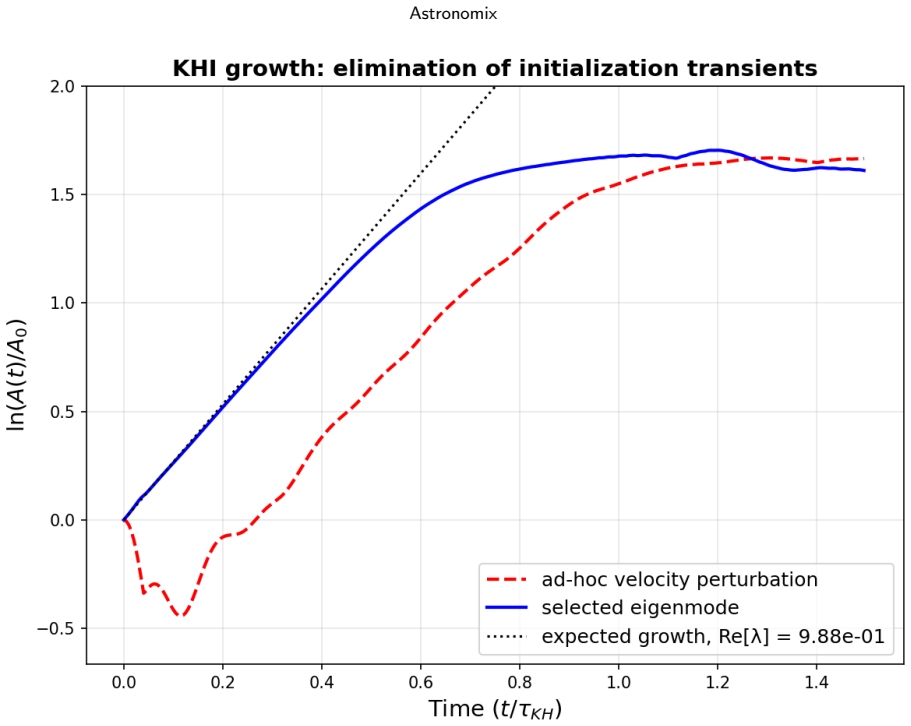
Summary. The paper presents astronomix, a JAX/Python differentiable ideal-(M)HD simulator with optional self-gravity. Its central technical contributions are: (i) a fifth-order finite-difference WENO constrained-transport MHD scheme following Seo & Ryu (2023), augmented by positivity/stability measures, a low-storage Runge-Kutta option, and an agent-generated Pallas GPU backend; (ii) a new self-gravity coupling that solves the Poisson equation with FFTs and constructs the gravitational energy source from the numerical mass flux so that the discrete gravitational-energy change telescopes exactly, yielding semi-discrete (time-continuous) energy conservation, with an explicit O(Δx^4) deconvolution correction intended to restore spatial order; (iii) demonstrations that reverse-mode automatic differentiation through the solver is accurate and scalable, including analytic-functional-derivative and finite-difference validation, eigenmode initialization of a Kelvin-Helmholtz instability, multiple-shooting optimization, and field-level inference over roughly 6.3 million parameters; and (iv) performance and scaling comparisons against AthenaPK. The forward solver is tested on standard hydro/MHD problems, turbulence, and Evrard collapse, and the paper is unusually candid about several limitations of the self-gravity tests and time-integration behavior.
Significance. If the claims hold, this is a significant contribution: a differentiable, GPU-scalable, high-order MHD+self-gravity code would enable gradient-based inference, sensitivity analysis, and solver-in-the-loop machine learning in astrophysics. The paper has real strengths: the energy-conservation identity is derived and tested, AD gradients are checked against hand-derived functional derivatives, the Evrard collapse shows energy errors below roughly 10^-8 for the flux-based schemes in the smooth regime, and the open-source code plus generated Pallas backend are validated against the JAX reference. Several limitations are explicitly acknowledged, including the inability of the Jeans-wave test to separate the schemes and the first-order temporal energy-error behavior when the positivity limiter engages. The main risk is the spatial-order guarantee of the self-gravity correction, which currently rests on an asymptotic formula and one smooth slab test; this is the principal reason for my recommendation.
major comments (3)
- [Sec. 3.4.2–3.4.4, Eqs. (84)–(86), Fig. 13] The flagship claim of a fourth-order self-gravity scheme is not established at the same level as the energy-conservation identity. Equation (86) is an asymptotic correction derived under the smoothness assumption, stated in Eq. (85), that the WENO interface mass flux is a high-order face value of the deconvolved flux \tilde f. The only direct numerical evidence is the slab advection test (Sec. 3.4.4), a single configuration with wave vector and advection velocity parallel to the box diagonal. The text itself says the remaining fourth-order error 'evidently carries a small enough constant' (Sec. 3.4.4); that is an empirical observation, not an order bound. In genuinely three-dimensional non-aligned flows the O(Δx^4) constant is uncontrolled, and if it is not small the scheme could be effectively second- or third-order, undercutting the abstract's 'fourth-order self-gravity scheme'. I ask
- [Sec. 3.4.5, Figs. 14–17] The advertised O(Δt^4) energy convergence of the flux-based schemes is conditional on the positivity-preserving limiter not engaging. The text states that the cold Evrard collapse at 32^3 crashes unless the PP limiter is enabled, and that where the limiter is active it reduces the temporal convergence of the energy error to first order, because the limited flux becomes an explicit function of Δt and breaks the RK4 cancellation. The O(Δt^4) behavior is demonstrated only for the milder e_th,0=0.2 case (Fig. 16). Since the limiter is necessary in exactly the gravitational-collapse regime where self-gravity matters, the practical discrete energy-conservation order in realistic use is first order in time, not fourth. This does not invalidate the semi-discrete identity, but the paper should either provide a limiter formulation that preserves high-order RK cancellation or state prominently that
- [Sec. 3.4.3, Fig. 12] The Jeans linear-wave test is explicitly unable to separate the corrected from the uncorrected flux-based scheme: the correction term is second order in the perturbation amplitude and falls below round-off at ε=10^-6. Consequently the entire spatial-order evidence for the corrected scheme rests on the slab test alone (Fig. 13), which covers only N=16–96 and one wavenumber/amplitude. In view of the central role of the order claim, I would like to see at least one additional independent test—for example, a manufactured solution with a non-trivial 3D potential and velocity field, or a small-amplitude Jeans wave at larger ε but still in the linear regime—before the fourth-order statement is accepted as general.
minor comments (6)
- [Sec. 3.4.4] Replace the phrase 'the remaining fourth-order error evidently carries a small enough constant' with a quantitative statement, e.g., the measured leading constant or an additional test that controls that constant. As written, this sentence is the only support for the observed fifth-order convergence.
- [Sec. 4.1, Fig. 18] The runtime comparison uses different CFL numbers and integrators (FD at CFL=1.5; AthenaPK at 0.3/0.4). The conclusion is supported by the error-vs-runtime panel, but the text should state explicitly that the total-runtime comparison combines spatial order, integrator efficiency, and CFL choice; the time-per-iteration panel already shows a 1.4–4.8× penalty.
- [Sec. 3.1.1, Eq. (18)] The WENO ε=10^-7 is dimensional and 'assumes code units of order one'. A short note on how ε should be rescaled when the code is used with astrophysical unit systems would be useful, since all WENO weights depend on it.
- [Sec. 5.1 / Sec. 6.3] The million-parameter field-level inference demo (Sec. 6.3) is qualitative and uses no regularization, as the authors note. For reproducibility, please report the optimizer schedule, number of iterations, checkpoint count, and wall-clock cost of the 128^3 logo inversion.
- [Sec. 3.4.2] In the implementation of Eq. (86), the correction is evaluated with cell-centered point values f_i=(ρv_x)_i and then averaged to faces, while the derivation writes \hat f and \hat f'. The text explains why this is asymptotically valid (f = \hat f + O(Δ^2)), but a reader may be confused; please state explicitly that the final O(Δ^4) error is unaffected by this replacement.
- [Sec. 3.1.2] The constrained-transport construction is formally fourth-order in the transverse interpolations, and fifth-order convergence is inherited from the WENO truncation error, as in Seo & Ryu (2023). The paper should make clear that this is an observed, not proven, property of the composite scheme.
Circularity Check
No significant circularity: central derivations are self-contained and independently validated.
full rationale
Astronomix's flagship claims do not reduce to fitted inputs or self-citations. The self-gravity energy-conserving source term is explicitly constructed to satisfy the discrete identity sum_i V_i S_E,i = -∂_t E_grav,d (Eq. 72); the paper acknowledges this by-design property, so the reported energy conservation in Evrard's collapse is an implementation check of a constructed invariant, not a prediction derived from the same invariant. The claimed fourth-order accuracy of the correction (Eq. 86) follows from an explicit asymptotic deconvolution argument (Eqs. 81–85) with no fitted constants, and the order claim is tested against independent analytical solutions (Jeans waves, slab advection) and external references (Hanawa & Mullen 2025). The differentiability claims are validated against hand-derived functional derivatives derived independently from the linearized Euler equations (Appendix F), not from the discretization itself. Benchmarks against AthenaPK and standard shock tests are external. Self-citations (Storcks & Buck 2024, 2025) provide context for radially-symmetric solvers and solver-in-the-loop applications but are not load-bearing for the central numerical or differentiability results. No uniqueness theorem is imported, and no ansatz is smuggled through self-citation. The paper candidly states the smoothness limitation of its order argument in Sec. 3.4.2, which is an acknowledged scope restriction, not circularity.
Axiom & Free-Parameter Ledger
free parameters (4)
- WENO smoothness-indicator epsilon =
1e-7
- Deep-void blend factor beta =
8
- Turbulence forcing amplitude F0 =
3.5
- Turbulence density floor and velocity cap =
rho_min=0.02, v_max=50
axioms (5)
- domain assumption WENO interface fluxes coincide with high-order face values of the deconvolved flux in smooth regions (Eqs. 84-85).
- domain assumption The surface term in the gravitational energy balance vanishes (Eq. 69): density falls off sufficiently fast or there is no mass flux through the boundary.
- domain assumption A Fourier/FFT Poisson solve with Jeans swindle or Hockney-Eastwood represents self-gravity accurately enough for the finite-difference coupling.
- standard math Explicit Runge-Kutta integration of the quadratic gravitational energy produces the claimed O(Delta t^4) fully discrete energy error.
- domain assumption The ideal MHD equations with adiabatic or isothermal closure are the correct physical model (Eqs. 1-5).
read the original abstract
We present astronomix, a performant differentiable (magneto)hydrodynamics simulator written in Python/JAX. We demonstrate how automatic differentiation, validated against hand-derived analytical functional derivatives and finite differences, enables inverse modeling over millions of parameters and allows for sensitivity and stability analysis as well as correct eigenmode initialization. The differentiability of astronomix furthermore enables training machine-learning models inside the simulator. On a single GPU at a given resolution, astronomix has runtimes of the same order of magnitude as the GPU-optimized code AthenaPK but reaches far lower errors on smooth problems due to its higher order. astronomix scales to multiple GPUs ($\sim 6.5$ strong scaling speedup on $8$ GPUs) and multiple nodes ($\sim 76\%$ weak scaling efficiency on $16$ GPUs over $4$ nodes). We also present a novel fourth-order self-gravity scheme which complements the fifth-order finite difference constrained transport magnetohydrodynamics scheme implemented in astronomix. To maximize performance, we created an agentic skill that generates and validates custom Pallas GPU kernels from our JAX reference code and test suite. The simulator is available at https://github.com/leo1200/astronomix.
Figures




Reference graph
Works this paper leans on
-
[1]
Interstellar bubbles. II. Structure and evolution. The Astrophysical Journal , keywords =. doi:10.1086/155692 , adsurl =
-
[2]
Greg L. Bryan and Michael L. Norman and James M. Stone and Renyue Cen and Jeremiah P. Ostriker , abstract =. A piecewise parabolic method for cosmological hydrodynamics , journal =. 1995 , note =. doi:https://doi.org/10.1016/0010-4655(94)00191-4 , url =
-
[3]
2025 , eprint=
diffhydro: Inverse Multiphysics Modeling and Embedded Machine Learning in Astrophysical Flows , author=. 2025 , eprint=
2025
-
[4]
Mullen, P. D. and Hanawa, Tomoyuki and Gammie, C. F. , title =. The Astrophysical Journal Supplement Series , abstract =. 2021 , month =. doi:10.3847/1538-4365/abcfbd , url =
-
[5]
2021 , eprint=
FFT-based free space Poisson solvers: why Vico-Greengard-Ferrando should replace Hockney-Eastwood , author=. 2021 , eprint=
2021
-
[6]
Simulating self-gravitating hydrodynamic flows , journal =
Ewald Müller and Matthias Steinmetz , abstract =. Simulating self-gravitating hydrodynamic flows , journal =. 1995 , note =. doi:https://doi.org/10.1016/0010-4655(94)00185-5 , url =
-
[7]
A new way to conserve total energy for Eulerian hydrodynamic simulations with self-gravity. New Astronomy , keywords =. doi:10.1016/j.newast.2012.08.002 , archivePrefix =. 1208.1795 , primaryClass =
Pith/arXiv arXiv 2012
-
[8]
Remarks on the solution of poisson's equation for isolated systems , journal =
J.W Eastwood and D.R.K Brownrigg , abstract =. Remarks on the solution of poisson's equation for isolated systems , journal =. 1979 , issn =. doi:https://doi.org/10.1016/0021-9991(79)90139-6 , url =
-
[9]
Journal of Computational Physics , year = 1977, month = oct, volume =
The Solution of Poisson's Equation for Isolated Source Distributions. Journal of Computational Physics , year = 1977, month = oct, volume =. doi:10.1016/0021-9991(77)90013-4 , adsurl =
-
[10]
Moon, Sanghyuk and Kim, Woong-Tae and Ostriker, Eve C. , title =. The Astrophysical Journal Supplement Series , abstract =. 2019 , month =. doi:10.3847/1538-4365/ab09e9 , url =
-
[11]
Multi-Level Adaptive Solutions to Boundary-Value Problems , urldate =
Achi Brandt , journal =. Multi-Level Adaptive Solutions to Boundary-Value Problems , urldate =
-
[12]
Tomida, Kengo and Stone, J. M. , year=. The Athena++ Adaptive Mesh Refinement Framework: Multigrid Solvers for Self-gravity , volume=. The Astrophysical Journal Supplement Series , publisher=. doi:10.3847/1538-4365/acc2c0 , number=
-
[13]
Euler Equations, Navier-Stokes Equations and Turbulence , ISBN =
Constantin, Peter , year =. Euler Equations, Navier-Stokes Equations and Turbulence , ISBN =. doi:10.1007/11545989_1 , booktitle =
-
[14]
, options =
van den Bosch, Frank C. , options =. Astrophysical Flows , howpublished =. 2020 , url =
2020
-
[15]
2024 , eprint=
Dissipation anomaly and anomalous dissipation in incompressible fluid flows , author=. 2024 , eprint=
2024
-
[16]
Matemati
Finite difference method for numerical computation of discontinuous solutions of the equations of fluid dynamics , author=. Matemati
-
[17]
2018 , eprint=
Automatic differentiation in machine learning: a survey , author=. 2018 , eprint=
2018
-
[18]
Il Nuovo Cimento (1943-1954) , volume=
Statistical hydrodynamics , author=. Il Nuovo Cimento (1943-1954) , volume=. 1949 , publisher=
1943
-
[19]
Eyink, Gregory L. , abstract =. Energy dissipation without viscosity in ideal hydrodynamics I. Fourier analysis and local energy transfer , journal =. 1994 , issn =. doi:https://doi.org/10.1016/0167-2789(94)90117-1 , url =
-
[20]
Annual Review of Astronomy and Astrophysics , volume=
Grid-based hydrodynamics in astrophysical fluid flows , author=. Annual Review of Astronomy and Astrophysics , volume=. 2015 , publisher=
2015
-
[21]
1900 , month = aug, day =
David Hilbert , title =. 1900 , month = aug, day =
1900
-
[22]
A Self-gravity Module for the PLUTO Code , volume=
Mandal, Ankush and Mukherjee, Dipanjan and Mignone, Andrea , year=. A Self-gravity Module for the PLUTO Code , volume=. The Astrophysical Journal Supplement Series , publisher=. doi:10.3847/1538-4365/aced0a , number=
-
[23]
Turbulence in the Solar Wind
Marsch, E. Turbulence in the Solar Wind. Reviews in Modern Astronomy. 1991
1991
-
[24]
Helzel, Christiane and Rossmanith, James A. and Taetz, Bertram , year=. An unstaggered constrained transport method for the 3D ideal magnetohydrodynamic equations , volume=. Journal of Computational Physics , publisher=. doi:10.1016/j.jcp.2011.02.009 , number=
-
[25]
2015 , month = feb, url =
A Primer on Magnetohydrodynamics , author =. 2015 , month = feb, url =
2015
-
[26]
The Astrophysical Journal Letters , keywords =
Simulations and Theory of Ion Injection at Non-relativistic Collisionless Shocks. The Astrophysical Journal Letters , keywords =. doi:10.1088/2041-8205/798/2/L28 , archivePrefix =. 1409.8291 , primaryClass =
Pith/arXiv arXiv 2041
-
[27]
G. The. Journal of Computational Physics , volume =. 2000 , issn =. doi:10.1006/jcph.2000.6519 , url =
arXiv 2000
-
[28]
The Astrophysical Journal , keywords =
Simulation of Magnetohydrodynamic Flows: A Constrained Transport Model. The Astrophysical Journal , keywords =. doi:10.1086/166684 , adsurl =
-
[29]
Kenneth G. Powell and Philip L. Roe and Timur J. Linde and Tamas I. Gombosi and Darren L. A Solution-Adaptive Upwind Scheme for Ideal Magnetohydrodynamics , journal =. 1999 , issn =. doi:https://doi.org/10.1006/jcph.1999.6299 , url =
arXiv 1999
-
[30]
Roe, P. L. and Balsara, D. S. , year =. Notes on the Eigensystem of Magnetohydrodynamics , volume =. SIAM Journal on Applied Mathematics , publisher =. doi:10.1137/s003613999427084x , number =
-
[31]
A. Dedner and F. Kemm and D. Kröner and C.-D. Munz and T. Schnitzer and M. Wesenberg , abstract =. Hyperbolic Divergence Cleaning for the MHD Equations , journal =. 2002 , issn =. doi:https://doi.org/10.1006/jcph.2001.6961 , url =
arXiv 2002
-
[32]
The Effect of Nonzero div B on the numerical solution of the magnetohydrodynamic equations , journal =. 1980 , issn =. doi:https://doi.org/10.1016/0021-9991(80)90079-0 , url =
-
[33]
Magnetohydrodynamics on an unstructured moving grid: MHD on an unstructured moving grid , volume=
Pakmor, Ruediger and Bauer, Andreas and Springel, Volker , year=. Magnetohydrodynamics on an unstructured moving grid: MHD on an unstructured moving grid , volume=. Monthly Notices of the Royal Astronomical Society , publisher=. doi:10.1111/j.1365-2966.2011.19591.x , number=
arXiv 2011
-
[34]
2016 , eprint=
Essential Magnetohydrodynamics for Astrophysics , author=. 2016 , eprint=
2016
-
[35]
Hanawa, Tomoyuki and Mullen, P. D. , year=. Toward Higher-order Accuracy in Self-gravitating Hydrodynamics , volume=. The Astrophysical Journal Supplement Series , publisher=. doi:10.3847/1538-4365/adb97b , number=
-
[36]
Wang, Wujie and Wu, Zhenghao and Dietschreit, Johannes C. B. and Gómez-Bombarelli, Rafael , year=. Learning pair potentials using differentiable simulations , volume=. The Journal of Chemical Physics , publisher=. doi:10.1063/5.0126475 , number=
-
[37]
Aerodynamic design via control theory , volume =
Jameson, Antony , year =. Aerodynamic design via control theory , volume =. Journal of Scientific Computing , publisher =. doi:10.1007/bf01061285 , number =
-
[38]
Algorithms for PDE‐constrained optimization , volume =
Herzog, Roland and Kunisch, Karl , year =. Algorithms for PDE‐constrained optimization , volume =. GAMM-Mitteilungen , publisher =. doi:10.1002/gamm.201010013 , number =
-
[39]
Toro, Eleuterio F. , year =. Riemann Solvers and Numerical Methods for Fluid Dynamics: A Practical Introduction , ISBN =. doi:10.1007/b79761 , publisher =
-
[40]
Horowitz, Benjamin and Lukić, Zarija , year=. Differentiable cosmological hydrodynamics for field level inference and high dimensional parameter constraints , volume=. Monthly Notices of the Royal Astronomical Society , publisher=. doi:10.1093/mnras/staf1785 , number=
-
[41]
Evrard, August E. , year =. Beyond N-body: 3D cosmological gas dynamics , volume =. Monthly Notices of the Royal Astronomical Society , publisher =. doi:10.1093/mnras/235.3.911 , number =
-
[42]
Crittenden, P. E. and Balachandar, S. , year =. The impact of the form of the Euler equations for radial flow in cylindrical and spherical coordinates on numerical conservation and accuracy , volume =. Shock Waves , publisher =. doi:10.1007/s00193-017-0784-y , number =
-
[43]
STARFORGE: Towards a comprehensive numerical model of star cluster formation and feedback , volume=
Grudić, Michael Y and Guszejnov, Dávid and Hopkins, Philip F and Offner, Stella S R and Faucher-Giguère, Claude-André , year=. STARFORGE: Towards a comprehensive numerical model of star cluster formation and feedback , volume=. Monthly Notices of the Royal Astronomical Society , publisher=. doi:10.1093/mnras/stab1347 , number=
-
[44]
2017 , eprint=
In-Datacenter Performance Analysis of a Tensor Processing Unit , author=. 2017 , eprint=
2017
-
[45]
Astronomy and Astrophysics , keywords =
A comparative study of computational methods in cosmic gas dynamics. Astronomy and Astrophysics , keywords =
-
[46]
2017 , eprint=
High-order schemes for the Euler equations in cylindrical/spherical coordinates , author=. 2017 , eprint=
2017
-
[47]
and Villar, Soledad , title =
Hogg, David W. and Villar, Soledad , title =. Proceedings of the 41st International Conference on Machine Learning , articleno =. 2024 , publisher =
2024
-
[48]
Naab, Thorsten and Ostriker, J. P. , title = ". Annual Review of Astronomy and Astrophysics , keywords =. doi:10.1146/annurev-astro-081913-040019 , archivePrefix =. 1612.06891 , primaryClass =
-
[49]
and Mackey, Jonathan and Grassitelli, Luca and Romano-Díaz, Emilio and Porciani, Cristiano , year=
Fichtner, Yvonne A. and Mackey, Jonathan and Grassitelli, Luca and Romano-Díaz, Emilio and Porciani, Cristiano , year=. Connecting stellar and galactic scales: Energetic feedback from stellar wind bubbles to supernova remnants , volume=. doi:10.1051/0004-6361/202449638 , journal=
-
[50]
Härer, L. and Vieu, T. and Reville, B. , year=. Stellar-wind feedback and magnetic fields around young compact star clusters: 3D magnetohydrodynamics simulations , volume=. doi:10.1051/0004-6361/202554057 , journal=
-
[51]
Monthly Notices of the Royal Astronomical Society , keywords =
Stellar feedback efficiencies: supernovae versus stellar winds. Monthly Notices of the Royal Astronomical Society , keywords =. doi:10.1093/mnras/stv2699 , archivePrefix =. 1511.05151 , primaryClass =
-
[52]
The contribution of winds from star clusters to the Galactic cosmic-ray population , volume =
Peron, Giada and Casanova, Sabrina and Gabici, Stefano and Baghmanyan, Vardan and Aharonian, Felix , year =. The contribution of winds from star clusters to the Galactic cosmic-ray population , volume =. Nature Astronomy , publisher =. doi:10.1038/s41550-023-02168-6 , number =
-
[53]
How to inflate a wind-blown bubble , volume=
Pittard, J M and Wareing, C J and Kupilas, M M , year=. How to inflate a wind-blown bubble , volume=. Monthly Notices of the Royal Astronomical Society , publisher=. doi:10.1093/mnras/stab2712 , number=
-
[54]
Enhanced fifth order WENO shock-capturing schemes with deep learning , journal =
Tatiana Kossaczká and Matthias Ehrhardt and Michael Günther , keywords =. Enhanced fifth order WENO shock-capturing schemes with deep learning , journal =. 2021 , issn =. doi:https://doi.org/10.1016/j.rinam.2021.100201 , url =
arXiv 2021
-
[55]
Towards the Ultimate Conservative Difference Scheme. V. A Second-Order Sequel to Godunov's Method
Introduction to “Towards the Ultimate Conservative Difference Scheme. V. A Second-Order Sequel to Godunov's Method” , journal =. 1997 , issn =. doi:https://doi.org/10.1006/jcph.1997.5757 , url =
arXiv 1997
-
[56]
and Iapichino, Luigi and Beattie, James R
Federrath, Christoph and Klessen, Ralf S. and Iapichino, Luigi and Beattie, James R. , year =. The sonic scale of interstellar turbulence , volume =. Nature Astronomy , publisher =. doi:10.1038/s41550-020-01282-z , number =
-
[57]
2024 , eprint=
Finite-difference compatible entropy-conserving schemes for the compressible Euler equations , author=. 2024 , eprint=
2024
-
[58]
Monthly Notices of the Royal Astronomical Society , keywords =
Fundamental differences between SPH and grid methods. Monthly Notices of the Royal Astronomical Society , keywords =. doi:10.1111/j.1365-2966.2007.12183.x , archivePrefix =. astro-ph/0610051 , primaryClass =
arXiv 2007
-
[59]
2011 , eprint=
Smoothed Particle Hydrodynamics: Things I wish my mother taught me , author=. 2011 , eprint=
2011
-
[60]
Hosono, Natsuki and Saitoh, Takayuki R. and Makino, Junichiro , year=. A COMPARISON OF SPH ARTIFICIAL VISCOSITIES AND THEIR IMPACT ON THE KEPLERIAN DISK , volume=. The Astrophysical Journal Supplement Series , publisher=. doi:10.3847/0067-0049/224/2/32 , number=
-
[62]
ExactPack: A python library of exact analytic solutions , journal =
Jasper Thrussell and Jim Michael Ferguson , keywords =. ExactPack: A python library of exact analytic solutions , journal =. 2023 , issn =. doi:https://doi.org/10.1016/j.softx.2023.101560 , url =
arXiv 2023
-
[63]
2017 , eprint=
Adam: A Method for Stochastic Optimization , author=. 2017 , eprint=
2017
-
[64]
Machine learning changes the rules for flux limiters , volume=
Nguyen-Fotiadis, Nga and McKerns, Michael and Sornborger, Andrew , year=. Machine learning changes the rules for flux limiters , volume=. Physics of Fluids , publisher=. doi:10.1063/5.0102939 , number=
-
[65]
Price, Daniel J. , year=. Smoothed particle hydrodynamics and magnetohydrodynamics , volume=. Journal of Computational Physics , publisher=. doi:10.1016/j.jcp.2010.12.011 , number=
-
[66]
and Clarke, N
Batten, P. and Clarke, N. and Lambert, C. and Causon, D. M. , title =. SIAM Journal on Scientific Computing , volume =. 1997 , doi =
1997
-
[67]
Numerische mathematik , volume=
Gaussian elimination is not optimal , author=. Numerische mathematik , volume=. 1969 , publisher=
1969
-
[68]
Least Squares Shadowing sensitivity analysis of chaotic limit cycle oscillations , volume=
Wang, Qiqi and Hu, Rui and Blonigan, Patrick , year=. Least Squares Shadowing sensitivity analysis of chaotic limit cycle oscillations , volume=. doi:10.1016/j.jcp.2014.03.002 , journal=
-
[69]
On extending the limits of variational assimilation in nonlinear chaotic systems , volume =
Pires, Carlos and Vautard, Robert and Talagrand, Olivier , year =. On extending the limits of variational assimilation in nonlinear chaotic systems , volume =. Tellus A: Dynamic Meteorology and Oceanography , publisher =. doi:10.3402/tellusa.v48i1.11634 , number =
-
[70]
Rene Winchenbach and Nils Thuerey , keywords =. diffSPH: Differentiable smoothed particle hydrodynamics for hybrid machine learning solutions in fluid mechanics , journal =. 2026 , issn =. doi:https://doi.org/10.1016/j.jcp.2026.114769 , url =
arXiv 2026
-
[71]
and Birch, Aaron and Gizon, Laurent and Tromp, Jeroen , year =
Hanasoge, Shravan M. and Birch, Aaron and Gizon, Laurent and Tromp, Jeroen , year =. THE ADJOINT METHOD APPLIED TO TIME-DISTANCE HELIOSEISMOLOGY , volume =. The Astrophysical Journal , publisher =. doi:10.1088/0004-637x/738/1/100 , number =
-
[72]
2024 , eprint=
Flow Matching for Posterior Inference with Simulator Feedback , author=. 2024 , eprint=
2024
-
[73]
Teyssier, Romain , year=. Cosmological hydrodynamics with adaptive mesh refinement: A new high resolution code called RAMSES , volume=. Astronomy and Astrophysics , publisher=. doi:10.1051/0004-6361:20011817 , number=
-
[74]
Astrophysical Journal , keywords =
A numerical approach to the testing of the fission hypothesis. Astrophysical Journal , keywords =. doi:10.1086/112164 , adsurl =
-
[75]
2021 , eprint=
NeuralSim: Augmenting Differentiable Simulators with Neural Networks , author=. 2021 , eprint=
2021
-
[76]
Advances in Neural Information Processing Systems 32 , pages =
PyTorch: An Imperative Style, High-Performance Deep Learning Library , author =. Advances in Neural Information Processing Systems 32 , pages =. 2019 , publisher =
2019
-
[77]
2024 , note =
tinygrad: A Simple and Powerful Neural Network Framework , author =. 2024 , note =
2024
-
[78]
J.A Greenough and W.J Rider , abstract =. A quantitative comparison of numerical methods for the compressible Euler equations: fifth-order WENO and piecewise-linear Godunov , journal =. 2004 , issn =. doi:https://doi.org/10.1016/j.jcp.2003.11.002 , url =
-
[79]
Rein, Hanno and Spiegel, David S. , year=. ias15: a fast, adaptive, high-order integrator for gravitational dynamics, accurate to machine precision over a billion orbits , volume=. Monthly Notices of the Royal Astronomical Society , publisher=. doi:10.1093/mnras/stu2164 , number=
-
[80]
2024 , publisher=
Ataei, Mohammadmehdi and Salehipour, Hesam , journal=. 2024 , publisher=
2024
-
[81]
van Leer, Bram , year =. Upwind and High-Resolution Methods for Compressible Flow: From Donor Cell to Residual-Distribution Schemes , url =. doi:10.2514/6.2003-3559 , booktitle =
discussion (0)
Sign in with ORCID, Apple, or X to comment. Anyone can read and Pith papers without signing in.