REVIEW 3 major objections 5 minor 40 references
Towards Principled Continual Anomaly Detection: A Systematic Framework and Benchmark Scenarios
T0 review · 3 major / 5 minor · reviewed 2026-08-02 · deepseek-v4-flash
Pith's one-line read Tabular anomaly-detection datasets can be converted into validated continual-learning benchmarks through an explicit discover-filter-order-validate pipeline, and the paper delivers five such scenarios from three cybersecurity datasets.
desk verdict A genuinely useful benchmark suite, but the formal filtering equation for FC1 is unsatisfiable as written, so the paper needs a fix before the framework is reproducible. read the letter →
The pith
A machine-rendered reading of the paper's core claim, the machinery that carries it, and where it could break.
The reading
What carries the argument
The cross-task transfer matrix M^f, whose entry M^f_{i,j} records the performance of a single-task expert of detector type f trained on task i and evaluated on task j. Computed with three construction-stage detectors — an autoencoder, a one-class SVM variant, and an isolation forest — this matrix carries the framework: it feeds the five filtering criteria (Equations 1–5), defines the six orderings through drift dissimilarity, self-performance difficulty, and off-diagonal generalization scores (Equations 6–8), and drives scenario selection through Kendall's coefficient of concordance and Borda count. The paper deliberately validates with a different detector pool, so the matrix is an empirica
What would settle it
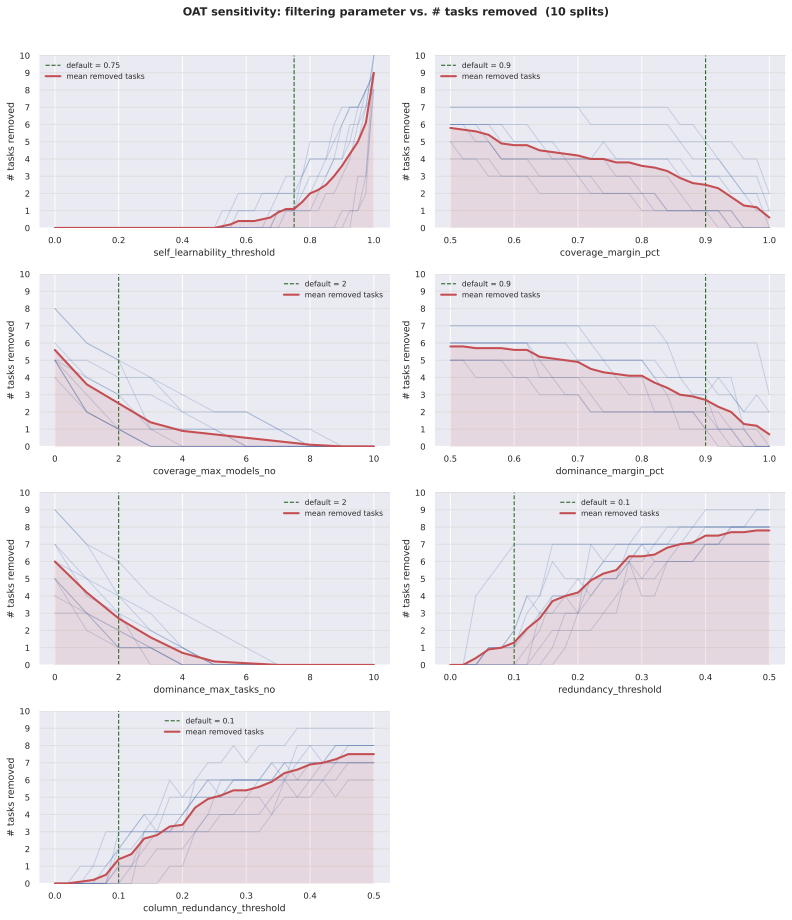
Re-run the framework's task-selection stage with a different construction-stage detector pool — for example, swapping the autoencoder/one-class-SVM/isolation-forest trio for VAE or Deep SVDD — and compare which candidate tasks survive the five filtering criteria and how the six consensus orderings change. If the retained task sets or final orderings differ materially across pools, the delivered scenarios are artifacts of the three chosen experts; if they coincide, the transfer structure is intrinsic to the data and the framework's claim holds. The paper's sensitivity analysis varies filtering
Extended reading notes
Core claim
The central claim is that task sequences for continual anomaly detection should be constructed and empirically validated, not inherited from metadata or arbitrary splits. A cross-task matrix, built by training single-task experts on each candidate task and testing on all others, exposes learnability and transfer structure; five filtering criteria (self-learnability, limited incoming/outgoing transfer, redundancy checks) iteratively remove unlearnable, trivial, or duplicative tasks. Six ordering families then arrange survivors by drift, curriculum, and generalization; a cross-model agreement statistic plus rank voting select a consensus scenario; and validation on three cybersecurity datasets
Load-bearing premise
The load-bearing premise is that the cross-task transfer structure measured with only three construction-stage detectors (an autoencoder, a one-class SVM variant, and an isolation forest) faithfully represents how other detectors — including the deep models used for validation — would experience the same tasks, so that task filtering and ordering decisions made from that matrix transfer to models never seen during construction.
Editorial extensions
If this is right
- Any tabular anomaly-detection dataset can be run through the pipeline to produce a CAD scenario whose task set carries documented evidence of learnability, non-redundancy, and non-triviality, making benchmark claims auditable rather than dependent on arbitrary splits.
- The six ordering families decouple 'which tasks' from 'in which order': the same validated task set supports studies of gradual drift, abrupt regime shifts, curriculum effects, and transfer-based sequencing, so conclusions are less likely to depend on one favorable sequence.
- Because task splits, train-test splits, and orderings are released as artifacts, future CAD methods can be compared on identical task sequences, giving the field a shared testbed for continual anomaly detection.
- The analysis showing that Cumulative (retraining on all past data) can underperform Replay on imbalanced scenarios implies that full data access is not automatically an upper bound in CAD evaluation; scenario-level task-size imbalance must be characterized and reported for baselines to be interpretable.
Reading between the lines
- The framework implicitly assumes that the transfer structure measured by the construction-stage detector pool is representative of other detectors; a direct extension would re-run task selection with a different pool (e.g., swapping in the validation-stage models) and measure how much of the retained task sets and consensus orderings survive — a stability check the paper does not report.
- The transfer matrix records only pairwise, single-expert transfer; an extension would test sequential transfer effects — whether learning task i then task k changes performance on task j differently than learning either alone — to verify that pairwise structure fully determines what a continual learner experiences.
- The pipeline is domain-agnostic for tabular data, so the same recipe could build validated continual scenarios from other static tabular domains such as fraud detection, medical monitoring, or predictive maintenance, a direction the authors list as future work.
Editorial analysis
A structured set of objections, weighed in public.
Referee Report
Summary. The paper introduces a seven-stage framework for turning tabular anomaly-detection datasets into continual-anomaly-detection (CAD) benchmark scenarios: candidate task discovery (natural splits, clustering, multi-dataset), single-task-expert cross-task evaluation, iterative filtering via five criteria (FC1–FC5), six principled task-ordering families, scenario selection via Kendall's W and Borda consensus, and a validation protocol comparing Naive, Replay, Cumulative, and MSTE references. The authors release five scenarios from CICIDS2017, CICIDS2018, and CIC-UNSW-NB15, along with task splits, orderings, statistics, and validation results. The central claim is that these scenarios are feasible, non-trivial, and capable of exposing measurable forgetting.
Significance. If the framework is reproducible and the released scenarios are stable, this is a useful contribution: tabular CAD currently lacks validated task boundaries and reusable scenario assets. The paper is strong in transparency—it includes detailed appendices with per-task statistics, STE transfer matrices, filtering traces, sensitivity analyses, execution times, and public code/benchmark artifacts. Using construction-stage models distinct from validation-stage models is a sensible design choice. However, the central validation claims are qualitative, and the formal specification contains an apparent inconsistency that prevents reproduction from the text alone.
major comments (3)
- [§3.2, Eq. (1); Appendix D, Table 7; Appendix J, Table 29] FC1 as written is unsatisfiable for ROC-AUC. Equation (1) requires M^f_{k,k} − b_k > γ_l, with b_k = 0.5 for ROC-AUC (Appendix A) and γ_l = 0.75 (Table 7). Since ROC-AUC ≤ 1, no task can ever pass. Yet Appendix J reports tasks removed by FC1 rather than all tasks being removed, and Figures 4–6 show a moderate filtering curve whose x-axis includes γ_l values up to 1. This means the published equation cannot be the rule actually executed. Please state the operative criterion explicitly—e.g., a normalized margin M > b + γ(1−b), or M > γ with b redefined—and align Eq. (1), Appendix C, Appendix D, and the Appendix J filtering tables. Without this, the formal pipeline is not self-consistent and the five scenarios cannot be reproduced from the manuscript alone.
- [§3.2–§3.4; §4.2; Appendix B.5] The entire scenario-selection pipeline—FC1–FC5, the six orderings, and the Kendall-W/Borda selection—is computed from cross-task matrices M^f produced only by Autoencoder, AE1SVM, and Isolation Forest. The validation stage then uses VAE, Deep SVDD, DAGMM, and NeutralAD, but only after the scenario has been fixed. This mitigates the risk that validation simply reflects the construction detectors, but it does not test the more load-bearing claim: that the retained task sets and orderings are structural properties of the datasets rather than artifacts of the three-model construction pool. I request a stability analysis: rerun or approximate the pipeline with alternative construction-model pools (e.g., replacing or augmenting the pool with VAE/Deep SVDD) and report overlap in retained tasks and final orderings, or at least report per-model ordering concordance values to show the selection is
- [§3.5 vs. §4.3] Section 3.5 explicitly states that the framework does not define universal pass/fail thresholds and that users should justify scenario acceptance. Yet Section 4.3 interprets the validation results using an implicit threshold: 'a meaningful ROC-AUC (≥0.8)' for feasibility, 'substantially below' for non-triviality, and 'large FM' for forgetting. These qualitative criteria are then used to support the abstract's claim that the scenarios are 'validated.' Please either operationalize the three criteria with explicit, pre-registered decision rules, or consistently label the validation as descriptive evidence rather than formal acceptance. As written, the central validation claim is underspecified and risks being circular with the filtering criteria.
minor comments (5)
- [Appendix A / §3.2] Notation is inconsistent: Table 3 lists Pc/Pd and O^f_k, while Eqs. (2)–(3) use Pt/Pd and D^f_k. Also, the notation table defines S⋆_k but Eq. (3) uses S⋆_i without restating the definition.
- [Appendix C, Figures 4–6] The x-axis for the self-learnability threshold is labeled 0.0–1.0, which is natural if γ_l is an absolute ROC-AUC threshold but not if it is a gain above b_k=0.5. This visual inconsistency should be resolved together with the FC1 fix.
- [Appendix J, Tables 29–33] The filtering tables use raw task IDs (e.g., t0…t9) that are remapped to final IDs only in later tables. For CICUNSW and MCAD-CIC-3xN the mapping is not always obvious from the text; please include an explicit concordance table for each dataset.
- [Appendix H, captions] Several figure captions say 'CICUNSW' instead of 'CAD-CICUNSW', and Figure 13/14 captions say 'CAD-CIC-3xN' while the scenario is elsewhere called 'MCAD-CIC-3xN'. Please standardize naming.
- [Appendix C.1, Table 4] The row labeled 'MCAD-CIC-1xN' appears to be a typo; the scenario is MCAD-CIC-3x1 throughout the rest of the paper. Please correct.
Circularity Check
Partial selection-validation circularity: the validation's feasibility and non-triviality restate the FC1–FC3 selection constraints; the separate FC1 threshold inconsistency is a correctness issue.
-
fitted input called prediction
[Section 3.2 (Eqs. 1–3) vs Section 3.5 and Section 4.3]
"FC1. Self-learnability—retaining only tasks that are individually learnable. A candidate task k is retained only if it is sufficiently learnable in isolation by at least one model f: ∃f∈F M^f_{k,k} − b_k > γ_l (1) ... Feasibility: A scenario should be learnable by at least one strong reference strategy, such as MSTE or Cumulative... Non-triviality: A valid continual scenario should not be solved by Naive sequential training alone."
The retained task set is defined by FC1–FC3: FC1 keeps only tasks with a high single-task-expert self-performance, and FC2–FC3 cap how many tasks can be solved from a given task (outgoing) and how many other STEs solve a given task (incoming). The validation criteria measure the same constructs: feasibility is confirmed with MSTE, an oracle pool of single-task experts, and non-triviality is assessed by Naive sequential training, whose success on later tasks is exactly cross-task transfer, which FC2/FC3 were designed to limit. Since the construction and validation models are disjoint, this is not an identity, but the headline “validation shows retained scenarios are feasible and non-trivial” is substantially a restatement of the filtering constraints rather than an independent discovery.
full rationale
The core circularity is partial: scenario selection through FC1–FC3 and the later feasibility/non-triviality validation measure the same underlying quantities, namely single-task learnability and cross-task transfer. The paper mitigates this by using a disjoint validation model pool (VAE, Deep SVDD, DAGMM, NeutralAD vs Autoencoder, AE1SVM, IsolationForest), and the released splits/orderings are concrete, reusable artifacts, so the central benchmark contribution is not purely tautological. No load-bearing self-citation appears: the Faber et al. references are contextual (CAD motivation and curriculum ordering) and no uniqueness theorem or ansatz is imported from the authors’ prior work. A separate, non-circular but serious flaw is the formal statement of FC1: with ROC-AUC, b_k=0.5, and γ_l=0.75 (Appendices A and D, Table 7), Eq. (1) requires M^f_{k,k}>1.25, which is impossible, so the published equation cannot be the actually executed filter. This breaks the derivational chain and needs correction (e.g., a normalized margin), but it is a reproducibility/correctness issue rather than a circular definition of the output.
Assumptions & free parameters
free parameters (10)
- FC1 self-learnability threshold gamma_l =
0.75
- FC2 retained-performance threshold gamma_t =
0.90
- FC2 max covering tasks P_t =
2
- FC3 dominance threshold gamma_d =
0.90
- FC3 max dominated tasks P_d =
2
- FC4/FC5 redundancy threshold delta_r =
0.10
- Clustering K =
10
- Minimum cluster sample sizes =
normal=1500, anomalous=1000
- Minimum tasks per candidate split =
5/5/3/3/5
- Replay buffer size =
25,000
assumptions (6)
- domain assumption STE transfer-matrix representativeness: learnability/transfer measured with AE, AE1SVM, and Isolation Forest generalizes to other anomaly detectors.
- ad hoc to paper Clustering with fixed K=10 surfaces materially distinct learning conditions.
- domain assumption ROC-AUC alone is a sufficient learnability/transfer signal during construction.
- domain assumption Anomaly labels in CICIDS2017, CICIDS2018, and CIC-UNSW-NB15 are reliable enough to define task learnability.
- standard math Kendall's W and Borda count are valid aggregation procedures for orderings across models.
- domain assumption Feasibility, non-triviality, and forgetting can be asserted without pass/fail thresholds or statistical tests.
Cite this review
Pith. "Pith review of Towards Principled Continual Anomaly Detection: A Systematic Framework and Benchmark Scenarios." pith.science (2026). https://pith.science/paper/GYD7AJGU
@misc{pith2026260718289,
  author       = {Pith},
  title        = {Pith review of: Towards Principled Continual Anomaly Detection: A Systematic Framework and Benchmark Scenarios},
  year         = {2026},
  howpublished = {\url{https://pith.science/paper/GYD7AJGU}},
  note         = {Machine review of arXiv:2607.18289}
}
read the original abstract
Continual anomaly detection (CAD) studies how models can adapt to evolving data distributions while retaining performance on previously observed regimes. CAD benchmarks, however, depend critically on how tasks are defined, filtered, ordered, and validated. In tabular domains, task boundaries are rarely given, and arbitrary splits can create unlearnable, redundant, or overly transferable tasks that obscure genuine continual-learning behavior. To this end, we introduce a systematic framework for reproducible benchmark scenario design from existing tabular anomaly-detection datasets. The framework discovers candidate tasks, filters unsuitable tasks, and derives principled orderings that expose diverse dynamics. The framework allows us to deliver five benchmark-ready scenarios from three large-scale cybersecurity anomaly detection datasets, yielding both single-dataset and multi-dataset CAD settings.
Figures


Figures from the paper (20 more)



Reference graph
Works this paper leans on
-
[1]
Advances in Neural Information Processing Systems , note =
Han, Songqiao and Hu, Xiyang and Huang, Hailiang and Jiang, Minqi and Zhao, Yue , title =. Advances in Neural Information Processing Systems , note =. 2022 , url =
2022
-
[2]
Advances in Neural Information Processing Systems , note =
Dragoi, Marius and Burceanu, Elena and Haller, Emanuela and Manolache, Andrei and Brad, Florin , title =. Advances in Neural Information Processing Systems , note =. 2022 , url =
2022
-
[3]
IEEE transactions on pattern analysis and machine intelligence , volume=
A comprehensive survey of continual learning: Theory, method and application , author=. IEEE transactions on pattern analysis and machine intelligence , volume=. 2024 , publisher=
2024
-
[4]
ACM computing surveys (CSUR) , volume=
Deep learning for anomaly detection: A review , author=. ACM computing surveys (CSUR) , volume=. 2021 , publisher=
2021
-
[5]
arXiv preprint arXiv:2412.00911 , year=
SOUL: A semi-supervised open-world continual learning method for network intrusion detection , author=. arXiv preprint arXiv:2412.00911 , year=
-
[6]
and Finn, Chelsea , title =
Yao, Huaxiu and Choi, Caroline and Cao, Bochuan and Lee, Yoonho and Koh, Pang Wei W. and Finn, Chelsea , title =. Advances in Neural Information Processing Systems , note =. 2022 , url =
2022
-
[7]
Proceedings of the Neural Information Processing Systems Track on Datasets and Benchmarks , year =
Lin, Zhiqiu and Shi, Jia and Pathak, Deepak and Ramanan, Deva , title =. Proceedings of the Neural Information Processing Systems Track on Datasets and Benchmarks , year =
-
[8]
Proceedings of the Neural Information Processing Systems Track on Datasets and Benchmarks , year =
Lai, Kwei-Herng and Zha, Daochen and Xu, Junjie and Zhao, Yue and Wang, Guanchu and Hu, Xia , title =. Proceedings of the Neural Information Processing Systems Track on Datasets and Benchmarks , year =
Show all 40 references
-
[9]
Advances in Neural Information Processing Systems , note =
Liu, Qinghua and Paparrizos, John , title =. Advances in Neural Information Processing Systems , note =. 2024 , url =
2024
-
[10]
Advances in Neural Information Processing Systems , note =
Arodi, Akshatha and Luck, Margaux and Bedwani, Jean-Luc and Zaimi, Aldo and Li, Ge and Pouliot, Nicolas and Beaudry, Julien and Caron, Gaetan Marceau , title =. Advances in Neural Information Processing Systems , note =. 2024 , url =
2024
-
[11]
, title =
Nikolov, Ivan and Philipsen, Mark Philip and Liu, Jinsong and Dueholm, Jacob Velling and Johansen, Anders Skaarup and Nasrollahi, Kamal and Moeslund, Thomas B. , title =. Proceedings of the Neural Information Processing Systems Track on Datasets and Benchmarks , year =
-
[12]
IEEE Access , volume =
Lifelong continual learning for anomaly detection: New challenges, perspectives, and insights , author =. IEEE Access , volume =. 2024 , publisher =
2024
-
[13]
Neural Networks , volume =
VLAD: Task-agnostic VAE-based lifelong anomaly detection , author =. Neural Networks , volume =. 2023 , publisher =
2023
-
[14]
Proceedings of the AAAI conference on artificial intelligence , volume =
Unsupervised continual anomaly detection with contrastively-learned prompt , author =. Proceedings of the AAAI conference on artificial intelligence , volume =
-
[15]
IEEE Transactions on Industrial Informatics , year =
A Task-Aware Parameter Decoupling Framework for Continual Anomaly Detection , author =. IEEE Transactions on Industrial Informatics , year =
-
[16]
Proceedings of the 30th ACM International Conference on Multimedia , pages =
Towards continual adaptation in industrial anomaly detection , author =. Proceedings of the 30th ACM International Conference on Multimedia , pages =
-
[17]
Proceedings of the IEEE/CVF Conference on Computer Vision and Pattern Recognition , pages =
Unveiling the anomalies in an ever-changing world: A benchmark for pixel-level anomaly detection in continual learning , author =. Proceedings of the IEEE/CVF Conference on Computer Vision and Pattern Recognition , pages =
-
[18]
Neural networks , volume=
Continual lifelong learning with neural networks: A review , author=. Neural networks , volume=. 2019 , publisher=
2019
-
[19]
arXiv preprint arXiv:2505.06603 , year=
ReplayCAD: Generative Diffusion Replay for Continual Anomaly Detection , author=. arXiv preprint arXiv:2505.06603 , year=
-
[20]
arXiv preprint arXiv:2506.00956 , year=
Continual-MEGA: A Large-scale Benchmark for Generalizable Continual Anomaly Detection , author=. arXiv preprint arXiv:2506.00956 , year=
-
[21]
Augmented Memory Replay-based Continual Learning Approaches for Network Intrusion Detection , url =
Amalapuram, Suresh Kumar and Channappayya, Sumohana and Tamma, Bheemarjuna Reddy , booktitle =. Augmented Memory Replay-based Continual Learning Approaches for Network Intrusion Detection , url =
-
[22]
IEEE INFOCOM 2024-IEEE Conference on Computer Communications , pages=
Spider: A semi-supervised continual learning-based network intrusion detection system , author=. IEEE INFOCOM 2024-IEEE Conference on Computer Communications , pages=. 2024 , organization=
2024
-
[23]
2023 IEEE European Symposium on Security and Privacy Workshops (EuroS&PW) , pages =
Fake it till you detect it: Continual anomaly detection in multivariate time-series using generative AI , author =. 2023 IEEE European Symposium on Security and Privacy Workshops (EuroS&PW) , pages =. 2023 , organization =
2023
-
[24]
2024 9th International Conference on Intelligent Computing and Signal Processing (ICSP) , pages =
Continual Adaptation for Unsupervised Time Series Anomaly Detection , author =. 2024 9th International Conference on Intelligent Computing and Signal Processing (ICSP) , pages =. 2024 , organization =
2024
-
[25]
SoftwareX , volume =
pyCLAD: The universal framework for continual lifelong anomaly detection , author =. SoftwareX , volume =. 2025 , publisher =
2025
-
[26]
Machine Learning and Knowledge Extraction , volume=
Continual semi-supervised malware detection , author=. Machine Learning and Knowledge Extraction , volume=. 2024 , publisher=
2024
-
[27]
ICLR , year=
Continual evaluation for lifelong learning: Identifying the stability gap , author=. ICLR , year=
-
[28]
TMLR , year=
Overcoming the stability gap in continual learning , author=. TMLR , year=
-
[29]
Applied Sciences , volume=
Review of anomaly detection algorithms for data streams , author=. Applied Sciences , volume=. 2023 , publisher=
2023
-
[30]
Neural Networks , volume=
A domain-agnostic approach for characterization of lifelong learning systems , author=. Neural Networks , volume=. 2023 , publisher=
2023
-
[31]
Transactions on Machine Learning Research , year=
Continual learning: Applications and the road forward , author=. Transactions on Machine Learning Research , year=
-
[32]
Machine Learning , volume=
From MNIST to ImageNet and back: benchmarking continual curriculum learning , author=. Machine Learning , volume=. 2024 , publisher=
2024
-
[33]
Applied Soft Computing , volume=
Online ensemble learning with abstaining classifiers for drifting and noisy data streams , author=. Applied Soft Computing , volume=. 2018 , publisher=
2018
-
[34]
Proceedings of the AAAI Conference on Artificial Intelligence , volume=
Borda count in collective decision making: A summary of recent results , author=. Proceedings of the AAAI Conference on Artificial Intelligence , volume=
-
[35]
Biometrika , volume=
A new measure of rank correlation , author=. Biometrika , volume=. 1938 , publisher=
1938
-
[36]
Proceedings of the 4th International Conference on Information Systems Security and Privacy , year=
Toward Generating a New Intrusion Detection Dataset and Intrusion Traffic Characterization , author=. Proceedings of the 4th International Conference on Information Systems Security and Privacy , year=
-
[37]
UNSW-NB15: A Comprehensive Data Set for Network Intrusion Detection Systems (
Moustafa, Nour and Slay, Jill , booktitle=. UNSW-NB15: A Comprehensive Data Set for Network Intrusion Detection Systems (
-
[38]
Public program analysis: A new categorical data approach , pages=
Rank correlation methods , author=. Public program analysis: A new categorical data approach , pages=. 1981 , publisher=
1981
-
[39]
Encyclopedia of statistics in behavioral science , year=
K endall's Coefficient of Concordance , author=. Encyclopedia of statistics in behavioral science , year=
-
[40]
2024 21st Annual international conference on privacy, security and trust (PST) , pages=
Poisoning and evasion: Deep learning-based nids under adversarial attacks , author=. 2024 21st Annual international conference on privacy, security and trust (PST) , pages=. 2024 , organization=
2024
Reviewed August 2, 2026 · model on record in the stance chip above.
Discussion (0). Sign in to comment.