REVIEW 3 major objections 5 minor 65 references
The paper argues that NLO unitarity, perturbativity, and the latest data leave no room for a metastable electroweak vacuum in the Type-II two-Higgs-doublet model.
Reviewed by Pith at T0; open to challenge. T0 means a machine referee read the full paper against a public rubric. the ladder, T0–T4 →
T0 review · deepseek-v4-flash
2026-08-01 15:35 UTC pith:HCKZ7PA4
load-bearing objection Probably right on the tree-level no-go; the one-loop exclusion is only proven for neutral vacua, so the abstract oversells it, but this is a useful, honest paper that deserves reviewing. the 3 major comments →
Fate of Metastable Vacua in the Type-II Two-Higgs Doublet Model
The pith
A machine-rendered reading of the paper's core claim, the machinery that carries it, and where it could break.
Core claim
On its own terms, the paper establishes that a metastable electroweak vacuum in the Type-II 2HDM is excluded (or confined to a tiny 99.7% probability sliver) once NLO unitarity, the perturbativity criterion R′1<1, and the latest Higgs and flavor data are imposed. In every viable benchmark point sampled, the physical EW vacuum is the global minimum at tree level, and the ℏ-expansion comparison of one-loop depths keeps it the global minimum at one-loop level as well.
What carries the argument
The multiple-extrema condition M̂0>0, expressed as m²_H± − Λ0 v² < 0 or equivalently m²₁₂ + (Λ1−Λ0) v₁v₂ < 0, is the criterion that a deeper neutral minimum can coexist; it links metastability to a light charged Higgs and to positive m²₁₂. The paper combines this with NLO unitarity bounds on the quartic couplings, the perturbativity criterion R′1<1, and a Bayesian fit to data, then uses the ℏ-expansion method to compare one-loop vacuum depths in a gauge-invariant way.
Load-bearing premise
The paper assumes that loop corrections cannot generate a deeper charge-breaking or CP-breaking minimum than the physical electroweak vacuum, because it compares depths only at neutral, CP-conserving extrema — a possibility it leaves for future work.
What would settle it
Perform a direct numerical minimization of the one-loop effective potential, including charge-breaking and CP-breaking field directions, at the parameter points in the tiny 99.7%-probability overlap region that satisfies all constraints; finding a deeper stationary point than the electroweak vacuum would falsify the paper's conclusion.
If this is right
- A metastable electroweak vacuum in the Type-II 2HDM is not a viable explanation under current constraints; the observed vacuum should be treated as the global minimum.
- The charged-Higgs mass lower bound from B→X_sγ, combined with the multiple-extrema condition, is what closes the metastable window; future flavor measurements that tighten this bound reinforce the conclusion.
- NLO unitarity and perturbativity are decisive: tree-level-only analyses that found metastable vacua are not contradicted but superseded by the stronger theoretical constraints.
- The Z₂-symmetric limit m²₁₂=0 is excluded by the fit, supporting a softly-broken Z₂ symmetry in the Type-II scalar sector.
Where Pith is reading between the lines
- A direct minimization of the one-loop effective potential including charge-breaking and CP-breaking field directions, carried out at the surviving benchmark points, would test the one part of the vacuum structure the paper deliberately sets aside.
- Because the exclusion depends on the chosen m²₁₂ prior of [-0.2, 0.8] TeV², repeating the fit with a wider, more negative range would show whether the conclusion is robust or prior-driven.
- The same constraint stack applied to the Type-I, Type-X, or Type-Y 2HDMs would likely give different outcomes, since the flavor observables that close the metastable window in Type-II are not equally restrictive there.
Editorial analysis
A structured set of objections, weighed in public.
Referee Report
Summary. This paper investigates whether the physical electroweak (EW) vacuum of the Type-II 2HDM can be metastable. Using the gauge-invariant bilinear formalism, the authors characterize the necessary condition for multiple extrema (M̂0 > 0) and translate it into constraints on m_{12}^2 and m_{H±}. They combine LO and NLO perturbative unitarity, the perturbativity criterion R'_1 < 1, bounded-from-below conditions, and a Bayesian global fit to Higgs signal strengths, B(\bar{B}→X_sγ), B_s mixing, and S,T,U. They find that, after NLO unitarity, the 95.4% credible region admitting multiple extrema and satisfying Higgs data does not overlap with the flavor-allowed region; only a tiny 99.7% overlap remains. For about 10^5 sampled points in this overlap, the physical EW vacuum is found to be the global minimum at tree level and in the ℏ-expanded one-loop potential. Imposing R'_1 < 1 removes the overlap. The paper concludes that metastable EW vacua in the Type-II 2HDM are excluded at both tree and one-loop levels.
Significance. If the conclusion holds, this is a significant sharpening of earlier tree-level vacuum-stability studies. The main strengths are the use of the established bilinear formalism for the tree-level analysis, the gauge-invariant ℏ-expansion method for one-loop depths, the simultaneous inclusion of NLO unitarity, perturbativity and current experimental likelihoods, and the explicit separation of the perturbativity criterion from the rigorous unitarity bound. The tree-level exclusion is on solid ground. However, the one-loop global-minimum claim is narrower than advertised: it is established only for neutral, CP-conserving tree-level extrema, and the possibility of loop-generated charge-breaking or CP-breaking minima is not searched. The paper's abstract and Sec. VII state the one-loop claim without this qualification, which is a load-bearing overstatement. The conclusion also depends on a finite prior range for m_{12}^2 and on Bayesian credible-region non-overlap being interpreted as exclusion.
major comments (3)
- [Sec. V, Eq. (21); abstract; Sec. VII] The one-loop comparison is performed only at neutral, CP-conserving tree-level extrema using the ℏ expansion. Eq. (21) computes V^(0)(φ_vac^(0)) + ℏ V^(1)(φ_vac^(0)); by construction this cannot detect a minimum that exists only in the one-loop effective potential. The authors acknowledge in Sec. V and footnote 4 that CB/CP-breaking loop-generated minima are left for future work, and they cite Ref. [25], which showed such minima can be deeper than the EW vacuum. Therefore the abstract's unqualified statement that metastable vacua are 'excluded at both the tree and one-loop levels' and the Sec. VII sentence that the EW vacuum 'remains the global minimum ... at one-loop level' are stronger than what is computed. The tree-level exclusion is sound, and the neutral one-loop comparison is valid, but the one-loop global exclusion requires either direct minimization of the full one-loop effectiv
- [Sec. VI, Eq. (22); Figs. 3–5] The prior for m_{12}^2 is restricted to [-0.2, 0.8] TeV^2. The multiple-extrema condition, Eq. (18), and the derived bounds on m_{H±} depend on m_{12}^2, and Fig. 3 even shows m_{12}^2 < 0 points re-entering after the M̂0 > 0 condition is imposed. A hard truncation at -0.2 TeV^2 is not itself an experimental constraint and can remove potentially metastable regions before the likelihood is evaluated. The central conclusion 'throughout the parameter space allowed by current data' therefore rests in part on this prior choice. The authors should test robustness by extending the lower bound (for example to -1 TeV^2 or wider) and showing that the posterior-overlap and exclusion conclusions are stable.
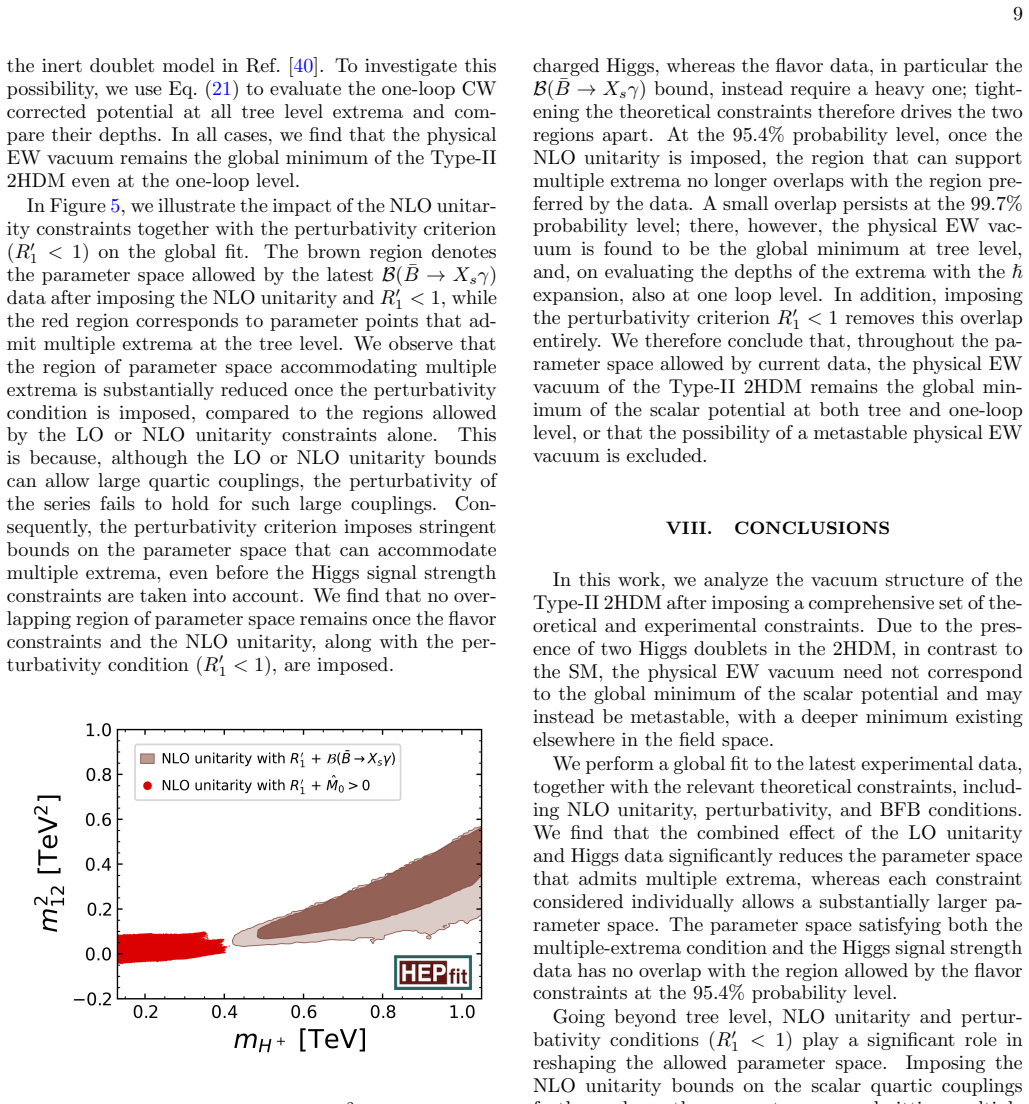
- [Sec. VII; Figs. 3–5] The word 'excluded' is used for non-overlap of 95.4% Bayesian credible regions. Non-overlap of credible intervals is not a rigorous exclusion, and the authors themselves find a 99.7% overlap in Fig. 4. The stronger claim that this overlap is eliminated relies on the R'_1 < 1 perturbativity criterion, which Sec. IV correctly describes as convention-dependent. The robust conclusion is that metastable EW vacua are strongly disfavored at 95.4%, and only excluded under an additional, less rigorous perturbativity criterion. This should be reflected in the abstract and conclusions.
minor comments (5)
- [Sec. VII, first paragraph] Typo: 'arsing' should be 'arising'.
- [Sec. V, footnote 4] The statement that loop-generated CB minima are 'numerically rare' would benefit from a quantitative citation or a rough rate from Ref. [25], since the rarity is otherwise anecdotal.
- [Sec. VII, paragraph on Fig. 2] The statement that the Z2-symmetric limit m_{12}^2 = 0 'is excluded' by Higgs signal strengths should be nuanced: at m_{12}^2 = 0 the tree-level neutral minima are exactly degenerate, and loop corrections can lift the degeneracy, so the exclusion refers to the sampled tree-level analysis rather than to the exact symmetry point in general.
- [Sec. V, renormalization scale] The choice μ = v is motivated, but since the one-loop potential is only computed to finite order, a brief numerical check of residual scale dependence of the depth differences would strengthen the claim.
- [Figures 3–5] The dark/light shading conventions are described in the text but are hard to follow in the captions; adding explicit legend entries would improve readability.
Circularity Check
No significant circularity: the exclusion is a post-fit scan under independent theoretical and experimental constraints; the one-loop caveat is an acknowledged scope limit, not a circular step.
full rationale
The paper's central claim is that, after imposing LO/NLO unitarity, perturbativity, BFB, and the latest Higgs, flavor, and EW precision data, no Type-II 2HDM point with a metastable physical EW vacuum survives. This is a derived intersection of constraints, not a parameter fitted to the target: the vacuum-stability property (global-minimum depth ordering) is not part of the likelihood and is checked afterwards using Eq. (21). The multiple-extrema condition (Eqs. 17-18) is a necessary condition from the tree-level potential, and the upper bound on m2_12 follows from unitarity/perturbativity bounds on quartics plus Eq. (18), while the lower bound from B→Xsγ is an independent experimental constraint; neither is constructed to force the conclusion. Self-citations [16], [38], [60] provide published RGE, NLO-unitarity, and Higgs-signal-strength inputs from external data/calculations; they are not used as an unverified uniqueness argument. The acknowledged restriction to neutral, CP-conserving vacua and tree-level extrema (Sec. V and footnote 4; Eq. 21 evaluates only at tree-level extrema) is an incompleteness/overstatement concern about the one-loop claim, not a reduction of the result to its inputs. Therefore no circular step is exhibited.
Axiom & Free-Parameter Ledger
free parameters (5)
- m²₁₂ prior range =
[-0.2, 0.8] TeV²
- Perturbativity threshold R'_1 < 1 =
< 1
- Renormalization scale µ = v for the one-loop vacuum analysis =
246.22 GeV
- Scale for NLO unitarity / BFB / perturbativity constraints =
1 TeV
- Priors on tanβ and heavy scalar masses =
tanβ ∈ [10^-0.3, 10^1.7]; m_H², m_A², m_H±² ∈ [(0.13 TeV)², (1.1 TeV)²]
axioms (5)
- domain assumption Tree-level theorem: if an EW-breaking minimum exists, any CB or CP-breaking extremum is a saddle lying above it (Refs. [17, 18, 24]).
- domain assumption The ℏ-expansion method (Refs. [44-48]) yields gauge-invariant one-loop depths at extrema order by order.
- domain assumption NLO unitarity conditions of Refs. [37, 38] correctly bound the two-to-two scalar partial-wave amplitudes at one loop.
- domain assumption The selected experimental likelihoods (Higgs signal strengths from Ref. [60], B→Xsγ and Δm_Bs from HFLAV, S,T,U from HEPfit) are the relevant constraints for this question.
- domain assumption Light fermion contributions to the one-loop effective potential are negligible.
read the original abstract
The scalar potential of the Two-Higgs-Doublet Model (2HDM) can admit multiple non-degenerate vacua due to the presence of the two Higgs doublets unlike the Standard Model (SM). For a physically viable parameter point, one of these vacua must correspond to the physical electroweak (EW) symmetry breaking vacuum with the vacuum expectation value of about $246$ GeV. Given the complex structure of the scalar potential, the physical EW vacuum may be metastable in nature rather than the global minimum of the potential. In this work, we delineate regions of the parameter space in the Type-II 2HDM accommodating multiple extrema of the scalar potential and analyze, in a gauge-independent manner, the stability of the EW vacuum there at the tree level and beyond. A Bayesian global fit of the Type-II 2HDM, including next-to-leading-order unitarity constraints and the latest experimental measurements, indicates that parameter space regions leading to metastable EW vacua are excluded at both the tree and one-loop levels.
Figures



Reference graph
Works this paper leans on
-
[1]
G. Aadet al.(ATLAS), Phys. Lett. B716, 1 (2012), arXiv:1207.7214 [hep-ex]
Pith/arXiv arXiv 2012
-
[2]
We review these LO and NLO pertur- 5 bative unitarity constraints in the following section. IV. NEXT-TO-LEADING-ORDER PER TURBA TIVE UNIT ARITY Requiring theS-matrix to be unitary bounds the quar- tic couplings through the amplitudes for all 2→2 scat- terings among the scalar and would-be-Goldstone compo- nents of the two Higgs doublets. By the optical th...
-
[3]
Dark (light) yellow/grey shaded area corresponds to 95.4% (99.7%) probability
The yellow region in the parameter space is allowed by theB( ¯B→X sγ) data. Dark (light) yellow/grey shaded area corresponds to 95.4% (99.7%) probability. (|λi|<4π). Imposing the Higgs signal strength data substantially reduces this region to the grey area. This is because the LO unitarity condition rules out large scalar quartic couplings in the regime w...
arXiv 2021
-
[4]
S. Alekhin, A. Djouadi, and S. Moch, Phys. Lett. B716, 214 (2012), arXiv:1207.0980 [hep-ph]
Pith/arXiv arXiv 2012
-
[5]
S. Chatrchyanet al.(CMS), Phys. Lett. B716, 30 (2012), arXiv:1207.7235 [hep-ex]
Pith/arXiv arXiv 2012
-
[6]
G. Degrassi, S. Di Vita, J. Elias-Miro, J. R. Espinosa, G. F. Giudice, G. Isidori, and A. Strumia, JHEP08, 098, arXiv:1205.6497 [hep-ph]
- [7]
-
[8]
D. Buttazzo, G. Degrassi, P. P. Giardino, G. F. Giu- dice, F. Sala, A. Salvio, and A. Strumia, JHEP12, 089, arXiv:1307.3536 [hep-ph]
-
[9]
A. Andreassen, W. Frost, and M. D. Schwartz, Phys. Rev. D97, 056006 (2018), arXiv:1707.08124 [hep-ph]
Pith/arXiv arXiv 2018
-
[10]
V. Branchina, E. Messina, and M. Sher, Phys. Rev. D 91, 013003 (2015), arXiv:1408.5302 [hep-ph]
Pith/arXiv arXiv 2015
-
[11]
F. Bezrukov, M. Y. Kalmykov, B. A. Kniehl, and M. Sha- poshnikov, JHEP10, 140, arXiv:1205.2893 [hep-ph]
-
[12]
In par- ticular, NLO perturbative unitarity constraints are more restrictive, and as a result lead to stronger upper bounds onm H ± andm 2
-
[13]
V. Branchina and E. Messina, Phys. Rev. Lett.111, 241801 (2013), arXiv:1307.5193 [hep-ph]
Pith/arXiv arXiv 2013
-
[14]
T. D. Lee, Phys. Rev. D8, 1226 (1973)
1973
-
[15]
J. F. Gunion and H. E. Haber, Phys. Rev. D67, 075019 (2003), arXiv:hep-ph/0207010
Pith/arXiv arXiv 2003
-
[16]
G. C. Branco, P. M. Ferreira, L. Lavoura, M. N. Re- belo, M. Sher, and J. P. Silva, Phys. Rept.516, 1 (2012), arXiv:1106.0034 [hep-ph]
Pith/arXiv arXiv 2012
-
[17]
S. L. Glashow and S. Weinberg, Phys. Rev. D15, 1958 (1977)
1958
-
[18]
E. A. Paschos, Phys. Rev. D15, 1966 (1977)
1966
-
[19]
D. Chowdhury and O. Eberhardt, JHEP11, 052, arXiv:1503.08216 [hep-ph]
-
[20]
P. M. Ferreira, R. Santos, and A. Barroso, Phys. Lett. B603, 219 (2004), [Erratum: Phys.Lett.B 629, 114–114 (2005)], arXiv:hep-ph/0406231
Pith/arXiv arXiv 2004
-
[21]
A. Barroso, P. M. Ferreira, and R. Santos, Phys. Lett. B 632, 684 (2006), arXiv:hep-ph/0507224
Pith/arXiv arXiv 2006
-
[22]
M. Maniatis, A. von Manteuffel, O. Nachtmann, and F. Nagel, Eur. Phys. J. C48, 805 (2006), arXiv:hep- ph/0605184
arXiv 2006
-
[23]
C. C. Nishi, Phys. Rev. D74, 036003 (2006), [Erratum: Phys.Rev.D 76, 119901 (2007)], arXiv:hep-ph/0605153
Pith/arXiv arXiv 2006
-
[24]
I. P. Ivanov, Phys. Rev. D75, 035001 (2007), [Erratum: Phys.Rev.D 76, 039902 (2007)], arXiv:hep-ph/0609018
Pith/arXiv arXiv 2007
-
[25]
I. P. Ivanov, Phys. Rev. D77, 015017 (2008), arXiv:0710.3490 [hep-ph]
Pith/arXiv arXiv 2008
-
[26]
M. Maniatis, A. von Manteuffel, and O. Nachtmann, Eur. Phys. J. C57, 719 (2008), arXiv:0707.3344 [hep-ph]. 11
Pith/arXiv arXiv 2008
-
[27]
A. Barroso, P. M. Ferreira, I. P. Ivanov, and R. Santos, JHEP06, 045, arXiv:1303.5098 [hep-ph]
-
[28]
P. M. Ferreira, L. A. Morrison, and S. Profumo, JHEP 04, 125, arXiv:1910.08662 [hep-ph]
Pith/arXiv arXiv 1910
-
[29]
A. Barroso, P. M. Ferreira, and R. Santos, Phys. Lett. B 652, 181 (2007), arXiv:hep-ph/0702098
Pith/arXiv arXiv 2007
-
[30]
I. P. Ivanov and J. P. Silva, Physical Review D92, 10.1103/physrevd.92.055017 (2015)
-
[31]
A. Barroso, P. M. Ferreira, I. Ivanov, R. Santos, and J. P. Silva, J. Phys. Conf. Ser.447, 012051 (2013), arXiv:1305.1906 [hep-ph]
Pith/arXiv arXiv 2013
-
[32]
V. Branchina, F. Contino, and P. M. Ferreira, JHEP11, 107, arXiv:1807.10802 [hep-ph]
-
[33]
Passarino, Physics Letters B156, 231 (1985)
G. Passarino, Physics Letters B156, 231 (1985)
1985
-
[34]
Dawson and S
S. Dawson and S. Willenbrock, Phys. Rev. Lett.62, 1232 (1989)
1989
-
[35]
Dawson and S
S. Dawson and S. Willenbrock, Phys. Rev. D40, 2880 (1989)
1989
-
[36]
Passarino, Nuclear Physics B343, 31 (1990)
G. Passarino, Nuclear Physics B343, 31 (1990)
1990
-
[37]
Durand, J
L. Durand, J. M. Johnson, and J. L. Lopez, Phys. Rev. Lett.64, 1215 (1990)
1990
-
[38]
Lendvai, G
E. Lendvai, G. Pocsik, and T. Torma, Mod. Phys. Lett. A6, 1195 (1991)
1991
-
[39]
Durand, J
L. Durand, J. M. Johnson, and J. L. Lopez, Phys. Rev. D45, 3112 (1992)
1992
-
[40]
B. Grinstein, C. W. Murphy, and P. Uttayarat, JHEP 06, 070, arXiv:1512.04567 [hep-ph]
-
[41]
V. Cacchio, D. Chowdhury, O. Eberhardt, and C. W. Murphy, JHEP11, 026, arXiv:1609.01290 [hep-ph]
-
[42]
I. Chakraborty and A. Kundu, Phys. Rev. D92, 095023 (2015), arXiv:1508.00702 [hep-ph]
Pith/arXiv arXiv 2015
-
[43]
P. M. Ferreira and B. Swiezewska, JHEP04, 099, arXiv:1511.02879 [hep-ph]
-
[44]
P. Basler and M. M¨ uhlleitner, Comput. Phys. Commun. 237, 62 (2019), arXiv:1803.02846 [hep-ph]
Pith/arXiv arXiv 2019
-
[45]
W. G. Hollik, G. Weiglein, and J. Wittbrodt, JHEP03, 109, arXiv:1812.04644 [hep-ph]
-
[46]
P. Basler, L. Biermann, M. M¨ uhlleitner, J. M¨ uller, R. Santos, and J. Viana, Comput. Phys. Commun.316, 109766 (2025), arXiv:2404.19037 [hep-ph]
Pith/arXiv arXiv 2025
-
[47]
N. K. Nielsen, Nucl. Phys. B101, 173 (1975)
1975
-
[48]
Fukuda and T
R. Fukuda and T. Kugo, Phys. Rev. D13, 3469 (1976)
1976
-
[49]
H. H. Patel and M. J. Ramsey-Musolf, JHEP07, 029, arXiv:1101.4665 [hep-ph]
-
[50]
A. Andreassen, W. Frost, and M. D. Schwartz, Phys. Rev. D91, 016009 (2015), arXiv:1408.0287 [hep-ph]
Pith/arXiv arXiv 2015
- [51]
-
[52]
D. Balui, J. Chakrabortty, D. Dey, and S. Mohanty, Phys. Rev. D111, 085032 (2025), arXiv:2502.17156 [hep-th]
Pith/arXiv arXiv 2025
-
[53]
A. Barroso, P. M. Ferreira, I. P. Ivanov, R. Santos, and J. P. Silva, Eur. Phys. J. C73, 2537 (2013), arXiv:1211.6119 [hep-ph]
Pith/arXiv arXiv 2013
-
[54]
N. G. Deshpande and E. Ma, Phys. Rev. D18, 2574 (1978)
1978
-
[55]
I. F. Ginzburg and I. P. Ivanov, Phys. Rev. D72, 115010 (2005), arXiv:hep-ph/0508020
Pith/arXiv arXiv 2005
-
[56]
J. S. Lee and A. Pilaftsis, Phys. Rev. D86, 035004 (2012), arXiv:1201.4891 [hep-ph]
Pith/arXiv arXiv 2012
-
[57]
Q.-H. Cao, K. Cheng, and C. Xu, Phys. Rev. D107, 015016 (2023), arXiv:2201.02989 [hep-ph]
Pith/arXiv arXiv 2023
-
[58]
E. J. Eichten and K. Lane, Phys. Rev. D107, 075038 (2023), arXiv:2209.06632 [hep-ph]
Pith/arXiv arXiv 2023
-
[59]
J. De Blaset al., Eur. Phys. J. C80, 456 (2020), arXiv:1910.14012 [hep-ph]
Pith/arXiv arXiv 2020
-
[60]
A. Caldwell, D. Kollar, and K. Kroninger, Comput. Phys. Commun.180, 2197 (2009), arXiv:0808.2552 [physics.data-an]
Pith/arXiv arXiv 2009
-
[61]
G. Aadet al.(ATLAS, CMS), Phys. Rev. Lett.114, 191803 (2015), arXiv:1503.07589 [hep-ex]
Pith/arXiv arXiv 2015
-
[62]
H. E. Haber, inTheoretical Advanced Study Institute (TASI 92): From Black Holes and Strings to Particles (1993) pp. 589–686, arXiv:hep-ph/9306207
Pith/arXiv arXiv 1993
-
[63]
D. Chowdhury, P. Mondal, and S. Samanta, (2024), arXiv:2404.18996 [hep-ph]
Pith/arXiv arXiv 2024
-
[64]
Banerjeeet al.(Heavy Flavor Averaging Group (HFLA V)), Phys
S. Banerjeeet al.(Heavy Flavor Averaging Group (HFLA V)), Phys. Rev. D113, 012008 (2026), arXiv:2411.18639 [hep-ex]
Pith/arXiv arXiv 2026
-
[65]
J. de Blas, M. Ciuchini, E. Franco, S. Mishima, M. Pierini, L. Reina, and L. Silvestrini, PoSEPS- HEP2017, 467 (2017), arXiv:1710.05402 [hep-ph]
Pith/arXiv arXiv 2017
discussion (0)
Sign in with ORCID, Apple, or X to comment. Anyone can read and Pith papers without signing in.