REVIEW 4 major objections 5 minor 154 references
Multi-view face reconstruction becomes a learnable UV-space fusion problem, and the learned fusion beats the heuristic it replaces.
Reviewed by Pith at T0; open to challenge. T0 means a machine referee read the full paper against a public rubric. the ladder, T0–T4 →
T0 review · deepseek-v4-flash
2026-08-01 14:15 UTC pith:5MCEPQA2
load-bearing objection A clean UV-space neural fusion system for fixed-topology face reconstruction, but the headline SOTA claim is riding on Chamfer gaps smaller than one fifth of the per-subject standard deviation. the 4 major comments →
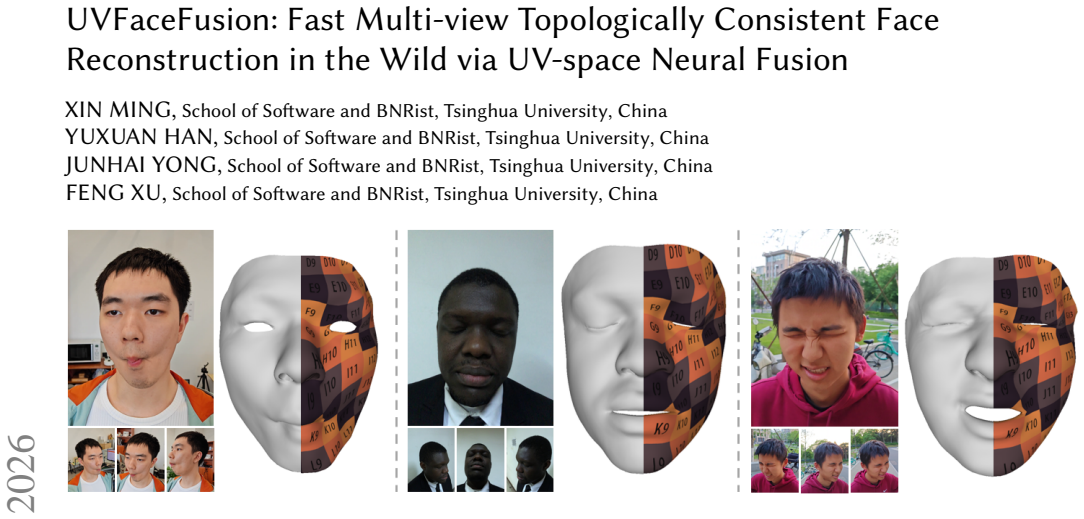
UVFaceFusion: Fast Multi-view Topologically Consistent Face Reconstruction in the Wild via UV-space Neural Fusion
The pith
A machine-rendered reading of the paper's core claim, the machinery that carries it, and where it could break.
Core claim
On the paper's own terms, the central discovery is that the topological-fusion stage of multi-view face reconstruction can be learned instead of engineered. Each view is lifted into a canonical UV parameterization by dense correspondences, lightly re-aligned to a template, and encoded with a shared network; the encoded features are combined with mask-weighted averaging, and a decoder fills in unobserved regions. The authors claim this yields a complete, fixed-topology mesh that outperforms heuristic bundle adjustment and several end-to-end competitors, using only a modest studio dataset for training, and does so in under three seconds for sixteen views.
What carries the argument
Canonical UV-space geometric fusion: each view's pixel-aligned 3D point map is forward-splatted into a shared UV face atlas using dense per-pixel UV correspondences, then per-view similarity alignment on sparse template vertices places the partial maps in a common frame. A shared-weight encoder interprets each partial map, a valid-mask-weighted average pools cross-view evidence, and a decoder completes the missing texels; the final fixed-topology mesh is sampled from the completed UV point map at template UV coordinates.
Load-bearing premise
The pipeline inherits the per-view 3D point maps and the UV correspondences from two frozen pretrained models, and assumes those are accurate enough that a UV-space fusion network can correct the remaining noise; if point-map noise is correlated with expression or identity, or if correspondences fail under occlusion, the fused result cannot recover what was never observed.
What would settle it
Construct a multi-view test set with a face mask or another strong occluder and compare against a high-quality scan; the paper's stated limitation predicts the occluder is absorbed into the mesh. A sharper test: swap the dense-correspondence backbone for a deliberately worse one while keeping the point maps fixed—if accuracy does not degrade, the claimed role of UV lifting is not load-bearing.
If this is right
- A fixed-topology face mesh with 16 views is produced in under 3 seconds on one GPU, roughly 3× faster than the heuristic-fusion baseline.
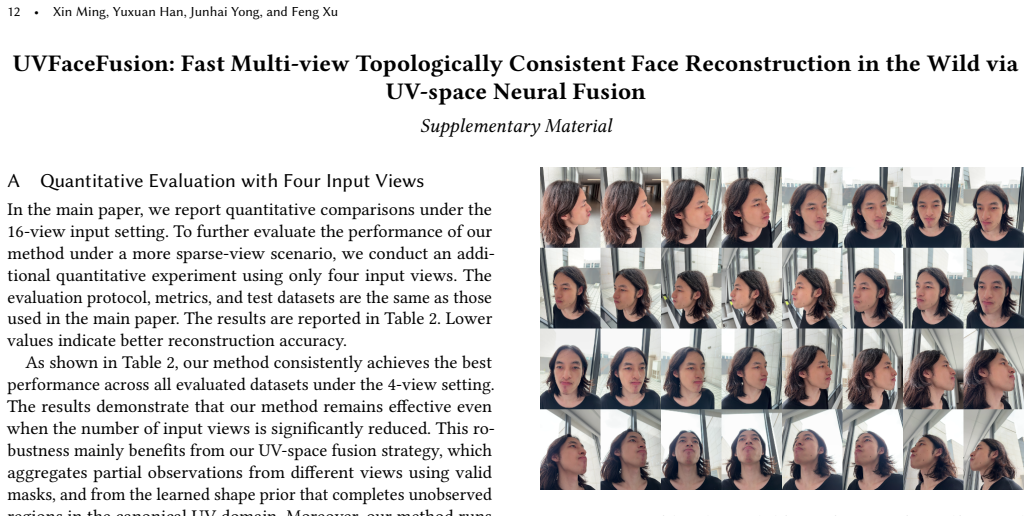
- Chamfer errors drop on all four public benchmarks (e.g., mean error from 1.18 to 1.12 mm on one dataset and 0.98 to 0.91 mm on another), and the gains hold with 4 input views.
- Training only on studio data transfers to in-the-wild captures because the fusion operates on pure geometry in a canonical space, not on appearance.
- The ablation shows learned feature-space fusion beats raw coordinate-space averaging, so the fusion network is doing real denoising and completion rather than mere smoothing.
- The same formulation degrades gracefully to a single input view, reconstructing a complete mesh from one partial UV map and a learned prior.
Where Pith is reading between the lines
- If the decoupling holds, improvements to the frozen geometry and correspondence backbones should transfer directly to this system with no retraining, making the fusion network a swappable head that can sit on top of stronger estimators.
- The same canonical-UV fusion recipe likely applies to any object class with a stable template parameterization, such as ears, hands, or full heads; the expensive ingredient is a registered training set.
- A testable extension would be to feed per-texel confidence from the geometry backbone into the mask-weighted averaging, potentially reducing reliance on a fixed threshold and improving occlusion handling.
- The monocular results suggest the network learns a genuine shape prior in UV space; this could be probed explicitly by measuring how much completed geometry is recalled from training identities versus inferred from the observed image.
Editorial analysis
A structured set of objections, weighed in public.
Referee Report
Summary. UVFaceFusion proposes a feed-forward, fixed-topology face reconstruction pipeline for in-the-wild multi-view images. It uses frozen VGGT point maps and Pixel3DMM UV correspondences, lifts each view's geometry into a canonical UV space via bilinear splatting and per-view Umeyama alignment, then trains a mask-aware convolutional encoder/decoder to fuse the partial UV-space point maps and predict a complete UV-space point map from which a fixed-topology mesh is sampled. The method is trained only on Ava-256 and evaluated on H3DS, NeRSemble, EmoTalk3D, and RenderMe-360, where it reports lower mean Chamfer distances than VGGTFace and other baselines, as well as runtime below 3 seconds for 16 views. The paper also includes ablations of the neural fusion module and Laplacian loss, a user study, and supplementary 4-view and monocular results.
Significance. If the reported benchmark numbers are reliable, the contribution is significant: it replaces a hand-crafted bundle-adjustment fusion stage with a learnable UV-space aggregation, decouples general geometry estimation from topology construction, and demonstrates data efficiency by training on a single studio dataset while generalizing to casual captures. The speed and fixed-topology output are practically useful for avatar pipelines. The paper also provides an honest limitations section and makes code available. However, the central quantitative claim currently rests on very small Chamfer-distance differences without statistical support, and part of the comparison is quoted from the authors' own prior work under potentially different protocols. The architecture is plausible and the ablations point in the expected direction, but the evidence as presented is not yet sufficient to establish state-of-the-art accuracy.
major comments (4)
- [Table 1, §4.1] The main SOTA claim is supported by mean Chamfer differences of only 0.06–0.15 mm between UVFaceFusion and VGGTFace (e.g., NeRSemble 0.91 vs 0.98; RenderMe-360 0.93 vs 1.08), while the reported per-dataset standard deviations are 0.65–0.76 mm. These gaps are below 0.2σ. No confidence intervals, per-subject error lists, or significance tests are provided. The H3DS row lacks even a standard deviation. Since the paper's central thesis is that learned neural fusion outperforms heuristic BA, the reader cannot tell whether the differences are real. Please report per-subject paired errors, bootstrap or paired-test confidence intervals, and the number of subjects used for each dataset. This applies also to the 'w/o Neural Fusion' ablation, whose 0.10–0.12 mm gaps may not be significant.
- [§4.1, Table 1] The evaluation protocol is not unified. For H3DS and NeRSemble, the paper says it 'follows the protocol used by prior work and quotes the numbers reported in SIRA++ and VGGTFace.' The primary competitor VGGTFace is the authors' own earlier system, and quoting its numbers rather than re-running it under an identical protocol introduces possible systematic differences in alignment, mesh sampling, subject splits, and metric code. For EmoTalk3D and RenderMe-360, ground truth is reconstructed with Metashape, which is a different source of supervision. To substantiate the SOTA claim, the authors should re-run VGGTFace (and ideally the other multi-view baselines) under exactly the same evaluation pipeline, with the same subject selection and alignment procedure, and report the results side-by-side.
- [§4.6, §3.4] The limitations section acknowledges that bangs and occluders such as masks can be absorbed into the reconstructed face mesh because neither VGGT point maps nor registered training meshes separate non-face geometry. This directly affects the interpretation of the quantitative metrics. If the training ground-truth meshes contain hair/forehead geometry or if the benchmark ground truth is restricted to a face mask, the Chamfer distance may not penalize non-face geometry consistently. Please clarify how the Ava-256 registration and each benchmark's ground truth define the face region, and discuss whether the reported Chamfer numbers include or exclude hair/occluder regions. A metric that ignores these artifacts could inflate the apparent accuracy of a method that silently blends occluders into the surface.
- [§3.2, Eqs. (11)–(12)] A load-bearing assumption is that per-view Umeyama alignment to the template, using a sparse set of sampled template vertices, is sufficient to correct residual cross-view misalignment in VGGT point maps. If the sampled vertices are themselves corrupted by VGGT noise or Pixel3DMM correspondence errors, the canonicalization step can inject a systematic distortion into every view before fusion. The paper does not provide any sensitivity analysis for this step. Please quantify the effect: e.g., compare with and without canonicalization, measure residual alignment error on the sparse vertices, and show failure cases where UV correspondence is poor. This would make the correctness-risk of the frozen-backbone assumption explicit rather than implicit.
minor comments (5)
- [§4.1] The loss weights λ_pm, λ_v, λ_lap in Eq. (20) are never given numerical values. Since these are important hyperparameters, please report them along with other training details (learning rate, batch size, number of sampled views per subject, validation selection).
- [Table 1] The H3DS columns report only Mean, while the other datasets report Median and Std. Please add the missing statistics or explain that they are unavailable from the quoted source. For reproducibility, also report the number of test subjects/sequences per dataset.
- [§4.2] The abstract and introduction state '3× inference speedup over VGGTFace,' but the paper only reports '<10s' for VGGTFace and '<3s' for the proposed method. A precise runtime table with per-component timings (VGGT, Pixel3DMM, lifting, fusion, mesh extraction) and hardware/software settings would be more informative.
- [§4.4, Fig. 3] The user study figure reports percentages for four criteria. It is helpful that the total votes per criterion are stated, but the exact number of participants per example and whether each participant saw all 24 groups should be stated. A confidence interval for the preference percentages would also be appropriate.
- [Supplementary, §D] The monocular extension is interesting but currently only qualitative. If monocular results are shown in the supplement, a brief quantitative comparison or at least a statement that this is not a supported setting would avoid confusion.
Circularity Check
No significant circularity: the UV-space fusion system is empirically evaluated, and the only self-citation (VGGTFace baseline) is not definitionally load-bearing.
full rationale
UVFaceFusion is an empirical system, not a derivation. The pipeline uses frozen pretrained backbones (VGGT, Pixel3DMM), lifts their outputs into a canonical UV space, and trains a neural fusion network with standard supervised losses (Eqs. 17-20) against ground-truth meshes registered to the FLAME topology. No equation is defined in terms of its target, and no fitted parameter is renamed as a prediction. The central claim is a benchmark comparison, not a derived identity. The paper's only self-referential element is that its primary competitor, VGGTFace, is the authors' prior work, and for H3DS/NeRSemble the VGGTFace numbers are quoted from that paper rather than re-run. This is a methodological self-citation, but it does not make the current results circular: the current method's Chamfer errors are independently measured, and the 'w/o Neural Fusion' ablation provides an internal control. Concerns about small Chamfer gaps, lack of error bars, and possible protocol differences are correctness/statistical risks, not circularity. The stated limitation about occluders being absorbed into the mesh is a robustness limitation, not a circular step. No specific reduction of the paper's predictions to its inputs by construction was found.
Axiom & Free-Parameter Ledger
free parameters (4)
- UV resolution S =
512
- splatting threshold tau_w =
not reported
- loss weights lambda_pm, lambda_v, lambda_lap =
not reported
- number of training views sampled (4-16) =
random 4-16 per subject
axioms (5)
- domain assumption VGGT point maps are accurate enough, especially for in-the-wild geometry with expressions
- domain assumption Pixel3DMM UV correspondences are reliable for in-the-wild faces, expressions, and occlusions
- domain assumption FLAME-template UV parameterization is a sufficient canonical space
- domain assumption Chamfer distance after similarity+ICP alignment is the right and sufficient accuracy metric
- domain assumption Ava-256 registered meshes are a valid supervision distribution for in-the-wild expression geometry
Cite this review
Pith. "Pith review of UVFaceFusion: Fast Multi-view Topologically Consistent Face Reconstruction in the Wild via UV-space Neural Fusion." pith.science (2026). https://pith.science/paper/5MCEPQA2
@misc{pith2026260718798,
  author       = {Pith},
  title        = {Pith review of: UVFaceFusion: Fast Multi-view Topologically Consistent Face Reconstruction in the Wild via UV-space Neural Fusion},
  year         = {2026},
  howpublished = {\url{https://pith.science/paper/5MCEPQA2}},
  note         = {Machine review of arXiv:2607.18798}
}
read the original abstract
Reconstructing high-fidelity facial geometry with an assigned topology is essential for digital avatar creation and animation, yet existing automated methods often trade off geometric fidelity and in-the-wild generalization. We present UVFaceFusion, a feed-forward framework for multi-view, fixed-topology face reconstruction from daily images. Our key idea is to replace heuristic topological optimization with learnable neural fusion in a canonical UV space. Given multi-view images, we first obtain dense point maps and facial UV correspondences of each view using VGGT and Pixel3DMM, respectively. Then, the view-specific point maps are lifted into the canonical UV domain and fused with a novel mask-aware neural fusion network. The network predicts a complete UV-space point map, from which a fixed-topology mesh is directly sampled. Although trained only on Ava-256, UVFaceFusion generalizes well to multiple public benchmarks and in-the-wild captures, benefiting from its canonical UV-space geometry-to-geometry fusion that reduces dependence on dataset-specific appearance and capture conditions. Experiments on various benchmarks show that UVFaceFusion achieves state-of-the-art reconstruction accuracy while reconstructing a mesh from 16 input views in less than 3 seconds on a single RTX 4090. Code is available at https://github.com/grignarder/UVFaceFusion.
Figures




Reference graph
Works this paper leans on
-
[1]
Patricia S. Abril and Robert Plant. The patent holder's dilemma: Buy, sell, or troll?. Communications of the ACM. 2007. doi:10.1145/1188913.1188915
arXiv 2007
-
[2]
Deciding equivalances among conjunctive aggregate queries
Sarah Cohen and Werner Nutt and Yehoshua Sagic. Deciding equivalances among conjunctive aggregate queries. 2007. doi:10.1145/1219092.1219093
arXiv 2007
-
[3]
Special issue: Digital Libraries. 1996
1996
-
[4]
Understanding Policy-Based Networking
David Kosiur. Understanding Policy-Based Networking. 2001
2001
-
[7]
The title of book two. 2008. doi:10.1007/3-540-09237-4
-
[8]
Asad Z. Spector. Achieving application requirements. Distributed Systems. 1990. doi:10.1145/90417.90738
arXiv 1990
-
[9]
Douglass and David Harel and Mark B
Bruce P. Douglass and David Harel and Mark B. Trakhtenbrot. Statecarts in use: structured analysis and object-orientation. Lectures on Embedded Systems. 1998. doi:10.1007/3-540-65193-4_29
-
[10]
Donald E. Knuth. The Art of Computer Programming, Vol. 1: Fundamental Algorithms (3rd. ed.). 1997
1997
-
[11]
Donald E. Knuth. The Art of Computer Programming. 1998
1998
-
[12]
Structured Variational Inference Procedures and their Realizations (as incol)
Dan Geiger and Christopher Meek. Structured Variational Inference Procedures and their Realizations (as incol). Proceedings of Tenth International Workshop on Artificial Intelligence and Statistics, The Barbados
-
[13]
Stan W. Smith. An experiment in bibliographic mark-up: Parsing metadata for XML export. Proceedings of the 3rd. annual workshop on Librarians and Computers. 2010. doi:99.9999/woot07-S422
2010
-
[14]
Catch me, if you can: Evading network signatures with web-based polymorphic worms
Matthew Van Gundy and Davide Balzarotti and Giovanni Vigna. Catch me, if you can: Evading network signatures with web-based polymorphic worms. Proceedings of the first USENIX workshop on Offensive Technologies. 2007
2007
-
[15]
Catch me, if you can: Evading network signatures with web-based polymorphic worms
Matthew Van Gundy and Davide Balzarotti and Giovanni Vigna. Catch me, if you can: Evading network signatures with web-based polymorphic worms. Proceedings of the first USENIX workshop on Offensive Technologies. 2008
2008
-
[16]
Catch me, if you can: Evading network signatures with web-based polymorphic worms
Matthew Van Gundy and Davide Balzarotti and Giovanni Vigna. Catch me, if you can: Evading network signatures with web-based polymorphic worms. Proceedings of the first USENIX workshop on Offensive Technologies. 2009
2009
-
[17]
Sten Andler. Predicate Path expressions. Proceedings of the 6th. ACM SIGACT-SIGPLAN symposium on Principles of Programming Languages. 1979. doi:10.1145/567752.567774
arXiv 1979
-
[18]
LOGICS of Programs: AXIOMATICS and DESCRIPTIVE POWER
David Harel. LOGICS of Programs: AXIOMATICS and DESCRIPTIVE POWER. 1978
1978
-
[19]
Anisi , title =
David A. Anisi , title =
-
[20]
Clarkson
Kenneth L. Clarkson. Algorithms for Closest-Point Problems (Computational Geometry). 1985
1985
-
[21]
Introduction to Bayesian Statistics
Harry Thornburg. Introduction to Bayesian Statistics. 2001
2001
-
[22]
CLIFFORD: a Maple 11 Package for Clifford Algebra Computations, version 11
Rafal Ablamowicz and Bertfried Fauser. CLIFFORD: a Maple 11 Package for Clifford Algebra Computations, version 11. 2007
2007
-
[23]
Stats and Analysis
Poker-Edge.Com. Stats and Analysis. 2006
2006
-
[24]
A more perfect union
Barack Obama. A more perfect union. 2008
2008
-
[25]
The fountain of youth
Joseph Scientist. The fountain of youth. 2009
2009
-
[26]
Solder man
Dave Novak. Solder man. ACM SIGGRAPH 2003 Video Review on Animation theater Program: Part I - Vol. 145 (July 27--27, 2003). 2003. doi:99.9999/woot07-S422
2003
-
[27]
Interview with Bill Kinder: January 13, 2005
Newton Lee. Interview with Bill Kinder: January 13, 2005. Comput. Entertain. 2005. doi:10.1145/1057270.1057278
arXiv 2005
-
[28]
The Enabling of Digital Libraries
Bernard Rous. The Enabling of Digital Libraries. Digital Libraries. 2008
2008
-
[30]
(new) Finding minimum congestion spanning trees , journal =
Werneck, Renato and Setubal, Jo\. (new) Finding minimum congestion spanning trees , journal =. 2000 , issn =. doi:10.1145/351827.384253 , acmid =
arXiv 2000
-
[32]
Conti, Mauro and Di Pietro, Roberto and Mancini, Luigi V. and Mei, Alessandro , title =. Inf. Fusion , volume =. 2009 , issn =. doi:10.1016/j.inffus.2009.01.002 , acmid =
-
[33]
Li, Cheng-Lun and Buyuktur, Ayse G. and Hutchful, David K. and Sant, Natasha B. and Nainwal, Satyendra K. , title =. CHI '08 extended abstracts on Human factors in computing systems , year =. doi:10.1145/1358628.1358946 , acmid =
-
[34]
, title =
Hollis, Billy S. , title =. 1999 , isbn =
1999
-
[35]
Goossens, Michel and Rahtz, S. P. and Moore, Ross and Sutor, Robert S. , title =. 1999 , isbn =
1999
-
[36]
and Rosenberg, Arnold L
Buss, Jonathan F. and Rosenberg, Arnold L. and Knott, Judson D. , title =. 1987 , source =
1987
-
[37]
CHI '08: CHI '08 extended abstracts on Human factors in computing systems , year =
, note =. CHI '08: CHI '08 extended abstracts on Human factors in computing systems , year =
-
[38]
Algorithms for Closest-Point Problems (Computational Geometry) , year =
Clarkson, Kenneth Lee , advisor =. Algorithms for Closest-Point Problems (Computational Geometry) , year =
-
[39]
SIGCOMM Comput. Commun. Rev. , year =
-
[40]
IEEE TCSC Executive Committee , booktitle =. 2004 , isbn =. doi:http://dx.doi.org/10.1109/ICWS.2004.64 , acmid =
-
[41]
Distributed systems (2nd Ed.) , year =
-
[42]
, title =
Petrie, Charles J. , title =. 1986 , source =
1986
-
[43]
Donald E. Knuth. Seminumerical Algorithms. 1981
1981
-
[44]
E-commerce and cultural values , year =
Kong, Wei-Chang , Title =. E-commerce and cultural values , year =
-
[45]
E-commerce and cultural values , year =
Kong, Wei-Chang , type =. E-commerce and cultural values , year =
-
[46]
Chapter 9 , booktitle =
Kong, Wei-Chang , editor =. Chapter 9 , booktitle =. 2002 , address =
2002
-
[47]
E-commerce and cultural values , editor =
Kong, Wei-Chang , title =. E-commerce and cultural values , editor =. 2003 , isbn =
2003
-
[48]
E-commerce and cultural values - (InBook-num-in-chap) , chapter =
Kong, Wei-Chang , editor =. E-commerce and cultural values - (InBook-num-in-chap) , chapter =. 2004 , address =
2004
-
[49]
E-commerce and cultural values (Inbook-text-in-chap) , chapter =
Kong, Wei-Chang , editor =. E-commerce and cultural values (Inbook-text-in-chap) , chapter =. 2005 , address =
2005
-
[50]
E-commerce and cultural values (Inbook-num chap) , chapter =
Kong, Wei-Chang , editor =. E-commerce and cultural values (Inbook-num chap) , chapter =. 2006 , address =
2006
-
[51]
Microelectron
Mehdi Saeedi and Morteza Saheb Zamani and Mehdi Sedighi , title =. Microelectron. J. , volume =. 2010 , pages =
2010
-
[52]
Mehdi Saeedi and Morteza Saheb Zamani and Mehdi Sedighi and Zahra Sasanian , title =. J. Emerg. Technol. Comput. Syst. , volume =
-
[53]
Kirschmer, Markus and Voight, John , title =. SIAM J. Comput. , issue_date =. 2010 , issn =. doi:https://doi.org/10.1137/080734467 , acmid =
-
[54]
Hoare, C. A. R. , title =. Structured programming (incoll) , editor =. 1972 , isbn =
1972
-
[55]
History of programming languages I (incoll) , editor =
Lee, Jan , title =. History of programming languages I (incoll) , editor =. 1981 , isbn =. doi:http://doi.acm.org/10.1145/800025.1198348 , acmid =
arXiv 1981
-
[56]
, title =
Dijkstra, E. , title =. Classics in software engineering (incoll) , year =
- [57]
-
[58]
, title =
Mumford, E. , title =. Critical issues in information systems research (incoll) , year =
-
[59]
and Golden, Donald G
McCracken, Daniel D. and Golden, Donald G. , title =. 1990 , isbn =
1990
-
[60]
The analysis of linear partial differential operators
H. The analysis of linear partial differential operators. 1985 , PAGES =
1985
-
[61]
IEEE", address =
A. Adya and P. Bahl and J. Padhye and A.Wolman and L. Zhou , title =. Proceedings of the IEEE 1st International Conference on Broadnets Networks (BroadNets'04) , publisher = "IEEE", address = "Los Alamitos, CA", year =
-
[62]
I. F. Akyildiz and W. Su and Y. Sankarasubramaniam and E. Cayirci , title =. Comm. ACM , volume = 38, number = "4", year =
-
[63]
I. F. Akyildiz and T. Melodia and K. R. Chowdhury , title =. Computer Netw. , volume = 51, number = "4", year =
-
[64]
ACM", address =
P. Bahl and R. Chancre and J. Dungeon , title =. Proceeding of the 10th International Conference on Mobile Computing and Networking (MobiCom'04) , publisher = "ACM", address = "New York, NY", year =
-
[65]
8 (Special Issue on Sensor Networks)
D. Culler and D. Estrin and M. Srivastava , title =. IEEE Comput. , volume = 37, number = "8 (Special Issue on Sensor Networks)", publisher = "IEEE", address = "Los Alamitos, CA", year =
-
[66]
Natarajan and M
A. Natarajan and M. Motani and B. de Silva and K. Yap and K. C. Chua , title =. Network Architectures , editor =. 960935712
-
[67]
Tzamaloukas and J
A. Tzamaloukas and J. J. Garcia-Luna-Aceves , title =
-
[68]
Zhou and J
G. Zhou and J. Lu and C.-Y. Wan and M. D. Yarvis and J. A. Stankovic , title =
-
[69]
Mapping Powerlists onto Hypercubes
Jacob Kornerup. Mapping Powerlists onto Hypercubes. 1994
1994
-
[70]
Automatic Parallelization for Distributed-Memory Multiprocessing Systems
Michael Gerndt. Automatic Parallelization for Distributed-Memory Multiprocessing Systems
-
[71]
J. E. Archer, Jr. and R. Conway and F. B. Schneider. User recovery and reversal in interactive systems. ACM Trans. Program. Lang. Syst
-
[72]
D. D. Dunlop and V. R. Basili. Generalizing specifications for uniformly implemented loops. ACM Trans. Program. Lang. Syst
-
[73]
Heering and P
J. Heering and P. Klint. Towards monolingual programming environments. ACM Trans. Program. Lang. Syst
-
[74]
Donald E. Knuth. The book
-
[75]
Korach and D
E. Korach and D. Rotem and N. Santoro. Distributed algorithms for finding centers and medians in networks. ACM Trans. Program. Lang. Syst
-
[76]
: A Document Preparation System
Leslie Lamport. : A Document Preparation System
-
[77]
F. Nielson. Program transformations in a denotational setting. ACM Trans. Program. Lang. Syst
-
[78]
Brian K. Reid. A high-level approach to computer document formatting. Proceedings of the 7th Annual Symposium on Principles of Programming Languages
-
[79]
Zhou, Gang and Wu, Yafeng and Yan, Ting and He, Tian and Huang, Chengdu and Stankovic, John A. and Abdelzaher, Tarek F. , title =. ACM Trans. Embed. Comput. Syst. , issue_date =. doi:10.1145/1721695.1721705 , acmid = 1721705, publisher =
-
[80]
Institutional members of the Users Group
-
[81]
Boris Veytsman , title =
-
[82]
and Peterson, Larry L
Bowman, Mic and Debray, Saumya K. and Peterson, Larry L. , title =. ACM Trans. Program. Lang. Syst. , volume =. 1993 , doi =
1993
-
[83]
TUGboat , volume =
Braams, Johannes , title =. TUGboat , volume =
-
[84]
Post Congress Tristesse
Malcolm Clark. Post Congress Tristesse. TeX90 Conference Proceedings
discussion (0)
Sign in with ORCID, Apple, or X to comment. Anyone can read and Pith papers without signing in.