REVIEW 3 major objections 7 minor 38 references
Quantum Dynamics of $H_2^+$ in Orthogonal Two-Color Fields
T0 review · 3 major / 7 minor · reviewed 2026-08-01 · deepseek-v4-flash
Pith's one-line read Adding a perpendicular laser field to a dissociating H2+ molecule creates a new proton-energy peak near 4–5 eV that can be tuned by the field's phase.
desk verdict Full-dimensional orthogonal-field H2+ simulation, but the novelty claim rests on a half-intensity linear reference; needs an equal-intensity control. read the letter →
The pith
A machine-rendered reading of the paper's core claim, the machinery that carries it, and where it could break.
The reading
What carries the argument
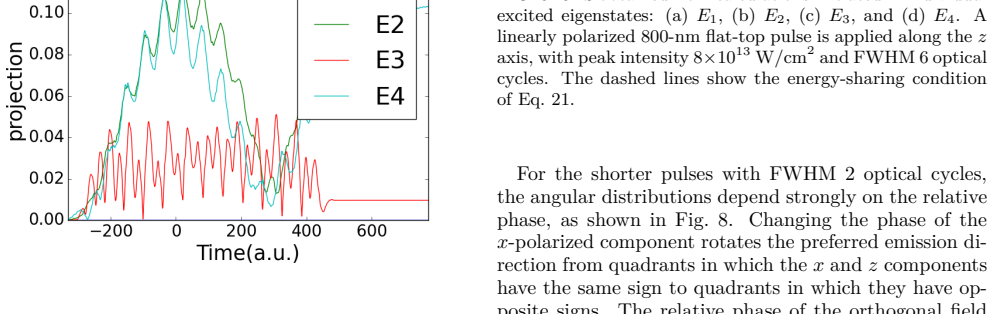
The argument is carried by full-dimensional time-dependent Schrödinger equation propagation in the two-body coordinates of the electron and the two protons, combined with a surface-flux analysis that extracts the joint kinetic-energy spectrum of dissociative ionization: this is what lets the paper see the new peak and its correlation with electron energy. Because the orthogonal field breaks the cylindrical symmetry, the calculations use a reduced-symmetry angular basis (m up to 2, l up to 8) centered at the molecular midpoint. The attribution to vibrational excitation relies on two complementary diagnostics: projections of the time-dependent wavefunction onto the first four excited eigenstat
What would settle it
Measure the proton kinetic-energy-release spectrum of H2+ dissociative ionization with orthogonal 800-nm and 400-nm pulses while scanning the relative carrier-envelope phase: a distinct 4–5 eV peak whose yield tracks the phase should appear if the claim is right. Equivalently, rerun the simulation with a much larger angular basis and check that the peak position and phase dependence remain unchanged.
Extended reading notes
Core claim
The paper's central claim is that an orthogonal second field opens a distinct fragmentation channel in H2+ that linear polarization cannot: a proton kinetic-energy-release peak at 4–5 eV, above the usual 2–4 eV main channel. The peak appears in every orthogonal-field configuration tested, whether the second component is 800 nm or 400 nm and regardless of pulse envelope, and it is absent in the corresponding linearly polarized runs. Its relative height is maximal when the two equal-frequency components combine to circular polarization (relative phase π/2 or 3π/2) and minimal when they combine to linear polarization (0 or π); shorter wavelength and higher intensity of the control field increas
Load-bearing premise
The result rests on the assumption that the truncated angular basis used in the orthogonal-field simulations captures all relevant electron–nuclear couplings; the paper concedes that a complete convergence study would require substantially more memory and computing time, so the precise relative height of the 4–5 eV peak could still depend on basis size.
Editorial extensions
If this is right
- A proton KER spectrum of H2+ dissociative ionization should show a separate 4–5 eV peak whenever a sufficiently strong perpendicular field component is added, with no such peak in the pure linear-polarization reference.
- The height of that peak relative to the main 2–4 eV peak follows the relative carrier-envelope phase, peaking near circular polarization and dipping near linear polarization, so the phase acts as a coherent on/off switch for this channel.
- Raising the perpendicular field's intensity or shortening its wavelength (400 nm versus 800 nm) makes the secondary channel more prominent.
- The clean electron–proton energy-sharing ridges that mark the linear-polarization channel are disrupted by the orthogonal field, so correlated energy-sharing measurements become multichannel.
- For short few-cycle pulses, the relative phase also selects which quadrant the fragments prefer, giving directional control of proton and electron emission.
Reading between the lines
- If the 4–5 eV channel really is laser-induced vibrational excitation, the same orthogonal-field geometry could be used in other small molecules to selectively populate excited vibrational states before dissociation, effectively a phase-tuned vibrational-state control.
- The strong phase dependence suggests coherent interference among pathways through excited states; a coincidence measurement of proton energy versus electron energy, gated on phase, could distinguish that interference from a simple population effect.
- Because the peak appears with pulses as short as two optical cycles, the channel might serve as a sensitive, easy-to-detect phase marker for few-cycle carrier-envelope phase stabilization.
- A systematic scan over relative intensity and frequency ratio (beyond the three control-field configurations reported) would map where the channel turns on and whether a threshold exists.
Editorial analysis
A structured set of objections, weighed in public.
Referee Report
Summary. The paper reports full-dimensional tSurff/TDSE simulations of dissociative ionization of H2+ in orthogonal two-color laser fields, with one component along the molecular axis and a perpendicular control component. The central claim is an additional proton KER peak near 4–5 eV that does not appear in the corresponding single-color, linearly polarized calculation, and whose height can be modulated by the relative carrier-envelope phase of the perpendicular field. The authors attribute this peak to laser-induced population of excited vibrational states E2 and E4, supported by time-dependent projections and by linearly polarized calculations initiated from those states. They further report that orthogonal geometry weakens the electron–proton energy-sharing pattern and rotates the fragment angular distributions. The paper is honest about the main numerical caveat: a complete convergence study at the reduced symmetry was not performed, and relative yields may retain basis dependence.
Significance. If the central prediction is correct, the 4–5 eV KER channel would be a new, phase-controllable dissociation pathway in a benchmark molecular system, and the paper would demonstrate that the spatial geometry of orthogonal fields is a genuine control knob beyond intensity and frequency. The work uses an established full-dimensional tSurff/TDSE method with prior benchmarks, and it makes a falsifiable prediction that could be tested experimentally. The explicit state-projection and excited-state-initiated calculations are a constructive step toward mechanistic attribution. However, the novelty claim is currently underdetermined by the missing equal-intensity linear-polarization control, and the acknowledged lack of numerical convergence leaves the quantitative phase-control result open to question.
major comments (3)
- [III.B, Fig. 3, Eqs. (18)–(19)] The 'absent from single-color' claim is not tested at equal total intensity. The dashed reference is the z-polarized pulse alone at 8×10^13 W/cm2, while every orthogonal-field curve combines equal-amplitude z and x components, giving a total intensity of 1.6×10^14 W/cm2. At φ=0 the combined field is linearly polarized along the 45° direction and already shows a larger secondary contribution than the dashed reference. Thus the additional 4–5 eV peak could be an intensity effect rather than a geometric effect. A linearly polarized, single-color 800-nm pulse along z at 1.6×10^14 W/cm2 is a necessary control; ideally also a 45°-polarized control at the same total intensity.
- [III (Numerical Results, basis and Rc)] The paper states that a complete convergence study at the reduced symmetry of the orthogonal field was not performed, that coarser angular representations reproduce only the peak position, and that 'the precise relative yields may retain some basis dependence.' This is load-bearing for the phase-control claim, since Fig. 3 quantifies the relative height H(φ). Coarse-basis agreement on peak position does not establish that the φ-dependence of H is converged. Please provide tests varying l_max (e.g., 6, 8, 10) and m_max (1, 2) for at least the key phases φ=0, π/2, and ideally an Rc variation, showing that both the existence of the peak and the H(φ) trend are stable.
- [III.C, Figs. 5 and 6] The attribution to laser-induced vibrational excitation is presented as a conclusion ('attribute the additional peak to...'), but the evidence is indirect. The projections in Fig. 5 are only 'relative indicators' of population, and the linearly polarized calculations initiated from E2/E4 show that these states are capable of producing a 4–5 eV peak, not that the orthogonal-field dynamics actually creates the peak through them. A quantitative test, for example comparing the circular-field KER in the 4–5 eV bin with a calculation that depletes or excludes these channels, or showing that the peak yield scales with the E2/E4 population across the phase scan, would make the causal statement convincing. Otherwise, the wording in the abstract and conclusions should be softened to 'consistent with' or 'suggest.'
minor comments (7)
- [II.B, Eq. (6)] The Volkov state in Eq. (6) is written with the operator -iβ A(τ)·∇ inside the exponential. This is not a standard c-number phase; please clarify the gauge and present the explicit Volkov phase or time-ordered form.
- [II.A, Eq. (2)] The Hamiltonian H(-) omits the A^2 term without comment, although ponderomotive energies appear in Eq. (21). State the gauge choice and whether the A^2 term is neglected or absorbed.
- [III.B, Eq. (21)] The energy-sharing lines use Up = A_{z,0}^2/(4m), i.e., only the z-component's ponderomotive energy. For orthogonal fields with an x-component of comparable amplitude, the cycle-averaged total A^2 differs, especially for equal-frequency circular polarization where the total vector potential averages to twice the single-component value. This shifts the dashed lines in Figs. 2, 4, and 9–11. Please use the total ponderomotive energy or explicitly state that the lines are guides using only the z-field ponderomotive shift.
- [III.B, Eq. (22)] The symbol σ(E_N) is used in Eq. (22) to define H, but the definition of σ(E_N) as the proton KER spectrum (the integral over electron energy) appears only in the text. Please define it before Eq. (22) or introduce a separate notation.
- [III (Numerical Results)] Please specify which coarser angular representations were tested and at what computational cost; a table or sentence with l_max/m_max values would make the stability claim reproducible.
- [Appendix A] The flat-top envelope in Eq. (A1) uses f_{n/2 τ,(n/2+1)τ}(t) with n introduced as the FWHM in optical cycles; the relationship between n, τ, and the total pulse duration is unclear. Please define these variables explicitly.
- [Throughout] There are several typographical issues, including 'suffiently' instead of 'sufficiently' in Sections II.B and III, and inconsistent spacing in 'H + 2'. A careful proofreading pass is needed.
Circularity Check
No significant circularity: the 4-5 eV KER peak is a direct TDSE simulation output, not a fitted or self-referential quantity; self-citations are non-load-bearing or explicitly qualitative.
full rationale
The paper's central result is obtained by solving the full-dimensional TDSE with fixed Hamiltonians and pulse parameters (Eqs. 1-21); no parameter is fitted to the 4-5 eV peak, and no equation defines that peak in terms of the input fields by construction. The KER ratio H in Eq. 22 is a post-processing metric, not a fitted predictor. The phase, intensity, and frequency scans in Fig. 3 are simulation outputs, not consistency-enforced identities. Self-citations do not carry the central argument: Refs. [34,35] provide the tSurff method and prior linearly polarized benchmarks, but the orthogonal-field peak is a new computed result; Ref. [38] is explicitly downgraded in the paper itself as 'a qualitative analogy rather than a quantitative derivation' and 'not evaluated directly,' so it is not load-bearing. Ground-state properties are checked against external quantum-chemistry references (Refs. [36,37]) and the KER comparison against experiment (Ref. [5]). The paper also honestly discloses the basis-convergence caveat ('the precise relative yields may retain some basis dependence'), which is a numerical robustness concern rather than circularity. The most substantive validity issue is external to circularity: the single-color linear reference in Fig. 3 is at half the total intensity of the orthogonal-field cases, so the claim that the peak is 'absent from corresponding single-color' lacks an equal-intensity control; that is a confounding-control issue, not a derivation that reduces to its inputs. No circular step meeting the quote-and-reduction standard is present, so the circularity score is low, reflecting only minor non-load-bearing self-citation.
Assumptions & free parameters
free parameters (2)
- Angular basis truncation l1/2 ≤ 8, m1/2 ≤ 2
- tSurff cutoff radius Rc(+) = Rc(-) = 12.5 a.u.
assumptions (4)
- domain assumption tSurff approximation: beyond Rc = 12.5 a.u., all particle interactions are neglected and outgoing particles evolve under asymptotic single-particle Hamiltonians.
- domain assumption Asymptotic electronic and nuclear scattering states are disentangled after sufficiently long propagation time T.
- domain assumption The molecular axis is fixed along the laser z axis; rotational degrees of freedom are not included.
- ad hoc to paper The angular basis truncation l1/2 ≤ 8, m1/2 ≤ 2 is sufficient for qualitative convergence.
Cite this review
Pith. "Pith review of Quantum Dynamics of $H_2^+$ in Orthogonal Two-Color Fields." pith.science (2026). https://pith.science/paper/IZBX57ZS
@misc{pith2026260718854,
  author       = {Pith},
  title        = {Pith review of: Quantum Dynamics of $H_2^+$ in Orthogonal Two-Color Fields},
  year         = {2026},
  howpublished = {\url{https://pith.science/paper/IZBX57ZS}},
  note         = {Machine review of arXiv:2607.18854}
}
abstract
We present full-dimensional quantum simulations of $H_2^+$ dissociative ionization driven by strong orthogonal laser fields. We consider equal-frequency orthogonal components, which generate elliptical or circular polarization depending on their relative phase and amplitude, as well as orthogonal $800$- and $400$-nm two-color fields. These two-dimensional fields strongly modify the fragmentation dynamics. Most notably, we identify a high-energy peak in the proton kinetic-energy-release (KER) spectrum at approximately $4-5$ eV that is absent from the corresponding single-color, linearly polarized calculations. The yield of this peak can be coherently controlled by varying the relative carrier-envelope phase of the perpendicular field component. The perpendicular field also disrupts the clear electron-proton energy-sharing pattern observed in the main $3-3.5$ eV dissociation channel, indicating more complex multichannel dynamics. Time-dependent state projections and calculations initiated from individual excited states attribute the additional peak to laser-induced vibrational excitation of $H_2^+$. Furthermore, the perpendicular field rotates the fragment angular distributions, causing the most probable proton and electron emission directions to deviate substantially from the principal $z$ axis. These findings demonstrate that the spatial and temporal geometry of orthogonal laser fields provides an additional degree of freedom for controlling ultrafast electron-nuclear dynamics.
Figures


Figures from the paper (7 more)




Reference graph
Works this paper leans on
-
[38]
J. Zhu, arXiv preprint arXiv:2601.08255 (2026), 10.48550/arXiv.2601.08255, arXiv:2601.08255 [physics.atom-ph]
-
[1]
Krausz and M
F. Krausz and M. Ivanov, Reviews of Modern Physics 81, 163 (2009)
2009
-
[2]
P. H. Bucksbaum, A. Zavriyev, H. G. Muller, and D. W. Schumacher, Phys. Rev. Lett. 64, 1883 (1990). 9
1990
-
[3]
Giusti-Suzor, F
A. Giusti-Suzor, F. H. Mies, L. F. DiMauro, E. Charron, and B. Yang, J. Phys. B At. Mol. Opt. Phys. 28, 309 (1995)
1995
-
[4]
Odenweller, N
M. Odenweller, N. Takemoto, A. Vredenborg, K. Cole, K. Pahl, J. Titze, L. P. H. Schmidt, T. Jahnke, R. Dörner, and A. Becker, Phys. Rev. Lett. 107, 1 (2011)
2011
-
[5]
Odenweller, J
M. Odenweller, J. Lower, K. Pahl, M. Schütt, J. Wu, K. Cole, A. Vredenborg, L. P. Schmidt, N. Neumann, J. Titze, T. Jahnke, M. Meckel, M. Kunitski, T. Haver- meier, S. Voss, M. Schöffler, H. Sann, J. Voigtsberger, H. Schmidt-Böcking, and R. Dörner, Phys. Rev. A - At. Mol. Opt. Phys. 89, 1 (2014)
2014
-
[6]
J. Wu, M. Kunitski, M. Pitzer, F. Trinter, L. P. H. Schmidt, T. Jahnke, M. Magrakvelidze, C. B. Madsen, L. B. Madsen, U. Thumm, and R. Dörner, Phys. Rev. Lett. 111, 1 (2013)
2013
-
[7]
X. Gong, P. He, Q. Song, Q. Ji, K. Lin, W. Zhang, P. Lu, H. Pan, J. Ding, H. Zeng, F. He, and J. Wu, Optica 3, 643 (2016)
2016
Show all 38 references
-
[8]
Pavičić, A
D. Pavičić, A. Kiess, T. W. Hänsch, and H. Figger, Phys. Rev. Lett. 94, 1 (2005)
2005
-
[9]
C. B. Madsen, F. Anis, L. B. Madsen, and B. D. Esry, Phys. Rev. Lett. 109, 163003 (2012)
2012
-
[10]
Scrinzi, New J
A. Scrinzi, New J. Phys. 14, 085008 (2012)
2012
-
[11]
K. C. Kulander, F. H. Mies, and K. J. Schafer, Phys. Rev. A - At. Mol. Opt. Phys. 53, 2562 (1996)
1996
-
[12]
Zhou and S.-I
Z. Zhou and S.-I. Chu, Phys. Rev. A 71, 011402(R) (2005)
2005
-
[13]
Yue and L
L. Yue and L. B. Madsen, Phys. Rev. A 90, 063408 (2014)
2014
-
[14]
P. Peng, S. Peng, H. Hu, N. Li, Y. Bai, P. Liu, H. Xu, R. Li, and Z. Xu, Optics Express 23, 18763 (2015)
2015
-
[15]
Znakovskaya, P
I. Znakovskaya, P. von den Hoff, G. Marcus, S. Zherebtsov, B. Bergues, X. Gu, Y. Deng, M. J. J. Vrakking, R. Kienberger, F. Krausz, R. de Vivie-Riedle, and M. F. Kling, Physical Review Letters 108, 63002 (2012)
2012
-
[16]
Granados, E
C. Granados, E. G. Neyra, L. Rebón, and M. F. Ciap- pina, The European Physical Journal D 78, 115 (2024)
2024
-
[17]
M. Wang, E. Zhang, Q. Liang, and Y. Liu, Photonics 12, 422 (2025)
2025
-
[18]
Charron, A
E. Charron, A. Giusti-Suzor, and F. H. Mies, Physical Review Letters 71, 692 (1993)
1993
-
[19]
S.-F. Wang, B. Liu, and W.-W. Yu, Optical Review 32, 325 (2025)
2025
-
[20]
D. Ray, F. He, S. De, W. Cao, H. Mashiko, P. Ranitovic, K. P. Singh, I. Znakovskaya, U. Thumm, G. G. Paulus, M. F. Kling, I. V. Litvinyuk, and C. L. Cocke, Physical Review Letters 103, 223201 (2009)
2009
-
[21]
J. Ma, C. Jia, T. Xu, S. Pei, Y. Tang, H. Ju, X. Hu, Y. Wu, and J. Wang, Physical Review A 112, 013120 (2025)
2025
-
[22]
Yue and L
L. Yue and L. B. Madsen, Phys. Rev. A - At. Mol. Opt. Phys. 88, 1 (2013)
2013
-
[23]
Ranitovic, C
P. Ranitovic, C. W. Hogle, P. Rivière, A. Palacios, X. M. Tong, N. Toshima, A. González-Castrillo, L. Martin, F. Martín, M. M. Murnane, and H. Kapteyn, Proceed- ings of the National Academy of Sciences of the United States of America 111, 912 (2014)
2014
-
[24]
Scrinzi, Phys
A. Scrinzi, Phys. Rev. A 81, 053845 (2010)
2010
-
[25]
Tao and A
L. Tao and A. Scrinzi, New J. Phys. 14, 013021 (2012)
2012
-
[26]
Zielinski, V
A. Zielinski, V. P. Majety, and A. Scrinzi, Phys. Rev. A 93, 1 (2016)
2016
-
[27]
Zhu and A
J. Zhu and A. Scrinzi, Phys. Rev. A 101, 063407 (2020)
2020
-
[28]
V. P. Majety and A. Scrinzi, Phys. Rev. Lett. 115, 1 (2015)
2015
-
[29]
V. P. Majety, A. Zielinski, and A. Scrinzi, J. Phys. B 48, 025601 (2015)
2015
-
[30]
Majety and A
V. Majety and A. Scrinzi, Photonics 2, 93 (2015)
2015
-
[31]
V. P. Majety, A. Zielinski, and A. Scrinzi, New J. Phys. 17, 63002 (2015)
2015
-
[32]
V. P. Majety and A. Scrinzi, J. Phys. B 48, 245603 (2015)
2015
-
[33]
Chundayil, V
H. Chundayil, V. P. Majety, and A. Scrinzi, Computer Physics Communications 303, 1 (2024)
2024
-
[34]
Zhu, Physical Review A 102, 053109 (2020)
J. Zhu, Physical Review A 102, 053109 (2020)
2020
-
[35]
Zhu, Physical Review A 103, 013113 (2021)
J. Zhu, Physical Review A 103, 013113 (2021)
2021
-
[36]
Bressanini, M
D. Bressanini, M. Mella, and G. Morosi, Chem. Phys. Lett. 272, 370 (1997)
1997
-
[37]
Equilibrium bond length in H2+,
L. J. Schaad and W. V. Hicks, “Equilibrium bond length in H2+,” (1970)
1970
Reviewed August 1, 2026 · model on record in the stance chip above.
Discussion (0). Continue with ORCID to comment.