REVIEW 4 major objections 4 minor 45 references
One graph-optimization pipeline cuts quantum circuits faster, with fewer cuts, and onto quieter hardware.
Reviewed by Pith at T0; open to challenge. T0 means a machine referee read the full paper against a public rubric. the ladder, T0–T4 →
2026-08-01 14:00 UTC pith:HSWQURM5
load-bearing objection MosaiQC is a genuine engineering advance for circuit-cutting placement, but the 19.56% fidelity headline is fragment-local only, and the large-scale runs turn off the noise-aware QAP. the 4 major comments →
MOSAIQC: Mixed-topology-aware Optimization for Scalable Approximate noise-Informed Quantum circuit Cutting
The pith
A machine-rendered reading of the paper's core claim, the machinery that carries it, and where it could break.
Core claim
MosaiQC jointly optimizes mixed wire and gate cuts, supports heterogeneous hardware partitions, and incorporates hardware-aware placement in a single polynomial-time heuristic. The central claim is that a hybrid warm-start (global graph partitioning) plus local refinement (tabu search with periodic re-evaluation of placement through a quadratic-assignment solver) yields solutions that beat the baseline best-first search in both speed and quality across benchmark sizes from 6 to 1000 qubits. The paper further claims that its placement score—a weighted graph-matching objective built from logarithmic noise weights—correlates strongly with measured local fidelity (Pearson r = 0.828–0.986) and ca
What carries the argument
The central object is a compact weighted connectivity graph of the circuit, storing qubits as nodes, two-qubit gates as edges, and per-qubit temporal dependency lists that allow wire cuts to be evaluated locally. The optimization objective combines the log of sampling overhead (gate- and wire-cut counts) with a hardware placement score computed by solving a quadratic assignment problem via a conditional-gradient (Frank-Wolfe) method, using noise weights w = ln(1 - epsilon) on hardware nodes and edges. An adaptive cost function S_adapt = S_cuts / S_upper + beta * S_QAP ties the two objectives together, with beta controlling the emphasis on fidelity over sampling overhead.
Load-bearing premise
The load-bearing premise is that the quadratic-assignment placement score, computed from static hardware noise, faithfully predicts the fidelity of the final reconstructed quantum state—the paper validates it only against local state fidelity and explicitly leaves that translation as an open question.
What would settle it
A decisive test: on a 20–30 qubit circuit, compute MosaiQC mappings with beta = 50 and beta = 0, execute both on real hardware, and compare the end-to-end reconstructed state fidelities (not just local subcircuit fidelities). If the beta = 50 mapping does not consistently yield higher end-to-end fidelity, or if the QAP score ranking of alternative mappings disagrees with measured reconstructed-state fidelity, the proxy assumption fails.
If this is right
- If the claim holds, cut placement no longer limits circuit size: circuits approaching 1000 qubits can be partitioned in seconds to minutes instead of timing out or overflowing memory.
- Combining wire and gate cuts in one objective reduces sampling overhead by an average factor of ~5.4e11 relative to the baseline, which directly lowers the number of shots required for reconstruction.
- Noise-aware placement can be folded into the same optimization as cut selection, improving local execution fidelity by roughly 19.6% at higher mapping weight without a separate post-hoc placement step.
- Heterogeneous hardware partitions allow cutting across cloud backends with different qubit counts and noise characteristics, broadening the applicability of circuit knitting.
- The warm-start plus local refinement structure demonstrates that global partitioning followed by local moves can beat best-first search, suggesting similar hybrid schemes are viable for other NP-hard compilation tasks.
Where Pith is reading between the lines
- A natural extension would couple MosaiQC's cut placement with approximate circuit-knitting techniques that reduce sampling overhead (e.g., randomized measurements), since the exponential overhead remains the fundamental limit—a complementarity the paper itself notes.
- The QAP placement score could serve as a training signal for learned heuristics: a future compiler could predict the score without running the full conditional-gradient solve, making the mapping stage even cheaper.
- One testable extension is to replace static noise weights with dynamic calibration data; if the proxy remains predictive under calibration drift, the approach transfers to production systems where noise changes over time.
- The mapping-weight beta is a fixed user knob; an automated schedule that increases beta for smaller circuits (which have more placement freedom) would likely dominate any fixed setting.
Editorial analysis
A structured set of objections, weighed in public.
Referee Report
Summary. The paper presents MosaiQC, a heuristic framework for quantum circuit cutting that jointly optimizes mixed wire- and gate-cut placement and hardware-aware partition assignment. The method combines a METIS warm-start, Tabu-search refinement, and a Frank-Wolfe-based quadratic assignment subroutine for placing partitions on noisy hardware. The authors benchmark against the Qiskit circuit-cutting add-on on circuits from 6 to 1000 qubits and report a 2.88x geometric-mean runtime improvement, a 16.84% average cut reduction, and a 19.56% mean local fidelity improvement. The paper also contributes a public Python/C++ implementation and discusses heterogeneous hardware support. The central claim is that scalable heuristic optimization can make circuit-cut placement practical for large circuits while improving solution quality and hardware-aware placement.
Significance. If fully validated, the paper addresses a real and growing bottleneck: cut-placement optimization for circuit knitting becomes computationally expensive as circuits approach thousands of qubits. The proposed combination of mixed wire/gate cuts, heterogeneous hardware support, and polynomial-time heuristics is a useful contribution, and the code release is a concrete strength. However, the empirical support is incomplete in two load-bearing respects: the fidelity claim is validated only on fragment-local states, not on the reconstructed full-circuit output, and the large-scale scalability experiments disable the QAP-based noise-aware component entirely. The comparison against the Qiskit baseline also excludes instances where the baseline fails, which may inflate the reported improvements. These issues are fixable within the manuscript's scope, but they need to be addressed before the main claims can be accepted as stated.
major comments (4)
- [§4.4, Fig. 11; §5, Eq. (14)] The headline 19.56% fidelity improvement is measured on local fragment output states, not on the state reconstructed through the full circuit-cutting protocol. The paper itself states in §5 that 'an open question is how improvements in local hardware fidelity translate to the fidelity of the reconstructed quantum state.' Because Eq. (14) explicitly trades sampling overhead against S_QAP, a placement that improves fragment fidelity can also increase the number of cuts and therefore the reconstruction error. As presented, the fidelity claim does not support end-to-end practical benefit. Please add an end-to-end reconstruction experiment on small instances where the sampling overhead is tractable, or clearly scope the claim as local-fragment fidelity only in the abstract, results, and conclusion.
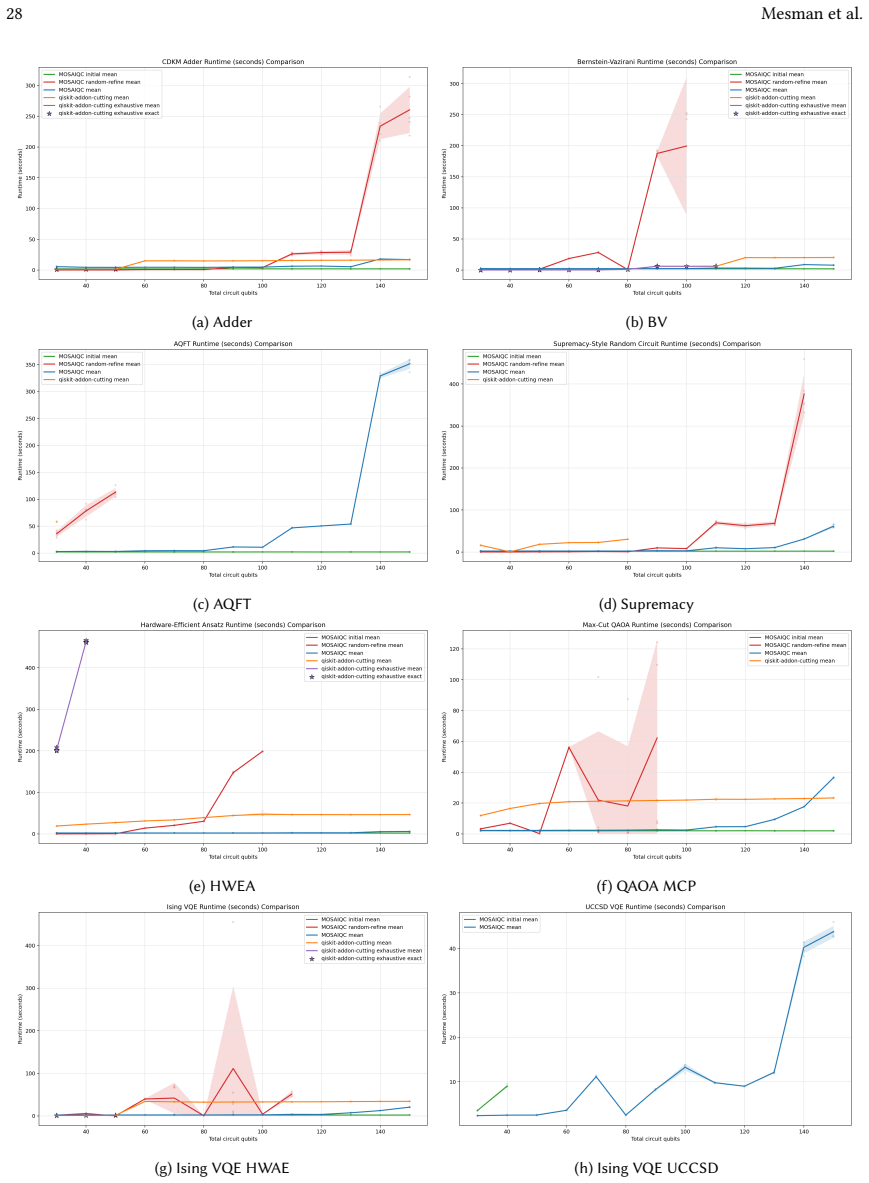
- [§4, first paragraph; §4.1] The large-scale experiments (150–1000 qubits) are run with QAP evaluations turned off, and the 127-qubit mapping optimizations also disable QAP. This means the scalability results exercise only the cut-placement and runtime components, not the noise-informed placement component that is central to the paper's title and contribution. The statement that MosaiQC 'jointly optimizes sampling overhead and hardware-aware placement' at large scale is therefore not supported by the reported experiments. Please either include large-scale runs with an approximate/bounded QAP mode and report the fidelity/quality trade-off, or explicitly restrict the large-scale claim to the non-noise-aware cut-placement components.
- [§4.1, §4.2, Appendix 8.3] The reported geometric-mean runtime improvement of 2.88x and the average 16.84% cut reduction are computed only over instances completed by both MosaiQC and the baseline. §4.1 acknowledges that the Qiskit add-on frequently times out or runs out of memory, and Appendix 8.3 notes that Qiskit results are not always available for larger circuits. Excluding baseline failures from the comparison removes exactly the cases where MosaiQC is claimed to be most advantageous. Please report results on the full benchmark set, for example by including timeout markers, median/imputed runtimes, or a separate analysis of the instances where the baseline fails.
- [§4, 'For most benchmarks' and 'For the BV benchmark'] The warm-start type (gate-cut versus wire-cut initialization) is chosen per benchmark: gate cuts for most benchmarks, but wire cuts for BV because it is 'wire-cut heavy.' As described, this appears to be a benchmark-specific tuning decision made after seeing the results. If the choice is part of the method, a principled selection rule should be given; otherwise, the benchmark results may reflect favorable per-instance tuning rather than the performance of a single algorithm. Please provide a general criterion or report sensitivity to both initialization choices across all benchmarks.
minor comments (4)
- [§7 Code Availability] The URL is malformed: 'https://https://github.com/koenmesman/MosaiQC' contains a duplicated scheme. It should be 'https://github.com/koenmesman/MosaiQC'.
- [Abstract vs. §4.2 and §6] There are numeric inconsistencies: the abstract reports 5.83·10^11 overhead reduction while §4.2 reports 5.38·10^11; the conclusion reports 19.65% improved fidelity while §4.4 and the abstract report 19.56%. Please harmonize these numbers.
- [§3.5, Eq. (12)] The equation for w_local is typeset ambiguously (the division by the square root is visually unclear), and the normalization is not derived. Since S_QAP in Eq. (13) is a nonlinear function of w_local, please clarify what quantity is being averaged and why the mean squared error aggregation is appropriate across partitions of different sizes.
- [§3.4] The claimed wire-cut evaluation complexity O((a+1)p log p) is introduced without defining p precisely and without explaining how it combines with the 'O(m) for per-qubit gate depth m' statement earlier in the same subsection. Please reconcile these cost statements.
Circularity Check
No significant circularity: claims are empirical comparisons against an external baseline; the QAP proxy is validated as a surrogate, and the local-to-reconstructed fidelity link is explicitly left open as a limitation.
full rationale
The paper's derivation chain is an empirical engineering comparison, not a formal derivation from assumed results. The central claims (2.88x runtime, 16.84% cut reduction, 19.56% local fidelity improvement) are measured against the Qiskit circuit-cutting add-on as an external baseline, so they are not forced by the paper's own definitions. The QAP placement score (Eqs. 9-13) is introduced as a surrogate, with a log-fidelity weighting w=ln(1-eps) that is standard for product-of-fidelities; its correlation with independently sampled fragment fidelity is reported (r=0.828-0.986), and the fidelity comparisons in Figs. 10-11 are measured on sampled states rather than read off the surrogate. The paper explicitly limits the claim: Section 5 states 'an open question is how improvements in local hardware fidelity translate to the fidelity of the reconstructed quantum state,' and notes the QAP subroutine was disabled in large-scale benchmarks. These are acknowledged limitations/correctness risks, not circular reductions. No load-bearing self-citation, no fitted parameter renamed as a prediction, and no uniqueness theorem imported from the authors' prior work appears in the paper.
Axiom & Free-Parameter Ledger
free parameters (4)
- alpha_path (alpha) =
0.25
- SWAP factor 3 =
3
- beta (mapping weight) =
1 and 50 in experiments
- Tabu tenure / max iterations =
N; N^2
axioms (7)
- domain assumption Exponential sampling overhead formulas for wire/gate cuts (Table 1)
- domain assumption METIS produces a useful warm-start partition for circuit graphs
- domain assumption Frank-Wolfe yields close-to-optimal QAP solutions
- domain assumption Static calibration noise data from Qiskit FakeBackends represent real hardware behavior
- domain assumption QAP score is a valid fidelity proxy
- ad hoc to paper Greedy min-cost-first conversion of wire cuts to gate cuts is near-optimal
- ad hoc to paper Per-benchmark initialization choice (gate vs wire cut warmstart)
Cite this review
Pith. "Pith review of MOSAIQC: Mixed-topology-aware Optimization for Scalable Approximate noise-Informed Quantum circuit Cutting." pith.science (2026). https://pith.science/paper/HSWQURM5
@misc{pith2026260718888,
  author       = {Pith},
  title        = {Pith review of: MOSAIQC: Mixed-topology-aware Optimization for Scalable Approximate noise-Informed Quantum circuit Cutting},
  year         = {2026},
  howpublished = {\url{https://pith.science/paper/HSWQURM5}},
  note         = {Machine review of arXiv:2607.18888}
}
read the original abstract
Current quantum computers do not yet have the required qubit resources to meet the demands of most practical quantum algorithms. To circumvent this constraint, the practice of dividing these algorithms into parts through quantum circuit cutting has been explored. Many of these works either show exponential scaling or are far from optimal solutions. In this paper, MosaiQC is presented as a novel framework to improve upon existing circuit cutting frameworks. A hybrid warmstart with refinement optimization is used to find cutting solutions, allowing the combination of both wire and gate cuts. Additionally, MosaiQC enables hardware partitions of mixed sizes. Furthermore, the refinement stage incorporates a fast approximate quadratic assignment solver to better place hardware partitions, demonstrating a mean local fidelity improvement of $19.56 \% \pm 6.17\%$ over the baseline algorithm. In runtime and sampling overhead costs, improvements of $2.88 \times$ and an average of $16.84\%$ cut reduction (resulting in an average $5.83 \cdot 10^{11} \times$ overhead reduction) are observed. MosaiQC demonstrates a superior trade-off for run speed and solution quality, while adding fundamental features excluded by most competitors. With this, MosaiQC demonstrates that scalable heuristic optimization can substantially reduce the computational overhead of circuit-cut placement for increasingly large quantum circuits.
Figures




Reference graph
Works this paper leans on
-
[1]
Frank Arute, Kunal Arya, Ryan Babbush, Dave Bacon, Joseph C Bardin, Rami Barends, Rupak Biswas, Sergio Boixo, Fernando GSL Brandao, David A Buell, et al. 2019. Quantum supremacy using a programmable superconducting processor.nature574, 7779 (2019), 505–510
2019
-
[2]
Thomas Ayral, François-Marie Le Régent, Zain Saleem, Yuri Alexeev, and Martin Suchara. 2021. Quantum divide and compute: exploring the effect of different noise sources.SN Computer Science2, 3 (2021), 132
2021
-
[3]
Saikat Basu, Arnav Das, Amit Saha, Amlan Chakrabarti, and Susmita Sur-Kolay. 2024. FragQC: An Efficient Quantum Error Reduction Technique using Quantum Circuit Fragmentation.Journal of Systems and Software214 (2024), 112085. doi:10.1016/j.jss.2024.112085
arXiv 2024
-
[4]
Marvin Bechtold, Johanna Barzen, Martin Beisel, Frank Leymann, and Benjamin Weder. 2023. Patterns for Quantum Circuit Cutting. InProceedings of the 30th Conference on Pattern Languages of Programs. 1–12
2023
-
[5]
Debasmita Bhoumik, Ritajit Majumdar, Amit Saha, and Susmita Sur-Kolay. 2023. Distributed Scheduling of Quantum Circuits with Noise and Time Optimization.arXiv preprint arXiv:2309.06005(2023). doi:10.48550/arXiv.2309.06005
-
[6]
Brańczyk, Almudena Carrera Vazquez, Daniel J
Agata M. Brańczyk, Almudena Carrera Vazquez, Daniel J. Egger, Bryce Fuller, Julien Gacon, James R. Garrison, Jennifer R. Glick, Caleb Johnson, Saasha Joshi, Edwin Pednault, C. D. Pemmaraju, Pedro Rivero, Ibrahim Shehzad, and Stefan Woerner. 2024. Qiskit addon: circuit cutting. https: //github.com/Qiskit/qiskit-addon-cutting. doi:10.5281/zenodo.7987997
-
[7]
Sebastian Brandhofer, Ilia Polian, and Kevin Krsulich. 2024. Optimal Partitioning of Quantum Circuits using Gate Cuts and Wire Cuts.IEEE Transactions on Quantum Engineering5 (2024), 1–10. doi:10.1109/TQE.2023.3347106
arXiv 2024
-
[8]
Marcello Caleffi, Michele Amoretti, Davide Ferrari, Jessica Illiano, Antonio Manzalini, and Angela Sara Cacciapuoti. 2024. Distributed quantum computing: A survey.Computer Networks254 (2024), 110672. doi:10.1016/j.comnet.2024.110672
arXiv 2024
-
[9]
Waldemir Cambiucci, Regina Melo Silveira, and Wilson Vicente Ruggiero. 2025. Spatial and Temporal Circuit Cutting with Hypergraphic Partitioning. arXiv preprint arXiv:2504.09334(2025). doi:10.48550/arXiv.2504.09334
work page internal anchor Pith review Pith/arXiv arXiv doi:10.48550/arxiv.2504.09334 2025
-
[10]
Po-Hung Chen, Dah-Wei Chiou, Bo-Hung Chen, and Jie-Hong Roland Jiang. 2025. Enhanced Quantum Circuit Cutting Framework for Sampling Overhead Reduction. arXiv:2412.17704 [quant-ph] https://arxiv.org/abs/2412.17704
arXiv 2025
-
[11]
Xinglei Dou, Lei Liu, Zhuohao Wang, and Pengyu Li. 2025. LarQucut: A New Cutting and Mapping Approach for Large-sized Quantum Circuits in Distributed Quantum Computing (DQC) Environments.arXiv preprint arXiv:2502.21000(2025). doi:10.48550/arXiv.2502.21000
work page internal anchor Pith review Pith/arXiv arXiv doi:10.48550/arxiv.2502.21000 2025
-
[12]
Zefan Du, Yanni Li, Zijian Mo, Wenqi Wei, Juntao Chen, Rajkumar Buyya, and Ying Mao. 2024. Hardware-aware Circuit Cutting and Distributed Qubit Mapping for Connected Quantum Systems.arXiv preprint arXiv:2412.18458(2024). doi:10.48550/arXiv.2412.18458
-
[13]
Pau Escofet, Anabel Ovide, Carmen G Almudever, Eduard Alarcón, and Sergi Abadal. 2023. Hungarian qubit assignment for optimized mapping of quantum circuits on multi-core architectures.IEEE Computer Architecture Letters22, 2 (2023), 161–164
2023
-
[14]
Marguerite Frank and Philip Wolfe. 1956. An algorithm for quadratic programming.Naval Research Logistics Quarterly3 (1956), 95–110. https://api.semanticscholar.org/CorpusID:122654717
1956
-
[15]
Keisuke Fujii, Kaoru Mizuta, Hiroshi Ueda, Kosuke Mitarai, Wataru Mizukami, and Yuya O Nakagawa. 2022. Deep variational quantum eigensolver: A divide-and-conquer method for solving a larger problem with smaller size quantum computers.PRX Quantum3, 1 (2022), 010346
2022
-
[16]
Fred Glover. 1989. Tabu search—part I.ORSA Journal on computing1, 3 (1989), 190–206
1989
-
[17]
Hiroyuki Harada, Kaito Wada, Naoki Yamamoto, and Suguru Endo. 2025. Exponential-to-polynomial scaling of measurement overhead in circuit knitting via quantum tomography. arXiv:2512.19623 [quant-ph] https://arxiv.org/abs/2512.19623
Pith/arXiv arXiv 2025
-
[18]
Yuval Idan, Eitan Zahavi, Elad Mentovich, Eliahu Cohen, and Shmuel Zaks. 2026. Quantum Circuit Cutting: Complexity and Optimization. arXiv:2604.23700 [quant-ph] https://arxiv.org/abs/2604.23700
Pith/arXiv arXiv 2026
-
[19]
Takehiro Ito, Naonori Kakimura, Naoyuki Kamiyama, Yusuke Kobayashi, and Yoshio Okamoto. 2023. Algorithmic theory of qubit routing. In Algorithms and Data Structures Symposium. Springer, 533–546
2023
-
[20]
Martin Jaggi. 2013. Revisiting Frank-Wolfe: Projection-free sparse convex optimization. InInternational conference on machine learning. PMLR, 427–435
2013
-
[21]
Wenzel Jakob, Jason Rhinelander, and Dean Moldovan. 2017. pybind11 – Seamless operability between C++11 and Python. https://github.com/pybind/pybind11
2017
-
[22]
Wood, Jake Lishman, Julien Gacon, Simon Martiel, Paul D
Ali Javadi-Abhari, Matthew Treinish, Kevin Krsulich, Christopher J. Wood, Jake Lishman, Julien Gacon, Simon Martiel, Paul D. Nation, Lev S. Bishop, Andrew W. Cross, Blake R. Johnson, and Jay M. Gambetta. 2024. Quantum computing with Qiskit. arXiv:2405.08810 [quant-ph] https://arxiv.org/abs/2405.08810
Pith/arXiv arXiv 2024
-
[23]
Grace Johnson, Aniello Esposito, Gaurav Gyawali, Xin Zhan, Rohit Ganti, Namit Anand, Raymond G
K. Grace Johnson, Aniello Esposito, Gaurav Gyawali, Xin Zhan, Rohit Ganti, Namit Anand, Raymond G. Beausoleil, and Masoud Mohseni. 2026. Distributed Quantum Computing via Adaptive Circuit Knitting. arXiv:2603.12411 [quant-ph] https://arxiv.org/abs/2603.12411
arXiv 2026
-
[24]
Stein, Chenxu Liu, Wenqi Wei, Juntao Chen, Ang Li, and Ying Mao
Shuwen Kan, Zefan Du, Miguel Palma, Samuel A. Stein, Chenxu Liu, Wenqi Wei, Juntao Chen, Ang Li, and Ying Mao. 2024. Scalable Circuit Cutting and Scheduling in a Resource-Constrained and Distributed Quantum System.arXiv preprint arXiv:2405.04514(2024). doi:10.48550/arXiv.2405.04514
-
[25]
Shuwen Kan, Yanni Li, Hao Wang, Sara Mouradian, and Ying Mao. 2025. Circuit Folding: Scalable and Graph-Based Circuit Cutting via Modular Structure Exploitation. In2025 IEEE/ACM International Conference On Computer Aided Design (ICCAD). IEEE, 1–9
2025
-
[26]
George Karypis and Vipin Kumar. 1997. METIS: A software package for partitioning unstructured graphs, partitioning meshes, and computing fill-reducing orderings of sparse matrices. (1997). 24 Mesman et al
1997
-
[27]
Angus Lowe, Matija Medvidović, Anthony Hayes, Lee J O’Riordan, Thomas R Bromley, Juan Miguel Arrazola, and Nathan Killoran. 2023. Fast quantum circuit cutting with randomized measurements.Quantum7 (2023), 934
2023
-
[28]
Alberto Marchisio, Emman Sychiuco, Muhammad Kashif, and Muhammad Shafique. 2025. Cutting is All You Need: Execution of Large-Scale Quantum Neural Networks on Limited-Qubit Devices. In2025 IEEE International Conference on Quantum Artificial Intelligence (QAI). 330–336
2025
-
[29]
Kosuke Mitarai and Keisuke Fujii. 2021. Constructing a virtual two-qubit gate by sampling single-qubit operations.New Journal of Physics23, 2 (2021), 023021
2021
-
[30]
Masoud Mohseni, Artur Scherer, K. Grace Johnson, Oded Wertheim, Matthew Otten, Namit Anand, Navid Anjum Aadit, Yuri Alexeev, Gilad Ben-Shach, Kirk M. Bresniker, Kerem Y. Camsari, Barbara Chapman, Soumitra Chatterjee, Shuvro Chowdhury, Gebremedhin A. Dagnew, Tom Dvir, Aniello Esposito, Farah Fahim, Michael Ferguson, Marco Fiorentino, Archit Gajjar, Katerin...
Pith/arXiv arXiv 2026
-
[31]
Junya Nakamura, Takahiko Satoh, and Shinichiro Sanji. 2025. Improved sampling bounds and scalable partitioning for quantum circuit cutting beyond bipartitions.Physical Review A112, 4 (2025), 042422
2025
-
[32]
Tianyi Peng, Aram W Harrow, Maris Ozols, and Xiaodi Wu. 2020. Simulating large quantum circuits on a small quantum computer.Physical review letters125, 15 (2020), 150504
2020
-
[33]
Maniraman Periyasamy, Christian Ufrecht, Daniel D. Scherer, and Wolfgang Mauerer. 2025. CutReg: A loss regularizer for enhancing the scalability of QML via adaptive circuit cutting. arXiv:2506.14858 [quant-ph] https://arxiv.org/abs/2506.14858
Pith/arXiv arXiv 2025
-
[34]
Christophe Piveteau, Lukas Schmitt, and David Sutter. 2025. Circuit cutting with classical side information.Physical Review Research7, 3 (2025). doi:10.1103/38mx-36k6
-
[35]
Xiangyu Ren, Mengyu Zhang, and Antonio Barbalace. 2024. A Hardware-Aware Gate Cutting Framework for Practical Quantum Circuit Knitting. InProceedings of the 2024 IEEE/ACM International Conference on Computer-Aided Design (ICCAD). doi:10.1145/3676536.3676719
arXiv 2024
-
[36]
Himanshu Sahu, Hari Prabhat Gupta, Vishnu Vardhan Puvvada, et al. 2025. DevQCC: Device-Aware Quantum Circuit Cutting Framework with Applications in Quantum Machine Learning.Quantum Machine Intelligence7 (2025), 89. doi:10.1007/s42484-025-00313-0
-
[37]
Smith, Michael A
Kaitlin N. Smith, Michael A. Perlin, Pranav Gokhale, Paige Frederick, David Owusu-Antwi, Richard Rines, Victory Omole, and Frederic T. Chong
-
[38]
Soloviev, Antonio Márquez Romero, Josh Kirsopp, and Michal Krompiec
Vicente P. Soloviev, Antonio Márquez Romero, Josh Kirsopp, and Michal Krompiec. 2025. Scaling Portfolio Diversification with Quantum Circuit Cutting Techniques. arXiv:2506.08947 [quant-ph] https://arxiv.org/abs/2506.08947
Pith/arXiv arXiv 2025
-
[39]
Wei Tang and Margaret Martonosi. 2022. ScaleQC: A Scalable Framework for Hybrid Computation on Quantum and Classical Processors.arXiv preprint arXiv:2207.00933(2022). doi:10.48550/arXiv.2207.00933
-
[40]
Wei Tang, Teague Tomesh, Martin Suchara, Jeffrey Larson, and Margaret Martonosi. 2021. CutQC: Using Small Quantum Computers for Large Quantum Circuit Evaluations. InProceedings of the 26th ACM International Conference on Architectural Support for Programming Languages and Operating Systems (ASPLOS ’21). 473–486. doi:10.1145/3445814.3446758
arXiv 2021
-
[41]
Mar Tejedor, Berta Casas, Javier Conejero, Alba Cervera-Lierta, and Rosa M. Badia. 2025. Distributed Quantum Circuit Cutting for Hybrid Quantum-Classical High-Performance Computing.arXiv preprint arXiv:2505.01184(2025). doi:10.48550/arXiv.2505.01184
-
[42]
Teague Tomesh, Zain H Saleem, Michael A Perlin, Pranav Gokhale, Martin Suchara, and Margaret Martonosi. 2023. Divide and conquer for combinatorial optimization and distributed quantum computation. In2023 IEEE International Conference on Quantum Computing and Engineering (QCE), Vol. 1. IEEE, 1–12
2023
-
[43]
Songqinghao Yang and Prakash Murali. 2024. Understanding the Scalability of Circuit Cutting Techniques for Practical Quantum Applications. arXiv preprint arXiv:2411.17756(2024). doi:10.48550/arXiv.2411.17756
-
[44]
Pengcheng Zhu, Shenggen Zheng, Lihua Wei, Xueyun Cheng, Zhijin Guan, and Shiguang Feng. 2022. The complexity of quantum circuit mapping with fixed parameters.Quantum Information Processing21, 10 (2022), 361. MOSAIQC: Mixed-topology-aware Optimization for Scalable Approximate noise-Informed Quantum circuit Cutting 25 8 Appendix 8.1 Wire cut optimization Th...
2022
-
[2023]
InProceedings of the 2023 ACM/IEEE International Symposium on Computer Architecture (ISCA)
Clifford-based Circuit Cutting for Quantum Simulation. InProceedings of the 2023 ACM/IEEE International Symposium on Computer Architecture (ISCA). doi:10.1145/3579371.3589352
arXiv 2023
This paper was first reviewed by deepseek-v4-flash on August 1, 2026.
discussion (0)
Sign in with ORCID, Apple, or X to comment. Anyone can read and Pith papers without signing in.