REVIEW 3 major objections 6 minor 52 references
Energy Conversion, Fluctuation Suppression, and Information Transfer in the Thermodynamic Performance of Kinesin
T0 review · 3 major / 6 minor · reviewed 2026-08-01 · deepseek-v4-flash
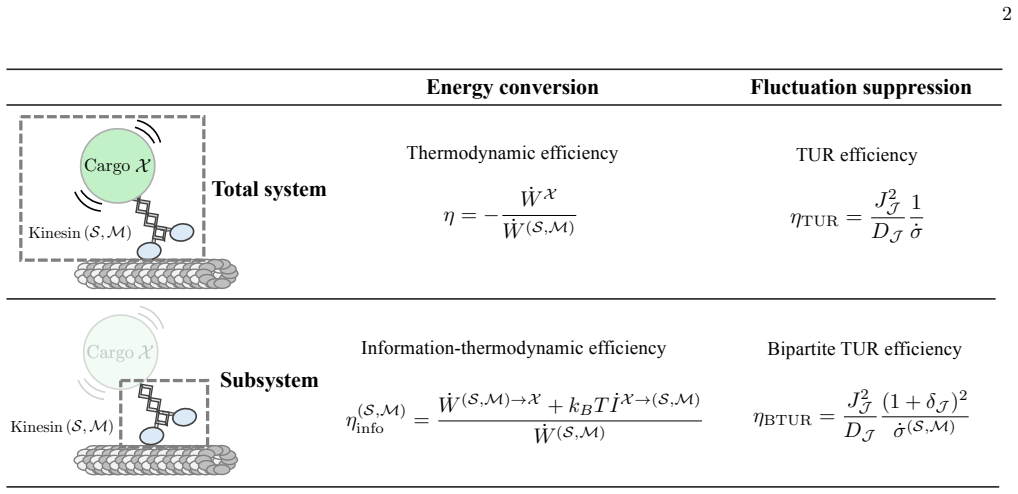
Pith's one-line read In one thermodynamically consistent kinesin–cargo model, the thermodynamic, information-thermodynamic, TUR, and bipartite TUR efficiencies all come out low, pointing to kinetic rather than thermodynamic optimization.
desk verdict A careful, useful unified efficiency analysis; the 'not optimized' claim is real but rides on non-unique transition-rate choices. read the letter →
The pith
A machine-rendered reading of the paper's core claim, the machinery that carries it, and where it could break.
The reading
What carries the argument
The central object is a two-state kinesin–cargo model: an internal kinesin state, a discrete motor position with 8 nm steps, and a continuum cargo coordinate connected by a spring, all constrained by local detailed balance. The analytical engine is a perturbative expansion in the ratio of cargo relaxation time to motor transition time, which yields effective force-dependent exponential rates for the slow motor dynamics. In the fast-cargo limit this expansion produces the paper's key identity, Eq. (98): the information-thermodynamic efficiency equals the standard thermodynamic efficiency. For the fluctuation efficiencies, the machinery is the tilted generator of the effective slow Markov chai
What would settle it
Evaluate the same four efficiencies with a different thermodynamically consistent transition-rate scheme (same local detailed balance ratios, different load-sharing or rate-shape choices); if the zero-load information-thermodynamic efficiency or the maximum thermodynamic efficiency rises above about 0.4, the low-efficiency conclusion is not robust. Alternatively, measure the zero-load quantity γv²/Ẇ(S,M) in a single-motor high-viscosity assay at controlled temperature; if it exceeds about 0.5, the model's calibration is inconsistent with the earlier high estimate.
Extended reading notes
Core claim
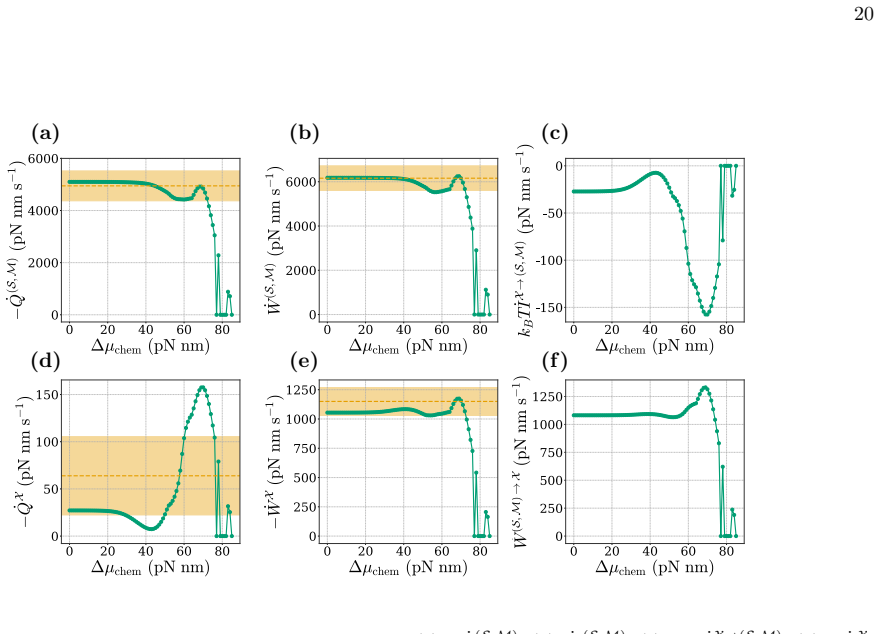
The central claim is that once four efficiency measures are computed within one model—thermodynamic efficiency, information-thermodynamic efficiency, TUR efficiency, and bipartite TUR efficiency—kinesin does not appear optimized for any of them. Under the in vitro high-ATP condition, the thermodynamic efficiency reaches about 0.26; under in-vivo-like friction, about 0.18. The information-thermodynamic efficiency, under time-scale separation, is analytically equal to the thermodynamic efficiency (Eq. 98): at zero external force it is near zero in vitro and at most about 0.24 in the in-vivo-like condition, contradicting earlier estimates of 0.7–0.9, with the discrepancy traced to assumptions a
Load-bearing premise
The numerical verdict rests on the specific exponential transition-rate functions chosen for the mechanical steps; local detailed balance fixes only the ratios of these rates, and the paper itself notes that a different thermodynamically consistent choice could significantly change the nonequilibrium physics.
Editorial extensions
If this is right
- Kinesin's design target is probably not maximum work output, information transduction, or fluctuation suppression: all four measures top out well below unity.
- The earlier result that kinesin has 70–90% information-thermodynamic efficiency is not reproduced; at zero load the model gives near zero in vitro and at most about 0.24 in the in-vivo-like condition.
- Under fast cargo relaxation, information flow between motor and cargo does not create a separate high-efficiency channel; it is thermodynamically equivalent to standard work-conversion efficiency.
- The TUR efficiency under the in-vivo-like load (about 0.28 at -1 pN) matches a prior six-state model, suggesting the low fluctuation-suppression verdict is not an artifact of the two-state coarse graining.
- The low-efficiency conclusion is qualitatively insensitive to ATP concentration: high- and low-ATP conditions give the same overall picture.
Reading between the lines
- If the conclusion extends beyond this model, kinesin's reliability—high processivity, directionality, and low backstepping—is likely achieved through kinetic design rather than thermodynamic efficiency, so future optimization studies should focus on rate asymmetries or other time-symmetric (frenetic) costs.
- The equivalence of information-thermodynamic and standard thermodynamic efficiency under time-scale separation may hold for any bipartite motor with a fast relaxation coordinate; it would be worth testing in six-state or more detailed motor models.
- Because the in-vivo-like condition here is modeled only by larger friction, the low-efficiency verdict may not survive a realistic cytoplasm with active nonthermal fluctuations; extending the model to a non-equilibrium bath is a testable next step.
- A direct experimental test: measure the zero-load ratio γv²/Ẇ(S,M) in a controlled single-motor intracellular or high-viscosity assay; values above roughly 0.5 would falsify the parameter-based explanation for the earlier high estimate.
Signed reviews
Editorial analysis
A structured set of objections, weighed in public.
Referee Report
Summary. The paper constructs a thermodynamically consistent two-state kinesin–cargo model that retains discrete kinesin stepping and elastic coupling to a diffusing cargo. Assuming a separation of time scales between motor and cargo, the authors derive perturbative analytical expressions for four efficiencies—thermodynamic, information-thermodynamic, TUR, and bipartite TUR—and compare them with Gillespie simulations that discretize the cargo Fokker–Planck dynamics onto a lattice. Parameters are fitted to the force–velocity data of Ref. [16], and the model is validated against measured energetic quantities at F = −2 pN. The central quantitative claim is that all four efficiencies remain low (thermodynamic efficiency ≈ 0.18–0.26; information-thermodynamic efficiency at most ≈ 0.24 under an in vivo-like condition; TUR efficiencies below ≈ 0.4 for the currents considered), so kinesin does not appear to be optimized for these thermodynamic efficiencies. A secondary key result is that, under time-scale separation, the information-thermodynamic efficiency reduces to the standard thermodynamic efficiency (Eq. (98)), contradicting the high 0.7–0.9 estimate of Ref. [20].
Significance. If the quantitative conclusions are robust, the paper makes a valuable contribution: it provides a unified framework for comparing several thermodynamic efficiencies in a single molecular-motor model and offers a concrete explanation for the discrepancy with the higher information-thermodynamic efficiency of Leighton and Sivak (Ref. [20]). The analytic derivations are detailed and transparent, the simulation method is carefully constructed (lattice-discretized cargo dynamics with a continuum-matching condition), and the model is validated against experimental force–velocity and heat/power data. The paper also explicitly enumerates limitations, including the breakdown of time-scale separation away from the stall force and in the in vivo-like regime. However, the significance of the central claim—that kinesin itself is not thermodynamically optimized—depends on the model's representativeness and on the fitted parameter uncertainties, both of which need sharper treatment before the strong abstract-level conclusion can be accepted.
major comments (3)
- [§II, Eqs. (13)–(16); Appendix B] The central quantitative conclusion depends on the specific exponential transition-rate functional forms, which are not fixed by local detailed balance. The paper itself notes after Eq. (12) that 'the specific choice of transition rates may significantly affect physics in the nonequilibrium case.' Since θ_f, θ_b, τ_f, and τ_b enter directly into the analytic efficiency expressions (Appendix D, Eqs. (D2)–(D11)), an equally thermodynamically consistent rate model that reproduces the same force–velocity data could yield different efficiency values and potentially a different qualitative verdict. The authors should either justify Eqs. (13)–(16) as the unique physically appropriate choice or demonstrate that the 'low efficiency' conclusion is invariant under a physically motivated class of rate models (e.g., varying the load-sharing parameters θ_f, θ_b while maintaining the fit). Without such
- [Table II; §V] The fitted parameters carry very large uncertainties (e.g., τ_b = 0.194 ± 1.476 s, θ_b = 0.000 ± 0.312), yet all efficiency calculations in Section V use point estimates and no uncertainty propagation is performed. The reported maxima (η ≈ 0.18–0.26, η_TUR ≈ 0.25–0.38, etc.) are therefore single-point estimates whose statistical support is unknown. A bootstrap or covariance-based propagation of the fitting uncertainties should be added, or at least a sensitivity analysis over the plausible parameter ranges, to show that the efficiencies remain 'low' (e.g., below 0.5) across the uncertainty region. Without this, the quantitative claims are not established by the fitted model.
- [§V, γ_vivo; §VI] The in vivo-like condition is implemented solely by increasing the friction coefficient to γ_vivo = 1.0×10⁻² pN s/nm, which the authors state gives ε ∼ 10, i.e., time-scale separation is no longer valid. The analytical perturbative results are therefore not applicable in this regime, and the numerical results for γ_vivo are used to support the conclusion that η_info remains low under in vivo-like conditions. This is load-bearing because the contrast with Ref. [20] (which reported η_info = 0.7–0.9 under in vivo conditions) depends precisely on this regime. The paper acknowledges this limitation in Section VI, but the abstract and conclusions do not carry the caveat. The authors should either qualify the in vivo-like conclusions as model-specific estimates for a single-parameter proxy, or add a validation/discussion showing that the qualitative low-efficiency result is insensitive to other
minor comments (6)
- [§IV A, near Eq. (75)] The sentence 'the assumption of time-scale separation is strictly violated away from the stall force, where the kinesin velocity vanishes' is self-contradictory: the velocity vanishes at the stall force, not away from it. The intended meaning is presumably 'away from the stall force, where the velocity does not vanish' or 'except near the stall force.' Please fix.
- [Table II and Table III] The notation '(Fixed) 42.4' and '(Fixed) 38.3' in Table II is unclear—these are not fixed during the fit but selected via the stall-force argument in Appendix B. Consider using a different marker (e.g., 'Set by Eq. (…)' or a footnote).
- [§III C, Eqs. (68) and (70)] The text says η_TUR and η_BTUR satisfy 0 ≤ η ≤ 1, but this is only true when the corresponding TUR bound is valid. For finite-time or approximate calculations, the efficiency can exceed 1; the authors should state that the inequalities hold in the exact long-time limit and that their approximate expressions may not strictly respect the bound.
- [§V A and Fig. 5] The information flow sign convention is described clearly, but the statement in the text 'information propagates from the kinesin to the cargo' could be confused with the definition of ˙I^(S,M)→X. Consider adding a parenthetical relating the sign convention to Eq. (34)–(35).
- [Appendix C] The lattice spacing Δx = 0.05 nm is smaller than the thermal width ~7.4 nm, but the computational cost scaling with Δx⁻² is not discussed. The authors correctly state that convergence was checked, but a brief statement of the runtimes or of the error as a function of Δx would strengthen the reproducibility of the numerics.
- [References] Ref. [26] is cited as 'arXiv preprint cond-mat/0407262'; if this paper has been published in a refereed venue, please update the reference. The same applies to any other preprint-only citations.
Circularity Check
No significant circularity: the efficiency identities are derived from the model's first laws and tilted generators, not imposed by the fit.
full rationale
The derivation chain is self-contained at the level of the claimed analytic results. η, η_info, η_TUR and η_BTUR are defined in Sec. III from the first/second laws and the bipartite TUR; the reduction η_info ≃ η is obtained from the derived relation Qdot_X = k_B T Idot + O(ε) (Eq. 96) and the subsystem first law (Eq. 97), not from a definitional equivalence. The TUR efficiencies are obtained from explicit tilted-generator calculations (Appendix E) using the model's rates. The quantitative efficiencies do depend on the transition-rate ansatz (13)-(16), and the paper explicitly acknowledges that local detailed balance fixes only ratios and that 'the specific choice of transition rates may significantly affect physics in the nonequilibrium case'; this is a robustness/extrapolation limitation, not a circular step. The parameters are calibrated to the force-velocity data of Ref. [16] (which shares a co-author with the present paper), and Table I then compares the resulting thermodynamic quantities with the same experimental paper. The -W_X entry is essentially -F v from the fitted F-v relation, so that particular comparison is in-sample rather than a strong out-of-sample prediction; however, the main efficiency values and the analytic identities do not reduce to the fitted data by construction. The self-citation [21] supplies the bipartite TUR inequality and the δ_J vanishing condition as an external theorem; it is not used to force the conclusion. I find no step where a claimed prediction is equivalent to its input by definition.
Assumptions & free parameters
free parameters (7)
- tau_f =
0.1445 ± 0.130 s (high ATP)
- tau_b =
0.194 ± 1.476 s (high ATP)
- k_c =
123.4 ± 18.50 s^-1 (high ATP)
- Delta_mu_chem =
42.4 pN nm (high ATP; fixed after scan)
- theta_f =
0.493 ± 0.184
- theta_b =
0.000 ± 0.312
- gamma_vivo =
1.0e-2 pN s/nm
assumptions (7)
- domain assumption Local detailed balance for kinesin transitions, Eqs. (10)–(12)
- ad hoc to paper Exponential transition-rate functional forms, Eqs. (13)–(16)
- domain assumption Overdamped Langevin cargo dynamics with white noise, Eq. (7)
- domain assumption Time-scale separation epsilon = tau_X / tau_(S,M) << 1 and O(epsilon^0) perturbative expansion
- ad hoc to paper In vivo-like condition modeled only by increasing gamma to gamma_vivo
- standard math Long-time limit with vanishing system-entropy time derivative
- standard math Perron–Frobenius largest eigenvalue of tilted generator for TUR cumulants, Eq. (E17)
Cite this review
Pith. "Pith review of Energy Conversion, Fluctuation Suppression, and Information Transfer in the Thermodynamic Performance of Kinesin." pith.science (2026). https://pith.science/paper/M25SPF32
@misc{pith2026260718905,
  author       = {Pith},
  title        = {Pith review of: Energy Conversion, Fluctuation Suppression, and Information Transfer in the Thermodynamic Performance of Kinesin},
  year         = {2026},
  howpublished = {\url{https://pith.science/paper/M25SPF32}},
  note         = {Machine review of arXiv:2607.18905}
}
read the original abstract
Kinesin is a molecular motor that transports intracellular cargoes along microtubules. Recent studies have quantified kinesin performance using various efficiencies within the framework of stochastic thermodynamics; however, quantitative comparisons remain difficult because different models and assumptions have been employed. As a result, it remains unclear which aspect of kinesin performance, if any, is thermodynamically optimized. Here, we systematically compare multiple thermodynamic efficiencies within a single kinesin-cargo model. To this end, we construct a thermodynamically consistent two-state kinesin-cargo model that retains both the discrete stepping of kinesin and its coupling to the cargo. Assuming a separation of time scales between the motor and the cargo, we derive analytical expressions for the thermodynamic efficiency, the information-thermodynamic efficiency, the thermodynamic uncertainty relation (TUR) efficiency, and the bipartite TUR efficiency, and compare them with numerical simulation results. We find that these efficiencies generally remain low, suggesting that kinesin is not optimized for maximizing the thermodynamic efficiencies considered here. Our results suggest that thermodynamic efficiencies alone may not fully characterize kinesin performance and motivate further investigation of complementary kinetic perspectives for assessing molecular motor function.
Figures


Figures from the paper (11 more)




Reference graph
Works this paper leans on
-
[16]
Ariga, M
T. Ariga, M. Tomishige, and D. Mizuno, Nonequilibrium energetics of molecular motor kinesin, Phys. Rev. Lett. 121, 218101 (2018)
2018
-
[20]
M. P. Leighton and D. A. Sivak, Inferring subsystem effi- ciencies in bipartite molecular machines, Phys. Rev. Lett. 130, 178401 (2023)
2023
-
[1]
R. D. Vale, The molecular motor toolbox for intracellular transport, Cell112, 467 (2003)
2003
-
[2]
Hirokawa, Y
N. Hirokawa, Y. Noda, Y. Tanaka, and S. Niwa, Kinesin superfamily motor proteins and intracellular transport, Nat. Rev. Mol. Cell Biol.10, 682 (2009)
2009
-
[3]
Svoboda, C
K. Svoboda, C. F. Schmidt, B. J. Schnapp, and S. M. Block, Direct observation of kinesin stepping by optical trapping interferometry, Nature365, 721 (1993)
1993
-
[4]
Kaseda, H
K. Kaseda, H. Higuchi, and K. Hirose, Alternate fast and slow stepping of a heterodimeric kinesin molecule, Nat. Cell Biol.5, 1079 (2003)
2003
-
[5]
C. L. Asbury, A. N. Fehr, and S. M. Block, Kinesin moves by an asymmetric hand-over-hand mechanism, Science 302, 2130 (2003)
2003
-
[6]
Yildiz, M
A. Yildiz, M. Tomishige, R. D. Vale, and P. R. Selvin, Kinesin walks hand-over-hand, Science303, 676 (2004)
2004
Show all 52 references
-
[7]
R. A. Cross, I. Crevel, N. J. Carter, M. C. Alonso, K. Hi- rose, and L. A. Amos, The conformational cycle of ki- nesin, Philos. Trans. R. Soc. Lond. B Biol. Sci.355, 459 (2000)
2000
-
[8]
T. Mori, R. D. Vale, and M. Tomishige, How kinesin waits between steps, Nature450, 750 (2007)
2007
-
[9]
M. J. Schnitzer and S. M. Block, Kinesin hydrolyses one ATP per 8-nm step, Nature388, 386 (1997)
1997
-
[10]
W. Hua, E. C. Young, M. L. Fleming, and J. Gelles, Coupling of kinesin steps to ATP hydrolysis, Nature388, 390 (1997)
1997
-
[11]
M. Y. Dogan, S. Can, F. B. Cleary, V. Purde, and A. Yildiz, Kinesin’s front head is gated by the backward orientation of its neck linker, Cell Rep.10, 1967 (2015)
1967
-
[12]
Isojima, R
H. Isojima, R. Iino, Y. Niitani, H. Noji, and M. Tomishige, Direct observation of intermediate states during the stepping motion of kinesin-1, Nat. Chem. Biol. 12, 290 (2016)
2016
-
[13]
Seifert,Stochastic thermodynamics(Cambridge Uni- versity Press, 2025)
U. Seifert,Stochastic thermodynamics(Cambridge Uni- versity Press, 2025)
2025
-
[14]
Peliti and S
L. Peliti and S. Pigolotti,Stochastic Thermodynamics: An Introduction(Princeton University Press, 2021)
2021
-
[15]
Shiraishi,An Introduction to Stochastic Thermody- namics, Fundamental Theories of Physics (Springer, Sin- gapore, 2023)
N. Shiraishi,An Introduction to Stochastic Thermody- namics, Fundamental Theories of Physics (Springer, Sin- gapore, 2023)
2023
-
[17]
Hwang and C
W. Hwang and C. Hyeon, Energetic costs, precision, and transport efficiency of molecular motors, J. Phys. Chem. Lett.9, 513 (2018)
2018
-
[18]
A. C. Barato and U. Seifert, Thermodynamic uncertainty relation for biomolecular processes, Phys. Rev. Lett.114, 158101 (2015)
2015
-
[19]
T. R. Gingrich, J. M. Horowitz, N. Perunov, and J. L. England, Dissipation bounds all steady-state current fluctuations, Phys. Rev. Lett.116, 120601 (2016)
2016
-
[21]
Tanogami, T
T. Tanogami, T. Van Vu, and K. Saito, Universal bounds on the performance of information-thermodynamic en- gine, Phys. Rev. Research5, 043280 (2023)
2023
-
[22]
Baiesi and C
M. Baiesi and C. Maes, Life efficiency does not always in- crease with the dissipation rate, Journal of Physics Com- munications2, 045017 (2018)
2018
-
[23]
Maes, Frenesy: Time-symmetric dynamical activity in nonequilibria, Phys
C. Maes, Frenesy: Time-symmetric dynamical activity in nonequilibria, Phys. Rep.850, 1 (2020)
2020
-
[24]
Risken, The Fokker-Planck Equation (Springer, 1996)
H. Risken, The Fokker-Planck Equation (Springer, 1996)
1996
-
[25]
Maes, Local detailed balance, SciPost Phys
C. Maes, Local detailed balance, SciPost Phys. Lect. Notes32, 1 (2021)
2021
-
[26]
Tasaki, A remark on the choice of stochastic transition rates in driven nonequilibrium systems, arXiv preprint cond-mat/0407262 (2004)
H. Tasaki, A remark on the choice of stochastic transition rates in driven nonequilibrium systems, arXiv preprint cond-mat/0407262 (2004)
2004 arXiv
-
[27]
Kawaguchi, S.-i
K. Kawaguchi, S.-i. Sasa, and T. Sagawa, Nonequilibrium dissipation-free transport in F1-ATPase and the thermo- dynamic role of asymmetric allosterism, Biophys. J.106, 2450 (2014)
2014
-
[28]
Taniguchi, M
Y. Taniguchi, M. Nishiyama, Y. Ishii, and T. Yanagida, Entropy rectifies the brownian steps of kinesin, Nat. Chem. Biol.1, 346 (2005)
2005
-
[29]
Nishiyama, H
M. Nishiyama, H. Higuchi, and T. Yanagida, Chemome- chanical coupling of the forward and backward steps of single kinesin molecules, Nat. Cell Biol.4, 790 (2002)
2002
-
[30]
Ariga, K
T. Ariga, K. Tateishi, M. Tomishige, and D. Mizuno, Noise-induced acceleration of single molecule kinesin-1, Phys. Rev. Lett.127, 178101 (2021)
2021
-
[31]
G. I. Bell, Models for the specific adhesion of cells to cells: a theoretical framework for adhesion mediated by reversible bonds between cell surface molecules., Science 200, 618 (1978)
1978
-
[32]
Sekimoto,Stochastic Energetics(Springer, New York, 2010)
K. Sekimoto,Stochastic Energetics(Springer, New York, 2010)
2010
-
[33]
C. W. Gardiner,Handbook of Stochastic Methods, 4th ed. (Springer, Berlin, 2009)
2009
-
[34]
A. E. Allahverdyan, D. Janzing, and G. Mahler, Thermo- dynamic efficiency of information and heat flow, J. Stat. Mech.2009, P09011 (2009)
2009
-
[35]
J. M. Horowitz and M. Esposito, Thermodynamics with continuous information flow, Phys. Rev. X4, 031015 (2014)
2014
-
[36]
J. M. Parrondo, J. M. Horowitz, and T. Sagawa, Ther- modynamics of information, Nat. Phys.11, 131 (2015)
2015
-
[37]
Chetrite, M
R. Chetrite, M. L. Rosinberg, T. Sagawa, and G. Tarjus, Information thermodynamics for interacting stochastic systems without bipartite structure, J. Stat. Mech.2019, 114002 (2019)
2019
-
[38]
Ehrich and D
J. Ehrich and D. A. Sivak, Energy and information flows in autonomous systems, Front. Phys.11, 155 (2023)
2023
-
[39]
Shiraishi and T
N. Shiraishi and T. Sagawa, Fluctuation theorem for par- tially masked nonequilibrium dynamics, Phys. Rev. E91, 012130 (2015)
2015
-
[40]
M. P. Leighton and D. A. Sivak, Flow of energy and infor- mation in molecular machines, Annu. Rev. Phys. Chem. 76(2025)
2025
-
[41]
J. M. Horowitz and T. R. Gingrich, Thermodynamic uncertainty relations constrain non-equilibrium fluctua- tions, Nat. Phys.16, 15 (2020)
2020
-
[42]
Shiraishi, Optimal thermodynamic uncertainty rela- tion in Markov jump processes, J
N. Shiraishi, Optimal thermodynamic uncertainty rela- tion in Markov jump processes, J. Stat. Phys.185, 1 (2021)
2021
-
[43]
Dechant and S.-i
A. Dechant and S.-i. Sasa, Current fluctuations and transport efficiency for general langevin systems, J. Stat. Mech.2018, 063209 (2018)
2018
-
[44]
Touchette, Introduction to dynamical large deviations of Markov processes, Physica A504, 5 (2018)
H. Touchette, Introduction to dynamical large deviations of Markov processes, Physica A504, 5 (2018). 31
2018
-
[45]
Schnakenberg, Network theory of microscopic and macroscopic behavior of master equation systems, Rev
J. Schnakenberg, Network theory of microscopic and macroscopic behavior of master equation systems, Rev. Mod. Phys.48, 571 (1976)
1976
-
[46]
D. T. Gillespie, Exact stochastic simulation of coupled chemical reactions, The journal of physical chemistry81, 2340 (1977)
1977
-
[47]
Shtridelman, T
Y. Shtridelman, T. Cahyuti, B. Townsend, D. DeWitt, and J. C. Macosko, Force–velocity curves of motor pro- teins cooperating in vivo, Cell Biochem. Biophys.52, 19 (2008)
2008
-
[48]
M. Guo, A. J. Ehrlicher, M. H. Jensen, M. Renz, J. R. Moore, R. D. Goldman, J. Lippincott-Schwartz, F. C. MacKintosh, and D. A. Weitz, Probing the stochastic, motor-driven properties of the cytoplasm using force spectrum microscopy, Cell158, 822 (2014)
2014
-
[49]
Ariga, Nonthermal fluctuations accelerate biomolecu- lar motors, Biophys
T. Ariga, Nonthermal fluctuations accelerate biomolecu- lar motors, Biophys. Rev.16, 605 (2024)
2024
-
[50]
Feng and Z
M. Feng and Z. Hou, Unraveling on kinesin acceleration in intracellular environments: A theory for active bath, Phys. Rev. Res.5, 013206 (2023)
2023
-
[51]
Tanogami, Violation of the second fluctuation- dissipation relation and entropy production in nonequi- librium medium, J
T. Tanogami, Violation of the second fluctuation- dissipation relation and entropy production in nonequi- librium medium, J. Stat. Phys.187, 1 (2022)
2022
-
[52]
Hyeon, S
C. Hyeon, S. Klumpp, and J. N. Onuchic, Kinesin’s back- steps under mechanical load, Phys. Chem. Chem. Phys. 11, 4899 (2009)
2009
Reviewed August 1, 2026 · model on record in the stance chip above.
Discussion (0). Continue with ORCID to comment.