REVIEW 5 major objections 5 minor 51 references
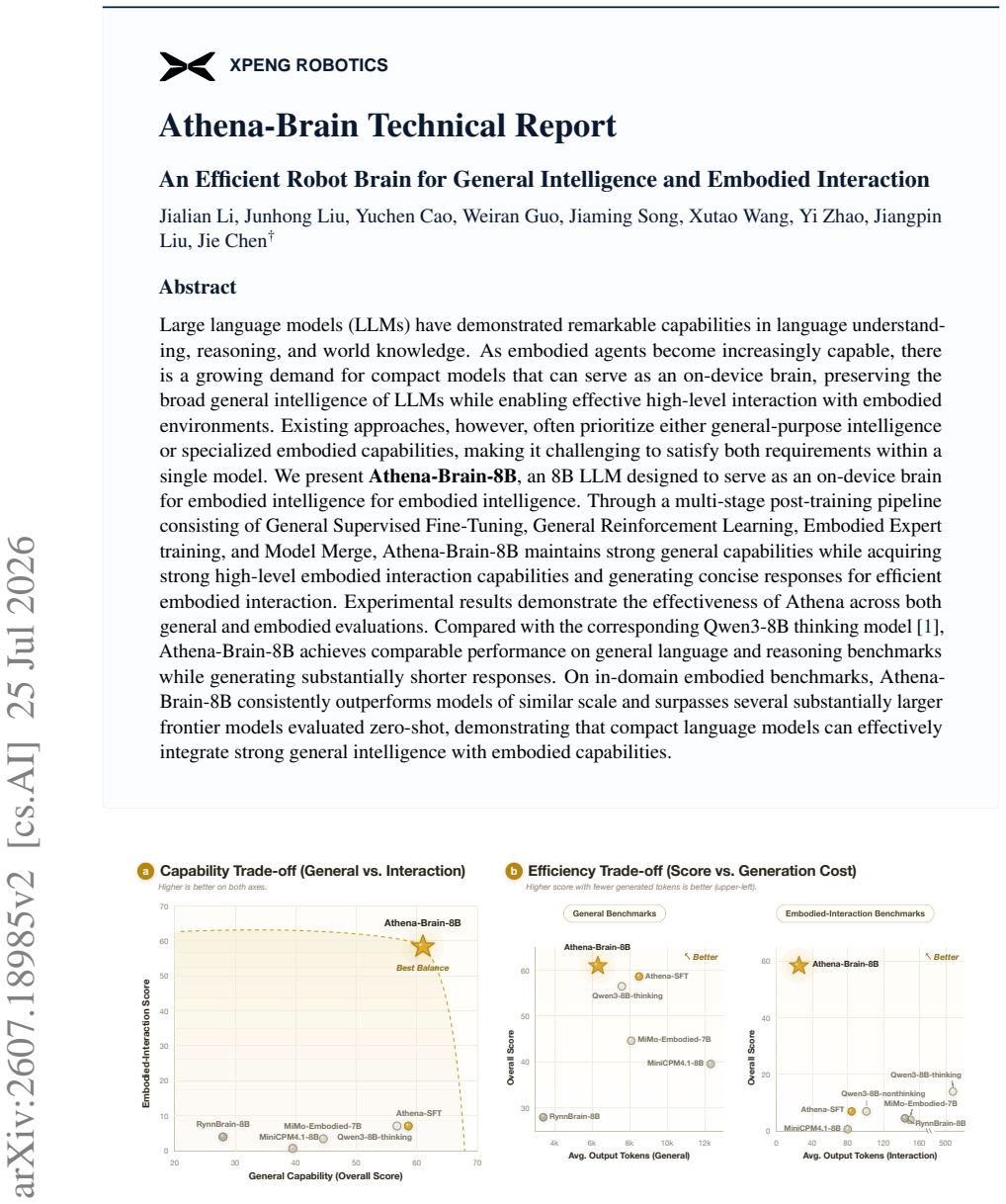
This report sets out to establish that an 8-billion-parameter language model can be an on-device robot brain: it can keep the general intelligence of a foundation LLM, gain high-level embodied interaction skills, and answer in far fewer tok
Reviewed by Pith at T0; open to challenge. T0 means a machine referee read the full paper against a public rubric. the ladder, T0–T4 →
T0 review · deepseek-v4-flash
2026-08-01 13:47 UTC pith:HC2UCGYQ
load-bearing objection Solid system report with a genuinely interesting merge chapter; the big embodied numbers come from in-domain training, so the 'general robot brain' framing oversells the evidence. the 5 major comments →
Athena-Brain Technical Report: An Efficient Robot Brain for General Intelligence and Embodied Interaction
The pith
A machine-rendered reading of the paper's core claim, the machinery that carries it, and where it could break.
Core claim
The paper's central claim is that the tension between general intelligence and embodied competence in a compact model is not a trade-off but a composition problem. Starting from an open 8B base, the authors build a general foundation with supervised fine-tuning, sharpen reasoning and penalize verbosity with reinforcement learning, specialize a branch for closed-loop interaction in two executable environments, and then merge the branches. The resulting single checkpoint, Athena-Brain-8B, outperforms all same-scale open models on the in-house Museum and Supermarket interaction suites (58.52% overall success, compared with 6.98% for the SFT-only intermediate), roughly matches or exceeds its sam
What carries the argument
The load-bearing mechanism is the staged parametrization of the problem. First, a token-budget reward inside GRPO — a reinforcement-learning update that compares groups of rollouts by relative reward — pulls the model toward concise reasoning without sacrificing correctness. Then embodied expert training creates a specialized branch through supervised warm-up and GRPO on executable interactions, with a curriculum of four embodiment levels ranging from zone-level graph planning to egocentric view-cone navigation. Finally a lineage-aware merge combines same-origin RL experts with TIES, a merging method that keeps only parameter updates whose signs agree across experts, before a low-weight line
Load-bearing premise
The 58.52% in-domain success is measured on held-out instances of the same two environment families (Museum and Supermarket) used for embodied training, while comparison models were evaluated zero-shot; if those test instances share the action parser, observation templates, or map priors with training, the result reflects in-distribution adaptation rather than a general robot brain.
What would settle it
Run Athena-Brain-8B zero-shot on a third environment family built with the same interaction protocol but new semantics, observation formats, and map layouts, or on held-out maps within the existing environments after checking for map overlap. If overall success falls to the level of the 6.98% SFT checkpoint or to the 7–14% range of zero-shot same-scale baselines, the paper's generalization claim collapses.
If this is right
- A compact 8B model can match or beat same-scale thinking models on general math, code, reasoning, and tool-use benchmarks while generating substantially fewer tokens, making response efficiency itself a trainable objective rather than a post-hoc constraint.
- Embodied competence can be added to a general LLM without destroying its generality: the merged model retains most of the embodied expert's in-domain success (58.52% vs 60.11%) while improving on most general benchmarks relative to the best single expert.
- Interaction-policy errors are recoverable: the ablation shows that truncating rollouts only on format violations, using mild reward penalties, and training on easier maps yields the best final policy, because it preserves recovery trajectories after wrong but executable actions.
- The skills acquired in two text environments transfer to a third, unseen environment: zero-shot success on ALFWorld rises from 11.94% (SFT checkpoint) to 36.57%.
- Token cost per unit of embodied performance can be cut by an order of magnitude: 0.41 for Athena-Brain-8B versus 11.96 for its SFT checkpoint and 36.81 for a same-scale thinking baseline, which matters for latency-sensitive on-device deployment.
Where Pith is reading between the lines
- The ALFWorld transfer result, not the 58.52% in-domain score, is the strongest evidence for a general robot brain; the in-domain comparison is confounded by training on the same two environment families. A fair test would hold out an entire environment family or a substantially different action grammar.
- Because the mild-reward/format-only-truncation configuration prevents RL from over-optimizing protocol avoidance, one testable prediction is that the same configuration will help other tool-use agents — code repair, computer use — where recoverable errors carry useful signal.
- The lineage-aware merge principle (TIES among same-origin updates, cautious interpolation across lineages) could generalize to any multi-skill post-training stack, such as merging math, code, and tool-use RL experts and later adding a new SFT lineage.
- The reported 24.25 tokens per step suggests the model has internalized the action schema; a testable extension is to measure whether token efficiency degrades gracefully as observations become more ambiguous, since E3 success rates of 25% (Museum) and 15% (Supermarket) show headroom.
Editorial analysis
A structured set of objections, weighed in public.
Referee Report
Summary. The paper proposes Athena-Brain-8B, an 8B model built from Qwen3-8B-Base through four post-training stages: General SFT, General RL with a token-budget reward, Embodied Expert RL in two text-based environments (Museum, Supermarket), and a two-stage TIES/linear model merge. The authors report that the final model is competitive with Qwen3-8B-Thinking on general benchmarks while generating far fewer tokens, and that it reaches 58.52% average success on in-domain Museum/Supermarket tasks versus 6.98% for the SFT-only checkpoint, requiring only 24.25 generated tokens per interaction. They also report zero-shot ALFWorld transfer and two intermediate probes.
Significance. The training recipe is well structured and the paper contains genuinely useful empirical content: detailed ablations of the General RL rollout budget (§5.2), the embodied RL truncation/reward/map-sampling axes (§5.3), and a lineage-aware merge analysis (§5.1). The token-efficiency results, 24.25 tokens per interaction step, are striking. However, the load-bearing evidence for the embodied half of the central claim is in-domain; if the authors can add a convincing held-out environment evaluation or clearly reframe the contribution as in-domain capability acquisition, the work would be a useful technical report. As it stands, the significance is conditional on that fix.
major comments (5)
- [§4.2.2 / Table 5] The central embodied claim is based on an in-distribution comparison. The manuscript states: 'Athena-Brain-8B is trained on the Museum and Supermarket environment families, while external baselines are evaluated zero-shot without environment-specific training.' Because the embodied RL reward is task completion in these exact environments (§3.3.2), the 58.52% overall success and the 51.5-point gain over Athena-SFT are in-distribution measures. They do not establish that the model has acquired a general robot brain. To support the generalization claim, the authors should either evaluate on a genuinely held-out environment family, train the comparison models on the same environment families, or explicitly limit the claim to in-domain capability acquisition. Note also that §3.4 selects merge coefficients using 'overall capability balance across both general and embodied evaluations,' so the
- [§4.2.3 / Table 7] ALFWorld is the only out-of-domain control, but the comparison is incomplete. Athena-Brain-8B's 36.57% is below MiniCPM4.1-8B's 40.30%, and Qwen3-8B-Thinking—the strongest reasoning baseline in Table 5—is not reported in Table 7. Single-run results with no variance are reported. Please add the missing baseline, report multiple runs and standard deviations, and specify how the 'unseen split' of ALFWorld is defined. Without this, the transfer evidence does not support the claim that the learned interaction skills generalize.
- [§4.1 / Table 4] Most general benchmark results are single-run evaluations; only AIME 2024/2025 are averaged over eight runs. Several headline differences are small (e.g., Athena-Brain vs Qwen3-8B: 60.85 vs 56.70 overall; GPQA-Diamond 59.60 vs 61.62). Without variance estimates or repeated decoding, the claim that Athena-Brain-8B maintains general capabilities comparable to the base model is not statistically supported. Add error bars or multiple seeds, at least for the category averages.
- [§4.2.4 / Tables 8–10] The intermediate probes are generated from successful trajectories 'on the test split of our in-domain evaluation environments' and are therefore in-domain as well. While they provide useful diagnostic information about short-horizon goal completion and spatial recovery, they do not break the in-domain circularity. If the intention is to use these probes as evidence of general embodied ability, they must be run in held-out environments.
- [§5.3 / Table 12] The best ablation configuration (partial maps, mild reward, format-only-stop) achieves 0.6000 overall, yet the final Athena-Brain-8B in Table 5 scores 58.52. The report does not explain why the final model does not adopt the best configuration found in the ablation. Please clarify whether the final model uses a different configuration, or whether the evaluations differ, so readers can reconcile the two numbers.
minor comments (5)
- [Abstract / §1] The phrase 'for embodied intelligence' is duplicated in the abstract ('an 8B LLM designed to serve as an on-device brain for embodied intelligence for embodied intelligence'). Fix the typo.
- [Figure 3] The figure contains an unresolved editorial note in the diagram ('RL/SFT, not Athena SFT / pick one'). This should be cleaned up before publication.
- [Table 4] The model name is spelled 'Mimo-Embodied-7B' in the table header but 'MiMo-Embodied-7B' elsewhere. Standardize the spelling.
- [Table 6] Token Cost is defined as average generated tokens divided by overall score, where overall score is a percentage; this makes the absolute values difficult to interpret. Use tokens per successful episode or clarify the denominator.
- [§4.2.1] The evaluation protocol does not state whether Table 5/7 results are averaged over multiple episodes or runs. Reporting the number of evaluation episodes and variance would strengthen the quantitative claims.
Circularity Check
Merge coefficients are tuned against the same general/embodied evaluation suites that are later reported as headline results, making the embodied success partly a selection outcome; the general benchmarks and the ALFWorld transfer probe provide independent evidence, so the circularity is partial.
specific steps
-
fitted input called prediction
[Section 3.4 (Model Merging), evaluation in Section 4.2.2 Table 5]
"the merging coefficients are selected based on overall capability balance across both general and embodied evaluations, rather than optimizing for a specific task or environment."
The merge weights are the final free parameters of Athena-Brain-8B. Selecting them 'based on ... embodied evaluations' and then reporting Table 5 (58.52% overall) as evidence means the headline number is the value of the selection objective, not an independent validation. The comparison to zero-shot baselines in the same section makes the selected score look like a prediction. The circularity is partial because the general benchmark table and the unseen ALFWorld probe (36.57%) are not part of this coefficient-selection loop for the embodied claim.
full rationale
The paper's pipeline is otherwise a standard post-training report: general SFT/RL, embodied expert RL, and TIES/linear merge are described with training curves and ablations, and the ALFWorld zero-shot result is an out-of-distribution probe. The explicit statement that 'Athena-Brain-8B is trained on the Museum and Supermarket environment families, while external baselines are evaluated zero-shot' is an evaluation-limitation, not a definitional circularity; in-domain evaluation alone does not make the derivation equivalent to its inputs. Self-citations ([9], [34], [50]) are not load-bearing: RynnBrain is a comparison baseline, DeepInsight is an evaluation platform, and the Engagement Process reference is future work. The one substantive circular step is the model-merge coefficient selection: the coefficients are chosen 'based on overall capability balance across both general and embodied evaluations,' and the same evaluation outcomes are then presented as the verified result. This is a fitted-input-called-prediction pattern, but it is not the whole story: the general-language improvement over Qwen3-8B and the ALFWorld transfer result are independent of the merge selection, and the embodied RL gain over Athena-SFT is not purely a merge artifact. I therefore score the circularity as partial (5/10).
Axiom & Free-Parameter Ledger
free parameters (5)
- Merge coefficients (TIES voting threshold/rescale factor; linear interpolation weight)
- Token-budget reward coefficient in General RL
- Embodied RL reward penalties =
punitive: -100 truncation, -10 tool error; mild: -0.1 tool error
- Rollout budget in General RL =
16K tokens
- Embodied supervised warm-up steps =
4K steps
axioms (5)
- domain assumption Text-based tool-mediated environments are a valid proxy for real robot-brain interaction
- domain assumption Held-out test instances of the same environment family measure generalization beyond training
- standard math TIES merging of same-origin task vectors preserves capabilities
- domain assumption Same-origin RL updates have limited principal-spectrum drift
- domain assumption Response length is a hardware-independent measure of inference efficiency
read the original abstract
Large language models (LLMs) have demonstrated remarkable capabilities in language understanding, reasoning, and world knowledge. As embodied agents become increasingly capable, there is a growing demand for compact models that can serve as an on-device brain, preserving the broad general intelligence of LLMs while enabling effective high-level interaction with embodied environments. Existing approaches, however, often prioritize either general-purpose intelligence or specialized embodied capabilities, making it challenging to satisfy both requirements within a single model. We present \textbf{Athena-Brain-8B}, an 8B LLM designed to serve as an on-device brain for embodied intelligence for embodied intelligence. Through a multi-stage post-training pipeline consisting of General Supervised Fine-Tuning, General Reinforcement Learning, Embodied Expert training, and Model Merge, Athena-Brain-8B maintains strong general capabilities while acquiring strong high-level embodied interaction capabilities and generating concise responses for efficient embodied interaction. Experimental results demonstrate the effectiveness of Athena across both general and embodied evaluations. Compared with the corresponding Qwen3-8B thinking model, Athena-Brain-8B achieves comparable performance on general language and reasoning benchmarks while generating substantially shorter responses. On in-domain embodied benchmarks, Athena-Brain-8B consistently outperforms models of similar scale and surpasses several substantially larger frontier models evaluated zero-shot, demonstrating that compact language models can effectively integrate strong general intelligence with embodied capabilities.
Figures


Reference graph
Works this paper leans on
-
[1]
An Yang, Anfeng Li, Baosong Yang, Beichen Zhang, Binyuan Hui, Bo Zheng, Bowen Yu, Chang Gao, Chengen Huang, Chenxu Lv, Chujie Zheng, Dayiheng Liu, Fan Zhou, Fei Huang, Feng Hu, Hao Ge, Haoran Wei, Huan Lin, Jialong Tang, Jian Yang, Jianhong Tu, Jianwei Zhang, Jianxin Yang, Jiaxi Yang, Jing Zhou, Jingren Zhou, Junyang Lin, Kai Dang, Keqin Bao, Kexin Yang, ...
Pith/arXiv arXiv 2025
-
[2]
GPT-5.5 system card
OpenAI. GPT-5.5 system card. https://openai.com/index/gpt-5-5-system-card/ , April
-
[3]
Introducing Claude Sonnet 5
Anthropic. Introducing Claude Sonnet 5. https://www.anthropic.com/news/ claude-sonnet-5, June 2026. Accessed: 2026-07-10
2026
-
[4]
Qwen3.7-Max: The agent frontier
Qwen Team. Qwen3.7-Max: The agent frontier. https://qwen.ai/blog?id=qwen3.7, May
-
[5]
Zhipu AI. GLM-5.2. https://docs.bigmodel.cn/cn/update/new-releases, June 2026. Ac- cessed: 2026-07-10
2026
-
[6]
Accessed: 2026-07-10
2026
-
[7]
Palm-e: an embodied multimodal language model
Danny Driess, Fei Xia, Mehdi SM Sajjadi, Corey Lynch, Aakanksha Chowdhery, Brian Ichter, Ayzaan Wahid, Jonathan Tompson, Quan Vuong, Tianhe Yu, et al. Palm-e: an embodied multimodal language model. InProceedings of the 40th International Conference on Machine Learning, pages 8469–8488, 2023. 25
2023
-
[8]
Rt-2: Vision-language-action models transfer web knowledge to robotic control
Brianna Zitkovich, Tianhe Yu, Sichun Xu, Peng Xu, Ted Xiao, Fei Xia, Jialin Wu, Paul Wohlhart, Stefan Welker, Ayzaan Wahid, et al. Rt-2: Vision-language-action models transfer web knowledge to robotic control. InConference on Robot Learning, pages 2165–2183. PMLR, 2023
2023
-
[9]
Rynnbrain: Open embodied foundation models.arXiv preprint arXiv:2602.14979, 2026
Ronghao Dang, Jiayan Guo, Bohan Hou, Sicong Leng, Kehan Li, Xin Li, Jiangpin Liu, Yunxuan Mao, Zhikai Wang, Yuqian Yuan, et al. Rynnbrain: Open embodied foundation models.arXiv preprint arXiv:2602.14979, 2026
arXiv 2026
-
[10]
Mimo-embodied: X-embodied foundation model technical report, 2025
Xiaomi Embodied Intelligence Team. Mimo-embodied: X-embodied foundation model technical report, 2025. URLhttps://arxiv.org/abs/2511.16518
Pith/arXiv arXiv 2025
-
[11]
Introducing ChatGPT Agent: Bridging research and action
OpenAI. Introducing ChatGPT Agent: Bridging research and action. https://openai.com/ index/introducing-chatgpt-agent/, July 2025. Accessed: 2026-07-10
2025
-
[12]
Introducing computer use, a new Claude 3.5 Sonnet, and Claude 3.5 Haiku
Anthropic. Introducing computer use, a new Claude 3.5 Sonnet, and Claude 3.5 Haiku. https:// www.anthropic.com/news/3-5-models-and-computer-use , October 2024. Accessed: 2026- 07-10
2024
-
[13]
Minicpm4: Ultra-efficient llms on end devices.arXiv preprint arXiv:2506.07900, 2025
Team MiniCPM. Minicpm4: Ultra-efficient llms on end devices.arXiv preprint arXiv:2506.07900, 2025
Pith/arXiv arXiv 2025
-
[14]
UI-TARS: Pioneering automated GUI interaction with native agents, 2025
Yujia Qin, Yining Ye, Junjie Fang, Haoming Wang, Shihao Liang, Shizuo Tian, Junda Zhang, Jiahao Li, Yunxin Li, Shijue Huang, et al. UI-TARS: Pioneering automated GUI interaction with native agents, 2025
2025
-
[15]
Zhihong Shao, Peiyi Wang, Qihao Zhu, Runxin Xu, Junxiao Song, Xiao Bi, Haowei Zhang, Mingchuan Zhang, YK Li, et al. Deepseekmath: Pushing the limits of mathematical reasoning in open language models.arXiv preprint arXiv:2402.03300, 2024
Pith/arXiv arXiv 2024
-
[16]
Qwen3-Max: Just scale
Qwen Team. Qwen3-Max: Just scale. https://qwen.ai/blog?id=qwen3-max, September 2025. Accessed: 2026-07-10
2025
-
[17]
Gemini 3.1 Pro model card
Google DeepMind. Gemini 3.1 Pro model card. https://deepmind.google/models/ model-cards/gemini-3-1-pro/, February 2026. Accessed: 2026-07-10
2026
-
[18]
Ties-merging: Resolving interference when merging models.arXiv preprint arXiv:2306.01708, 2023
Prateek Yadav, Derek Tam, Leshem Choshen, Colin Raffel, and Mohit Bansal. Ties-merging: Resolving interference when merging models.arXiv preprint arXiv:2306.01708, 2023
Pith/arXiv arXiv 2023
-
[19]
Meet Kimi K2.6: Advancing open-source coding
Moonshot AI. Meet Kimi K2.6: Advancing open-source coding. https://forum.moonshot.ai/ t/meet-kimi-k2-6-advancing-open-source-coding/369 , April 2026. Accessed: 2026-07- 10
2026
-
[20]
DeepSeek-V4 Preview: Towards affordable million-token context
DeepSeek-AI. DeepSeek-V4 Preview: Towards affordable million-token context. https:// api-docs.deepseek.com/news/news260424, April 2026. Accessed: 2026-07-10
2026
-
[21]
Beyondaime: Advancing math reasoning evaluation beyond high school olympiads
ByteDance-Seed. Beyondaime: Advancing math reasoning evaluation beyond high school olympiads. https://huggingface.co/datasets/ByteDance-Seed/BeyondAIME, 2025
2025
-
[22]
Aime problems and solutions
Art of Problem Solving. Aime problems and solutions. https://artofproblemsolving.com/ wiki/index.php/AIME_Problems_and_Solutions, 2025. Accessed: 2026-07-09
2025
-
[23]
LiveCodeBench: Holistic and contamination free eval- uation of large language models for code
Naman Jain, King Han, Alex Gu, Wen-Ding Li, Fanjia Yan, Tianjun Zhang, Sida Wang, Armando Solar-Lezama, Koushik Sen, and Ion Stoica. LiveCodeBench: Holistic and contamination free eval- uation of large language models for code. InInternational Conference on Learning Representations, 2025. 26
2025
-
[24]
Olympiad- bench: A challenging benchmark for promoting agi with olympiad-level bilingual multimodal scientific problems, 2024
Chaoqun He, Renjie Luo, Yuzhuo Bai, Shengding Hu, Zhen Leng Thai, Junhao Shen, Jinyi Hu, Xu Han, Yujie Huang, Yuxiang Zhang, Jie Liu, Lei Qi, Zhiyuan Liu, and Maosong Sun. Olympiad- bench: A challenging benchmark for promoting agi with olympiad-level bilingual multimodal scientific problems, 2024
2024
-
[25]
Tianle Li, Wei-Lin Chiang, Evan Frick, Lisa Dunlap, Tianhao Wu, Banghua Zhu, Joseph E Gonzalez, and Ion Stoica. From crowdsourced data to high-quality benchmarks: Arena-hard and benchbuilder pipeline.arXiv preprint arXiv:2406.11939, 2024
Pith/arXiv arXiv 2024
-
[26]
Zebralogic: Benchmarking the logical rea- soning ability of language models, 2024
Bill Yuchen Lin, Ronan Le Bras, and Yejin Choi. Zebralogic: Benchmarking the logical rea- soning ability of language models, 2024. URL https://huggingface.co/spaces/allenai/ ZebraLogic
2024
-
[27]
Instruction-following evaluation for large language models.arXiv preprint arXiv:2311.07911, 2023
Jeffrey Zhou, Tianjian Lu, Swaroop Mishra, Siddhartha Brahma, Sujoy Basu, Yi Luan, Denny Zhou, and Le Hou. Instruction-following evaluation for large language models.arXiv preprint arXiv:2311.07911, 2023
Pith/arXiv arXiv 2023
-
[28]
David Rein, Betty Li Hou, Asa Cooper Stickland, Jackson Petty, Richard Yuanzhe Pang, Julien Dirani, Julian Michael, and Samuel R. Bowman. GPQA: A graduate-level google-proof Q&A benchmark. InInternational Conference on Machine Learning, 2024
2024
-
[29]
Xinrun Du, Yifan Yao, Kaijing Ma, Bingli Wang, Tianyu Zheng, Kang Zhu, Minghao Liu, Yiming Liang, Xiaolong Jin, Zhenlin Wei, Chujie Zheng, Kaixin Deng, Shian Jia, Sichao Jiang, Yiyan Liao, Rui Li, Qinrui Li, Sirun Li, Yizhi Li, Yunwen Li, Dehua Ma, Yuansheng Ni, Haoran Que, Qiyao Wang, Zhoufutu Wen, Siwei Wu, Tianshun Xing, Ming Xu, Zhenzhu Yang, Zekun Mo...
Pith/arXiv arXiv 2025
-
[30]
Aryo Pradipta Gema, Joshua Ong Jun Leang, Giwon Hong, Alessio Devoto, Alberto Carlo Maria Mancino, Rohit Saxena, Xuanli He, Yu Zhao, Xiaotang Du, Mohammad Reza Ghasemi Madani, Claire Barale, Robert McHardy, Joshua Harris, Jean Kaddour, Emile van Krieken, and Pasquale Minervini. Are we done with MMLU? InProceedings of the 2025 Conference of the Nations of ...
2025
-
[31]
Humanity’s last exam.arXiv preprint arXiv:2501.14249, 2025
Long Phan, Alice Gatti, Ziwen Han, Nathaniel Li, Josephina Hu, Hugh Zhang, Chen Bo Calvin Zhang, Mohamed Shaaban, John Ling, Sean Shi, Michael Choi, Anish Agrawal, Arnav Chopra, Adam Khoja, Ryan Kim, Richard Ren, Jason Hausenloy, Oliver Zhang, Mantas Mazeika, et al. Humanity’s last exam.arXiv preprint arXiv:2501.14249, 2025
Pith/arXiv arXiv 2025
-
[32]
LiveBench: A challenging, contamination-limited LLM benchmark
Colin White, Samuel Dooley, Manley Roberts, Arka Pal, Ben Feuer, Siddhartha Jain, Ravid Shwartz- Ziv, Neel Jain, Khalid Saifullah, Sreemanti Dey, Shubh-Agrawal, Sandeep Singh Sandha, Siddartha Naidu, Chinmay Hegde, Yann LeCun, Tom Goldstein, Willie Neiswanger, and Micah Goldblum. LiveBench: A challenging, contamination-limited LLM benchmark. InInternation...
2025
-
[33]
URL https://arxiv.org/abs/2506
Victor Barres, Honghua Dong, Soham Ray, Xujie Si, and Karthik Narasimhan.τ2-bench: Evaluating conversational agents in a dual-control environment, 2025. URL https://arxiv.org/abs/2506. 07982
2025
-
[34]
Patil, Huanzhi Mao, Fanjia Yan, Charlie Cheng-Jie Ji, Vishnu Suresh, Ion Stoica, and Joseph E
Shishir G. Patil, Huanzhi Mao, Fanjia Yan, Charlie Cheng-Jie Ji, Vishnu Suresh, Ion Stoica, and Joseph E. Gonzalez. The berkeley function calling leaderboard (BFCL): From tool use to agentic evaluation of large language models. InProceedings of the 42nd International Conference on Machine Learning, volume 267 ofProceedings of Machine Learning Research, pa...
2025
-
[35]
ALFWorld: Aligning text and embodied environments for interactive learning
Mohit Shridhar, Xingdi Yuan, Marc-Alexandre Côté, Yonatan Bisk, Adam Trischler, and Matthew Hausknecht. ALFWorld: Aligning text and embodied environments for interactive learning. In International Conference on Learning Representations, 2021. URL https://openreview.net/ forum?id=0IOX0YcCdTn
2021
-
[36]
Deepinsight: A unified evaluation infrastructure across the physical ai stack, 2026
Siyi Li, Chunyu Sun, Jiahao Zhang, Yuchen Kang, Wuliang Wang, Yu Qiu, Rui Jiang, Haitao Cui, and Jie Chen. Deepinsight: A unified evaluation infrastructure across the physical ai stack, 2026. URLhttps://arxiv.org/abs/2606.17574. 27
Pith/arXiv arXiv 2026
-
[37]
The path not taken: Rlvr provably learns off the principals.arXiv preprint arXiv:2511.08567, 2025
Hanqing Zhu, Zhenyu Zhang, Hanxian Huang, et al. The path not taken: Rlvr provably learns off the principals.arXiv preprint arXiv:2511.08567, 2025
arXiv 2025
-
[38]
Haoqing Wang, Xiang Long, Ziheng Li, Yilong Xu, Tingguang Li, and Yehui Tang. To mix or to merge: Toward multi-domain reinforcement learning for large language models.arXiv preprint arXiv:2602.12566, 2026
arXiv 2026
-
[39]
Constitutional ai: Harmlessness from ai feedback.arXiv preprint arXiv:2212.08073, 2022
Yuntao Bai, Saurav Kadavath, Sandipan Kundu, Amanda Askell, Jackson Kernion, Andy Jones, Anna Chen, Anna Goldie, Azalia Mirhoseini, Cameron McKinnon, et al. Constitutional ai: Harmlessness from ai feedback.arXiv preprint arXiv:2212.08073, 2022
Pith/arXiv arXiv 2022
-
[40]
Training language models to follow instructions with human feedback.Advances in Neural Information Processing Systems, 35:27730– 27744, 2022
Long Ouyang, Jeffrey Wu, Xu Jiang, Diogo Almeida, Carroll Wainwright, Pamela Mishkin, Chong Zhang, Sandhini Agarwal, Katarina Slama, Alex Ray, et al. Training language models to follow instructions with human feedback.Advances in Neural Information Processing Systems, 35:27730– 27744, 2022
2022
-
[41]
Training verifiers to solve math word problems.arXiv preprint arXiv:2110.14168, 2021
Karl Cobbe, Vineet Kosaraju, Mohammad Bavarian, Mark Chen, Heewoo Jun, Lukasz Kaiser, Matthias Plappert, Jerry Tworek, Jacob Hilton, Reiichiro Nakano, et al. Training verifiers to solve math word problems.arXiv preprint arXiv:2110.14168, 2021
Pith/arXiv arXiv 2021
-
[42]
Chi, Quoc V
Jason Wei, Xuezhi Wang, Dale Schuurmans, Maarten Bosma, Brian Ichter, Fei Xia, Ed H. Chi, Quoc V . Le, and Denny Zhou. Chain-of-thought prompting elicits reasoning in large language models.Advances in Neural Information Processing Systems, 35:24824–24837, 2022
2022
-
[43]
Llama: Open and efficient foundation language models.arXiv preprint arXiv:2302.13971, 2023
Hugo Touvron, Thibaut Lavril, Gautier Izacard, Xavier Martinet, Marie-Anne Lachaux, Timothée Lacroix, Baptiste Rozière, Naman Goyal, Eric Hambro, Faisal Azhar, et al. Llama: Open and efficient foundation language models.arXiv preprint arXiv:2302.13971, 2023
Pith/arXiv arXiv 2023
-
[44]
Let’s verify step by step.arXiv preprint arXiv:2305.20050, 2023
Hunter Lightman, Vineet Kosaraju, Yura Burda, Harrison Edwards, Bowen Baker, Teddy Lee, Jan Leike, John Schulman, Ilya Sutskever, and Karl Cobbe. Let’s verify step by step.arXiv preprint arXiv:2305.20050, 2023
Pith/arXiv arXiv 2023
-
[45]
Swe-agent: Agent-computer interfaces enable automated software engineering.Advances in Neural Information Processing Systems, 37:50528–50652, 2024
John Yang, Carlos Jimenez, Alexander Wettig, Kilian Lieret, Shunyu Yao, Karthik Narasimhan, and Ofir Press. Swe-agent: Agent-computer interfaces enable automated software engineering.Advances in Neural Information Processing Systems, 37:50528–50652, 2024
2024
-
[46]
Abhimanyu Dubey, Abhinav Jauhri, Abhinav Pandey, Abhishek Kadian, Ahmad Al-Dahle, Aiesha Letman, Akhil Mathur, Alan Schelten, Amy Yang, Angela Fan, et al. The llama 3 herd of models. arXiv preprint arXiv:2407.21783, 2024
Pith/arXiv arXiv 2024
-
[47]
Do as i can, not as i say: Grounding language in robotic affordances
Anthony Brohan, Yevgen Chebotar, Chelsea Finn, Karol Hausman, Alexander Herzog, Daniel Ho, Julian Ibarz, Alex Irpan, Eric Jang, Ryan Julian, et al. Do as i can, not as i say: Grounding language in robotic affordances. InConference on robot learning, pages 287–318. PMLR, 2023
2023
-
[48]
Openhands: An open platform for ai software developers as generalist agents
Xingyao Wang, Boxuan Li, Yufan Song, Frank F Xu, Xiangru Tang, Mingchen Zhuge, Jiayi Pan, Yueqi Song, Bowen Li, Jaskirat Singh, et al. Openhands: An open platform for ai software developers as generalist agents. InInternational Conference on Learning Representations, volume 2025, pages 65882–65919, 2025
2025
-
[49]
Textworld: A learning environment for text-based games.Computer Games, page 41
Tavian Barnes, Emery Fine, James Moore, Matthew Hausknecht, Layla El Asri, Mahmoud Adada, Wendy Tay, and Adam Trischler. Textworld: A learning environment for text-based games.Computer Games, page 41
-
[50]
Openvla: An open-source vision-language-action model
Moo Jin Kim, Karl Pertsch, Siddharth Karamcheti, Ted Xiao, Ashwin Balakrishna, Suraj Nair, Rafael Rafailov, Ethan P Foster, Pannag R Sanketi, Quan Vuong, et al. Openvla: An open-source vision-language-action model. InConference on Robot Learning, pages 2679–2713. PMLR, 2025. 28
2025
-
[52]
Engagement process: Rethinking the temporal interface of action and observation, 2026
Jialian Li, Yuchen Cao, Junhong Liu, Weiran Guo, Xutao Wang, Jiaming Song, Jiahao Zhang, and Jie Chen. Engagement process: Rethinking the temporal interface of action and observation, 2026. URLhttps://arxiv.org/abs/2605.11484. 29
Pith/arXiv arXiv 2026
discussion (0)
Sign in with ORCID, Apple, or X to comment. Anyone can read and Pith papers without signing in.