REVIEW 2 major objections 5 minor 73 references
Rare kaon decay can still beat the Standard Model tenfold despite the new K+ measurement.
Reviewed by Pith at T0; open to challenge. T0 means a machine referee read the full paper against a public rubric. the ladder, T0–T4 →
T0 review · deepseek-v4-flash
2026-08-01 13:32 UTC pith:PQPLZIIK
load-bearing objection A useful Z' existence proof for enhanced K_L->pi0 nu nu after NA62, but the numerical demonstration as written has a consistency hole: it sets Delta_R^sd=0 while relying on Eq. (66), whose whole point is a tuned nonzero Delta_R^sd to keep epsilon_K SM-like. the 2 major comments →
Prospects for K_(L)toπ⁰νbar{ν}, K_Stoμ^+μ^-, K_Ltoπ⁰ ell^+ell^- and varepsilon^(prime)/varepsilon after the new K⁺toπ⁺νbar{ν} result from NA62
The pith
A machine-rendered reading of the paper's core claim, the machinery that carries it, and where it could break.
Core claim
The central claim is that the combination of a left-handed and a small right-handed s̄d coupling to a new Z' boson, together with a large new weak phase β_X ≈ 110° in the combination X_eff that controls K→πννbar amplitudes, can decouple the two kaon-pion-neutrino modes: the K_L→π0ννbar rate can be pushed close to the Grossman-Nir bound (about ten times the Standard Model value) while K+→π+ννbar remains within the recently measured SM-like band. The small right-handed coupling is not a correction; it is the load-bearing ingredient, because the ratio Δ_R^sd/Δ_L^sd ≈ 1/240 cancels the Z' tree-level contribution to K0–K0bar mixing, keeping ε_K and ΔM_K SM-like. The paper then shows that the same
What carries the argument
The argument runs on two pieces. First, the branching ratios of the two K→πννbar decays are expressed through a single complex function X_eff; its imaginary part alone controls K_L→π0ννbar, while both magnitude and phase enter K+→π+ννbar. A large phase β_X ≈ 110° therefore allows K_L to be enhanced without touching K+, and measuring both modes pins down |X_eff| and β_X up to a four-fold ambiguity. Second, in the Z' model, the ratio of right-handed to left-handed s̄d coupling is tuned to Δ_R^sd/Δ_L^sd ≈ 1/240, the value at which the left-left, right-right and left-right contributions to the K0–K0bar mixing amplitude cancel (Eq. 66), so ε_K and ΔM_K stay SM-like while the ΔF=1 decays proceed u
Load-bearing premise
The load-bearing premise is that the hadronic matrix-element ratio κ_sd equals about −120 for M_Z' between 5 and 20 TeV, so that the right-handed s̄d coupling tuned to 1/240 of the left-handed one exactly cancels the Z' contribution to K0–K0bar mixing; if that ratio changes, ε_K and ΔM_K are no longer automatically SM-like.
What would settle it
Measure B(K_L→π0ννbar) and B(K+→π+ννbar) precisely: if K_L stays within a factor of ~2 of the SM while K+ remains SM-like, the large-phase enhancement is falsified. Alternatively, an updated lattice calculation of the hadronic matrix elements entering κ_sd that moves κ_sd noticeably away from −120 would remove the ε_K cancellation, and the benchmark scenario with Δ_R^sd=0 would cease to satisfy the ε_K constraint.
If this is right
- If K_L→π0ννbar is measured by the proposed next-generation experiment, an order-of-magnitude enhancement over the SM prediction is still a live possibility even if the final K+ result stays SM-like.
- A discovery of K_L→π0ννbar near the Grossman-Nir bound would, within this scenario, imply strongly enhanced K_S→μ+μ- (up to two orders of magnitude in parts of the parameter space) and enhanced K_L→π0ℓ+ℓ-.
- The same NP phase structure produces a positive contribution to ε'/ε of order 10^-3, potentially closing the gap between the experimental value and the lower SM estimate.
- A measurement of both K→πννbar branching ratios would determine the underlying new-physics amplitude |X_eff| and phase β_X, up to a four-fold ambiguity that other observables like K_S→μ+μ- or ε'/ε can resolve.
Where Pith is reading between the lines
- The scenario's viability rests on a precise cancellation: if lattice or other hadronic inputs shift κ_sd from ≈ −120, the required Δ_R^sd/Δ_L^sd ratio changes and the ε_K/ΔM_K suppression weakens, so the 'SM-like regardless of other parameters' claim is not robust to hadronic revisions.
- Because the cancellation requires a tuned ratio, a fully natural model would need a mechanism that generates such a hierarchy between left- and right-handed couplings; absent that, the scenario is an existence proof rather than a complete theory.
- The paper's correlation structure suggests a decisive test: if K_L→π0ννbar is found enhanced while K_S→μ+μ- remains SM-like, the mixed-chirality Z' scenario would be disfavoured, pointing instead to models with pure left-handed couplings or to non-Z' mediators.
- One could extend the same flavour structure to B-meson or top decays involving equivalent chiral couplings; such extensions are not explored here but would sharpen the model's predictivity.
Editorial analysis
A structured set of objections, weighed in public.
Referee Report
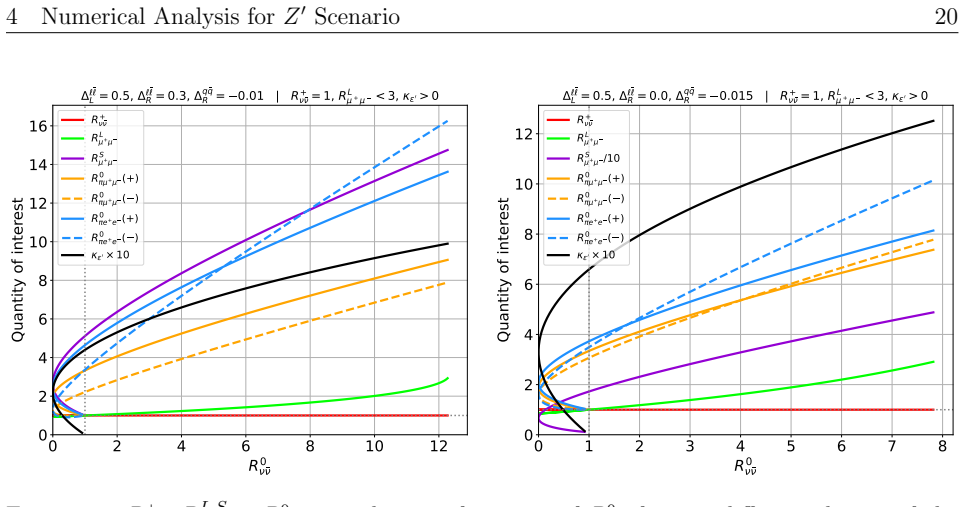
Summary. The paper argues that, after the NA62 measurement of B(K+→π+ννbar) consistent with the SM, appreciable NP effects in other rare kaon observables are still possible. A model-independent parametrisation of K→πννbar shows that a large CP-violating phase β_X≈110° can enhance B(KL→π0ννbar) by an order of magnitude while keeping B(K+→π+ννbar) SM-like. The authors then construct a specific Z′ model with both left- and right-handed sbar-d couplings and show, in Sec. 4, that a benchmark with chosen couplings can simultaneously keep ε_K and ΔM_K SM-like, satisfy the KL→μ+μ− bound, enhance KS→μ+μ−, KL→π0ℓ+ℓ−, and ε′/ε, and reach R^0_{ννbar}≈O(10). The numerical demonstration is a parameter scan over the couplings that appear in the observables, not a global fit.
Significance. If the claimed benchmark is valid, the paper provides a useful counterexample to the expectation that a SM-like NA62 result and SM-like ε_K exclude large enhancements of KL→π0ννbar, KS→μ+μ−, KL→π0ℓ+ℓ− and ε′/ε. The general formulae collected in Sec. 2 are standard and clearly presented, and the analysis correctly identifies that both LH and RH sbar-d couplings are needed to evade the ε_K-induced correlation that would otherwise bound KL→π0ννbar. The explicit Z′ scenario with stated coupling choices and constraints is a concrete, reproducible existence proof. The central gap is that the numerical scan sets to zero the very right-handed coupling on which the ε_K/ΔM_K cancellation relies, so the headline claim of simultaneous satisfaction of all seven requirements is not yet demonstrated.
major comments (2)
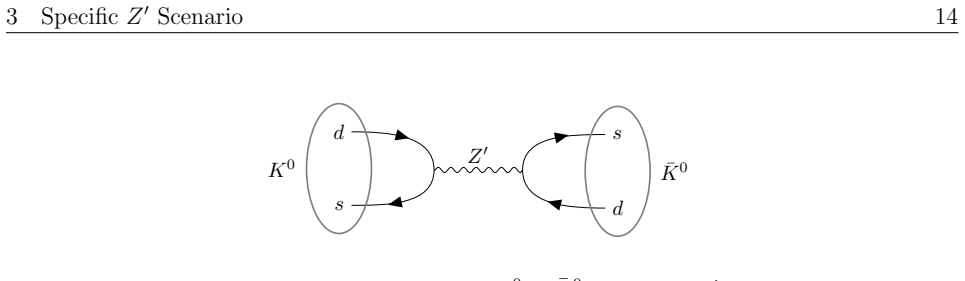
- [Sec. 4, Point 1; Secs. 3.2–3.3] Point 1 of the requirement list is asserted to follow from the choice Δ_R^sd(Z′)≈(1/240)Δ_L^sd(Z′)≈0. However, the numerical analysis in the same section states 'we set Δ_R^sd(Z′)=0'. With Δ_R=0, z_sd in Eq. (65) equals 1, not 0, because the cancellation relies on the 2κ_sd r term with κ_sd≈−120. Consequently the tree-level Z′ contribution to (M_12^*)^sd in Eq. (64) is unsuppressed and proportional to (Δ_L^sd)^2. The benchmarks in Fig. 10 have non-zero Re Δ_L^sd and Im Δ_L^sd, so ε_K and ΔM_K receive an unquantified NP contribution. The statement that requirement 1 is satisfied 'regardless of the values of the other parameters' is therefore not demonstrated by the numerical scan. Including the small tuned value Δ_R^sd=Δ_L^sd/240 in the scan would not affect the plotted rates and should restore the cancellation; this needs to be checked and reported.
- [Sec. 3.2, Eq. (66)] The cancellation condition is a fine-tuning between VLL, VRR and LR contributions that depends on the hadronic matrix-element ratio κ_sd≈−120 from Table 5 of Ref. [75]. No uncertainty on κ_sd is propagated, and no tolerance on Δ_R/Δ_L around 1/240 is given. If κ_sd changes by ~20% (or the hadronic matrix-element input is revised), the ratio required for z_sd≈0 shifts and the ε_K suppression is no longer automatic. Since the paper's summary claims ε_K remains SM-like, the authors should quantify the sensitivity, e.g. by varying κ_sd within its expected uncertainty and showing the allowed band of Δ_R/Δ_L, or at least state explicitly that the benchmark is a fine-tuned illustration.
minor comments (5)
- [Introduction, Eq. (1) and throughout] Several occurrences of 'π oℓ+ℓ−' should read 'π^0ℓ+ℓ−' (e.g. Eq. (1), Eqs. (4)–(7) region, Sec. 2.4 heading).
- [Eq. (65)] The last denominator is missing a closing parenthesis: it should be Δ_L^sd(Z′), not Δ_L^sd Z′).
- [Fig. 10 caption] The caption writes 'Δq¯q_L(R′)' where the parameter is Δq¯q_R(Z′). This typo could confuse readers.
- [Fig. 10, right panel] The legend entry 'R^S_{μ+μ−}/10' is not explained in the caption; please clarify that the displayed curve is rescaled by a factor 1/10.
- [Secs. 2.5 and 3.2] The symbol for ε_K is written as both 'ε_K' and 'ϵ_K'; please standardise the notation.
Circularity Check
No significant circularity: the model-independent formulas and Z' benchmark scan are parameter demonstrations, and the noted Delta_R=0 issue is an internal consistency flaw, not a circular derivation.
full rationale
Walking the derivation chain: (i) Sec. 2.1 defines X_eff via Eqs. (8)-(9), and Eq. (27) is a rearrangement of those definitions; requiring beta_X about 110 degrees for a large K_L to pi0 nu nubar rate is an algebraic consequence, not a fitted prediction. (ii) Sec. 3 introduces the Z' parameters and writes the Delta F=1 and Delta F=2 contributions in terms of them. Eq. (66) is not imported as a uniqueness theorem; it is derived in the paper from kappa_sd about -120, quoted from Ref. [75]. That hadronic matrix-element input is external to the paper's target claim (it does not contain the K_L enhancement as an input), so even though [75] shares an author, the self-citation does not by itself make the argument circular. (iii) Sec. 4 is an explicit benchmark scan, not a fit-then-predict exercise: the authors state that they enforce R+_nu nubar = 1, R_L_mu mu < 3, kappa_epsilon' > 0 and then display the correlated rates. Choosing model parameters that satisfy constraints and showing that other observables are enhanced is a standard existence demonstration; the plotted quantities are not equal to the inputs by construction because the correlations are nontrivial functions of the couplings (Table 1). (iv) I checked for renamed known results: the beta_X / |X_eff| parameterization is a re-parametrization of previous kaon formulae, but the paper does not present it as a new derivation. The one serious concern is not circularity: Sec. 4 sets Delta_R^sd(Z')=0 while the derivation of requirement 1 relies on z_sd about 0 from Delta_R^sd / Delta_L^sd about 1/240. At Delta_R=0, Eq. (65) gives z_sd=1, so the tree-level M_12 contribution is not suppressed; this means point 1 is not actually demonstrated by the numerical scan. That is an internal consistency or correctness problem, not a reduction of the prediction to its inputs, so it does not raise the circularity score.
Axiom & Free-Parameter Ledger
free parameters (6)
- Δ_ℓℓ_L(Z') (leptonic LH coupling) =
0.5
- Δ_ℓℓ_R(Z') (leptonic RH coupling) =
0, 0.3, -1.00, 1.25 (set in different benchmark scenarios)
- Δ_R^qq(Z') (flavour-conserving RH quark coupling) =
-0.01, -0.015 (benchmarks)
- Re Δ_L^sd(Z') =
not given explicitly; constrained to small values by R^L_μμ<3
- Im Δ_L^sd(Z') =
not given explicitly; constrained by R^0_ννbar and κ_ε'
- M_Z' =
5 TeV
axioms (6)
- domain assumption The SM contributions and input parameters (X(x_t), P_c(X), κ_+, κ_L, κ_μ, Y_0, etc.) from cited literature are correct.
- domain assumption The BV-strategy CKM determination (|V_ts|, |V_td|, β, β_s, Im λ_t) from Refs. [14,15,24] is adopted.
- standard math The Grossman-Nir bound is valid (SM neutrinos in the final state).
- domain assumption The hadronic matrix-element ratio κ_sd ≈ -120 from Ref. [75] is correct.
- domain assumption The ε'/ε NP coefficient 14.5 B_8^(3/2) from Ref. [82] captures the dominant Q_8 contribution to 10% precision.
- domain assumption The 2026 NA62 measurement and KOTO upper bound are quoted correctly.
invented entities (1)
-
Z' boson with flavour-violating sbar-d couplings and lepton-flavour-universal couplings
independent evidence
read the original abstract
The recently announced NA62 measurement of the $K^{+}\to\pi^{+}\nu\bar{\nu}$ branching ratio, based on 2016--2024 data, is fully consistent with its very accurate Standard Model (SM) prediction. While it is not excluded that the final result based on 2016--2026 data will deviate from the SM prediction, the question arises whether a similar fate awaits the $K_{L}\to\pi^{0}\nu\bar{\nu}$ decay. This decay is currently being searched for by the KOTO experiment, with the present upper bound roughly two orders of magnitude above its very precise SM prediction. The proposed KOTO II experiment aims to provide the first discovery of the $K_{L}\to\pi^{0}\nu\bar{\nu}$ decay and measure its branching ratio. Building on the findings of several previous papers we demonstrate that in the presence of suitably chosen large new complex phases and of a small amount of new right-handed $\bar s d$ couplings, in addition to the left-handed ones, the $K_{L}\to\pi^{0}\nu\bar{\nu}$ branching ratio can still be enhanced by one order of magnitude with respect to the SM prediction while keeping both $K^{+}\to\pi^{+}\nu\bar{\nu}$ and $\varepsilon_K$ SM-like. Simultaneously the decays $K_S\to\mu^+\mu^-$, studied by LHCb, and $K_L\to\pi^0\ell^+\ell^-$, searched for by KOTO II, can be strongly enhanced and the anomaly in the ratio $\varepsilon^{\prime}/\varepsilon$, as claimed by Dual QCD, removed. We illustrate this with an example of a specific $Z^\prime$ scenario.
Figures





Reference graph
Works this paper leans on
-
[1]
J. Aebischer, A. J. Buras, and J. Kumar,On the Importance of Rare Kaon Decays: A Snowmass 2021 White Paper, inSnowmass 2021, 3, 2022.arXiv:2203.09524
Pith/arXiv arXiv 2021
-
[2]
Aebischer et al.,Kaon physics: a cornerstone for future discoveries,J
J. Aebischer et al.,Kaon physics: a cornerstone for future discoveries,J. Phys. G52(2025), no. 10 100501, [arXiv:2503.22256]
Pith/arXiv arXiv 2025
-
[3]
A. J. Buras,Hunting New Animalcula with Flavour Changing Processes,Acta Phys. Polon. B 57(2026), no. 6 6–A15, [arXiv:2605.27525]. [4]NA62Collaboration, S. Alibocus et al.,Measurement of the branching ratio of the K+ →π +ν¯νdecay,arXiv:2607.16413. [5]KOTOCollaboration, J. K. Ahn et al.,Search for theK L →π 0ν¯νDecay at the J-PARC KOTO Experiment,Phys. Rev....
Pith/arXiv arXiv 2026
-
[8]
G. Isidori and R. Unterdorfer,On the short-distance constraints fromK L,S →µ +µ−,JHEP01 (2004) 009, [hep-ph/0311084]. [9]LHCbCollaboration, R. Aaij et al.,Constraints on theK 0 S →µ +µ− Branching Fraction, Phys. Rev. Lett.125(2020), no. 23 231801, [arXiv:2001.10354]
Pith/arXiv arXiv 2004
-
[10]
G. D’Ambrosio and T. Kitahara,DirectCPViolation inK→µ +µ−,Phys. Rev. Lett.119 (2017), no. 20 201802, [arXiv:1707.06999]
Pith/arXiv arXiv 2017
-
[11]
A. A. Alves Junior et al.,Prospects for Measurements with Strange Hadrons at LHCb,JHEP 05(2019) 048, [arXiv:1808.03477]. REFERENCES 25 [12]KT eVCollaboration, A. Alavi-Harati et al.,Search for the rare decayK L →π 0e+e−,Phys. Rev. Lett.93(2004) 021805, [hep-ex/0309072]. [13]KTEVCollaboration, A. Alavi-Harati et al.,Search for the DecayK L →π 0µ+µ−,Phys. R...
Pith/arXiv arXiv 2019
-
[14]
A. J. Buras and E. Venturini,Searching for New Physics in RareKandBDecays without |Vcb|and|V ub|Uncertainties,arXiv:2109.11032
-
[15]
A. J. Buras and E. Venturini,The exclusive vision of rare K and B decays and of the quark mixing in the standard model,Eur. Phys. J. C82(2022), no. 7 615, [arXiv:2203.11960]. [16]NA48Collaboration, J. Batley et al.,A Precision measurement of direct CP violation in the decay of neutral kaons into two pions,Phys. Lett.B544(2002) 97–112, [hep-ex/0208009]. [1...
Pith/arXiv arXiv 2022
-
[19]
A. J. Buras and J.-M. G´ erard,Upper Bounds onε ′/εParametersB (1/2) 6 andB (3/2) 8 from Large N QCD and other News,JHEP12(2015) 008, [arXiv:1507.06326]
Pith/arXiv arXiv 2015
-
[20]
R. Abbott et al.,Direct CP violation and the∆I= 1/2rule inK→ππdecay from the Standard Model,arXiv:2004.09440
Pith/arXiv arXiv 2004
-
[21]
V. Cirigliano, H. Gisbert, A. Pich, and A. Rodr ´ ıguez-S´ anchez,Theoretical status ofε′/ε,J. Phys. Conf. Ser.1526(2020) 012011, [arXiv:1912.04736]
Pith/arXiv arXiv 2020
-
[22]
Gisbert,NonleptonicK→2πdecay dynamics,Nucl
H. Gisbert,NonleptonicK→2πdecay dynamics,Nucl. Part. Phys. Proc.312-317(2021) 175–179, [arXiv:2012.09483]
Pith/arXiv arXiv 2021
-
[23]
A. J. Buras,Theϵ ′/ϵ-Story: 1976-2021,Acta Phys. Polon. B52(2021), no. 1 7–41, [arXiv:2101.00020]
Pith/arXiv arXiv 1976
-
[24]
A. J. Buras,Addicted to Flavour: 1976-2026,arXiv:2601.03722
arXiv 1976
-
[25]
J. Aebischer, A. J. Buras, and J. Kumar,Kaon physics without new physics inε K,Eur. Phys. J. C83(2023), no. 5 368, [arXiv:2302.00013]
Pith/arXiv arXiv 2023
-
[26]
A. J. Buras, D. Buttazzo, and R. Knegjens,K→πν¯νandϵ ′/ϵin Simplified New Physics Models,JHEP11(2015) 166, [arXiv:1507.08672]
Pith/arXiv arXiv 2015
-
[27]
Y. Grossman and Y. Nir,K L →π 0ν¯νbeyond the standard model,Phys. Lett.B398(1997) 163–168, [hep-ph/9701313]
Pith/arXiv arXiv 1997
-
[28]
M. Blanke et al.,Rare and CP-violatingKandBdecays in the Littlest Higgs model with T-parity,JHEP01(2007) 066, [hep-ph/0610298]
Pith/arXiv arXiv 2007
-
[29]
C. Promberger, S. Schatt, and F. Schwab,Flavor Changing Neutral Current Effects and CP Violation in the Minimal 3-3-1 Model,Phys. Rev.D75(2007) 115007, [hep-ph/0702169]. REFERENCES 26
Pith/arXiv arXiv 2007
-
[30]
M. Blanke,Insights from the Interplay ofK→πν νandϵ K on the New Physics Flavour Structure,Acta Phys.Polon.B41(2010) 127, [arXiv:0904.2528]
Pith/arXiv arXiv 2010
-
[31]
A. J. Buras, P. Gambino, M. Gorbahn, S. Jager, and L. Silvestrini,Universal unitarity triangle and physics beyond the standard model,Phys. Lett.B500(2001) 161–167, [hep-ph/0007085]
Pith/arXiv arXiv 2001
-
[32]
A. J. Buras,Minimal flavor violation,Acta Phys. Polon.B34(2003) 5615–5668, [hep-ph/0310208]
Pith/arXiv arXiv 2003
-
[33]
M. Blanke, A. J. Buras, D. Guadagnoli, and C. Tarantino,Minimal Flavour Violation Waiting for Precise Measurements of∆M s,S ψϕ,A s SL,|V ub|,γandB 0 s,d →µ +µ−,JHEP10(2006) 003, [hep-ph/0604057]
Pith/arXiv arXiv 2006
-
[34]
A. J. Buras,Gauge Theory of Weak Decays. Cambridge University Press, 6, 2020
2020
-
[35]
G. Buchalla and A. J. Buras,K→πν¯νand high precision determinations of the CKM matrix, Phys. Rev.D54(1996) 6782–6789, [hep-ph/9607447]
Pith/arXiv arXiv 1996
-
[36]
G. Buchalla, A. J. Buras, and M. E. Lautenbacher,Weak decays beyond leading logarithms, Rev. Mod. Phys.68(1996) 1125–1144, [hep-ph/9512380]
Pith/arXiv arXiv 1996
-
[37]
G. Buchalla and A. J. Buras,The rare decaysK→πν¯ν,B→Xν¯νandB→ℓ +ℓ−: An Update,Nucl. Phys.B548(1999) 309–327, [hep-ph/9901288]
Pith/arXiv arXiv 1999
-
[38]
F. Mescia and C. Smith,Improved estimates of rare K decay matrix-elements fromK ℓ3 decays, Phys. Rev.D76(2007) 034017, [arXiv:0705.2025]
Pith/arXiv arXiv 2007
-
[39]
Buchalla and A
G. Buchalla and A. J. Buras,QCD corrections to rareKandBdecays for arbitrary top quark mass,Nucl. Phys.B400(1993) 225–239
1993
-
[40]
M. Misiak and J. Urban,QCD corrections to FCNC decays mediated by Z penguins and W boxes,Phys. Lett.B451(1999) 161–169, [hep-ph/9901278]
Pith/arXiv arXiv 1999
-
[41]
J. Brod, M. Gorbahn, and E. Stamou,Two-Loop Electroweak Corrections for theK→πν¯ν Decays,Phys. Rev.D83(2011) 034030, [arXiv:1009.0947]
Pith/arXiv arXiv 2011
-
[42]
G. Buchalla and A. J. Buras,The rare decaysK + →π +ν¯νandK L →µ +µ− beyond leading logarithms,Nucl. Phys.B412(1994) 106–142, [hep-ph/9308272]
Pith/arXiv arXiv 1994
-
[43]
A. J. Buras, M. Gorbahn, U. Haisch, and U. Nierste,The rare decayK + →π +ν¯νat the next-to-next-to-leading order in QCD,Phys. Rev. Lett.95(2005) 261805, [hep-ph/0508165]
Pith/arXiv arXiv 2005
-
[44]
A. J. Buras, M. Gorbahn, U. Haisch, and U. Nierste,Charm quark contribution to K+ →π +ν¯νat next-to-next-to-leading order,JHEP11(2006) 002, [hep-ph/0603079]
Pith/arXiv arXiv 2006
-
[45]
J. Brod and M. Gorbahn,Electroweak Corrections to the Charm Quark Contribution to K+ →π +ν¯ν,Phys. Rev.D78(2008) 034006, [arXiv:0805.4119]
Pith/arXiv arXiv 2008
-
[46]
G. Isidori, F. Mescia, and C. Smith,Light-quark loops inK→πν¯ν,Nucl. Phys.B718(2005) 319–338, [hep-ph/0503107]
Pith/arXiv arXiv 2005
-
[47]
K→πν¯ν: updated SM predictions and its distributions at NA62
E. Stamou, “K→πν¯ν: updated SM predictions and its distributions at NA62.” Talk presented at Kaon2025, based on a forthcoming publication with Gorbahn and Yu, September 08, 2025. REFERENCES 27
2025
-
[48]
J. Brod, M. Gorbahn, and E. Stamou,Updated Standard Model Prediction forK→πν¯νand ϵK, in19th International Conference on B-Physics at Frontier Machines, 5, 2021. arXiv:2105.02868
Pith/arXiv arXiv 2021
-
[49]
A. J. Buras, R. Fleischer, S. Recksiegel, and F. Schwab,Anatomy of prominentBandK decays and signatures of CP-violating new physics in the electroweak penguin sector, Nucl. Phys.B697(2004) 133–206, [hep-ph/0402112]
Pith/arXiv arXiv 2004
-
[50]
Bosch et al.,Standard model confronting new results forε ′/ε,Nucl
S. Bosch et al.,Standard model confronting new results forε ′/ε,Nucl. Phys.B565(2000) 3–37, [hep-ph/9904408]
Pith/arXiv arXiv 2000
-
[51]
K. Fuyuto, W.-S. Hou, and M. Kohda,Loophole inK→πν¯νSearch and New Weak Leptonic Forces,Phys. Rev. Lett.114(2015) 171802, [arXiv:1412.4397]
Pith/arXiv arXiv 2015
-
[52]
C. Bobeth, M. Gorbahn, T. Hermann, M. Misiak, E. Stamou, et al.,B s,d →ℓ +ℓ− in the Standard Model with Reduced Theoretical Uncertainty,Phys. Rev. Lett.112(2014) 101801, [arXiv:1311.0903]
Pith/arXiv arXiv 2014
-
[53]
M. Gorbahn and U. Haisch,Charm quark contribution toK L →µ +µ− at next-to-next-to-leading order,Phys. Rev. Lett.97(2006) 122002, [hep-ph/0605203]
Pith/arXiv arXiv 2006
-
[54]
G. D’Ambrosio and J. Portoles,Vector meson exchange contributions toK→πγγand KL →γℓ +ℓ−,Nucl. Phys.B492(1997) 417–454, [hep-ph/9610244]
Pith/arXiv arXiv 1997
-
[55]
J.-M. G´ erard, C. Smith, and S. Trine,Radiative kaon decays and the penguin contribution to the∆I= 1/2rule,Nucl. Phys.B730(2005) 1–36, [hep-ph/0508189]
Pith/arXiv arXiv 2005
-
[56]
D. Gomez Dumm and A. Pich,Long distance contributions to theK L →µ +µ− decay width, Phys. Rev. Lett.80(1998) 4633–4636, [hep-ph/9801298]
Pith/arXiv arXiv 1998
-
[57]
G. D’Ambrosio, D. Greynat, and M. Knecht,On the amplitudes for the CP-conserving K±(KS)→π ±(π0)ℓ+ℓ− rare decay modes,JHEP02(2019) 049, [arXiv:1812.00735]
Pith/arXiv arXiv 2019
-
[58]
G. D’Ambrosio, D. Greynat, and M. Knecht,Matching long and short distances at orderO(α s) in the form factors forK→πℓ +ℓ−,Phys. Lett. B797(2019) 134891, [arXiv:1906.03046]
Pith/arXiv arXiv 2019
-
[59]
A. Dery, M. Ghosh, Y. Grossman, and S. Schacht,K→µ +µ− as a clean probe of short-distance physics,JHEP07(2021) 103, [arXiv:2104.06427]
Pith/arXiv arXiv 2021
-
[60]
A. Dery, M. Ghosh, Y. Grossman, T. Kitahara, and S. Schacht,A precision relation between Γ(K→µ +µ−)(t)and andB(K L →µ +µ−)/B(K L →γγ),JHEP03(2023) 014, [arXiv:2211.03804]
Pith/arXiv arXiv 2023
-
[61]
G. D’Ambrosio, A. Dery, Y. Grossman, T. Kitahara, R. Marchevski, D. Mart ´ ınez Santos, and S. Schacht,CP violation inK→µ +µ− with and without time dependence through a tagged analysis,JHEP09(2025) 190, [arXiv:2507.13445]
Pith/arXiv arXiv 2025
-
[62]
Ecker and A
G. Ecker and A. Pich,The Longitudinal muon polarization inK L →µ +µ−,Nucl. Phys.B366 (1991) 189–205
1991
- [63]
-
[64]
A. J. Buras, F. De Fazio, and J. Girrbach,The Anatomy of Z’ and Z with Flavour Changing Neutral Currents in the Flavour Precision Era,JHEP1302(2013) 116, [arXiv:1211.1896]. REFERENCES 28
Pith/arXiv arXiv 2013
-
[65]
C. Bobeth and A. J. Buras,Leptoquarks meetε ′/εand rare Kaon processes,JHEP02(2018) 101, [arXiv:1712.01295]
Pith/arXiv arXiv 2018
-
[66]
G. D’Ambrosio, G. Ecker, G. Isidori, and J. Portoles,The decaysK→πℓ +ℓ− beyond leading order in the chiral expansion,JHEP08(1998) 004, [hep-ph/9808289]
Pith/arXiv arXiv 1998
-
[67]
G. Buchalla, G. D’Ambrosio, and G. Isidori,Extracting short-distance physics from KL,S →π 0e+e− decays,Nucl. Phys.B672(2003) 387–408, [hep-ph/0308008]
Pith/arXiv arXiv 2003
-
[68]
G. Isidori, C. Smith, and R. Unterdorfer,The rare decayK L →π 0µ+µ− within the SM,Eur. Phys. J.C36(2004) 57–66, [hep-ph/0404127]
Pith/arXiv arXiv 2004
-
[69]
S. Friot, D. Greynat, and E. De Rafael,Rare kaon decays revisited,Phys. Lett.B595(2004) 301–308, [hep-ph/0404136]
Pith/arXiv arXiv 2004
-
[70]
F. Mescia, C. Smith, and S. Trine,K L →π 0e+e− andK L →π 0µ+µ−: A binary star on the stage of flavor physics,JHEP08(2006) 088, [hep-ph/0606081]
Pith/arXiv arXiv 2006
-
[71]
A. J. Buras, M. E. Lautenbacher, M. Misiak, and M. Munz,Direct CP violation in KL →π 0e+e− beyond leading logarithms,Nucl. Phys.B423(1994) 349–383, [hep-ph/9402347]. [72]KT eVCollaboration, E. Worcester,The Final Measurement ofε ′/εfrom KTeV, arXiv:0909.2555
Pith/arXiv arXiv 1994
-
[73]
A. J. Buras and J.-M. G´ erard,Final state interactions inK→ππdecays:∆I= 1/2rule vs. ε′/ε,Eur. Phys. J.C77(2017), no. 1 10, [arXiv:1603.05686]
Pith/arXiv arXiv 2017
-
[74]
A. J. Buras, F. De Fazio, and J. Girrbach, ∆I= 1/2rule,ε ′/εandK→πν¯νinZ ′(Z)andG ′ models with FCNC quark couplings,Eur. Phys. J.C74(2014) 2950, [arXiv:1404.3824]
Pith/arXiv arXiv 2014
-
[75]
A. J. Buras, D. Buttazzo, J. Girrbach-Noe, and R. Knegjens,Can we reach the Zeptouniverse with rareKandB s,d decays?,JHEP1411(2014) 121, [arXiv:1408.0728]
Pith/arXiv arXiv 2014
-
[76]
A. Crivellin, L. Hofer, J. Matias, U. Nierste, S. Pokorski, and J. Rosiek,Lepton-flavour violatingBdecays in genericZ ′ models,Phys. Rev.D92(2015), no. 5 054013, [arXiv:1504.07928]
Pith/arXiv arXiv 2015
-
[77]
A. J. Buras and D. Guadagnoli,Correlations among new CP violating effects in∆F= 2 observables,Phys. Rev.D78(2008) 033005, [arXiv:0805.3887]
Pith/arXiv arXiv 2008
-
[78]
A. J. Buras, D. Guadagnoli, and G. Isidori,Onϵ K beyond lowest order in the Operator Product Expansion,Phys. Lett.B688(2010) 309–313, [arXiv:1002.3612]
Pith/arXiv arXiv 2010
-
[79]
A. J. Buras, S. J¨ ager, and J. Urban,Master formulae for∆F= 2NLO QCD factors in the standard model and beyond,Nucl. Phys.B605(2001) 600–624, [hep-ph/0102316]
Pith/arXiv arXiv 2001
-
[80]
A. J. Buras and J. Girrbach,Complete NLO QCD Corrections for Tree Level∆F= 2FCNC Processes,JHEP1203(2012) 052, [arXiv:1201.1302]
Pith/arXiv arXiv 2012
-
[81]
M. Blanke, A. J. Buras, B. Duling, K. Gemmler, and S. Gori,Rare K and B Decays in a Warped Extra Dimension with Custodial Protection,JHEP03(2009) 108, [arXiv:0812.3803]. REFERENCES 29
Pith/arXiv arXiv 2009
-
[82]
A. J. Buras,New physics patterns inε ′/εandε K with implications for rare kaon decays and ∆MK,JHEP04(2016) 071, [arXiv:1601.00005]
Pith/arXiv arXiv 2016
-
[83]
J. Aebischer, A. J. Buras, and J. Kumar,Another SMEFT Story:Z ′ Facing New Results on ε′/ε,∆M K andK→πν¯ν,arXiv:2006.01138
Pith/arXiv arXiv 2006
-
[84]
de Vries,Four-Quark Effective Operators at Hadron Colliders,arXiv:1409.4657
M. de Vries,Four-Quark Effective Operators at Hadron Colliders,arXiv:1409.4657. [85]ALEPH Collaboration, DELPHI Collaboration, L3 Collaboration, OP AL Collaboration, LEP Electroweak W orking GroupCollaboration, S. Schael et al., Electroweak Measurements in Electron-Positron Collisions at W-Boson-Pair Energies at LEP, arXiv:1302.3415. [86]Heavy Flavor Aver...
Pith/arXiv arXiv 2023
discussion (0)
Sign in with ORCID, Apple, or X to comment. Anyone can read and Pith papers without signing in.