REVIEW 2 major objections 5 minor 8 references
Instruction-based SVG editing is failing the preservation half of the contract: the best of 34 model endpoints passes all three gates on only 15.0% of tasks.
Reviewed by Pith at T0; open to challenge. T0 means a machine referee read the full paper against a public rubric. the ladder, T0–T4 →
T0 review · deepseek-v4-flash
2026-08-01 13:34 UTC pith:JBOJU43J
load-bearing objection Vector-Bench is a sound, honestly reported benchmark: the three-gate reward is a real measurement contribution, and the repair-vs-specification gap is robust even if the absolute pass rates depend on author-set thresholds. the 2 major comments →
Vector-Bench: Can Models Surgically Edit SVG Code?
The pith
A machine-rendered reading of the paper's core claim, the machinery that carries it, and where it could break.
Core claim
The central discovery is that current large language models, when asked to repair a corrupted SVG from a natural-language instruction, routinely perform recognizable requested edits yet violate the implicit contract that everything else must stay intact. The paper demonstrates this with a benchmark where every task includes a hidden target program, explicit protected objects, and a binary reward that requires all requested edits to pass perceptual tolerances, the unrequested semantic structure to remain unchanged, and the output to be valid SVG. On 1,360 scored outcomes, only 32 satisfy the full specification, while roughly half make at least one annotated repair and validity-gated repair pr
What carries the argument
The load-bearing artifact is the deterministic binary specification reward, evaluated as valid(S) AND all requested edits ok_e(S) AND V(masked(S)) = V(masked(S*)). The three gates play distinct roles: requested-edit checks use attribute-aware tolerances (CIE Lab ΔE76 for color, 129-point sampled path distance with RMS/95th-percentile thresholds, corruption-relative bounds capped by viewport-relative limits); the preservation gate uses a semantic normalizer V(·) that permits only representation-level variation such as consistent ID renaming or equivalent style storage while holding element order, geometry, paint, text, and references strict; and the validity gate requires well-formed XML, uni
Load-bearing premise
The evaluator's hand-set perceptual tolerances and the semantic normalizer's definition of 'application-relevant structure' are assumed to match what a human editor accepts; the paper reports in §4.2 and §8 that no human agreement study was run and that CIE76 and finite path sampling are approximations, so the absolute rates are calibration-dependent even though the qualitative direction survives tolerance rescaling.
What would settle it
Conduct a human-agreement study on the 40 tasks: have human editors judge each released model output against the instruction for repair correctness, preservation of unmentioned content, and validity, then compare their verdicts to the binary reward. A systematic mismatch (for example, human-accepted repairs receiving zero reward) would recalibrate the central numbers; a strong match would confirm the gap is real. Alternatively, an intervention that adds a raster preview to the prompt and moves full-spec success substantially above 15% would indicate the gap is partly protocol-bound rather than
If this is right
- If the result is correct, repair-progress metrics overstate real editing capability for structured artifacts; benchmarks for editing agents need preservation and validity gates to be informative.
- Editing agents must treat preservation and validity as hard constraints: a model that cannot leave unmentioned objects alone will fail real asset-editing workflows even when its raster output looks plausible.
- The shortfall is not confined to cheap models: both inexpensive and frontier endpoints cluster near low full-spec success, with a large fraction of outcomes truncated or structurally invalid, pointing to output-length and validity as limiting factors.
- The released corpus and evaluator provide a reproducible target for tracking whether future editing models improve on the combined repair-and-preserve contract, rather than only on visible repair completion.
- The binary rate is calibration-dependent, but the qualitative gap survives rescaled tolerances, so the main conclusion—partial repair is common, full specification-faithful repair is rare—is robust to moderate threshold changes.
Where Pith is reading between the lines
- Beyond the paper's own caution, the most consequential open question is human calibration: if a panel of human editors accepts outputs the evaluator rejects, the tolerance constants would need adjustment; the authors report in §4.2 and §8 that no human agreement study was run and that CIE76 and finite path sampling are approximate.
- The preservation gate's semantic equivalence could be decomposed further—separating element reordering, path rewrites, and deleted definitions as failure subtypes—which would tell developers where to invest (e.g., localization vs. restraint vs. validity).
- The same three-gate construction transfers naturally to other structured program-editing tasks (JSON config repair, code refactoring, CSS fixes) where 'make this change, break nothing else' is the core contract; the masking and semantic-normalization design is a reusable template.
- A testable extension is to give models a raster preview or interactive editor alongside the SVG source; the benchmark is text-and-source only, and the authors note multimodal interaction is out of scope, so a modality intervention could reveal how much of the gap is protocol-bound.
Editorial analysis
A structured set of objections, weighed in public.
Referee Report
Summary. The paper introduces Vector-Bench, a benchmark of 40 SVG repair tasks. Each task provides a corrupted SVG, an author-written instruction, a hidden target SVG, and a target/anchor-based deterministic specification reward. The reward requires (i) requested edits to pass attribute-aware perceptual tolerances, (ii) unrequested rendering- and application-relevant structure to remain semantically unchanged under a canonical semantic form V(·), and (iii) the output to be a valid SVG. The authors evaluate 34 model endpoints over 1,360 requests and report that the best endpoint (Claude Sonnet 5) achieves only 15.0% full specification success, while its mean repair progress is 43.7%. They also report aggregate outcomes: 2.35% full specification success, 49.9% with at least one repair, and 27.5% validity-gated repair progress overall. The paper interprets this gap as evidence that repair-progress metrics substantially overstate models' surgical editing capability. The release includes prompts, outputs, evaluator code, per-task reports, and deterministic controls.
Significance. If the evaluator is accepted as a reasonable operationalization of 'surgical editing,' Vector-Bench is a valuable, transparent stress test for instruction-based SVG editing. The strengths are substantial: the evaluator is deterministic and does not rely on a learned judge; four controls verify its behavior; the paper publishes all model outputs and scoring code, supporting exact reruns; and Table 4 shows the qualitative conclusion is robust to rescaling of requested-edit distance tolerances. The finding that even frontier endpoints rarely satisfy the full repair-and-preserve contract, while making partial visible repairs, is a measurable and practically important result for LLM-based code editing evaluation. The paper is appropriately cautious in framing binary reward as success under the released executable specification, but the broader conclusion about model editing capability rests on the perceptual validity of that specification.
major comments (2)
- [Sec. 4.1, Sec. 8, Table 4] The central claim—that repair progress (43.7%) far exceeds specification-faithful success (15.0%)—depends on the semantic preservation gate V(M_E(S)) = V(M_E(S*)). The authors concede (§8) that no human agreement study was run and that the comparator does not model browser layout, CSS, animation, or accessibility. Table 4 perturbs only the distance-based requested-edit tolerances; it never varies the preservation equivalence (element-order sensitivity, strict geometry/paint equality, style-storage merging, or the treatment of consistent ID renaming). If V(·) is stricter than a typical human editor, the reported success rates are underestimates; if more lenient, overestimates. Because the gap magnitude is the headline result, this is load-bearing. I recommend adding (a) a small human-annotation calibration on a subset of tasks, or (b) a sensitivity analysis that varies V(·) while keeping
- [Sec. 6, Table 3, Sec. 5.2] The 'strongest endpoint' claim in the abstract (15.0% for Claude Sonnet 5 vs 12.5% for the next endpoint) is based on a difference of one task out of 40. With one scored outcome per model-task pair and overlapping Wilson intervals, the ordering of the top endpoints is not statistically robust. The broader conclusion that all endpoints perform poorly is well supported, but the precision attached to 'the strongest endpoint' overstates the certainty. Please soften the language or add a significance test for the top-endpoint comparison.
minor comments (5)
- [Sec. 4.1] The term 'application-relevant structure' for V(S) is not formally defined. What exactly does 'application-relevant' include beyond rendering (e.g., ID references, script hooks, aria attributes)? Please clarify the algorithmic scope of the comparator.
- [Table 4 caption] The caption says 'Scaling applies only to distance-based requested-edit tolerances.' Please clarify whether color ΔE76 and opacity absolute-error distances are considered 'distance-based' and thus scaled. If not, list exactly which checks are scaled and which are not.
- [Sec. 5.2] The Wilson intervals are described under a Bernoulli task-sampling interpretation. It would help to state the effective sample size for the top endpoints (40 tasks) and to note that, for models with 0 passes, the interval is one-sided in practice.
- [Sec. 6] The sentence 'Valid-output UCR is 2.4% overall' is ambiguous because UCR is conditional on valid outputs per model. Please specify whether this is a macro-average across models, a pooled average, or something else.
- [Appendix A] The 'legacy_final_record' labeling is honest about missing retry envelopes, but it means the exact behavior of the model in the presence of transient failures is not fully reconstructable for the reported study. Please state how many tasks were affected by retries in the legacy run, if known.
Circularity Check
No significant circularity: the benchmark result is an executable measurement with hidden targets and unfitted tolerances.
full rationale
Vector-Bench is an evaluation artifact rather than a derivation. The central result—that repair progress (43.7% for Claude Sonnet 5) exceeds full specification success (15.0%)—is an empirical measurement under a published deterministic reward R_spec(S) = 1[valid(S)] · 1[∀e∈E: ok_e(S)] · 1[V(M_E(S)) = V(M_E(S*))]. The tolerance map t_e = min(c_e, max(f_e, r_e·δ_e), 0.9δ_e) uses author-set constants, but they were not fitted to any endpoint's outputs, and §6 Table 4 shows the qualitative conclusion survives 0.5×–1.5× rescaling, so the headline is not forced by calibration. The hidden target S* and expected repairs E are withheld from models (§3.1), so success is not constructed from model responses. No load-bearing self-citation appears; the cited prior work is external and contextual. The closest concern is external validity: §8 explicitly states 'no independent annotator-agreement or human-performance study was run' and 'binary reward should be interpreted as success under this released executable specification, not universal perceptual approval.' That is a calibration/limitation issue, not circularity, and the paper discloses it while providing deterministic controls (Table 2) and sensitivity analysis. No step in the paper's chain reduces by definition or by self-citation to its own inputs.
Axiom & Free-Parameter Ledger
free parameters (3)
- Requested-edit tolerance scale factors r_e =
0.50 (scalar), 0.45 (color), 0.55 (point lists), 0.70 (paths)
- Per-check caps c_e and floor f_e =
position 2.5% of viewport; color 18 ΔE76; opacity 0.12; path/point 3% of smaller viewport dimension; stroke width 1 user
- Path sampling density and distance statistic =
129 length-normalized samples; RMS + 95th percentile symmetric nearest-point distance
axioms (5)
- domain assumption The hidden target S* is the canonical correct output for each task; correctness of a repair is equivalence-within-tolerance to S*.
- ad hoc to paper The semantic form V(S) captures all rendering- and application-relevant structure; anything V ignores is out of scope for preservation.
- domain assumption CIE Lab ΔE76 and sampled geometric distances are adequate perceptual proxies for color and shape equality.
- domain assumption A single decoded completion per model–task pair suffices to rank endpoints; Bernoulli task-sampling underlies the intervals.
- domain assumption Evaluating via OpenRouter endpoints with provider-default temperature is a fair proxy for endpoint capability.
read the original abstract
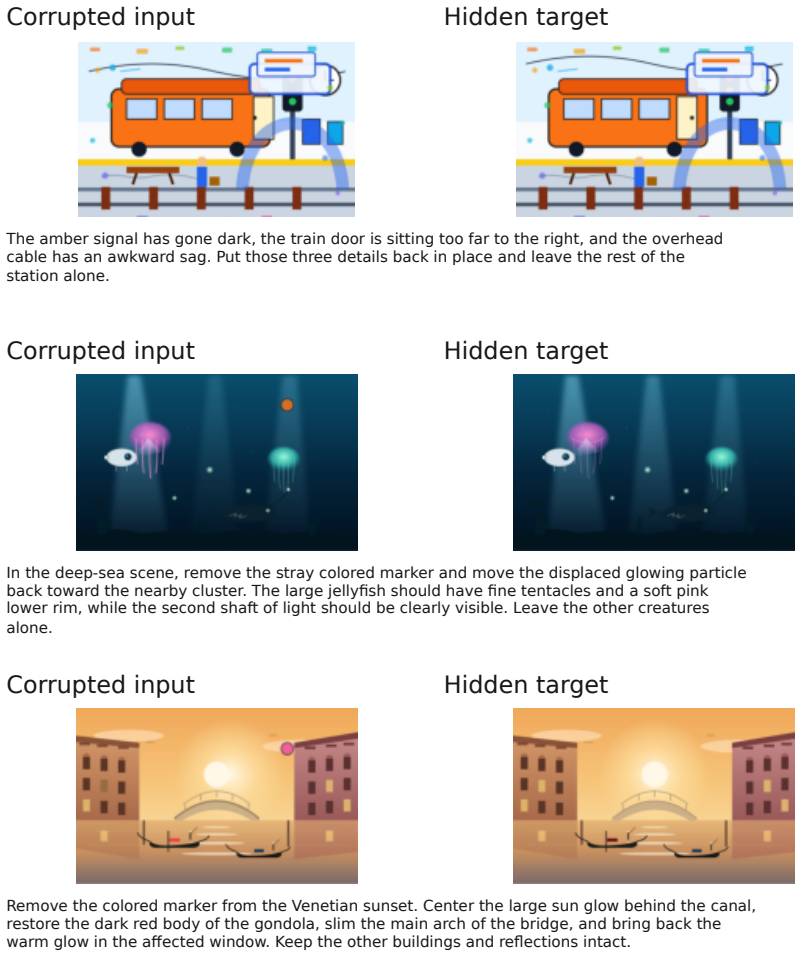
Instruction-based vector editing requires two capabilities: making a requested change and leaving everything else alone. The second is easy to miss when an output is judged only as a raster image. We introduce Vector-Bench, a compact, difficult benchmark of 40 SVG repair tasks. Each task pairs a corrupted SVG program with an author-written visual instruction, a hidden target program, 5.05 annotated repairs on average, and an average of 60.55 protected objects. Instructions describe visible defects without exposing element identifiers, coordinates, color codes, or path data. We define a deterministic binary specification reward: requested repairs use attribute-aware perceptual tolerances, while unrequested rendering- or application-relevant structure must remain semantically unchanged and the result must be a valid SVG. Canonical target equality and stricter source fidelity are retained as diagnostics. Validity-gated repair progress, a near-complete tier, and valid-output Unintended Change Rate (UCR) explain partial outcomes. We evaluate 34 model endpoints (25 listed as open-weight, 5 inexpensive controls, and 4 frontier closed endpoints) over 1360 requests. The strongest endpoint reaches only 15.0% full specification success, despite 43.7% mean repair progress, showing that apparent repair progress and specification-faithful editing remain substantially different. All prompts, outputs, scoring code, costs, and per-task reports are released.
Figures


Reference graph
Works this paper leans on
-
[1]
Kunato Nishina and Yusuke Matsui , year =. 2404.13710 , archivePrefix=
-
[2]
Kunato Nishina and Yusuke Matsui , year =. 2502.19453 , archivePrefix=
-
[3]
2025 , eprint =
Josef Kucha. 2025 , eprint =
2025
-
[4]
Ronghuan Wu and Wanchao Su and Kede Ma and Jing Liao , year =. 2304.14400 , archivePrefix=
-
[5]
Ximing Xing and Juncheng Hu and Guotao Liang and Jing Zhang and Dong Xu and Qian Yu , year =. Empowering. 2412.11102 , archivePrefix=
-
[6]
Rodriguez and Abhay Puri and Shubham Agarwal and Issam H
Juan A. Rodriguez and Abhay Puri and Shubham Agarwal and Issam H. Laradji and Pau Rodriguez and Sai Rajeswar and David Vazquez and Christopher Pal and Marco Pedersoli , year =. 2312.11556 , archivePrefix=
-
[7]
API Reference and Model Catalog , year =
-
[8]
2018 , url =
Scalable Vector Graphics (. 2018 , url =
2018
discussion (0)
Sign in with ORCID, Apple, or X to comment. Anyone can read and Pith papers without signing in.