REVIEW 4 major objections 4 minor 53 references
Parallel Noising in Neural Markov Logic Networks
T0 review · 4 major / 4 minor · reviewed 2026-08-01 · deepseek-v4-flash
Pith's one-line read Neural Markov Logic Networks can match diffusion and molecule-specific generators on molecular graph generation by pairing GNN potentials with corruption-ladder MCMC.
desk verdict A useful neurosymbolic advance: corruption-ladder replica exchange is a good idea, but the molecule experiments need error bars and swap-acceptance data before the central claim lands. read the letter →
The pith
A machine-rendered reading of the paper's core claim, the machinery that carries it, and where it could break.
The reading
What carries the argument
The load-bearing mechanism is the Bernoulli corruption operator Kν, which independently flips each ground atom with probability ν to produce noised distributions πν = πKν. Parallel noising runs a ladder of these noised targets, with the coldest level at near-zero noise sampling the desired NMLN; within-level Gibbs updates alternate with Metropolis swap moves between adjacent noise levels (Algorithm 1). Each level maintains its own NMLN parameters trained on data corrupted at that level's noise rate, making the ladder fixed by the corruption operator rather than by an energy scale that drifts during learning. Proposition 1 guarantees the lowest-noise chain marginally samples the desired targe
What would settle it
A direct falsifier would be a training run of NMLN* in which the accepted swap rate between every adjacent pair of levels is recorded: if acceptance collapses to near zero before the recall gains appear, the gains must come from the GNN potentials alone, not from parallel noising. More specifically, comparing NMLN* against NMLN s.5 (GNN + 500 Gibbs chains) on a task with no mode separation but a poorly tuned temperature ladder would separate the effect; if parallel noising still wins, the advantage must come from something other than replica exchange.
Extended reading notes
Core claim
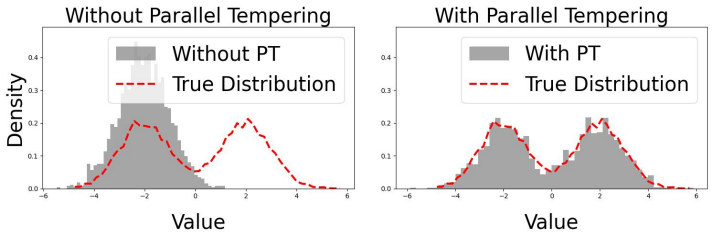
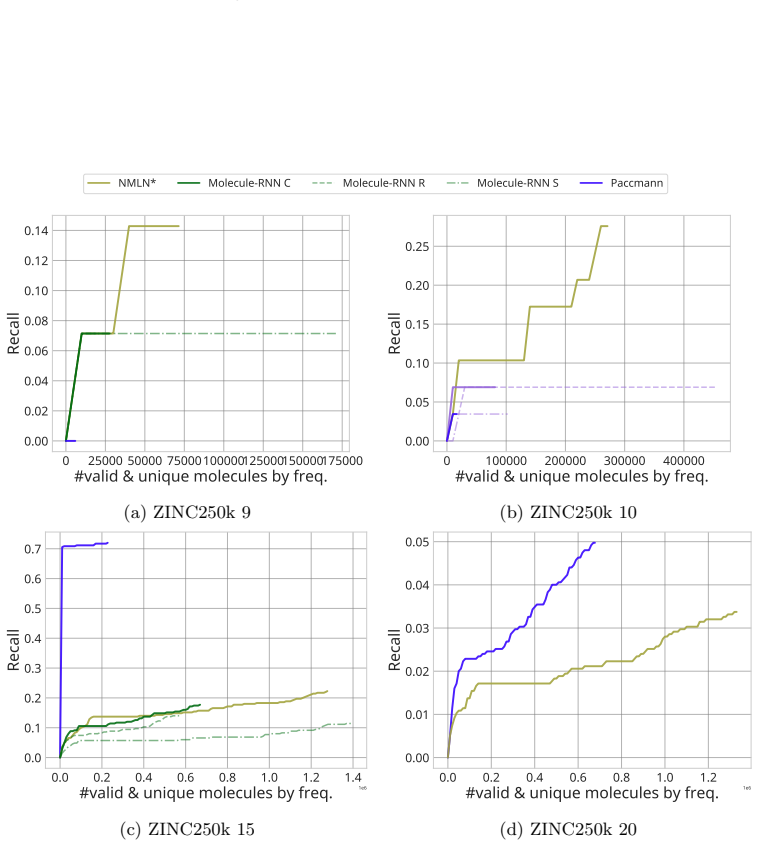
The central claim is that replacing fragment-based potentials with GNN energies and replacing single-chain Gibbs with parallel noising—a replica-exchange MCMC where adjacent chains target distributions corrupted by increasing Bernoulli bit-flip rates—makes NMLNs reach recall on molecular benchmarks that is competitive with or better than DiGress and comparable to specialized SMILES/SELFIES-based generators at sizes 9–10. The paper proves parallel noising is exact (Proposition 1), shows expected swap acceptance equals a distributional overlap coefficient (Proposition 2), and gives a distribution-free but admittedly loose total-variation bound for Bernoulli noising (Proposition 3, Corollary 2)
Load-bearing premise
The replica-exchange acceleration depends on adjacent noise levels' target distributions overlapping enough that swap proposals are accepted, and the paper does not prove this overlap is maintained during training—it recommends monitoring swap acceptance instead.
Editorial extensions
If this is right
- NMLN* improves recall over DiGress on ChEMBL, QM9, ZINC250k, and MOSES, with the biggest gains on smaller molecules.
- At matched compute, parallel noising outperforms plain multi-chain Gibbs with the same chain count or total chains, suggesting the improvement is not just a compute effect.
- On molecules of sizes 9–10, NMLN* matches specialized recurrent molecular generators without using SMILES, SELFIES, or other chemistry-specific string representations.
- Because the coldest chain is an exact sampler for the target distribution, parallel noising can serve not only generation but also likelihood training for energy-based neurosymbolic models.
- The noise ladder behaves monotonically: higher noise levels produce progressively less valid molecules, confirming the intended smoothing and exploration trade-off.
Reading between the lines
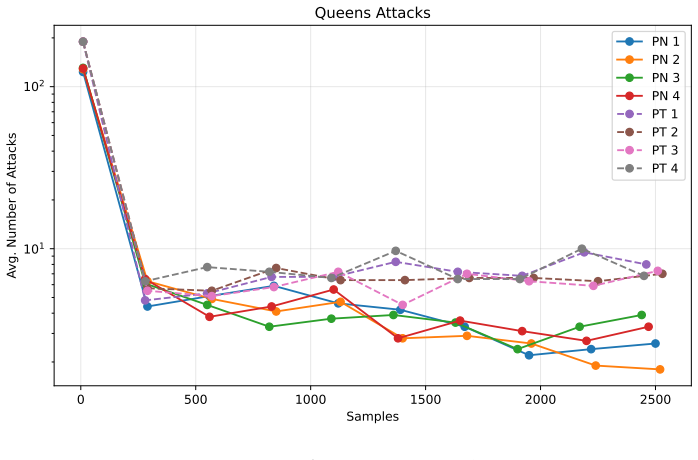
- If parallel noising generalizes beyond molecules, it offers a principled way to do replica-exchange MCMC in any domain with a natural corruption operator (e.g., text, relational databases), where temperature ladders are notoriously fragile.
- The paper's theoretical TV bound is distribution-free but explicitly too loose to tune schedules in high-dimensional spaces; the real test is whether empirically monitored swap acceptance stays healthy during training, so reporting acceptance-rate traces alongside recall curves would strengthen the evidence.
- Since the ladder is defined by fixed corruption levels, parallel noising could combine naturally with denoising and diffusion objectives, potentially bridging NMLN-style energy-based models and diffusion generative models.
- The training objective maximizes a sum of per-level log-likelihoods with no parameter sharing, and nothing guarantees the per-level models remain mutually consistent; if they drift apart, the ladder could decouple—a testable extension is to tie levels with a shared energy and only noise the data distribution.
Editorial analysis
A structured set of objections, weighed in public.
Referee Report
Summary. The paper proposes NMLN*, a Neural Markov Logic Network variant that combines global GNN potentials with a replica-exchange MCMC sampler called 'parallel noising'. Instead of temperature ladders, parallel noising defines auxiliary targets by Bernoulli corruption of possible worlds; during training, one NMLN is fit per corruption level to the corresponding corrupted-data distribution (Eq. 7), and persistent coupled chains supply negative-phase samples. Theoretical sections prove correctness of the replica-exchange construction (Prop. 1), identify expected swap acceptance with an overlap coefficient (Prop. 2), give a distribution-free TV bound for Bernoulli noising (Prop. 3, Cor. 2), and note shift invariance (Prop. 4). The experimental section reports recall curves on ChEMBL in the main text, with additional datasets and ablations in the appendix, and claims gains over DiGress, parity with molecule-specific RNN methods on small molecules, and a compute-aware ablation against multi-chain Gibbs.
Significance. If the empirical claims survive scrutiny, this is a useful contribution: it demonstrates that an energy-based neurosymbolic model with exact replica-exchange sampling can be competitive with diffusion and specialized sequence models on small molecular benchmarks, and the corruption-ladder idea is a sensible response to the temperature-tuning problem in NMLNs. The theory is correct but elementary, and the authors are appropriately careful in stating that the TV bound is too loose to tune by. The toy and n-queens diagnostics are suggestive. However, the central empirical claim—that parallel noising beats multi-chain Gibbs at fixed compute—is currently supported only by single-run recall curves and lacks the swap-acceptance measurements that the paper itself identifies as the relevant diagnostic. Therefore the significance of the work is not yet established.
major comments (4)
- [§8, Q2; §6.3, Eq. (7)] The ablation labeled 'effect of the sampler' (NMLN s.4/s.5 vs. NMLN*) does not control the training objective. NMLN* is trained with per-level corrupted-data objectives (Eq. 7) and persistent PN chains (Algorithm 2), while s.4/s.5 are described only as 'GNN + Gibbs'. If these baselines use the standard clean-data NMLN objective, the comparison conflates the sampler with the training loss and the added auxiliary-level parameters. Please state the exact training objective for s.3–s.5; if it differs, rerun the ablation so that the only difference is the presence of swap moves (e.g., keep the same ladder and auxiliary objectives but disable exchanges).
- [§8, Figs. 1–2] All molecular recall curves are single runs; no error bars, multiple seeds, or significance tests are presented. This is especially problematic for the claim that increasing the number of Gibbs chains 'seems to hurt performance' (s.5 vs. s.4), which may be run-to-run noise. Since the gap between NMLN* and s.5 in Fig. 2 is modest, the central 'PN beats matched-compute Gibbs' conclusion is not yet statistically supported. Report at least 3–5 seeds with means/variances or error bars for every compared method and dataset.
- [§6.5, §7, App. C.2] The paper's own mechanism requires adjacent noise-level targets to overlap (Prop. 2), but Prop. 3/Cor. 2 are explicitly vacuous for molecular d, and the authors say they 'monitor' acceptance rates. No swap-acceptance rates are reported for ChEMBL, MOSES, QM9, or ZINC. Without this diagnostic, the reader cannot tell whether the ladder is coupled or decoupled; if decoupled, PN degenerates to multi-chain Gibbs and the reported gains are unexplained. Please report acceptance rates for each adjacent pair, and if acceptance is low, temper the claim.
- [§8 Q2; App. B.5 'Compute note'] The compute-matching argument is incomplete. s.5 matches the total chain count of NMLN* (500) but not the parameter count or training compute: PN trains five separate NMLNs and performs swap evaluations, while s.5 trains a single model. The 'same generation budget' matches only evaluation cost. If the claim is 'at matched compute', define the budget explicitly (energy evaluations, wall-clock time, or FLOPs for training and sampling) and compare under that metric; otherwise the improvement could be due to additional model capacity or training cost in the auxiliary levels rather than to replica exchange.
minor comments (4)
- [§8] The first paragraph says 'We report results only on ChEMBL', yet the abstract claims broad benchmark gains. The appendix does contain QM9/MOSES/ZINC, but the main text should at least summarize those results or qualify the abstract.
- [§8, Fig. 2] The ordering of curves in Fig. 2 is hard to read and s.5 is not defined in the figure caption; the text's observation that more Gibbs chains hurt performance deserves an explanation (e.g., optimization instability or chain initialization) or a caveat.
- [App. B.3] The recall-curve metric needs a precise definition: how are ties in frequency handled, are invalid molecules removed before ranking, and is recall computed against the test set at each frequency threshold? The x-axis label 'valid & unique molecules by freq.' is ambiguous.
- [throughout] Minor typos and inconsistencies: 'V alidity' in the appendix heading, inconsistent 'Paccmann'/'PaccMann', and 'NMLN s.5' label missing from Fig. 2 legend. Also Appendix A.3 mentions n_runs=5 in the caption but not in the text.
Circularity Check
No significant circularity: PN's exactness and overlap results are standard identities, and the empirical gains are not constructed from the assumptions.
full rationale
The paper's derivation chain is self-contained. Proposition 1 (correctness of PN) is a standard replica-exchange invariance argument proven in Appendix D from within-level invariance and Metropolis detailed balance; it does not presuppose the empirical conclusion. Proposition 2 (expected acceptance equals overlap) is cited to Kofke, an external standard result, and used only to guide ladder design. Proposition 3/Corollary 2 is a distribution-free TV bound with an explicit coupling proof; the paper expressly states it is 'not use[d] to tune noise schedules' and that it is vacuous for large d, so no fitted value is disguised as a prediction. The ladders are chosen by monitoring swap acceptance, which the paper admits is a practical heuristic; this is an evidentiary limitation (no reported acceptance rates or error bars) rather than circularity. The cited prior work by the same authors (Marra & Kuželka 2021, Jung et al. 2024) supplies context and expressivity motivation for GNN potentials, but the central claims—that GNN energies plus PN improve recall—are evaluated empirically against external baselines (DiGress, Molecule-RNN, PaccMann) and against compute-matched Gibbs ablations, so the self-citations are not load-bearing. No equation in the paper reduces to its inputs by construction.
Assumptions & free parameters
free parameters (2)
- Noise schedule {ν_i} (N=5 levels) =
e.g., {0.1, 0.01, 0.005, 0.0025, 0.001} for molecules; {0, 0.02, 0.05, 0.1, 0.2} for n-queens
- Target noise ν_N =
10^-3 (molecules)
assumptions (5)
- domain assumption Bernoulli corruption K_ν smooths sharp, multi-modal target distributions enough for replica exchange to mix.
- domain assumption Independently trained per-level models on corrupted data q_i form a ladder with sufficient overlap.
- standard math Replica-exchange Metropolis updates preserve the product distribution Π.
- domain assumption The learned GNN energy assigns low probability to chemically invalid structures after training.
- domain assumption Preserving one-hot constraints in corruption is sufficient realism for molecular relational structures.
Cite this review
Pith. "Pith review of Parallel Noising in Neural Markov Logic Networks." pith.science (2026). https://pith.science/paper/4PPOHL44
@misc{pith2026260719126,
  author       = {Pith},
  title        = {Pith review of: Parallel Noising in Neural Markov Logic Networks},
  year         = {2026},
  howpublished = {\url{https://pith.science/paper/4PPOHL44}},
  note         = {Machine review of arXiv:2607.19126}
}
read the original abstract
Neural Markov Logic Networks (NMLNs) are a flexible neurosymbolic relational model. Previous work has shown that, although NMLNs achieve strong performance as generative models for small relational structures, they underperform diffusion-based generative graph models on larger structures. In this paper, we strengthen NMLNs along two main dimensions: (i) we increase the expressive capacity of their potential functions using graph neural networks, and (ii) we develop a new training and inference algorithm inspired by parallel-tempering Markov chain Monte Carlo methods, which we name parallel noising. Together, these enhancements enable NMLNs to attain strong performance in graph generation relative to general diffusion-based generative graph models. Furthermore, they allow NMLNs to match the performance of specialized text-based recurrent models when generating small molecular structures.
Figures


Figures from the paper (14 more)





Reference graph
Works this paper leans on
-
[1]
Advances in Neural Information Processing Systems , volume =
Assessing Generative Models via Precision and Recall , author =. Advances in Neural Information Processing Systems , volume =
-
[2]
, title =
Casella, George and Berger, Roger L. , title =. 2024 , isbn =
2024
-
[3]
Domingos , title =
Hoifung Poon and Pedro M. Domingos , title =. Proceedings, The Twenty-First National Conference on Artificial Intelligence and the Eighteenth Innovative Applications of Artificial Intelligence Conference , pages =
-
[4]
Journal of the Royal Statistical Society Series B: Statistical Methodology , volume =
Non-reversible parallel tempering: a scalable highly parallel MCMC scheme , author =. Journal of the Royal Statistical Society Series B: Statistical Methodology , volume =. 2022 , publisher =
2022
-
[5]
Proceedings of the thirteenth international conference on artificial intelligence and statistics , pages =
Tempered Markov chain Monte Carlo for training of restricted Boltzmann machines , author =. Proceedings of the thirteenth international conference on artificial intelligence and statistics , pages =. 2010 , organization =
2010
-
[6]
Proceedings of the Thirty-Seventh Conference on Uncertainty in Artificial Intelligence , pages =
Neural Markov Logic Networks , author =. Proceedings of the Thirty-Seventh Conference on Uncertainty in Artificial Intelligence , pages =. 2021 , publisher =
2021
-
[7]
International Journal of Approximate Reasoning , volume =
Quantified neural Markov logic networks , author =. International Journal of Approximate Reasoning , volume =. 2024 , publisher =
2024
-
[8]
Proceedings of the 34th ACM SIGMOD-SIGACT-SIGAI Symposium on Principles of Database Systems , pages =
Symmetric weighted first-order model counting , author =. Proceedings of the 34th ACM SIGMOD-SIGACT-SIGAI Symposium on Principles of Database Systems , pages =
Show all 53 references
-
[9]
Quantified Markov Logic Networks , booktitle =
V. Quantified Markov Logic Networks , booktitle =. 2018 , url =
2018
-
[10]
1999 , publisher =
Monte Carlo Statistical Methods , author =. 1999 , publisher =. doi:10.1007/978-1-4757-3071-5 , url =
1999 doi
-
[11]
Learning to Reason: Leveraging Neural Networks for Approximate
Abboud, Ralph and Ceylan, Ismail and Lukasiewicz, Thomas , booktitle =. Learning to Reason: Leveraging Neural Networks for Approximate. 2020 , doi =
2020
-
[12]
van Krieken, Emile and Thanapalasingam, Thiviyan and Tomczak, Jakub and Van Harmelen, Frank and Ten Teije, Annette , journal =
-
[13]
Differentiable Sampling of Categorical Distributions Using the
De Smet, Lennert and Sansone, Emanuele and Zuidberg Dos Martires, Pedro , journal =. Differentiable Sampling of Categorical Distributions Using the
-
[14]
2024 , eprint =
Verreet, Victor and De Smet, Lennert and De Raedt, Luc and Sansone, Emanuele , booktitle =. 2024 , eprint =
2024
-
[15]
18th International Conference on Principles of Knowledge Representation and Reasoning (KR) , pages =
Approximate Inference for Neural Probabilistic Logic Programming , author =. 18th International Conference on Principles of Knowledge Representation and Reasoning (KR) , pages =
-
[16]
Advances in Neural Information Processing Systems , volume =
Neurosymbolic Diffusion Models , author =. Advances in Neural Information Processing Systems , volume =. 2025 , eprint =
2025
-
[17]
arXiv preprint arXiv:2308.16534 , year =
Zero-Shot Conditioning of Score-Based Diffusion Models by Neuro-Symbolic Constraints , author =. arXiv preprint arXiv:2308.16534 , year =
-
[18]
Proceedings of the 41st International Conference on Machine Learning , pages =
Symbolic Music Generation with Non-Differentiable Rule Guided Diffusion , author =. Proceedings of the 41st International Conference on Machine Learning , pages =. 2024 , url =
2024
-
[19]
Proceedings of the AAAI Conference on Artificial Intelligence , volume =
Relational neurosymbolic Markov models , author =. Proceedings of the AAAI Conference on Artificial Intelligence , volume =
-
[20]
Misino, Eleonora and Marra, Giuseppe and Sansone, Emanuele , journal =
-
[21]
The Twelfth International Conference on Learning Representations , year =
How Realistic Is Your Synthetic Data? Constraining Deep Generative Models for Tabular Data , author =. The Twelfth International Conference on Learning Representations , year =
-
[22]
Advances in neural information processing systems , volume =
Efficient generation of structured objects with constrained adversarial networks , author =. Advances in neural information processing systems , volume =
-
[23]
Machine learning , volume =
Markov logic networks , author =. Machine learning , volume =. 2006 , publisher =
2006
-
[24]
2023 , doi =
Pryor, Connor and Dickens, Charles and Augustine, Eriq and Albalak, Alon and Wang, William Yang and Getoor, Lise , booktitle =. 2023 , doi =
2023
-
[25]
Winters, Thomas and Marra, Giuseppe and Manhaeve, Robin and De Raedt, Luc , booktitle =
-
[26]
Advances in Neural Information Processing Systems , volume =
Semantic probabilistic layers for neuro-symbolic learning , author =. Advances in Neural Information Processing Systems , volume =
-
[27]
Proceedings of the 35th International Conference on Machine Learning , pages =
A Semantic Loss Function for Deep Learning with Symbolic Knowledge , author =. Proceedings of the 35th International Conference on Machine Learning , pages =. 2018 , publisher =
2018
-
[28]
2023 , publisher =
Li, Ziyang and Huang, Jiani and Naik, Mayur , journal =. 2023 , publisher =
2023
-
[29]
ECAI 2020 , pages =
Relational neural machines , author =. ECAI 2020 , pages =. 2020 , publisher =
2020
-
[30]
Advances in Neural Information Processing Systems , volume =
Manhaeve, Robin and Duman. Advances in Neural Information Processing Systems , volume =
-
[31]
Artificial Intelligence , volume =
Logic tensor networks , author =. Artificial Intelligence , volume =. 2022 , publisher =
2022
-
[32]
Artificial Intelligence , volume =
Analyzing differentiable fuzzy logic operators , author =. Artificial Intelligence , volume =. 2022 , publisher =
2022
-
[33]
Artificial Intelligence , volume =
Semantic-based regularization for learning and inference , author =. Artificial Intelligence , volume =. 2017 , publisher =
2017
-
[34]
Self-referencing embedded strings (
Krenn, Mario and H. Self-referencing embedded strings (. 2020 , month =. doi:10.1088/2632-2153/aba947 , url =
2020 doi
-
[35]
2025 , howpublished =
Shi, Wentao , title =. 2025 , howpublished =
2025
-
[36]
The Eleventh International Conference on Learning Representations , year =
Vignac, Cl. The Eleventh International Conference on Learning Representations , year =
-
[37]
iScience , volume =
Born, Jannis and Manica, Matteo and Oskooei, Ali and Cadow, Joris and Markert, Greta and Rodr. iScience , volume =. 2021 , publisher =. doi:10.1016/j.isci.2021.102269 , url =
2021
-
[38]
and Blackshaw, James and Corbett, Sybilla and de Veij, Marleen and Ioannidis, Harris and Mendez Lopez, David and Mosquera, Juan F
Zdrazil, Barbara and Felix, Eloy and Hunter, Fiona and Manners, Emma J. and Blackshaw, James and Corbett, Sybilla and de Veij, Marleen and Ioannidis, Harris and Mendez Lopez, David and Mosquera, Juan F. and Magarinos, Maria Paula and Bosc, Nicolas and Arcila, Ricardo and Kizil...
2024 doi
-
[39]
and Reymond, Jean-Louis , title =
Ruddigkeit, Lars and van Deursen, Ruud and Blum, Lorenz C. and Reymond, Jean-Louis , title =. Journal of Chemical Information and Modeling , volume =. 2012 , doi =
2012
-
[40]
Scientific Data , volume =
Quantum chemistry structures and properties of 134 kilo molecules , author =. Scientific Data , volume =. 2014 , publisher =. doi:10.1038/sdata.2014.22 , url =
2014 doi
-
[41]
2020 , doi =
Polykovskiy, Daniil and Zhebrak, Alexander and Sanchez-Lengeling, Benjamin and Golovanov, Sergey and Tatanov, Oktai and Belyaev, Stanislav and Kurbanov, Rauf and Artamonov, Aleksey and Aladinskiy, Vladimir and Veselov, Mark and Kadurin, Artur and Johansson, Simon and Chen, Hon...
2020
-
[42]
and Shoichet, Brian K
Irwin, John J. and Shoichet, Brian K. , title =. Journal of Chemical Information and Modeling , volume =. 2005 , doi =
2005
-
[43]
2021 , howpublished =
2021
-
[44]
2023 , howpublished =
Vignac, Cl. 2023 , howpublished =
2023
-
[45]
The Semantic Web , series =
Modeling Relational Data with Graph Convolutional Networks , author =. The Semantic Web , series =. 2018 , doi =
2018
-
[46]
Proceedings of the 23rd Symposium on the Interface: Computing Science and Statistics , pages =
Markov Chain Monte Carlo Maximum Likelihood , author =. Proceedings of the 23rd Symposium on the Interface: Computing Science and Statistics , pages =
-
[47]
Journal of the Physical Society of Japan , volume =
Exchange Monte Carlo Method and Application to Spin Glass Simulations , author =. Journal of the Physical Society of Japan , volume =
-
[48]
Physical Review Letters , volume =
Replica Monte Carlo Simulation of Spin-Glasses , author =. Physical Review Letters , volume =
-
[49]
Journal of Computational and Graphical Statistics , volume =
An Adaptive Parallel Tempering Algorithm , author =. Journal of Computational and Graphical Statistics , volume =. 2013 , doi =
2013
-
[50]
Neural Computation , year =
Training Products of Experts by Minimizing Contrastive Divergence , author =. Neural Computation , year =
-
[51]
Proceedings of the 25th International Conference on Machine Learning , pages =
Training Restricted Boltzmann Machines Using Approximations to the Likelihood Gradient , author =. Proceedings of the 25th International Conference on Machine Learning , pages =. 2008 , publisher =. doi:10.1145/1390156.1390290 , url =
2008
-
[52]
The Journal of Chemical Physics , volume =
On the acceptance probability of replica-exchange Monte Carlo trials , author =. The Journal of Chemical Physics , volume =. 2002 , publisher =
2002
-
[53]
, journal =
Kofke, David A. , journal =. Erratum: ``On the Acceptance Probability of Replica-Exchange Monte Carlo Trials'' [. 2004 , doi =
2004
Reviewed August 1, 2026 · model on record in the stance chip above.
Discussion (0). Sign in to comment.