REVIEW 3 major objections 5 minor 57 references
The paper establishes that approximate energies for atoms in the radial screened Coulomb potential can be obtained in closed form—using Coulomb, Kratzer, variational, and Hellmann-Feynman methods—with relative errors below 0.63% for the fir
Reviewed by Pith at T0; open to challenge. T0 means a machine referee read the full paper against a public rubric. the ladder, T0–T4 →
T0 review · deepseek-v4-flash
2026-08-01 13:09 UTC pith:RTB6XXNV
load-bearing objection Solid analytical approximation paper for a niche potential; the math checks out and the sub-0.63% benchmark is credible, but the bias interpretation in §2.3 contradicts their own tables and the excited-state variational claim is empirical rather than proven. the 3 major comments →
Bound state solutions of the Schr\"odinger equation for the atomic systems interacting with the radial screened Coulomb potential: analytical approximation methods
The pith
A machine-rendered reading of the paper's core claim, the machinery that carries it, and where it could break.
Core claim
The central claim is that the energy eigenvalues of the radial screened Coulomb potential V(r) = -e^{-c/r}/r can be approximated analytically with sub-percent accuracy. The key move is to use the Kratzer potential -1/r + c/r^2 as a reference: because the leading short-distance screening term c/r^2 has the same radial form as a centrifugal barrier, it is absorbed exactly into an effective angular momentum ν_l = -1/2 + sqrt((l+1/2)^2 + 2c). Evaluating the exact RSCP Hamiltonian in Kratzer eigenstates produces closed-form energies as double sums of modified Bessel functions of the second kind, valid for arbitrary n and l. For the first ten s-states at c=0.1, the relative error against high-prec
What carries the argument
The central object is the Kratzer reference Hamiltonian -1/r + c/r^2, whose eigenfunctions are Coulomb-like functions with a shifted effective angular momentum ν_l = -1/2 + sqrt((l+1/2)^2 + 2c). This absorbs the leading short-distance screening correction exactly, making the residual potential small. The master integral ∫ x^{ν-1} e^{-β/x - γx} dx = 2(β/γ)^{ν/2} K_ν(2√(βγ)) converts all expectation values into finite double sums of modified Bessel functions of the second kind. A single unified expression with an interpolation parameter k and a scaling parameter β generates the Coulomb-reference, Kratzer-reference, and variational methods as special cases.
Load-bearing premise
The accuracy claims rest on the assumption that a Kratzer-shaped trial wave function with one adjustable scale β lies close to the true eigenfunction; for excited states the variational step is not a rigorous upper bound because the trial states are not orthogonalized against lower states.
What would settle it
A converged numerical solution of the radial Schrödinger equation for the 1s state at c=0.1 can settle the claim: if the Kratzer expectation value deviates from the exact energy by more than the stated 0.63%, or if the variational energy falls below the exact ground-state energy, the central accuracy claim fails.
If this is right
- Energies for any bound state (n, l) and any screening parameter c are available as closed-form Bessel-function expressions, so parametric scans over screening strength need no numerical Schrödinger solver.
- The effective-angular-momentum construction works uniformly across l, so states with non-zero angular momentum are approximated with errors comparable to the s-states.
- The extension to positronium shows the method transfers to any hydrogen-like reduced-mass system, giving mass-dependent screening shifts.
- The Hellmann-Feynman result implies ∂E/∂c > 0, so energies rise monotonically with screening and s-states remain bound for all finite c—there is no critical screening in this potential, unlike the Yukawa case.
- Combining the Coulomb reference (which underbinds) with the Kratzer reference (which overbinds) brackets the true energy, providing an error estimate without a separate high-precision calculation.
Where Pith is reading between the lines
- Applying the same Kratzer-reference trick to other screened potentials, such as the Yukawa or exponential-cosine screened Coulomb potential, would test whether the effective-angular-momentum absorption generalizes; the paper does not do this.
- A Gram-Schmidt orthogonalized version of the scaled-Kratzer variational basis would restore a rigorous upper-bound property for excited states and likely improve the variational energies further.
- Because the Coulomb reference underbinds and the Kratzer reference overbinds at moderate c, the arithmetic mean of the two reference energies is a cheap estimator whose error could be quantified systematically against exact data.
- The predicted absence of critical screening at large c for s-states is a qualitative signature that could be checked in simulations or experiments of strongly screened plasma-embedded atoms.
Editorial analysis
A structured set of objections, weighed in public.
Referee Report
Summary. The paper develops three analytical approximation schemes for bound states of the radial screened Coulomb potential (RSCP), V(r) = -(1/r)e^{-c/r}, for hydrogen-like atoms: (i) expectation values evaluated with Coulomb and Kratzer reference eigenfunctions, (ii) a one-parameter variational optimization using a scaled Kratzer basis, and (iii) a Hellmann–Feynman route obtained by integrating the derivative of the expectation value. Closed-form expressions in terms of modified Bessel functions are derived for arbitrary n and l, with a unified master formula in Appendix A. The results are benchmarked against GPS data at c=0.1, reporting relative errors below 0.63% for the Kratzer expectation-value method and below 0.41% for the variational method for the first ten s-states; the extension to Positronium is presented in Section 7.
Significance. The RSCP is not exactly solvable analytically, and the paper provides a transparent, self-contained set of closed-form approximations that could be useful for plasma diagnostics and parametric spectral studies. The algebraic core appears sound: I re-derived the master integral (13), the general expressions (14), (15), (A.18)–(A.20), and the c→0 limits, and they are internally consistent. A strength is that no parameter is fitted to the GPS benchmark; β_opt is chosen by minimizing the expectation value of the exact RSCP Hamiltonian. However, the manuscript makes two load-bearing interpretive claims that are not supported by its own evidence: the excited-state variational calculation lacks a variational upper bound and the stated 'complementary biases' of the two reference methods are contradicted by Tables 1–2. These issues do not invalidate the energy formulas themselves but they do affect the significance of the claimed improvements and the error-estimation rationale.
major comments (3)
- [Section 3, Eqs. (28)–(34), Table 3] The variational calculation for excited states is not protected by the variational theorem. The trial functions (28) for different n_r are not orthogonalized against lower states, so minimizing E_var(β) for n_r>0 can lower the energy artificially by admixing lower-state character. The manuscript acknowledges this in the text after Eq. (28), yet Section 5.2 and the abstract present the variational results as providing the 'best accuracy' for the first ten s-states. Since the reported improvement over the Kratzer reference is small (roughly 0.06–0.40% in Table 1), this is exactly the scale at which non-orthogonality contamination could masquerade as improvement. A concrete test would be to Gram–Schmidt orthogonalize each excited trial function against the optimized lower states and re-minimize β; if the improvement persists, the empirical claim is robust. As it stands, the improvement is a
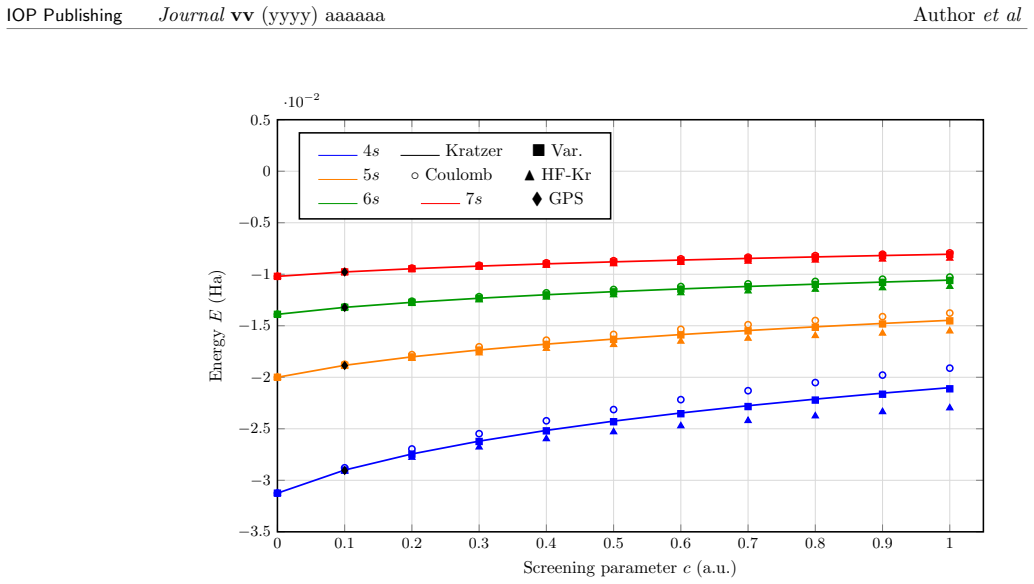
- [Section 2.3, bullet 'Kratzer reference', Tables 1–2] The stated complementary bias is contradicted by the paper's own numerical results. For every listed state, the Kratzer reference energy is above E_GPS (less bound), not below it. For example, Table 1 gives E_Kr(1s) = -0.3769734 Ha versus E_GPS(1s) = -0.3793464 Ha, and E_Kr(2s) = -0.1079848 Ha versus E_GPS(2s) = -0.1083227 Ha; Table 2 shows the same sign at c=1.0 and c=10.0. Thus the Kratzer reference does not overestimate binding; it underestimates binding, and the statement in Section 3 that the true RSCP energy lies between the Coulomb and Kratzer predictions is not supported. Consequently, the 'complementary biases ... robust error estimation' claim in the Abstract and Conclusions is not supported. This does not affect the energy formulas themselves, but it invalidates the error-estimation interpretation and should be corrected.
- [Section 7, Table 4] Table 4's caption states that relative errors are computed with respect to the reference values of Ref. [34], but no [34] Positronium values are listed; the table's last column is labeled S-H (2021) [32]. Moreover, the parenthetical percentages are not consistent with the S-H column if that is the reference: for the 1s variational energy, |(-0.2131429) - (-0.2134)|/0.2134 ≈ 0.120%, not 0.106% as tabulated. Without the actual [34] reference energies, the claimed sub-0.1% accuracy for Positronium cannot be verified. Please either quote the reference values in the table or add a dedicated reference column.
minor comments (5)
- [Abstract and Introduction] Several typographical and grammatical errors should be corrected: 'RSCP. using' in the abstract, 'prvide' in the Introduction, 'numeriacl', 'significally', and 'efficeint' later in the text.
- [Section 5.3, Table 3] The text claims 'β_opt > 1 for all states and screening parameters', but Table 3 only reports β_opt for c=0.1. Either provide data for additional screening parameters or rephrase the claim to refer to the computed range.
- [Section 6, Eq. (42)] The observation that Eq. (42) coincides with the bare Kratzer eigenvalue in Eq. (24) is important and should be stated earlier, in Section 2.2, where the Kratzer reference is introduced, not only in the comparison with Ref. [34].
- [Figure 2] The legend and symbol definitions in Figure 2 are crowded and ambiguous: '1s Kratzer■Var.' and '2s◦Coulomb▲HF-Kr' mix methods and symbols without clear visual separation. Please use distinct linestyles or separate panels.
- [Eq. (25)] The symbol I_RSCP is introduced in Eq. (25) but defined only in Appendix A. A pointer to Eq. (A.21) would help the reader.
Circularity Check
No significant circularity: all energy formulas are derived from self-contained integrals, the variational parameter is minimized against the exact RSCP Hamiltonian, and the benchmark comparison is external.
full rationale
The paper's derivations are self-contained. The Coulomb- and Kratzer-reference energies (Eqs. (12), (14), (24)) are obtained by evaluating exact expectation values ⟨Ψ_ref|Ĥ_RSCP|Ψ_ref⟩, with the full unscreened RSCP potential retained; the master integral (13) and Laguerre expansions are standard mathematics. The variational parameter β_opt is determined by minimizing E_var(β) for the exact Hamiltonian (Eqs. (29)–(34), (A.20), (A.25)), not by fitting to the GPS benchmark, so the reported sub-0.63%/0.41% errors are genuine external comparisons. The overlap with Xu et al.'s asymptotic formula is explicitly identified as the k=1, β=1 Kratzer limit (§6), not disguised as new. No load-bearing step reduces to a self-citation: the cited GPS data [33,34], Stachura–Hancock [32], and Hellmann–Feynman references [35,36] are external, with no author overlap. The paper also honestly flags a known limitation: the variational upper-bound property for excited states requires orthogonality constraints (§3, Eq. (27) discussion), so the excited-state variational improvement is empirical rather than theorem-guaranteed — a correctness caveat, not circularity. A separate internal inconsistency exists: §2.3 claims the Kratzer reference overestimates binding, but Tables 1–2 show E_Kratzer > E_GPS (less bound) for every listed state; this undermines the 'complementary biases' error-estimation narrative but does not affect the independent derivation of the energy formulas themselves.
Axiom & Free-Parameter Ledger
free parameters (1)
- β_opt (variational scaling parameter) =
1.0502 (1s), 1.0254 (2s), ..., 1.0052 (10s) at c=0.1
axioms (5)
- standard math Master integral: ∫_0^∞ x^{ν-1} e^{-β/x-γx} dx = 2(β/γ)^{ν/2} K_ν(2√(βγ)) for Re β, Re γ > 0.
- standard math Generalized Laguerre expansion (A.16) and orthogonality (A.9) hold for non-integer indices 2ν+1.
- domain assumption The Kratzer reference potential -1/r + c/r², obtained by truncating the Taylor expansion of e^{-c/r} at first order, provides a good zeroth-order description of the RSCP.
- domain assumption The RSCP is an appropriate model for plasma-embedded atoms and exotic atoms.
- ad hoc to paper The scaled Kratzer ansatz (28) with a single parameter β suffices to approximate the true eigenfunction; for excited states the variational upper bound is not guaranteed because no orthogonality to lower states is imposed.
read the original abstract
We investigate the bound state properties of the hydrogen-like atoms in the radial screened Coulomb potential (RSCP). using three complementary analytical approaches - expectation values with Coulomb and Kratzer reference states, variational optimization with a scaled Kratzer basis, and the Hellmann-Feynman theorem - we derive approximate energy eigenvalues as function of the screening parameter c. Benchmarked against high-precision generalized pseudospectral data, the expectation value-approach with the Kratzer basis achieves relative errors of 0.63% for the first ten s-states at $c=0.1$, while the variational method improves this further. The formalism extends naturally to Positronium, demonstrating its generality for arbitrary reduced-mass systems. The complementary biases of the methods provide robust error estimation for plasma-embedded atoms.
Figures




Reference graph
Works this paper leans on
-
[1]
Rep.2711–107 (doi:10.1016/0370- 1573(95)00070-4)
Jaskolski W 1996 Confined many-electron systemsPhys. Rep.2711–107 (doi:10.1016/0370- 1573(95)00070-4)
doi:10.1016/0370- 1996
-
[2]
Quantum Chem.58115–175 (doi:10.1016/S0065-3276(09)00708-4)
Sil A N, Canuto S and Mukherjee P K 2005 Spectroscopy of confined atomic systems: effect of plasmaAdv. Quantum Chem.58115–175 (doi:10.1016/S0065-3276(09)00708-4)
-
[3]
Plasmas16 063302 (doi:10.1063/1.3152602)
Paul S and Ho Y K 2009 Hydrogen atoms in Debye plasma environmentsPhys. Plasmas16 063302 (doi:10.1063/1.3152602)
-
[4]
Yukawa H 1935 On the interaction of elementary particles IProc. Phys. Math. Soc. Japan17 48–57 (doi:10.11429/ppmsj1919.17.0˙48)
-
[5]
Rev.99510–519 (doi:10.1103/PhysRev.99.510)
Latter R 1955 Atomic energy levels for the Thomas-Fermi and Thomas-Fermi-Dirac potential Phys. Rev.99510–519 (doi:10.1103/PhysRev.99.510)
-
[6]
Sternheimer R M and Peierls R F 1971 Quadrupole antishielding factors and nuclear quadrupole moments of several alkali isotopesPhys. Rev. A3837 (doi:10.1103/PhysRevA.3.837)
-
[7]
Weisheit J C 1989 Atomic excitation in dense plasmasAdv. At. Mol. Phys.25101–131 (doi:10.1016/S0065-2199(08)60084-6)
-
[8]
Salzmann D 1998Atomic Physics in Hot Plasmas(Oxford: Oxford University Press) (doi:10.1093/oso/9780195109306.001.0001)
-
[9]
Rep.3021–65 (doi:10.1016/S0370-1573(98)00017-9)
Murillo M S and Weisheit J C 1998 Dense plasmas, screened interactions, and atomic ionisation Phys. Rep.3021–65 (doi:10.1016/S0370-1573(98)00017-9)
-
[10]
Bielinska-Waz D, Karwowski J and Diercksen G H F 2001 Spectra of confined two-electron atoms J. Phys. B: At. Mol. Opt. Phys.341987 (doi:10.1088/0953-4075/34/10/312)
-
[11]
Plasmas16023502 (doi:10.1063/1.3073675)
Qi Y Y, Wu Y, Wang J G and Qu Y Z 2009 The generalised oscillator strengths of hydrogenlike ions in Debye plasmasPhys. Plasmas16023502 (doi:10.1063/1.3073675)
-
[12]
Lin C Y and Ho Y K 2010 Effects of screened Coulomb (Yukawa) and exponential-cosine- screened Coulomb potentials on photoionisation of H and He + Eur. Phys. J. D5721–26 (doi:10.1140/epjd/e2010-00009-8)
-
[13]
Ghoshal A and Ho Y K 2010 Photodetachment of H − in dense quantum plasmasPhys. Rev. E 81016403 (doi:10.1103/PhysRevE.81.016403)
-
[14]
Edwards J P, Gerber U, Schubert C, Trejo M A and Weber A 2017 The Yukawa po- tential: ground state energy and critical screeningProg. Theor. Exp. Phys.2017083A01 (doi:10.1093/ptep/ptx107) 19 IOP PublishingJournalvv(yyyy) aaaaaa Authoret al
-
[15]
Napsuciale M and Rodriguez S 2021 Complete analytical solution to the quantum Yukawa potentialPhys. Lett. B816136218 (doi:10.1016/j.physletb.2021.136218)
arXiv 2021
-
[16]
Ghoshal A and Ho Y K 2011 Properties of hydrogen molecular ion with static screened Coulomb and exponential cosine screened Coulomb potentialsInt. J. Quant. Chem.1114288–4295 (doi:10.1002/qua.22960)
-
[17]
Ghoshal A and Ho Y K 2009 Doubly excited resonance states of helium atom in exponential cosine-screened Coulomb potentialPhys. Rev. A79062514 (doi:10.1103/PhysRevA.79.062514)
-
[18]
Takimoto N 1959 On the screening of impurity potential by conduction electronsJ. Phys. Soc. Japan141142–1150 (doi:10.1143/JPSJ.14.1142)
-
[19]
Ikhdair S M and Sever R 1993 Bound states of the exponential-cosine-screened Coulomb potential Z. Phys. D281–5 (doi:10.1007/BF01437449)
-
[20]
Scr.84045001 (doi:10.1088/0031-8949/84/04/045001)
Nasser I, Abdelmonem M S and Abdel-Hady A 2011 J-matrix approach for the exponential- cosine-screened Coulomb potentialPhys. Scr.84045001 (doi:10.1088/0031-8949/84/04/045001)
-
[21]
Lai C S, Lin C Y, Lin C Y and Ho Y K 2013 Bound-state energies, oscillator strengths, and multipole polarisabilities for the hydrogen atom with exponential-cosine-screened Coulomb potentialsChin. J. Phys.5173–84 (doi:10.6122/CJP.51.73)
-
[22]
Plasmas21092703 (doi:10.1063/1.4894684)
Bahar M K and Soylu A 2014 The hydrogen atom in plasmas with an external electric field Phys. Plasmas21092703 (doi:10.1063/1.4894684)
-
[23]
Falaye B J, Ikhdair S M and Hamzavi M 2015 Shifted Tietz-Wei oscillator for simulating the atomic interaction in diatomic moleculesJ Theor. Appl. Phys.9151–158 (doi:10.1007/s40094- 015-0173-9)
-
[24]
He Y Y, Zhou Z L, Jiao L G, Liu A, Montgomery Jr H E and Ho Y K 2023 Hyperpolarizabil- ities of hydrogenlike atoms in Debye and dense quantum plasmasPhys. Rev. E107045201 (doi:10.1103/PhysRevE.107.045201)
-
[25]
Marklund M and Shukla P K 2006 Nonlinear collective effects in photon-photon and photon- plasma interactionsRev. Mod. Phys.78591–640 (doi:10.1103/RevModPhys.78.591)
-
[26]
Usp.53 51–76 (doi:10.3367/UFNe.0180.201001b.0055)
Shukla P K and Eliasson B 2010 Nonlinear aspects of quantum plasma physicsPhys. Usp.53 51–76 (doi:10.3367/UFNe.0180.201001b.0055)
arXiv 2010
-
[27]
Plasmas19 072701 (doi:10.1063/1.4736947)
Soylu A 2012 Plasma screening effects on the energies of hydrogen atomPhys. Plasmas19 072701 (doi:10.1063/1.4736947)
-
[28]
Jiao L G and Ho Y K 2014 Doubly excited states of the hydrogen negative ion in Debye plasmas J. Quanti. Spectr. Rad. Trans.14427–35 (doi:10.1016/j.jqsrt.2014.03.026)
-
[29]
Plasmas15073301 (doi:10.1063/1.2953802)
Paul S and Ho Y K 2008 Two-photon transitions of hydrogen atoms embedded in weakly coupled plasmasPhys. Plasmas15073301 (doi:10.1063/1.2953802)
-
[30]
Ghoshal A and Ho Y K 2009 Ground states and doubly excited resonance states of H − embedded in dense quantum plasmasJ. Phys. B: At. Mol. Opt. Phys.42175006 (doi:10.1088/0953- 4075/42/17/175006)
doi:10.1088/0953- 2009
-
[31]
Plasmas24043506 (doi:10.1063/1.4979893)
Rej P and Ghoshal A 2017 Positron scattering from hydrogen atom in dense quantum plasmas: Positronium formation in Rydberg statesPhys. Plasmas24043506 (doi:10.1063/1.4979893)
-
[32]
Stachura E and Hancock H 2021 Bound states and energy eigenvalues of a radial screened Coulomb potentialJ. Phys. Commun.5065004 (doi:10.1088/2399-6528/abfff8)
-
[33]
Xu L, Jiao L G, Liu A, Montgomery Jr H E, Ho Y K and Fritzsche S 2023 Energy spectra and asymptotic laws of the radial screened Coulomb potentialPhys. Lett. A483129064 (doi:10.1016/j.physleta.2023.129064)
arXiv 2023
-
[34]
Scr.99065404 (doi:10.1088/1402- 4896/ad42e5) 20 IOP PublishingJournalvv(yyyy) aaaaaa Authoret al
Xu L, Fernandez F M, Jiao L G, Montgomery Jr H E, Ho Y K and Fritzsche S 2024 Revisiting the energy spectrum of the radial screened Coulomb potentialPhys. Scr.99065404 (doi:10.1088/1402- 4896/ad42e5) 20 IOP PublishingJournalvv(yyyy) aaaaaa Authoret al
doi:10.1088/1402- 2024
-
[35]
Hellmann H 1937Einf¨ uhrung in die Quantenchemie(Leipzig: Deuticke)
-
[36]
Rev.56340–343 (doi:10.1103/PhysRev.56.340)
Feynman R P 1939 Forces in moleculesPhys. Rev.56340–343 (doi:10.1103/PhysRev.56.340)
-
[37]
Schiff L I 1968Quantum Mechanics3rd edn (New York: McGraw-Hill)
-
[38]
Bethe H A and Salpeter E E 2013Quantum Mechanics of One- and Two-Electron Atoms(Berlin: Springer) (doi:10.1007/978-3-662-12869-5)
-
[39]
Gradshteyn I S and Ryzhik I M 2007Table of Integrals, Series, and Products7th edn (Amsterdam: Elsevier) (doi:10.1016/B978-0-12-294757-5.X5000-4)
-
[40]
(eds) Advances in Nuclear Physics
Friar J L and Negele J W 1975 Theoretical and experimental determination of nuclear charge distributions In: Baranger, M., Vogt, E. (eds) Advances in Nuclear Physics. Springer, Boston, MA. (doi:10.1007/978-1-4757-4398-2˙3)
-
[41]
Sick I 2003 On the rms-radius of the protonPhys. Lett. B57662–67 (doi:10.1016/j.physletb.2003.09.092)
-
[42]
Pohl Ret al2010 The size of the protonNature466213–216 (doi:10.1038/nature09250)
-
[43]
Antognini Aet al2013 Proton structure from the measurement of 2S-2P transition frequencies of muonic hydrogenScience339417–420 (doi:10.1126/science.1230016)
-
[44]
Z.24185–206
Debye P and H¨ uckel E 1923 Zur Theorie der ElektrolytePhys. Z.24185–206
1923
-
[45]
Mitroy J, Safronova M S and Clark C W 2010 Theory and applications of atomic and ionic polarisabilitiesJ. Phys. B: At. Mol. Opt. Phys.43202001 (doi:10.1088/0953-4075/43/20/202001)
-
[46]
Pohl Ret al2016 Laser spectroscopy of muonic deuteriumScience353669–673 (doi:10.1126/science.aaf2468)
-
[47]
De Vries H, De Jager C W and De Vries C 1987 Nuclear charge-density-distribution parameters from elastic electron scatteringAt. Data Nucl. Data Tables36495–536 (doi:10.1016/0092- 640X(87)90013-1)
doi:10.1016/0092- 1987
-
[48]
Angeli I and Marinova K P 2013 Table of experimental nuclear ground state charge radii: An updateAt. Data Nucl. Data Tables9969–95 (doi:10.1016/j.adt.2011.12.006)
-
[49]
Electron conduction in magnetized neutron star envelopes
Potekhin A Y 1999 Electron conduction in magnetised neutron star envelopesAstron. Astrophys. 351787–797 (doi:10.48550/arXiv.astro-ph/9909100)
work page internal anchor Pith review Pith/arXiv arXiv doi:10.48550/arxiv.astro-ph/9909100 1999
-
[50]
Chabrier G, Douchin F and Potekhin A Y 2002 Dense astrophysical plasmasJ. Phys.: Condens. Matter149133–9139 (doi:10.1088/0953-8984/14/40/307)
-
[51]
Griem H R 1997Principles of Plasma Spectroscopy(Cambridge: Cambridge University Press) (doi:10.1017/CBO9780511524578)
-
[52]
Fujimoto T 2004Plasma Spectroscopy(Oxford: Oxford University Press) (doi:10.1093/acprof:oso/9780198530282.001.0001)
-
[53]
Rosmej F B, Astapenko V A and Lisitsa V S 2021 Plasma atomic physicsSpringer Ser. At. Opt. Plasma Phys.1041–496 (doi:10.1007/978-3-030-05968-2)
-
[54]
Plasmas11339–491 (doi:10.1063/1.1578638)
Lindl J Det al2004 The physics basis for ignition using indirect-drive targets on the National Ignition FacilityPhys. Plasmas11339–491 (doi:10.1063/1.1578638)
-
[55]
Hurricane O Aet al2014 Fuel gain exceeding unity in an inertially confined fusion implosion Nature506343–348 (doi:10.1038/nature13008)
-
[56]
Behringer K 1991 Diagnostics and modelling of ECRH microwave dischargesPlasma Phys. Control. Fusion33997 (doi:10.1088/0741-3335/33/9/001)
-
[57]
Isler R C 1994 An overview of charge-exchange spectroscopy as a plasma diagnosticPlasma Phys. Control. Fusion36171 (doi:10.1088/0741-3335/36/2/001) 21
discussion (0)
Sign in with ORCID, Apple, or X to comment. Anyone can read and Pith papers without signing in.