REVIEW 3 major objections 5 minor 26 references
This paper claims that quantum teleportation can be used as a directed, tunable communication channel between musical agents, turning teleportation infidelity into a controlled parameter for improvisation.
Reviewed by Pith at T0; open to challenge. T0 means a machine referee read the full paper against a public rubric. the ladder, T0–T4 →
T0 review · deepseek-v4-flash
2026-08-01 13:03 UTC pith:TZNQX5X7
load-bearing objection A genuinely new use of teleportation as a tunable 'whisper' channel between musical agents — with a real idea in the interpreter module, but the headline fidelity claim is only shown on isolated qubits, not the entangled circuits the system actually runs. the 3 major comments →
Teleportation Game: Quantum Teleportation in Multi-Agent Systems for Interactive Music
The pith
A machine-rendered reading of the paper's core claim, the machinery that carries it, and where it could break.
Core claim
The central discovery is a parameterized 'interpreter module' inserted into the teleportation correction stage. Standard teleportation recovers the sent state with X and Z corrections; the paper replaces those with RX(θ) and RZ(θ) gates. Simulator experiments over randomized U(θ,φ,λ) states show that as θ increases toward π, the fidelity between sender and receiver states rises and the variance across trials falls; as θ approaches zero, fidelity drops and variance grows. The paper interprets this as a continuous spectrum of interpretative distance—from faithful reproduction to free reinterpretation—and treats it as a musical parameter rather than an error. This reframes teleportation-based i
What carries the argument
SQPAM (Single Qubit Probability Amplitude Modulation) encodes melodic and rhythmic information into the probability amplitudes of single qubits via U(θ,φ,λ) rotations; PKBSE (Phase Kickback Sequencing Encoding) uses quantum phase estimation to entangle the signal qubits with a time register and place the rotations at the correct sequence positions. Teleportation moves one agent's signal qubit state to another agent's qubit via a Bell pair and classical measurements. The interpreter module—parameterized RX/RZ corrections replacing the Pauli X/Z corrections—is the knob that controls how faithfully the received state is reproduced.
Load-bearing premise
The approach assumes that the audio features (contour energy, tempo, spectral centroid, onset intensity) mapped to rotation angles, and the subsequent scale-quantized decoding, preserve enough musical structure that differences between agents' outputs after teleportation are meaningful measures of imitation versus divergence rather than artifacts of the encoding and decoding pipeline.
What would settle it
Run the same two-agent teleportation circuit but replace the teleportation channel with a direct classical copy of agent 1's U(θ,φ,λ) parameters into agent 2's initial state (perfect transfer); if melodic correlation, Hamming distance, and fidelity distributions are statistically indistinguishable from the teleportation runs, then the observed interpretive variation is not caused by teleportation at all—it would be a property of the encoding/decoding and the parameterized corrections, not of the quantum channel.
If this is right
- Teleportation can mediate directed influence between musical agents without enforcing synchronization or identity; after reception, the receiver evolves independently, enabling divergence.
- Cascading teleportation across three agents produces composite influences: downstream agents' outputs reflect both direct and indirect transmissions, and NISQ noise can reverse which influence dominates.
- The interpreter module gives performers and composers a continuous control over interpretive distance, not just a binary success or failure of state transfer.
- The work offers a new evaluation lens for quantum communication: fidelity can be treated as a continuum of interpretive transformation with perceptible musical meaning, potentially useful for Quantum Internet design.
- The framework extends to distributed agents connected via quantum networks, where teleportation would carry non-local musical information that classical networks cannot transmit.
Where Pith is reading between the lines
- The interpreter module could be generalized beyond RX/RZ to arbitrary single-qubit rotations or even non-unitary operations, creating a larger space of 'listening styles'; the paper's claim that θ is the dial suggests a family of such dials.
- The temporal misalignment between agents' time registers, noted in the paper as a cause of divergence, could be isolated and deliberately controlled to add a rhythmic-displacement dimension independent of state fidelity.
- A blind listening study where human listeners rate melodic similarity between agents' outputs could test whether perceptual ratings correlate with the computed fidelity continuum, giving the 'interpretative distance' metric ecological validity.
- If hardware noise indeed inflates variance as the paper assumes, different devices or noise-injection levels could be used as a compositional parameter, making device noise an expressive resource rather than a limitation.
Editorial analysis
A structured set of objections, weighed in public.
Referee Report
Summary. The paper presents an interactive music system in which musical agents encode melodic and rhythmic features of a live input as quantum states (SQPAM/PKBSE), entangle these with a time register via QPE, and communicate by quantum teleportation. Two- and three-agent demonstrations on a simulator and IBM hardware are compared with melodic-correlation and Hamming-distance metrics. The central quantitative experiment (Section 5) generalizes the teleportation correction stage by replacing Pauli gates with parameterized RX(RZ) rotations and reports that increasing the correction angle theta toward pi increases sender-receiver fidelity and reduces variance, which is interpreted as a tunable 'interpreter module' that shapes musical interpretative distance. The paper frames NISQ noise and teleportation infidelity as creative resources ('quantum whispers') and positions the work toward future Quantum Internet music ensembles.
Significance. The artistic idea of treating infidelity in quantum teleportation as a continuous, tunable musical parameter is original and could be a useful proof-of-concept for quantum computer music and for human-centered evaluation of imperfect quantum state transfer. The paper is clearly written, builds on established building blocks (SQPAM, PKBSE, QPE, standard teleportation), and the Section 5 single-qubit trend is internally consistent. However, the main claims about 'systematically shaped' musical interpretation are not yet supported by experiments on the actual multi-agent entangled circuits, and the hand-built encoding/decoding pipeline lacks controls. If the follow-up experiments requested below demonstrate the trend in the full pipeline, the contribution would be significant for its community; as it stands, the result is a promising but incomplete demonstration.
major comments (3)
- [Section 5, Fig. 18; Eqs. (6)-(7)] The central claim of a tunable interpreter module is supported only by a standalone single-qubit teleportation circuit U(theta, phi, lambda)|0> with RX(theta)/RZ(theta) corrections (Fig. 18). In the actual agent circuits of Sections 3-4, the teleported melodic qubit is entangled with the time register and rhythm qubit through controlled-U and QFT/PKBSE, so the receiver qubit is not an isolated pure state; single-qubit sender-vs-receiver fidelity cannot quantify the resulting distortion of the multipartite state. Section 5 also states that the hardware experiment was not run and merely assumes that noise will increase variance. Please run the interpreter module on the full SQPAM/PKBSE circuit and decode the corrected states; without that, 'interpretative behaviour can be systematically shaped' as a musical parameter is unsupported.
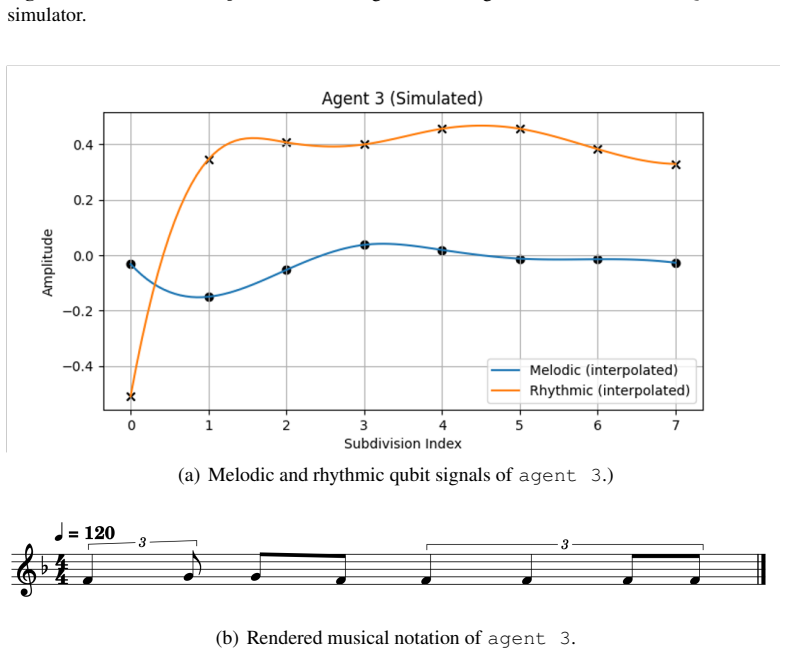
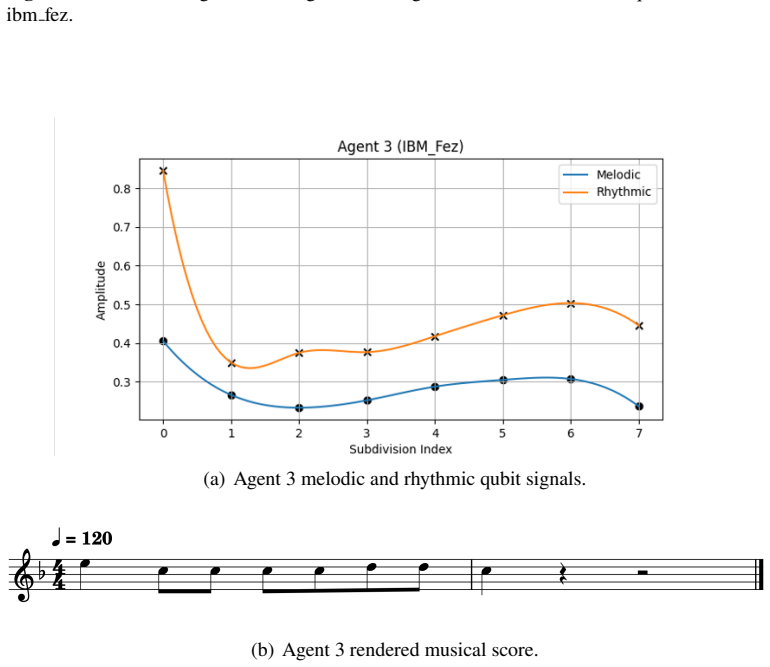
- [Sections 3.1-3.2 and Tables 3-4] The conclusions about imitation/divergence and direct/indirect influence depend on a hand-built pipeline: audio features are scaled to [-10,10], mapped to U-gate angles, decoded via Eq. (3), and quantized to an F-major scale. No control condition or ablation is provided, so the melodic correlations and Hamming distances may reflect the quantizer/decoder rather than teleportation. In addition, Tables 3-4 report single runs without error bars; the simulator/hardware discrepancy for the Agent 2-3 pair (0.717 vs 0.290) is unexplained. A baseline with random replacement of the teleported state, or varying only the decoder, is needed before attributing the observed differences to teleportation.
- [Section 4.1, Fig. 7] The correction table appears to interchange the X and Z corrections for measurement outcomes |01> and |10> relative to the standard teleportation protocol as described (Bennett et al.). Moreover, Fig. 7 shows unconditional X and Z gates on q2 rather than classically conditioned corrections. If the corrections are not applied conditionally on the measurement outcomes, the protocol is not standard teleportation, and the Section 5 fidelity results measure a different operation. Please clarify the exact conditional correction logic and verify it on |0>, |1>, and a superposition state.
minor comments (5)
- [Section 5, Eq. (6)] The ranges from which theta, phi, lambda are sampled are not specified, and the number of shots is not stated. This prevents reproduction of the 100-trial experiment.
- [Eq. (4)] The melodic-correlation sum uses A_i and A_{i-1}; the index range should start at i=2 (or the first term should be defined separately). Also clarify the min-of-ratios convention.
- [Figure 19] Panel (a) is labeled 'Normal distribution for state fidelities,' but no fitted distribution or axis labels are shown. State the sample statistics and whether a normal fit was actually performed.
- [Abstract and Section 5] Minor typos: 'asquantum whispers' should be 'as quantum whispers'; the paragraph beginning 'For each trial, the teleportation protocol was executed...' is repeated almost verbatim.
- [Reference [15]] The DOI/URL for the Librosa paper is malformed: 'https://doi.org/10.25080/Majora-7b98e3ed-01ehttps://doi.org/10.25080/Majora-7b98e3ed-003'.
Circularity Check
No significant circularity: the Section 5 fidelity result is a direct consequence of the teleportation correction gate, not a fitted input; self-citations are methodological and not load-bearing.
full rationale
The paper's derivation chain is not circular. The SQPAM/PKBSE encoding methods are cited from the authors' prior work, but the present paper independently implements and runs the circuits on Qiskit Aer and IBM hardware, so the self-citations are not the sole support for the central claims. The Section 5 interpreter module replaces Pauli corrections with RX(θ)/RZ(θ) and measures sender-receiver fidelity; the observed increase in mean fidelity as θ approaches π follows directly from RX(π) implementing the X correction up to a global phase, and the variance trend is an empirical statistic computed over randomly sampled input states, not a parameter fitted to the data. No uniqueness theorem is invoked, no fitted parameter is renamed as a prediction, and the melodic-correlation/Hamming-distance results are computed from decoded outputs rather than being fixed by construction. The paper's main limitation—that the interpreter module was not tested on the full entangled multi-agent circuit—is an external-validity concern, not circularity.
Axiom & Free-Parameter Ledger
free parameters (5)
- Feature-to-Ugate scaling bounds =
-10 to +10
- Contour-energy block segmentation =
3 equal blocks
- Scaling of decoded amplitude ai to pitches =
Key of F major; quantized to scale
- Sampled parameter ranges in Section 5 =
uniform over a 'predefined range'
- Correction rotation angle θ in demonstrations =
π
axioms (4)
- standard math Standard quantum teleportation protocol with ideal Bell-state measurements and classical feed-forward corrections.
- domain assumption The SQPAM representation and PKBSE phase-kickback sequencing encode musical amplitude information faithfully enough for musical purposes.
- domain assumption Librosa feature extraction (pYIN, beat.tempo, spectral centroid, onset strength) produces musically relevant parameter values for the U gates.
- domain assumption The Uhlmann-Jozsa fidelity between the teleported sender/receiver qubit states is a meaningful proxy for 'musical understanding' or 'interpretive distance'.
invented entities (2)
-
Quantum whisper
no independent evidence
-
Interpreter module
independent evidence
read the original abstract
This paper introduces an interactive music system with quantum musical agents that communicate by teleporting quantum states to one another. Human performers interact in real time with agents whose melodic and rhythmic behaviours are encoded as quantum states using Single Qubit Probability Amplitude Modulation (SQPAM) and structured through Quantum Phase Estimation (QPE). Up to three agents are combined within a single quantum circuit, with directed communication via quantum teleportation. We are interested in supporting ambiguous, transformative interactions reminiscent of free Jazz improvisation. Therefore, rather than treating noise and decoherence as limitations, the system embraces NISQ-era constraints as creative affordances, framing agent communication as quantum whispers, that is, deliberate, musically expressive imperfections in state transfer. We provide demonstrations and analyses based on melodic correlation, pitch-set distance, and state fidelity, where a continuum between imitation and divergence can be observed. We developed a tunable interpretation method to assess how agents reinterpret teleported states. This work positions teleportation as a promising interaction mechanism for agent-based quantum computer music and outlines future directions toward distributed ensembles connected via the Quantum Internet.
Figures






Reference graph
Works this paper leans on
-
[1]
Andronikos, T., Bitsakos, C., Nikas, K., Goumas, G. I., and Koziris, N. (2026). “Probabilis- tic Links Between Quantum Classification of Patterns of Boolean Functions and Hamming Distance”.Stats, 9(1): 5. DOI:https://doi.org/10.3390/stats9010005
-
[2]
Teleporting an unknown quantum state via dual classical and Einstein–Podolsky–Rosen chan- nels
Bennett, C. H., Brassard, G., Cr ´epeau, C., Jozsa, R., Peres, A., and Wootters, W. K. (1993). “Teleporting an unknown quantum state via dual classical and Einstein–Podolsky–Rosen chan- nels”.Physical Review Letters, 70(13): 1895-1899. DOI:https://doi.org/10.1103/ PhysRevLett.70.1895
1993
-
[3]
(2019).Quantum Computing for Everyone
Bernhardt, C. (2019).Quantum Computing for Everyone. The MIT Press, Cambridge, MA. ISBN: 978-0-26-203925-3
2019
-
[4]
Improvizing with Genetic Algorithms: GenJam
Biles J. A. (2007). “Improvizing with Genetic Algorithms: GenJam”. In Miranda, E.R. and Biles, J.A. (eds.),Evolutionary Computer Music. Springer, London. DOI:https://doi. org/10.1007/978-1-84628-600-1_7
-
[5]
Djordjevic, I. B. (2022).Quantum Communication, Quantum Networks, and Quantum Sensing. Elsevier, Amsterdam. ISBN: 978-0-12-822942-2
2022
-
[6]
Gabrielli, L. and Squartini, S. (2016).Wireless Networked Music Performance. Springer, Sin- gapore. DOI:https://doi.org/10.1007/9789811003356
-
[7]
and Pikrakis, A
Giannakopoulos, T. and Pikrakis, A. (2014).Introduction to Audio Analysis. Academic Press, Cambridge, MA. ISBN: 978-0-08-099388-1
2014
-
[8]
Information security through controlled quantum tele- portation networks
Hamdoun, H. and Sagheer, A. (2020). “Information security through controlled quantum tele- portation networks”.Digital Communications and Networks, 6(4):463-470. DOI:https: //doi.org/10.1016/j.dcan.2020.04.009
-
[9]
Quantum Representations of Sound: From Mechanical Waves to Quantum Circuits
Itaborai, P. V. and Miranda, E. R. (2022). “Quantum Representations of Sound: From Mechanical Waves to Quantum Circuits”. In Miranda, E.R. (Ed.)Quantum Computer Music. Springer, Cham. DOI:https://doi.org/10.1007/978-3-031-13909-3_10
-
[10]
Kim, K., Fram, N., Nerness, B., Turnbull, C., Chander, A., Georgieva, E., James, S., Wright, M. and Fujioka, T. (2024). “Performance Monitoring of Improvisation and Score-Playing in a Turn-Taking Piano Duet: An EEG Study Using Altered Auditory Feedback”Psychophysiology. Psychophysiology. 62(2):e14704.DOI:https://doi.org/10.1111/psyp.14704
-
[11]
Kimble, H. J. (2008).The Quantum Internet. arXiv:0806.4195:https://doi.org/10. 48550/arXiv.0806.4195
-
[12]
Too many notes: Computers, complexity and culture in Voyager
Lewis, G. E. (2000). “Too many notes: Computers, complexity and culture in Voyager”.Leonardo Music Journal, 10(2): 33–39. DOI:https://doi.org/10.1162/096112100570585
-
[13]
Quantum fidelity measures for mixed states
Liang, Y.-C., Yeh, Y.-H., Mendonc ¸a, P. E. M. F., Teh, R. Y., Reid, M. D. and Drummond, P. D. (2019). “Quantum fidelity measures for mixed states”.Reports on Progress in Physics, 82(7), 076001. DOI:https://doi.org/10.1088/1361-6633/ab1ca4
-
[14]
pYIN: A fundamental frequency estimator using probabilistic threshold distributions
Mauch, M. and Dixon, S. (2014). “pYIN: A fundamental frequency estimator using probabilistic threshold distributions”. InProceedings of the IEEE International Conference on Acoustics, Speech and Signal Processing (ICASSP), pp. 659–663. IEEE. DOI:https://doi.org/ 10.1109/ICASSP.2014.6853678
arXiv 2014
-
[15]
Librosa: Audio and music signal analysis in Python
McFee, B., Raffel, C., Liang, D., Ellis, D. P. W., McVicar, M., Battenberg, E. and Nieto, O. (2015). “Librosa: Audio and music signal analysis in Python”. InProceedings of the 14th Python in Science Conference, pp. 18-25. Austix, Texas. DOI:https://doi.org/10. 25080/Majora-7b98e3ed-01ehttps://doi.org/10.25080/Majora-7b98e3ed-003 23
-
[16]
Available online:https://midi.org/specs(Ac- cessed on 21 December 2025)
MIDI Association.MIDISpecifications. Available online:https://midi.org/specs(Ac- cessed on 21 December 2025)
2025
-
[17]
Introduction to Quantum Computing for Musicians
Miranda, E. R. and Weaver, J.(2022). “Introduction to Quantum Computing for Musicians”. In Miranda, E. R. (ed.),Quantum Computer Music. Springer, Cham. DOI:https://doi.org/ 10.1007/978-3-031-13909-3_1
-
[18]
Brain Dynamics During Music Improvisation
Nerness, B. (2025). “Brain Dynamics During Music Improvisation” Doctoral disser- tation. Stanford University. Available online:https://stacks.stanford.edu/ file/xm667gf4960/BarbaraNerness_diss_Brain_Dynamics_Music_ Improvisation-augmented.pdf(Accessed on 19 March 2025)
2025
-
[19]
(2023).Lineage and Freedom: A Quantum Computational Framework for Im- provisation
Oshiro, S. (2023).Lineage and Freedom: A Quantum Computational Framework for Im- provisation. Doctoral dissertation. Stanford University. Available online:https://purl. stanford.edu/sg420hc4768
2023
-
[20]
(2022).QuiKo: A quantum beat generation application
Oshiro, S. (2022).QuiKo: A quantum beat generation application. Available on arXiv:2204.04370:https://doi.org/10.48550/arXiv.2204.04370
-
[21]
ibm.com/docs/en/api/qiskit/qiskit.circuit.library.UGate
IBM Quantum Platform (2025).Qiskit API Reference: UGate.https://quantum.cloud. ibm.com/docs/en/api/qiskit/qiskit.circuit.library.UGate
2025
-
[22]
Rohde, P. P. (2021).The Quantum Internet: The Second Quantum Revolution. Cambridge University Press, Cambridge. DOI:https://doi.org/10.1017/9781108868815
-
[23]
Machine listening and composing with Cypher
Rowe, R. (1992). “Machine listening and composing with Cypher”.Computer Music Journal, 16(1): 62–73. DOI:https://www.jstor.org/stable/3680494
arXiv 1992
-
[24]
Spectral centroid and timbre in com- plex, multiple instrumental textures
Schubert, E., Wolfe, J., and Tarnopolsky, A. (2004). “Spectral centroid and timbre in com- plex, multiple instrumental textures”. InProceedings of the International Conference on Music Perception and Cognition (ICMPC)
2004
-
[25]
(2024).Quantum algorithms: Phase estimation
Ueda, K. (2024).Quantum algorithms: Phase estimation. IBM Quantum Platform Courses. Available online:https://quantum.cloud.ibm.com/learning/en/courses/ utility-scale-quantum-computing/quantum-phase-estimation
2024
-
[26]
Capturing coordination and intentionality in joint musical improvisation
Vaarten, L. and Wiltshire, T. J. (2023). “Capturing coordination and intentionality in joint musical improvisation”.Psychomusicology: Music, Mind, and Brain, 33(1-4): 26–39. DOI: https://doi.org/10.1037/pmu0000299 24
discussion (0)
Sign in with ORCID, Apple, or X to comment. Anyone can read and Pith papers without signing in.