REVIEW 3 major objections 5 minor 61 references
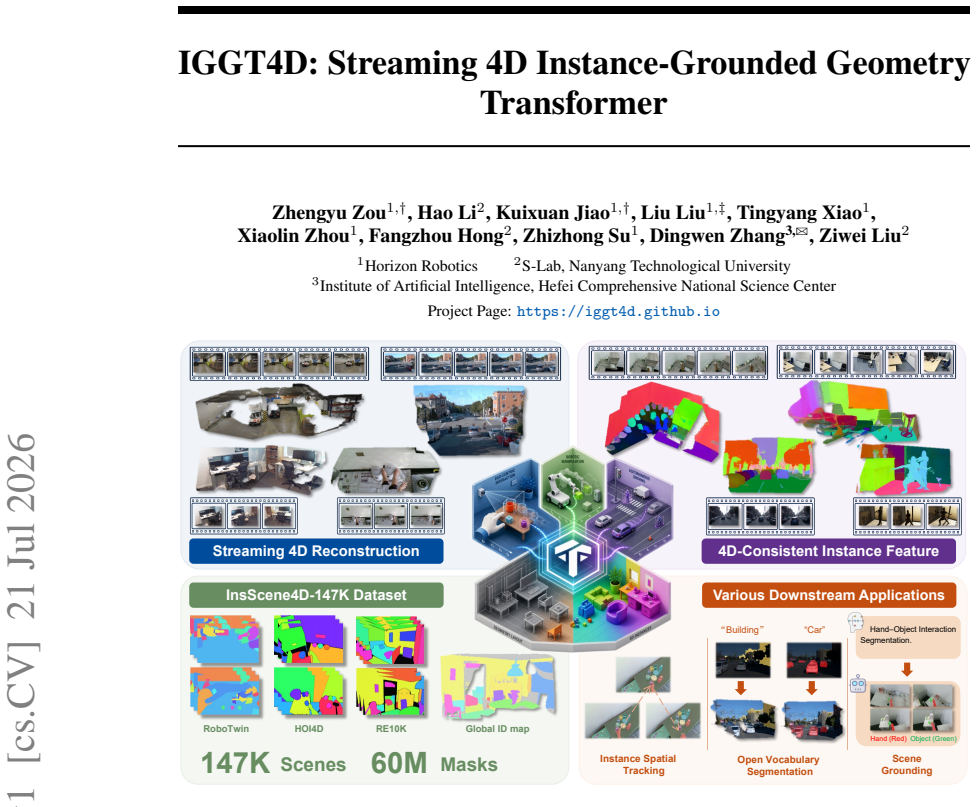
IGGT4D turns 4D scene reconstruction into a causal streaming task, jointly predicting camera motion, geometry, and persistent object identities from video, and claims to beat streaming baselines while keeping memory constant.
Reviewed by Pith at T0; open to challenge. T0 means a machine referee read the full paper against a public rubric. the ladder, T0–T4 →
T0 review · deepseek-v4-flash
2026-08-01 13:01 UTC pith:V3T4YEYY
load-bearing objection A serious streaming instance-geometry model with a real dataset, but the headline streaming-baseline win is confounded by DA3 initialization and DA3-generated pseudo-labels. the 3 major comments →
IGGT4D: Streaming 4D Instance-Grounded Geometry Transformer
The pith
A machine-rendered reading of the paper's core claim, the machinery that carries it, and where it could break.
Core claim
The paper's central claim is that geometry and instance understanding can be unified in a causal streaming architecture and that this unification is what enables persistent object identity in long dynamic videos. IGGT4D encodes each frame, applies causal attention so it only sees current and past frames, decodes depth, rays, and instance features through a coupled Tri-DPT head, and then merges local instance clusters into a global codebook that is updated in constant time. The authors demonstrate that this design maintains temporally consistent object IDs across occlusions and reappearance without explicit motion modeling, and that the memory footprint of the clustering step stays at about 0
What carries the argument
The central mechanism is a causal geometry-instance Transformer with three coupled components: (1) causal intra-view and cross-view attention with camera and cross-view KV caches, so each frame reuses historical context without recomputation; (2) a Tri-DPT head that jointly decodes depth, ray maps, and instance features, injecting geometric features into the instance branch via geometry-aware attention; and (3) a streaming clustering strategy that maintains a lightweight global instance codebook (feature center plus accumulated pixel count) and updates it in constant time per frame via area-weighted fusion. First-frame geometric normalization is used during training to remove the scale ambig
Load-bearing premise
The load-bearing premise is that the depth, pose, and instance labels used for training are trustworthy, especially the DA3-generated geometry pseudo-labels; if those are biased in dynamic, egocentric, or small-object scenes, the model's gains may come from inheriting the teacher's bias rather than from its streaming design.
What would settle it
Train IGGT4D on a purely synthetic dataset with ground-truth depth, pose, and instance masks (e.g., Kubric or RoboTwin), and compare it against a streaming baseline also trained on the same ground-truth labels. If the causal streaming model no longer outperforms the baseline, the claim that causal streaming geometry-instance modeling drives the improvement is falsified. Alternatively, evaluate on sequences where objects fully leave the view for many frames and then reappear; if identity tracking fails at reappearance, the claim of persistent identity under reappearance is falsified.
If this is right
- If the central claim holds, long-sequence 4D reconstruction becomes practical in online settings: a single GPU can process arbitrarily long video streams without unbounded memory growth, which current streaming baselines cannot do.
- Instance identities can be maintained across occlusions and viewpoint changes without explicit tracking or optical flow, because the instance features are grounded in reconstructed geometry and clustered incrementally.
- A unified geometry-instance representation enables downstream tasks like open-vocabulary segmentation and 4D QA grounding to work from streaming input, rather than requiring offline 3D reconstruction first.
- The proposed dataset with geometry-consistent instance masks provides a way to supervise such models at scale, potentially shifting the field from semantic-lifting pipelines to end-to-end streaming prediction.
Where Pith is reading between the lines
- Inference: The performance gap over non-DA3 streaming baselines may partly measure teacher transfer rather than the streaming architecture itself; a cleaner test would compare against a baseline fine-tuned on the same DA3 geometry labels without the causal streaming design.
- Inference: The evaluation protocol reorders sequences so every frame overlaps a previous one, removing the hardest streaming failure mode (total re-observation after disappearance). A natural extension is to evaluate on truly unconstrained streams where objects leave and re-enter the field of view with no overlap, testing whether the incremental codebook truly recovers identities.
- Inference: Because the clustering memory is constant in sequence length and time scales linearly, the approach is directly applicable to real-time robotic and embodied perception, but its robustness to rapidly changing lighting, motion blur, and long-term drift remains untested on real egocentric data.
- Inference: The instance features are learned from pseudo-labels generated by a teacher model; if those pseudo-labels contain systematic bias in dynamic or small-object scenes, the model will inherit that bias. A testable extension is to pretrain with fully ground-truth synthetic supervision and measure whether the streaming advantage persists.
Editorial analysis
A structured set of objections, weighed in public.
Referee Report
Summary. The paper proposes IGGT4D, a streaming Transformer that jointly predicts camera pose, depth/ray maps, and per-pixel instance features from video streams under causal attention, plus an online clustering stage that maintains persistent instance IDs. It also introduces InsScene4D-147K, a large dataset of real and synthetic, static and dynamic sequences with geometry-guided instance annotations. Experiments cover pose estimation, 3D reconstruction (F1 and Chamfer), instance spatial tracking, open-vocabulary segmentation, and an ablation, and report consistent improvements over streaming baselines while avoiding the OOM failure of the offline IGGT model.
Significance. If the claims hold, the paper makes a useful step: it combines the streaming-reconstruction paradigm with object-level instance persistence in a single feed-forward model, and provides a large training corpus with instance masks. The architecture is sensible, the causal-masking and KV-cache design is a natural extension of existing streaming geometry models, and the streaming clustering with a constant-size codebook is a practical improvement over HDBSCAN. The evaluation spans several external benchmarks and multiple tasks, which is broader than typical. However, the central empirical claim—'outperforms existing streaming baselines'—is weakened by a teacher-chain confound: the model is initialized from DA3-Giant and trained on DA3-generated pseudo-labels, while the compared streaming baselines are neither DA3-initialized nor trained on this pseudo-label distribution. In addition, the instance-tracking evaluation relies on manually curated masks and reordered sequences that remove the hardest streaming failure mode. These issues do not invalidate the architecture but make the headline comparison ambiguous.
major comments (3)
- [Sec. 5.1, Table 1; Sec. 4; A.5] The main comparison against streaming baselines is confounded by the DA3 teacher chain. A.5 states that IGGT4D is initialized from DA3-Giant, and Sec. 4 constructs the static and dynamic geometry labels using DA3 depth and pose predictions (TSDF-fused for static scenes). The streaming baselines in Table 1 (CUT3R, StreamVGGT, Wint3R, Stream3R, LingBot-Map) are neither DA3-initialized nor trained on this pseudo-label distribution. The reported margins (e.g., Avg AUC@3 0.446 vs 0.306, Avg F1 0.668 vs 0.523) may therefore reflect inherited DA3 priors and label alignment rather than the proposed causal streaming and instance clustering. A concrete test is to initialize or fine-tune a strong streaming baseline on InsScene4D-147K under the same conditions, or to ablate IGGT4D's initialization from DA3-Giant. Without such a control, the headline 'outperforms existing streaming baselines' is not
- [A.6; Table 2] The instance-tracking evaluation is partly based on manual curation and a protocol that removes the central streaming challenge. A.6 reports that HOI4D masks are 'manually annotated by us', that Waymo and ScanNet++ have 'manually remove[d] several small objects', and that PointOdyssey masks are 'manually select[ed]' and merged. Moreover, all geometry evaluation sequences are reordered so that 'every frame shares visual overlap with at least one preceding frame', which eliminates the total re-observation scenario (an object disappears and later reappears) that a streaming instance-consistency model should handle. The paper should evaluate on the original sequence order and on sequences with explicit reappearance, and should release the manually curated masks/protocol so that the reported T-mIoU/T-SR numbers are independently verifiable.
- [Sec. 3.2, Sec. 3.3, Table 5] The constant-memory claim is only demonstrated for the clustering stage, not for the full model. Table 5 and the surrounding text state that 'our method maintains a constant memory footprint (~0.7 GB)', but this measurement is for the streaming clustering algorithm only. The model itself maintains 'camera and cross-view KV caches' (Sec. 3.2) whose size is not described or bounded; if all historical tokens are cached, memory grows linearly with sequence length and the long-sequence scalability claim is weaker than implied. Please specify whether these caches are compressed or bounded, and report full-model GPU memory as a function of sequence length alongside the clustering-only numbers.
minor comments (5)
- [General] No error bars or variance information is reported for any table. Given the manual curation and reordering, at least a few repeated runs or per-sequence standard deviations would help the reader assess the stability of the reported margins.
- [Eq. (4)] The contrastive loss notation is dense: it is unclear whether the sums over v and k are nested or run over all valid pairs, and the definition of prototypes mu_v_k should be stated explicitly in the main text rather than only in words.
- [A.6] The reordering of evaluation sequences is described as ensuring visual overlap, but the amount of overlap and the original ordering are not quantified. Please report statistics (e.g., average number of overlapping frames) and, ideally, results on the original ordering.
- [References] Several cited works are given as 2026 preprints (e.g., LingBot-Map [60], LangSurf [35], Iris-SLAM [7], Spa3R [29]) without arXiv identifiers or availability notes. Please add stable identifiers or state if they are under review.
- [Figures 3 and 11] Figures 3 and 11 appear to show very similar qualitative visualization of instance features/masks. Consider merging or differentiating them to avoid redundancy.
Circularity Check
No circular derivation: the reported geometry and instance predictions are tested against external ground truth, not against the model's own outputs or fitted inputs.
full rationale
I find no circular step that reduces a claimed prediction to the paper's inputs by construction. The geometry benchmark in Table 1 is evaluated on hold-out external datasets (HiRoom, ETH3D, 7Scenes, ScanNet++), and A.6 states explicitly: 'Our evaluation datasets (HiRoom, ETH3D, 7Scenes, and ScanNet++) and protocol follow the DA3 benchmark.' Ground-truth depth and poses for these datasets are not DA3 pseudo-labels, so reporting pose AUC and reconstruction F1 against them is an independent test. The fact that IGGT4D is initialized from DA3-Giant (A.5) and that InsScene4D-147K static and dynamic geometry labels are generated by DA3 (Section 4: 'We first estimate multi-view consistent depth with DA3... A static 3D mesh is then reconstructed via TSDF fusion') is a legitimate concern about teacher transfer and label bias, but it is not circularity: the model's outputs are not being compared to DA3's predictions, and no equation in the paper makes the benchmark metric equal to a fitted parameter or to the training-label generator. The instance tracking evaluation on HOI4D uses author-supplied masks (A.6: 'HOI4D contains about 40 frames per scene and is manually annotated by us'), which is an annotation-independence concern, but again the reported T-mIoU/T-SR are computed against those masks, not derived from the model's own masks by construction. The open-vocabulary evaluation aggregates external 2D VLM features with the model's predicted masks; this tests mask quality in a downstream task rather than assuming the conclusion. Self-citations to IGGT [37] appear as prior context and as the source of the offline HDBSCAN comparison, not as a load-bearing uniqueness theorem or as the sole justification for the streaming contribution. No enumerated circularity pattern is exhibited, so a non-finding with score 0 is appropriate; the DA3-initialization and pseudo-label concerns belong under correctness risk or benchmark fairness, not circularity.
Axiom & Free-Parameter Ledger
free parameters (6)
- Contrastive margins delta_in_pull, delta_in_push, delta_cr_pull, delta_cr_push =
not reported
- Loss weights lambda_ins, lambda_conf, lambda_grad; scale alpha =
not reported
- Clustering thresholds tau_s, tau_l =
not reported
- Disappearance threshold N=5 frames =
5
- Instance feature dimensionality =
8
- GT-pose injection probability =
20%
axioms (5)
- domain assumption DA3's offline geometry predictions are accurate enough to serve as ground-truth depth/pose/mesh for 4D supervision
- domain assumption Causal attention with cached history preserves the geometry-instance consistency of full attention
- domain assumption Geometry-aware attention in the Tri-DPT head grounds instance embeddings meaningfully
- domain assumption Matching SAM2 masks to projected-mesh IDs yields temporally consistent instance labels
- domain assumption 2D VLM features aggregated over instance masks constitute a valid open-vocabulary segmentation metric
read the original abstract
Real-world spatial intelligence requires agents to understand scenes from continuous video streams, where objects move, persist, disappear, and reappear over time. While recent spatial foundation models have enabled generalizable feed-forward 3D reconstruction, most streaming methods remain geometry-centric and lack temporally consistent object-level understanding. Meanwhile, existing semantic reconstruction and 3D-aware vision-language methods largely rely on externally extracted 2D semantic cues or loosely coupled geometry inputs, limiting unified geometry-instance learning in long dynamic scenes. In this paper, we propose IGGT4D, a streaming instance-grounded geometry Transformer for online 4D scene understanding. IGGT4D processes video frames sequentially, reuses historical context through causal spatial-temporal modeling, and incrementally updates a unified representation of camera motion, geometry, and object identity. This enables long-sequence feed-forward reconstruction with geometry-instance consistency in dynamic environments. To address the lack of high-quality 4D supervision, we further construct InsScene4D-147K, a large-scale dataset spanning real/synthetic and static/dynamic scenes, with RGB images, depth, poses, and temporally consistent instance masks generated by an automated geometry-guided annotation pipeline. Experiments on 3D reconstruction, pose estimation, instance spatial tracking, and open-vocabulary segmentation demonstrate that IGGT4D outperforms existing streaming baselines while maintaining scalable online inference for long dynamic sequences.
Figures


Reference graph
Works this paper leans on
-
[1]
Structure-from-motion revisited
Johannes L Schonberger and Jan-Michael Frahm. Structure-from-motion revisited. InProceed- ings of the IEEE conference on computer vision and pattern recognition, pages 4104–4113, 2016
2016
-
[2]
Pixelwise view selection for unstructured multi-view stereo
Johannes L Schönberger, Enliang Zheng, Jan-Michael Frahm, and Marc Pollefeys. Pixelwise view selection for unstructured multi-view stereo. InEuropean conference on computer vision, pages 501–518. Springer, 2016
2016
-
[3]
Orb-slam3: An accurate open-source library for visual, visual–inertial, and multimap slam
Carlos Campos, Richard Elvira, Juan J Gómez Rodríguez, José MM Montiel, and Juan D Tardós. Orb-slam3: An accurate open-source library for visual, visual–inertial, and multimap slam. IEEE transactions on robotics, 37(6):1874–1890, 2021
2021
-
[4]
Geoflow-slam: A robust tightly-coupled rgbd-inertial and legged odometry fusion slam for dynamic legged robotics, 2025
Tingyang Xiao, Xiaolin Zhou, Liu Liu, Wei Sui, Wei Feng, Jiaxiong Qiu, Xinjie Wang, and Zhizhong Su. Geoflow-slam: A robust tightly-coupled rgbd-inertial and legged odometry fusion slam for dynamic legged robotics, 2025
2025
-
[5]
Droid-slam: Deep visual slam for monocular, stereo, and rgb-d cameras.Advances in neural information processing systems, 34:16558–16569, 2021
Zachary Teed and Jia Deng. Droid-slam: Deep visual slam for monocular, stereo, and rgb-d cameras.Advances in neural information processing systems, 34:16558–16569, 2021
2021
-
[6]
Nice-slam: Neural implicit scalable encoding for slam
Zihan Zhu, Songyou Peng, Viktor Larsson, Weiwei Xu, Hujun Bao, Zhaopeng Cui, Martin R Oswald, and Marc Pollefeys. Nice-slam: Neural implicit scalable encoding for slam. In Proceedings of the IEEE/CVF conference on computer vision and pattern recognition, pages 12786–12796, 2022
2022
-
[7]
Iris-slam: Unified geo-instance representations for robust semantic localization and mapping, 2026
Tingyang Xiao, Liu Liu, Wei Feng, Zhengyu Zou, Xiaolin Zhou, Wei Sui, Hao Li, Dingwen Zhang, and Zhizhong Su. Iris-slam: Unified geo-instance representations for robust semantic localization and mapping, 2026
2026
-
[8]
Hierarchical open-vocabulary 3d scene graphs for language-grounded robot navigation
Abdelrhman Werby, Chenguang Huang, Martin Büchner, Abhinav Valada, and Wolfram Burgard. Hierarchical open-vocabulary 3d scene graphs for language-grounded robot navigation. InFirst Workshop on Vision-Language Models for Navigation and Manipulation at ICRA 2024, 2024
2024
-
[9]
Conceptgraphs: Open-vocabulary 3d scene graphs for perception and planning
Qiao Gu, Ali Kuwajerwala, Sacha Morin, Krishna Murthy Jatavallabhula, Bipasha Sen, Aditya Agarwal, Corban Rivera, William Paul, Kirsty Ellis, Rama Chellappa, et al. Conceptgraphs: Open-vocabulary 3d scene graphs for perception and planning. In2024 IEEE International Conference on Robotics and Automation (ICRA), pages 5021–5028. IEEE, 2024
2024
-
[10]
Vggt: Visual geometry grounded transformer
Jianyuan Wang, Minghao Chen, Nikita Karaev, Andrea Vedaldi, Christian Rupprecht, and David Novotny. Vggt: Visual geometry grounded transformer. InProceedings of the Computer Vision and Pattern Recognition Conference, pages 5294–5306, 2025
2025
-
[11]
Mapanything: Universal feed-forward metric 3d reconstruction.arXiv preprint arXiv:2509.13414, 2025
Nikhil Keetha, Norman Müller, Johannes Schönberger, Lorenzo Porzi, Yuchen Zhang, Tobias Fischer, Arno Knapitsch, Duncan Zauss, Ethan Weber, Nelson Antunes, et al. Mapanything: Universal feed-forward metric 3d reconstruction.arXiv preprint arXiv:2509.13414, 2025
Pith/arXiv arXiv 2025
-
[12]
π3: Permutation-equivariant visual geometry learning.arXiv preprint arXiv:2507.13347, 2025
Yifan Wang, Jianjun Zhou, Haoyi Zhu, Wenzheng Chang, Yang Zhou, Zizun Li, Junyi Chen, Jiangmiao Pang, Chunhua Shen, and Tong He. π3: Permutation-equivariant visual geometry learning.arXiv preprint arXiv:2507.13347, 2025
Pith/arXiv arXiv 2025
-
[13]
Depth anything 3: Recovering the visual space from any views.arXiv preprint arXiv:2511.10647, 2025
Haotong Lin, Sili Chen, Junhao Liew, Donny Y Chen, Zhenyu Li, Guang Shi, Jiashi Feng, and Bingyi Kang. Depth anything 3: Recovering the visual space from any views.arXiv preprint arXiv:2511.10647, 2025
Pith/arXiv arXiv 2025
-
[14]
3d reconstruction with spatial memory
Hengyi Wang and Lourdes Agapito. 3d reconstruction with spatial memory. In2025 Interna- tional Conference on 3D Vision (3DV), pages 78–89. IEEE, 2025
2025
-
[15]
Continuous 3d perception model with persistent state
Qianqian Wang, Yifei Zhang, Aleksander Holynski, Alexei A Efros, and Angjoo Kanazawa. Continuous 3d perception model with persistent state. InProceedings of the Computer Vision and Pattern Recognition Conference, pages 10510–10522, 2025
2025
-
[16]
Yushi Lan, Yihang Luo, Fangzhou Hong, Shangchen Zhou, Honghua Chen, Zhaoyang Lyu, Shuai Yang, Bo Dai, Chen Change Loy, and Xingang Pan. Stream3r: Scalable sequential 3d reconstruction with causal transformer.arXiv preprint arXiv:2508.10893, 2025. 10
Pith/arXiv arXiv 2025
-
[17]
Learning transferable visual models from natural language supervision
Alec Radford, Jong Wook Kim, Chris Hallacy, Aditya Ramesh, Gabriel Goh, Sandhini Agarwal, Girish Sastry, Amanda Askell, Pamela Mishkin, Jack Clark, et al. Learning transferable visual models from natural language supervision. InInternational conference on machine learning, pages 8748–8763. PmLR, 2021
2021
-
[18]
Language- driven semantic segmentation.arXiv preprint arXiv:2201.03546, 2022
Boyi Li, Kilian Q Weinberger, Serge Belongie, Vladlen Koltun, and René Ranftl. Language- driven semantic segmentation.arXiv preprint arXiv:2201.03546, 2022
Pith/arXiv arXiv 2022
-
[19]
Scaling open-vocabulary image segmen- tation with image-level labels
Golnaz Ghiasi, Xiuye Gu, Yin Cui, and Tsung-Yi Lin. Scaling open-vocabulary image segmen- tation with image-level labels. InEuropean conference on computer vision, pages 540–557. Springer, 2022
2022
-
[20]
Segment anything
Alexander Kirillov, Eric Mintun, Nikhila Ravi, Hanzi Mao, Chloe Rolland, Laura Gustafson, Tete Xiao, Spencer Whitehead, Alexander C Berg, Wan-Yen Lo, et al. Segment anything. In Proceedings of the IEEE/CVF international conference on computer vision, pages 4015–4026, 2023
2023
-
[21]
Lerf: Language embedded radiance fields
Justin Kerr, Chung Min Kim, Ken Goldberg, Angjoo Kanazawa, and Matthew Tancik. Lerf: Language embedded radiance fields. InProceedings of the IEEE/CVF international conference on computer vision, pages 19729–19739, 2023
2023
-
[22]
Openscene: 3d scene understanding with open vocabularies
Songyou Peng, Kyle Genova, Chiyu Jiang, Andrea Tagliasacchi, Marc Pollefeys, Thomas Funkhouser, et al. Openscene: 3d scene understanding with open vocabularies. InProceedings of the IEEE/CVF conference on computer vision and pattern recognition, pages 815–824, 2023
2023
-
[23]
Openmask3d: Open-vocabulary 3d instance segmentation.arXiv preprint arXiv:2306.13631, 2023
Ayça Takmaz, Elisabetta Fedele, Robert W Sumner, Marc Pollefeys, Federico Tombari, and Francis Engelmann. Openmask3d: Open-vocabulary 3d instance segmentation.arXiv preprint arXiv:2306.13631, 2023
Pith/arXiv arXiv 2023
-
[24]
Xiangyu Sun, Haoyi Jiang, Liu Liu, Seungtae Nam, Gyeongjin Kang, Xinjie Wang, Wei Sui, Zhizhong Su, Wenyu Liu, Xinggang Wang, et al. Uni3r: Unified 3d reconstruction and semantic understanding via generalizable gaussian splatting from unposed multi-view images.arXiv preprint arXiv:2508.03643, 2025
arXiv 2025
-
[25]
Feature 3dgs: Supercharging 3d gaussian splatting to enable distilled feature fields
Shijie Zhou, Haoran Chang, Sicheng Jiang, Zhiwen Fan, Zehao Zhu, Dejia Xu, Pradyumna Chari, Suya You, Zhangyang Wang, and Achuta Kadambi. Feature 3dgs: Supercharging 3d gaussian splatting to enable distilled feature fields. InProceedings of the IEEE/CVF Conference on Computer Vision and Pattern Recognition, pages 21676–21685, 2024
2024
-
[26]
3d-llm: Injecting the 3d world into large language models.Advances in Neural Information Processing Systems, 36:20482–20494, 2023
Yining Hong, Haoyu Zhen, Peihao Chen, Shuhong Zheng, Yilun Du, Zhenfang Chen, and Chuang Gan. 3d-llm: Injecting the 3d world into large language models.Advances in Neural Information Processing Systems, 36:20482–20494, 2023
2023
-
[27]
Chenming Zhu, Tai Wang, Wenwei Zhang, Jiangmiao Pang, and Xihui Liu. Llava-3d: A simple yet effective pathway to empowering lmms with 3d-awareness.arXiv preprint arXiv:2409.18125, 2024
Pith/arXiv arXiv 2024
-
[28]
Vlm-3r: Vision-language models augmented with instruction-aligned 3d reconstruction, 2025
Zhiwen Fan, Jian Zhang, Renjie Li, Junge Zhang, Runjin Chen, Hezhen Hu, Kevin Wang, Huaizhi Qu, Shijie Zhou, Dilin Wang, Zhicheng Yan, Hongyu Xu, Justin Theiss, Tianlong Chen, Jiachen Li, Zhengzhong Tu, Zhangyang Wang, and Rakesh Ranjan. Vlm-3r: Vision-language models augmented with instruction-aligned 3d reconstruction, 2025
2025
-
[29]
Spa3r: Predictive spatial field modeling for 3d visual reasoning, 2026
Haoyi Jiang, Liu Liu, Xinjie Wang, Yonghao He, Wei Sui, Zhizhong Su, Wenyu Liu, and Xinggang Wang. Spa3r: Predictive spatial field modeling for 3d visual reasoning, 2026
2026
-
[30]
Dust3r: Geometric 3d vision made easy
Shuzhe Wang, Vincent Leroy, Yohann Cabon, Boris Chidlovskii, and Jerome Revaud. Dust3r: Geometric 3d vision made easy. InProceedings of the IEEE/CVF conference on computer vision and pattern recognition, pages 20697–20709, 2024
2024
-
[31]
Grounding image matching in 3d with mast3r
Vincent Leroy, Yohann Cabon, and Jérôme Revaud. Grounding image matching in 3d with mast3r. InEuropean conference on computer vision, pages 71–91. Springer, 2024. 11
2024
-
[32]
Haosong Peng, Hao Li, Yalun Dai, Yushi Lan, Yihang Luo, Tianyu Qi, Zhengshen Zhang, Yufeng Zhan, Junfei Zhang, Wenchao Xu, and Ziwei Liu. Omnivggt: Omni-modality driven visual geometry grounded transformer.arXiv preprint arXiv:2511.10560, 2025
arXiv 2025
-
[33]
Must3r: Multi-view network for stereo 3d reconstruction
Yohann Cabon, Lucas Stoffl, Leonid Antsfeld, Gabriela Csurka, Boris Chidlovskii, Jerome Revaud, and Vincent Leroy. Must3r: Multi-view network for stereo 3d reconstruction. In Proceedings of the IEEE/CVF Conference on Computer Vision and Pattern Recognition, pages 1050–1060, 2025
2025
-
[34]
Langsplat: 3d language gaussian splatting
Minghan Qin, Wanhua Li, Jiawei Zhou, Haoqian Wang, and Hanspeter Pfister. Langsplat: 3d language gaussian splatting. InProceedings of the IEEE/CVF Conference on Computer Vision and Pattern Recognition, pages 20051–20060, 2024
2024
-
[35]
Langsurf: Language-embedded surface gaussians for 3d scene understanding, 2026
Hao Li, Minghan Qin, Zhengyu Zou, Diqi He, Xinhao Ji, Bohan Li, Bingquan Dai, Dingewn Zhang, and Junwei Han. Langsurf: Language-embedded surface gaussians for 3d scene understanding, 2026
2026
-
[36]
Large spatial model: End-to-end unposed images to semantic 3d.Advances in neural information processing systems, 37:40212–40229, 2024
Zhiwen Fan, Jian Zhang, Wenyan Cong, Peihao Wang, Renjie Li, Kairun Wen, Shijie Zhou, Achuta Kadambi, Zhangyang Wang, Danfei Xu, et al. Large spatial model: End-to-end unposed images to semantic 3d.Advances in neural information processing systems, 37:40212–40229, 2024
2024
-
[37]
Hao Li, Zhengyu Zou, Fangfu Liu, Xuanyang Zhang, Fangzhou Hong, Yukang Cao, Yushi Lan, Manyuan Zhang, Gang Yu, Dingwen Zhang, et al. Iggt: Instance-grounded geometry transformer for semantic 3d reconstruction.arXiv preprint arXiv:2510.22706, 2025
arXiv 2025
-
[38]
hdbscan: Hierarchical density based clustering
Leland McInnes, John Healy, Steve Astels, et al. hdbscan: Hierarchical density based clustering. J. Open Source Softw., 2(11):205, 2017
2017
-
[39]
Qwen3 technical report.arXiv preprint arXiv:2505.09388, 2025
An Yang, Anfeng Li, Baosong Yang, Beichen Zhang, Binyuan Hui, Bo Zheng, Bowen Yu, Chang Gao, Chengen Huang, Chenxu Lv, et al. Qwen3 technical report.arXiv preprint arXiv:2505.09388, 2025
Pith/arXiv arXiv 2025
-
[40]
Qwen3-vl technical report.arXiv preprint arXiv:2511.21631, 2025
Shuai Bai, Yuxuan Cai, Ruizhe Chen, Keqin Chen, Xionghui Chen, Zesen Cheng, Lianghao Deng, Wei Ding, Chang Gao, Chunjiang Ge, et al. Qwen3-vl technical report.arXiv preprint arXiv:2511.21631, 2025
Pith/arXiv arXiv 2025
-
[41]
Tinghui Zhou, Richard Tucker, John Flynn, Graham Fyffe, and Noah Snavely. Stereo magnifi- cation: Learning view synthesis using multiplane images.arXiv preprint arXiv:1805.09817, 2018
Pith/arXiv arXiv 2018
-
[42]
Scannet++: A high- fidelity dataset of 3d indoor scenes
Chandan Yeshwanth, Yueh-Cheng Liu, Matthias Nießner, and Angela Dai. Scannet++: A high- fidelity dataset of 3d indoor scenes. InProceedings of the IEEE/CVF International Conference on Computer Vision, pages 12–22, 2023
2023
-
[43]
Aria digital twin: A new benchmark dataset for egocentric 3d machine perception
Xiaqing Pan, Nicholas Charron, Yongqian Yang, Scott Peters, Thomas Whelan, Chen Kong, Omkar Parkhi, Richard Newcombe, and Yuheng Carl Ren. Aria digital twin: A new benchmark dataset for egocentric 3d machine perception. InProceedings of the IEEE/CVF International Conference on Computer Vision, pages 20133–20143, 2023
2023
-
[44]
John McCormac, Ankur Handa, Stefan Leutenegger, and Andrew J Davison. Scenenet rgb-d: Can 5m synthetic images beat generic imagenet pre-training on indoor segmentation? In Proceedings of the IEEE international conference on computer vision, pages 2678–2687, 2017
2017
-
[45]
Infinigen indoors: Photorealistic indoor scenes using procedural generation
Alexander Raistrick, Lingjie Mei, Karhan Kayan, David Yan, Yiming Zuo, Beining Han, Hongyu Wen, Meenal Parakh, Stamatis Alexandropoulos, Lahav Lipson, et al. Infinigen indoors: Photorealistic indoor scenes using procedural generation. InProceedings of the IEEE/CVF Conference on Computer Vision and Pattern Recognition, pages 21783–21794, 2024
2024
-
[46]
Hypersim: A photorealistic synthetic dataset for holistic indoor scene understanding
Mike Roberts, Jason Ramapuram, Anurag Ranjan, Atulit Kumar, Miguel Angel Bautista, Nathan Paczan, Russ Webb, and Joshua M Susskind. Hypersim: A photorealistic synthetic dataset for holistic indoor scene understanding. InProceedings of the IEEE/CVF international conference on computer vision, pages 10912–10922, 2021. 12
2021
-
[47]
Hoi4d: A 4d egocentric dataset for category-level human-object interaction
Yunze Liu, Yun Liu, Che Jiang, Kangbo Lyu, Weikang Wan, Hao Shen, Boqiang Liang, Zhoujie Fu, He Wang, and Li Yi. Hoi4d: A 4d egocentric dataset for category-level human-object interaction. InProceedings of the IEEE/CVF Conference on Computer Vision and Pattern Recognition, pages 21013–21022, 2022
2022
-
[48]
Waymo open dataset: Panoramic video panoptic segmentation
Jieru Mei, Alex Zihao Zhu, Xinchen Yan, Hang Yan, Siyuan Qiao, Liang-Chieh Chen, and Henrik Kretzschmar. Waymo open dataset: Panoramic video panoptic segmentation. In European Conference on Computer Vision, pages 53–72. Springer, 2022
2022
-
[49]
Tianxing Chen, Zanxin Chen, Baijun Chen, Zijian Cai, Yibin Liu, Zixuan Li, Qiwei Liang, Xianliang Lin, Yiheng Ge, Zhenyu Gu, et al. Robotwin 2.0: A scalable data generator and benchmark with strong domain randomization for robust bimanual robotic manipulation.arXiv preprint arXiv:2506.18088, 2025
Pith/arXiv arXiv 2025
-
[50]
Kubric: A scalable dataset generator
Klaus Greff, Francois Belletti, Lucas Beyer, Carl Doersch, Yilun Du, Daniel Duckworth, David J Fleet, Dan Gnanapragasam, Florian Golemo, Charles Herrmann, et al. Kubric: A scalable dataset generator. InProceedings of the IEEE/CVF conference on computer vision and pattern recognition, pages 3749–3761, 2022
2022
-
[51]
Dynamicstereo: Consistent dynamic depth from stereo videos
Nikita Karaev, Ignacio Rocco, Benjamin Graham, Natalia Neverova, Andrea Vedaldi, and Christian Rupprecht. Dynamicstereo: Consistent dynamic depth from stereo videos. In Proceedings of the IEEE/CVF Conference on Computer Vision and Pattern Recognition, pages 13229–13239, 2023
2023
-
[52]
Pointodyssey: A large-scale synthetic dataset for long-term point tracking
Yang Zheng, Adam W Harley, Bokui Shen, Gordon Wetzstein, and Leonidas J Guibas. Pointodyssey: A large-scale synthetic dataset for long-term point tracking. InProceedings of the IEEE/CVF International Conference on Computer Vision, pages 19855–19865, 2023
2023
-
[53]
Virtual kitti 2.arXiv preprint arXiv:2001.10773, 2020
Yohann Cabon, Naila Murray, and Martin Humenberger. Virtual kitti 2.arXiv preprint arXiv:2001.10773, 2020
Pith/arXiv arXiv 2001
-
[54]
A volumetric method for building complex models from range images
Brian Curless and Marc Levoy. A volumetric method for building complex models from range images. InProceedings of the 23rd annual conference on Computer graphics and interactive techniques, pages 303–312, 1996
1996
-
[55]
Sam 2: Segment anything in images and videos.arXiv preprint arXiv:2408.00714, 2024
Nikhila Ravi, Valentin Gabeur, Yuan-Ting Hu, Ronghang Hu, Chaitanya Ryali, Tengyu Ma, Haitham Khedr, Roman Rädle, Chloe Rolland, Laura Gustafson, et al. Sam 2: Segment anything in images and videos.arXiv preprint arXiv:2408.00714, 2024
Pith/arXiv arXiv 2024
-
[56]
A multi-view stereo benchmark with high-resolution images and multi-camera videos
Thomas Schops, Johannes L Schonberger, Silvano Galliani, Torsten Sattler, Konrad Schindler, Marc Pollefeys, and Andreas Geiger. A multi-view stereo benchmark with high-resolution images and multi-camera videos. InProceedings of the IEEE conference on computer vision and pattern recognition, pages 3260–3269, 2017
2017
-
[57]
Scene coordinate regression forests for camera relocalization in rgb-d images
Jamie Shotton, Ben Glocker, Christopher Zach, Shahram Izadi, Antonio Criminisi, and Andrew Fitzgibbon. Scene coordinate regression forests for camera relocalization in rgb-d images. InProceedings of the IEEE conference on computer vision and pattern recognition, pages 2930–2937, 2013
2013
-
[58]
Streaming 4d visual geometry transformer.arXiv preprint arXiv:2507.11539, 2025
Dong Zhuo, Wenzhao Zheng, Jiahe Guo, Yuqi Wu, Jie Zhou, and Jiwen Lu. Streaming 4d visual geometry transformer.arXiv preprint arXiv:2507.11539, 2025
Pith/arXiv arXiv 2025
-
[59]
Zizun Li, Jianjun Zhou, Yifan Wang, Haoyu Guo, Wenzheng Chang, Yang Zhou, Haoyi Zhu, Junyi Chen, Chunhua Shen, and Tong He. Wint3r: Window-based streaming reconstruction with camera token pool.arXiv preprint arXiv:2509.05296, 2025
Pith/arXiv arXiv 2025
-
[60]
Geometric context transformer for streaming 3d reconstruction.arXiv preprint arXiv:2604.14141, 2026
Lin-Zhuo Chen, Jian Gao, Yihang Chen, Ka Leong Cheng, Yipengjing Sun, Liangxiao Hu, Nan Xue, Xing Zhu, Yujun Shen, Yao Yao, et al. Geometric context transformer for streaming 3d reconstruction.arXiv preprint arXiv:2604.14141, 2026
Pith/arXiv arXiv 2026
-
[61]
Spatialtrackerv2: 3d point tracking made easy
Yuxi Xiao, Jianyuan Wang, Nan Xue, Nikita Karaev, Yuri Makarov, Bingyi Kang, Xing Zhu, Hujun Bao, Yujun Shen, and Xiaowei Zhou. Spatialtrackerv2: 3d point tracking made easy. arXiv preprint arXiv:2507.12462, 2025. 13 A Technical Appendices and Supplementary Material A.1 Visualization of the Automated Geometry-Guided Annotation Pipeline To demonstrate the ...
Pith/arXiv arXiv 2025
discussion (0)
Sign in with ORCID, Apple, or X to comment. Anyone can read and Pith papers without signing in.