REVIEW 2 major objections 6 minor 89 references
Long-baseline radial velocities refine the orbit of a 0.85-eccentricity cold Jupiter in K2-312, the only system known with both a highly eccentric giant and an ultra-short-period rocky planet, and trace that architecture to a scattered-away
Reviewed by Pith at T0; open to challenge. T0 means a machine referee read the full paper against a public rubric. the ladder, T0–T4 →
T0 review · deepseek-v4-flash
2026-08-01 12:44 UTC pith:ZZYWYDUD
load-bearing objection Good data, honest paper, but the headline 4.5-sigma period shift for planet c rests on a drift model the data don't strongly prefer. the 2 major comments →
Refined parameters, formation, and dynamical stability of the wild exoplanet system K2-312=HD 80653
The pith
A machine-rendered reading of the paper's core claim, the machinery that carries it, and where it could break.
Core claim
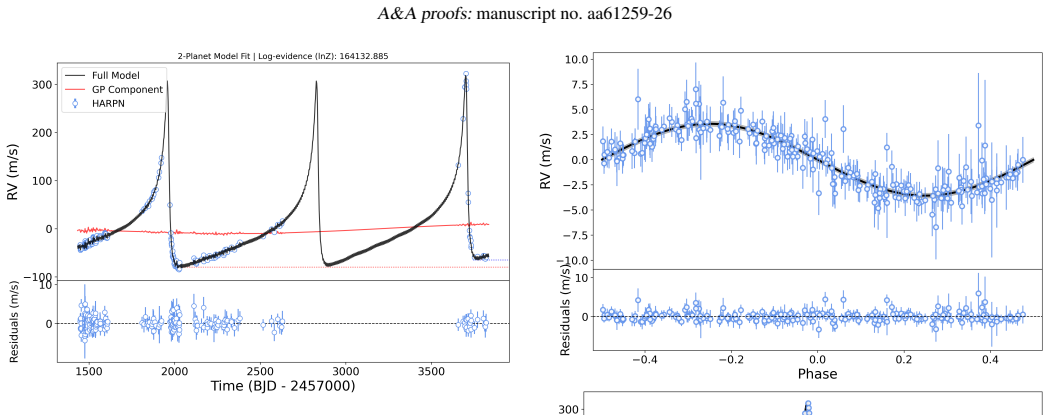
The discovery is that K2-312 consists of two extreme planets whose coexistence is dynamically meaningful: an ultra-short-period rocky super-Earth (P_b = 0.71957926 d, radius ~1.62 R_earth, mass ~5.6 M_earth) and a cold Jupiter (P_c = 871.32 d, minimum mass ~5.3 M_Jup) on an unusually eccentric orbit (e = 0.8435). The refined orbital solution comes from a joint fit of 237 radial-velocity measurements with space-based photometry, in which a quasi-periodic plus squared-exponential Gaussian process absorbs stellar activity. The secondary eclipse of the inner planet is detected at 3.4 sigma, implying a geometric albedo A_g = 0.52 ± 0.15 under the assumption that the eclipse is mostly reflected li
What carries the argument
The load-bearing ingredient is the 6.5-year, 237-point radial-velocity time series that fully captures three periastron passages of the eccentric giant, combined with a composite Gaussian-process kernel (quasi-periodic plus squared exponential) that models the star's ~19-day rotation and long activity cycle. This is what pins down the 871-day period and the 0.84 eccentricity against the pull of stellar activity. On the formation side, the central mechanism is planet-planet scattering: n-body integrations starting with two equal-mass, nearly circular, Hill-unstable giants reproduce the observed eccentricity while ejecting one planet and leaving a close-in super-Earth intact.
Load-bearing premise
The period, eccentricity, and mass of the outer planet all hinge on the assumption that the ~15 m/s drift between the first and third periastron passages is a stellar activity cycle rather than another companion or an instrumental drift; the paper itself notes a quadratic trend fits the data equally well.
What would settle it
If future astrometry yields the true inclination and mass of K2-312 c and they disagree with the scattering scenario's prediction of a low mutual inclination, or if continued radial-velocity monitoring shows the long-term drift is a coherent Keplerian signal (i.e., another planet), then the refined 871-day period and the activity-cycle interpretation would need to be revisited.
If this is right
- The refined 871.32-day period revises the earlier 921-day value by 4.5 sigma, changing predictions for future transits and the orbital geometry of the outer planet.
- The 3.4-sigma secondary eclipse of K2-312 b implies a geometric albedo of 0.52 ± 0.15; if confirmed, the dayside of this ultra-hot rocky planet is highly reflective rather than dark.
- Dynamical detection limits exclude additional inner companions between b and c above roughly 4 Earth masses out to periods of 17 days, under the modeled inclinations of the outer planet.
- The scattering scenario predicts a low mutual inclination between the surviving eccentric giant and the inner super-Earth, a prediction that becomes testable once astrometry constrains the outer planet's inclination.
Where Pith is reading between the lines
- If the 4.5-sigma period revision is robust, similar activity-induced biases may affect the orbital solutions of other eccentric giants discovered with only partial periastron coverage; K2-312 is a cautionary example.
- The derived albedo, taken at face value, puts K2-312 b among the most reflective ultra-hot rocky planets; a longer-wavelength eclipse measurement would break the reflection-versus-emission degeneracy and test a magma-ocean interpretation.
- The survival of a USP planet next to a scattered giant suggests that close-in rocky planets can remain stable even through violent dynamical rearrangement, implying that a USP does not rule out a past giant-planet instability.
- Because the paper reports that a quadratic trend fits the radial-velocity data as well as the activity-cycle model, continued monitoring through another periastron passage could cleanly separate a stellar cycle from a second companion.
Editorial analysis
A structured set of objections, weighed in public.
Referee Report
Summary. The paper presents an extended HARPS-N radial-velocity dataset (237 spectra, 6.5-year baseline) for K2-312 = HD 80653, jointly modeled with K2 and TESS photometry. The authors report a refined orbital solution for the outer giant planet K2-312 c: P_c = 871.32 ± 0.13 d, e_c = 0.8435 ± 0.0013, K_c = 191.6 ± 1.3 m/s, a minimum mass ~5.3 M_Jup. This period is a 4.5-sigma revision relative to the previous value of 921.2 ± 10.8 d (B23). They also refine the USP planet b ephemeris, report a 3.4-sigma secondary eclipse detection from a newly reduced K2 light curve, compute ARDENT dynamical detection limits for additional inner planets, and present N-body simulations suggesting a planet-planet scattering origin for the high eccentricity of planet c. The central claim is that K2-312 is the only known system combining a USP small planet with a highly eccentric cold Jupiter, making it a benchmark for violent dynamical histories that preserve close-in rocky planets.
Significance. If the orbital parameters and formation scenario hold, K2-312 would indeed be a unique benchmark system: an ultra-short-period super-Earth coexisting with a highly eccentric (e~0.84) cold Jupiter whose architecture was likely shaped by planet-planet scattering. The paper is strengthened by two independent analysis pipelines (juliet and PyORBIT) that agree on the planetary parameters, by the public availability of the RV data via CDS, and by the explicit treatment of stellar activity through Gaussian processes and of dynamical stability through ARDENT. The 3.4-sigma secondary eclipse of planet b, if confirmed, also adds astrophysical value. However, the headline quantitative result—the 4.5-sigma period revision—depends on how the long-term ~15 m/s RV drift is modeled, and the manuscript itself reports that the adopted combined GP kernel is not statistically preferred over a quadratic trend. The significance of the period revision and the 'only known system' claim therefore hinge on a robustness check that is currently missing.
major comments (2)
- [§4.2, Eq. (1); §4.3] The adopted GP kernel (QP + squared exponential) is explicitly stated to be not statistically preferred: ln ΔZ ~ 2 relative to QP-only, and a QP + quadratic trend fits equally well (ln ΔZ ~ 1). Since the 4.5-sigma period revision vs B23 (871.32 d vs 921.2 d) relies on how the ~15 m/s long-term drift is modeled, this is a load-bearing model choice, not a presentation detail. The independent PyORBIT analysis (§4.5) also absorbs long-term variation through polynomial trends and a multivariate GP, so it does not break the degeneracy. Please demonstrate that the derived P_c, e_c, K_c (and the periastron epoch) are robust under alternative treatments of the drift: at minimum, fit (i) QP-only, (ii) QP + quadratic trend, and (iii) a two-planet model with an outer Keplerian companion or an instrumental offset, and report the resulting posteriors and Bayesian evidences. Without this, the central c
- [§5.2] The formation scenario assumes, as an initial condition, two equal-mass giant planets at a1=3.12 au and a2=4.67 au with zero mutual inclination except for small random values, and the paper states that the survival of the USP planet is only demonstrated in this restricted setup. The conclusion that 'planet-planet scattering can produce the observed eccentricity while allowing b to survive' is thus conditional on a specific and unverified starting architecture. Since the manuscript does not explore variations in giant-planet masses, mass ratios, or number of giants, the claim as stated is over-broad. Please either soften the conclusion to reflect the demonstrated conditions or add simulations that vary these parameters and report the success fraction as a function of initial conditions.
minor comments (6)
- [§4.3 / Table 2] The text reports P_c = 871.30±0.13 d while Table 2 gives 871.32±0.13 d. Please harmonize.
- [Table A.2] In the PyORBIT column, K_c is listed as 189.91±0.095 m/s, whereas the text in §4.5 gives 189.91±0.95 m/s. The uncertainty appears too small by a factor of 10; please correct.
- [Table 2] The entry σ_TESS200(ppm) = 6.5 +47 −6 appears typographically wrong (likely 6.5 +47 −6 is intended, but the order of the error bars is suspicious). Please check and clarify.
- [§3.1] The observation sector '1751' is unusual for TESS; standard sectors are numbered in the range ~1–100. If this is not a typo, please clarify the sector numbering convention; otherwise correct it (e.g., 'Sector 17' or '51').
- [§4.4] The secondary eclipse detection at 3.4σ is described as 'meaningful'. Given the modest significance and the custom 25-parameter K2SFF systematics model, it would strengthen the paper to state explicitly in the main text that this is a candidate detection pending longer-wavelength confirmation (e.g., JWST/MIRI), as is already done in the discussion.
- [Abstract / §1] The phrase 'the only one that is highly eccentric and has a USP planet companion' is repeated in the abstract and introduction. It would be helpful to state the selection criteria (e.g., e>0.8, P_usb<1 d) explicitly in one place.
Circularity Check
No significant circularity: central parameters are re-derived from new RVs/photometry and independently reproduced; only minor overlapping-author citations and an acknowledged GP/trend degeneracy are present.
full rationale
The derivation chain is self-contained and data-driven. Planet c's period, eccentricity, and semi-amplitude are fit to 237 HARPS-N RVs plus K2/TESS photometry with wide uniform priors (U(700,1200) d on P_c), and the result is reproduced by a second independent pipeline (PyORBIT: P_c=871.34±0.11 d vs juliet 871.32±0.13 d), so no fitted value is rebranded as a prediction. The secondary-eclipse depth (δ_ecl=9.1 ppm, 3.4σ) and albedo (A_g=0.52±0.15) are inferred from the same photometry through a forward model, not defined by the claim they support. The scattering simulations are a plausibility test with randomized initial phases/eccentricities and a stated dependence on the assumed two-giant initial configuration, explicitly acknowledged in the text ('we acknowledge, however, that this result is somewhat dependent on two giant planets initially'); the current orbit is used as a boundary condition, not derived from the simulation. The QP+SE GP kernel is admittedly not statistically preferred over a quadratic trend (ln ΔZ ~ 1-2; Section 4.2), which is a model-uncertainty caveat, not a circular reduction. Self-citations (B23, Bonomo et al. 2025) provide prior literature values and population context; the period revision is an independent re-fit, and the ARDENT uniqueness/calibration step from Stalport et al. (2025) is explicitly not trusted for inclined orbits and bypassed with brute-force integrations. No load-bearing step reduces by construction to its inputs, so no circular step is identified.
Axiom & Free-Parameter Ledger
free parameters (12)
- K_c =
191.6±1.3 m/s
- P_c =
871.32±0.13 d
- e_c =
0.8435±0.0013
- K_b =
3.66±0.20 m/s
- P_b =
0.71957926 d
- HARPS-N GP hyperparameters =
H_cycle=9.6 m/s, lambda_cycle=788 d, H_rot=3.0 m/s, P_rot=18.98 d, P_dec=13.78 d, O_amp=0.062
- Photometric GP hyperparameters =
sigma_K2=34.8 ppm, rho_K2=0.998 d; TESS120: 341.6 ppm, 0.42 d; TESS200: 185 ppm, 0.62 d
- Secondary-eclipse coefficient C1_1 =
0.414 (+0.053/-0.074)
- Stellar parameters =
M*=1.150 (+0.063/-0.069) M_sun, R*=1.199±0.033 R_sun, age=3.3 (+2.7/-2.0) Gyr
- K2SFF systematics coefficients =
25 free parameters per segment (values not tabulated)
- Scattering initial conditions =
a1=3.12 au, a2=4.67 au, Mp=5.3 M_Jup, e<=0.05, i<=1 deg
- Limb-darkening coefficients =
q1,q2 per instrument (Table 2)
axioms (8)
- domain assumption Two-planet Keplerian model with circular orbit for b and eccentric orbit for c
- ad hoc to paper The long-term RV trend is a stellar activity cycle modeled by QP plus squared-exponential GP, not another companion
- domain assumption Activity indicators share a common GP driving the RVs in the PyORBIT analysis
- domain assumption K2SFF systematics model with 25 parameters per segment captures spacecraft systematics without suppressing the eclipse
- standard math Mercury n-body integrations with the Bulirsch-Stoer integrator accurately simulate scattering
- ad hoc to paper Formation scenario starts with two equal-mass 5.3 M_Jup giant planets at a1=3.12 au and a2=4.67 au
- domain assumption Thermal phase-curve parameters are fixed to literature values (hotspot offset 0, omega_drag=4.5, alpha=0.6, f'=0.707)
- domain assumption Kepler-band secondary eclipse is dominated by reflected light, with thermal contribution only ~0.5 ppm
invented entities (1)
-
Ejected second giant planet (formation scenario)
no independent evidence
read the original abstract
The architecture of planetary systems hosting ultra-short-period (USP) planets is a key diagnostic for understanding formation and migration scenarios. The presence of outer giant companions in these systems is of particular interest to test theories regarding dynamical effects and pebble accretion. We present an extended radial velocity (RV) monitoring of the bright star K2-312=HD80653, known to host a rocky USP super-Earth ($P_b=0.720$d). Previous studies identified a long-term trend and subsequently a Keplerian signal due to an outer highly eccentric giant planet, K2-312c. We aim to refine the orbital parameters of K2-312c by precisely monitoring its periastron passage and to model the formation and dynamical evolution of the system. We analyzed a set of 237 HARPS-N high-resolution spectra, extending the observation baseline of previous literature by almost 4 years. We performed a joint analysis of the RVs together with K2 and TESS photometry to refine the ephemerides and properties of the two planets. To account for stellar activity, we coupled the Keplerian models with a Gaussian processes regression. K2-312c is a cold Jupiter on a wide orbit (orbital period refined to $P_c=871.32$d), with a minimum mass of Msin(i)$\sim5 M_{Jup}$ and a refined eccentricity of $e_c \sim 0.85$. It is among the most eccentric cold Jupiters known in multi-planet systems, and the only one that is highly eccentric and has a USP planet companion. Our simulations suggest that planet-planet scattering between two giant planets could have driven K2-312c to its current high eccentricity, ejected the other giant, and still allowed for the survival of K2-312b. The extended observation baseline further allowed us to identify the stellar rotation period and a long activity cycle, while a new K2 reduction improved the significance of the secondary eclipse detection for K2-312b.
Figures


Reference graph
Works this paper leans on
-
[1]
Precise Masses in the WASP-47 System. , keywords =. doi:10.3847/1538-3881/aa918b , archivePrefix =. 1710.00026 , primaryClass =
-
[2]
Planetary Candidates from the First Year of the K2 Mission. , keywords =. doi:10.3847/0067-0049/222/1/14 , archivePrefix =. 1511.07820 , primaryClass =
-
[3]
The Kepler Giant Planet Search. I. A Decade of Kepler Planet-host Radial Velocities from W. M. Keck Observatory. , keywords =. doi:10.3847/1538-4365/ad0cab , archivePrefix =. 2304.00071 , primaryClass =
-
[4]
Resolving the Super-Earth/Gas Giant Connection in Stellar Mass and Metallicity. , keywords =. doi:10.3847/2041-8213/adb0bd , archivePrefix =. 2502.01748 , primaryClass =
Pith/arXiv arXiv 2041
-
[5]
Cold Jupiters and small planets: Friends, foes, or indifferent?: A search for correlations with the largest exoplanet samples. , keywords =. doi:10.1051/0004-6361/202452523 , archivePrefix =. 2505.20035 , primaryClass =
-
[6]
Kepler-78 and the Ultra-Short-Period planets. , keywords =. doi:10.1016/j.newar.2019.03.006 , archivePrefix =. 1803.03303 , primaryClass =
Pith/arXiv arXiv 2019
-
[7]
Absolute densities, masses, and radii of the WASP-47 system determined dynamically. , keywords =. doi:10.1051/0004-6361/201629770 , archivePrefix =. 1610.09533 , primaryClass =
-
[8]
Ground-based and Airborne Instrumentation for Astronomy IV , year = 2012, editor =
Harps-N: the new planet hunter at TNG. Ground-based and Airborne Instrumentation for Astronomy IV , year = 2012, editor =. doi:10.1117/12.925738 , adsurl =
-
[9]
A Study of the Shortest-period Planets Found with Kepler. , keywords =. doi:10.1088/0004-637X/787/1/47 , archivePrefix =. 1403.2379 , primaryClass =
-
[10]
Modules for Experiments in Stellar Astrophysics (MESA): Binaries, Pulsations, and Explosions. , keywords =. doi:10.1088/0067-0049/220/1/15 , archivePrefix =. 1506.03146 , primaryClass =
-
[11]
EXOFASTv2: Generalized publication-quality exoplanet modeling code
-
[12]
Ricker and Joshua N
George R. Ricker and Joshua N. Winn and Roland Vanderspek and David W. Latham and Gáspár Á. Bakos and Jacob L. Bean and Zachory K. Berta-Thompson and Timothy M. Brown and Lars Buchhave and Nathaniel R. Butler and R. Paul Butler and William J. Chaplin and David Charbonneau and Jørgen Christensen-Dalsgaard and Mark Clampin and Drake Deming and John Doty and...
-
[13]
EXOFASTv2: A public, generalized, publication-quality exoplanet modeling code. arXiv e-prints , keywords =. doi:10.48550/arXiv.1907.09480 , archivePrefix =. 1907.09480 , primaryClass =
-
[14]
An ultra-short period rocky super-Earth orbiting the G2-star HD 80653. , keywords =. doi:10.1051/0004-6361/201936689 , archivePrefix =. 2001.02217 , primaryClass =
Pith/arXiv arXiv 2001
-
[15]
No excess of cold Jupiters in small planet systems
Cold Jupiters and improved masses in 38 Kepler and K2 small planet systems from 3661 HARPS-N radial velocities. No excess of cold Jupiters in small planet systems. , keywords =. doi:10.1051/0004-6361/202346211 , archivePrefix =. 2304.05773 , primaryClass =
-
[16]
Secular Chaos and the Production of Hot Jupiters. , keywords =. doi:10.1088/0004-637X/735/2/109 , archivePrefix =. 1012.3475 , primaryClass =
-
[17]
Ultra-short-period Planets from Secular Chaos. , keywords =. doi:10.3847/1538-3881/ab0e0a , archivePrefix =. 1804.05065 , primaryClass =
-
[18]
, year = 1996, month = apr, volume =
Orbital migration of the planetary companion of 51 Pegasi to its present location. , year = 1996, month = apr, volume =. doi:10.1038/380606a0 , adsurl =
doi:10.1038/380606a0 1996
-
[19]
Origins of Hot Jupiters. , keywords =. doi:10.1146/annurev-astro-081817-051853 , archivePrefix =. 1801.06117 , primaryClass =
-
[20]
DYNESTY: a dynamic nested sampling package for estimating Bayesian posteriors and evidences. , keywords =. doi:10.1093/mnras/staa278 , archivePrefix =. 1904.02180 , primaryClass =
Pith/arXiv arXiv 1904
-
[21]
juliet: a versatile modelling tool for transiting and non-transiting exoplanetary systems. , keywords =. doi:10.1093/mnras/stz2688 , archivePrefix =. 1812.08549 , primaryClass =
-
[22]
The GAPS Programme at TNG. LV. Multiple molecular species in the atmosphere of HAT-P-11 b and review of the HAT-P-11 planetary system. , keywords =. doi:10.1051/0004-6361/202347659 , archivePrefix =. 2403.01527 , primaryClass =
-
[23]
A Gaussian process framework for modelling stellar activity signals in radial velocity data. , keywords =. doi:10.1093/mnras/stv1428 , archivePrefix =. 1506.07304 , primaryClass =
-
[24]
The TESS Objects of Interest Catalog from the TESS Prime Mission. , keywords =. doi:10.3847/1538-4365/abefe1 , archivePrefix =. 2103.12538 , primaryClass =
-
[25]
Cannon and Edward C
Annie J. Cannon and Edward C. Pickering , title =. 1918--1924 , publisher =
1918
-
[26]
Summary of the content and survey properties
Gaia Data Release 3. Summary of the content and survey properties. , keywords =. doi:10.1051/0004-6361/202243940 , archivePrefix =. 2208.00211 , primaryClass =
-
[27]
, keywords =
The Tycho-2 catalogue of the 2.5 million brightest stars. , keywords =
-
[28]
2MASS All-Sky Catalog of Point Sources
-
[29]
AllWISE Data Release
-
[30]
Intrinsic Colors, Temperatures, and Bolometric Corrections of Pre-main-sequence Stars. , keywords =. doi:10.1088/0067-0049/208/1/9 , archivePrefix =. 1307.2657 , primaryClass =
-
[31]
An inner eccentric sub-Neptune and an outer sub-Neptune-mass candidate around BD+00 444 (TOI-2443)
The GAPS programme at TNG: LXIV. An inner eccentric sub-Neptune and an outer sub-Neptune-mass candidate around BD+00 444 (TOI-2443). , keywords =. doi:10.1051/0004-6361/202451859 , archivePrefix =. 2411.09417 , primaryClass =
-
[32]
AAVSO Photometric All Sky Survey (APASS) DR9
-
[33]
Can Kozai-Lidov cycles explain Kepler-78b?. , keywords =. doi:10.1093/mnras/stv073 , archivePrefix =. 1501.03304 , primaryClass =
-
[34]
Orbital Evolution in Binary and Triple Stars, with an Application to SS Lacertae. , keywords =. doi:10.1086/323843 , archivePrefix =. astro-ph/0104126 , primaryClass =
-
[35]
On the tidal evolution of Hot Jupiters on inclined orbits. , keywords =. doi:10.1111/j.1365-2966.2009.14694.x , archivePrefix =. 0902.4563 , primaryClass =
arXiv 2009
-
[36]
Kepler Presearch Data Conditioning I Architecture and Algorithms for Error Correction in Kepler Light Curves. , keywords =. doi:10.1086/667698 , archivePrefix =. 1203.1382 , primaryClass =
-
[37]
, year = 2014, month = jan, volume =
Multiscale Systematic Error Correction via Wavelet-Based Bandsplitting in Kepler Data. , year = 2014, month = jan, volume =. doi:10.1086/674989 , adsurl =
doi:10.1086/674989 2014
-
[38]
Kepler Presearch Data Conditioning II - A Bayesian Approach to Systematic Error Correction. , keywords =. doi:10.1086/667697 , archivePrefix =. 1203.1383 , primaryClass =
-
[39]
Lightkurve: Kepler and TESS time series analysis in Python
-
[40]
Software and Cyberinfrastructure for Astronomy , year = 2010, editor =
Selecting pixels for Kepler downlink. Software and Cyberinfrastructure for Astronomy , year = 2010, editor =. doi:10.1117/12.857625 , adsurl =
-
[41]
Kepler Data Processing Handbook: Target and Aperture Definitions: Selecting Pixels for Kepler Downlink
-
[42]
Tidal interactions and disruptions of giant planets on highly eccentric orbits. , keywords =. doi:10.1016/j.icarus.2004.10.021 , archivePrefix =. astro-ph/0407318 , primaryClass =
Pith/arXiv arXiv 2004
-
[43]
Lindstedt \`a l' \'e tude du mouvement des com \`e tes p \'e riodiques
Sur l'application des s \'e ries de M. Lindstedt \`a l' \'e tude du mouvement des com \`e tes p \'e riodiques. Astronomische Nachrichten , year = 1910, month = mar, volume =. doi:10.1002/asna.19091832202 , adsurl =
-
[44]
, volume=
The eccentric Kozai-Lidov effect and its applications , author=. , volume=. 2016 , publisher=
2016
-
[45]
Planet Migration and Binary Companions: The Case of HD 80606b. , keywords =. doi:10.1086/374598 , archivePrefix =. astro-ph/0303010 , primaryClass =
-
[46]
Planetary and Space Science , volume=
The evolution of orbits of artificial satellites of planets under the action of gravitational perturbations of external bodies , author=. Planetary and Space Science , volume=. 1962 , publisher=
1962
-
[47]
, volume=
Secular perturbations of asteroids with high inclination and eccentricity , author=. , volume=
-
[48]
A Technique for Extracting Highly Precise Photometry for the Two-Wheeled Kepler Mission. , keywords =. doi:10.1086/678764 , archivePrefix =. 1408.3853 , primaryClass =
-
[49]
A hybrid symplectic integrator that permits close encounters between massive bodies. , keywords =. doi:10.1046/j.1365-8711.1999.02379.x , adsurl =
arXiv 1999
-
[50]
Probing Kepler's hottest small planets via homogeneous search and analysis of optical secondary eclipses and phase variations. , keywords =. doi:10.1051/0004-6361/202039037 , archivePrefix =. 2111.05716 , primaryClass =
-
[51]
IEEE Transactions on Pattern Analysis and Machine Intelligence , keywords =
Fast Direct Methods for Gaussian Processes. IEEE Transactions on Pattern Analysis and Machine Intelligence , keywords =. doi:10.1109/TPAMI.2015.2448083 , archivePrefix =. 1403.6015 , primaryClass =
arXiv 2015
-
[52]
Eccentricity Evolution for Planets in Gaseous Disks. , keywords =. doi:10.1086/346202 , archivePrefix =. astro-ph/0202462 , primaryClass =
-
[53]
Eccentric Jupiters via Disk-Planet Interactions. , keywords =. doi:10.1088/0004-637X/812/2/94 , archivePrefix =. 1507.08667 , primaryClass =
-
[54]
Origins of Eccentric Extrasolar Planets: Testing the Planet-Planet Scattering Model. , keywords =. doi:10.1086/590926 , archivePrefix =. astro-ph/0703163 , primaryClass =
-
[55]
Planet─Planet Scattering and Von Zeipel─Lidov─Kozai Migration The Dynamical History of HAT-P-11. , keywords =. doi:10.3847/1538-4357/ad9b79 , archivePrefix =. 2405.19511 , primaryClass =
-
[56]
Planet-planet scattering as the source of the highest eccentricity exoplanets. , keywords =. doi:10.1051/0004-6361/201935744 , archivePrefix =. 1903.02564 , primaryClass =
Pith/arXiv arXiv 1903
-
[57]
Dynamics of Systems of Two Close Planets. , keywords =. doi:10.1006/icar.1993.1169 , adsurl =
arXiv 1993
-
[58]
Physically-motivated basis functions for temperature maps of exoplanets. , keywords =. doi:10.1051/0004-6361/202142135 , archivePrefix =. 2110.11837 , primaryClass =
-
[59]
ARDENT: A Python package for fast dynamical detection limits with radial velocities. , keywords =. doi:10.1051/0004-6361/202556044 , archivePrefix =. 2509.13521 , primaryClass =
-
[60]
Formation of Ultra-short-period Planets by Obliquity-driven Tidal Runaway. , keywords =. doi:10.3847/1538-4357/abc4e5 , archivePrefix =. 2010.15087 , primaryClass =
Pith/arXiv arXiv 2010
-
[61]
The GAPS programme with HARPS-N at TNG. XI. Pr 0211 in M 44: the first multi-planet system in an open cluster. , keywords =. doi:10.1051/0004-6361/201527933 , archivePrefix =. 1602.00009 , primaryClass =
-
[62]
An Ultra-short Period Rocky Super-Earth with a Secondary Eclipse and a Neptune-like Companion around K2-141. , keywords =. doi:10.3847/1538-3881/aaa5b5 , archivePrefix =. 1801.03502 , primaryClass =
-
[63]
The GAPS programme at TNG. XLIX. TOI-5398, the youngest compact multi-planet system composed of an inner sub-Neptune and an outer warm Saturn. , keywords =. doi:10.1051/0004-6361/202347472 , archivePrefix =. 2310.16888 , primaryClass =
-
[64]
The GAPS Programme at TNG. XXXVII. A precise density measurement of the young ultra-short period planet TOI-1807 b. , keywords =. doi:10.1051/0004-6361/202243743 , archivePrefix =. 2206.03496 , primaryClass =
-
[65]
A HARPS-N mass for the elusive Kepler-37d: a case study in disentangling stellar activity and planetary signals. , keywords =. doi:10.1093/mnras/stab2192 , archivePrefix =. 2107.13900 , primaryClass =
-
[66]
Efficient, uninformative sampling of limb darkening coefficients for two-parameter laws. , keywords =. doi:10.1093/mnras/stt1435 , archivePrefix =. 1308.0009 , primaryClass =
-
[67]
Binning is sinning: morphological light-curve distortions due to finite integration time. , keywords =. doi:10.1111/j.1365-2966.2010.17242.x , archivePrefix =. 1004.3741 , primaryClass =
arXiv 2010
-
[68]
batman: BAsic Transit Model cAlculatioN in Python. , keywords =. doi:10.1086/683602 , archivePrefix =. 1507.08285 , primaryClass =
-
[69]
Efficient modeling of correlated noise. II. A flexible noise model with fast and scalable methods. , keywords =. doi:10.1051/0004-6361/201936906 , archivePrefix =. 2004.10678 , primaryClass =
Pith/arXiv arXiv 2004
-
[70]
Efficient modeling of correlated noise. III. Scalable methods for jointly modeling several observables' time series with Gaussian processes. , keywords =. doi:10.1051/0004-6361/202141949 , archivePrefix =. 2201.02440 , primaryClass =
-
[71]
emcee: The MCMC Hammer. , keywords =. doi:10.1086/670067 , archivePrefix =. 1202.3665 , primaryClass =
-
[72]
PYTRANSIT: fast and easy exoplanet transit modelling in PYTHON. , keywords =. doi:10.1093/mnras/stv894 , archivePrefix =. 1504.07433 , primaryClass =
-
[73]
doi:10.5281/zenodo.17268284 , url =
Sergey Koposov and Josh Speagle and Kyle Barbary and Gregory Ashton and Ed Bennett and Johannes Buchner and Carl Scheffler and Colm Talbot and Ben Cook and James Guillochon and Patricio Cubillos and Andrés Asensio Ramos and Matthieu Dartiailh and Ilya and Erik Tollerud and Dustin Lang and Ben Johnson and jtmendel and Edward Higson and Thomas Vandal and Ta...
-
[74]
Application to radial velocities of different starspot configurations
Auto-correlation functions of astrophysical processes, and their relation to Gaussian processes. Application to radial velocities of different starspot configurations. , keywords =. doi:10.1051/0004-6361/202039594 , archivePrefix =. 2012.01862 , primaryClass =
Pith/arXiv arXiv 2012
-
[75]
EXOFAST: A Fast Exoplanetary Fitting Suite in IDL. , keywords =. doi:10.1086/669497 , archivePrefix =. 1206.5798 , primaryClass =
-
[76]
W \= o tan: Comprehensive Time-series Detrending in Python. , keywords =. doi:10.3847/1538-3881/ab3984 , archivePrefix =. 1906.00966 , primaryClass =
Pith/arXiv arXiv 1906
-
[77]
Dynamical Outcomes of Planet-Planet Scattering. , keywords =. doi:10.1086/590227 , archivePrefix =. astro-ph/0703166 , primaryClass =
-
[78]
Dynamical Origin of Extrasolar Planet Eccentricity Distribution. , keywords =. doi:10.1086/590047 , archivePrefix =. astro-ph/0703160 , primaryClass =
-
[79]
The Destruction of Inner Planetary Systems during High-eccentricity Migration of Gas Giants. , keywords =. doi:10.1088/0004-637X/808/1/14 , archivePrefix =. 1502.06971 , primaryClass =
-
[80]
Shrinking Binary and Planetary Orbits by Kozai Cycles with Tidal Friction. , keywords =. doi:10.1086/521702 , archivePrefix =. 0705.4285 , primaryClass =
discussion (0)
Sign in with ORCID, Apple, or X to comment. Anyone can read and Pith papers without signing in.