REVIEW 4 major objections 3 minor 61 references
Update surgery beats joint training in federated continual learning.
Reviewed by Pith at T0; open to challenge. T0 means a machine referee read the full paper against a public rubric. the ladder, T0–T4 →
T0 review · deepseek-v4-flash
2026-08-02 09:14 UTC pith:LJZZPWWX
load-bearing objection Clean server-side projection idea for FCIL with large reported gains, but the theory is overclaimed and the inference-time task-selection protocol is under-specified; worth a careful referee, not worth believing yet. the 4 major comments →
SUM: Unified Geometric Surgery on Spatio-Temporal Adaptation Vectors for Federated Class Incremental Learning
The pith
A machine-rendered reading of the paper's core claim, the machinery that carries it, and where it could break.
Core claim
The paper's central discovery is that spatio-temporal catastrophic forgetting can be reduced by treating client and task updates as adaptation vectors and removing, at aggregation time, each vector's components that are aligned with the others (Eqs. 5 and 9). Spatial SUM applies this within a round to client updates; causal online temporal SUM applies it sequentially across task vectors anchored to a common base model. The refined vectors are then merged, and compact inference modules are built via sparsification, sign consensus, and task-specific masks. Empirically, SUM reports the highest Final Averaged Accuracy on six vision and two language benchmarks, outperforming all baselines and som
What carries the argument
The load-bearing identity is the projection-based surgery operator: for each adaptation vector v_i, compute \hat{v}_i = v_i - Σ_{j≠i} (v_i·v_j / ||v_j||²) v_j, then aggregate with \hat{v}_i instead of v_i. This operator is applied to client updates within a round (Spatial SUM) and recursively to task vectors that share a common pretrained base (Temporal SUM), making the temporal version a sequential orthogonalization. The same refinement is supported by Theorem 1, which states that under convexity, Lipschitz-smooth losses and a common base, the refined merge has loss no higher than the naive sum. The inference-ready module then compresses the refined task vectors into a unified direction plu
Load-bearing premise
The inference-ready module assumes that the correct task (or set of tasks) can be identified for each test input; if task identity is unavailable at test time, the reported accuracy gains may not materialize because the evaluation protocol becomes task-incremental rather than class-incremental.
What would settle it
Run the same FCIL protocol but evaluate inference with a single shared model (e.g., the spatially aggregated global model without per-task module selection) on test samples whose task labels are concealed; if the accuracy gain over baselines largely disappears, then the improvements hinge on task-selection rather than on the surgery operator itself.
If this is right
- If the claim holds, any federated continual system can adopt interference-aware aggregation without changing client code, replay buffers, or extra communication.
- SUM's improvement over the centralized joint baseline suggests that directional conflict resolution during aggregation can compensate for the loss of central data access.
- The reported O(TD) server memory can be compressed with top-k/low-precision storage, so the method remains tractable for long task sequences.
- The method's robustness to corrupted clients suggests that projection surgery also filters malicious update directions, not just heterogeneity.
Where Pith is reading between the lines
- The strongest practical gains depend on the assumption that the correct task-specific module can be selected at inference; the paper does not report results under a fully class-incremental protocol where task identity is unknown, so the headline numbers may overstate the benefit in truly task-agnostic deployment.
- The core surgery operator could be adapted to other settings that merge parameter updates, such as model merging of independently trained models or federated personalization, where interfering directions are known to hurt.
- Because the refinement is purely server-side, one could test it as a drop-in addition to existing FL and FCIL pipelines by simply replacing the aggregation rule, making the claimed improvement directly reproducible.
Editorial analysis
A structured set of objections, weighed in public.
Referee Report
Summary. The paper proposes SUM (Surgery & Merge), a server-side aggregation framework for Federated Class Incremental Learning (FCIL). Updates from clients and tasks are treated as adaptation vectors in parameter space; spatial SUM projects each client update against the others within a round, and temporal SUM projects the current task vector against previously stored task vectors. The refined vectors are then merged, and a compact inference module is built via sparsification, sign-consensus, and element-wise masking. The authors claim up to 22% FAA improvement over prior FCIL methods, robustness to unreliable clients, and no additional client-side overhead. A theorem is stated asserting that SUM merging reduces the loss relative to standard merging under smoothness and convexity assumptions, with a proof built on a transfer of the PCGrad guarantee.
Significance. If the empirical claims hold under a fair FCIL protocol, the work is significant: it addresses a real problem (spatio-temporal interference in FCIL) with a purely server-side mechanism, preserves standard client communication, and reports consistent gains across vision and language benchmarks. The ablation study and robustness analyses are useful. However, the paper currently lacks code and error bars, and the evaluation protocol for inference-time task selection is not clearly specified. The theoretical guarantee, as stated, is not sound because the proof transfers a PCGrad result that applies only to conditional projection (negative inner products) to the unconditional projection in Eq. (5). These issues must be resolved before the central claims can be accepted.
major comments (4)
- [§5.1, Tab. 2, Appendix A.3] The evaluation protocol for FAA is not specified with respect to task identity. Appendix A.3 states that the inference-ready module 'assumes that the relevant task adaptation vectors can be selected at inference time,' and the main text does not describe how this selection is performed in Tables 2–3. If oracle task IDs are used to choose the correct module for each test sample, SUM is evaluated in a task-incremental/multi-head setting while baselines such as EWC, LwF, CCVR, and LoRM are single-model class-incremental learners. This would make the reported >Joint results and the 22% improvement an artifact of the protocol rather than of the geometric surgery. The authors must report exactly how inference was conducted, and provide results under strict class-incremental evaluation (or with the proposed retrieval mechanism actually implemented).
- [§4.1, Theorem 1, Appendix B.4] Theorem 1 as stated claims L(θSum) ≤ L(θstandard) unconditionally for convex losses with L-Lipschitz gradients. The proof maps Eq. (5) to a PCGrad update, but PCGrad's guarantee in Yu et al. (2020) holds only for the conditional projection used by PCGrad, which subtracts pairwise components only when the inner product is negative. SUM's Eq. (5) subtracts projection components for all nonzero inner products, including positive ones. Appendix B.5 implicitly acknowledges this by downgrading the result to a 'local descent-bound interpretation' under a signal–interference condition, but the main theorem still states an unconditional inequality. This is a load-bearing theoretical claim and must be corrected: either state and prove a conditional theorem with explicit assumptions, or remove the theorem and present the analysis as a heuristic. Note also that for two identical vectors, Eq. (5) can
- [§5.1, Tables 2–3] No error bars or standard deviations are reported for the main FAA results. Given the large claimed improvements and the fact that SUM has several per-dataset hyperparameters (z_thr, λ_S, k_pct in Tables 12–19) that appear to be tuned per distribution level, it is important to establish that the gains are not due to hyperparameter selection or run-to-run variance. At minimum, report means and standard deviations over multiple seeds, and state the number of runs. This is especially important because Table 7, which does include errors, shows a large variance (±9.6) for SUM under unreliable-client settings.
- [§4.1, Eq. (5)] The projection in Eq. (5) is applied to all pairwise interactions, including positive (aligned) ones. In federated learning, clients working on the same task are expected to share a common signal direction; removing that shared direction from every client's update may discard useful task information and can even reverse the aggregate update when multiple clients are aligned (for n equal vectors, each refined vector becomes (2−n)v). The paper's own ablation in Fig. 3 shows that positive-only projection underperforms the no-surgery baseline. This does not invalidate the empirical results, but it means the method's success cannot be attributed to the projection alone without a more careful analysis of when aligning versus decorrelating helps. The authors should clarify what property of the update distribution makes full orthogonalization beneficial, and ideally provide an experiment isolati
minor comments (3)
- [§5.1] The term 'Final Averaged Accuracy (FAA)' is used throughout but never formally defined. Please provide the exact formula (e.g., average accuracy over all tasks after the last task, using which inference rule).
- [Appendix B.3] The last displayed equation before Eq. (30) states the stochastic deviation is 'O(η_eff,i) in norm', while the text says O(η_eff,i^2) in mean-square. This is confusing; please be consistent about the quantity being bounded.
- [Fig. 3] The figure appears garbled in the PDF (many literal '/uni0000...' sequences), making the ablation curves unreadable. The source figure must be embedded properly.
Circularity Check
No significant circularity: the derivation chain is a deterministic projection method with self-contained algebraic/probabilistic supporting results, and the main theory reuses an external PCGrad guarantee rather than the paper's own outputs.
full rationale
The paper's central claim is that removing components of adaptation vectors aligned with other adaptation vectors before merging reduces spatial–temporal interference. This is implemented by deterministic equations: Eq. (5) defines the refined vector as v_i minus projections onto other vectors; Eq. (7) and Eq. (9) instantiate the same projection for client and task vectors. The supporting theory is not circular: Proposition 2 (Appendix B.2) derives the gradient-like interpretation of adaptation vectors from Lipschitz smoothness and local-step assumptions, with a written proof; Theorem 1 (Appendix B.4) transfers PCGrad's published guarantee to the model-merging setting by substituting the Proposition 2 relation, which is an external result, not a self-citation or a restatement of the paper's fitted values; Proposition 1 (Appendix B.6) is an algebraic identity showing projection on accumulated task vectors is equivalent to projection on sequential increments. No parameter is fitted to test labels or to the FAA numbers: the three hyperparameters (zthr, lambda_S, kpct) are validation-tuned and reported transparently, and the reported gains are empirical outcomes rather than consequences of the projection definition. The main limitation noted in Appendix A.3 — that inference-ready modules assume task-relevant adaptation vectors can be selected at inference time — is an evaluation-protocol assumption that could affect the fairness of comparisons, but it is not a circular derivation: the surgery equations themselves do not assume task identity, and the limitation is admitted rather than hidden. There are no load-bearing self-citations, no uniqueness theorem imported from the authors' prior work, and no fitted quantity relabeled as a prediction. Accordingly, the paper's derivation chain is self-contained and no circular step is exhibited.
Axiom & Free-Parameter Ledger
free parameters (4)
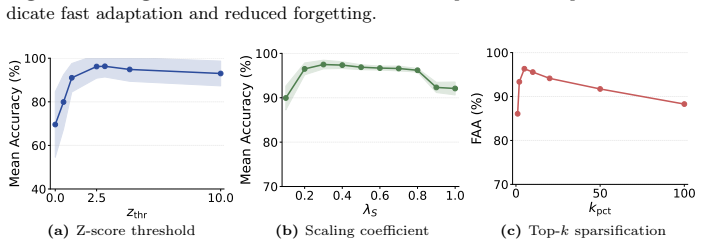
- z_thr (Z-score trimming threshold) =
4.5
- lambda_S (spatial aggregation scaling) =
0.1–1.0 per dataset
- k_pct (top-k sparsification percent) =
0.05 or 0.1
- Sum learning rate =
1e-5 to 1e-4 (vision), 2e-3 to 5e-3 (language)
axioms (6)
- domain assumption FCIL can be modeled as multi-task learning with client and task updates as adaptation vectors (Sec. 3.1–3.2).
- domain assumption Adaptation vectors approximate negative scaled gradients at the anchor model (Prop. 2, Appendix B.2).
- domain assumption All adaptation vectors share a common base model, enforced by re-anchoring task vectors to theta_pre (Eq. 8).
- ad hoc to paper Removing directional components of adaptation vectors does not destroy task-specific information (core design premise).
- ad hoc to paper The PCGrad guarantee (Yu et al. 2020) extends to unconditional projection (Appendix B.4).
- domain assumption Inference-time task selection is feasible (Appendix A.3).
Cite this review
Pith. "Pith review of SUM: Unified Geometric Surgery on Spatio-Temporal Adaptation Vectors for Federated Class Incremental Learning." pith.science (2026). https://pith.science/paper/LJZZPWWX
@misc{pith2026260719384,
  author       = {Pith},
  title        = {Pith review of: SUM: Unified Geometric Surgery on Spatio-Temporal Adaptation Vectors for Federated Class Incremental Learning},
  year         = {2026},
  howpublished = {\url{https://pith.science/paper/LJZZPWWX}},
  note         = {Machine review of arXiv:2607.19384}
}
read the original abstract
Real-world intelligent systems often require both distributed collaboration across data-isolated clients and continual adaptation to evolving tasks. This setting naturally gives rise to Federated Class Incremental Learning (FCIL), which combines Federated Learning (FL) and Continual Learning (CL). However, their combination introduces two coupled sources of interference: spatial interference from heterogeneous clients and temporal interference from sequential tasks, jointly leading to Spatial-Temporal Catastrophic Forgetting (ST-CF). Existing approaches typically address spatial and temporal interference with separate mechanisms, often incurring additional client-side computation or communication, while leaving directional interactions among updates during aggregation unregulated. In this paper, we reinterpret FCIL as a unified multi-task learning problem, where both client and task updates are represented as adaptation vectors in a shared parameter space. Based on this view, we propose Unified Geometric Surgery on Spatio-Temporal Adaptation Vectors (SUM), a purely server-side framework that performs geometric surgery on adaptation vectors during aggregation. Spatial SUM mitigates client-level interference within each round, while causal online temporal SUM removes cross-task interference over time without additional client-side computation, communication, or memory beyond standard federated training. Empirically, SUM achieves up to 22% improvement over prior FCIL methods across diverse vision and language benchmarks while remaining robust to unreliable clients and maintaining computational efficiency.
Figures




Reference graph
Works this paper leans on
-
[1]
Babakniya, S., Fabian, Z., He, C., Soltanolkotabi, M., Avestimehr, S.: A data-free approach to mitigate catastrophic forgetting in federated class incremental learning for vision tasks. Proc. of Neural Information Processing Systems (NeurIPS)36, 66408–66425 (2023) 16 J. Kim and J. Do
2023
-
[2]
arXiv preprint arXiv:2307.04869 (2023)
Bagwe, G., Yuan, X., Pan, M., Zhang, L.: Fed-cprompt: Contrastive prompt for rehearsal-free federated continual learning. arXiv preprint arXiv:2307.04869 (2023)
Pith/arXiv arXiv 2023
-
[3]
arXiv preprint arXiv:2309.01289 (2023)
Bakman, Y.F., Yaldiz, D.N., Ezzeldin, Y.H., Avestimehr, S.: Federated orthogonal training: Mitigating global catastrophic forgetting in continual federated learning. arXiv preprint arXiv:2309.01289 (2023)
Pith/arXiv arXiv 2023
-
[4]
arXiv preprint arXiv:2104.05025 (2021)
Caccia, L., Aljundi, R., Asadi, N., Tuytelaars, T., Pineau, J., Belilovsky, E.: New insights on reducing abrupt representation change in online continual learning. arXiv preprint arXiv:2104.05025 (2021)
Pith/arXiv arXiv 2021
-
[5]
arXiv preprint arXiv:2504.06768 (2025)
Chen, S., Zhou, T., Long, G., Jiang, J., Zhang, C.: Fedmerge: Federated personal- ization via model merging. arXiv preprint arXiv:2504.06768 (2025)
arXiv 2025
-
[6]
In: Proc
Dong, J., Wang, L., Fang, Z., Sun, G., Xu, S., Wang, X., Zhu, Q.: Federated class-incremental learning. In: Proc. of Computer Vision and Pattern Recognition (CVPR). pp. 10164–10173 (2022)
2022
-
[7]
arXiv preprint arXiv:2010.11929 (2020)
Dosovitskiy, A.: An image is worth 16x16 words: Transformers for image recogni- tion at scale. arXiv preprint arXiv:2010.11929 (2020)
Pith/arXiv arXiv 2010
-
[8]
In: Proc
Guo, H., Zhu, F., Liu, W., Zhang, X.Y., Liu, C.L.: Pilora: Prototype guided incre- mental lora for federated class-incremental learning. In: Proc. of European Conf. on Computer Vision (ECCV). pp. 141–159. Springer (2024)
2024
-
[9]
IEEE Journal of Selected Topics in Applied Earth Observations and Remote Sensing12(7), 2217– 2226 (2019)
Helber, P., Bischke, B., Dengel, A., Borth, D.: Eurosat: A novel dataset and deep learning benchmark for land use and land cover classification. IEEE Journal of Selected Topics in Applied Earth Observations and Remote Sensing12(7), 2217– 2226 (2019)
2019
-
[10]
In: Proceedings of the IEEE/CVF international conference on computer vision
Hendrycks, D., Basart, S., Mu, N., Kadavath, S., Wang, F., Dorundo, E., Desai, R., Zhu, T., Parajuli, S., Guo, M., et al.: The many faces of robustness: A critical analysis of out-of-distribution generalization. In: Proceedings of the IEEE/CVF international conference on computer vision. pp. 8340–8349 (2021)
2021
-
[11]
In: Proc
Hendrycks, D., Zhao, K., Basart, S., Steinhardt, J., Song, D.: Natural adversarial examples. In: Proc. of Computer Vision and Pattern Recognition (CVPR). pp. 15262–15271 (2021)
2021
-
[12]
Hu, E.J., Shen, Y., Wallis, P., Allen-Zhu, Z., Li, Y., Wang, S., Wang, L., Chen, W., et al.: Lora: Low-rank adaptation of large language models. Proc. of Int’l Conf. on Learning Representations (ICLR)1(2), 3 (2022)
2022
-
[13]
Huang, C., Ye, P., Chen, T., He, T., Yue, X., Ouyang, W.: Emr-merging: Tuning- free high-performance model merging. Proc. of Neural Information Processing Sys- tems (NeurIPS) (2024)
2024
-
[14]
In: Proc
Huang, W., Ye, M., Du, B.: Learn from others and be yourself in heterogeneous federated learning. In: Proc. of Computer Vision and Pattern Recognition (CVPR). pp. 10143–10153 (2022)
2022
-
[15]
Ilharco, G., Ribeiro, M.T., Wortsman, M., Gururangan, S., Schmidt, L., Hajishirzi, H., Farhadi, A.: Editing models with task arithmetic. Proc. of Int’l Conf. on Learn- ing Representations (ICLR) (2023)
2023
-
[16]
Jin, X., Ren, X., Preotiuc-Pietro, D., Cheng, P.: Dataless knowledge fusion by merging weights of language models. Proc. of Int’l Conf. on Learning Representa- tions (ICLR) (2023)
2023
-
[17]
In: International conference on machine learning
Karimireddy, S.P., Kale, S., Mohri, M., Reddi, S., Stich, S., Suresh, A.T.: Scaffold: Stochastic controlled averaging for federated learning. In: International conference on machine learning. pp. 5132–5143. PMLR (2020)
2020
-
[18]
Proceedings of the national academy of sciences114(13), 3521–3526 (2017) Surgery & Merge17
Kirkpatrick, J., Pascanu, R., Rabinowitz, N., Veness, J., Desjardins, G., Rusu, A.A., Milan, K., Quan, J., Ramalho, T., Grabska-Barwinska, A., et al.: Overcoming catastrophic forgetting in neural networks. Proceedings of the national academy of sciences114(13), 3521–3526 (2017) Surgery & Merge17
2017
-
[19]
In: Proceedings of the IEEE international conference on computer vision workshops
Krause, J., Stark, M., Deng, J., Fei-Fei, L.: 3d object representations for fine- grained categorization. In: Proceedings of the IEEE international conference on computer vision workshops. pp. 554–561 (2013)
2013
-
[20]
Krizhevsky, A., Hinton, G., et al.: Learning multiple layers of features from tiny images.(2009) (2009)
2009
-
[21]
Lang,K.:Newsweeder:Learningtofilternetnews.In:Machinelearningproceedings 1995, pp. 331–339. Elsevier (1995)
1995
-
[22]
arXiv preprint arXiv:1909.02027 (2019)
Larson, S., Mahendran, A., Peper, J.J., Clarke, C., Lee, A., Hill, P., Kummerfeld, J.K., Leach, K., Laurenzano, M.A., Tang, L., et al.: An evaluation dataset for intent classification and out-of-scope prediction. arXiv preprint arXiv:1909.02027 (2019)
Pith/arXiv arXiv 1909
-
[23]
IEEE Transactions on Pattern Analysis and Machine Intelligence (2025)
Li, Y., Wang, H., Qi, Y., Liu, W., Li, R.: Re-fed+: A better replay strategy for fed- erated incremental learning. IEEE Transactions on Pattern Analysis and Machine Intelligence (2025)
2025
-
[24]
Advances in Neural Information Processing Systems38, 104726–104744 (2026)
Li, Y., Wang, X., Xu, W., Wang, H., Qi, Y., Dong, J., Li, R.: Feature distillation is the better choice for model-heterogeneous federated learning. Advances in Neural Information Processing Systems38, 104726–104744 (2026)
2026
-
[25]
arXiv preprint arXiv:2412.13779 (2024)
Li, Y., Wang, Y., Wang, H., Qi, Y., Xiao, T., Li, R.: Rehearsal-free con- tinual federated learning with synergistic synaptic intelligence. arXiv preprint arXiv:2412.13779 (2024)
Pith/arXiv arXiv 2024
-
[26]
IEEE transactions on pattern anal- ysis and machine intelligence40(12), 2935–2947 (2017)
Li, Z., Hoiem, D.: Learning without forgetting. IEEE transactions on pattern anal- ysis and machine intelligence40(12), 2935–2947 (2017)
2017
-
[27]
Liu, B., Liu, X., Jin, X., Stone, P., Liu, Q.: Conflict-averse gradient descent for multi-task learning. Proc. of Neural Information Processing Systems (NeurIPS) 34, 18878–18890 (2021)
2021
-
[28]
In: Proc
Liu, Z., Mao, H., Wu, C.Y., Feichtenhofer, C., Darrell, T., Xie, S.: A convnet for the 2020s. In: Proc. of Computer Vision and Pattern Recognition (CVPR). pp. 11976–11986 (2022)
2022
-
[29]
Lopez-Paz, D., Ranzato, M.: Gradient episodic memory for continual learning. Proc. of Neural Information Processing Systems (NeurIPS)30(2017)
2017
-
[30]
Luo, M., Chen, F., Hu, D., Zhang, Y., Liang, J., Feng, J.: No fear of heterogene- ity: Classifier calibration for federated learning with non-iid data. Proc. of Neural Information Processing Systems (NeurIPS)34, 5972–5984 (2021)
2021
-
[31]
In: Int’l Joint Conf
Ma, Y., Xie, Z., Wang, J., Chen, K., Shou, L.: Continual federated learning based on knowledge distillation. In: Int’l Joint Conf. on Artificial Intelligence (IJCAI). pp. 2182–2188 (2022)
2022
-
[32]
In: Proc
Marczak, D., Twardowski, B., Trzciński, T., Cygert, S.: Magmax: Leveraging model merging for seamless continual learning. In: Proc. of European Conf. on Computer Vision (ECCV). pp. 379–395. Springer (2024)
2024
-
[33]
Matena, M.S., Raffel, C.A.: Merging models with fisher-weighted averaging. Proc. of Neural Information Processing Systems (NeurIPS)35, 17703–17716 (2022)
2022
-
[34]
McCloskey, M., Cohen, N.J.: Catastrophic interference in connectionist networks: Thesequentiallearningproblem.In:Psychologyoflearningandmotivation,vol.24, pp. 109–165. Elsevier (1989)
1989
-
[35]
In: Artificial intelligence and statistics
McMahan, B., Moore, E., Ramage, D., Hampson, S., y Arcas, B.A.: Communication-efficient learning of deep networks from decentralized data. In: Artificial intelligence and statistics. pp. 1273–1282. PMLR (2017)
2017
-
[36]
Journal of Machine Learning Research25(418), 1–53 (2024) 18 J
Mhanna, E., Assaad, M.: Countering the communication bottleneck in federated learning: A highly efficient zero-order optimization technique. Journal of Machine Learning Research25(418), 1–53 (2024) 18 J. Kim and J. Do
2024
-
[37]
In: ICML 2025 Workshop on Collaborative and Federated Agentic Workflows (2025)
Nguyen, D.M., Nguyen, L.T., Pham, Q.V.: Spatio-temporal gradient matching for federated continual learning. In: ICML 2025 Workshop on Collaborative and Federated Agentic Workflows (2025)
2025
-
[38]
In: Proceedings of the IEEE/CVF International Conference on Computer Vision
Phan, H., Tran, L., Tran, Q., Tran, N., Truong, T., Lei, Q., Ho, N., Phung, D., Le, T.: Beyond losses reweighting: Empowering multi-task learning via the gener- alization perspective. In: Proceedings of the IEEE/CVF International Conference on Computer Vision. pp. 2440–2450 (2025)
2025
-
[39]
Journal of machine learning research21(140), 1–67 (2020)
Raffel, C., Shazeer, N., Roberts, A., Lee, K., Narang, S., Matena, M., Zhou, Y., Li, W., Liu, P.J.: Exploring the limits of transfer learning with a unified text-to-text transformer. Journal of machine learning research21(140), 1–67 (2020)
2020
-
[40]
arXiv preprint arXiv:2103.09762 (2021)
Saha, G., Garg, I., Roy, K.: Gradient projection memory for continual learning. arXiv preprint arXiv:2103.09762 (2021)
Pith/arXiv arXiv 2021
-
[41]
Salami, R., Buzzega, P., Mosconi, M., Bonato, J., Sabetta, L., Calderara, S.: Closed-form merging of parameter-efficient modules for federated continual learn- ing. Proc. of Int’l Conf. on Learning Representations (ICLR) (2024)
2024
-
[42]
arXiv preprint arXiv:2406.02447 (2024)
Salami, R., Buzzega, P., Mosconi, M., Verasani, M., Calderara, S.: Federated class-incremental learning with hierarchical generative prototypes. arXiv preprint arXiv:2406.02447 (2024)
Pith/arXiv arXiv 2024
-
[43]
Sener, O., Koltun, V.: Multi-task learning as multi-objective optimization. Proc. of Neural Information Processing Systems (NeurIPS)31(2018)
2018
-
[44]
In: Proceedings of the IEEE/CVF Conference on Computer Vision and Pattern Recognition
Senushkin, D., Patakin, N., Kuznetsov, A., Konushin, A.: Independent component alignment for multi-task learning. In: Proceedings of the IEEE/CVF Conference on Computer Vision and Pattern Recognition. pp. 20083–20093 (2023)
2023
-
[45]
In: Proc
Shi, C., Zhao, H., Zhang, B., Zhou, M., Guo, D., Chang, Y.: Fedawa: Adaptive optimization of aggregation weights in federated learning using client vectors. In: Proc. of Computer Vision and Pattern Recognition (CVPR). pp. 30651–30660 (2025)
2025
-
[46]
Shin, H., Lee, J.K., Kim, J., Kim, J.: Continual learning with deep generative replay. Proc. of Neural Information Processing Systems (NeurIPS)30(2017)
2017
-
[47]
In: Proc
Smith, J.S., Karlinsky, L., Gutta, V., Cascante-Bonilla, P., Kim, D., Arbelle, A., Panda, R., Feris, R., Kira, Z.: Coda-prompt: Continual decomposed attention- based prompting for rehearsal-free continual learning. In: Proc. of Computer Vision and Pattern Recognition (CVPR). pp. 11909–11919 (2023)
2023
-
[48]
In: Proceedings of the AAAI conference on artificial intelligence
Tan, Y., Long, G., Liu, L., Zhou, T., Lu, Q., Jiang, J., Zhang, C.: Fedproto: Federated prototype learning across heterogeneous clients. In: Proceedings of the AAAI conference on artificial intelligence. vol. 36, pp. 8432–8440 (2022)
2022
-
[49]
14768027,https://doi.org/10.5281/zenodo.14768027
Tziolas, G., Siniosoglou, I., Sarigiannidis, P., Argyriou, V.: A contemporary sur- vey of federated continual learning (2025).https://doi.org/10.5281/zenodo. 14768027,https://doi.org/10.5281/zenodo.14768027
doi:10.5281/zenodo 2025
-
[50]
Wah,C.,Branson,S.,Welinder,P.,Perona,P.,Belongie,S.:Thecaltech-ucsdbirds- 200-2011 dataset. Tech. Rep. CNS-TR-2011-001, California Institute of Technology (2011)
2011
-
[51]
In: Proc
Wang, Z., Zhang, Z., Lee, C.Y., Zhang, H., Sun, R., Ren, X., Su, G., Perot, V., Dy, J., Pfister, T.: Learning to prompt for continual learning. In: Proc. of Computer Vision and Pattern Recognition (CVPR). pp. 139–149 (2022)
2022
-
[52]
Worsham, J., Kalita, J.: Multi-task learning for natural language processing in the 2020s: Where are we going? Pattern Recognition Letters136, 120–126 (2020)
2020
-
[53]
Yadav, P., Tam, D., Choshen, L., Raffel, C.A., Bansal, M.: Ties-merging: Resolving interference when merging models. Proc. of Neural Information Processing Systems (NeurIPS)36(2023) Surgery & Merge19
2023
-
[54]
Yang, E., Wang, Z., Shen, L., Liu, S., Guo, G., Wang, X., Tao, D.: Adamerging: Adaptive model merging for multi-task learning. Proc. of Int’l Conf. on Learning Representations (ICLR) (2024)
2024
-
[55]
IEEE Transactions on Knowledge and Data Engineering36(8), 3832–3850 (2024)
Yang, X., Yu, H., Gao, X., Wang, H., Zhang, J., Li, T.: Federated continual learn- ing via knowledge fusion: A survey. IEEE Transactions on Knowledge and Data Engineering36(8), 3832–3850 (2024)
2024
-
[56]
Yang, Z., Zhang, Y., Zheng, Y., Tian, X., Peng, H., Liu, T., Han, B.: Fedfed: Fea- ture distillation against data heterogeneity in federated learning. Proc. of Neural Information Processing Systems (NeurIPS)36, 60397–60428 (2023)
2023
-
[57]
In: Proc
Yoon, J., Jeong, W., Lee, G., Yang, E., Hwang, S.J.: Federated continual learning with weighted inter-client transfer. In: Proc. of Int’l Conf. on Machine Learning (ICML). pp. 12073–12086. PMLR (2021)
2021
-
[58]
In: Proceedings of the 32nd ACM International Conference on Multimedia
Yu, H., Yang, X., Gao, X., Feng, Y., Wang, H., Kang, Y., Li, T.: Overcoming spatial-temporal catastrophic forgetting for federated class-incremental learning. In: Proceedings of the 32nd ACM International Conference on Multimedia. pp. 5280–5288 (2024)
2024
-
[59]
In: Proceedings of the Computer Vision and Pattern Recognition Conference
Yu, H., Yang, X., Zhang, L., Gu, H., Li, T., Fan, L., Yang, Q.: Handling spatial- temporal data heterogeneity for federated continual learning via tail anchor. In: Proceedings of the Computer Vision and Pattern Recognition Conference. pp. 4874–4883 (2025)
2025
-
[60]
Yu, T., Kumar, S., Gupta, A., Levine, S., Hausman, K., Finn, C.: Gradient surgery for multi-task learning. Proc. of Neural Information Processing Systems (NeurIPS) 33, 5824–5836 (2020)
2020
-
[61]
In: Proc
Zhang, J., Chen, C., Zhuang, W., Lyu, L.: Target: Federated class-continual learn- ing via exemplar-free distillation. In: Proc. of Int’l Conf. on Computer Vision (ICCV). pp. 4782–4793 (2023) Surgery & Merge1 Appendix In this supplementary material, we provide additional theoretical analyses, im- plementation details, and extended experimental results tha...
2023
discussion (0)
Sign in with ORCID, Apple, or X to comment. Anyone can read and Pith papers without signing in.