REVIEW 4 major objections 4 minor 90 references
A generative video codec that drops inter-frame latents entirely and synthesizes them from noise reaches state-of-the-art perceptual quality below 0.005 bpp, where conventional codecs disintegrate into blur.
Reviewed by Pith at T0; open to challenge. T0 means a machine referee read the full paper against a public rubric. the ladder, T0–T4 →
T0 review · deepseek-v4-flash
2026-08-01 14:26 UTC pith:ADU3X7QP
load-bearing objection Genuinely new I/P latent decomposition for generative video compression at extreme low bitrate; the core claim is plausible but temporal fidelity to the source video is never actually measured. the 4 major comments →
Group-of-Latents: Perceptual Video Compression at Extreme Bitrates via Masked Latent Generative Modeling
The pith
A machine-rendered reading of the paper's core claim, the machinery that carries it, and where it could break.
Core claim
On the paper's own terms, the central discovery is that the latent space of a causal video tokenizer naturally separates spatial texture (carried within each latent) from temporal motion (encoded in transitions between consecutive latents). Therefore the inter-latents need not be transmitted; a pretrained diffusion transformer, conditioned on the decoded intra-latents and a short text prompt, can synthesize them. The authors show that this explicit I/P decoupling reaches bitrates below 0.005 bpp, yields smooth rate-perception curves across multiple GoL mask configurations with a single trained model, and delivers superior spatial detail and temporal consistency compared to both conventional
What carries the argument
The load-bearing structure is the Group-of-Latents (GoL) binary mask over the causal latent sequence, which splits latents into I (transmitted) and P (generated). Carrying the bitstream is the I-latent Deep Compression Module (I-DCM), a hierarchical VAE with 8x/64x spatial downsampling and hyperprior entropy coding, plus a losslessly compressed text caption (about 3e-5 bpp). The reconstruction engine is the Unified Latent Denoising Module (U-LDM), a flow-matching DiT that injects the decoded anchors through a zero-convolution conditioning branch, preserving clean Gaussian denoising dynamics while refining I-latents and synthesizing P-latents from noise. Dynamic GoL mask sampling during train
Load-bearing premise
The whole framework rests on the claim that the causal tokenizer's latent sequence cleanly separates spatial texture from temporal motion, so discarding the P-latents does not throw away information that the decoder cannot infer; if motion leaks into individual latents or their transitions are not as predictable as visualized, synthesized videos will drift from the original.
What would settle it
Take any video, encode it with the described causal tokenizer, and train a small probe to predict the next latent (or compute optical flow) from consecutive latents. If the probe achieves low prediction error on held-out videos, then P-latents are largely redundant and the method's premise is confirmed; if prediction error is high, discarding P-latents loses irrecoverable motion information, and comparing the synthesized P-latents to ground-truth latents under the same DiT would show a measurable fidelity gap.
If this is right
- A single trained model spans multiple bitrate points by changing only the GoL mask pattern at inference, with no retraining needed.
- Because P-latents cost zero bits, the practical bitrate floor is set solely by the I-latent rate plus the caption overhead, pushing the achievable extreme into a regime below 0.005 bpp.
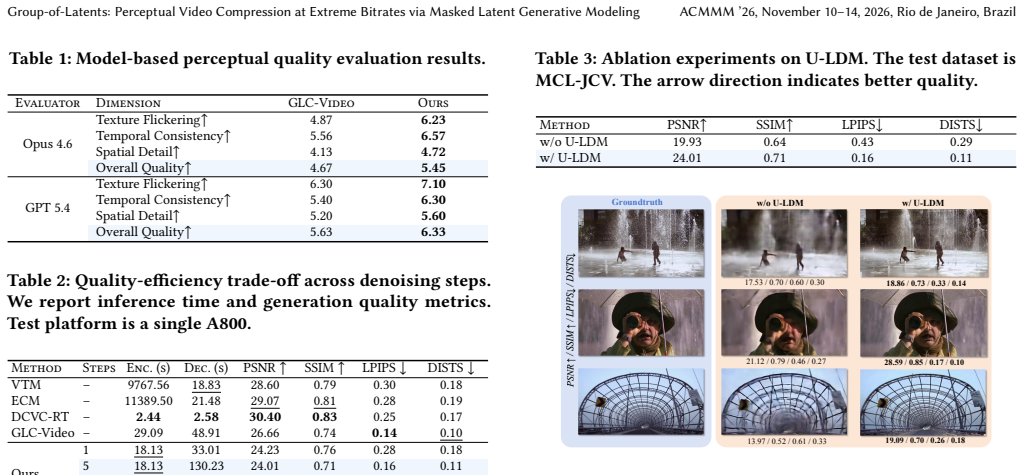
- The stable structural conditioning reduces required denoising steps from 35 to 5, making decoding latency comparable to efficiency-oriented diffusion codecs and much lower than multi-step native diffusion pipelines.
- If the latent-space decomposition holds broadly, the same GoL scheme can be transplanted onto other causal tokenizers and pretrained DiTs, potentially lowering the bitrate floor of future generative codecs further.
Where Pith is reading between the lines
- The core assumption—that motion lives only in latent transitions—can be tested directly by training a probe that predicts the next latent (or optical flow) from a sequence of latents; if prediction error is low, the discarded P-latents were partially redundant, strengthening the paper's case, and if not, the synthesized video will drift on motion-heavy content.
- The text caption, despite costing almost nothing, may be carrying a large share of the scene semantics at these bitrates; this suggests that semantic conditioning could be exploited further, for example to preserve object identity or to support tasks like video editing and retrieval directly from the compressed representation.
- The success of zero-cost P-latent synthesis implies an extreme reading of rate-distortion-perception theory: at very low rates, the decoder's generative prior can substitute for transmitted information to a degree that conventional residual coding cannot match, so the 'essential visual entropy' for perceptually acceptable video may be far lower than current codecs assume.
Editorial analysis
A structured set of objections, weighed in public.
Referee Report
Summary. The paper proposes a generative video compression framework for the extreme-low-bitrate regime (<0.005 bpp). A causal video tokenizer maps frames into a spatio-temporal latent stream, and a binary Group-of-Latents (GoL) mask partitions the latents into I-latents (structural anchors) and P-latents (inter-latents). I-latents are compressed by a VAE-based Deep Compression Module (I-DCM), while a DiT-based Unified Latent Denoising Module (U-LDM), trained with flow matching, refines the quantized I-latents and synthesizes P-latents from pure Gaussian noise. A text caption is also transmitted. The authors report rate-perception curves, ablations, LLM-as-judge scores, and a user study, claiming state-of-the-art perceptual fidelity and robust temporal consistency at extreme bitrates.
Significance. If the central claims hold, the paper offers a conceptually attractive way to reach bitrates below those of conventional codecs: rather than coding temporal residuals, the decoder regenerates inter-frame latents from a strong video-generation prior, with only sparse I-latents and a text caption as conditioning. The GoL mask provides a single-model, retraining-free rate-control mechanism, and the Dynamic GoL Training strategy is a reasonable way to support multiple masks. The ablation in Table 3 shows that the U-LDM contributes large gains, and the reduction from 35 to 5 denoising steps is practically useful. However, the strongest claims—state-of-the-art perceptual quality and temporal consistency at <0.005 bpp—are currently supported by limited quantitative evidence: the concurrent diffusion-based codecs are not compared numerically, and no experiment verifies that the synthesized temporal dynamics correspond to the original video's motion rather than merely being plausible.
major comments (4)
- [§4.2, §4.4, Table 2, Fig. 6] The SOTA claim is not quantitatively supported against the concurrent diffusion-based video codecs cited in §2.3 ([42,45,65]). §4.4 dismisses these methods with the qualitative statement that they 'generally operate at considerably higher bitrates,' and §4.2 says only that a 'qualitative discussion' is provided. No rate–perception points on the same datasets, no LPIPS/DISTS/KID values, and no bitrate values are reported for these methods. In addition, Table 2 reports no bitrate for any baseline, and Fig. 6's 'comparable bitrate' operating point is not quantified. Please add quantitative results on at least one shared benchmark and report bpp for every operating point, or substantially soften the SOTA claim.
- [§3.2, §3.4.1, §4.4, Table 1, Fig. 8] The paper's central claim of 'robust temporal consistency' is not verified by any metric that measures fidelity to the source video's motion. Since P-latents are pure noise at the decoder (Eq. 5), the recovery of the original motion depends entirely on the I/P decomposition and on the text conditioning. LPIPS and DISTS are frame-wise, KID is distribution-level, the LLM-as-judge 'Temporal Consistency' score measures plausibility of motion, and the 2AFC user study measures preference. None of these detects a 'different-but-plausible' trajectory. Please add a temporal fidelity measure, such as optical-flow endpoint error against the source, warped-frame error, or an oracle comparison of synthesized P-latents against ground-truth P-latents, before claiming that the original temporal content is preserved.
- [§3.4.1 vs. §3.5] There is an inconsistency in the definition of the conditioning at masked positions. Eq. (5) defines P-latent positions as pure Gaussian noise, but the 'Dynamic GoL Training' paragraph states that the condition is synthesized as L_c = L ⊙ M. If ⊙ is literal element-wise multiplication with the binary mask, then masked positions are zero (or true P-latents, depending on interpretation), not noise. If training conditions on true or zeroed P-latents rather than noise, the inference-time gap could be substantially understated. Please clarify the exact construction of L_c during training and, if the two differ, ablate the noise-vs-zero condition.
- [§3.5, Eq. (12), Table 2, Fig. 4] LPIPS is directly optimized in the stage-II loss (Eq. 12), and LPIPS is also one of the two headline metrics in Fig. 4 and Table 2. The LPIPS advantage over baselines is hence partly by construction. This does not invalidate the method—DISTS, KID, and the user study provide independent evidence—but the perceptual-fidelity claim should be buttressed by reporting all metrics for a model trained without the explicit LPIPS term, or by emphasizing metrics that are not in the training objective, to disentangle the contribution of the loss from the architecture.
minor comments (4)
- [§3.3.1, Eq. (4)] The total bitrate expression in Eq. (4) includes only the I-latent entropy terms, while the text description is mentioned separately as approximately 3×10^-5 bpp. Please state the total bitrate formula explicitly, including the text overhead, so that rate points in Fig. 4 are unambiguous.
- [§4.2, ] The test-set captions are generated by Gemini 3 and are transmitted as part of the bitstream. Since caption quality directly affects the generative reconstruction, please report the caption compression overhead and provide a sensitivity analysis (e.g., reconstruction quality with and without the text prompt).
- [§4.5, Table 1] The LLM-as-judge evaluation would benefit from more detail: number of videos rated, number of LLM judgments per video, inter-judge agreement, and whether the judge had access to the original video or only to the reconstructed videos. Without this, the numeric scores in Table 1 are difficult to interpret.
- [Fig. 5] The metric triplets below each image in Fig. 5 are hard to read. A small table or clearer labeling would improve interpretability.
Circularity Check
LPIPS is optimized in Stage II and then reported as a primary metric, so part of the perceptual-quality advantage is by construction; other metrics provide independent support.
specific steps
-
fitted input called prediction
[Sec. 3.5 Eq. (12); Sec. 4.2 Metrics]
"L_stageII = L_R(ŷ, ẑ) + L_v + λ_adp{LPIPS(X, X~) + MSE(X, X~)} ... To directly supervise the quality of the reconstructed video in the pixel domain, we apply the LPIPS and MSE losses to a one-step projection estimate X~_{0|t}=D(L_t - t·v_θ). ... We therefore adopt LPIPS [75] and DISTS [12] as primary metrics for perceptual quality assessment."
Stage II directly optimizes LPIPS on a one-step projection of the very denoising network that produces the final reconstruction, and the paper then reports LPIPS as the primary perceptual metric in Fig. 4 and Table 2. Since the training objective and headline evaluation are the same quantity, the LPIPS advantage of Ours over baselines that were not trained with LPIPS is partly forced by construction. The claim is not entirely circular because DISTS, KID, and the 2AFC user study are not directly optimized and provide independent support, but the main quantitative evidence is partially self-fulfilling.
full rationale
The central mechanism—masking P-latents and synthesizing them from noise at zero bitrate—is not circular: the velocity objective in Eq. (10) is supervised by the original full latent L, and the GoL mask is not defined in terms of the reported metrics. The statement that L_v is mathematically equivalent to latent-level MSE is a legitimate reparameterization, not a definitional shortcut. The only self-citation ([66]) is background and is not load-bearing. The one concrete reduction is the training/evaluation overlap: Eq. (12) directly trains LPIPS, and LPIPS is then reported as the primary success metric, so part of the perceptual-quality gap is explained by construction. DISTS, KID, and the user study mitigate this but do not eliminate it. The larger concern that temporal consistency is measured by plausibility rather than source-fidelity is a validation gap, not a circular derivation, and is therefore not scored here.
Axiom & Free-Parameter Ledger
free parameters (5)
- λ_I-DCM =
1e-3
- annealing schedule γ(1-t)^2 =
γ unspecified
- denoising steps =
5 (default)
- test GoL masks =
[1111],[1010],[1001],[1000]
- text bitrate overhead =
~3e-5 bpp
axioms (6)
- domain assumption Cosmos causal tokenizer maps pixels to latents with temporal stride 4 and spatial stride 8, preserving content
- domain assumption The latent space decomposes spatial texture and temporal motion across consecutive latents
- domain assumption Pretrained DiT (Cosmos-Transfer2.5) prior is sufficiently strong to synthesize P-latents from noise with high fidelity
- standard math Flow matching linear interpolant and decoupled condition (Eq. 8) yield a valid generative model
- domain assumption Text description via Gemini 3 from original video provides sufficient semantic conditioning
- standard math RDP theory justifies using perceptual metrics instead of PSNR
invented entities (1)
-
Group-of-Latents (GoL) I/P latent partition
no independent evidence
read the original abstract
Most existing video compression algorithms follow a paradigm of transformation and quantization, optimizing the trade-off between distortion and bitrate. However, extremely low-bitrate compression remains an underexplored frontier where perceptual quality optimization under severely constrained coding resources has not been adequately addressed. In this paper, we propose a unified generative framework that leverages pre-trained Diffusion Transformer (DiT) priors to achieve high perceptual quality at extremely low bitrates. We first introduce a flexible Group-of-Latents (GoL) strategy within the latent space of a causal tokenizer, explicitly partitioning the latent stream into intra $I$-latents and inter $P$-latents. The Deep Compression Module (I-DCM) then encodes key $I$-latents to preserve perceptual anchors with minimal overhead. Building upon these anchors, the DiT-based Unified Latent Denoising Module (U-LDM) refines intra-frame textures and synthesizes $P$-latents from noise, reconstructing temporal dynamics at zero additional bitrate cost. Extensive experiments demonstrate that our method uniquely operates in the extreme-low-bitrate regime (e.g., (<0.005) bpp), achieving state-of-the-art perceptual fidelity with rich spatial details and robust temporal consistency. The code will be made publicly available.
Figures




Reference graph
Works this paper leans on
-
[1]
Niket Agarwal, Arslan Ali, Maciej Bala, Yogesh Balaji, Erik Barker, Tiffany Cai, Prithvijit Chattopadhyay, Yongxin Chen, Yin Cui, Yifan Ding, et al. 2025. Cosmos world foundation model platform for physical AI.arXiv preprint arXiv:2501.03575 (2025)
Pith/arXiv arXiv 2025
-
[2]
Eirikur Agustsson, Michael Tschannen, Fabian Mentzer, Radu Timofte, and Luc Van Gool. 2019. Generative adversarial networks for extreme learned image compression. InProceedings of the IEEE/CVF International Conference on Computer Vision. 221–231
2019
-
[3]
Arslan Ali, Junjie Bai, Maciej Bala, Yogesh Balaji, Aaron Blakeman, Tiffany Cai, Jiaxin Cao, Tianshi Cao, Elizabeth Cha, Yu-Wei Chao, et al. 2025. World simulation with video foundation models for physical ai.arXiv preprint arXiv:2511.00062 (2025)
Pith/arXiv arXiv 2025
-
[4]
Anthropic. 2026. Introducing Claude Opus 4.6. https://www.anthropic.com/news/claude-opus-4-6. Accessed: 2026-03-30
2026
-
[5]
Tom Bachard, Tom Bordin, and Thomas Maugey. 2024. CoCliCo: Extremely low bitrate image compression based on CLIP semantic and tiny color map. InPicture Coding Symposium
2024
-
[6]
Fabrice Bellard. 2018. BPG Image Format. https://bellard.org/bpg/. Accessed: 2024-11-01
2018
-
[7]
Mikołaj Bińkowski, Danica J Sutherland, Michael Arbel, and Arthur Gretton
-
[8]
Yochai Blau and Tomer Michaeli. 2019. Rethinking lossy compression: The rate- distortion-perception tradeoff. InInternational Conference on Machine Learning. PMLR, 675–685
2019
-
[9]
Benjamin Bross, Ye-Kui Wang, Yan Ye, Shan Liu, Jianle Chen, Gary J Sullivan, and Jens-Rainer Ohm. 2021. Overview of the versatile video coding (VVC) standard and its applications.IEEE Transactions on Circuits and Systems for Video Technology31, 10 (2021), 3736–3764
2021
-
[10]
Marlene Careil, Matthew J Muckley, Jakob Verbeek, and Stéphane Lathuilière
-
[11]
Prafulla Dhariwal and Alexander Nichol. 2021. Diffusion models beat gans on image synthesis.Advances in Neural Information Processing Systems34 (2021), 8780–8794
2021
-
[12]
Keyan Ding, Kede Ma, Shiqi Wang, and Eero P Simoncelli. 2020. Image quality assessment: Unifying structure and texture similarity.IEEE Transactions on Pattern Analysis and Machine Intelligence44, 5 (2020), 2567–2581
2020
-
[13]
David Flynn, Karl Sharman, and Chris Rosewarne. [n. d.]. Common Test Con- ditions and Software Reference Configurations for HEVC Range Extensions, document JCTVC-N1006. ([n. d.])
-
[14]
Bossen Frank, Suehring Karsten, and Li Xiang. 2018. ECMSoftware. https://vcgit.hhi.fraunhofer.de/ecm_ECM. Accessed: 2025-05-01
2018
-
[15]
Bossen Frank, Suehring Karsten, and Li Xiang. 2018. VVCSoftware. https://vcgit.hhi.fraunhofer.de/jvet/VVCSoftware_VTM. Accessed: 2025-05-01
2018
-
[16]
Daniel Geng, Charles Herrmann, Junhwa Hur, Forrester Cole, Serena Zhang, Tobias Pfaff, Tatiana Lopez-Guevara, Yusuf Aytar, Michael Rubinstein, Chen Sun, et al. 2025. Motion prompting: Controlling video generation with motion trajec- tories. InProceedings of the Computer Vision and Pattern Recognition Conference. 1–12
2025
-
[17]
Shuyang Gu, Dong Chen, Jianmin Bao, Fang Wen, Bo Zhang, Dongdong Chen, Lu Yuan, and Baining Guo. 2022. Vector quantized diffusion model for text-to-image synthesis. InProceedings of the IEEE/CVF Conference on Computer Vision and Pattern Recognition. 10696–10706
2022
-
[18]
Agrim Gupta, Lijun Yu, Kihyuk Sohn, Xiuye Gu, Meera Hahn, Fei-Fei Li, Irfan Essa, Lu Jiang, and José Lezama. 2024. Photorealistic video generation with diffusion models. InEuropean Conference on Computer Vision. Springer, 393–411
2024
-
[19]
Dailan He, Ziming Yang, Weikun Peng, Rui Ma, Hongwei Qin, and Yan Wang
-
[20]
Zhaoyang Jia, Bin Li, Jiahao Li, Wenxuan Xie, Linfeng Qi, Houqiang Li, and Yan Lu. 2025. Towards Practical Real-Time Neural Video Compression. InProceedings of the IEEE/CVF conference on computer vision and pattern recognition
2025
-
[21]
Wei Jiang, Jiayu Yang, Yongqi Zhai, Peirong Ning, Feng Gao, and Ronggang Wang
-
[22]
Yuming Jiang, Tianxing Wu, Shuai Yang, Chenyang Si, Dahua Lin, Yu Qiao, Chen Change Loy, and Ziwei Liu. 2024. Videobooth: Diffusion-based video generation with image prompts. InProceedings of the IEEE/CVF Conference on Computer Vision and Pattern Recognition. 6689–6700
2024
-
[23]
Nikolai Körber, Eduard Kromer, Andreas Siebert, Sascha Hauke, Daniel Mueller- Gritschneder, and Björn Schuller. 2025. EGIC: Enhanced low-bit-rate generative image compression guided by semantic segmentation. InProceedings of the Euro- pean Conference on Computer Vision. Springer, 202–220
2025
-
[24]
Haowei Kuang, Yiyang Ma, Wenhan Yang, Zongming Guo, and Jiaying Liu. 2024. Consistency Guided Diffusion Model with Neural Syntax for Perceptual Image Compression. InACM Multimedia
2024
-
[25]
Black Forest Labs, Stephen Batifol, Andreas Blattmann, Frederic Boesel, Saksham Consul, Cyril Diagne, Tim Dockhorn, Jack English, Zion English, Patrick Esser, et al. 2025. FLUX. 1 Kontext: Flow Matching for In-Context Image Generation and Editing in Latent Space.arXiv preprint arXiv:2506.15742(2025)
Pith/arXiv arXiv 2025
-
[26]
Eric Lei, Yiğit Berkay Uslu, Hamed Hassani, and Shirin Saeedi Bidokhti. 2023. Text+ sketch: Image compression at ultra low rates. InICML 2023 Workshop on Neural Compression: From Information Theory to Applications
2023
-
[27]
Bohan Li, Yiming Liu, Xueyan Niu, Bo Bait, Wei Han, Lei Deng, and Deniz Gunduz
-
[28]
Dongxu Li, Junnan Li, and Steven Hoi. 2024. Blip-diffusion: Pre-trained subject representation for controllable text-to-image generation and editing.Advances in Neural Information Processing Systems36 (2024)
2024
-
[29]
Han Li, Shaohui Li, Wenrui Dai, Chenglin Li, Junni Zou, and Hongkai Xiong
-
[30]
Jiahao Li, Bin Li, and Yan Lu. 2021. Deep contextual video compression.Advances in Neural Information Processing Systems34 (2021), 18114–18125
2021
-
[31]
Jiahao Li, Bin Li, and Yan Lu. 2023. Neural video compression with diverse contexts. InProceedings of the IEEE/CVF conference on computer vision and pattern recognition. 22616–22626
2023
-
[32]
In2024 16th International Conference on Wireless Communications and Signal Processing
Extreme Video Compression with Prediction Using Pre-trained Diffusion Models. In2024 16th International Conference on Wireless Communications and Signal Processing. IEEE, 1449–1455
-
[33]
Xingchen Li, Junzhe Zhang, Junqi Shi, Ming Lu, and Zhan Ma. 2026. YODA: Yet Another One-step Diffusion-based Video Compressor.arXiv preprint arXiv:2601.01141(2026)
arXiv 2026
-
[34]
Zhiyuan Li, Yanhui Zhou, Hao Wei, Chenyang Ge, and Jingwen Jiang. 2025. Toward Extreme Image Compression With Latent Feature Guidance and Diffusion Prior.IEEE Transactions on Circuits and Systems for Video Technology35, 1 (2025)
2025
-
[35]
InThe Twelfth International Conference on Learning Representations
Frequency-Aware Transformer for Learned Image Compression. InThe Twelfth International Conference on Learning Representations
-
[36]
Ming Liu and Wensheng Zhang. 2025. Is your video language model a reliable judge?arXiv preprint arXiv:2503.05977(2025)
Pith/arXiv arXiv 2025
-
[37]
Xiao Liu, Xinhao Xiang, Zizhong Li, Yongheng Wang, Zhuoheng Li, Zhuosheng Liu, Weidi Zhang, Weiqi Ye, and Jiawei Zhang. 2024. A survey of AI-generated video evaluation.arXiv preprint arXiv:2410.19884(2024)
arXiv 2024
-
[38]
Jiahao Li, Bin Li, and Yan Lu. 2024. Neural video compression with feature modulation. InProceedings of the IEEE/CVF Conference on Computer Vision and Pattern Recognition. 26099–26108
2024
-
[39]
Yuchen Liu, Zhixin Shu, Yijun Li, Zhe Lin, Federico Perazzi, and Sun-Yuan Kung
-
[40]
Google LLC. 2025. Gemini 3. https://gemini.google.com/. Accessed: 2026-01-28
2025
-
[41]
Zhiyuan Li, Yanhui Zhou, Hao Wei, Chenyang Ge, and Ajmal Mian. 2025. RDEIC: Accelerating Diffusion-Based Extreme Image Compression with Relay Residual Diffusion.IEEE Transactions on Circuits and Systems for Video Technology(2025)
2025
-
[42]
Wenzhuo Ma and Zhenzhong Chen. 2025. Diffusion-based perceptual neural video compression with temporal diffusion information reuse.ACM Transactions on Multimedia Computing, Communications and Applications21, 12 (2025), 1–22
2025
-
[43]
Wenzhuo Ma and Zhenzhong Chen. 2025. DiffVC-OSD: One-Step Diffusion- based Perceptual Neural Video Compression Framework.arXiv preprint arXiv:2508.07682(2025)
Pith/arXiv arXiv 2025
-
[44]
Yaofang Liu, Xiaodong Cun, Xuebo Liu, Xintao Wang, Yong Zhang, Haoxin Chen, Yang Liu, Tieyong Zeng, Raymond Chan, and Ying Shan. 2024. Evalcrafter: Benchmarking and evaluating large video generation models. InProceedings of the IEEE/CVF conference on computer vision and pattern recognition. 22139–22149
2024
-
[45]
Qi Mao, Hao Cheng, Tinghan Yang, Libiao Jin, and Siwei Ma. 2026. Genera- tive Neural Video Compression via Video Diffusion Prior. InProceedings of the Computer Vision and Pattern Recognition Conference
2026
-
[46]
Fabian Mentzer, Eirikur Agustsson, Johannes Ballé, David Minnen, Nick Johnston, and George Toderici. 2022. Neural video compression using GANs for detail synthesis and propagation. InEuropean Conference on Computer Vision. Springer, 562–578
2022
-
[47]
Fabian Mentzer, George D Toderici, Michael Tschannen, and Eirikur Agustsson
-
[48]
Guo Lu, Wanli Ouyang, Dong Xu, Xiaoyun Zhang, Chunlei Cai, and Zhiyong Gao
-
[49]
David Minnen, Johannes Ballé, and George D Toderici. 2018. Joint autoregressive and hierarchical priors for learned image compression.Advances in Neural Information Processing Systems31 (2018)
2018
-
[50]
Matthew J Muckley, Alaaeldin El-Nouby, Karen Ullrich, Hervé Jégou, and Jakob Verbeek. 2023. Improving statistical fidelity for neural image compression with implicit local likelihood models. InInternational Conference on Machine Learning. PMLR, 25426–25443
2023
-
[51]
OpenAI. 2026. Introducing GPT-5.4. https://openai.com/index/introducing-gpt- 5-4/. Accessed: 2026-03-30
2026
-
[52]
Yiyang Ma, Wenhan Yang, and Jiaying Liu. 2024. Correcting Diffusion-Based Perceptual Image Compression with Privileged End-to-End Decoder.arXiv preprint arXiv:2404.04916(2024)
Pith/arXiv arXiv 2024
-
[53]
Lucas Relic, Roberto Azevedo, Markus Gross, and Christopher Schroers. 2024. Lossy image compression with foundation diffusion models. InEuropean Confer- ence on Computer Vision. Springer, 303–319
2024
-
[54]
Robin Rombach, Andreas Blattmann, Dominik Lorenz, Patrick Esser, and Björn Ommer. 2022. High-resolution image synthesis with latent diffusion models. In Proceedings of the IEEE/CVF Conference on Computer Vision and Pattern Recognition. 10684–10695
2022
-
[55]
Sadaf Salehkalaibar, Buu Phan, João Atz Dick, Ashish J Khisti, Jun Chen, and Wei Yu. 2024. Perception Loss Function Adaptive to Rate for Learned Video Compression. InWorkshop on Machine Learning and Compression, Advances in Neural Information Processing Systems
2024
-
[56]
Gary J Sullivan, Jens-Rainer Ohm, Woo-Jin Han, and Thomas Wiegand. 2012. Overview of the high efficiency video coding (HEVC) standard.IEEE Transactions on Circuits and Systems for Video Technology22, 12 (2012), 1649–1668
2012
-
[57]
Alexandre Mercat, Marko Viitanen, and Jarno Vanne. 2020. UVG dataset: 50/120fps 4K sequences for video codec analysis and development. InProceedings of the 11th ACM multimedia systems conference. 297–302
2020
-
[58]
Bill Tao, Om Chabra, Ishani Janveja, Indranil Gupta, and Deepak Vasisht. 2024. Known Knowns and Unknowns: Near-realtime Earth Observation Via Query Bifurcation in Serval. In21st USENIX Symposium on Networked Systems Design and Implementation (NSDI 24). 809–824
2024
-
[59]
Gregory K Wallace. 1992. The JPEG still picture compression standard.IEEE Transactions on Consumer Electronics38, 1 (1992), xviii–xxxiv
1992
-
[60]
Team Wan, Ang Wang, Baole Ai, Bin Wen, Chaojie Mao, Chen-Wei Xie, Di Chen, Feiwu Yu, Haiming Zhao, Jianxiao Yang, et al. 2025. Wan: Open and advanced large-scale video generative models.arXiv preprint arXiv:2503.20314(2025)
Pith/arXiv arXiv 2025
-
[61]
Linfeng Qi, Zhaoyang Jia, Jiahao Li, Bin Li, Houqiang Li, and Yan Lu. 2025. Generative latent coding for ultra-low bitrate image and video compression.IEEE Transactions on Circuits and Systems for Video Technology(2025)
2025
-
[62]
Haiqiang Wang, Weihao Gan, Sudeng Hu, Joe Yuchieh Lin, Lina Jin, Longguang Song, Ping Wang, Ioannis Katsavounidis, Anne Aaron, and C-C Jay Kuo. 2016. MCL-JCV: a JND-based H.264/AVC video quality assessment dataset. In2016 IEEE International Conference on Image Processing. IEEE, 1509–1513
2016
-
[63]
Lingdong Wang, Guan-Ming Su, Divya Kothandaraman, Tsung-Wei Huang, Mo- hammad Hajiesmaili, and Ramesh K Sitaraman. 2025. Low-Bitrate Video Compres- sion through Semantic-Conditioned Diffusion.arXiv preprint arXiv:2512.00408 (2025)
Pith/arXiv arXiv 2025
-
[64]
Yaohui Wang, Xinyuan Chen, Xin Ma, Shangchen Zhou, Ziqi Huang, Yi Wang, Ceyuan Yang, Yinan He, Jiashuo Yu, Peiqing Yang, et al. 2025. Lavie: High-quality video generation with cascaded latent diffusion models.International Journal of Computer Vision133, 5 (2025), 3059–3078
2025
-
[65]
Zhitao Wang, Hengyu Man, Wenrui Li, Xingtao Wang, Xiaopeng Fan, and Debin Zhao. 2025. T-GVC: Trajectory-Guided Generative Video Coding at Ultra-Low Bitrates.arXiv preprint arXiv:2507.07633(2025)
arXiv 2025
-
[66]
Zhiyu Tan, Xiaomeng Yang, Luozheng Qin, and Hao Li. 2024. VidGen-1M: A large-scale dataset for text-to-video generation.arXiv preprint arXiv:2408.02629 (2024)
Pith/arXiv arXiv 2024
-
[67]
Tongda Xu, Ziran Zhu, Dailan He, Yanghao Li, Lina Guo, Yuanyuan Wang, Zhe Wang, Hongwei Qin, Yan Wang, Jingjing Liu, et al. 2024. Idempotence and per- ceptual image compression. InThe Twelfth International Conference on Learning Representations
2024
-
[68]
Naifu Xue, Zhaoyang Jia, Jiahao Li, Bin Li, Yuan Zhang, and Yan Lu. 2025. One- Step Diffusion-Based Image Compression with Semantic Distillation.Advances in Neural Information Processing Systems(2025)
2025
-
[69]
Ruihan Yang and Stephan Mandt. 2023. Lossy image compression with conditional diffusion models.Advances in Neural Information Processing Systems36 (2023)
2023
-
[70]
Boyang Wang, Nikhil Sridhar, Chao Feng, Mark Van der Merwe, Adam Fishman, Nima Fazeli, and Jeong Joon Park. 2025. This&that: Language-gesture controlled video generation for robot planning. In2025 IEEE International Conference on Robotics and Automation (ICRA). IEEE, 12842–12849
2025
-
[71]
Zhuoyi Yang, Jiayan Teng, Wendi Zheng, Ming Ding, Shiyu Huang, Jiazheng Xu, Yuanming Yang, Wenyi Hong, Xiaohan Zhang, Guanyu Feng, et al . 2024. CogVideoX: Text-to-video diffusion models with an expert transformer.arXiv preprint arXiv:2408.06072(2024)
Pith/arXiv arXiv 2024
-
[72]
Fangqiu Yi, Jingyu Xu, Jiawei Shao, Chi Zhang, and Xuelong Li. 2025. Condi- tional Video Generation for High-Efficiency Video Compression.arXiv preprint arXiv:2507.15269(2025)
arXiv 2025
-
[73]
Blau Yochai and Michaeli Tomer. 2018. The perception-distortion tradeoff. In Proceedings of the IEEE/CVF Conference on Computer Vision and Pattern Recognition. 6228–6237
2018
-
[74]
Zhihang Yuan, Rui Xie, Yuzhang Shang, Hanling Zhang, Siyuan Wang, Shengen Yan, Guohao Dai, and Yu Wang. 2025. VGDFR: Diffusion-based Video Generation with Dynamic Latent Frame Rate. InProceedings of the IEEE/CVF International Conference on Computer Vision. 1–10
2025
-
[75]
Jinchang Xu, Shaokang Wang, Jintao Chen, Zhe Li, Peidong Jia, Fei Zhao, Guoqing Xiang, Zhijian Hao, Shanghang Zhang, and Xiaodong Xie. 2025. Decouple Distortion from Perception: Region Adaptive Diffusion for Extreme-low Bitrate Perception Image Compression. InProceedings of the Computer Vision and Pattern Recognition Conference. 18051–18061
2025
-
[76]
Tianyu Zhang, Xin Luo, Li Li, and Dong Liu. 2025. StableCodec: Taming One- Step Diffusion for Extreme Image Compression. InProceedings of the IEEE/CVF International Conference on Computer Vision. 1–18
2025
-
[77]
Ziyuan Zhang, Han Qiu, Maosen Zhang, Jun Liu, Bin Chen, Tianwei Zhang, and Hewu Li. 2024. COSMIC: Compress Satellite Images Efficiently via Diffusion Compensation. InThe Thirty-eighth Annual Conference on Neural Information Processing Systems
2024
-
[78]
Shihao Zhao, Dongdong Chen, Yen-Chun Chen, Jianmin Bao, Shaozhe Hao, Lu Yuan, and Kwan-Yee K Wong. 2024. Uni-controlnet: All-in-one control to text-to- image diffusion models.Advances in Neural Information Processing Systems36 (2024)
2024
-
[79]
Ren Yang, Radu Timofte, and Luc Van Gool. 2022. Perceptual Video Compres- sion with Recurrent Conditional GAN. InProcessings of the International Joint Conference on Artificial Intelligence
2022
-
[84]
Richard Zhang, Phillip Isola, Alexei A Efros, Eli Shechtman, and Oliver Wang
discussion (0)
Sign in with ORCID, Apple, or X to comment. Anyone can read and Pith papers without signing in.