REVIEW 3 major objections 5 minor 54 references
Dirichlet boundary conditions do not define a stable boundary CFT for conformal QED in three dimensions, while Neumann boundary conditions do.
Reviewed by Pith at T0; open to challenge. T0 means a machine referee read the full paper against a public rubric. the ladder, T0–T4 →
T0 review · deepseek-v4-flash
2026-08-01 12:38 UTC pith:6IDJX4PQ
load-bearing objection A solid AdS/BCFT computation with a plausible but not proven instability claim for Dirichlet boundary conditions; worth refereeing. the 3 major comments →
Conformal QED in AdS as a BCFT
The pith
A machine-rendered reading of the paper's core claim, the machinery that carries it, and where it could break.
Core claim
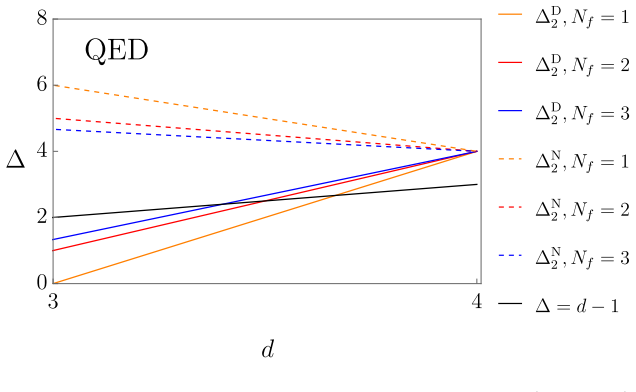
At the interacting infrared fixed point of N_f Dirac fermions coupled to a gauge field in AdS in dimension 4 - epsilon, the two lightest parity-even singlet boundary scalars mix and diagonalize (Eqs. (4.7)-(4.8) of the paper) to dimensions Delta_1 = 4 - epsilon, the protected displacement operator, and Delta_2 = 4 - 2 epsilon - (2/N_f) epsilon for Dirichlet boundary conditions on the gauge field, versus Delta_2 = 4 + (2/N_f) epsilon for Neumann boundary conditions. Extrapolated to epsilon = 1 (d = 3), the Dirichlet operator lies below the marginal dimension d - 1 for every positive N_f, while the Neumann operator stays above it. The paper concludes that the Dirichlet BCFT merges with a D* bo
What carries the argument
The central tool is the AdS/BCFT correspondence: conformal QED in Euclidean AdS_d is Weyl-equivalent to QED on a half-space, so boundary conformal data can be computed from AdS Feynman diagrams. The calculation combines one-loop spectral determinants on hyperbolic space for the leading free energy; a construction of the Neumann free energy from the Dirichlet one by promoting the boundary value of the gauge field (the source of the conserved boundary current) to a dynamical boundary gauge field; and the one-loop mixing of the two lightest singlet scalar operators - the Maxwell displacement operator and the matter displacement operator - whose logarithmic two-point functions give the anomalous
Load-bearing premise
The load-bearing assumption is that the boundary beta function for the almost-marginal scalar has the form beta_eta = c1 eta^2 + c2 (1/g^2 - 1/g_crit^2) with real fixed points only below a critical coupling - a mechanism imported from non-abelian, non-conformal theories - so that once the scalar crosses marginality the Dirichlet BCFT annihilates with D*. If the coefficients in the abelian conformal case have the wrong signs, the annihilation and the disappearance of the Diric
What would settle it
A direct two-loop computation in AdS of the beta function for the boundary coupling conjugate to the almost-marginal singlet scalar in abelian conformal QED: if the zeros of this beta function remain real when the scalar's scaling dimension crosses marginality, the merger-and-annihilation conclusion fails. Alternatively, a non-perturbative Monte Carlo or fuzzy-sphere simulation of QED_3 with Dirichlet boundary conditions that finds a conformal boundary fixed point at d=3 would falsify the central claim.
If this is right
- Conformal QED in three dimensions would admit no Dirichlet conformal boundary condition; surface studies of deconfined critical points and Dirac spin liquids should use the Neumann boundary condition or another stable one.
- The exact recovery of the displacement operator, Delta_1 = d, provides a consistency check that the one-loop mixing calculation is sound.
- The ordering d_merg < d_crit follows from the boundary F-theorem if the flow after the merger ends at the Neumann boundary condition, making the free-energy and spectral data mutually consistent.
- For scalar QED, the same stability dichotomy holds wherever a real bulk fixed point exists, and in the large-N limit the composite J^i J^i becomes marginal exactly at d=3, so the merger dimension approaches 3.
Where Pith is reading between the lines
- The merger mechanism is imported from non-abelian, non-conformal gauge theories; a direct computation of the boundary beta function coefficients in abelian conformal QED would be needed to confirm that the fixed points annihilate exactly when the scalar hits marginality.
- The epsilon expansion is extrapolated to epsilon = 1; a large-N_f computation at fixed d=3, or a Monte Carlo/fuzzy-sphere simulation of QED3 with both boundary conditions, could independently confirm or refute the disappearance of the Dirichlet boundary condition.
- The predicted free-energy ordering ~F_N < ~F_D at the merger point is a concrete signature that non-perturbative methods could measure, for example by comparing free energies on a ball with the two boundary conditions.
- The same AdS/BCFT machinery should be applicable to other conformal gauge theories, raising the possibility that the Dirichlet instability is a general criterion for which boundary conditions survive at low dimensions.
Editorial analysis
A structured set of objections, weighed in public.
Referee Report
Summary. The paper studies conformal QED in Euclidean AdS_d for d = 4 − ε, with either N_f massless Dirac fermions or N_s conformally coupled scalars, under Dirichlet or Neumann boundary conditions for the gauge field. It computes the regularized AdS free energy to next-to-leading order at the interacting IR fixed point and extracts the one-loop dimensions of the two lightest parity-even singlet boundary scalars. The main qualitative results are: with Dirichlet BC the second scalar has Δ_D2 = 4 − 2ε − (2/N_f)ε (Eq. 4.7), which crosses marginality in 3 < d < 4; with Neumann BC the analogous operator stays irrelevant (Eq. 4.8). Interpreting the Dirichlet marginality crossing through the D/D* merger mechanism of Refs. [24,28], the authors suggest that the Dirichlet BCFT ceases to exist in d = 3, while the Neumann BCFT remains stable. The scalar QED case is treated analogously (Eqs. 6.32–6.33). Internal checks include recovering the protected displacement operator and matching the boundary fermion anomalous dimension from the equations of motion with an existing direct calculation.
Significance. If the stability conclusion is correct, this is an important step toward understanding boundary universality classes of conformal QED in 2 < d < 4, with direct applications to deconfined critical points and Dirac spin liquids. The paper's concrete assets are substantial: the NLO free-energy computation is detailed and shows nontrivial pole cancellations after renormalization; the identification of the protected displacement operator provides a strong consistency check on the operator mixing; the EOM-based boundary fermion anomalous dimension (Sec. 5) reproduces an independent result; and the large-N_f limit gives a controlled limiting mechanism for the Dirichlet instability. The central no-go claim, however, is less solid than the perturbative data: it relies on an imported boundary beta-function mechanism whose applicability to abelian, conformal, non-running QED is not demonstrated.
major comments (3)
- [Sec. 1, Eq. (1.5); Sec. 4, Eqs. (4.7)–(4.8)] The claim that the Dirichlet BCFT ceases to exist when Δ_D2 crosses marginality rests entirely on the D/D* merger mechanism. The paper itself states that the derivation of Ref. [28] cannot be used directly because their mechanism relies on a running bulk coupling, and that the coefficients c1, c2 in Eq. (1.5) are unknown if g_crit^2 is not small. A boundary primary with Δ < d − 1 is a relevant deformation, which is allowed at a conformal fixed point and does not by itself annihilate the boundary condition. Without a computation or at least a sign constraint on β_η in abelian conformal QED, the marginality crossing is circumstantial evidence, not a proof of non-existence. Please either derive the needed boundary beta function, or explicitly label the no-go conclusion as a conjecture and separate it from the established free-energy and spectral results.
- [Sec. 4, Eqs. (4.7)–(4.8), Table 1] The extrapolation from the one-loop ε-expansion to ε = 1 is uncontrolled for finite N_f. Table 1 lists d_merg values from the linear formula Δ_D2 = 4 − 2ε − (2/N_f)ε, but for N_f = 1 the expansion parameter is order one and O(ε^2) corrections could move d_merg substantially. The large-N_f argument at the end of Sec. 4 supports only the limiting behavior, not the finite-N_f claim that the Dirichlet BC 'does not persist' for all N_f. Please provide an estimate of higher-order or 1/N_f corrections, or a direct d = 3 computation, or soften the wording to make the provisional nature explicit in the abstract and Sec. 4.
- [Sec. 4, final paragraph (d_merg < d_crit)] The F-theorem ordering argument presumes the flow D → D* → N, which is precisely the point at issue. The inequality d_merg < d_crit is therefore a consistency condition, not independent evidence for the merger scenario. If the boundary beta function is not established, the ordering cannot be used to support the central claim. Please mark it explicitly as a consistency check rather than a justification.
minor comments (5)
- [Fig. 5 caption] Typo 'dasehed' should be 'dashed'; also the phrase 'remains safely above Δ = d' should read 'above Δ = d − 1', which is the marginality line used in the text.
- [Table 2 caption] The column header 'Nf' in the caption of Table 2 should be 'N_s' for consistency with the scalar QED discussion.
- [Eq. (4.4)] The mixing matrix Γ is imported from Ref. [25] without derivation. Because Ref. [25] has overlapping authorship, an appendix showing the abelian contraction and group-factor replacement would improve reproducibility and reader confidence.
- [Eq. (4.6)] The notation δ∆ for the free-theory dimension shifts is introduced without definition in the text; please state explicitly that δ∆_ii is the coefficient of the log in the free two-point function at d = 4 − ε.
- [Ref. [45]] Reference [45] is cited as 'Work in progress, 2026'; if no public preprint exists, it should be marked as private communication or removed from the formal reference list.
Circularity Check
Dirichlet BC instability is carried by an imported beta-function ansatz from overlapping-author prior work; the one-loop spectrum and free energy are otherwise independently computed.
specific steps
-
ansatz smuggled in via citation
[Eq. (1.5) and Section 4 (continuity argument)]
"As explained in [24, 28], the beta function for the boundary coupling η associated with that operator takes the form βη = c1η² + c2(1/g² − 1/g²_crit), g² ≲ g²_crit, where the coefficients c1,2 are determined by the data of the boundary CFT, which are unknown if g²_crit is not small."
The paper's central conclusion — that the Dirichlet BCFT disappears via merger with D* — is obtained by applying this beta-function form to the regime where g_crit corresponds to d_merg, which is not close to 4. The coefficients c1,2 are admitted to be unknown in that regime, and their required sign pattern is exactly what makes the fixed points complex and enforces annihilation. The paper even notes that [28]'s mechanism cannot be used directly because it relies on a running bulk coupling, then substitutes a continuity argument that invokes 'the exact same instability' from Eq. (1.5). Thus the instability claim is not derived from the paper's one-loop computations but imported as an unverified, self-cited ansatz.
full rationale
The paper contains substantial independent computation: the NLO AdS free energies for fermionic and scalar QED, the one-loop anomalous dimensions (including recovery of the protected displacement operator), and the EOM-based boundary fermion/scalar dimensions. These do not reduce by construction to any fitted parameter. The main caveat concerns the interpretation of the crossing of marginality by Δ_D2. That interpretation relies on the D/D* merger mechanism encoded in Eq. (1.5), which is taken from prior work [24,28]. Ref. [24] shares an author with the present paper, and the relevant coefficients are explicitly stated to be unknown for the regime in question. The paper's own continuity argument is a plausible reductio, but it does not derive βη; it re-invokes the same imported beta function. This makes the central stability/annihilation claim partially dependent on a self-citation whose validity in conformal abelian QED is not established here. However, the crossing itself is a genuine one-loop result, and the free-energy ordering d_crit is independently computed. Therefore the circularity is partial, not total: score 3.
Axiom & Free-Parameter Ledger
axioms (7)
- domain assumption Boundary-condition dictionary: Dirichlet BC on the bulk gauge field is dual to a conserved boundary current, Neumann BC to a dynamical boundary gauge field; ghost BCs are tied to the vector BCs.
- domain assumption The bulk theory flows to an interacting IR fixed point in d=4-epsilon with e*^2 = 6 pi^2 epsilon/N_f (fermionic) and e*^2 = 24 pi^2 epsilon/N_s (scalar), from flat-space beta functions.
- domain assumption The boundary F-theorem for the regularized AdS free energy holds and can be used to order boundary fixed points.
- domain assumption The one-loop mixing matrix Gamma for the two lightest singlet boundary scalars, computed for non-abelian gauge theory in Ref. [25], applies to abelian conformal QED after replacing color factors.
- ad hoc to paper The D* boundary condition and the beta-function merger mechanism in Eq. (1.5) apply to conformal abelian gauge theories in AdS.
- ad hoc to paper The one-loop epsilon-expansion results can be linearly extrapolated to epsilon=1 (d=3).
- domain assumption For scalar QED, a real IR fixed point exists only for sufficiently large N_s (N_s >= 183 at leading order), and the paper restricts to such values.
read the original abstract
We study conformal Quantum Electrodynamics (QED) coupled to either $N_f$ massless fermions or $N_s$ conformally coupled scalars in Euclidean Anti-de Sitter (AdS$_d$) space for $d < 4$. Using the $\epsilon$-expansion around $d=4$, we investigate the associated Boundary Conformal Field Theories (BCFTs) defined by imposing either Dirichlet or Neumann boundary conditions on the gauge field. We compute the regularized AdS free energy at the interacting fixed point up to next-to-leading order and extract some of the boundary conformal data at one loop, including the anomalous dimensions of the lightest singlet scalar operators. For Dirichlet boundary conditions, extrapolation of our $\epsilon$-expansion results indicate that one of these scalar operators, which is irrelevant near $d=4$, reaches marginality within the range $3 < d < 4$. This suggests that the Dirichlet boundary condition may not define a stable BCFT in $d=3$.
Figures



Reference graph
Works this paper leans on
-
[1]
The Theory of boundary critical phenomena,
H. W. Diehl, “The Theory of boundary critical phenomena,”Int. J. Mod. Phys. B11 (1997) 3503–3523,arXiv:cond-mat/9610143. 1
Pith/arXiv arXiv 1997
-
[2]
Conformal field theories near a boundary in general dimensions,
D. M. McAvity and H. Osborn, “Conformal field theories near a boundary in general dimensions,”Nucl. Phys. B455(1995) 522–576,arXiv:cond-mat/9505127
Pith/arXiv arXiv 1995
-
[3]
The Bootstrap Program for Boundary CFTd,
P. Liendo, L. Rastelli, and B. C. van Rees, “The Bootstrap Program for Boundary CFTd,”JHEP07(2013) 113,arXiv:1210.4258 [hep-th]. 1
Pith/arXiv arXiv 2013
-
[4]
A Study of Quantum Field Theories in AdS at Finite Coupling,
D. Carmi, L. Di Pietro, and S. Komatsu, “A Study of Quantum Field Theories in AdS at Finite Coupling,”JHEP01(2019) 200,arXiv:1810.04185 [hep-th]. 1
Pith/arXiv arXiv 2019
-
[5]
CFT in AdS and boundary RG flows,
S. Giombi and H. Khanchandani, “CFT in AdS and boundary RG flows,”JHEP11 (2020) 118,arXiv:2007.04955 [hep-th]. 1, 19
arXiv 2020
-
[6]
Fermions in AdS and Gross-Neveu BCFT,
S. Giombi, E. Helfenberger, and H. Khanchandani, “Fermions in AdS and Gross-Neveu BCFT,”JHEP07(2022) 018,arXiv:2110.04268 [hep-th]. 9, 11, 19
Pith/arXiv arXiv 2022
-
[7]
Higher loops in AdS: applications to boundary CFT,
S. Giombi and Z. Sun, “Higher loops in AdS: applications to boundary CFT,”JHEP12 (2025) 011,arXiv:2506.14699 [hep-th]. 2, 7, 22
Pith/arXiv arXiv 2025
-
[8]
Boundary criticality in the Gross-Neveu-Yukawa model at higher orders,
O. Diatlyk, S. Giombi, and Z. Sun, “Boundary criticality in the Gross-Neveu-Yukawa model at higher orders,”arXiv:2606.07510 [hep-th]. 2, 10
-
[9]
O(N) BCFT: new data from conformal partial wave expansions,
J. Csipes and P. Vaˇ sko, “O(N) BCFT: new data from conformal partial wave expansions,” arXiv:2606.14733 [hep-th]. 1
-
[10]
S. Giombi and I. R. Klebanov, “Interpolating betweenaandF,”JHEP03(2015) 117, arXiv:1409.1937 [hep-th]. 1, 10
Pith/arXiv arXiv 2015
-
[11]
Towards aC-theorem in defect CFT,
N. Kobayashi, T. Nishioka, Y. Sato, and K. Watanabe, “Towards aC-theorem in defect CFT,”JHEP01(2019) 039,arXiv:1810.06995 [hep-th]. 1, 2
Pith/arXiv arXiv 2019
-
[12]
F-theorem for Quantum Field Theories in Anti-de Sitter Space,
D. Bason, C. Copetti, L. Di Pietro, Z. Ji, and S. Komatsu, “F-theorem for Quantum Field Theories in Anti-de Sitter Space,”arXiv:2512.18392 [hep-th]. 1, 7
-
[13]
Deconfined quantum critical points,
T. Senthil, A. Vishwanath, L. Balents, S. Sachdev, and M. P. A. Fisher, “Deconfined quantum critical points,”Science303(2004) 1490–1494,arXiv:cond-mat/0311326. 2
Pith/arXiv arXiv 2004
-
[14]
Quantum criticality beyond the Landau-Ginzburg-Wilson paradigm,
T. Senthil, L. Balents, S. Sachdev, A. Vishwanath, and M. P. A. Fisher, “Quantum criticality beyond the Landau-Ginzburg-Wilson paradigm,”Phys. Rev. B70(2004) 144407,arXiv:cond-mat/0312617. 2 30
Pith/arXiv arXiv 2004
-
[15]
Large-n limit of the Hubbard-Heisenberg model,
J. B. Marston and I. Affleck, “Large-n limit of the Hubbard-Heisenberg model,”Phys. Rev. B39(1989) 11538–11558. 2
1989
-
[16]
M. Franz, Z. Tesanovic, and O. Vafek, “QED(3) theory of pairing pseudogap in cuprates: From d-wave superconductor to antiferromagnet via algebraic Fermi liquid,”Phys. Rev. B 66(2002) 054535,arXiv:cond-mat/0203333
Pith/arXiv arXiv 2002
-
[17]
QED(3) theory of underdoped high temperature superconductors,
I. F. Herbut, “QED(3) theory of underdoped high temperature superconductors,”Phys. Rev. B66(2002) 094504,arXiv:cond-mat/0202491
Pith/arXiv arXiv 2002
-
[18]
Algebraic spin liquid as the mother of many competing orders,
M. Hermele, T. Senthil, and M. P. A. Fisher, “Algebraic spin liquid as the mother of many competing orders,”Phys. Rev. B72(2005) 104404,arXiv:cond-mat/0502215
Pith/arXiv arXiv 2005
-
[19]
From Spinon Band Topology to the Symmetry Quantum Numbers of Monopoles in Dirac Spin Liquids,
X.-Y. Song, Y.-C. He, A. Vishwanath, and C. Wang, “From Spinon Band Topology to the Symmetry Quantum Numbers of Monopoles in Dirac Spin Liquids,”Phys. Rev. X10 no. 1, (2020) 011033,arXiv:1811.11182 [cond-mat.str-el]
Pith/arXiv arXiv 2020
-
[20]
Unifying description of competing orders in two-dimensional quantum magnets,
X.-Y. Song, C. Wang, A. Vishwanath, and Y.-C. He, “Unifying description of competing orders in two-dimensional quantum magnets,”Nat. Commun.10no. 1, (2019) 4254, arXiv:1905.03262 [cond-mat.str-el]. 2
Pith/arXiv arXiv 2019
-
[21]
Confinement in Anti-de Sitter Space,
O. Aharony, M. Berkooz, D. Tong, and S. Yankielowicz, “Confinement in Anti-de Sitter Space,”JHEP02(2013) 076,arXiv:1210.5195 [hep-th]. 3
Pith/arXiv arXiv 2013
-
[22]
Ankur, D. Carmi, and L. Di Pietro, “Scalar QED in AdS,”JHEP10(2023) 089, arXiv:2306.05551 [hep-th]
Pith/arXiv arXiv 2023
-
[23]
Taming Mass Gaps with Anti–de Sitter Space,
C. Copetti, L. Di Pietro, Z. Ji, and S. Komatsu, “Taming Mass Gaps with Anti–de Sitter Space,”Phys. Rev. Lett.133no. 8, (2024) 081601,arXiv:2312.09277 [hep-th]
Pith/arXiv arXiv 2024
-
[24]
Exploring confinement in Anti-de Sitter space,
R. Ciccone, F. De Cesare, L. Di Pietro, and M. Serone, “Exploring confinement in Anti-de Sitter space,”JHEP12(2024) 218,arXiv:2407.06268 [hep-th]. [Erratum: JHEP 06, 037 (2025)]. 3, 10, 26
Pith/arXiv arXiv 2024
-
[25]
R. Ciccone, F. De Cesare, L. Di Pietro, and M. Serone, “QCD in AdS,” arXiv:2511.04752 [hep-th]. 3, 11, 17, 18, 21, 26, 29
-
[26]
A Bootstrap Study of Confinement in AdS,
L. Di Pietro, S. R. Kousvos, M. Meineri, A. Piazza, M. Serone, and A. Vichi, “A Bootstrap Study of Confinement in AdS,”arXiv:2512.00150 [hep-th]
-
[27]
Dressing and Screening in Anti-de Sitter,
Ankur, L. Di Pietro, V. Gorbenko, S. Komatsu, and V. Sacchi, “Dressing and Screening in Anti-de Sitter,”arXiv:2601.04321 [hep-th]. 3
-
[28]
Perturbative RG flows in AdS. An ´ etude,
E. Lauria, M. N. Milam, and B. C. van Rees, “Perturbative RG flows in AdS. An ´ etude,” JHEP03(2024) 005,arXiv:2309.10031 [hep-th]. 3, 4 31
Pith/arXiv arXiv 2024
-
[29]
B. Gabai, V. Gorbenko, and J. Qiao, “Yang-Mills flux tube in AdS,”JHEP06(2026) 029, arXiv:2508.08250 [hep-th]. 3
arXiv 2026
-
[30]
Yang-Mills Flux Tube in AdS II: Effective String Theory,
B. Gabai, V. Gorbenko, and B. Offertaler, “Yang-Mills Flux Tube in AdS II: Effective String Theory,”arXiv:2602.16694 [hep-th]. 3
-
[31]
Quantum Electrodynamics in d=3 from theϵExpansion,
L. Di Pietro, Z. Komargodski, I. Shamir, and E. Smolkin, “Quantum Electrodynamics in d=3 from theϵExpansion,”JHEP02(2016) 041,arXiv:1508.06278 [hep-th]. 3
Pith/arXiv arXiv 2016
-
[32]
Conformal QED d,F-Theorem and theϵ Expansion,
S. Giombi, I. R. Klebanov, and G. Tarnopolsky, “Conformal QED d,F-Theorem and theϵ Expansion,”J. Phys. A49no. 13, (2016) 135403,arXiv:1508.06354 [hep-th]. 3, 5, 6, 7, 8, 9
Pith/arXiv arXiv 2016
-
[33]
First-Order Phase Transitions in Superconductors and Smectic-A Liquid Crystals,
B. I. Halperin, T. C. Lubensky, and S.-k. Ma, “First-Order Phase Transitions in Superconductors and Smectic-A Liquid Crystals,”Phys. Rev. Lett.32(1974) 292–295. 3
1974
-
[34]
Quantum field theory in the large N limit: A review,
M. Moshe and J. Zinn-Justin, “Quantum field theory in the large N limit: A review,” Phys. Rept.385(2003) 69–228,arXiv:hep-th/0306133. 3
Pith/arXiv arXiv 2003
-
[35]
Arbitrary spin effective potentials in anti-de Sitter space-time,
R. Camporesi and A. Higuchi, “Arbitrary spin effective potentials in anti-de Sitter space-time,”Phys. Rev. D47(1993) 3339–3344. 6
1993
-
[36]
Spectral functions and zeta functions in hyperbolic spaces,
R. Camporesi and A. Higuchi, “Spectral functions and zeta functions in hyperbolic spaces,”J. Math. Phys.35(1994) 4217–4246. 6
1994
-
[37]
AdS Description of Induced Higher-Spin Gauge Theory,
S. Giombi, I. R. Klebanov, S. S. Pufu, B. R. Safdi, and G. Tarnopolsky, “AdS Description of Induced Higher-Spin Gauge Theory,”JHEP10(2013) 016,arXiv:1306.5242 [hep-th]. 8
Pith/arXiv arXiv 2013
-
[38]
SL(2,Z) action on three-dimensional conformal field theories with Abelian symmetry,
E. Witten, “SL(2,Z) action on three-dimensional conformal field theories with Abelian symmetry,” inFrom Fields to Strings: Circumnavigating Theoretical Physics: A Conference in Tribute to Ian Kogan, pp. 1173–1200. 7, 2003.arXiv:hep-th/0307041. 8
Pith/arXiv arXiv 2003
-
[39]
Correlation functions in the CFT(d) / AdS(d+1) correspondence,
D. Z. Freedman, S. D. Mathur, A. Matusis, and L. Rastelli, “Correlation functions in the CFT(d) / AdS(d+1) correspondence,”Nucl. Phys. B546(1999) 96–118, arXiv:hep-th/9804058. 9
Pith/arXiv arXiv 1999
-
[40]
Entanglement Entropy of 3-d Conformal Gauge Theories with Many Flavors,
I. R. Klebanov, S. S. Pufu, S. Sachdev, and B. R. Safdi, “Entanglement Entropy of 3-d Conformal Gauge Theories with Many Flavors,”JHEP05(2012) 036,arXiv:1112.5342 [hep-th]. 9
Pith/arXiv arXiv 2012
-
[41]
Free energy and defectC-theorem in free fermion,
Y. Sato, “Free energy and defectC-theorem in free fermion,”JHEP05(2021) 202, arXiv:2102.11468 [hep-th]. 10
Pith/arXiv arXiv 2021
-
[42]
Vector two-point functions in maximally symmetric spaces,
B. Allen and T. Jacobson, “Vector two-point functions in maximally symmetric spaces,” Comm. Math. Phys.103no. 4, (1986) 669–692. https://projecteuclid.org:443/euclid.cmp/1104114862. 10 32
arXiv 1986
-
[43]
Spinor parallel propagator and Green’s function in maximally symmetric spaces,
W. Mueck, “Spinor parallel propagator and Green’s function in maximally symmetric spaces,”J. Phys. A33(2000) 3021–3026,arXiv:hep-th/9912059. 11
Pith/arXiv arXiv 2000
-
[44]
Gravitino propagator in anti de Sitter space,
A. Basu and L. I. Uruchurtu, “Gravitino propagator in anti de Sitter space,”Class. Quant. Grav.23(2006) 6059–6076,arXiv:hep-th/0603089. 11
Pith/arXiv arXiv 2006
-
[45]
Symmetry breaking in QED 3 from Anti-de Sitter Space
L. Di Pietro, S. C. Lanza, and P. Niro, “Symmetry breaking in QED 3 from Anti-de Sitter Space.” Work in progress, 2026. 13
2026
-
[46]
Analogs for thecTheorem for Four-dimensional Renormalizable Field Theories,
I. Jack and H. Osborn, “Analogs for thecTheorem for Four-dimensional Renormalizable Field Theories,”Nucl. Phys. B343(1990) 647–688. 15, 24
1990
-
[47]
Trace Anomalies and QED in Curved Space,
S. J. Hathrell, “Trace Anomalies and QED in Curved Space,”Annals Phys.142(1982)
1982
-
[48]
Talk at qft in ads 2026
L. Di Pietro, “Talk at qft in ads 2026.”https://drive.google.com/file, 2026. 18
2026
-
[49]
FEYN CALC: Computer algebraic calculation of Feynman amplitudes,
R. Mertig, M. Bohm, and A. Denner, “FEYN CALC: Computer algebraic calculation of Feynman amplitudes,”Comput. Phys. Commun.64(1991) 345–359. 20
1991
-
[50]
New Developments in FeynCalc 9.0
V. Shtabovenko, R. Mertig, and F. Orellana, “New Developments in FeynCalc 9.0” Comput. Phys. Commun.207(2016) 432–444,arXiv:1601.01167 [hep-ph]
Pith/arXiv arXiv 2016
-
[51]
FeynCalc 9.3: New features and improvements,
V. Shtabovenko, R. Mertig, and F. Orellana, “FeynCalc 9.3: New features and improvements,”Comput. Phys. Commun.256(2020) 107478,arXiv:2001.04407 [hep-ph]. 20
Pith/arXiv arXiv 2020
-
[52]
M. Loparco, G. Mathys, J. Penedones, J. Qiao, and X. Zhao, “QFT as a set of ODEs,” arXiv:2601.04310 [hep-th]. 21
-
[53]
QFT as a set of ODEs: higher dimensions,
F. De Cesare and M. Loparco, “QFT as a set of ODEs: higher dimensions,” arXiv:2607.00079 [hep-th]. 21
-
[54]
Free energy on the sphere for non-abelian gauge theories,
F. De Cesare, L. Di Pietro, and M. Serone, “Free energy on the sphere for non-abelian gauge theories,”JHEP04(2023) 099,arXiv:2212.11848 [hep-th]. 23 33
Pith/arXiv arXiv 2023
discussion (0)
Sign in with ORCID, Apple, or X to comment. Anyone can read and Pith papers without signing in.