REVIEW 5 major objections 4 minor 63 references
The paper claims a unified Bayesian framework that learns a low-dimensional input projection jointly with a Gaussian process (or deep GP) surrogate, propagating projection uncertainty into predictions.
Reviewed by Pith at T0; open to challenge. T0 means a machine referee read the full paper against a public rubric. the ladder, T0–T4 →
T0 review · deepseek-v4-flash
2026-08-01 12:33 UTC pith:4DRVEJUL
load-bearing objection A useful idea—joint Bayesian projection learning for GP/DGP surrogates—but the printed core sampler is not reproducible and several equations don't parse; distinct major-revision material. the 5 major comments →
A Bayesian Framework for Built-in Input Dimension Reduction for Gaussian Process Modeling
The pith
A machine-rendered reading of the paper's core claim, the machinery that carries it, and where it could break.
Core claim
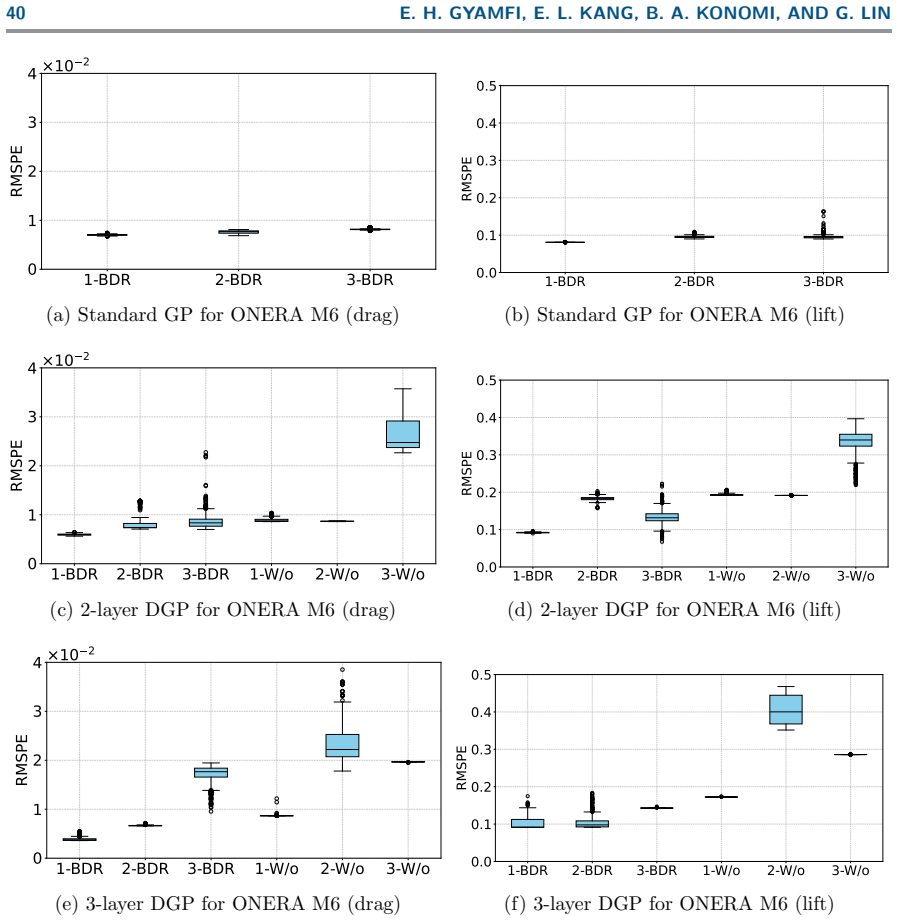
The paper introduces a hierarchical Bayesian model in which high-dimensional inputs are projected by an orthonormal matrix W on the Stiefel manifold, a Gaussian process (or deep GP) is placed on the projected inputs, and W, kernel hyperparameters, latent layers, and noise are sampled jointly via Hamiltonian Monte Carlo with geodesic flow, elliptical slice sampling, and Gibbs updates. The central claim is that this joint inference removes the two-stage separation that ignores projection uncertainty and distorts the input-output relationship. The paper reports numerical studies showing that the built-in dimension reduction (BDR) models match or approach oracle fits that use the true projection
What carries the argument
The central object is the orthonormal projection matrix W on the Stiefel manifold V_{p,D}, assigned a Matrix Langevin prior ML(F) and sampled by Hamiltonian Monte Carlo with geodesic flow. This matrix maps high-dimensional inputs x to low-dimensional coordinates z = W^T x, and its closed-form kernel gradient with respect to W makes joint inference tractable. The same projection is embedded in deep Gaussian processes by composing it with additional GP latent layers, allowing nonlinear warping after the linear reduction.
Load-bearing premise
The load-bearing premise is that the response depends on the inputs only through a D-dimensional linear subspace; if the true active structure is nonlinear, or if the sample is too small to identify the subspace, the learned projection cannot reduce the inputs without distorting the response.
What would settle it
Construct a response whose low-dimensional structure is nonlinear, e.g., y = g(w_1^T x, w_2^T x) where g is a nonlinear function of squared or product terms, using a known orthonormal W. Fit BDR with the true D and compare RMSPE and 95% coverage to a GP fit on the full inputs. If BDR does not improve prediction and does not concentrate the posterior of W on the true column space, the linear-subspace assumption is the culprit.
If this is right
- If joint learning works, two-stage dimension-reduction approaches are shown to be misspecified, and users should prefer a fully Bayesian joint inference.
- Projection uncertainty propagates through to predictions, so credible intervals stay near nominal coverage in small-data, high-dimensional regimes.
- DGP variants with BDR can capture nonstationary and strongly nonlinear responses that plain stationary GPs, with or without BDR, cannot.
- The higher computational cost is a real cost: per-iteration complexity is roughly O(T(n^3 + n^2 p D) + D n^3), limiting current applicability to moderate datasets.
Where Pith is reading between the lines
- Editorial inference: If the true active subspace is linear, the same machinery could be adapted to non-Gaussian observation models by swapping the output layer, making the approach applicable to classification or count data.
- Editorial inference: A practical diagnostic that the paper does not provide is monitoring posterior contraction of the projection matrix W W^T; weak contraction would signal that D is misspecified or that the linear-subspace assumption is strained.
- Editorial inference: The fixed-D treatment leaves the subspace dimension itself uncertain; a reversible-jump or model-averaging extension would be needed to make D an inferential quantity.
- Editorial inference: A direct test of the load-bearing linear assumption would be to apply BDR to data generated from a nonlinear active manifold and observe where predictive accuracy and coverage degrade relative to the linear case.
Editorial analysis
A structured set of objections, weighed in public.
Referee Report
Summary. The paper proposes a hierarchical Bayesian model for Gaussian process (GP) and deep Gaussian process (DGP) surrogates with built-in input dimension reduction. A matrix Langevin prior is placed on the projection matrix W on the Stiefel manifold, and posterior inference is performed via a hybrid Gibbs-MH-HMC-ESS sampler, with geodesic Hamiltonian Monte Carlo for W. The method is evaluated on three synthetic examples, a stochastic elliptic PDE, and the ONERA-M6 wing design problem, comparing against no-dimension-reduction and oracle versions. The central claim is that joint learning of the projection and the surrogate improves predictive accuracy and uncertainty calibration relative to two-stage or full-space methods.
Significance. If the methodology is correct and reproducible, the framework is a useful contribution: it unifies dimension reduction and GP regression in a single Bayesian formulation, and the extension to DGPs is natural. The experimental scope is broad and the comparison against oracle models is a good idea for assessing subspace recovery. However, the printed algorithm contains several mathematical inconsistencies in load-bearing components, most importantly the HMC gradient for W. Until these are corrected and the code is made available, the numerical results cannot be taken as evidence for the method exactly as described.
major comments (5)
- [§2.5.5 / Eq. (2.9) / Eq. (2.3)] The gradient formula (2.9) is dimensionally inconsistent. C_y is n×n, X_n−X'_n is n×p, and W is p×D; neither (C_y/θ)(X_n−X'_n)(X_n−X'_n)^T W nor the expression in Eq. (2.3) is a well-defined p×D matrix. Since Algorithm 2.1 uses ∇_W log π in the leapfrog updates, the core sampler cannot be executed from the text. In the same paragraph, the prior gradient is stated as VΛM^T, but from π(W)∝exp(tr(F^T W)) with F=MΛV^T, the derivative is F=MΛV^T, not VΛM^T. Please provide a corrected derivation, with explicit matrix dimensions, or point to the exact corrected equation in the supplement.
- [§2.5.2] The stated full conditional M|W,Λ,V ∼ ML(WΛV + F_M) does not follow from the stated prior. From π(W|M,Λ,V) ∝ exp(tr(VΛM^T W)) = exp(tr((W V Λ)^T M)), the concentration matrix for M should be W V Λ, not WΛV. As printed, the Gibbs update for M is inconsistent with the prior in Eq. (2.6).
- [§3, CRPS definition] The printed CRPS formula is the negative of the standard Gaussian CRPS. For z=(Y−μ)/σ, the standard expression is σ[z(2Φ(z)−1)+2φ(z)−1/√π]. The paper writes σ[1/√π−2φ(z)−z(2Φ(z)−1)], which is the same expression with the opposite sign. Since all reported CRPS values are positive, either the implementation uses a different formula or the printed definition is a typo. Please correct this and state the exact scoring rule used to produce the tables.
- [§3, reproducibility] The text says 'A full reproducibility repository is provided at GitHub' but no URL is given. Given that the gradient equations above appear to be mathematically inconsistent, the repository is the only way to determine whether the numerical experiments used corrected expressions and whether the reported results are produced by Algorithm 2.1 as written. Please provide the repository URL and a commit hash, and explicitly state whether the code implements the printed formulas or a corrected version.
- [§3.1.1 / Table 1] The text states that 'the tight agreement between the oracle and BDR-based fits indicates that the proposed method recovers the correct 1D manifold with high fidelity.' In Table 1, however, DGP 3-layer(1) BDR has RMSPE 0.2133 at n=280 and 0.1601 at n=480, while DGP 3-layer(1) Oracle has RMSPE 0.0592 and 0.0432, a gap of roughly 3×. If the claim is meant only for GP(1)-BDR and DGP 2-layer(1)-BDR, the text should be narrowed; otherwise the reported numbers do not support the blanket statement.
minor comments (4)
- [§2.2] Equation (2.3) is used for both the kernel gradient and the predictive distribution. Renumber the predictive distribution equation to avoid ambiguity.
- [§2.5.4 / §3] The remark that the slice-type sampling 'does not correspond to standard Gaussian-prior ESS' appears twice (Section 2.5.4 and Section 3). Consolidate to avoid repetition.
- [Tables] The table captions say 'Table entries report, for each metric, the median value across posterior samples,' but TC (minutes) is a runtime measure, not a posterior quantity. Clarify whether TC is the median runtime or the total runtime.
- [References] There are duplicated and malformed entries in the bibliography, e.g., [13] and [14] are identical, and several entries have overlapping or broken URLs. Please clean up the reference list.
Circularity Check
No significant circularity: the posterior and predictive distributions form a self-contained Bayesian derivation; the true W is used only as an oracle benchmark, and there is no self-citation chain carrying the central argument.
full rationale
The derivation chain is self-contained and no equation reduces to its own input. The model defines a proper hierarchical posterior (Eq. 2.7) from a likelihood, a matrix Langevin prior on W (Eq. 2.6), and priors on hyperparameters; the predictive distributions (Eqs. 2.10-2.15) are ordinary GP conditionings averaged over posterior draws of (W, hyperparameters). No fitted parameter is relabeled as a prediction, and the target response never enters the model definition beyond the likelihood. In the numerical studies the oracle models use the true W only as a held-out benchmark; the true W is not fed into the BDR fits, so 'close agreement with oracle' is an honest comparison whose failure would be visible. Cited prior work ([51], [54], [22], [27]) is by disjoint author sets, so the 'first Bayesian joint framework' claim is a novelty assertion rather than a self-citation-loaded deduction; the 'Following [51]' design restrictions are adopted assumptions from independent work, not claimed derived predictions. Items worth flagging as limitations but outside the circularity definition: D is selected by comparing held-out test metrics across D=1,2,3 (model selection, not a fitted-input-called-prediction); the paper itself states D is treated as fixed so 'full uncertainty propagation' excludes D; and Eq. (2.9)/Algorithm 2.1 contain a dimensionally inconsistent gradient while the promised GitHub URL is absent, which are correctness/reproducibility risks rather than circular reductions. No exhibited Eq.-to-Eq. reduction or fitted-parameter-as-prediction exists.
Axiom & Free-Parameter Ledger
free parameters (4)
- Reduced dimension D =
D ∈ {1,2,3}
- Matrix Langevin concentration prior hyperparameters b1, b2 =
b1=5/2, b2=10/3
- Lengthscale and nugget prior scales b[θr], b[θq], b[θy], b[g] =
3.9/6, 3.9/3, 3.9, 3.9
- HMC integration parameters ε and T =
ε=0.09, T=15
axioms (5)
- domain assumption The response satisfies y ⊥ x | W^T x for some D-dimensional orthonormal projection W (linear sufficient dimension reduction).
- domain assumption A GP with squared-exponential kernel and scalar lengthscale adequately models η on the reduced space (with DGP layers handling nonstationarity).
- standard math The matrix Langevin Gibbs sampler of Hoff (2009) produces correct posterior draws for M and V.
- ad hoc to paper Geodesic HMC on the Stiefel manifold with the printed gradient is a valid sampler for W.
- ad hoc to paper The prior rate ordering bθy > bθq > bθr is a valid structural assumption for the smoothness hierarchy.
read the original abstract
Gaussian process (GP) modeling is widely used in computational science and engineering. However, fitting a GP to high-dimensional inputs remains challenging due to the curse of dimensionality. While various methods have been proposed to reduce input dimensionality, they typically follow a two-stage approach, performing dimension reduction and GP fitting separately. We introduce a Bayesian framework that seamlessly integrates dimensionality reduction with GP modeling and inference. Our approach, built on a hierarchical Bayesian model with priors on the Stiefel manifold, enforces orthonormality on the projection matrix and enables posterior inference via Hamiltonian Monte Carlo with geodesic flow. Additionally, we extend this framework by incorporating Deep Gaussian Processes (DGP) with built-in dimension reduction, providing a more flexible and powerful tool for complex datasets. Through extensive numerical studies, we demonstrate that while the proposed Bayesian method incurs higher computational costs, it improves predictive performance and uncertainty quantification, providing a principled and robust alternative to existing methods.
Figures



Reference graph
Works this paper leans on
-
[1]
Chinese Journal of Aeronautics , year=
Application of a PCA-DBN-based surrogate model to robust aerodynamic design optimization , author=. Chinese Journal of Aeronautics , year=
-
[2]
2016 IEEE Symposium Series on Computational Intelligence (SSCI) , year=
The use of Kernel PCA in evolutionary optimization for computationally demanding engineering applications , author=. 2016 IEEE Symposium Series on Computational Intelligence (SSCI) , year=
2016
-
[3]
Computers & Structures , year=
Kernel principal component analysis-based Gaussian process regression modelling for high-dimensional reliability analysis , author=. Computers & Structures , year=
-
[4]
Mathematical Problems in Engineering , year=
An Improved Approach for Estimating the Hyperparameters of the Kriging Model for High-Dimensional Problems through the Partial Least Squares Method , author=. Mathematical Problems in Engineering , year=
-
[6]
and Dow, Eric and Wang, Qiqi , title =
Constantine, Paul G. and Dow, Eric and Wang, Qiqi , title =. SIAM Journal on Scientific Computing , volume =. 2014 , doi =. https://doi.org/10.1137/130916138 , abstract =
-
[7]
AIAA AVIATION 2022 Forum , year=
A Multi-Fidelity Approximation of the Active Subspace Method for Surrogate Models with High-Dimensional Inputs , author=. AIAA AVIATION 2022 Forum , year=
2022
-
[8]
, title =
Constantine, Paul G. , title =. 2015 , isbn =
2015
-
[9]
2011 , eprint=
Gradient-based kernel dimension reduction for supervised learning , author=. 2011 , eprint=
2011
-
[10]
Liu, Xiaoyu and Guillas, Serge , Doi =. Dimension Reduction for Gaussian Process Emulation: An Application to the Influence of Bathymetry on Tsunami Heights , Url =. 2017 , Bdsk-Url-1 =. https://doi.org/10.1137/16M1090648 , Journal =
-
[11]
International Journal for Uncertainty Quantification , DOI=
A Fully Bayesian Gradient-Free Supervised Dimension Reduction Method using Gaussian Processes , author=. International Journal for Uncertainty Quantification , DOI=. 2022 , volumn=. 2008.03534 , archivePrefix=
Pith/arXiv arXiv 2022
-
[12]
Rohit Tripathy and Ilias Bilionis and Marcial Gonzalez , keywords =. Gaussian processes with built-in dimensionality reduction: Applications to high-dimensional uncertainty propagation , journal =. 2016 , issn =. doi:https://doi.org/10.1016/j.jcp.2016.05.039 , url =
-
[13]
Gramacy and David Higdon , title =
Annie Sauer and Robert B. Gramacy and David Higdon , title =. Technometrics , volume =. 2023 , publisher =
2023
-
[14]
Peter D. Hoff , title =. Journal of Computational and Graphical Statistics , volume =. 2009 , publisher =. doi:10.1198/jcgs.2009.07177 , URL =
Pith/arXiv arXiv 2009
-
[15]
Tsilifis, P. and Ghanem, R. G. , title =. Proceedings of the Royal Society A: Mathematical, Physical and Engineering Sciences , volume =. 2018 , doi =. https://royalsocietypublishing.org/doi/pdf/10.1098/rspa.2018.0285 , abstract =
arXiv 2018
-
[16]
Bayesian learning of orthogonal embeddings for multi-fidelity Gaussian Processes , journal =
Panagiotis Tsilifis and Piyush Pandita and Sayan Ghosh and Valeria Andreoli and Thomas Vandeputte and Liping Wang , keywords =. Bayesian learning of orthogonal embeddings for multi-fidelity Gaussian Processes , journal =. 2021 , issn =. doi:https://doi.org/10.1016/j.cma.2021.114147 , url =
arXiv 2021
-
[17]
Concentrated matrix Langevin distributions , journal =
Yasuko Chikuse , keywords =. Concentrated matrix Langevin distributions , journal =. 2003 , issn =. doi:https://doi.org/10.1016/S0047-259X(02)00065-9 , url =
-
[18]
, booktitle =
Damianou, Andreas and Lawrence, Neil D. , booktitle =. Deep. 2013 , editor =
2013
-
[19]
Inference in Deep Gaussian Processes using Stochastic Gradient Hamiltonian Monte Carlo , url =
Havasi, Marton and Hern\'. Inference in Deep Gaussian Processes using Stochastic Gradient Hamiltonian Monte Carlo , url =. Advances in Neural Information Processing Systems , editor =
-
[20]
Proceedings of The 33rd International Conference on Machine Learning , pages =
Deep Gaussian Processes for Regression using Approximate Expectation Propagation , author =. Proceedings of The 33rd International Conference on Machine Learning , pages =. 2016 , editor =
2016
-
[21]
and Girolami, Mark A
Dunlop, Matthew M. and Girolami, Mark A. and Stuart, Andrew M. and Teckentrup, Aretha L. , title =. J. Mach. Learn. Res. , month = jan, pages =. 2018 , issue_date =
2018
-
[22]
SIAM/ASA Journal on Uncertainty Quantification , volume =
Fadikar, Arindam and Higdon, Dave and Chen, Jiangzhuo and Lewis, Bryan and Venkatramanan, Srinivasan and Marathe, Madhav , title =. SIAM/ASA Journal on Uncertainty Quantification , volume =. 2018 , doi =. https://doi.org/10.1137/17M1161233 , abstract =
-
[23]
and Winskill, Peter and Ghani, Azra and Bhatt, Samir and Flaxman, Seth , title =
Charles, Giovanni and Wolock, Timothy M. and Winskill, Peter and Ghani, Azra and Bhatt, Samir and Flaxman, Seth , title =. Proceedings of the Thirty-Seventh AAAI Conference on Artificial Intelligence and Thirty-Fifth Conference on Innovative Applications of Artificial Intelligence and Thirteenth Symposium on Educational Advances in Artificial Intelligence...
-
[24]
PLoS Computational Biology , year=
Bayesian History Matching of Complex Infectious Disease Models Using Emulation: A Tutorial and a Case Study on HIV in Uganda , author=. PLoS Computational Biology , year=
-
[25]
Technometrics , year=
Building Accurate Emulators for Stochastic Simulations via Quantile Kriging , author=. Technometrics , year=
-
[26]
Journal of the American Statistical Association , year=
Statistical Agent-Based Models for Discrete Spatio-Temporal Systems , author=. Journal of the American Statistical Association , year=
-
[27]
SIAM/ASA J
Efficient History Matching of a High Dimensional Individual-Based HIV Transmission Model , author=. SIAM/ASA J. Uncertain. Quantification , year=
-
[28]
Journal of Advances in Modeling Earth Systems , volume =
Lu, Dan and Ricciuto, Daniel and Stoyanov, Miroslav and Gu, Lianhong , title =. Journal of Advances in Modeling Earth Systems , volume =. doi:https://doi.org/10.1002/2017MS001134 , url =. https://agupubs.onlinelibrary.wiley.com/doi/pdf/10.1002/2017MS001134 , abstract =
-
[29]
Shuang Li and Changqing Li and Yuwen Huang and Changhai Zhai , keywords =. Real-time seismic damage simulation for urban building portfolio based on basic building information and machine learning , journal =. 2024 , issn =. doi:https://doi.org/10.1016/j.ijdrr.2024.104687 , url =
arXiv 2024
-
[30]
and Rahimian, M
Ahmed, Abdulrahman A. and Rahimian, M. Amin and Roberts, Mark S. , title =. Proceedings of the Winter Simulation Conference , pages =. 2024 , isbn =
2024
-
[31]
Journal of the Royal Statistical Society: Series B (Statistical Methodology) , year=
Bayesian calibration of computer models , author=. Journal of the Royal Statistical Society: Series B (Statistical Methodology) , year=
-
[32]
Geoscientific Model Development , year=
Correcting a bias in a climate model with an augmented emulator , author=. Geoscientific Model Development , year=
-
[33]
Donnelly, James and Daneshkhah, Alireza and Abolfathi, Soroush , title =. 2024 , issue_date =. doi:10.1016/j.engappai.2023.107536 , journal =
arXiv 2024
-
[34]
2022 , MONTH = Jan, DOI =
Marmin, S. 2022 , MONTH = Jan, DOI =
2022
-
[35]
Muhit and Annalisa Occhipinti and Nashwan Dawood , keywords =
Delbaz Samadian and Imrose B. Muhit and Annalisa Occhipinti and Nashwan Dawood , keywords =. Surrogate models for seismic and pushover response prediction of steel special moment resisting frames , journal =. 2024 , issn =. doi:https://doi.org/10.1016/j.engstruct.2024.118307 , url =
arXiv 2024
-
[36]
Fei, Yifan and Liao, Wenjie and Zhao, Pengju and Lu, Xinzheng and Guan, Hong , year=. Hybrid surrogate model combining physics and data for seismic drift estimation of shear‐wall structures , volume=. Earthquake Engineering. doi:10.1002/eqe.4151 , number=
-
[37]
Gramacy, R. B. , Isbn =. Surrogates: Gaussian Process Modeling, Design, and Optimization for the Applied Sciences , Url =. 2020 , Bdsk-Url-1 =
2020
-
[38]
Piyush M. Mehta and Andrew Walker and Earl Lawrence and Richard Linares and David Higdon and Josef Koller , keywords =. Modeling satellite drag coefficients with response surfaces , journal =. 2014 , issn =. doi:https://doi.org/10.1016/j.asr.2014.06.033 , url =
-
[39]
Springer Series in Statistics , year=
The Design and Analysis of Computer Experiments , author=. Springer Series in Statistics , year=
-
[40]
Adaptive computation and machine learning , year=
Gaussian Processes for Machine Learning , author=. Adaptive computation and machine learning , year=
-
[41]
Radaideh and Tomasz Kozlowski , keywords =
Majdi I. Radaideh and Tomasz Kozlowski , keywords =. Surrogate modeling of advanced computer simulations using deep Gaussian processes , journal =. 2020 , issn =. doi:https://doi.org/10.1016/j.ress.2019.106731 , url =
arXiv 2020
-
[42]
Proceedings of the 31st International Conference on Neural Information Processing Systems , pages =
Salimbeni, Hugh and Deisenroth, Marc Peter , title =. Proceedings of the 31st International Conference on Neural Information Processing Systems , pages =. 2017 , isbn =
2017
-
[43]
Proceedings of the Thirteenth International Conference on Artificial Intelligence and Statistics , pages =
Elliptical slice sampling , author =. Proceedings of the Thirteenth International Conference on Artificial Intelligence and Statistics , pages =. 2010 , editor =
2010
-
[44]
, title =
Smith, Ralph C. , title =. 2024 , doi =
2024
-
[45]
and Casella, George , title =
Robert, Christian P. and Casella, George , title =. 2005 , isbn =
2005
-
[46]
Dynamic Programming and Lagrange Multipliers , urldate =
Richard Bellman , journal =. Dynamic Programming and Lagrange Multipliers , urldate =
-
[47]
The Curse of Highly Variable Functions for Local Kernel Machines , url =
Bengio, Yoshua and Delalleau, Olivier and Roux, Nicolas , booktitle =. The Curse of Highly Variable Functions for Local Kernel Machines , url =
-
[48]
2008 , publisher=
Global Sensitivity Analysis: The Primer , author=. 2008 , publisher=
2008
-
[49]
2012 , publisher=
Bayesian Learning for Neural Networks , author=. 2012 , publisher=
2012
-
[50]
2003 , publisher=
Stochastic Finite Elements: A Spectral Approach , author=. 2003 , publisher=
2003
-
[51]
Annie Sauer and Andrew Cooper and Robert B. Gramacy , title =. Journal of Computational and Graphical Statistics , volume =. 2023 , publisher =. doi:10.1080/10618600.2022.2129662 , URL =
arXiv 2023
-
[53]
Lukaczyk and Paul Constantine and Francisco Palacios and Juan J
Trent W. Lukaczyk and Paul Constantine and Francisco Palacios and Juan J. Alonso , title =. 10th AIAA Multidisciplinary Design Optimization Conference , year =. doi:10.2514/6.2014-1171 , note =
-
[54]
Kenway, Gaetan K. W. and Martins, Joaquim R. R. A. , title =. Journal of Aircraft , volume =. 2014 , doi =. https://doi.org/10.2514/1.C032150 , abstract =
-
[55]
Scandinavian Journal of Statistics , volume =
Byrne, Simon and Girolami, Mark , title =. Scandinavian Journal of Statistics , volume =. doi:https://doi.org/10.1111/sjos.12036 , url =. https://onlinelibrary.wiley.com/doi/pdf/10.1111/sjos.12036 , abstract =
-
[56]
and Kent, Carson and Bui-Thanh, Tan , title =
Constantine, Paul G. and Kent, Carson and Bui-Thanh, Tan , title =. SIAM Journal on Scientific Computing , volume =. 2016 , doi =
2016
-
[57]
Welch and Toby J
Jerome Sacks and William J. Welch and Toby J. Mitchell and Henry P. Wynn , title =. Statistical Science , number =. 1989 , doi =
1989
-
[58]
Electronic Journal of Statistics , number =
Wenjia Wang , title =. Electronic Journal of Statistics , number =. 2021 , doi =
2021
-
[59]
Binois, Micka\". A Survey on High-dimensional Gaussian Process Modeling with Application to Bayesian Optimization , year =. ACM Trans. Evol. Learn. Optim. , month = aug, articleno =. doi:10.1145/3545611 , abstract =
-
[60]
Gecheng Chen and Rui Tuo , title =. IISE Transactions , volume =. 2023 , publisher =. doi:10.1080/24725854.2022.2121882 , URL =
arXiv 2023
-
[61]
Gramacy, Robert B. and Lee, Herbert K. , title =. Statistics and Computing , month = may, pages =. 2012 , issue_date =. doi:10.1007/s11222-010-9224-x , abstract =
-
[62]
Rubin , title =
Andrew Gelman and Donald B. Rubin , title =. Statistical Science , number =. 1992 , doi =
1992
-
[63]
Welch , journal =
Philip Heidelberger and Peter D. Welch , journal =. Simulation Run Length Control in the Presence of an Initial Transient , urldate =
-
[64]
CODA: convergence diagnosis and output analysis for MCMC , journal =
Plummer, Martyn and Best, Nicky and Cowles, Kate and Vines, Karen , url =. CODA: convergence diagnosis and output analysis for MCMC , journal =. 2006 , number =
2006
-
[65]
Geyer , journal =
Charles J. Geyer , journal =. Practical Markov Chain Monte Carlo , urldate =
discussion (0)
Sign in with ORCID, Apple, or X to comment. Anyone can read and Pith papers without signing in.