REVIEW 4 major objections 4 minor 22 references
A background-suppressing compression scheme keeps vision-language scores flat while marking half of surveillance frames skippable.
Reviewed by Pith at T0; open to challenge. T0 means a machine referee read the full paper against a public rubric. the ladder, T0–T4 →
T0 review · deepseek-v4-flash
2026-08-01 12:30 UTC pith:ZWCRBDF2
load-bearing objection A clean paired evaluation of a background-suppressed H.265 variant that preserves VLM caption quality, but the 53% inference-cost claim is an untested estimate and the codec is never specified. the 4 major comments →
BLUE: Semantics-Preserving Video Compression for Efficient Vision-Language Surveillance Analytics
The pith
A machine-rendered reading of the paper's core claim, the machinery that carries it, and where it could break.
Core claim
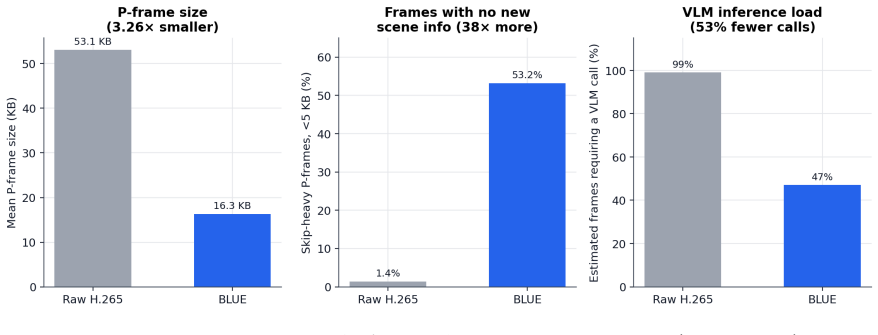
On its own terms, the paper establishes that BLUE preserves VLM semantic inference quality while reducing file size and creating a packet-size signal for inference skipping. The paired comparison shows no systematic leftward shift in judge scores: VIRAT deltas center near zero with 116 ties out of 227, CHAD has 30 ties out of 54, and the Pearson correlation between compression saving and score delta on VIRAT is 0.004. The P-frame analysis on CHAD is the second half of the claim: BLUE turns static-background frames into nearly zero-bit P-frames, so a pipeline that skips P-frames under 5 KB would call the VLM on only 47% of frames instead of 99%.
What carries the argument
The central mechanism is a persistent background model plus background seeding before conventional H.265 encoding. BLUE identifies unchanged static regions and substitutes seeded background pixels, so the codec represents those regions as skips or near-zero-motion blocks. This produces two effects at once: smaller files and a bitstream-level indicator — very small P-frames — that downstream VLM pipelines can read without decoding. The paper operationalizes the indicator with a 5 KB threshold.
Load-bearing premise
The inference-cost claim rests on the assumption that a P-frame smaller than 5 KB carries no semantically important scene change, so it can be skipped; the paper estimates the call reduction from packet sizes but never runs a pipeline that actually skips those frames and measures VLM outputs afterward.
What would settle it
Run the skip loop on CHAD: decode BLUE video, skip every P-frame below 5 KB, caption the kept frames, and compare VLM scores or anomaly detection against the full-frame pipeline. If a skipped small P-frame contains a visible anomaly that the full pipeline detects, the equivalence between packet size and semantic informativeness fails. A simpler check: find any frame under 5 KB in the BLUE bitstream where a human or VLM can identify an event that neighboring kept frames do not show.
If this is right
- Surveillance operators can transmit and store substantially less data without changing the semantic content a VLM can extract.
- VLM inference cost on fixed-camera footage can be cut by roughly half by reading P-frame sizes and skipping low-information frames.
- Compression level is not a reliable predictor of semantic loss, so aggressive static-background suppression can coexist with open-ended VLM querying.
- The framework suggests a general recipe for fixed-camera VLM analytics: suppress static background at encode time and sample by packet size at inference time.
Where Pith is reading between the lines
- A direct validation would run the actual skip-and-evaluate loop: skip every CHAD P-frame under 5 KB, caption the remaining frames, and compare anomaly-detection outcomes against the full pipeline; until then the 53% reduction is an estimate, not a measured saving.
- The background-seeding trick could transfer to other codecs such as AV1 or VVC and to edge cameras that already perform background subtraction, since the P-frame-size signal is not tied to H.265 specifically.
- Category-level CHAD differences (fight, bicycle, and normal clips scoring lower; lying, playing, robbery, and throwing scoring higher) hint that BLUE may favor sparse foreground anomalies, which a larger balanced dataset could confirm.
- P-frame size could be combined with motion history to build an adaptive sampling policy that concentrates VLM calls around activity bursts rather than a fixed threshold.
Editorial analysis
A structured set of objections, weighed in public.
Referee Report
Summary. The paper evaluates BLUE, a background-substitution pre-encoding transform for H.265, in a visual-language-model (VLM) surveillance pipeline. Using paired same-frame-index samples from VIRAT (227 events, 106 clips) and CHAD (54 clips), the authors compare raw H.265 against BLUE-compressed H.265 with a Qwen3.6 captioning model and a blind judge model. They report no measurable degradation in mean VLM scores (VIRAT difference -0.01, CHAD -0.06 on a 0-10 scale), balanced win/loss counts, near-zero correlation between compression saving and score change (r=0.004), and a large increase in skip-heavy (<5 KB) P-frames on CHAD (1.4% to 53.2%), leading to an estimated 53% reduction in VLM calls. The paper concludes that BLUE acts as a machine-centric compression layer, reducing bandwidth and inference cost while preserving semantic performance.
Significance. The empirical evaluation is well designed for a relative comparison: the same frame index is used for both variants, the judging protocol is blind, and the win/loss symmetry on VIRAT (55 vs 56) is a genuinely informative result. If the claims hold, BLUE would be a practical contribution to video coding for machines, especially for VLM-based surveillance. The paper also introduces a plausible bitstream-level mechanism for frame skipping via P-frame packet sizes. However, two of the headline claims—'no measurable degradation' and '53% VLM-call reduction'—are currently presented without the statistical support or direct validation they require. The work is significant as a pilot study, but the central conclusions would need reinforcement before publication in a serious venue.
major comments (4)
- [§3.5, Table 6] The estimated 53% reduction in VLM calls is based solely on the share of P-frames below a fixed 5 KB threshold. The paper never actually runs a pipeline that skips these frames and measures whether the VLM still detects the relevant events or anomalies. The equivalence between a small P-frame and 'little new scene information' is asserted, not tested. In fixed-camera surveillance, a subtle but semantically important event (a person collapsing, a vehicle creeping) can yield a small P-frame. The threshold itself is arbitrary, and no sensitivity analysis is provided. This is a load-bearing issue because the inference-cost advantage is a central part of the abstract and conclusion. Please add a direct experiment: skip frames below several thresholds, run the VLM on the remaining frames, and compare anomaly/event detection quality. At minimum, report the semantic content of the skipped frames
- [§3.1, Table 3] The claim of 'no measurable degradation' is an equivalence claim, but the paper does not provide confidence intervals or an equivalence test. The mean differences (-0.01 on VIRAT, -0.06 on CHAD) might be within a reasonable tolerance, but without a pre-specified margin and uncertainty bounds, the claim is not statistically established. The win/loss symmetry is suggestive, but it is not a substitute for a formal analysis. Please report bootstrap confidence intervals for the mean delta, and consider a two-one-sided test (TOST) with an explicit equivalence margin (e.g., 0.5 points on the 0-10 scale). Also justify the margin before seeing the data.
- [§2, Methodology] The paper proposes BLUE but provides almost no algorithmic description. The only information is that BLUE 'maintains a persistent background representation and substitutes unchanged static background regions with seeded background pixels before conventional H.265 encoding.' No parameters, implementation details, or reference to a prior BLUE paper are given. For a manuscript whose title names BLUE, this is insufficient for reproducibility and for interpreting the results. Please either describe the method in enough detail to be reimplemented, or cite and summarize a separate technical report.
- [§3.3, Fig. 4] The near-zero correlation (r=0.004) is interpreted as evidence that higher compression does not predict semantic degradation. However, a null correlation is not evidence of the absence of a relationship. Please report a confidence interval for r or a Bayesian credible interval. In addition, VIRAT event samples are clustered within clips (227 events from 106 clips), so the effective sample size for the correlation is smaller than 227; consider a clustered analysis or at least discuss this source of non-independence.
minor comments (4)
- [§2.4] The 5 KB skip-heavy threshold is defined without justification. A sensitivity table showing skip-heavy share and predicted call reduction for thresholds from 1 KB to 10 KB would strengthen the analysis.
- [§3.5] The paper uses the term 'P-frame' for H.265, but H.265 packetization is more complex (NAL units, slices). Please clarify how ffprobe packet sizes are mapped to frames, and whether B-frames or other types are accounted for.
- [Fig. 2] The 'mean extracted JPEG size per frame' is used as a proxy for visual complexity, but this measurement is not described in the methods. Either explain its purpose and computation, or remove it to avoid confusion.
- [Table 4] Table 4 reports deltas on a 0-1 scale while the text and figures use a 0-10 scale. This inconsistency makes the table hard to read; reconcile the scales or explicitly annotate the table.
Circularity Check
Semantic-preservation claim is independently measured, but the 53% VLM-call reduction is a definitional restatement of the chosen 5 KB skip threshold.
specific steps
-
self definitional
[Section 2.4 (Metrics and P-Frame Analysis) and Section 3.5/Table 6]
"A P-frame below 5 KB is treated as skip-heavy, indicating little new scene information. The estimated VLM call rate is computed as the fraction of frames above this threshold."
The ~53% reduction in VLM calls is not measured by an experiment that skips these frames and re-evaluates the VLM; it is the arithmetic complement of the observed fraction of P-frames below the 5 KB threshold. Since 'skip-heavy' is defined as <5 KB and 'frames requiring a VLM call' is computed from the same threshold, the claimed saving restates the input definition. The semantic equivalence (small packet size = little new scene information) is assumed, not tested, so the inference-cost prediction reduces to the threshold choice by construction.
full rationale
The paper's central semantic-preservation result is an external paired measurement: identical frame indices for raw H.265 and BLUE, a fixed VLM captioning model, and a blind judge scoring against annotation-derived ground truth. No self-citation chain is load-bearing, and no fitted parameter is renamed as a prediction; the VIRAT r=0.004 correlation and the near-zero mean score deltas are empirical. The only step that approaches circularity is the inference-cost estimate in Section 3.5/Table 6: the 53% call reduction is a direct consequence of defining skip-heavy P-frames as <5 KB and computing the fraction of frames above that threshold. This is a conditional estimate rather than a validated outcome, since no pipeline actually skips frames and measures VLM outputs afterward. It is a definitional/assumption issue in the efficiency claim, not in the semantics claim, so the overall circularity score is modest.
Axiom & Free-Parameter Ledger
free parameters (1)
- P-frame skip-heavy threshold =
5 KB
axioms (3)
- domain assumption The Qwen judge model reliably scores caption-ground-truth similarity on a 0-10 scale with enough sensitivity to detect compression-induced semantic degradation.
- domain assumption A single frame selected from the annotated event/anomaly window is representative of the semantic content of the event/anomaly for the purpose of measuring BLUE's effect.
- domain assumption Encoding both variants with libx265 at CRF 28 with the same settings isolates the effect of BLUE.
Cite this review
Pith. "Pith review of BLUE: Semantics-Preserving Video Compression for Efficient Vision-Language Surveillance Analytics." pith.science (2026). https://pith.science/paper/ZWCRBDF2
@misc{pith2026260719515,
  author       = {Pith},
  title        = {Pith review of: BLUE: Semantics-Preserving Video Compression for Efficient Vision-Language Surveillance Analytics},
  year         = {2026},
  howpublished = {\url{https://pith.science/paper/ZWCRBDF2}},
  note         = {Machine review of arXiv:2607.19515}
}
read the original abstract
Continuous surveillance video creates a growing storage, transmission, and inference burden for enterprise video analytics systems. While modern codecs such as H.265 reduce bitrate for human-viewable video, aggressive compression can degrade downstream computer-vision performance and does not necessarily reduce the number of vision-language model (VLM) inference calls required for semantic video understanding. This paper evaluates BLUE, a fixed-camera surveillance compression approach that suppresses static-background redundancy while preserving foreground activity, for its effect on VLM-based event and anomaly understanding. We compare raw H.265 and BLUE-compressed H.265 video on two surveillance datasets: VIRAT, comprising 227 paired event samples from 106 clips, and CHAD, comprising 54 human-activity anomaly clips. For each pair, the same frame index is evaluated using a VLM captioning pipeline, and outputs are scored against annotation-derived ground truth using a blind judging protocol. The results show no measurable degradation in semantic inference quality. On VIRAT, the mean VLM score remains effectively unchanged between raw H.265 and BLUE, with a mean difference of approximately -0.01 on a 0-10 scale. On CHAD, raw H.265 and BLUE obtain near-equivalent mean scores of 4.31 and 4.26, respectively. Compression saving is also uncorrelated with VLM score change on VIRAT (r = 0.004), indicating that higher BLUE compression does not predict semantic quality loss. Beyond storage reduction, BLUE increases the share of skip-heavy P-frames on CHAD from 1.4% to 53.2%, enabling an estimated 53% reduction in VLM calls through packet-size-based frame skipping. These findings suggest that BLUE functions as a machine-centric compression layer for surveillance video, reducing bandwidth and inference cost while preserving VLM semantic performance.
Figures




Reference graph
Works this paper leans on
-
[1]
Overview of the High Efficiency Video Coding (HEVC) standard,
G. J. Sullivan, J.-R. Ohm, W.-J. Han, and T. Wiegand, “Overview of the High Efficiency Video Coding (HEVC) standard,”IEEE Transactions on Circuits and Systems for Video Technology, vol. 22, no. 12, pp. 1649–1668, Dec. 2012
2012
-
[2]
Overview of the Versatile Video Coding (VVC) standard and its applications,
B. Bross, Y.-K. Wang, Y. Ye, S. Liu, J. Chen, G. J. Sullivan, and J.-R. Ohm, “Overview of the Versatile Video Coding (VVC) standard and its applications,”IEEE Transactions on Circuits and Systems for Video Technology, vol. 31, no. 10, pp. 3736–3764, Oct. 2021
2021
-
[3]
A technical overview of AV1,
J. Han et al., “A technical overview of AV1,”Proceedings of the IEEE, vol. 109, no. 9, pp. 1435–1462, Sept. 2021
2021
-
[4]
Image and video compression with neural networks: A review,
S. Ma, X. Zhang, C. Jia, Z. Zhao, S. Wang, and S. Wang, “Image and video compression with neural networks: A review,”IEEE Transactions on Circuits and Systems for Video Technology, vol. 30, no. 6, pp. 1683–1698, Jun. 2020
2020
-
[5]
Advances in video compression system using deep neural network: A review and case studies,
D. Ding, Z. Ma, D. Chen, Q. Chen, Z. Liu, and F. Zhu, “Advances in video compression system using deep neural network: A review and case studies,”Proceedings of the IEEE, vol. 109, no. 9, pp. 1494–1520, Sept. 2021
2021
-
[6]
Video coding for machines: A paradigm of collaborative compression and intelligent analytics,
L.-Y. Duan, J. Liu, W. Yang, T. Huang, and W. Gao, “Video coding for machines: A paradigm of collaborative compression and intelligent analytics,”IEEE Transactions on Image Processing, vol. 29, pp. 8680–8695, 2020. 15
2020
-
[7]
Recent standard development activities on video coding for machines,
W. Gao, S. Liu, X. Xu, M. Rafie, Y. Zhang, and I. Curcio, “Recent standard development activities on video coding for machines,”arXiv preprint arXiv:2105.12653, 2021
Pith/arXiv arXiv 2021
-
[8]
Understanding how video quality affects object detection algorithms,
M. Aqqa, P. Mantini, and S. K. Shah, “Understanding how video quality affects object detection algorithms,” inProc. International Conference on Computer Vision Theory and Applications (VISAPP), 2019, pp. 96–104
2019
-
[9]
Impact of video compression on the performance of object detection algo- rithms in automotive applications,
K. Kajak, “Impact of video compression on the performance of object detection algo- rithms in automotive applications,” M.S. thesis, KTH Royal Institute of Technology, Stockholm, Sweden, 2020
2020
-
[10]
M. O’Byrne, Vibhoothi, M. Sugrue, and A. Kokaram, “Impact of video compression on the performance of object detection systems for surveillance applications,”arXiv preprint arXiv:2211.05805, 2022
Pith/arXiv arXiv 2022
-
[11]
Does video compression impact tracking accu- racy?
T. Tanaka, A. Harell, and I. V. Bajic, “Does video compression impact tracking accu- racy?” inProc. IEEE International Symposium on Circuits and Systems (ISCAS), 2022
2022
-
[12]
K. Shao et al., “When tokens talk too much: A survey of multimodal long-context token compression across images, videos, and audios,”arXiv preprint arXiv:2507.20198, 2025
arXiv 2025
-
[13]
Small vision-language models are smart compressors for long video under- standing,
J. Fei et al., “Small vision-language models are smart compressors for long video under- standing,”arXiv preprint arXiv:2604.08120, 2026
Pith/arXiv arXiv 2026
-
[14]
A large-scale benchmark dataset for event recognition in surveillance video,
S. Oh et al., “A large-scale benchmark dataset for event recognition in surveillance video,” inProc. IEEE Conference on Computer Vision and Pattern Recognition (CVPR), 2011, pp. 3153–3160
2011
-
[15]
CHAD: Charlotte Anomaly Dataset,
A. Danesh Pazho, G. Alinezhad Noghre, B. Rahimi Ardabili, C. Neff, and H. Tabkhi, “CHAD: Charlotte Anomaly Dataset,” inProc. Scandinavian Conference on Image Anal- ysis (SCIA), 2023, pp. 50–66
2023
-
[16]
Efficient memory management for large language model serving with PagedAttention,
W. Kwon et al., “Efficient memory management for large language model serving with PagedAttention,” inProc. ACM Symposium on Operating Systems Principles (SOSP), 2023, pp. 611–626
2023
-
[17]
ffprobe documentation,
FFmpeg Developers, “ffprobe documentation,” FFmpeg multimedia framework docu- mentation. [Online]. Available:https://ffmpeg.org/ffprobe.html. Accessed: Jul. 18, 2026
2026
-
[18]
How do vision transformers work?
N. Park and S. Kim, “How do vision transformers work?” inProc. International Confer- ence on Learning Representations (ICLR), 2022
2022
-
[19]
Intriguing properties of vision transformers,
M. Naseer, K. Ranasinghe, S. Khan, M. Hayat, F. S. Khan, and M.-H. Yang, “Intriguing properties of vision transformers,” inProc. Advances in Neural Information Processing Systems (NeurIPS), 2021
2021
-
[20]
Understanding how image quality affects deep neural networks,
S. Dodge and L. Karam, “Understanding how image quality affects deep neural networks,” inProc. Eighth International Conference on Quality of Multimedia Experience (QoMEX), 2016. 16
2016
-
[21]
On the impact of lossy image and video compression on the performance of deep convolutional neural network archi- tectures,
M. Poyser, A. Atapour-Abarghouei, and T. P. Breckon, “On the impact of lossy image and video compression on the performance of deep convolutional neural network archi- tectures,” inProc. International Conference on Pattern Recognition (ICPR), 2020, pp. 2830–2837
2020
-
[22]
Qwen2-VL: Enhancing vision-language model’s perception of the world at any resolution,
P. Wang et al., “Qwen2-VL: Enhancing vision-language model’s perception of the world at any resolution,”arXiv preprint arXiv:2409.12191, 2024. 17
Pith/arXiv arXiv 2024
discussion (0)
Sign in with ORCID, Apple, or X to comment. Anyone can read and Pith papers without signing in.