REVIEW 1 major objections 5 minor 24 references
A matrix-free algorithm reconstructs low-rank quantum states without forming dense density, POVM, or gradient matrices.
Reviewed by Pith at T0; open to challenge. T0 means a machine referee read the full paper against a public rubric. the ladder, T0–T4 →
T0 review · deepseek-v4-flash
2026-08-01 12:20 UTC pith:HTQRWVAA
load-bearing objection Solid algorithmic paper with a real matrix-free rank-adaptive QST method, but the abstract's 'prediction consistency' is not in the theorems. the 1 major comments →
Rank-Adaptive Matrix-Free Atomic Quantum State Tomography
The pith
A machine-rendered reading of the paper's core claim, the machinery that carries it, and where it could break.
Core claim
The central claim is that combining rank-one atomic coordinates with descriptor-level measurement actions reduces the memory and runtime of low-rank QST to O(DR_t+M) without sacrificing recovery accuracy. The estimate is maintained as ρ=Ψ diag(α)Ψ^*, with unit-norm atoms and α in the simplex, so positivity and unit trace hold by construction. Every measurement-dependent quantity—atom responses a(ψ), the transposed response product A^T c, and gradient-vector products Gv=Σ c_m E_m v—is evaluated from POVM descriptors, so dense density, POVM, and gradient matrices are never formed. The rank-adaptation mechanism prunes small coefficients and periodically performs a spectral refactorization: the
What carries the argument
The central object is the atomic representation ρ(α,Ψ)=Σ_{r=1}^{R} α_r |ψ_r⟩⟨ψ_r| with α in the simplex and unit-norm atoms, together with the matrix-free oracle that evaluates atom responses a(ψ), products A^T c, and gradient-vector products Gv=Σ c_m E_m v using only POVM descriptors. The rank is adapted by pruning coefficients below a threshold and by a spectral refactorization step: a Lanczos routine on S_t=ρ_t+η_ρG_t produces leading Ritz pairs, whose values are projected onto the simplex to form feasible candidates; the master selects among them with the rank-penalized proximal objective Q_t(X)=(1/2η_ρ)||ρ_X−S_t||_F²+μR. Theorem 1 shows this refactorization is the exact minimizer of a r
Load-bearing premise
The scalability claim rests on the assumption that the POVM effects admit structured representations (Pauli, local, sparse, or tensor-product measurements) so that every oracle call—atom responses, A^T c, and Gv—can be evaluated through descriptors without forming dense matrices.
What would settle it
Run the algorithm on an N-qubit instance with a generic informationally complete POVM whose effects are dense random matrices, and monitor memory and runtime per oracle call; if per-call cost scales as O(MD) and total memory as O(MD), the claimed O(DR_t+M) advantage collapses. Alternatively, on a small N where L_ε can be estimated, choose η_ρ > 1/L_ε and check whether the penalized objective J ever increases; if it does, the descent claim in Theorem 1(iii) fails under the stated condition.
If this is right
- If the claims hold, low-rank QST becomes feasible for many-qubit systems where dense D×D density and gradient matrices exceed available memory; working memory is O(DR_t+M).
- The rank penalty replaces the need to know the true rank in advance, so the method can be applied when only an upper bound R_max is available.
- The measurement-partitioned master-worker design splits the M outcomes across K workers, so the scheme parallelizes naturally over measurement data.
- The exact proximal characterization of the spectral refactorization step links adaptive rank selection to a principled optimization objective, rather than an ad-hoc truncation heuristic.
- Because all operations are descriptor-level, the method inherits the scaling of the POVM representation, so structured measurements (Pauli, local, sparse, tensor-product) directly translate into bounded oracle costs.
Where Pith is reading between the lines
- Editorial inference: The same atomic matrix-free template could be applied to quantum process tomography or channel estimation whenever the effective measurement map admits structured descriptors, not just state tomography.
- Editorial inference: The memory claim is conditional on structured POVMs; a natural stress test is to instantiate a generic informationally complete POVM with dense effects and measure the oracle cost, which would expose the regime where the O(DR_t+M) advantage disappears.
- Editorial inference: The descent proof requires the unquantified step-size bound 0<η_ρ<1/L_ε; an adaptive step-size rule that shrinks η_ρ whenever J fails to decrease could extend the practical guarantee without computing L_ε.
- Editorial inference: The rank-penalized proximal objective suggests a connection to Bayesian model selection or minimum-description-length criteria for choosing the number of atoms, which might yield sample-complexity guarantees beyond the algorithmic analysis.
Editorial analysis
A structured set of objections, weighed in public.
Referee Report
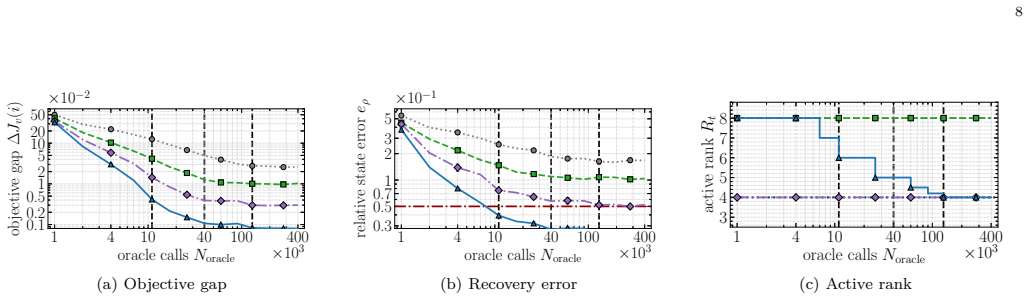
Summary. The paper proposes a rank-adaptive, matrix-free algorithm for low-rank quantum state tomography. The density operator is represented as a convex combination of rank-one pure-state atoms with simplex weights, ensuring feasibility by construction. The optimization alternates projected-gradient updates of the mixture weights, tangent-space atom updates, and a periodic spectral refactorization step driven by Lanczos/Ritz pairs, with a rank penalty to adapt the active number of atoms. Measurement-dependent quantities are evaluated through sharded, descriptor-level POVM actions, avoiding dense D×D density, measurement, and gradient matrices for structured measurements such as Pauli strings. The main theoretical result (Theorem 1) characterizes the exact spectral refactorization proposal as the global minimizer of a rank-penalized proximal problem and establishes descent of the penalized objective under an exact-eigenpair, Lipschitz-smoothness assumption. Numerical experiments compare the method with dense projected-gradient, fixed-rank factored, and Frank-Wolfe baselines on Pauli measurements up to N=14 qubits, reporting favorable accuracy-runtime-memory tradeoffs.
Significance. If the claims are correct, the paper offers a useful algorithmic contribution to scalable low-rank QST for structured POVMs. The matrix-free oracle design with measurement partitioning is practically attractive, and the exact spectral proximal characterization of the refactorization step is a clean and nontrivial optimization result. The paper is generally well structured and the proof of Theorem 1 is largely sound under its explicit assumptions. However, the advertised proof of 'prediction consistency' is not present anywhere in the manuscript; this is a mismatch between the stated contributions and the actual theoretical content. The remaining contributions — feasibility, monotone descent of the penalized objective, and the spectral proximal characterization — are defensible and, with the caveats noted below, the algorithmic framework appears viable for its intended class of measurements.
major comments (1)
- [Abstract; Section I (C3); Section V; Theorem 1 (Section III-D)] The abstract, contribution C3, and concluding summary state that 'prediction consistency' is proved. I find no theorem, proposition, or lemma establishing any statistical consistency property (e.g., convergence of the estimated state or its Born probabilities to the true ones as the number of shots or measurements grows). Theorem 1 is purely an optimization statement about a single spectral step under exact eigenpairs; Eq. (11) is an algebraic identity for the atomic representation, not a statistical guarantee. If 'prediction consistency' is intended to mean Eq. (11), the manuscript should say so explicitly and should not list it as a proven statistical property. Please either add a formal consistency result with appropriate assumptions (e.g., identifiability, information-completeness, sample complexity) or remove 'prediction consistency' from the list of established contributions. This
minor comments (5)
- [Section III-B; Table in Section III-B] The O(DR_t + M) memory claim and the 'never materializes dense operators' statement are conditional on the POVM effects admitting structured representations (Pauli, local, sparse, tensor-product). This is stated after Eq. (20), but the abstract and Introduction state it more categorically. Please add a qualifier in the abstract/contribution list so that the scope is clear.
- [Section III-C, Eq. (26)] The quantity d_{t,r_t,k} used in the sharded response-gradient formula is not defined. It should be defined as the restriction of the response difference a(ψ_new) - a(ψ_old) to the k-th shard, or equivalent.
- [Algorithm 1, line 6] The reference '(25)–(25)' should be '(25)–(26)'.
- [Theorem 1(iii); Section IV] The descent guarantee assumes an L_ε-Lipschitz continuous gradient and η_ρ < 1/L_ε, but no bound on L_ε is provided and the implemented algorithm selects η_ρ by backtracking without verifying the condition. Please provide a bound on L_ε in terms of ε and the POVM (e.g., via ‖E_m‖_op) or explicitly state that the theorem's descent is an idealized characterization while the practical guarantee is supplied by the acceptance rule (24).
- [Theorem 1(iii)] The symbol L_ε denotes both the stabilized loss and the Lipschitz constant, which is confusing. Rename the Lipschitz constant (e.g., L) for clarity.
Circularity Check
No circular derivation of the algorithm's convergence properties; Theorem 1 is self-contained, though the advertised 'prediction consistency' is either definitional or unproved.
full rationale
The central analysis, Theorem 1, is self-contained. Its proof uses von Neumann's trace inequality to identify the exact spectral candidate as the minimizer of ||rho - S_t||_F over rank <= s, then shows the prox candidate minimizes Q_t and uses L_epsilon-smoothness to obtain descent (Eq. 37). None of these steps assumes the target recovery of rho*; they are statements about the algorithm's own objective. The atomic parametrization (2) makes feasibility a construction, and the acceptance rule (24) is a designed safeguard rather than a fitted result. There is no fitted-parameter-as-prediction: the rank penalty mu is fixed a priori in Eq. (12) and simulations are synthetic benchmarks against ground truth. The only self-citation, ref [3] by the same group, is an introductory pointer about scalable QST and is not used to justify any theorem, ansatz, or uniqueness claim, so it is not load-bearing. The one caveat worth flagging is terminological: the abstract/C3 advertise 'provable ... prediction consistency,' but no statistical consistency theorem is stated; the only formal identity is Eq. (11), pi(rho(alpha,Psi)) = A(Psi) alpha, the linearity of the Born map under the atomic parametrization. If 'prediction consistency' means this identity, it is definitional; if it means estimator consistency as N_shot or M grows, it is unproved. That is an overclaim/correctness issue, not a circular derivation, and it does not affect the independence of Theorem 1.
Axiom & Free-Parameter Ledger
free parameters (8)
- Rank penalty weight mu =
1e-3
- Stabilization epsilon =
1e-8
- Pruning threshold tau =
1e-3
- Acceptance threshold tau_acc =
1e-10
- Learning rates eta_psi, eta_alpha, eta_rho =
grid {2^-j, j=0..10} with per-instance backtracking
- Rank budget R_max and initialization R_0 =
8
- Lanczos dimension cap =
<= 30
- Update schedules T_alpha = 5, T_ref = 50 =
5, 50
axioms (5)
- standard math von Neumann trace inequality: tr(rho S) <= sum_i gamma_i lambda_i for Hermitian S and PSD rho with sorted eigenvalues
- domain assumption Born-rule categorical measurement model with POVM {E_m}
- domain assumption L_epsilon-smoothness of rho -> L_epsilon(pi(rho)) on D, with step size 0 < eta_rho < 1/L_epsilon
- domain assumption POVM effects admit descriptor-level matrix-free actions (Pauli/local/sparse/tensor-product)
- domain assumption Exact eigenpairs of S_t are available for the theorem (complete-information spectral step)
Cite this review
Pith. "Pith review of Rank-Adaptive Matrix-Free Atomic Quantum State Tomography." pith.science (2026). https://pith.science/paper/HTQRWVAA
@misc{pith2026260719577,
  author       = {Pith},
  title        = {Pith review of: Rank-Adaptive Matrix-Free Atomic Quantum State Tomography},
  year         = {2026},
  howpublished = {\url{https://pith.science/paper/HTQRWVAA}},
  note         = {Machine review of arXiv:2607.19577}
}
read the original abstract
Quantum state tomography estimates an unknown density operator from measurement data. Dense reconstruction however, can be impractical for many-qubit systems because the Hilbert-space dimension grows exponentially. This contribution develops a rank-adaptive matrix-free approach to low-rank quantum state tomography based on rank-one atomic coordinates. The density operator is represented as a convex combination of pure-state atoms, which preserves positivity and unit trace while avoiding dense density, measurement, and gradient matrices. The resultant algorithm combines atom updates, simplex-constrained coefficient reweighting, and periodic spectral refactorization using only predicted probability vectors, atom vectors, and descriptor-level measurement actions. These computations decompose across measurement outcomes, and admit a master--worker implementation with the measurements partitioned across workers. A rank penalty adapts the representation size during optimization. Provable feasibility, prediction consistency, monotone descent of the penalized objective, and an exact spectral proximal characterization of the refactorization step are established. Simulations with Pauli measurements show favorable accuracy--runtime--memory tradeoffs relative to competing alternatives.
Figures


Reference graph
Works this paper leans on
-
[1]
M. A. Nielsen and I. L. Chuang, Quantum Computation and Quantum Information, 10th ed. Cambridge, U.K.: Cambridge Univ. Press, 2010
2010
-
[2]
Quantum-state estimation,
Z. Hradil, “Quantum-state estimation,” Phys. Rev. A, vol. 55, no. 3, pp. R1561–R1564, 1997
1997
-
[3]
Distributed learning of quantum state tomography robust to readout errors,
A. Taherpour, A. Sadeghi, and G. B. Giannakis, “Distributed learning of quantum state tomography robust to readout errors,” arXiv:2604.14428, 2026
Pith/arXiv arXiv 2026
-
[4]
Quantum state tomography via compressed sensing,
D. Gross, Y.-K. Liu, S. T. Flammia, S. Becker, and J. Eisert, “Quantum state tomography via compressed sensing,” Phys. Rev. Lett., vol. 105, no. 15, p. 150401, 2010. 9
2010
-
[5]
Quantum tomography via compressed sensing: Error bounds, sample complexity and efficient estimators,
S. T. Flammia, D. Gross, Y.-K. Liu, and J. Eisert, “Quantum tomography via compressed sensing: Error bounds, sample complexity and efficient estimators,” New J. Phys., vol. 14, no. 9, p. 095022, 2012
2012
-
[6]
Optimal lower bounds for quantum state tomography,
T. Scharnhorst, J. Spilecki, and J. Wright, “Optimal lower bounds for quantum state tomography,” arXiv:2510.07699, 2025
arXiv 2025
-
[7]
Projected gradient descent algorithms for quantum state tomography,
E. Bolduc, G. C. Knee, E. M. Gauger, and J. Leach, “Projected gradient descent algorithms for quantum state tomography,” npj Quantum Inf., vol. 3, p. 44, 2017
2017
-
[8]
A nonlinear programming algorithm for solving semidefinite programs via low-rank factor- ization,
S. Burer and R. D. C. Monteiro, “A nonlinear programming algorithm for solving semidefinite programs via low-rank factor- ization,” Math. Program., Ser. B, vol. 95, no. 2, pp. 329–357, 2003
2003
-
[9]
Provable compressed sensing quantum state tomography via non-convex methods,
A. Kyrillidis, A. Kalev, D. Park, S. Bhojanapalli, C. Caramanis, and S. Sanghavi, “Provable compressed sensing quantum state tomography via non-convex methods,” npj Quantum Inf., vol. 4, p. 36, 2018
2018
-
[10]
Quantum state tomography via nonconvex Riemannian gradi- ent descent,
M.-C. Hsu, E.-J. Kuo, W.-H. Yu, J.-F. Cai, and M.-H. Hsieh, “Quantum state tomography via nonconvex Riemannian gradi- ent descent,” Phys. Rev. Lett., vol. 132, no. 24, p. 240804, 2024
2024
-
[11]
Efficient factored gradient descent algorithm for quantum state tomog- raphy,
Y. Wang, L. Liu, S. Cheng, L. Li, and J. Chen, “Efficient factored gradient descent algorithm for quantum state tomog- raphy,” Phys. Rev. Res., vol. 6, no. 3, p. 033034, 2024
2024
-
[12]
Gradient-descent methods for fast quantum state tomography,
A. Gaikwad, M. S. Torres, S. Ahmed, and A. F. Kockum, “Gradient-descent methods for fast quantum state tomography,” Quantum Sci. Technol., vol. 10, no. 4, p. 045055, 2025
2025
-
[13]
Online quantum state tomography via stochastic gradient descent,
J.-F. Cai, Y. Jiao, Y. Li, X. Lu, J. Z. Yang, and J. You, “Online quantum state tomography via stochastic gradient descent,” arXiv:2507.07601, 2025
Pith/arXiv arXiv 2025
-
[14]
Quan- tum state tomography for matrix product density operators,
Z. Qin, C. Jameson, Z. Gong, M. B. Wakin, and Z. Zhu, “Quan- tum state tomography for matrix product density operators,” IEEE Trans. Inf. Theory, vol. 70, no. 7, pp. 5030–5056, 2024
2024
-
[15]
Quantum state tomography with locally purified density operators and local measurements,
Y. Guo and S. Yang, “Quantum state tomography with locally purified density operators and local measurements,” Commun. Phys., vol. 7, p. 322, 2024
2024
-
[16]
Online Riemannian gradient descent for quantum state tomography with matrix product operators,
J.-F. Cai, J. Li, X. Zhang, and Y. Zhang, “Online Riemannian gradient descent for quantum state tomography with matrix product operators,” arXiv:2605.04533, 2026
Pith/arXiv arXiv 2026
-
[17]
Parametric quantum state tomography with HyperRBMs,
S. Tonner, V. T. Tran, and R. Kueng, “Parametric quantum state tomography with HyperRBMs,” arXiv:2601.20950, 2026
arXiv 2026
-
[18]
Predicting many properties of a quantum system from very few measurements,
H.-Y. Huang, R. Kueng, and J. Preskill, “Predicting many properties of a quantum system from very few measurements,” Nat. Phys., vol. 16, no. 10, pp. 1050–1057, 2020
2020
-
[19]
Rank-penalized estimation of a quantum system,
P. Alquier, C. Butucea, M. Hebiri, K. Meziani, and T. Morimae, “Rank-penalized estimation of a quantum system,” Phys. Rev. A, vol. 88, no. 3, p. 032113, 2013
2013
-
[20]
Quantum information criteria for model selection in quantum state estimation,
H. Yano and N. Yamamoto, “Quantum information criteria for model selection in quantum state estimation,” J. Phys. A: Math. Theor., vol. 56, no. 40, p. 405301, 2023
2023
-
[21]
An iteration method for the solution of the eigenvalue problem of linear differential and integral operators,
C. Lanczos, “An iteration method for the solution of the eigenvalue problem of linear differential and integral operators,” J. Res. Natl. Bur. Stand., vol. 45, no. 4, pp. 255–282, 1950
1950
-
[22]
Saad, Numerical Methods for Large Eigenvalue Problems, revised ed
Y. Saad, Numerical Methods for Large Eigenvalue Problems, revised ed. Philadelphia, PA, USA: SIAM, 2011
2011
-
[23]
Sparse approximate solutions to semidefinite pro- grams,
E. Hazan, “Sparse approximate solutions to semidefinite pro- grams,” in LATIN 2008: Theoretical Informatics, ser. Lecture Notes in Comput. Sci., vol. 4957. Springer, 2008, pp. 306–316
2008
-
[24]
Revisiting Frank–Wolfe: Projection-free sparse con- vex optimization,
M. Jaggi, “Revisiting Frank–Wolfe: Projection-free sparse con- vex optimization,” in Proc. 30th Int. Conf. Mach. Learn., ser. Proc. Mach. Learn. Res., vol. 28, no. 1. PMLR, 2013, pp. 427– 435
2013
discussion (0)
Sign in with ORCID, Apple, or X to comment. Anyone can read and Pith papers without signing in.