REVIEW 3 major objections 5 minor 30 references
This paper claims that decentralized agents coordinate better under temporary occlusion when their messages are generated from a world model's latent dynamics—which encode observation and action history—rather than from current observations
Reviewed by Pith at T0; open to challenge. T0 means a machine referee read the full paper against a public rubric. the ladder, T0–T4 →
T0 review · deepseek-v4-flash
2026-08-01 11:37 UTC pith:VDRAEGVV
load-bearing objection New integration of CPC messaging with an RSSM world model, but the experiments conflate backbone and message-source changes, so the 'latent dynamics' claim is underdetermined. the 3 major comments →
Dreamer-CPC: Message Learning with World Models for Decentralized Multi-agent Reinforcement Learning
The pith
A machine-rendered reading of the paper's core claim, the machinery that carries it, and where it could break.
Core claim
Dreamer-CPC integrates Collective Predictive Coding-style message learning into the recurrent state-space model (RSSM) of a world model. Each agent's message module keeps its own recurrent state and samples a stochastic message from a posterior conditioned on the RSSM latent state; messages from other agents enter the RSSM transition and observation prediction, but are treated with stop-gradient, so no gradient flows between agents. The unified objective combines prediction, dynamics, representation, and message-prior KL terms, so world-model learning and message learning happen jointly. In the Observer and CatchApple tasks, the method surpasses IPPO-CPC and no-communication baselines; in Ca
What carries the argument
The recurrent state-space model (RSSM) world model—a deterministic recurrent state h_t plus a stochastic latent z_t updated from past observations, actions, and received messages—together with a recurrent message module that maintains its own state ξ_t. The message module predicts messages from ξ_t alone and infers them from ξ_t plus the RSSM state; predicted messages condition the RSSM transition, while inferred messages condition observation prediction. This arrangement is what lets a message represent temporal context rather than only the current observation.
Load-bearing premise
The paper's central explanation—that the gain comes from latent-history-grounded messages—is only indirectly supported because the winning method changes the RL algorithm (model-based Dreamer versus model-free IPPO) at the same time as it changes the message source, so the CatchApple gap cannot be cleanly attributed to the message source alone.
What would settle it
Run Dreamer-CPC with messages sampled from the current RSSM latent state but without the recurrent message module, holding all other Dreamer machinery fixed. If CatchApple return stays near 28, the history-carrying message channel is not the cause; if it drops toward IPPO-CPC's near-5 level, the paper's explanation is supported.
If this is right
- Decentralized agents can act on information that is not present in any current observation, as long as their world models can track the hidden state.
- Message learning and world-model learning can share a single objective, removing the need for a separate communication reward or a centralized value function.
- Because messages from other agents are stop-gradient inputs, the scheme introduces no inter-agent gradient paths, preserving decentralized training.
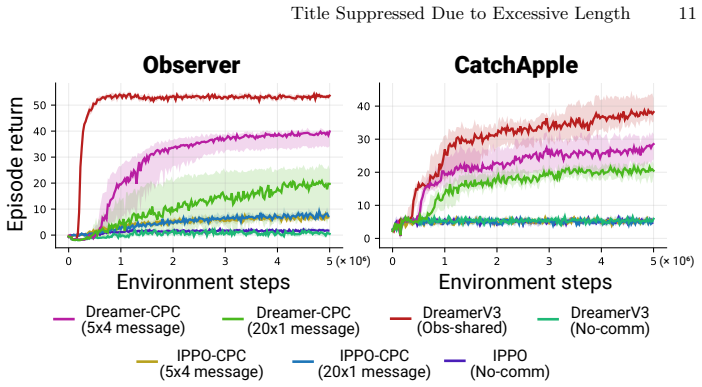
- In CatchApple, the method turns a near-failure baseline (episode return around 5) into a functional coordinator (around 28), roughly a 4 to 5 times improvement.
- The same latent-state message channel also helps in non-cooperative settings where agents do not share rewards.
Where Pith is reading between the lines
- Beyond the paper: if messages carry latent history, the same channel should let agents anticipate not only occluded states but also other agents' future actions, since the RSSM latent is predictive; a direct test would be a task with longer, variable occlusion gaps.
- Beyond the paper: the message-prior KL weights are very small (1e-3 and 1e-4), which raises the possibility that the message channel acts as a free-form bottleneck; varying these weights could reveal how much of the gain comes from message content as opposed to the world model's own predictions.
- Beyond the paper: the two-agent, custom-environment evidence suggests that scaling to more agents would require messages to become compressed summaries of latent state rather than copies; a natural next step is measuring how performance degrades as the number of agents grows.
Editorial analysis
A structured set of objections, weighed in public.
Referee Report
Summary. The paper introduces Dreamer-CPC, a decentralized multi-agent RL method that adds a stochastic message module to each agent's DreamerV3-style RSSM world model. Each agent maintains its own world model and message module; at every step, a message is inferred from the agent's latent state (deterministic recurrent state h and stochastic latent z, Eq. 10), exchanged with other agents, and used in the next transition (Eq. 11) and observation prediction (Eq. 12). Messages from other agents are detached to keep learning decentralized. World-model and message learning are trained jointly by minimizing a variational lower bound (Eqs. 15-19) with KL-balanced free-bits terms (Eqs. 20-24); actor and critic are trained as in DreamerV3, with imagination rollouts that include synchronous message exchange. The method is evaluated in two custom two-agent tasks: Observer, where one stationary agent observes the reward location and a second must dig at that location, and CatchApple, where the object's trajectory is temporarily occluded and the catcher must anticipate the landing column from messages. Dreamer-CPC outperforms IPPO-CPC and no-communication baselines in both tasks (e.g., CatchApple IQM 28.53 vs 5.52 for IPPO-CPC), suggesting that latent-dynamics-grounded messages help when current observations are insufficient.
Significance. If the mechanism claim is upheld, the paper makes a useful contribution: an extension of CPC-based messaging from current observations to latent histories, with a principled derivation and plausible empirical gains. Concrete strengths: the ELBO derivation (Eqs. 15-18) is standard and correctly carried out; the DTDE setup is clearly described; and the evaluation uses 10 independent runs with IQM and bootstrap CIs rather than a single run. The two main weaknesses are (i) the experiments do not isolate the claimed mechanism and (ii) an implementation-critical detail (the discrete-message gradient estimator) is unstated. Both are addressable in revision.
major comments (3)
- [Section 3.3, Fig. 6] The headline comparison confounds two variables. Dreamer-CPC and IPPO-CPC differ simultaneously in the RL backbone (DreamerV3 model-based vs IPPO model-free) and the message source (RSSM latent (h^k_t,z^k_t), Eq. 10, vs current observation). The low no-comm DreamerV3 baselines (0.48 Observer, 5.93 CatchApple) show a channel is necessary, but not that latent-dynamics grounding is the operative factor. Observer has no occlusion - the full state is reconstructible from current observations every step - yet Dreamer-CPC (39.85) far exceeds IPPO-CPC (7.31); this gap is more plausibly ascribed, at least partly, to backbone differences. A within-backbone ablation (DreamerV3-CPC with current-observation messages, and/or IPPO with recurrent-state messages) is required before the title claim is supported.
- [Section 2.3, Eqs. (10)-(12), (23)-(24); Appendix A] Messages are one-hot (Section 3), but no gradient estimator for the discrete samples is specified. The message posterior is trained via the ELBO (Eq. 17), i.e., through the decoder input (Eq. 12) and the message KL terms. For one-hot samples, no gradient reaches q_psi through the sample without a straight-through/Gumbel-Softmax/REINFORCE estimator. Moreover, the KL terms are nearly inactive: free-bits threshold 0.5 and weights beta_m-dyn=1e-3, beta_m-rep=1e-4. Without stating the estimator, the 'unified objective' claim (contribution 2) is unverifiable and the experiments are not reproducible. Please specify the gradient path and report sensitivity to these weights.
- [Section 4 (limitations)] The paper explicitly states that what information the learned messages carry was not analyzed. This is load-bearing because the central claim is that latent-dynamics grounding lets messages carry temporal history, and because Fig. 6's comparison is confounded (see major comment 1). I recommend closing this limitation with at least a probe (e.g., decoding the object trajectory from messages) or a control with random messages, to show the gains come from information-bearing communication rather than from the model-based backbone alone. The limitation is acknowledged by the authors; I weigh it as requiring action before publication, not merely a scope note.
minor comments (5)
- [Eqs. (15)-(18)] The derivation does not spell out that h_t in Eq. (11) uses the prior-predicted \hat m_t while the variational q in Eq. (10) conditions on h_t; given the deterministic recurrence, a brief clarification of the amortized variational family and the role of \hat m_t would prevent apparent circularity.
- [Section 2.3] No InfoNCE/contrastive loss appears in the objective; the connection between the ELBO (Eq. 17) and 'Collective Predictive Coding' (Refs. [22,23]) should be spelled out, since 'CPC' typically denotes a contrastive objective.
- [Fig. 6] The curves are hard to read; a table of final IQMs with 95% CIs for each method and message configuration would make the numbers in Section 3.3 easier to verify. Also, the legend is small.
- [Section 2.2 heading; Section 3] The heading 'W orld Model' has a typo. The obs-shared baseline is not precisely defined: what exactly is shared (raw observations or a concatenated vector) and does the policy remain independent?
- [General] No code or artifact link is provided; releasing code would improve reproducibility, especially given the unstated discrete-message gradient details.
Circularity Check
No significant circularity: the central result is an external reward comparison; only minor non-load-bearing self-citations are present.
full rationale
Dreamer-CPC's message construction does make the statement that messages 'reflect history' true by design: Eq. (10) defines m_t^k ~ q(h_t^k, z_t^k, ξ_t^k), and h_t is recurrent, so the message is a function of accumulated latent state. However, this is an architectural design property, not a fitted prediction or a claimed first-principles result. The paper's headline claim is empirical: Dreamer-CPC outperforms IPPO-CPC and no-communication baselines on episode return measured in the environments. That comparison is against external task rewards, not against the definition of the message. The ELBO in Eq. (17) is a standard Jensen lower bound derived in the text; the KL-balanced surrogate follows DreamerV3 by citation, but DreamerV3 is external and not the target of the paper's claim. The main weakness is a confound, not circularity: Dreamer-CPC and IPPO-CPC differ in both backbone and message source, and the paper's own limitation section admits that the learned message content was not analyzed. This undermines the attribution of the performance gain to latent-dynamics grounding, but it does not reduce the result to its inputs by construction. Self-citations to CPC and MARL-CPC are present and contextual, but no load-bearing uniqueness theorem is imported and the derivation is self-contained apart from standard external technique. Therefore the circularity score is low.
Axiom & Free-Parameter Ledger
free parameters (4)
- β_pred, β_dyn, β_rep (state KL weights) =
1, 1, 0.1
- β_m-dyn (message prior KL weight) =
1×10^-3
- β_m-rep (message representation KL weight) =
1×10^-4
- Free-bits thresholds for state and message KL =
1.0 (state), 0.5 (message)
axioms (5)
- domain assumption The environment is a partially observable Markov game and each agent optimizes its own discounted return (Eq. 1).
- domain assumption An RSSM/DreamerV3 world model with deterministic recurrent state h_t and stochastic latent z_t is sufficient to capture task-relevant history.
- standard math The variational lower bound via Jensen's inequality (Eq. 17) is a valid objective, and KL-balanced/free-bits surrogates preserve the optimum direction.
- ad hoc to paper Messages from other agents can be treated as fixed inputs via stop-gradient, preserving decentralized learning.
- domain assumption Reward and continuation predictions do not condition on messages (Eq. 13).
invented entities (1)
-
Recurrent message state ξ_t and stochastic message m_t
no independent evidence
read the original abstract
In multi-agent reinforcement learning (MARL), inter-agent communication is effective for improving performance under partial observability. Representation learning-based approaches enable decentralized agents to learn messages grounded in their own observations, but they rely only on current observations and cannot convey information accumulated over time. We propose Dreamer-CPC, a decentralized model-based MARL method that integrates message learning based on Collective Predictive Coding (CPC) into the world model of DreamerV3. Each agent independently maintains a world model and a message module, and infers and exchanges messages from the latent states of the world model that reflect the history of past observations and actions. We evaluated Dreamer-CPC in two environments: Observer, a non-cooperative information-sharing task, and CatchApple, a newly introduced task in which task-relevant observations are temporarily missing. In both environments, Dreamer-CPC outperformed IPPO-CPC, an existing CPC-based method that generates messages from current observations, as well as no-communication baselines. In particular, in CatchApple, Dreamer-CPC achieved 4 to 5 times the episode return of IPPO-CPC, demonstrating effective coordination where other methods fail due to missing observations. These results suggest that communication grounded in the latent dynamics of world models can support decentralized decision-making when current observations alone are insufficient.
Figures


Reference graph
Works this paper leans on
-
[1]
MIT Press (2024)
Albrecht, S.V., Christianos, F., Sch¨ afer, L.: Multi-Agent Reinforcement Learning: Foundations and Modern Approaches. MIT Press (2024)
2024
-
[2]
In: 2023 15th International Congress on Advanced Applied Informatics Winter (IIAI-AAI-Winter)
Ebara, H., Nakamura, T., Taniguchi, A., Taniguchi, T.: Multi-agent reinforcement learning with emergent communication using discrete and indifferentiable message. In: 2023 15th International Congress on Advanced Applied Informatics Winter (IIAI-AAI-Winter). pp. 366–371 (2023)
2023
-
[3]
In: 21st International Conference on Autonomous Agents and Multiagent Sys- tems, AAMAS 2022, Auckland, New Zealand, May 9-13, 2022
Egorov, V., Shpilman, A.: Scalable multi-agent model-based reinforcement learn- ing. In: 21st International Conference on Autonomous Agents and Multiagent Sys- tems, AAMAS 2022, Auckland, New Zealand, May 9-13, 2022. pp. 381–390 (2022)
2022
-
[4]
In: Advances in Neural Information Processing Systems
Foerster, J.N., Assael, Y.M., de Freitas, N., Whiteson, S.: Learning to communicate with deep multi-agent reinforcement learning. In: Advances in Neural Information Processing Systems. vol. 29, pp. 2137–2145 (2016)
2016
-
[5]
Ar- tificial Intelligence Review55(2), 895–943 (2022)
Gronauer, S., Diepold, K.: Multi-agent deep reinforcement learning: A survey. Ar- tificial Intelligence Review55(2), 895–943 (2022)
2022
-
[6]
In: Advances in Neural Information Processing Systems (2018)
Ha, D., Schmidhuber, J.: Recurrent world models facilitate policy evolution. In: Advances in Neural Information Processing Systems (2018)
2018
-
[7]
In: Proceedings of the 36th International Conference on Machine Learning
Hafner, D., Lillicrap, T., Fischer, I., Villegas, R., Ha, D., Lee, H., Davidson, J.: Learning latent dynamics for planning from pixels. In: Proceedings of the 36th International Conference on Machine Learning. pp. 2555–2565 (2019)
2019
-
[8]
In: International Conference on Learning Representations (2021)
Hafner, D., Lillicrap, T.P., Norouzi, M., Ba, J.: Mastering Atari with discrete world models. In: International Conference on Learning Representations (2021)
2021
-
[9]
Nature640(8059), 647–653 (2025)
Hafner, D., Pasukonis, J., Ba, J., Lillicrap, T.: Mastering diverse control tasks through world models. Nature640(8059), 647–653 (2025)
2025
-
[10]
In: Proceedings of the Nineteenth National Confer- ence on Artificial Intelligence
Hansen, E.A., Bernstein, D.S., Zilberstein, S.: Dynamic programming for partially observable stochastic games. In: Proceedings of the Nineteenth National Confer- ence on Artificial Intelligence. pp. 709–715 (2004)
2004
-
[11]
Acta Mathematica30(1), 175–193 (1906)
Jensen, J.L.W.V.: Sur les fonctions convexes et les in´ egalit´ es entre les valeurs moyennes. Acta Mathematica30(1), 175–193 (1906)
1906
-
[12]
Artificial Intelligence101(1–2), 99–134 (1998)
Kaelbling, L.P., Littman, M.L., Cassandra, A.R.: Planning and acting in partially observable stochastic domains. Artificial Intelligence101(1–2), 99–134 (1998)
1998
-
[13]
In: 2nd International Conference on Learning Representations, ICLR 2014, Banff, AB, Canada, April 14-16, 2014, Conference Track Proceedings (2014)
Kingma, D.P., Welling, M.: Auto-encoding variational bayes. In: 2nd International Conference on Learning Representations, ICLR 2014, Banff, AB, Canada, April 14-16, 2014, Conference Track Proceedings (2014)
2014
-
[14]
In: Advances in Neural Information Processing Systems (2016)
Kingma, D.P., Salimans, T., Jozefowicz, R., Chen, X., Sutskever, I., Welling, M.: Improved variational inference with inverse autoregressive flow. In: Advances in Neural Information Processing Systems (2016)
2016
-
[15]
In: Advances in Neural Information Processing Systems
Lin, T., Huh, J., Stauffer, C., Lim, S., Isola, P.: Learning to ground multi-agent communication with autoencoders. In: Advances in Neural Information Processing Systems. pp. 15230–15242 (2021)
2021
-
[16]
In: Advances in Neu- ral Information Processing Systems
Lowe, R., Wu, Y., Tamar, A., Harb, J., Abbeel, P., Mordatch, I.: Multi-agent actor-critic for mixed cooperative-competitive environments. In: Advances in Neu- ral Information Processing Systems. vol. 30. Curran Associates, Inc. (2017)
2017
-
[17]
IEEE Transactions on Automatic Control58(7), 1644–1658 (2013)
Nayyar, A., Mahajan, A., Teneketzis, D.: Decentralized stochastic control with partial history sharing: A common information approach. IEEE Transactions on Automatic Control58(7), 1644–1658 (2013)
2013
-
[18]
In: 2025 IEEE International Conference on Development and Learning (ICDL)
Nomura, K., Aoki, T., Taniguchi, T., Horii, T.: Decentralized collective world model for emergent communication and coordination. In: 2025 IEEE International Conference on Development and Learning (ICDL). pp. 1–8 (2025) Title Suppressed Due to Excessive Length 15
2025
-
[19]
arXiv preprint arXiv:1807.03748 (2018)
van den Oord, A., Li, Y., Vinyals, O.: Representation learning with contrastive predictive coding. arXiv preprint arXiv:1807.03748 (2018)
Pith/arXiv arXiv 2018
-
[20]
In: Advances in Neural Information Processing Systems (2016)
Sukhbaatar, S., Szlam, A., Fergus, R.: Learning multiagent communication with backpropagation. In: Advances in Neural Information Processing Systems (2016)
2016
-
[21]
In: Proceed- ings of the 17th International Conference on Autonomous Agents and MultiAgent Systems
Sunehag, P., Lever, G., Gruslys, A., Czarnecki, W.M., Zambaldi, V., Jaderberg, M., Lanctot, M., Sonnerat, N., Leibo, J.Z., Tuyls, K., Graepel, T.: Value-decomposition networks for cooperative multi-agent learning based on team reward. In: Proceed- ings of the 17th International Conference on Autonomous Agents and MultiAgent Systems. pp. 2085–2087 (2018)
2085
-
[22]
Frontiers in Robotics and AI11(2024)
Taniguchi, T.: Collective predictive coding hypothesis: Symbol emergence as de- centralized bayesian inference. Frontiers in Robotics and AI11(2024)
2024
-
[23]
Artificial Life31(4), 465–496 (2025)
Taniguchi, T., Hirai, Y., Suzuki, M., Murata, S., Horii, T., Tanaka, K.: System 0/1/2/3: Quad-process theory for multitimescale embodied collective cognitive sys- tems. Artificial Life31(4), 465–496 (2025)
2025
-
[24]
Advanced Robotics37(19), 1266–1282 (2023)
Taniguchi, T., Yoshida, Y., Matsui, Y., Hoang, N.L., Taniguchi, A., Hagiwara, Y.: Emergent communication through metropolis-hastings naming game with deep generative models. Advanced Robotics37(19), 1266–1282 (2023)
2023
-
[25]
de Witt, C.S., Gupta, T., Makoviichuk, D., Makoviychuk, V., Torr, P.H.S., Sun, M., Whiteson, S.: Is independent learning all you need in the StarCraft multi-agent challenge? arXiv preprint arXiv:2011.09533 (2020)
Pith/arXiv arXiv 2011
-
[26]
In: Proceedings of the AAAI Conference on Artificial Intelligence (2023)
Wu, Z., Yu, C., Chen, C., Hao, J., Zhuo, H.H.: Models as agents: Optimizing multi- step predictions of interactive local models in model-based multi-agent reinforce- ment learning. In: Proceedings of the AAAI Conference on Artificial Intelligence (2023)
2023
-
[27]
In: Advances in Neural Information Processing Systems (2022)
Xu, Z., Li, D., Zhang, B., Zhan, Y., Bai, Y., Fan, G.: Mingling foresight with imag- ination: Model-based cooperative multi-agent reinforcement learning. In: Advances in Neural Information Processing Systems (2022)
2022
-
[28]
In: Neural Information Processing
Yoshida, N., Taniguchi, T.: Reward-independent messaging for decentralized multi- agent reinforcement learning. In: Neural Information Processing. Lecture Notes in Computer Science, vol. 16309, pp. 367–382. Springer (2026)
2026
-
[29]
Transactions on Machine Learning Research (2025)
Zhang, Y., Bai, C., Zhao, B., Yan, J., Li, X., Li, X.: Decentralized Transformers with Centralized Aggregation Are Sample-Efficient Multi-Agent World Models. Transactions on Machine Learning Research (2025)
2025
-
[30]
Autonomous Agents and Multi-Agent Systems38(1) (2024)
Zhu, C., Dastani, M., Wang, S.: A survey of multi-agent deep reinforcement learn- ing with communication. Autonomous Agents and Multi-Agent Systems38(1) (2024)
2024
discussion (0)
Sign in with ORCID, Apple, or X to comment. Anyone can read and Pith papers without signing in.