REVIEW 4 major objections 5 minor 35 references
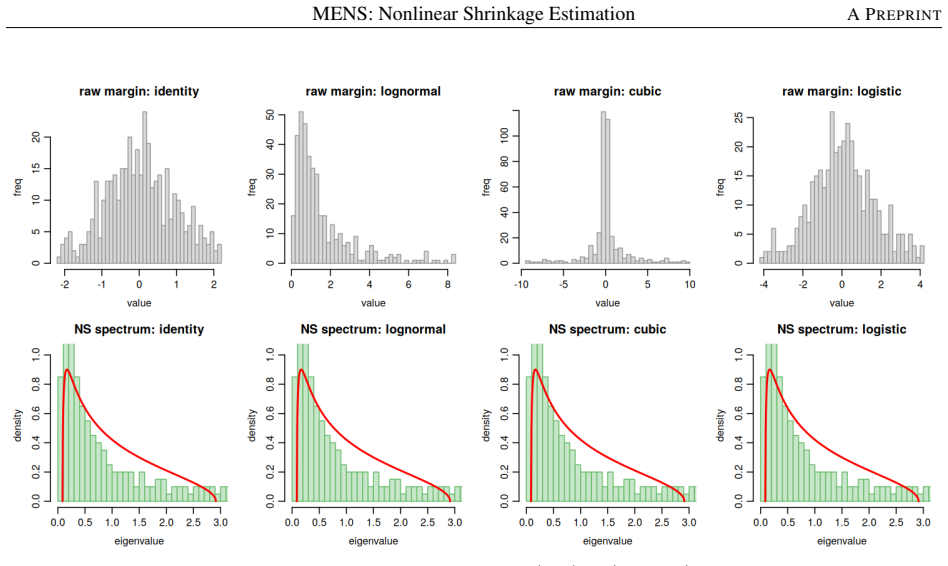
For Gaussian-copula data, the normal-scores covariance inherits the latent correlation's spectral law, making nonlinear shrinkage asymptotically optimal and giving a closed-form spike-detection threshold.
Reviewed by Pith at T0; open to challenge. T0 means a machine referee read the full paper against a public rubric. the ladder, T0–T4 →
T0 review · deepseek-v4-flash
2026-08-01 11:35 UTC pith:NCZWQI6O
load-bearing objection Clean idea, plausible results, but the proof of the key perturbation lemma has a false independence claim and the eigenvector transfer is under-supported; worth a serious referee. the 4 major comments →
Mens: Nonlinear shrinkage estimation in nonparanormal models for financial applications
The pith
A machine-rendered reading of the paper's core claim, the machinery that carries it, and where it could break.
Core claim
Under the nonparanormal model, the oracle normal scores z*_ij = Phi^{-1}(F_j(x_ij)) exactly recover the latent Gaussian values y_ij, because F_j(x_ij) = Phi(y_ij). Hence the oracle covariance S*_n = n^{-1} sum_i y_i y_i^T is a genuine Gaussian sample covariance with population latent correlation Sigma, and the rank-based normal-scores covariance bS_n differs from it by o_P(1) in operator norm. The paper proves (Theorem 3.4) that the empirical spectral distribution of bS_n converges almost surely to the generalized Marchenko-Pastur law of Sigma, independent of the marginal transformations; that the oracle nonlinear shrinkage function minimizing asymptotic Frobenius risk among rotation-equivar
What carries the argument
The load-bearing object is the normal-scores covariance bS_n, obtained by replacing each column's values with Phi^{-1}(rank/(n+1)). Under the Gaussian-copula assumption, this transform inverts the unknown marginals exactly, so bS_n is an o_P(1) operator-norm perturbation of a Gaussian sample covariance with population latent correlation Sigma. The generalized Marchenko-Pastur equation—the Stieltjes-transform fixed-point system for the limiting spectrum—then supplies the oracle shrinkage function d*(lambda) = lambda / |1 - gamma - gamma lambda m_bar(lambda)|^2, and the boundary Stieltjes transform m_bar gives the spike-detection threshold and outlier map.
Load-bearing premise
The central proofs assume the normal-scores covariance matrix is o_P(1) close in operator norm to the oracle Gaussian sample covariance (Lemma 3.1); the proof treats the rows of the Hajek projection as i.i.d., but each entry depends on the whole sample through the empirical CDF, so the rows are not independent, and the eigenvector-level phase transition is transferred using only operator-norm closeness, which does not by itself control individual eigenvector quadratic forms.
What would settle it
Simulate p=200, n=400 under an identity-bulk Gaussian copula with a single subcritical spike theta = sqrt(gamma) - epsilon; if the largest eigenvalue of the normal-scores covariance systematically separates from the bulk edge, or if the squared cosine between the leading sample eigenvector and the spike direction stays above about 0.05 as n doubles, then the asserted phase transition and eigenvector alignment are false.
If this is right
- Within the nonparanormal class, the spectrum of the rank-based covariance is invariant to the unknown marginal transformations, so the estimator is stable under skewness and heavy tails without losing the spectral theory on which shrinkage depends.
- No rotation-equivariant estimator built from the normal-scores covariance can beat the oracle nonlinear shrinkage in asymptotic Frobenius risk, and the feasible MENS estimator attains that oracle risk.
- Spiked latent correlations are detectable from the largest eigenvalue of the rank covariance precisely when the spike exceeds sqrt(gamma) for an identity bulk; below that threshold no eigenvalue-based test is consistent, and the threshold does not depend on the marginals.
- The estimator is operator-norm consistent on the bulk, and the paper establishes a parametric n^{-1/2} minimax lower bound for bounded-spectrum correlation classes.
- In the reported S&P 500 minimum-variance backtest, MENS reduces annualized out-of-sample portfolio volatility from 11.0% to 9.4%, improves the median condition number of the correlation estimate by more than a factor of three, and cuts turnover by 41% relative to linear shrinkage.
Where Pith is reading between the lines
- If the latent distribution is not Gaussian, the exact recovery identity z*_ij = y_ij fails, and the limiting spectrum of the normal-scores covariance would be driven by a nonlinearly transformed latent variable rather than by Sigma; a diagnostic for Gaussian-copula structure could indicate when MENS is trustworthy.
- The paper's Conjecture 6.3 suggests the sin-transformed Kendall matrix may share the same limiting spectrum even though its operator-norm distance to bS_n does not vanish; if true, MENS could be implemented directly on the Kendall matrix, avoiding normal-score inversion and possibly improving finite-sample behavior.
- For p/n near 1, the threshold sqrt(gamma) approaches 1, so only very strong latent correlations can be separated from the bulk; a factor-augmented variant that shrinks only the bulk while fixing the spike via the outlier map would be a natural next estimator.
- A direct test outside the model would be to simulate a t-copula with non-Gaussian dependence and measure the bias of the MENS spectrum relative to the generalized Marchenko-Pastur law; this would quantify the cost of the Gaussian-copula assumption.
Editorial analysis
A structured set of objections, weighed in public.
Referee Report
Summary. The paper proposes MENS, a nonlinear shrinkage estimator of the latent correlation matrix in nonparanormal (Gaussian-copula) models. The estimator applies the Ledoit–Wolf oracle nonlinear shrinkage function to the normal-scores covariance matrix bSn, whose entries are rank-based transforms of the observed coordinates. The main theoretical claims are: (i) the empirical spectral distribution of bSn converges almost surely to the generalized Marchenko–Pastur law of the latent correlation Sigma, with the same limit for every choice of monotone marginals (Theorem 3.4); (ii) MENS is asymptotically optimal among rotation-equivariant estimators under Frobenius loss and achieves an operator-norm minimax lower bound of order n^{-1/2} (Theorem 3.9); and (iii) a Baik–Ben Arous–Péché phase transition with closed-form threshold sqrt(gamma), outlier map, and eigenvector alignment for spiked latent correlations (Theorem 3.10). The proof strategy is to compare bSn with the oracle Gaussian sample covariance S*_n via an operator-norm perturbation lemma (Lemma 3.1), and then transfer classical Gaussian random-matrix results. Simulations and an S&P 500 backtest are provided. The central theoretical results, however, rest on two unproved and, as written, incorrect proof steps: the row-independence claim in Lemma 3.1 and the operator-norm-to-eigenvector transfer in Lemmas 3.8 and 3.10.
Significance. If the central theorems were established, this would be a valuable contribution: it would extend the Ledoit–Wolf nonlinear shrinkage theory to a semiparametric Gaussian-copula setting, unifying the robustness of rank-based estimation with the efficiency of nonlinear shrinkage. The exact-recovery identity for oracle normal scores is elegant, and the paper clearly identifies the precise role of the Gaussian-copula assumption. The simulation study is well designed and the publicly available reference implementation is a strength. However, the main theorems are not proven by the arguments given. The proof of Lemma 3.1 relies on a false independence assumption, and the eigenvector-level results are transferred from S*_n to bSn using only operator-norm closeness, which is insufficient in the bulk. The paper itself concedes (Remark 3.5, Conjecture 6.1) that no local law is proved, and Conjecture 6.3 shows that a related operator-norm equivalence fails. Thus the three headline results—spectral limit, oracle optimality, and phase transition—are not established in the present manuscript.
major comments (4)
- [§3.1, Lemma 3.1, Eq. (16)] The proof claims that the rows of the Hájek projection matrix L are i.i.d. and applies Vershynin Thm 4.6.1 to √n L. This is false as written: each entry L_ij = g'_n(F_j(x_ij))(Phat_nj(x_ij)-F_j(x_ij)) depends on the full empirical CDF of column j, so L_ij and L_i'j are dependent for i ≠ i'. The cited row-independent matrix deviation inequality cannot be applied. Consequently the bound ||L||_op = O_P(√p/√n) and hence the o_P(1) operator-norm closeness of bSn to S*_n, on which Theorems 3.4, 3.9, and 3.10 all depend, is not established.
- [§3.3, Lemma 3.8 and Theorem 3.9] Lemma 3.8 attempts to prove convergence of the eigenvector quadratic form Rgamma_j^Rtop Σ Rgamma_j for bSn. The proof invokes the Ledoit–Péché deterministic equivalent for S*_n and a contour around Rlambda_j, but Rlambda_j is an eigenvalue of bSn while the resolvent is that of S*_n. The argument does not transfer eigenvector information from S*_n to bSn. Operator-norm closeness alone does not control individual eigenvector projections when bulk spacings are O(1/p); a local law would be required, and Remark 3.5 and Conjecture 6.1 concede that none is proved. Thus the projection limit (30) and the oracle optimality claim in Theorem 3.9(i) are unsupported.
- [§3.4, Theorem 3.10] The phase-transition proof argues with S*_n and asserts that the o_P(1) operator-norm perturbation from Lemma 3.1 transfers both eigenvalue outlier locations and eigenvector alignments. For eigenvalue outliers, Weyl's inequality gives closeness of leading eigenvalues, so the outlier location φ(θ) may be salvageable. However, the subcritical 'sticking to the edge' claim and the alignment limit (38) require control of individual eigenvectors of bSn. The Woodbury identity is applied to the finite-rank perturbation of S*_n; the perturbation bSn - S*_n is full-rank and not controlled at eigenvector level. No local law for bSn is supplied. Hence Theorem 3.10(ii) and the identity-bulk cosine formula (39) are not proven.
- [§2.3 and proof of Theorem 3.9(i)] The consistency of the feasible analytic shrinkage estimators (11)–(13) is imported from Ledoit and Wolf (2020, Thm 3.1). That theorem is stated for the sample covariance matrix of i.i.d. observations, whereas bSn has dependent rows (the normal scores use ranks computed from the full sample). Even if the eigenvalue-limiting law is the same, the conditions of the cited theorem need to be verified for bSn. As written, the assertion supi |Rd_i - d*(Rlambda_i)| = o_P(1) is an unexamined transfer and is load-bearing for the claim that the feasible MENS attains the oracle risk.
minor comments (5)
- [Throughout] Typos: 'becasue' in Section 3 heading; 'seperation' in Lemma 3.3; 'Mar cenko' spacing in several places. The typesetting of Rbar m and Rbreve m in Proposition 2.5 could be clarified.
- [Assumption A4] The parenthetical 'This is the only role A1 plays in the perturbation bound' is confusing because A1 is the nonparanormal model itself, not a regularity condition. Consider rewording.
- [Section 4.4 and Table 2] The GMV risk-ratio result shows linear shrinkage beating MENS on that metric; the authors explain this, but it weakens the practical motivation for the simulated setting. This is a presentation point, not a flaw.
- [Section 5.1] The admission that the real-data application lies outside the theoretical setting is welcome. However, the claim that the volatility ranking reverses at p/n ≳ 1 is only 'unreported experiments'; naming the experiments or deferring them would strengthen reproducibility.
- [Conjecture 6.3] This conjecture itself undermines the reliance on operator-norm equivalence for rank inputs. It would be helpful to state explicitly which of the paper's results would survive if only entrywise consistency, rather than operator-norm closeness, held.
Circularity Check
No significant circularity: the central results derive from an exact normal-score identity plus standard external random-matrix theorems; flagged limitations are proof gaps, not circularity.
full rationale
The derivation chain is not circular. The central reduction (Lemma 3.1) bounds ||bSn - S*_n||_op by an o_P(1) rank-perturbation argument; this is an independent mathematical claim, not an assumption of the target results. Theorem 3.4 then uses the exact-recovery identity z*_ij = y_ij (Remark 2.4, Eq. 7) to identify S*_n with a Gaussian sample covariance with population Sigma, and invokes the external Silverstein-Bai theorem. The oracle optimality of Theorem 3.9 follows from the Ledoit-Peche deterministic equivalent (31) and the Frobenius-loss expansion (34); no parameter is fitted to data and then renamed a prediction. The BBP phase transition of Theorem 3.10 is derived by Woodbury/deterministic-equivalent arguments and explicitly matches the classical Gaussian result, which is the correct consequence of exact score recovery. There are no self-citations by the present authors; all load-bearing citations are to standard external works (Silverstein-Bai, Ledoit-Wolf, Ledoit-Peche, Benaych-Georges-Nadakuditi, Bai-Silverstein). The paper itself flags unresolved technical limitations: Remark 3.5 disclaims a local law, Conjecture 6.1 asks for a quantitative rate, and Conjecture 6.3 admits that the operator-norm equivalence between bSn and the Kendall matrix is not proved. These are correctness/rigor concerns, not circularity: they do not assume the theorems being proved. The suspicious i.i.d.-row claim inside Lemma 3.1 is a potential proof gap, but it is not a circular step; the lemma is not equivalent to the target result by construction.
Axiom & Free-Parameter Ledger
free parameters (1)
- Epanechnikov bandwidth scale h_j = λhat_j n^{-1/3} =
n^{-1/3}
axioms (8)
- domain assumption A1: Data are exactly nonparanormal: x_j = f_j(y_j), y ~ N(0,Σ), with unknown strictly increasing f_j.
- domain assumption A2: The ESD H_p of the latent correlation Σ converges weakly to a compactly supported measure H on (0,∞), with spectrum bounded away from 0 and ∞.
- standard math A3: p/n → γ ∈ (0,∞) as min(n,p) → ∞.
- domain assumption A5: Spike directions {v_k} are delocalized: max_k ||v_k||_∞ → 0.
- standard math Silverstein-Bai Marchenko-Pastur theorem for Gaussian sample covariance matrices.
- standard math Ledoit-Péché deterministic equivalent for weighted resolvents and Ledoit-Wolf oracle optimality for nonlinear shrinkage.
- standard math Baik-Ben Arous-Péché / Benaych-Georges-Nadakuditi spiked covariance results.
- standard math Dvoretzky-Kiefer-Wolfowitz inequality and matrix deviation inequality for sub-Gaussian matrices.
read the original abstract
We develop a theory of nonlinear shrinkage covariance estimation for nonparanormal (Gaussian-copula) models, in which each observed coordinate is an unknown strictly increasing transformation of a latent Gaussian vector. This model accommodates arbitrary marginal skewness and heavy marginal tails while retaining a Gaussian dependence structure, and it is the natural semiparametric setting for heavy-tailed, asymmetric financial returns. Our estimator, marginal-free nonlinear shrinkage (MENS), applies an oracle nonlinear shrinkage function to the eigenvalues of the normal-scores rank-covariance matrix. We give the almost-sure convergence of the empirical spectral distribution of the normal-scores covariance to the generalized Marchenko-Pastur law of Sigma, and asymptotic optimality of MENS among rotation-equivariant estimators under Frobenius loss. We establish a Baik-Ben Arous-Peche phase transition for spiked latent correlations. The MENS attains the robustness of rank-based estimation and the efficiency of nonlinear shrinkage at once within this class. We corroborate the theory with a simulation study that isolates the marginal-invariance property and the spiked transition. In an out-of-sample minimum-variance backtest on S&P 500 stocks, MENS delivers a better-conditioned covariance estimate, lower realized portfolio volatility, and lower turnover than linear shrinkage, illustrating its practical value for high-dimensional allocation and decision-making.
Figures


Reference graph
Works this paper leans on
-
[1]
and SILVERSTEIN, J
BAI, Z. and SILVERSTEIN, J. W. (2010).Spectral Analysis of Large Dimensional Random Matrices, 2nd ed. Springer, New York
2010
-
[2]
BAI, Z. D. and SILVERSTEIN, J. W. (1998). No eigenvalues outside the support of the limiting spectral distribution of large-dimensional sample covariance matrices.The Annals of Probability26(1) 316–345
1998
-
[3]
BAI, Z. D. and YIN, Y. Q. (1993). Limit of the smallest eigenvalue of a large dimensional sample covariance matrix. The Annals of Probability21(3) 1275–1294
1993
-
[4]
BAIK, J., BENAROUS, G., and PÉCHÉ, S. (2005). Phase transition of the largest eigenvalue for nonnull complex sample covariance matrices.The Annals of Probability33(5) 1643–1697
2005
-
[5]
S., LODHIA, A., and RIGOLLET, P
BANDEIRA, A. S., LODHIA, A., and RIGOLLET, P. (2017). Mar ˇcenko–Pastur law for Kendall’s tau.Electronic Communications in Probability22(32) 1–7
2017
-
[6]
BAO, Z. (2019). Tracy–Widom limit for Kendall’s tau.The Annals of Statistics47(6) 3504–3532
2019
-
[7]
and NADAKUDITI, R
BENAYCH-GEORGES, F. and NADAKUDITI, R. R. (2012). The singular values and vectors of low rank perturbations of large rectangular random matrices.Journal of Multivariate Analysis111120–135
2012
-
[8]
CONT, R. (2001). Empirical properties of asset returns: Stylized facts and statistical issues.Quantitative Finance1(2) 223–236
2001
-
[9]
and MCKAY, M
COUILLET, R. and MCKAY, M. (2014). Large dimensional analysis and optimization of robust shrinkage covariance matrix estimators.Journal of Multivariate Analysis13199–120
2014
-
[10]
EARLE, C. J. and HAMILTON, R. S. (1970). A fixed point theorem for holomorphic mappings.Proceedings of Symposia in Pure Mathematics1661–65
1970
-
[11]
ELKAROUI, N. (2009). Concentration of measure and spectra of random matrices: Applications to correlation matrices, elliptical distributions and beyond.The Annals of Applied Probability19(6) 2362–2405
2009
-
[12]
J., and STRAUMANN, D
EMBRECHTS, P., MCNEIL, A. J., and STRAUMANN, D. (2002). Correlation and dependence in risk management: Properties and pitfalls. In DEMPSTER, M. A. H., editor,Risk Management: Value at Risk and Beyond, pages 176–223. Cambridge University Press
2002
-
[13]
FAN, J., LIU, H., and WANG, W. (2018). Large covariance estimation through elliptical factor models.The Annals of Statistics46(4) 1383–1414
2018
-
[14]
FRIEDMAN, J., HASTIE, T., and TIBSHIRANI, R. (2008). Sparse inverse covariance estimation with the graphical lasso. Biostatistics9(3) 432–441. HÁJEK, J. and ŠIDÁK, Z. (1967).Theory of Rank Tests. Academic Press, New York
2008
-
[15]
and LIU, H
HAN, F. and LIU, H. (2018). ECA: High-dimensional elliptical component analysis in non-Gaussian distributions. Journal of the American Statistical Association113(521) 252–268
2018
-
[16]
JOHNSTONE, I. M. (2001). On the distribution of the largest eigenvalue in principal components analysis.The Annals of Statistics29(2) 295–327
2001
-
[17]
KRUSKAL, W. H. (1958). Ordinal measures of association.Journal of the American Statistical Association53(284)
1958
-
[18]
and PÉCHÉ, S
LEDOIT, O. and PÉCHÉ, S. (2011). Eigenvectors of some large sample covariance matrix ensembles.Probability Theory and Related Fields151(1–2) 233–264
2011
-
[19]
and WOLF, M
LEDOIT, O. and WOLF, M. (2004). A well-conditioned estimator for large-dimensional covariance matrices.Journal of Multivariate Analysis88(2) 365–411
2004
-
[20]
and WOLF, M
LEDOIT, O. and WOLF, M. (2012). Nonlinear shrinkage estimation of large-dimensional covariance matrices.The Annals of Statistics40(2) 1024–1060
2012
-
[21]
and WOLF, M
LEDOIT, O. and WOLF, M. (2015). Spectrum estimation: A unified framework for covariance matrix estimation and PCA in large dimensions.Journal of Multivariate Analysis139360–384
2015
-
[22]
and WOLF, M
LEDOIT, O. and WOLF, M. (2020). Analytical nonlinear shrinkage of large-dimensional covariance matrices.The Annals of Statistics48(5) 3043–3065
2020
-
[23]
and WOLF, M
LEDOIT, O. and WOLF, M. (2022). Quadratic shrinkage for large covariance matrices.Bernoulli28(3) 1519–1547
2022
-
[24]
LI, Z., WANG, C., and WANG, Q. (2023). On eigenvalues of a high-dimensional Kendall’s rank correlation matrix with dependence.Science China Mathematics66(11) 2615–2640
2023
-
[25]
LI, Z., WANG, Q., and LI, R. (2021). Central limit theorem for linear spectral statistics of large dimensional Kendall’s rank correlation matrices and its applications.The Annals of Statistics49(3) 1569–1593. 20 MENS: Nonlinear Shrinkage EstimationA PREPRINT
2021
-
[26]
LIU, H., HAN, F., YUAN, M., LAFFERTY, J., and WASSERMAN, L. (2012). High-dimensional semiparametric Gaussian copula graphical models.The Annals of Statistics40(4) 2293–2326
2012
-
[27]
LIU, H., LAFFERTY, J., and WASSERMAN, L. (2009). The nonparanormal: Semiparametric estimation of high dimensional undirected graphs.Journal of Machine Learning Research102295–2328
2009
-
[28]
MARKOWITZ, H. (1952). Portfolio selection.The Journal of Finance7(1) 77–91. MAR ˇCENKO, V. A. and PASTUR, L. A. (1967). Distribution of eigenvalues for some sets of random matrices. Mathematics of the USSR-Sbornik1(4) 457–483
1952
-
[29]
MASSART, P. (1990). The tight constant in the Dvoretzky–Kiefer–Wolfowitz inequality.The Annals of Probability 18(3) 1269–1283
1990
-
[30]
PAUL, D. (2007). Asymptotics of sample eigenstructure for a large dimensional spiked covariance model.Statistica Sinica17(4) 1617–1642
2007
-
[31]
SILVERSTEIN, J. W. and BAI, Z. D. (1995). On the empirical distribution of eigenvalues of a class of large dimensional random matrices.Journal of Multivariate Analysis54(2) 175–192
1995
-
[32]
TSYBAKOV, A. B. (2009).Introduction to Nonparametric Estimation. Springer, New York
2009
-
[33]
(2018).High-Dimensional Probability: An Introduction with Applications in Data Science
VERSHYNIN, R. (2018).High-Dimensional Probability: An Introduction with Applications in Data Science. Cambridge University Press
2018
-
[34]
and ZHAO, Y
WEGKAMP, M. and ZHAO, Y. (2016). Adaptive estimation of the copula correlation matrix for semiparametric elliptical copulas.Bernoulli22(2) 1184–1226
2016
-
[35]
and WANG, C
WU, Z. and WANG, C. (2022). Limiting spectral distribution of large dimensional Spearman’s rank correlation matrices. Journal of Multivariate Analysis191105011. 21
2022
discussion (0)
Sign in with ORCID, Apple, or X to comment. Anyone can read and Pith papers without signing in.