REVIEW 4 major objections 5 minor 39 references
SequenceFI makes microservice fault injection temporally precise by gating every fault on an occurrence-count guard synthesized from clean traces.
Reviewed by Pith at T0; open to challenge. T0 means a machine referee read the full paper against a public rubric. the ladder, T0–T4 →
T0 review · deepseek-v4-flash
2026-08-01 10:54 UTC pith:B4X2AEMO
load-bearing objection Genuinely new sidecar-based TFI with a neat guard-synthesis algorithm, but the 100% success claim is a self-consistency result on the same workload and needs held-out validation before the strong claims can be trusted. the 4 major comments →
SequenceFI: Non-intrusive Temporal Fault Injection for Microservice Systems
The pith
A machine-rendered reading of the paper's core claim, the machinery that carries it, and where it could break.
Core claim
SequenceFI's core claim is that a temporal fault-injection configuration can be decomposed into a static target (which API, which occurrence k, request or response phase, fault type) and an After temporal guard over event counts, and that the guard can be synthesized from clean traces. For each candidate target, the generator collects event-prefix counts at the target position across traces, keeps atoms that are true there, and then solves a minimum hitting set over the distinguishing sets that separate the target from every earlier occurrence of the same API-phase operation. The resulting guard is false at all premature trigger points and true at the intended moment. The paper reports that
What carries the argument
The After temporal guard: a conjunction of occurrence-count atoms of the form 'event e has occurred at least t times,' evaluated over a compact binary evidence vector propagated across service boundaries by sidecar proxies. Guards are built by selecting atoms from the candidate set U_r,σ that are satisfied at the k-th matching occurrence in every training trace but fail at each earlier occurrence p; choosing at least one atom per distinguishing set Dτ(p, iσ(τ)) reduces the problem to a minimum hitting set. This monotone, prefix-count formulation is what lets SequenceFI distinguish the intended execution context from premature triggers while keeping the propagated metadata small.
Load-bearing premise
The load-bearing premise is that the event-count patterns seen in the handful of clean traces used to build a guard will recur in live, fault-injected executions; if a live trial produces lower counts, different interleavings, or fault-induced trace changes, the guard can fire early or miss.
What would settle it
Take one k-of-n scenario, train the guard on 10 clean traces, then run 50 trials in which a workload change inserts one extra homogeneous downstream call before the target occurrence; any trial with premature firing or no injection in the intended window falsifies the 100% temporal-success claim. A simpler check: find a trace in which the (k-1)-th and k-th occurrences of the target API have identical prefix-count vectors for all candidate atoms, in which case no After guard can distinguish them and the construction must fail.
If this is right
- Timing-dependent failure modes — failures after a side effect, order-sensitive concurrent responses, and k-of-n partial failures — become reproducible in routine resilience testing.
- Because interposition is at the communication layer, the technique applies to polyglot microservice stacks without serialization-library instrumentation or application changes.
- Automatic guard synthesis removes the need to hand-write or randomly enumerate temporal conditions; the reported one-attempt success implies the search burden collapses.
- The low sidecar overhead (97.3% of no-proxy throughput, 2.3% of a full mesh sidecar's memory in the paper's measurements) makes always-on temporal monitoring feasible.
- The prototype's support for HTTP/1.x and gRPC over HTTP/2 positions the scheme for cloud-native deployments.
Where Pith is reading between the lines
- The trace-stability assumption is untested: guards are learned from 10 clean traces and evaluated on 50 live trials under the same workload; under a different arrival pattern or interleaving, prefix counts could shift and cause premature or missed injections.
- The monotone After-only design is also its boundary: scenarios requiring event absence, bounded intervals, or Before/Until semantics would need a richer evidence model, and the hitting-set formulation might not extend.
- The claimed 100% success pertains to the evaluated scenarios; generalizing to larger fan-out or nondeterministic timing would require either many more training traces or runtime guard adaptation.
- One could test transferability directly by training on one workload and evaluating on a perturbed one; that experiment is a natural next step the paper does not report.
Editorial analysis
A structured set of objections, weighed in public.
Referee Report
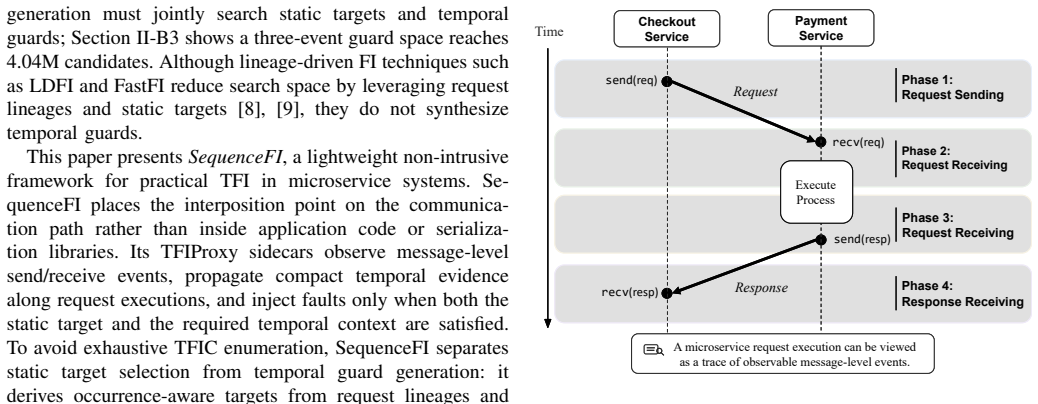
Summary. The paper proposes SequenceFI, a Kubernetes sidecar-based temporal fault injection framework for microservices. It models a request execution as a trace of message-level send/receive events, propagates compact evidence through an x-fic-evidence header, and injects a fault only when a static target and an After guard over occurrence-count atoms are both satisfied. Guard synthesis uses clean traces to compute minimum prefix counts at the intended target occurrence (Eq. (3)), build distinguishing sets against earlier occurrences (Eq. (4)), and solve a minimum hitting-set problem (Eq. (5)). The evaluation on four benchmarks and nine scenarios reports 100% temporal success over 450 valid trials, one-attempt TFIC generation, 95.91% end-to-end search-time reduction over H-Random, and low sidecar overhead.
Significance. If the central claims hold, the paper addresses a real and underexplored problem: controlling when a fault becomes active inside a distributed execution, not just where and what to inject. The formalization is clean, and the reduction of temporal-guard synthesis to a minimum hitting set is a principled way to avoid exhaustive enumeration. The sidecar implementation and the overhead measurements are also concrete and useful. However, the main evidence for the 100% temporal-success claim is currently a self-consistency check on the same workload used to synthesize the guards, and the oracle that defines 'valid trials' is underspecified. The approach is plausible, but the paper does not yet demonstrate that the synthesized guards transfer to varied live executions. The paper would be substantially strengthened by held-out or perturbed-trace validation and a fully auditable trial-validity definition.
major comments (4)
- [§VI-B and Eqs. (3)-(6)] The temporal guard is generated from 10 fault-free traces of the exact workload that is then used for the 50 injection trials. Eq. (3) takes minima over T_r and Eq. (4) only distinguishes earlier occurrences that appear in T_r. Consequently, the 100% temporal success is consistent with the guard being overfit to T_r, not with a transferable guarantee. A live trace with a lower prefix count at the target than the training minimum would cause a Miss; a different interleaving could make an earlier occurrence satisfy the guard and cause a Prem. The paper reports no held-out traces, no workload perturbation (e.g., varying concurrency or service delays), and no per-scenario confidence intervals. This is load-bearing for the central claim and needs direct validation.
- [§VI-B, metric definitions] The Miss condition is defined as 'no injection occurs within the intended temporal window when that window remains observable or can be aligned with a clean execution.' This introduces an unspecified oracle: what makes a window 'observable,' and how is alignment performed? The abstract reports '450 valid trials,' but the paper does not state how many raw trials were excluded per scenario or why. Without this information, the denominator of the 100% temporal-success result is not auditable. Please specify the validity rules and report both raw and valid trial counts for every scenario.
- [§IV-B, Eqs. (4)-(5)] For an earlier occurrence p, Dτ(p, iσ(τ)) is the set of atoms that are true at the target but false at p. If, in some trace, every atom in U_r,σ is already true at p, then D is empty and constraint (5) is unsatisfiable. The paper does not discuss this feasibility condition or report whether any scenario produced an empty distinguishing set. Since the 'no premature injection' guarantee rests on hitting every D, the presentation should either prove that a nonempty D always exists for the modeled patterns or qualify the claim and describe what the implementation does when the hitting set is infeasible.
- [§VI-C, Table VI] The RQ2 efficiency results report only single aggregate values for fault-injection attempts, solving time, and end-to-end time. H-Random and 3MileBeach-Random are stochastic baselines, so a single average over an unspecified number of independent runs is insufficient; the paper should report the number of repetitions and the distribution (or at least min/max) of attempts and times. Moreover, SequenceFI's one-attempt result is expected because the guard is synthesized from exactly the same traces used to define success; the comparison should be repeated with fresh traces and should report the full distribution of attempts. This is necessary to support the 95.91% reduction claim.
minor comments (5)
- [§V] The text says 'encodes only FIC-relevant events'; this appears to be a typo for 'TFIC-relevant events.'
- [Abstract and §V] The term 'non-intrusive' should be qualified: the approach avoids modifying application code and serialization libraries, but it does inject a sidecar and an admission webhook into the deployment. That is an infrastructure-level change and should be described as such.
- [§VI-D and Figs. 5-6] Throughput and resource-overhead results are averaged over 'at least six' repetitions, but the figures show no error bars or confidence intervals. Reporting variance would help assess the stability of the overhead comparison.
- [§VII-B] The threats-to-validity discussion does not mention trace variability or the train/test overlap between guard generation and RQ1 trials. The paper should address this explicitly, since it is the main external threat to the temporal-success claim.
- [General] No artifact link or code-release statement is provided, which makes independent replication of the Kubernetes prototype and the trace-generation experiments difficult.
Circularity Check
No significant circularity; guard synthesis and the RQ1/RQ2 evaluations are separate fitting and testing steps, with only a validity concern about trace transfer.
full rationale
SequenceFI's guard synthesis (Eqs. 3-6) does construct a guard that is true at the target occurrence and false at earlier occurrences on the trace set T_r, so on the 10 training traces the guard enforces the RQ1 success conditions by construction. However, RQ1 then evaluates on 50 separate injection trials after the guard is fixed; TS is defined by the behavioral oracle (CW/PS/Prem/Miss/Mult), not merely by the guard's truth value. A live trial with different event counts or interleaving could make the guard fire prematurely or miss, so the 100% result is not logically forced by Eq. (5) on held-out trials. The same-workload training/testing protocol in Section VI-B is a legitimate external-validity concern: the paper does not show the guard transfers to varied traces, and the Miss condition's 'aligned with a clean execution' qualifier is underspecified. But that is an evaluation weakness, not a circular reduction. The one-attempt RQ2 result is the intended behavior of a solver whose objective closely matches the RQ1 oracle, yet the comparison against H-Random is still an empirical efficiency measurement. The only self-citation (FastFI, ref. [9]) is used to adapt static configuration solving; the central temporal-guard contribution does not depend on a self-cited uniqueness theorem or an ansatz smuggled in by citation. No equation is defined in terms of the outcome it purportedly predicts.
Axiom & Free-Parameter Ledger
free parameters (2)
- Occurrence index k per scenario =
1-3 across scenarios (Table V)
- Number of clean traces used for guard generation =
10
axioms (5)
- domain assumption All target temporal scenarios can be expressed as monotonic After guards over positive occurrence-count atoms.
- domain assumption Message-level send/receive events observed at sidecars are sufficient and correctly propagated to reconstruct temporal context.
- domain assumption The 10 clean traces used for guard generation are representative of the 50 live trials.
- domain assumption Lineage-driven static-target selection from FastFI/LDFI produces correct candidate static configurations.
- domain assumption HTTP method-level classification (POST/PUT/PATCH/DELETE as state-changing) approximates side-effect behavior.
invented entities (3)
-
TFIProxy sidecar
no independent evidence
-
x-fic-evidence header
no independent evidence
-
tracestate token map
no independent evidence
Cite this review
Pith. "Pith review of SequenceFI: Non-intrusive Temporal Fault Injection for Microservice Systems." pith.science (2026). https://pith.science/paper/B4X2AEMO
@misc{pith2026260720050,
  author       = {Pith},
  title        = {Pith review of: SequenceFI: Non-intrusive Temporal Fault Injection for Microservice Systems},
  year         = {2026},
  howpublished = {\url{https://pith.science/paper/B4X2AEMO}},
  note         = {Machine review of arXiv:2607.20050}
}
read the original abstract
Fault injection is widely used to evaluate the resilience of microservice systems, where client requests often span multiple services and execution stages. Existing request-level techniques usually control where and what faults are injected, but not when they are activated within a distributed execution. This limitation makes it difficult to reproduce timing-dependent failures, such as failures after state-changing side effects, order-sensitive concurrent responses, and partial failures among repeated downstream calls. This paper presents SequenceFI, a non-intrusive framework for temporal fault injection in microservice systems. SequenceFI observes message-level send and receive events, propagates compact temporal evidence along request executions, and triggers faults only when occurrence-sensitive temporal guards are satisfied. It further synthesizes temporal guards from traces, reducing the need for exhaustive enumeration of temporal fault-injection configurations, while requiring no modifications to application code or serialization libraries. We implement SequenceFI on Kubernetes and evaluate it on four widely used microservice benchmarks. Across nine temporal-fault scenarios and 450 valid trials, SequenceFI achieves 100.0\% temporal success without premature or multiple injections, finds effective configurations in one attempt on average, and reduces aggregate end-to-end search time by 95.91\% compared with H-Random.
Figures


Reference graph
Works this paper leans on
-
[1]
Chaos engineering,
A. Basiri, N. Behnam, R. de Rooij, L. Hochstein, L. Kosewski, J. Reynolds, and C. Rosenthal, “Chaos engineering,”IEEE Software, vol. 33, no. 3, pp. 35–41, 2016
2016
-
[2]
Automating chaos experiments in production,
A. Basiri, L. Hochstein, N. Jones, and H. Tucker, “Automating chaos experiments in production,” in2019 IEEE/ACM 41st International Conference on Software Engineering: Software Engineering in Practice (ICSE-SEIP), 2019, pp. 31–40
2019
-
[3]
Chaos monkey,
Netflix, “Chaos monkey,” https://github.com/Netflix/chaosmonkey/, 2025
2025
-
[4]
Chaos mesh,
C. N. C. Foundation, “Chaos mesh,” https://chaos-mesh.org/, 2025
2025
-
[5]
Chaos blade,
C. N. C. Foundation, “Chaos blade,” https://chaosblade.io/, 2025
2025
-
[6]
Microfi: Non-intrusive and prioritized request-level fault injection for microservice applications,
H. Chen, P. Chen, G. Yu, X. Li, and Z. He, “Microfi: Non-intrusive and prioritized request-level fault injection for microservice applications,” IEEE Transactions on Dependable and Secure Computing, vol. 21, no. 5, pp. 4921–4938, 2024
2024
-
[7]
3milebeach: A tracer with teeth,
J. Zhang, R. Ferydouni, A. Montana, D. Bittman, and P. Alvaro, “3milebeach: A tracer with teeth,” inProceedings of the ACM Symposium on Cloud Computing, ser. SoCC ’21. New York, NY , USA: Association for Computing Machinery, 2021, p. 458–472. [Online]. Available: https://doi.org/10.1145/3472883.3486986
arXiv 2021
-
[8]
Lineage-driven fault injection,
P. Alvaro, J. Rosen, and J. M. Hellerstein, “Lineage-driven fault injection,” inProceedings of the 2015 ACM SIGMOD International Conference on Management of Data, ser. SIGMOD ’15. New York, NY , USA: Association for Computing Machinery, 2015, p. 331–346. [Online]. Available: https://doi.org/10.1145/2723372.2723711
arXiv 2015
-
[9]
Fastfi: Enhancing api call-site robustness in microservice-based systems with fault injection,
Y . Tan, J. Wang, S. Xie, B. Li, Y . Yong, N. Zhang, and S. Tan, “Fastfi: Enhancing api call-site robustness in microservice-based systems with fault injection,”ACM Trans. Softw. Eng. Methodol., May 2026, just Accepted. [Online]. Available: https://doi.org/10.1145/3813806
-
[10]
RFC 9110: HTTP Semantics,
R. T. Fielding, M. Nottingham, and J. Reschke, “RFC 9110: HTTP Semantics,” Internet Engineering Task Force, Request for Comments 9110, 2022, accessed: 2026-06-01. [Online]. Available: https://www.rfc-editor.org/rfc/rfc9110.html
2022
-
[11]
Microsoft Graph OpenAPI Metadata,
Microsoft, “Microsoft Graph OpenAPI Metadata,” GitHub repository, 2026, accessed: 2026-06-01. [Online]. Available: https://github.com/ microsoftgraph/msgraph-metadata
2026
-
[12]
Azure REST API Specifications,
Microsoft Azure, “Azure REST API Specifications,” GitHub repository, 2026, accessed: 2026-06-01. [Online]. Available: https://github.com/ Azure/azure-rest-api-specs
2026
-
[13]
Google APIs Discovery Artifact Manager,
Google, “Google APIs Discovery Artifact Manager,” GitHub repository, 2026, accessed: 2026-06-01. [Online]. Available: https://github.com/ googleapis/discovery-artifact-manager
2026
-
[14]
Cloudflare API Schemas,
Cloudflare, “Cloudflare API Schemas,” GitHub repository, 2026, accessed: 2026-06-01. [Online]. Available: https://github.com/cloudflare/ api-schemas
2026
-
[15]
GitHub REST API OpenAPI Description,
GitHub, “GitHub REST API OpenAPI Description,” GitHub repository, 2026, accessed: 2026-06-01. [Online]. Available: https://github.com/ github/rest-api-description
2026
-
[16]
DigitalOcean API v2 OpenAPI Specification,
DigitalOcean, “DigitalOcean API v2 OpenAPI Specification,” GitHub repository, 2026, accessed: 2026-06-01. [Online]. Available: https: //github.com/digitalocean/openapi
2026
-
[17]
Stripe OpenAPI Specification,
Stripe, “Stripe OpenAPI Specification,” GitHub repository, 2026, accessed: 2026-06-01. [Online]. Available: https://github.com/stripe/ openapi
2026
-
[18]
Jira Cloud Platform REST API v3,
Atlassian, “Jira Cloud Platform REST API v3,” Atlassian Developer Documentation, 2026, accessed: 2026-06-01. [Online]. Available: https://developer.atlassian.com/cloud/jira/platform/rest/v3/intro/
2026
-
[19]
GitHub Topics: Serialization Library,
GitHub, “GitHub Topics: Serialization Library,” https://github.com/ topics/serialization-library, accessed: 2026-06-01
2026
-
[20]
Kubernetes webhook,
C. N. C. Foundation, “Kubernetes webhook,” https://kubernetes.io/docs/ reference/access-authn-authz/webhook/, 2026
2026
-
[21]
Opentelemetry,
C. N. C. Foundation, “Opentelemetry,” https://opentelemetry.io/, 2026
2026
-
[22]
Trace context,
W. W. W. Consortium, “Trace context,” https://www.w3.org/TR/ trace-context/, 2021
2021
-
[23]
Online boutique,
G. C. Platform, “Online boutique,” https://github.com/ GoogleCloudPlatform/microservices-demo/, 2025
2025
-
[24]
Y . Gan, Y . Zhang, D. Cheng, A. Shetty, P. Rathi, N. Katarki, A. Bruno, J. Hu, B. Ritchken, B. Jackson, K. Hu, M. Pancholi, Y . He, B. Clancy, C. Colen, F. Wen, C. Leung, S. Wang, L. Zaruvinsky, M. Espinosa, R. Lin, Z. Liu, J. Padilla, and C. Delimitrou, “An open-source benchmark suite for microservices and their hardware- software implications for cloud...
arXiv 2019
-
[25]
Sock shop,
microservices demo, “Sock shop,” https://github.com/ microservices-demo/microservices-demo/, 2025
2025
-
[26]
Benchmarking microservice systems for software engineering research,
X. Zhou, X. Peng, T. Xie, J. Sun, C. Xu, C. Ji, and W. Zhao, “Benchmarking microservice systems for software engineering research,” inProceedings of the 40th International Conference on Software Engineering: Companion Proceeedings, ser. ICSE ’18. New York, NY , USA: Association for Computing Machinery, 2018, p. 323–324. [Online]. Available: https://doi.or...
arXiv 2018
-
[27]
Coverage based failure injection toward efficient chaos engineering,
H. Ikeuchi, A. Watanabe, and Y . Takahashi, “Coverage based failure injection toward efficient chaos engineering,” inICC 2023 - IEEE International Conference on Communications, 2023, pp. 4571–4577
2023
-
[28]
Fault injec- tion analytics: A novel approach to discover failure modes in cloud- computing systems,
D. Cotroneo, L. De Simone, P. Liguori, and R. Natella, “Fault injec- tion analytics: A novel approach to discover failure modes in cloud- computing systems,”IEEE Transactions on Dependable and Secure Computing, vol. 19, no. 3, pp. 1476–1491, 2022
2022
-
[29]
Fault injection based interventional causal learning for distributed applications,
Q. Wang, J. Rios, S. Jha, K. Shanmugam, F. Bagehorn, X. Yang, R. Filepp, N. Abe, and L. Shwartz, “Fault injection based interventional causal learning for distributed applications,”Proceedings of the AAAI Conference on Artificial Intelligence, vol. 37, no. 13, pp. 15 738–15 744, 2024
2024
-
[30]
Identifying and prioritizing chaos experiments by using established risk analysis techniques,
D. Kesim, A. van Hoorn, S. Frank, and M. H ¨aussler, “Identifying and prioritizing chaos experiments by using established risk analysis techniques,” in2020 IEEE 31st International Symposium on Software Reliability Engineering (ISSRE), 2020, pp. 229–240
2020
-
[31]
Maximizing error injection realism for chaos engineering with system calls,
L. Zhang, B. Morin, B. Baudry, and M. Monperrus, “Maximizing error injection realism for chaos engineering with system calls,”IEEE Transactions on Dependable and Secure Computing, vol. 19, no. 4, pp. 2695–2708, 2022
2022
-
[32]
Push-Button reliability testing for Cloud-Backed applications with rainmaker,
Y . Chen, X. Sun, S. Nath, Z. Yang, and T. Xu, “Push-Button reliability testing for Cloud-Backed applications with rainmaker,” in20th USENIX Symposium on Networked Systems Design and Implementation (NSDI 23). Boston, MA: USENIX Association, 2023, pp. 1701–1716. [Online]. Available: https://www.usenix.org/conference/ nsdi23/presentation/chen-yinfang
2023
-
[33]
J. Pan, H. Wu, T. Leesatapornwongsa, S. Nath, and P. Huang, “Efficient reproduction of fault-induced failures in distributed systems with feedback-driven fault injection,” inProceedings of the ACM SIGOPS 30th Symposium on Operating Systems Principles, ser. SOSP ’24. New York, NY , USA: Association for Computing Machinery, 2024, pp. 46–62. [Online]. Availa...
arXiv 2024
-
[34]
One-Size-Fits- None: Understanding and enhancing Slow-Fault tolerance in modern distributed systems,
R. Lu, Y . Lu, Y . Jiang, G. Xue, and P. Huang, “One-Size-Fits- None: Understanding and enhancing Slow-Fault tolerance in modern distributed systems,” in22nd USENIX Symposium on Networked Systems Design and Implementation (NSDI 25). Philadelphia, PA: USENIX Association, 2025, pp. 359–378. [Online]. Available: https://www.usenix.org/conference/nsdi25/prese...
2025
-
[35]
Automating failure testing research at internet scale,
P. Alvaro, K. Andrus, C. Sanden, C. Rosenthal, A. Basiri, and L. Hochstein, “Automating failure testing research at internet scale,” inProceedings of the Seventh ACM Symposium on Cloud Computing, ser. SoCC ’16. New York, NY , USA: Association for Computing Machinery, 2016, pp. 17–28. [Online]. Available: https://doi.org/10.1145/2987550.2987555
arXiv 2016
-
[36]
Fitness- guided resilience testing of microservice-based applications,
Z. Long, G. Wu, X. Chen, C. Cui, W. Chen, and J. Wei, “Fitness- guided resilience testing of microservice-based applications,” in2020 IEEE International Conference on Web Services (ICWS), 2020, pp. 151– 158
2020
-
[37]
Service-level fault injection testing,
C. S. Meiklejohn, A. Estrada, Y . Song, H. Miller, and R. Padhye, “Service-level fault injection testing,” inProceedings of the ACM Symposium on Cloud Computing, ser. SoCC ’21. New York, NY , USA: Association for Computing Machinery, 2021, pp. 388–402. [Online]. Available: https://doi.org/10.1145/3472883.3487005
arXiv 2021
-
[38]
Microres: Versatile resilience profiling in microservices via degradation dissemination indexing,
T. Yang, C. Lee, J. Shen, Y . Su, C. Feng, Y . Yang, and M. R. Lyu, “Microres: Versatile resilience profiling in microservices via degradation dissemination indexing,” inProceedings of the 33rd ACM SIGSOFT International Symposium on Software Testing and Analysis, ser. ISSTA 2024. New York, NY , USA: Association for Computing Machinery, 2024, pp. 325–337. ...
arXiv 2024
-
[39]
Gremlin: Systematic resilience testing of microservices,
V . Heorhiadi, S. Rajagopalan, H. Jamjoom, M. K. Reiter, and V . Sekar, “Gremlin: Systematic resilience testing of microservices,” in2016 IEEE 36th International Conference on Distributed Computing Systems (ICDCS), 2016, pp. 57–66
2016
discussion (0)
Sign in with ORCID, Apple, or X to comment. Anyone can read and Pith papers without signing in.