REVIEW 3 major objections 5 minor 96 references
The effective circuit degrees of freedom for a Hermitian observable are the quotient of the unitary group by the observable's stabilizer, with dimension n² − Σ n_j².
Reviewed by Pith at T0; open to challenge. T0 means a machine referee read the full paper against a public rubric. the ladder, T0–T4 →
T0 review · deepseek-v4-flash
2026-08-01 10:28 UTC pith:7QFUS45U
load-bearing objection Correct Lie-group geometry of the Hermitian orbit, but the practical ansatz-selection score is not actually shown to work because the experiment confounds score with gate position and generator family. the 3 major comments →
Observable Geometry for Effective Quantum Circuits
The pith
A machine-rendered reading of the paper's core claim, the machinery that carries it, and where it could break.
Core claim
For a Hermitian observable H with distinct eigenvalues λ_j and eigenspaces W_j, the stabilizer S = {A ∈ U(V) : [H,A]=0} decomposes as the product U(W_1) × ... × U(W_k). Consequently the quotient space S\U(V), which parameterizes all distinct conjugation maps U†HU, is a smooth homogeneous space equivariantly diffeomorphic to the Hermitian orbit M_H = {U†HU}. Its real dimension is n² − Σ_j n_j², with n_j = dim W_j. This formula shows that degeneracy of H reduces the effective circuit degrees of freedom: a totally degenerate H gives zero effective motion, while a non-degenerate H reaches the maximum n² − n. The paper further introduces a stabilizer-overlap score s(A) = ‖Σ_j T_j A T_j‖²_F / ‖A‖²
What carries the argument
The central object is the stabilizer subgroup S = {A ∈ U(V) | [H,A]=0}, together with its decomposition as a product of unitary groups on the eigenspaces of H. This turns the quotient S\U(V) into a homogeneous space (a smooth manifold) that is equivariantly diffeomorphic to the conjugation orbit M_H. The dimension count dim_R M_H = n² − Σ n_j² is the load-bearing formula that quantifies the effective degrees of freedom. For practical use, the paper defines the stabilizer-overlap score s(A) = ‖Π_{is}(A)‖²_F / ‖A‖²_F, where Π_{is} projects a Hermitian generator onto the stabilizer algebra; a low score means the generator produces visible motion in the observable.
Load-bearing premise
The central claim assumes that the dimension and score ordering computed from the full unitary orbit on H transfer to the much smaller submanifold explored by a fixed-depth variational ansatz; if that transfer fails, the practical recommendation to prefer low-stabilizer-overlap generators is unsupported.
What would settle it
A concrete counterexample would be a Hamiltonian and a fixed-depth ansatz where the generator with the lowest stabilizer-overlap score systematically achieves worse VQE energy than a higher-score generator, or where pruning all high-score gates leaves the achievable energy unchanged. More directly, compute the dimension of the Lie algebra generated by an ansatz and check whether the achieved energy correlates with the dimension of that generated group's orbit, not with the full-orbit dimension n² − Σ n_j².
If this is right
- Ansatz generators with high stabilizer-overlap score can be removed without affecting the reachable expectation values, shortening circuit depth and reducing noise.
- The dimension formula n² − Σ n_j² provides an upper bound n² − n on the effective observable degrees of freedom for any Hermitian, achieved exactly by non-degenerate Hamiltonians.
- For a totally degenerate Hamiltonian H = λI, the effective circuit space has dimension zero, so every unitary circuit is redundant for optimizing that observable.
- The stabilizer-overlap score can be computed from the spectral decomposition of H before running a variational algorithm, enabling a pre-optimization pruning of gate sets.
- The homogeneous-space identification suggests that geometric optimization on the quotient S\U(V) could replace optimization over the full unitary group, potentially mitigating trainability issues.
Where Pith is reading between the lines
- The dimension formula counts the full unitary orbit, but a fixed-depth ansatz explores only the submanifold generated by its own gates; a natural extension is to compute the analogous dimension for the Lie algebra generated by a specific ansatz and use that as the practical effective dimension.
- The stabilizer-overlap score could be extended from per-generator comparison to a collective score for an entire gate set, enabling direct comparison of different ansatz architectures before optimization.
- Because the score is based on infinitesimal generators, it does not capture finite-parameter interference; an interesting test would compare score ordering with landscape metrics such as the quantum Fisher information or the reachable-state effective dimension.
- The construction S\U(V) ≅ M_H may generalize to qudits or fermionic systems with non-abelian symmetries, offering a unified treatment of gauge freedom in analog quantum simulation.
Editorial analysis
A structured set of objections, weighed in public.
Referee Report
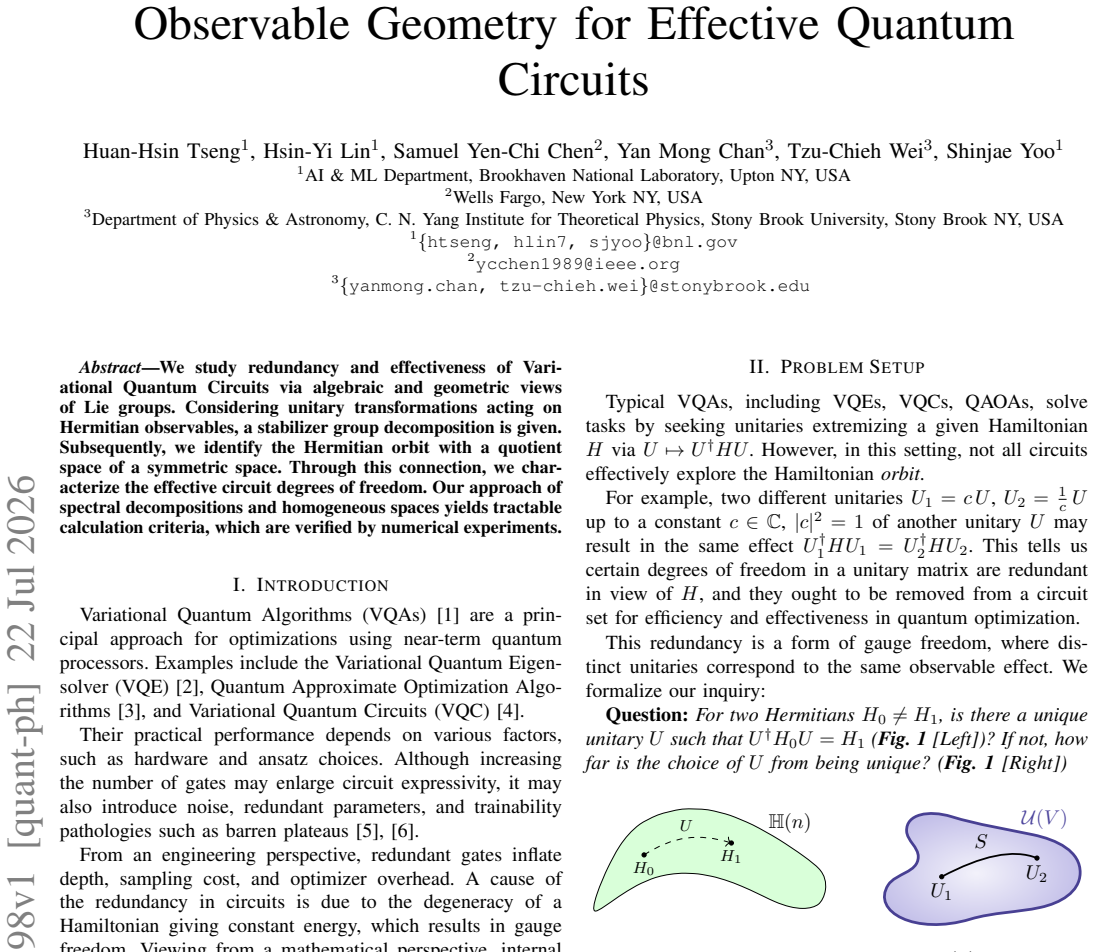
Summary. The paper studies redundancy and effectiveness of variational quantum circuits by analyzing the action of U(V) on a Hermitian observable H by conjugation. It defines the stabilizer S of H, proves S decomposes as a product of unitary groups on eigenspaces (Theorem 2), identifies the quotient S\U(V) with the Hermitian orbit M_H via an equivariant diffeomorphism (Theorem 4, Corollary 2), and derives the real dimension of M_H as n^2 − Σ n_j^2 (Eq. 10). It then introduces a stabilizer-overlap score s(A) (Eq. 13) and reports a VQE experiment (Sec. V) in which an ansatz built from low-score generators reaches lower energy than one built from high-score generators. The mathematical part is a correct and clean application of homogeneous-space theory; the practical ansatz-selection claim rests on assumptions and an experiment that do not currently support it.
Significance. If the practical criterion were established, it would provide a cheap, spectral-data-based rule for pruning redundant generators in variational ans"atze, with relevance to VQE, QAOA, and quantum architecture search. The paper's mathematical contribution—characterizing the full unitary orbit of a degenerate Hamiltonian as a homogeneous space and giving its dimension—is sound and potentially useful as a reference for gauge freedom in observable space. However, the central practical claim connecting this full-orbit geometry to fixed-depth circuit optimization is not supported by the presented theory or the numerical experiment. The paper also contributes a reproducible code link, which is a strength, but the experiment lacks essential controls and details.
major comments (3)
- [Sec. V.A, Eq. (13), Eq. (15)] The stabilizer-overlap score s(A) is presented as a position-independent measure of a generator's redundancy in a circuit, but redundancy is position-dependent. For a circuit U = V R_A W, the objective is W^† R_A^† (V^† H V) R_A W, not W^† R_A^† H R_A W. If A commutes with H, then R_A† H R_A = H, but R_A does not commute with V^† H V unless V also commutes with H. Hence s(A)=1 implies 'no change to the terminal cost' only when A is the leftmost (final) factor in the product, i.e., when there is no V after it. This is exactly the position where U_high and U_low differ not only in score but also in ordering, confounding the comparison. The statement in Sec. V.A that s(A)=1 'giving no change to the terminal cost' is therefore valid only in a special position, not as a general circuit-redundancy criterion.
- [Sec. IV–V, Eq. (10)] The dimension count (10) describes the orbit M_H under the full unitary group U(V). A concrete variational ansatz explores the orbit of the Lie subgroup generated by its own gates, which is generally a much smaller submanifold. The paper does not prove that the full-orbit dimension—or the stabilizer-overlap ordering derived from the full stabilizer S—transfers to a fixed-depth, fixed-generator circuit. Theorems 1–4 are mathematically correct for the full group action, but the claim that low-score generators are 'more effective' in practical variational circuits requires an additional argument linking the full orbit to the reachable set of a given ansatz. This missing link is load-bearing for the paper's applied conclusion.
- [Sec. V.C, Fig. 2(b), Eq. (14)] The VQE experiment is not sufficiently controlled or described to support the strong quantitative claim. The coefficients J_ij and K_ij,kℓ in Eq. (14) are never specified, so the Hamiltonian is not fully defined. The optimizer, initial parameters, learning rates, and stopping criteria are not given; 'the same engineering setting' is vague. Only 6 trials per ansatz are run, with overlapping error bars (E_low = −8.06±1.2, E_high = −1.84±0.76). More importantly, U_high and U_low differ in both generator score and gate order (by construction in Eq. (15)), so any observed energy gap cannot be uniquely attributed to the score. A matched baseline—e.g., random generator order with the same mean score or a permutation of the same generator families—is needed to separate these factors. Without that, the experiment only shows that a circuit of low-score 2-qubit rotations outperformed a circuit cont
minor comments (5)
- [Abstract] The abstract says the Hermitian orbit is identified with 'a quotient space of a symmetric space.' The space S\U(V) is a homogeneous space, but it is not necessarily a symmetric space when H has more than two distinct eigenvalues (the flag manifold U(n)/(U(n1)×...×U(nk)) is not a symmetric space for k>2). Please adjust the wording to 'homogeneous space.'
- [Sec. II] The parenthetical about non-normality reads 'may not be normal (U SU^{-1} ⊆ S for all U∈U(V))'. This condition is actually a consequence of normality, not a statement of non-normality. It should be something like 'it is not the case that USU^{-1} ⊆ S for all U,' or 'USU^{-1} ≠ S in general.'
- [Sec. III] In the spectral decomposition, 'T_j : V → W_j' is described as 'an orthogonal projection onto eigenspace W_j⊆W_j'; the inclusion should be W_j⊆V. Also, the derivation of Eq. (5) contains index inconsistencies (T_i vs T_j) that should be corrected for clarity.
- [Sec. V.B] The Hamiltonian coefficients J_ij and K_ij,kℓ in Eq. (14) are said to be complex but no actual values, ranges, or random seeds are given. Without these, the experiment is not reproducible. Please provide the full Hamiltonian data or a link to a file with exact coefficients.
- [Sec. V.C] The phrase 'with the same engineering setting' is vague. State the optimizer (e.g., Adam, COBYLA), number of iterations, parameter initialization strategy, and hardware/noise model (if simulation) so that the 6 trials can be meaningfully interpreted.
Circularity Check
No significant circularity: the orbit-stabilizer derivation is self-contained and the score is computed from H independently of the VQE energies; the experiment is a genuine numerical test.
full rationale
The paper's mathematical chain (Theorem 1 -> Theorem 2 -> Theorems 3/4 -> Corollary 2 -> dimension formula (10)) is self-contained or cites the external textbook Lee [10] for standard homogeneous-space facts; no step assumes the VQE outcome. The stabilizer-overlap score (13) is a pure function of H and the generator A, not fitted to any energy, so the U_low/U_high comparison is not a fitted parameter renamed as prediction. The claim that s(A)=1 generators are redundant is a direct consequence of the definition of S, but the paper uses it as a criterion and then tests it numerically, not as a post-hoc explanation. The only substantive caveat is validity, not circularity: the statement 's(A)=1 gives no change to the terminal cost' is position-dependent in a product circuit (the generator must be the last applied gate), and Eq. (15) varies gate order and family composition along with score, so the quantitative ranking is confounded. This weakens the practical conclusion but does not make the derivation equivalent to its inputs.
Axiom & Free-Parameter Ledger
free parameters (1)
- ansatz generator count r =
24
axioms (4)
- domain assumption Spectral decomposition H = Σ λ_j T_j with orthogonal eigenspace projectors (Theorem 2)
- standard math Closed-subgroup homogeneous-space theorems (Lee [10]) give S\U(V) a smooth manifold and F an equivariant diffeomorphism.
- ad hoc to paper The variational optimization search space can be modeled by the full conjugation orbit {U†HU | U ∈ U(V)}.
- domain assumption The 8-qubit Hamiltonian has global SU(2) symmetry, [H, A_α]=0 for collective Paulis A_α.
read the original abstract
We study redundancy and effectiveness of Variational Quantum Circuits via algebraic and geometric views of Lie groups. Considering unitary transformations acting on Hermitian observables, a stabilizer group decomposition is given. Subsequently, we identify the Hermitian orbit with a quotient space of a symmetric space. Through this connection, we characterize the effective circuit degrees of freedom. Our approach of spectral decompositions and homogeneous spaces yields tractable calculation criteria, which are verified by numerical experiments.
Figures

Reference graph
Works this paper leans on
-
[1]
Proceedings of the IEEE conference on computer vision and pattern recognition , pages=
Learning deep features for discriminative localization , author=. Proceedings of the IEEE conference on computer vision and pattern recognition , pages=
-
[2]
Proceedings of the IEEE international conference on computer vision , pages=
Grad-cam: Visual explanations from deep networks via gradient-based localization , author=. Proceedings of the IEEE international conference on computer vision , pages=
-
[3]
2018 IEEE winter conference on applications of computer vision (WACV) , pages=
Grad-cam++: Generalized gradient-based visual explanations for deep convolutional networks , author=. 2018 IEEE winter conference on applications of computer vision (WACV) , pages=. 2018 , organization=
2018
-
[4]
2020 , publisher=
Modern quantum mechanics , author=. 2020 , publisher=
2020
-
[5]
Lee, John M. Smooth Manifolds. Introduction to Smooth Manifolds. 2012. doi:10.1007/978-1-4419-9982-5_1
-
[6]
National Institute of Standards and Technology (NIST), Gaithersburgh, MD , volume=
Getting started with the DARPA TIMIT CD-ROM: An acoustic phonetic continuous speech database , author=. National Institute of Standards and Technology (NIST), Gaithersburgh, MD , volume=
-
[7]
Why should i trust you?
" Why should i trust you?" Explaining the predictions of any classifier , author=. Proceedings of the 22nd ACM SIGKDD international conference on knowledge discovery and data mining , pages=
-
[8]
Advances in neural information processing systems , volume=
A unified approach to interpreting model predictions , author=. Advances in neural information processing systems , volume=
-
[9]
Proceedings of the AAAI conference on artificial intelligence , volume=
Anchors: High-precision model-agnostic explanations , author=. Proceedings of the AAAI conference on artificial intelligence , volume=
-
[10]
Journal of Machine Learning Research , volume=
All models are wrong, but many are useful: Learning a variable's importance by studying an entire class of prediction models simultaneously , author=. Journal of Machine Learning Research , volume=
-
[11]
International conference on machine learning , pages=
Accuracy, interpretability, and differential privacy via explainable boosting , author=. International conference on machine learning , pages=. 2021 , organization=
2021
-
[12]
1999 Reitz lecture , author=. Ann. Stat. , volume=
1999
-
[13]
journal of Computational and Graphical Statistics , volume=
Peeking inside the black box: Visualizing statistical learning with plots of individual conditional expectation , author=. journal of Computational and Graphical Statistics , volume=. 2015 , publisher=
2015
-
[14]
Computer Vision--ECCV 2014: 13th European Conference, Zurich, Switzerland, September 6-12, 2014, Proceedings, Part I 13 , pages=
Visualizing and understanding convolutional networks , author=. Computer Vision--ECCV 2014: 13th European Conference, Zurich, Switzerland, September 6-12, 2014, Proceedings, Part I 13 , pages=. 2014 , organization=
2014
-
[15]
arXiv preprint arXiv:1412.6856 , year=
Object detectors emerge in deep scene cnns , author=. arXiv preprint arXiv:1412.6856 , year=
-
[16]
Proceedings of the IEEE conference on computer vision and pattern recognition , pages=
Understanding deep image representations by inverting them , author=. Proceedings of the IEEE conference on computer vision and pattern recognition , pages=
-
[17]
arXiv preprint arXiv:1506.02753 , volume=
Inverting convolutional networks with convolutional networks , author=. arXiv preprint arXiv:1506.02753 , volume=. 2015 , publisher=
Pith/arXiv arXiv 2015
-
[18]
International Journal of Computer Vision , volume=
Visualizing deep convolutional neural networks using natural pre-images , author=. International Journal of Computer Vision , volume=. 2016 , publisher=
2016
-
[19]
Proceedings of the IEEE conference on computer vision and pattern recognition , pages=
Is object localization for free?-weakly-supervised learning with convolutional neural networks , author=. Proceedings of the IEEE conference on computer vision and pattern recognition , pages=
-
[20]
Proceedings of the IEEE conference on computer vision and pattern recognition , pages=
From image-level to pixel-level labeling with convolutional networks , author=. Proceedings of the IEEE conference on computer vision and pattern recognition , pages=
-
[21]
2008 , publisher=
Riemannian geometry and geometric analysis , author=. 2008 , publisher=
2008
-
[22]
2012 , publisher=
Matrix analysis , author=. 2012 , publisher=
2012
-
[23]
2002 , publisher=
Classical and quantum computation , author=. 2002 , publisher=
2002
-
[24]
arXiv preprint quant-ph/0504050 , year=
The complexity of quantum spin systems on a two-dimensional square lattice , author=. arXiv preprint quant-ph/0504050 , year=
-
[25]
International conference on machine learning , pages=
A convergence theory for deep learning via over-parameterization , author=. International conference on machine learning , pages=. 2019 , organization=
2019
-
[26]
2020 , publisher=
Quantum mechanics , author=. 2020 , publisher=
2020
-
[27]
and Nielsen, Michael A
Dawson, Christopher M. and Nielsen, Michael A. , title =. Quantum Info. Comput. , month = jan, pages =. 2006 , issue_date =
2006
-
[28]
arXiv preprint arXiv:2306.13158 , year=
Breaking the cubic barrier in the Solovay-Kitaev algorithm , author=. arXiv preprint arXiv:2306.13158 , year=
-
[29]
Nature , volume=
Quantum machine learning , author=. Nature , volume=. 2017 , publisher=
2017
-
[30]
Physical Review A , volume=
Effect of data encoding on the expressive power of variational quantum-machine-learning models , author=. Physical Review A , volume=. 2021 , publisher=
2021
-
[31]
2025 IEEE International Conference on Quantum Computing and Engineering (QCE) , volume=
Adaptive non-local observable on quantum neural networks , author=. 2025 IEEE International Conference on Quantum Computing and Engineering (QCE) , volume=. 2025 , organization=
2025
-
[32]
2025 IEEE International Conference on Quantum Computing and Engineering (QCE) , volume=
Quantum reinforcement learning by adaptive non-local observables , author=. 2025 IEEE International Conference on Quantum Computing and Engineering (QCE) , volume=. 2025 , organization=
2025
-
[33]
Lin, Hsin-Yi and Tseng, Huan-Hsin and Chen, Samuel Yen-Chi and Yoo, Shinjae , title =. 2026 , archivePrefix =. doi:10.48550/arXiv.2601.14433 , url =. 2601.14433 , primaryClass =
-
[34]
Reviews of Modern Physics , volume=
Noisy intermediate-scale quantum algorithms , author=. Reviews of Modern Physics , volume=. 2022 , publisher=
2022
-
[35]
arXiv preprint arXiv:1411.4028 , year=
A quantum approximate optimization algorithm , author=. arXiv preprint arXiv:1411.4028 , year=
-
[36]
PRX Quantum , volume=
Capacity and quantum geometry of parametrized quantum circuits , author=. PRX Quantum , volume=. 2021 , publisher=
2021
-
[37]
Advanced Quantum Technologies , volume=
Expressibility and entangling capability of parameterized quantum circuits for hybrid quantum-classical algorithms , author=. Advanced Quantum Technologies , volume=. 2019 , publisher=
2019
-
[38]
Nature communications , volume=
Barren plateaus in quantum neural network training landscapes , author=. Nature communications , volume=. 2018 , publisher=
2018
-
[39]
npj Quantum Information , volume=
Quantum circuit architecture search for variational quantum algorithms , author=. npj Quantum Information , volume=. 2022 , publisher=
2022
-
[40]
arXiv preprint arXiv:2104.07715 , year=
Quantum architecture search via deep reinforcement learning , author=. arXiv preprint arXiv:2104.07715 , year=
-
[41]
arXiv preprint arXiv:2405.08917 , year=
Feature Importance and Explainability in Quantum Machine Learning , author=. arXiv preprint arXiv:2405.08917 , year=
-
[42]
arXiv preprint arXiv:2301.09138 , year=
Explaining quantum circuits with shapley values: Towards explainable quantum machine learning , author=. arXiv preprint arXiv:2301.09138 , year=
-
[43]
Nature Computational Science , volume=
The power of quantum neural networks , author=. Nature Computational Science , volume=. 2021 , publisher=
2021
-
[44]
Physical Review Research , volume=
Expressive power of parametrized quantum circuits , author=. Physical Review Research , volume=. 2020 , publisher=
2020
-
[45]
Nature communications , volume=
Generalization in quantum machine learning from few training data , author=. Nature communications , volume=. 2022 , publisher=
2022
-
[46]
Nature Communications , volume=
Out-of-distribution generalization for learning quantum dynamics , author=. Nature Communications , volume=. 2023 , publisher=
2023
-
[47]
Physical Review A , volume=
Quantum circuit learning , author=. Physical Review A , volume=. 2018 , publisher=
2018
-
[48]
ICASSP 2022-2022 IEEE International Conference on Acoustics, Speech and Signal Processing (ICASSP) , pages=
Quantum long short-term memory , author=. ICASSP 2022-2022 IEEE International Conference on Acoustics, Speech and Signal Processing (ICASSP) , pages=. 2022 , organization=
2022
-
[49]
ICASSP 2022-2022 IEEE International Conference on Acoustics, Speech and Signal Processing (ICASSP) , pages=
The dawn of quantum natural language processing , author=. ICASSP 2022-2022 IEEE International Conference on Acoustics, Speech and Signal Processing (ICASSP) , pages=. 2022 , organization=
2022
-
[50]
2023 IEEE International Conference on Quantum Computing and Engineering (QCE) , volume=
Applying QNLP to sentiment analysis in finance , author=. 2023 IEEE International Conference on Quantum Computing and Engineering (QCE) , volume=. 2023 , organization=
2023
-
[51]
ICASSP 2023-2023 IEEE International Conference on Acoustics, Speech and Signal Processing (ICASSP) , pages=
Pqlm-multilingual decentralized portable quantum language model , author=. ICASSP 2023-2023 IEEE International Conference on Acoustics, Speech and Signal Processing (ICASSP) , pages=. 2023 , organization=
2023
-
[52]
Physical Review Research , volume=
Quantum convolutional neural networks for high energy physics data analysis , author=. Physical Review Research , volume=. 2022 , publisher=
2022
-
[53]
Nature Physics , volume=
Quantum convolutional neural networks , author=. Nature Physics , volume=. 2019 , publisher=
2019
-
[54]
Proceedings of the AAAI Conference on Artificial Intelligence , volume=
Quantum multi-agent meta reinforcement learning , author=. Proceedings of the AAAI Conference on Artificial Intelligence , volume=
-
[55]
Proceedings of the AAAI conference on artificial intelligence and interactive digital entertainment , volume=
Reinforcement learning with quantum variational circuit , author=. Proceedings of the AAAI conference on artificial intelligence and interactive digital entertainment , volume=
-
[56]
IEEE access , volume=
Variational quantum circuits for deep reinforcement learning , author=. IEEE access , volume=. 2020 , publisher=
2020
-
[57]
Machine Learning: Science and Technology , volume=
An end-to-end trainable hybrid classical-quantum classifier , author=. Machine Learning: Science and Technology , volume=. 2021 , publisher=
2021
-
[58]
Machine Learning: Science and Technology , volume=
Variational quantum reinforcement learning via evolutionary optimization , author=. Machine Learning: Science and Technology , volume=. 2022 , publisher=
2022
-
[59]
Quantum , volume=
Transfer learning in hybrid classical-quantum neural networks , author=. Quantum , volume=. 2020 , publisher=
2020
-
[60]
Nature Communications , volume=
Quantum machine learning beyond kernel methods , author=. Nature Communications , volume=. 2023 , publisher=
2023
-
[61]
npj Quantum Information , volume=
Demonstration of quantum advantage in machine learning , author=. npj Quantum Information , volume=. 2017 , publisher=
2017
-
[62]
Huck and Chen, Pin-Yu , year =
Qi, Jun and Yang, C.-H. Huck and Chen, Pin-Yu , year =. QTN-VQC: An End-to-End Learning Framework for Quantum Neural Networks , volume =. Physica Scripta , doi =
-
[63]
ICASSP 2022-2022 IEEE International Conference on Acoustics, Speech and Signal Processing (ICASSP) , pages=
When BERT Meets Quantum Temporal Convolution Learning for Text Classification in Heterogeneous Computing , author=. ICASSP 2022-2022 IEEE International Conference on Acoustics, Speech and Signal Processing (ICASSP) , pages=. 2022 , organization=
2022
-
[64]
ICASSP 2023-2023 IEEE International Conference on Acoustics, Speech and Signal Processing (ICASSP) , pages=
Quantum deep recurrent reinforcement learning , author=. ICASSP 2023-2023 IEEE International Conference on Acoustics, Speech and Signal Processing (ICASSP) , pages=. 2023 , organization=
2023
-
[65]
Quantum , volume=
Quantum agents in the gym: a variational quantum algorithm for deep q-learning , author=. Quantum , volume=. 2022 , publisher=
2022
-
[66]
Advances in Neural Information Processing Systems , volume=
Parametrized quantum policies for reinforcement learning , author=. Advances in Neural Information Processing Systems , volume=
-
[67]
arXiv preprint arXiv:2207.10221 , year=
Slimmable quantum federated learning , author=. arXiv preprint arXiv:2207.10221 , year=
-
[68]
2022 IEEE 42nd International Conference on Distributed Computing Systems (ICDCS) , pages=
Quantum multi-agent reinforcement learning via variational quantum circuit design , author=. 2022 IEEE 42nd International Conference on Distributed Computing Systems (ICDCS) , pages=. 2022 , organization=
2022
-
[69]
2024 IEEE Workshop on Signal Processing Systems (SiPS) , pages=
Qeegnet: Quantum machine learning for enhanced electroencephalography encoding , author=. 2024 IEEE Workshop on Signal Processing Systems (SiPS) , pages=. 2024 , organization=
2024
-
[70]
2024 IEEE Workshop on Signal Processing Systems (SiPS) , pages=
Quantum Gradient Class Activation Map for Model Interpretability , author=. 2024 IEEE Workshop on Signal Processing Systems (SiPS) , pages=. 2024 , organization=
2024
-
[71]
arXiv preprint arXiv:2402.17760 , year=
Learning to Program Variational Quantum Circuits with Fast Weights , author=. arXiv preprint arXiv:2402.17760 , year=
-
[72]
Quantum Machine Intelligence , volume=
Federated quantum long short-term memory (fedqlstm) , author=. Quantum Machine Intelligence , volume=. 2024 , publisher=
2024
-
[73]
arXiv preprint arXiv:2501.05663 , year=
Learning to Measure Quantum Neural Networks , author=. arXiv preprint arXiv:2501.05663 , year=
-
[74]
Prx quantum , volume=
Learning to measure: Adaptive informationally complete generalized measurements for quantum algorithms , author=. Prx quantum , volume=. 2021 , publisher=
2021
-
[75]
nature , volume=
Hardware-efficient variational quantum eigensolver for small molecules and quantum magnets , author=. nature , volume=. 2017 , publisher=
2017
-
[76]
New Journal of Physics , volume=
The theory of variational hybrid quantum-classical algorithms , author=. New Journal of Physics , volume=. 2016 , publisher=
2016
-
[77]
Nature communications , volume=
A variational eigenvalue solver on a photonic quantum processor , author=. Nature communications , volume=. 2014 , publisher=
2014
-
[78]
Quantum , volume=
Structure optimization for parameterized quantum circuits , author=. Quantum , volume=. 2021 , publisher=
2021
-
[79]
Physical Review B , volume=
Strategies for solving the Fermi-Hubbard model on near-term quantum computers , author=. Physical Review B , volume=. 2020 , publisher=
2020
-
[80]
Physical Review A , volume=
Performance comparison of optimization methods on variational quantum algorithms , author=. Physical Review A , volume=. 2023 , publisher=
2023
discussion (0)
Sign in with ORCID, Apple, or X to comment. Anyone can read and Pith papers without signing in.