REVIEW 4 major objections 5 minor 53 references
The key to visible-infrared pre-training is weighting patches by reliability, not aligning them all equally.
Reviewed by Pith at T0; open to challenge. T0 means a machine referee read the full paper against a public rubric. the ladder, T0–T4 →
Reweighting visible-infrared pre-training patches by infrared structural reliability improves downstream segmentation, detection, and retrieval by small, mostly consistent margins.
T0 review reviewed 2026-08-01 challenge →
load-bearing objection Good question, plausible method, but the evidence is muddier than the prose: the retrieval results contradict the paper's 'consistent improvement' claim, and the reproduced baseline is not a clean control. the 4 major comments →
Not All Patches are Equal: Sampling Matters for Visible-Infrared Pre-Training
The pith
A machine-rendered reading of the paper's core claim, the machinery that carries it, and where it could break.
The reading
Core claim
The paper's claim is that uniformly aligning all spatially paired visible-infrared patches is suboptimal. It identifies four failure modes—textureless infrared regions, homogeneous weak-gradient areas, modality-specific artifacts, and residual misregistration—and shows empirically that infrared patches with low edge strength incur higher contrastive loss. IAS converts infrared structural cues into per-patch importance weights, optionally learned by a small network warm-started from those hand-crafted cues, and applies the weights to the contrastive objective through loss reweighting or importance pooling, with a curriculum that starts from confident patches and expands. On downstream infrare
What carries the argument
The load-bearing object is the per-patch importance weight, a scalar between zero and one that gates how much each visible-infrared patch pair contributes. It is instantiated three ways: a Sobel/HOG structural prior pooled per patch and normalized; a two-layer MLP sampler that predicts a soft importance mask from infrared patch embeddings, optionally warm-started by the prior; and a curriculum mask that keeps only the top fraction of patches early and linearly expands coverage. These weights enter three objective variants: they reweight patch-level contrastive losses, they weight correlations in a correlation-alignment loss, and they pool infrared tokens into a global representation for imag
Load-bearing premise
The decisive assumption is that the reference model used for comparison is an exact control, so the reported gains are caused by the sampling weights and not by implementation differences; the paper's own tables show reproduction gaps that are sometimes larger than the gains it attributes to sampling.
What would settle it
Re-run one downstream transfer benchmark with the exact same pre-training code and hyperparameters in two conditions—uniform patch weights and importance-aware weights—repeatedly enough to estimate run-to-run variance. The claim is falsified if the importance-weighted run does not beat the uniform run by more than that variance, or if the gap disappears once the baseline is re-run inside the same codebase.
If this is right
- Because IAS only changes patch selection and loss weighting, it can be dropped into image-level, patch-level, and correlation-based alignment objectives without retraining the backbone.
- Soft importance weighting outperforms hard patch truncation, suggesting the benefit comes from down-weighting unreliable gradients rather than discarding patches.
- A learned sampler warm-started by hand-crafted infrared cues beats either cue alone, indicating that the importance mask should adapt to data.
- The same pre-trained representation improves infrared segmentation and detection while also transferring to visible-only segmentation, evidence that the weighting improves general alignment quality.
Where Pith is reading between the lines
- The observed relationship between edge strength and contrastive loss suggests a cheap, label-free diagnostic: monitoring the correlation between patch importance and patch loss during pre-training could flag when the weighting is mis-calibrated.
- The same gating idea should transfer to other asymmetric modality pairs, such as visible and synthetic-aperture radar, which the paper lists as future work; one testable expectation is that gains scale with the fraction of unreliable correspondences.
- If the gains survive at larger scales and with more recent backbones, importance-aware weighting could become a default component of multimodal pre-training rather than a task-specific trick.
- The paper does not separate whether the improvement comes from suppressing noisy gradients or from a milder, implicit regularization effect; a controlled comparison against uniform weighting with increased loss sharpening could disentangle these.
Editorial analysis
A structured set of objections, weighed in public.
Referee Report
Summary. The paper argues that in visible-infrared (VIS-IR) pre-training, treating all spatially paired patches as equally trustworthy is suboptimal, because imaging-physics differences make some patches poorly alignable across modalities. It proposes Importance-Aware Sampling (IAS), a plug-and-play training strategy that (i) computes a hand-crafted structural prior (Sobel/HOG) from the infrared image to assign per-patch importance weights, (ii) optionally replaces or warm-starts a lightweight learned sampler that predicts soft importance masks from infrared patch embeddings, and (iii) applies a curriculum that gradually expands training from high-importance to low-importance patches. These weights are used to reweight image-level, patch-level, or correlation-based contrastive objectives. The method is evaluated on infrared semantic segmentation (MFNet, SODA, SCUTSEG, MSRS), infrared object detection (M3FD), visible semantic segmentation (ADE20K), and visible-infrared retrieval (M3FD subset). The central claim is that IAS consistently improves over strong baselines, including the official UNIV checkpoint and its own reproduction of UNIV.
Significance. If the central claim is fully supported, the paper makes a useful contribution: it identifies a rarely examined assumption in VIS-IR pre-training, proposes a simple and low-cost reweighting mechanism (0.107M additional parameters, according to the overhead analysis), and demonstrates plug-and-play behavior across three alignment paradigms. The formulation in Eqs. (9)-(13) is clear, and the ablation study covers importance sources, hard vs. soft weighting, and curriculum schedules. The code release would aid reproducibility. However, the evidence for the 'consistent improvements' claim is weakened by a large reproduction gap between the official UNIV* and the reproduced UNIV† baseline, by a direct contradiction in the retrieval results, by missing statistical reliability, and by an ablation that does not fully support the claim that the learned sampler is best. These issues are load-bearing because the method's benefit is measured relative to the reproduced baseline.
major comments (4)
- [§4.2, Table 3] The retrieval results contradict the paper's claim of 'consistent improvements over strong baselines.' On every metric in Table 3, IAS(UNIV-style) is below the official UNIV* checkpoint: e.g., V2I R@1 is 13.80 vs. 15.95, V2I R@10 is 44.52 vs. 48.69, and I2V R@10 is 29.64 vs. 39.52. The text acknowledges only gains over the reproduced UNIV† baseline, whose mRecall is 24.94 versus 30.65 for UNIV*. Moreover, the retrieval prose cites '56.71% R@1 for visible2infrared and 58.07% R@1 for infrared2visible,' but Table 3 reports IAS(Image-style) R@1 values of 82.14 and 83.33; the numbers 56.71/58.07 appear in no table. The authors should correct the prose, report official-baseline comparisons for all retrieval metrics, and either retract or substantiate the consistency claim for retrieval.
- [§4.2, Tables 2-5] The reproduced UNIV† baseline is not a neutral control for IAS. The gap between official UNIV* and reproduced UNIV† is sometimes larger than the reported IAS gain: on SODA, UNIV* is 70.22 mIoU vs. UNIV† 69.68, a difference of 0.54, while IAS(UNIV-style) exceeds UNIV* by only 0.37; on retrieval the difference is much larger (mRecall 30.65 vs. 24.94). The paper says the gap is due to 'implementation details' but provides no details. Since IAS modifies the training loss, any difference in optimizer settings, augmentation, checkpoint selection, or fine-tuning protocol could interact with the reweighting and produce the observed numbers. I request the exact reproduction protocol, same-seed comparisons, and ideally fine-tuning from the official UNIV* checkpoint so the effect of IAS is isolated.
- [§4.3, Table 7] Table 7 does not support the claim that the learned importance module 'performs best overall.' The learned-with-Sobel-warm-up source gives 52.16 on MFNet and 70.50 on SODA, which are only marginally better than the plain Sobel prior (52.14, 70.17), and on SCUTSEG it is worse than HOG (71.04 vs. 71.71). Additionally, it is unclear whether the curriculum is active in all rows of Table 7. Please clarify the experimental setup and state which variants are used in the final IAS results. As presented, the advantage of the learned sampler over the hand-crafted prior is not established with statistical confidence.
- [All experimental tables] The paper reports no error bars, no multiple seeds, and no significance tests for the main comparisons. Many of the headline gains are small in absolute terms (e.g., +0.37 mIoU on SODA over UNIV*, +0.89 mIoU on ADE20K over UNIV*, +0.74 mAP on M3FD over UNIV†). Given that the baseline reproduction gap is of similar size, single-run numbers are insufficient to support the central 'consistent improvement' claim. I request mean and standard deviation over at least three seeds for the key IAS-vs-baseline comparisons, and ideally for the main ablations.
minor comments (5)
- [§3.6, Eq. (19)] The retaining factor η is introduced but its value is never specified in the implementation details. Please report it.
- [§4.2] The detection paragraph says 'these results suggest that ISA improves infrared representation learning' — 'ISA' should be 'IAS.'
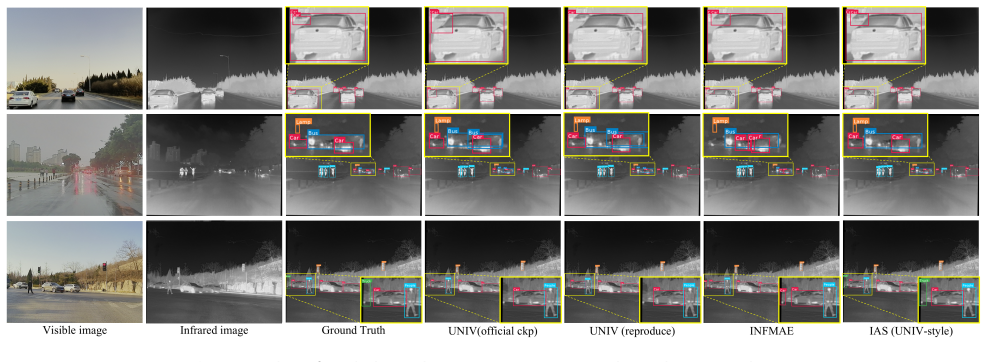
- [Figures] The segmentation text refers to 'Fig. 4 and Fig 6' when describing MFNet and M3FD; Fig. 6 is labeled as SCUTSEG, and detection results are in Fig. 5. Please correct the cross-references.
- [§4.3, Table 7] The overhead analysis mentions 'Sobel, HOG, and Random variants' but no Random row appears in any table. Either add the Random experiment or remove the mention.
- [§5 and §6] The visualizations are qualitative and rely on a small number of examples. It would strengthen the case study to report a quantitative comparison of low-edge regions, e.g., mean patch weights on such regions under Sobel vs. learned sampling.
Circularity Check
No circularity: IAS is an empirical training-time weighting scheme; its gains are evaluated on held-out downstream benchmarks, not derived from its own inputs.
full rationale
IAS does not present a derivation or a first-principles prediction that could reduce to its inputs. Patch importance weights are computed from infrared structural cues (Eq. 9-10) or from a learned module (Eq. 14-15), and then used to reweight contrastive objectives (Eq. 11-13). The learned sampler is optimized with the same contrastive objective it modulates plus a Sobel-guidance term (Eq. 16-17); this is standard self-supervised training, not circular, because the training objective is not the downstream evaluation target and no downstream labels are used to fit the weights. The central claims are assessed on external benchmarks (MFNet, SODA, SCUTSEG, MSRS, M3FD, ADE20K) with held-out splits, so the method is self-contained against external data. No load-bearing self-citation chain exists: the only self-reference in the bibliography [26] is not invoked to justify the method. The manuscript does contain a correctness/consistency issue that is not circularity: in Table 3, IAS(UNIV-style) is below official UNIV* on every retrieval metric (e.g., V2I R@1 13.80 vs 15.95), and the retrieval prose quotes 56.71/58.07 R@1 values that do not appear in any table. These issues undermine the 'consistent improvements' claim but do not constitute a circular derivation.
Axiom & Free-Parameter Ledger
free parameters (4)
- Sampler temperature Ts =
0.5
- Guidance weight lambda_guide =
decayed 1.0 -> 0.2 over first 5 epochs
- Curriculum bounds rho_min, rho_max =
0.2, 1.0
- Curriculum length T =
not specified
axioms (4)
- domain assumption Input VIS-IR pairs are pixel-aligned; residual misalignment is ignored.
- domain assumption Infrared edge/gradient strength is a reliable proxy for cross-modal patch alignability.
- standard math Contrastive learning assumptions hold: co-located patches are positives, non-co-located are negatives, and similarity in embedding space is meaningful.
- domain assumption BCE-based correlation alignment with a pseudo-label matrix derived from visible attention (Eq. 8) is valid supervision.
Cite this review
Pith. "Pith review of Not All Patches are Equal: Sampling Matters for Visible-Infrared Pre-Training." pith.science (2026). https://pith.science/paper/TM4JUTPD
@misc{pith2026260720238,
  author       = {Pith},
  title        = {Pith review of: Not All Patches are Equal: Sampling Matters for Visible-Infrared Pre-Training},
  year         = {2026},
  howpublished = {\url{https://pith.science/paper/TM4JUTPD}},
  note         = {Machine review of arXiv:2607.20238}
}
read the original abstract
Visible-infrared (VIS-IR) alignment is a key pre-training task for robust multi-sensor perception. Most existing methods use uniform patch-wise contrastive learning, but this can be unreliable in VIS-IR data because imaging-physics differences make some spatially paired regions inherently less comparable, and aligning them with equal strength hinders representation learning and downstream transfer. In this paper, we revisit VIS-IR pre-training from a sampling perspective and propose Importance-Aware Sampling (IAS), which adjusts training emphasis based on patch reliability. Specifically, IAS (i) derives patch weights from infrared structural cues and uses them to reweight the contrastive objective; (ii) learns a soft importance mask with a lightweight sampler, optionally warm-started from the hand-crafted prior; and (iii) employs a patch curriculum learning strategy that gradually expands from high-reliability regions to harder patches. It is worth noting that IAS is plug-and-play and works with both patch-/correlation-level alignment (e.g., UNIV-style) and image-level contrastive baselines (e.g., ImageBind-style). Extensive experiments on multiple VIS-IR benchmarks demonstrate consistent improvements over strong baselines, including for IR semantic segmentation, IR object detection and VIS semantic segmentation and cross-modal retrieval task. Code will be released on https://github.com/KlayMa527/IAS.
Figures




Reference graph
Works this paper leans on
-
[1]
Atmospherictransmissionandthermalinertia induced blind road segmentation with a large-scale dataset tbrsd, in: Proc
Chen,J.,Bai,X.,2023. Atmospherictransmissionandthermalinertia induced blind road segmentation with a large-scale dataset tbrsd, in: Proc. IEEE Int. Conf. Comput. Vis., pp. 1053–1063
2023
-
[2]
Encoder-decoder with atrous separable convolution for semantic im- age segmentation, in: Proc
Chen, L.C., Zhu, Y., Papandreou, G., Schroff, F., Adam, H., 2018. Encoder-decoder with atrous separable convolution for semantic im- age segmentation, in: Proc. Eur. Conf. Comput. Vis., pp. 801–818
2018
-
[3]
Vision transformer adapter for dense predictions, in: Proc
Chen, Z., Duan, Y., Wang, W., He, J., Lu, T., Dai, J., Qiao, Y., 2023. Vision transformer adapter for dense predictions, in: Proc. Int. Conf. Learn. Represent
2023
-
[4]
Masked-attention mask transformer for universal image segmenta- tion,in:Proc.IEEEConf.Comput.Vis.PatternRecognit.,pp.1290– 1299
Cheng, B., Misra, I., Schwing, A.G., Kirillov, A., Girdhar, R., 2022. Masked-attention mask transformer for universal image segmenta- tion,in:Proc.IEEEConf.Comput.Vis.PatternRecognit.,pp.1290– 1299
2022
-
[5]
ViM-VQ: Efficientpost-trainingvectorquantizationforvisualmamba,in:Proc
Deng,J.,Li,S.,Wang,Z.,Xu,K.,Gu,H.,Huang,K.,2025. ViM-VQ: Efficientpost-trainingvectorquantizationforvisualmamba,in:Proc. IEEE Int. Conf. Comput. Vis., pp. 24518–24527
2025
-
[6]
Lraf-net: Long-range attention fusion network for visible–infrared object detection
Fu, H., Wang, S., Duan, P., Xiao, C., Dian, R., Li, S., Li, Z., 2023. Lraf-net: Long-range attention fusion network for visible–infrared object detection. IEEE Trans. Neural. Netw. Learn. Syst. 35, 13232– 13245
2023
-
[7]
Cf- deformable detr: an end-to-end alignment-free model for weakly Qiwei Ma et al.:Preprint submitted to ElsevierPage 11 of 13 aligned visible-infrared object detection, in: Proc
Fu, H., Yuan, J., Zhong, G., He, X., Lin, J., Li, Z., 2024. Cf- deformable detr: an end-to-end alignment-free model for weakly Qiwei Ma et al.:Preprint submitted to ElsevierPage 11 of 13 aligned visible-infrared object detection, in: Proc. Int. Joint Conf. Artif. Intell
2024
-
[8]
MCMAE: Maskedconvolutionmeetsmaskedautoencoders,in:Proc.Adv.Neu- ral Inf
Gao, P., Ma, T., Li, H., Lin, Z., Dai, J., Qiao, Y., 2022. MCMAE: Maskedconvolutionmeetsmaskedautoencoders,in:Proc.Adv.Neu- ral Inf. Process. Syst., pp. 35632–35644
2022
-
[9]
Imagebind:Oneembeddingspacetobindthemall,in: Proc
Girdhar,R.,El-Nouby,A.,Liu,Z.,Singh,M.,Alwala,K.V.,Joulin,A., Misra,I.,2023. Imagebind:Oneembeddingspacetobindthemall,in: Proc. IEEE Conf. Comput. Vis. Pattern Recognit., pp. 15180–15190
2023
-
[10]
Grill, J.B., Strub, F., Altché, F., Tallec, C., Richemond, P., Buchatskaya, E., Doersch, C., Avila Pires, B., Guo, Z., Ghesh- laghiAzar,M.,etal.,2020.Bootstrapyourownlatent-anewapproach to self-supervised learning. Proc. Adv. Neural Inf. Process. Syst. 33, 21271–21284
2020
-
[11]
Guo,J.,Gao,C.,Liu,F.,Meng,D.,Gao,X.,2024.Damsdet:Dynamic adaptive multispectral detection transformer with competitive query selection and adaptive feature fusion, in: Proc. Eur. Conf. Comput. Vis., Springer. pp. 464–481
2024
-
[12]
Ha, Q., Watanabe, K., Karasawa, T., Ushiku, Y., Harada, T., 2017. Mfnet: Towards real-time semantic segmentation for autonomous vehicleswithmulti-spectralscenes,in:Proc.Int.Conf.Intell.Robots Systems, pp. 5108–5115. doi:10.1109/IROS.2017.8206396
arXiv 2017
-
[13]
Masked autoencoders are scalable vision learners, in: Proc
He, K., Chen, X., Xie, S., Li, Y., Dollár, P., Girshick, R., 2022. Masked autoencoders are scalable vision learners, in: Proc. IEEE Conf. Comput. Vis. Pattern Recognit., pp. 16000–16009
2022
-
[14]
MaskR-CNN,in: Proc
He,K.,Gkioxari,G.,Dollár,P.,Girshick,R.,2017. MaskR-CNN,in: Proc. IEEE Int. Conf. Comput. Vis., pp. 2961–2969
2017
-
[15]
Global–local feature fusion networkforvisible–infraredvehicledetection
Kang, X., Yin, H., Duan, P., 2024. Global–local feature fusion networkforvisible–infraredvehicledetection. IEEEGeosci.Remote Sens. Lett. 21, 1–5
2024
-
[16]
Configuring data augmentations to reduce variance shift in positional embedding of vision transformers, in: Proc
Kim, B.J., Kim, S.W., 2025. Configuring data augmentations to reduce variance shift in positional embedding of vision transformers, in: Proc. AAAI Conf. Artif. Intell., pp. 17840–17849
2025
-
[17]
Segmentingobjects in day and night: Edge-conditioned cnn for thermal image semantic segmentation.IEEETrans.Neural.Netw.Learn.Syst.32,3069–3082
Li,C.,Xia,W.,Yan,Y.,Luo,B.,Tang,J.,2020a. Segmentingobjects in day and night: Edge-conditioned cnn for thermal image semantic segmentation.IEEETrans.Neural.Netw.Learn.Syst.32,3069–3082
-
[18]
Segmentingobjects in day and night: Edge-conditioned cnn for thermal image semantic segmentation.IEEETrans.Neural.Netw.Learn.Syst.32,3069–3082
Li,C.,Xia,W.,Yan,Y.,Luo,B.,Tang,J.,2020b. Segmentingobjects in day and night: Edge-conditioned cnn for thermal image semantic segmentation.IEEETrans.Neural.Netw.Learn.Syst.32,3069–3082
-
[19]
Li, F., Zhang, H., Xu, H., Liu, S., Zhang, L., Ni, L.M., Shum, H.Y.,
-
[20]
Explicit attention-enhanced fusion for rgb-thermal perception tasks
Liang, M., Hu, J., Bao, C., Feng, H., Deng, F., Lam, T.L., 2023. Explicit attention-enhanced fusion for rgb-thermal perception tasks. IEEE Robot. Autom. Lett. 8, 4060–4067
2023
-
[21]
COMO:Cross- mamba interaction and offset-guided fusion for multimodal object detection
Liu,C.,Ma,X.,Yang,X.,Zhang,Y.,Dong,Y.,2026. COMO:Cross- mamba interaction and offset-guided fusion for multimodal object detection. Inf. Fusion 125, 103414. doi:https://doi.org/10.1016/ j.inffus.2025.103414
arXiv 2026
-
[22]
Liu, F., Gao, C., Sun, Y., Zhao, Y., Yang, F., Qin, A., Meng, D.,
-
[23]
InfMAE: A foundation model in the infrared modality, in: Proc
Liu, F., Gao, C., Zhang, Y., Guo, J., Wang, J., Meng, D., 2024. InfMAE: A foundation model in the infrared modality, in: Proc. Eur. Conf. Comput. Vis., Springer. pp. 420–437
2024
-
[24]
Liu,J.,Fan,X.,Huang,Z.,Wu,G.,Liu,R.,Zhong,W.,Luo,Z.,2022. Target-aware dual adversarial learning and a multi-scenario multi- modality benchmark to fuse infrared and visible for object detection, in:Proc.IEEEConf.Comput.Vis.PatternRecognit.,pp.5802–5811
2022
-
[25]
Bridging rgb-t image fusion and semantic segmentation via multi-task collaborative learning
Lu, T., Wu, H., Fu, W., Fang, L., Li, S., 2026. Bridging rgb-t image fusion and semantic segmentation via multi-task collaborative learning. Inf. Fusion 129, 103988. doi:https://doi.org/10.1016/j. inffus.2025.103988
arXiv 2026
-
[26]
Ma,Q.,Wang,Z.,Liu,W.,Lu,X.,Deng,B.,Duan,P.,Kang,X.,Li,S.,
-
[27]
Visualizing data using t-SNE
Maaten, L.v.d., Hinton, G., 2008. Visualizing data using t-SNE. J. Mach. Learn. Res. 9, 2579–2605
2008
-
[28]
UNIV: Unified foundation model for infrared and visible modalities
Mao, F., Wang, S., Mei, J., Lu, S., Min, C., Liu, F., Feng, X., Wu, M., Hu, Y., 2025. UNIV: Unified foundation model for infrared and visible modalities. arXiv preprint arXiv:2509.15642
Pith/arXiv arXiv 2025
-
[29]
Suppresscontentshift:Betterdiffusionfeaturesviaoff-the-shelfgen- eration techniques
Meng, B., Xu, Q., Wang, Z., Yang, Z., Cao, X., Huang, Q., 2024. Suppresscontentshift:Betterdiffusionfeaturesviaoff-the-shelfgen- eration techniques. Proc. Adv. Neural Inf. Process. Syst. 37, 18910– 18939
2024
-
[30]
Connecting joint-embedding predictive architecture with contrastive self-supervised learning
Mo, S., Tong, S., 2024. Connecting joint-embedding predictive architecture with contrastive self-supervised learning. Proc. Adv. Neural Inf. Process. Syst. 37, 2348–2377
2024
-
[31]
Attributefilterbased infrared and visible image fusion
Mo,Y.,Kang,X.,Duan,P.,Sun,B.,Li,S.,2021. Attributefilterbased infrared and visible image fusion. Information Fusion 75, 41–54
2021
-
[32]
Interactive visible and infrared image fusion and segmentation
Nie, J., Lai, L., Wei, W., Zhang, L., Zhang, Y., 2026. Interactive visible and infrared image fusion and segmentation. Inf. Fusion 127, 103832. doi:https://doi.org/10.1016/j.inffus.2025.103832
arXiv 2026
-
[33]
Learning by aligning: Visible-infrared person re-identification using cross-modal corre- spondences, in: Proc
Park, H., Lee, S., Lee, J., Ham, B., 2021. Learning by aligning: Visible-infrared person re-identification using cross-modal corre- spondences, in: Proc. IEEE Int. Conf. Comput. Vis., pp. 12046– 12055
2021
-
[34]
Learning transferable visual models from natural language supervision, in: Proc
Radford, A., Kim, J.W., Hallacy, C., Ramesh, A., Goh, G., Agarwal, S.,Sastry,G.,Askell,A.,Mishkin,P.,Clark,J.,etal.,2021. Learning transferable visual models from natural language supervision, in: Proc. Int. Conf. Mach. Learn., PmLR. pp. 8748–8763
2021
-
[35]
Drone-based rgb- infraredcross-modalityvehicledetectionviauncertainty-awarelearn- ing
Sun, Y., Cao, B., Zhu, P., Hu, Q., 2022. Drone-based rgb- infraredcross-modalityvehicledetectionviauncertainty-awarelearn- ing. IEEE Trans. Circuits Syst. Video Technol. 32, 6700–6713
2022
-
[36]
PIAFusion: A progressive infrared and visible image fusion network based on illumination aware
Tang, L., Yuan, J., Zhang, H., Jiang, X., Ma, J., 2022. PIAFusion: A progressive infrared and visible image fusion network based on illumination aware. Information Fusion 83-84, 79–92. doi:https: //doi.org/10.1016/j.inffus.2022.03.007
-
[37]
Yolov8: A novel object detection algorithm with enhanced performance and robustness, in: Proc
Varghese, R., Sambath, M., 2024. Yolov8: A novel object detection algorithm with enhanced performance and robustness, in: Proc. Int. Conf. Adv. Data Eng. Intell. Comput. Syst., IEEE. pp. 1–6
2024
-
[38]
Unifiedperceptual parsing for scene understanding, in: Proc
Xiao,T.,Liu,Y.,Zhou,B.,Jiang,Y.,Sun,J.,2018. Unifiedperceptual parsing for scene understanding, in: Proc. Eur. Conf. Comput. Vis., pp. 418–434
2018
-
[39]
SegFormer: Simple and efficient design for semantic segmentationwithtransformers
Xie, E., Wang, W., Yu, Z., Anandkumar, A., Alvarez, J.M., Luo, P., 2021. SegFormer: Simple and efficient design for semantic segmentationwithtransformers. Proc.Adv.NeuralInf.Process.Syst. 34, 12077–12090
2021
-
[40]
MCNet:Multi-levelcorrectionnet- work for thermal image semantic segmentation of nighttime driving scene
Xiong,H.,Cai,W.,Liu,Q.,2021. MCNet:Multi-levelcorrectionnet- work for thermal image semantic segmentation of nighttime driving scene. Infrared Physics & Technology 113, 103628
2021
-
[41]
Fast and robust matching for multimodal remote sensing image registration
Ye, Y., Bruzzone, L., Shan, J., Bovolo, F., Zhu, Q., 2019. Fast and robust matching for multimodal remote sensing image registration. IEEETrans.Geosci.RemoteSens.57,9059–9070. doi:10.1109/TGRS. 2019.2924684
arXiv 2019
-
[42]
SPGFusion: Semantic prior guided infrared and visible image fusion via pretrained vision models
Zhang, H., Yao, S., Ma, J., Jiang, J., Zhang, Y., Zhou, H., 2026. SPGFusion: Semantic prior guided infrared and visible image fusion via pretrained vision models. Inf. Fusion 125, 103433. doi:https: //doi.org/10.1016/j.inffus.2025.103433
arXiv 2026
-
[43]
CR2PQ:Continuousrelativerotarypositionalqueryfordense visual representation learning, in: Proc
Zhang, S., Zhou, Q., Wu, S., Tan, H., Wang, Z., Huang, J., Yan, J., 2025a. CR2PQ:Continuousrelativerotarypositionalqueryfordense visual representation learning, in: Proc. Int. Conf. Learn. Represent
-
[44]
Zhang,T.,Ding,K.,Wen,J.,Xiong,Y.,Zhang,Z.,Xiang,S.,Pan,C.,
-
[45]
UNIP:Rethinkingpre-trainedattentionpatternsforinfraredsemantic segmentation, in: Proc
Zhang, T., Wen, J., Chen, Z., Ding, K., Xiang, S., Pan, C., 2025b. UNIP:Rethinkingpre-trainedattentionpatternsforinfraredsemantic segmentation, in: Proc. Int. Conf. Learn. Represent
-
[46]
IEEE Conf
Zhao,H.,Shi,J.,Qi,X.,Wang,X.,Jia,J.,2017.Pyramidsceneparsing network, in: Proc. IEEE Conf. Comput. Vis. Pattern Recognit., pp. 2881–2890
2017
-
[47]
Cddfuse:Correlation-drivendual-branchfeature decompositionformulti-modalityimagefusion,in:Proc.IEEEConf
Zhao, Z., Bai, H., Zhang, J., Zhang, Y., Xu, S., Lin, Z., Timofte, R., VanGool,L.,2023. Cddfuse:Correlation-drivendual-branchfeature decompositionformulti-modalityimagefusion,in:Proc.IEEEConf. Qiwei Ma et al.:Preprint submitted to ElsevierPage 12 of 13 Comput. Vis. Pattern Recognit., pp. 5906–5916
2023
-
[48]
arXiv preprint arXiv:2312.08192
PAD:self-supervisedpre-trainingwithpatchwise-scaleadapter for infrared images. arXiv preprint arXiv:2312.08192
-
[49]
Semantic understanding of scenes through the ade20k dataset
Zhou, B., Zhao, H., Puig, X., Xiao, T., Fidler, S., Barriuso, A., Torralba, A., 2019. Semantic understanding of scenes through the ade20k dataset. Int J Comput Vis 127, 302–321. Qiwei Ma et al.:Preprint submitted to ElsevierPage 13 of 13
2019
-
[52]
Equivariant multi-modality image fusion, in: Proc
Zhao, Z., Bai, H., Zhang, J., Zhang, Y., Zhang, K., Xu, S., Chen, D., Timofte, R., Van Gool, L., 2024. Equivariant multi-modality image fusion, in: Proc. IEEE Conf. Comput. Vis. Pattern Recognit., pp. 25912–25921
2024
-
[2021]
IEEE Trans
Infraredandvisiblecross-modalimageretrievalthroughshared features. IEEE Trans. Circuits Syst. Video Technol. 31, 4485–4496
-
[2023]
IEEE Conf
Mask dino: Towards a unified transformer-based framework for object detection and segmentation, in: Proc. IEEE Conf. Comput. Vis. Pattern Recognit., pp. 3041–3050
-
[2025]
arXivpreprint arXiv:2510.22665
SARVLM: A vision language foundation model for semantic understandingandtargetrecognitioninSARimagery. arXivpreprint arXiv:2510.22665
This paper was first reviewed by deepseek-v4-flash on August 1, 2026.
discussion (0)
Sign in with ORCID, Apple, or X to comment. Anyone can read and Pith papers without signing in.