REVIEW 4 major objections 5 minor 80 references
THOR: A Theta-Gamma Hierarchical Oscillatory Reasoning Framework for Multi-hop QA
T0 review · 4 major / 5 minor · reviewed 2026-08-02 · deepseek-v4-flash
Pith's one-line read THOR — a theta–gamma control loop with slot-schema memory and verifier-gated repair — more than doubles exact-match accuracy on MuSiQue and suppresses drift and compounding errors in multi-hop QA
desk verdict A well-engineered agentic wrapper with solid internal ablation, but the headline comparison against prior work rests on unverified numbers; the core mechanism deserves closer study. read the letter →
The pith
A machine-rendered reading of the paper's core claim, the machinery that carries it, and where it could break.
The reading
What carries the argument
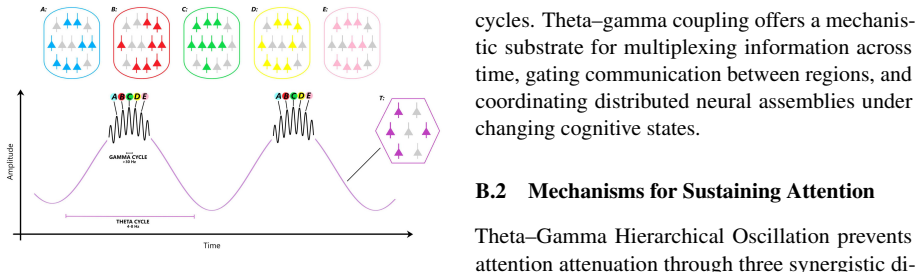
The load-bearing mechanism is a two-timescale finite-state controller inspired by theta–gamma phase-amplitude coupling. The 'theta' outer loop is a planner (iPFC) that owns a slot-schema memory — a typed frame in which each hop binds named slots (sub-question, core entity, expected answer type, sub-answer, completion flag) to explicit values. The 'gamma' inner loop is an executor/verifier pair: iHPC retrieves evidence using topic-top-3 and context-top-3 fallback strategies plus replay-based query refinement, and iACC checks whether the candidate answer anchors on the intended entity, matches the expected type, and is supported by the evidence. The controller converts that three-bit check vec
What would settle it
Re-run THOR and each baseline in the main comparison with one fixed backbone, the same retriever, the same evidence budget, and the same answer-matching judge. If THOR's MuSiQue exact-match advantage over the strongest agentic baseline nearly vanishes, the claim that the framework itself — rather than backbone or retriever differences — drives the improvement is falsified.
Extended reading notes
Core claim
THOR's central claim: multi-hop failures are control failures — drift plus compounding — correctable by an explicit two-timescale loop. A slow theta planner (iPFC) maintains a slot-schema frame (sub-questions, entities, answer types); a fast gamma executor (iHPC) retrieves and proposes a sub-answer; a verifier (iACC) emits three binary checks (anchoring, type, support). These drive a finite-state controller: continue, retrieve, repair, or replan. With GPT-3.5-turbo on MuSiQue, THOR lifts exact match from 19.7 to 48.5, reduces 4-hop frame-shift to 15.3% and anchor-shift to 10.4%, and degrades less under adversarial injection. Ablations show every component matters; removing the planner costs
Load-bearing premise
The headline comparison assumes every baseline in the main table was evaluated under identical conditions — same backbone LLM, same retriever, same evidence budget, same evaluation split, and same answer-judging protocol — as THOR; if the baseline numbers were taken from their original papers under different conditions, the reported gains are not purely from the framework.
Editorial extensions
If this is right
- A given LLM can become a much stronger multi-hop solver without changing the model: THOR reports exact-match gains of roughly 2× on MuSiQue for GPT-3.5-turbo and consistent gains across eight regular and five reasoning backbones.
- Ablation evidence implies the four framework components are complementary: removing the planner costs 20.1 exact-match points on MuSiQue, while removing the retriever, verifier, or slot-schema memory each costs several points on all three benchmarks.
- The anti-drift benefit grows with chain depth: THOR's frame-shift and anchor-shift rates are lowest at 4 hops, where chain-of-thought, chain-of-retrieval, and reversible-agent baselines drift most.
- Iterative retrieval refinement is a concrete source of the gains: with up to three per-hop retries, recall@15 on MuSiQue rises from 36.4 to 44.5, surpassing a chain-of-retrieval baseline.
- The retry budget Imax provides an explicit accuracy–cost dial: Imax=3 gives the best accuracy, and Imax=1 already achieves a better accuracy–token trade-off than a reversible multi-agent baseline.
Reading between the lines
- A testable extension: replace the LLM planner and verifier with a rule-based planner and a cheaper verifier; if the anti-drift effect survives, per-question token cost could drop well below the reported figures.
- The controller is essentially a deterministic protocol over typed signals, so the same design could transfer to other sequential tasks with explicit constraints — multi-step tool use, database query composition, or theorem proving — where the failure mode is also silent drift rather than missing information.
- A stress-test for any future multi-hop system falls out of the adversarial protocol: inject a document that preserves the surface answer pattern but breaks the entity bridge, and measure the relative drop in exact match; this directly probes error accumulation independent of retrieval quality.
- Because the paper's frame-shift and anchor-shift metrics rely on LLM and lightweight judges, an extension would be to publish the judged annotations and measure how sensitive the reported drift reductions are to judge choice — the framework's robustness claim depends on those metrics being reproducible.
Editorial analysis
A structured set of objections, weighed in public.
Referee Report
Summary. THOR is a closed-loop, brain-inspired reasoning wrapper for multi-hop QA. It alternates between a global 'theta' planner (iPFC), a local 'gamma' executor/retriever (iHPC), and a verifier (iACC), with a slot-schema memory and a finite-state controller that decides between Continue, Retrieve, Repair, and Replan. The authors claim that this design mitigates attention decay and error accumulation, and they report large EM/F1 gains over the plain GPT-3.5-turbo backbone on HotpotQA, 2WikiMultiHopQA, and MuSiQue, plus a backbone-adaptation study across eight regular and five reasoning LLMs. They also report FSR/ASR 'attention decay' metrics, an adversarial document-injection experiment, retrieval recall comparisons, and an accuracy-cost frontier. The main results are accompanied by ablations and a controlled add-on experiment, but the headline comparison to prior systems rests on baseline numbers whose experimental conditions are not documented.
Significance. If the central empirical claims hold, THOR would be a practically useful, largely model-agnostic reasoning wrapper: its controlled add-on experiment (Section 6.1, Table 7) isolates the contribution of finite-state control plus typed slot-schema memory, and the external EM/F1 and adversarial-drop benchmarks are appropriate targets. The paper also ships code, reports a human-reliability check for FSR (Table 10), and includes a broad backbone sweep — these are genuine strengths. The main reservation is that the strongest headline claim ('outperforms the vast majority of methods') depends on a baseline table whose provenance and comparability are not established. The mechanism-specific FSR/ASR evidence is also, in part, circular because the metrics are defined in terms of the same anchor/type/support checks the verifier is designed to optimize. These are addressable but load-bearing issues.
major comments (4)
- [§5.2, Table 1; Appendix C.2] The head-to-head comparison against 27 prior methods is not auditable. The paper never states whether any baseline was re-run under THOR's exact conditions: backbone (GPT-3.5-turbo), retriever (BGE-M3/BGE-Reranker), evaluation split and subset size (especially MuSiQue), answer normalization, and the same EM/F1 judging script. Section 5.1 describes only THOR's implementation, and Appendix C.2 gives conceptual descriptions of each method without experimental conditions. An internal red flag is the BELLE row for MuSiQue: F1=42.1 with EM=50.5, which is impossible for a single prediction set and suggests the table mixes numbers from heterogeneous sources. Please either rerun all baselines under matched conditions, or clearly source each number and provide a comparability table. Without this, the superiority claim over prior methods is not supported.
- [§5.1, §5.2.2, Algorithm 2] The FSR/ASR evidence for 'attention decay mitigation' is partially circular with THOR's own verification checks. ASR is essentially the negation of C_ei from Algorithm 2 ('anchor mention in evidence'), and FSR is judged by a GPT-4o rubric for sub-question alignment with gold decomposition, which is closely related to the type/constraint checks C_tau and C_r. Since iACC explicitly rejects anchor-missing evidence and drives repair, low ASR is to some extent guaranteed by the construction. The authors report human agreement only for FSR (Table 10), not for ASR. To make the mechanistic claim non-circular, please (i) report FSR/ASR with human-validated rubrics on both metrics, (ii) show that FSR/ASR improvements predict EM/F1 gains beyond the effect of retrieval quality, or (iii) rely on the external adversarial and EM/F1 results as the primary evidence and present FSR/ASR as descriptive diag
- [§5.2, Tables 2, 3, 6, 7] No variance or statistical testing is reported anywhere. In Tables 2, 3, 6, and 7, every number is a single run. Several comparisons are within 1–2 EM/F1 points (e.g., Table 6: Qwen-3-Thinking 2Wiki F1 72.9→73.0; Table 7: FSR 13.1 vs 12.1), which is well within typical LLM stochasticity unless explicitly controlled. Please report means and standard deviations over at least 3–5 seeds (or fixed seeds plus sensitivity analysis), and run paired significance tests for the main backbone and the add-on comparison. At minimum, the ablation and backbone claims should not rely on differences that are smaller than expected run-to-run variance.
- [§5.2.5, Table 6] The claim that THOR 'consistently yields large gains' and 'generalizes' is contradicted by several cells in the authors' own table. Concretely: DeepSeek-R1 2Wiki F1 drops from 70.7 to 69.2; Gemini-2.5-Pro 2Wiki F1 drops from 82.9 to 82.3; O1 MuSiQue drops from 41.7 to 39.1 EM and from 55.1 to 49.4 F1. There are also unexplained numeric differences with Table 2 for the same GPT-3.5-turbo baseline (EM 31.9 vs 31.2). These patterns weaken the 'plug-and-play wrapper' story. Please report per-backbone wins/losses, discuss cases where THOR hurts, and consider whether the generalization claim should be softened to 'most backbones'.
minor comments (5)
- [Table 4] The THOR row for 'Drop' is printed as '12.79.3', which should be '12.7 9.3'. Please format the two columns clearly.
- [Algorithm 1] The symbol 'I' is used for an indicator function but is not defined. Also 'δ_i ← I(Insuff(E_topic))' is unclear: what exactly does iACC return, and how is 'insufficient' operationalized? Please define these variables and the threshold.
- [§5.1] 'fixedLLM judge' has a missing space; please proofread formulas and prose for spacing errors (e.g., '0.7 9.8' in Table 3, 'THOR-Iter@273.1' in Table 5 caption).
- [§5.2.6 / Figure 4] The accuracy-cost discussion would be clearer with the exact token/call/latency numbers from Table 11 referenced in the main text, and with a statement on whether the cost includes the verification calls or only generation tokens.
- [Appendix C.3] The FSR judge uses the gold decomposition and evaluates only the first h predicted hops. This is reasonable, but please state explicitly in the main text that FSR/ASR are computed on MuSiQue only, since the main text's 'all three benchmarks' phrasing in §5.2.2 is ambiguous.
Circularity Check
ASR validation metric is identical to THOR's own evidence-anchoring gate, making the anchor-shift reduction claim partly by construction; EM/F1 and gold-based FSR results remain independent.
-
self definitional
[Section 5.1 (ASR definition) with Algorithm 2 (Evidence Anchoring Check) and Algorithm 3 (controller gating)]
"Define hop-level anchor alignment aa_t(x)∈{0,1} , where aa_t(x)=1 if the anchor entity in the predicted sub-question is mentioned in the retrieved evidence at hop t. ... (1) Evidence Anchoring Check: C_ei ← I[Mention(ce_t, ei)] ... if Acc_i = ⟨1,1,1⟩ then c_t ← CONTINUE(θ→γ)"
ASR's condition—anchor entity mentioned in retrieved evidence—is exactly the condition iACC verifies as C_ei, and Algorithm 3 only commits a hop to CONTINUE when Acc_i = ⟨1,1,1⟩, i.e., when C_ei = 1. Therefore every hop that THOR commits is anchor-present by construction, so THOR's low ASR is a restatement of its own verification gate rather than independent evidence that attention decay / anchor shift is mitigated. The 'validation' metric and the mechanism are the same check.
full rationale
The central accuracy and robustness claims rest on external EM/F1 benchmarks (HotpotQA, 2WikiMultiHopQA, MuSiQue) and on gold-decomposition-based FSR, so the paper is not globally circular. The specific attention-decay evidence, however, includes ASR, whose definition is the same condition as THOR's Evidence Anchoring Check that gates whether a hop may be committed. Reporting low ASR as proof of anchor-shift mitigation is therefore partly a construction: the controller enforces the measured property. The controlled add-on experiment and external EM/F1 comparisons give independent support for the framework's value, and FSR is not reduced by construction. The Table 1 baseline comparability issue (including the impossible BELLE F1<EM cell) is a separate reproducibility/data-quality concern, not a circularity finding.
Assumptions & free parameters
free parameters (2)
- Imax (max per-hop retry budget) =
3 (default; swept over 1,3,5 in §5.2.6)
- topic_top_k and context_top_k =
3 and 3
assumptions (3)
- domain assumption Gold decomposition of MuSiQue provides ground truth for hop-level frame alignment
- domain assumption LLM verification signals are reliable enough to drive control decisions
- domain assumption The three benchmark datasets are valid measures of multi-hop reasoning capability
invented entities (3)
-
iPFC (Prefrontal Cortex-inspired planner)
-
iHPC (Hippocampus-inspired executor)
-
iACC (Anterior Cingulate-inspired verifier)
Cite this review
Pith. "Pith review of THOR: A Theta-Gamma Hierarchical Oscillatory Reasoning Framework for Multi-hop QA." pith.science (2026). https://pith.science/paper/QMQF4DYJ
@misc{pith2026260720459,
  author       = {Pith},
  title        = {Pith review of: THOR: A Theta-Gamma Hierarchical Oscillatory Reasoning Framework for Multi-hop QA},
  year         = {2026},
  howpublished = {\url{https://pith.science/paper/QMQF4DYJ}},
  note         = {Machine review of arXiv:2607.20459}
}
read the original abstract
Multi-hop question answering requires retrieving and integrating evidence from multiple contexts. Despite the rapid progress of current research, multi-hop reasoning remains constrained by two persistent limitations: attention decay, where the model's focus on main question degrades as the reasoning chain grows, and error accumulation, where mistakes propagate across hops and compounds into final failure. Inspired by Theta-Gamma hierarchical oscillation which decouples global planning from local retrieval, enabling efficient attention transfer between hops and a verification and repair mechanism that interrupts the accumulation of errors in the wrong paths, we present THOR, a brain-inspired Theta-Gamma hierarchical oscillatory reasoning framework. Extensive comparative experiments and specific validation experiments on multi-hop QA benchmarks demonstrate that THOR improves answer accuracy and robustness while mitigating limitations, showcasing its generalization across different backbones.
Figures


Figures from the paper (14 more)




Reference graph
Works this paper leans on
-
[1]
2025 , eprint=
Multi-Hop Question Answering: When Can Humans Help, and Where do They Struggle? , author=. 2025 , eprint=
2025
-
[2]
2018 , eprint=
HotpotQA: A Dataset for Diverse, Explainable Multi-hop Question Answering , author=. 2018 , eprint=
2018
-
[3]
2022 , eprint=
MuSiQue: Multihop Questions via Single-hop Question Composition , author=. 2022 , eprint=
2022
-
[4]
Foundations and Trends in Information Retrieval , volume =
Multi-hop Question Answering , author =. Foundations and Trends in Information Retrieval , volume =. 2024 , publisher =
2024
-
[5]
ACM Computing Surveys , volume =
Multi-step Reasoning with Large Language Models, a Survey , author =. ACM Computing Surveys , volume =. 2025 , doi =
2025
-
[6]
arXiv preprint arXiv:2510.04493 , year=
Multi-Hop Question Answering: When Can Humans Help, and Where do They Struggle? , author=. arXiv preprint arXiv:2510.04493 , year=
-
[7]
Jiang, Yichen and Bansal, Mohit. Avoiding Reasoning Shortcuts: Adversarial Evaluation, Training, and Model Development for Multi-Hop QA. Proceedings of the 57th Annual Meeting of the Association for Computational Linguistics. 2019. doi:10.18653/v1/P19-1262
-
[8]
Science , volume=
Entrainment of neuronal oscillations as a mechanism of attentional selection , author=. Science , volume=. 2008 , publisher=
2008
Show all 80 references
-
[9]
Neuron , volume=
Gamma and beta bursts underlie working memory , author=. Neuron , volume=. 2016 , publisher=
2016
-
[10]
Transactions of the Association for Computational Linguistics , volume =
Lost in the Middle: How Language Models Use Long Contexts , author =. Transactions of the Association for Computational Linguistics , volume =. 2024 , publisher =
2024
-
[11]
Advances in Neural Information Processing Systems , volume =
Language Models Don't Always Say What They Think: Unfaithful Explanations in Chain-of-Thought Prompting , author =. Advances in Neural Information Processing Systems , volume =. 2023 , url =
2023
-
[12]
and Jensen, Ole , title =
Lisman, John E. and Jensen, Ole , title =. Neuron , year =
-
[13]
2025 , eprint=
ComposeRAG: A Modular and Composable RAG for Corpus-Grounded Multi-Hop Question Answering , author=. 2025 , eprint=
2025
-
[14]
Current Opinion in Behavioral Sciences , year =
Ursino, Mauro and Pirazzini, Gabriele , title =. Current Opinion in Behavioral Sciences , year =
-
[15]
and Rosen, Andrew M
Tamura, Makoto and Spellman, Timothy J. and Rosen, Andrew M. and Gogos, Joseph A. and Gordon, Joshua A. , title =. Nature Communications , year =
-
[16]
and Foster, David J
Pfeiffer, Brad E. and Foster, David J. , title =. Nature , year =
-
[17]
and Cohen, Jonathan D
Miller, Earl K. and Cohen, Jonathan D. , title =. Annual Review of Neuroscience , year =
-
[18]
and Cohen, Jonathan D
Shenhav, Amitai and Botvinick, Matthew M. and Cohen, Jonathan D. , title =. Neuron , year =
-
[19]
Annual Review of Psychology , year =
Baddeley, Alan , title =. Annual Review of Psychology , year =
-
[20]
Nature Neuroscience , volume =
Episodic sequence memory is supported by a theta--gamma phase code , author =. Nature Neuroscience , volume =. 2016 , doi =
2016
-
[21]
Neuron , volume =
What is a cognitive map? Organizing knowledge for flexible behavior , author =. Neuron , volume =. 2018 , doi =
2018
-
[22]
Neuron , volume =
Prefrontal phase locking to hippocampal theta oscillations , author =. Neuron , volume =. 2005 , doi =
2005
-
[23]
Nature Reviews Neuroscience , volume =
Prefrontal--hippocampal interactions in episodic memory , author =. Nature Reviews Neuroscience , volume =. 2017 , doi =
2017
-
[24]
Nature Neuroscience , volume =
Prioritized memory access explains planning and hippocampal replay , author =. Nature Neuroscience , volume =. 2018 , doi =
2018
-
[25]
Findings of the Association for Computational Linguistics: EMNLP 2023 , pages =
Self-prompted Chain-of-Thought on Large Language Models for Open-domain Multi-hop Reasoning , author =. Findings of the Association for Computational Linguistics: EMNLP 2023 , pages =. 2023 , address =. 2310.13552 , archivePrefix =
2023 arXiv
-
[26]
2024 , eprint=
Tree of Reviews: A Tree-based Dynamic Iterative Retrieval Framework for Multi-hop Question Answering , author=. 2024 , eprint=
2024
-
[27]
2023 , eprint=
Tree of Thoughts: Deliberate Problem Solving with Large Language Models , author=. 2023 , eprint=
2023
-
[28]
2024 , eprint=
FSM: A Finite State Machine Based Zero-Shot Prompting Paradigm for Multi-Hop Question Answering , author=. 2024 , eprint=
2024
-
[29]
2023 , eprint=
Chain-of-Thought Prompting Elicits Reasoning in Large Language Models , author=. 2023 , eprint=
2023
-
[30]
2023 , eprint=
Least-to-Most Prompting Enables Complex Reasoning in Large Language Models , author=. 2023 , eprint=
2023
-
[31]
2022 , eprint=
Atlas: Few-shot Learning with Retrieval Augmented Language Models , author=. 2022 , eprint=
2022
-
[32]
Measuring and Narrowing the Compositionality Gap in Language Models
Press, Ofir and Zhang, Muru and Min, Sewon and Schmidt, Ludwig and Smith, Noah and Lewis, Mike. Measuring and Narrowing the Compositionality Gap in Language Models. Findings of the Association for Computational Linguistics: EMNLP 2023. 2023. doi:10.18653/v1/2023.findings-emnlp.378
2023 doi
-
[33]
Interleaving Retrieval with Chain-of-Thought Reasoning for Knowledge-Intensive Multi-Step Questions
Trivedi, Harsh and Balasubramanian, Niranjan and Khot, Tushar and Sabharwal, Ashish. Interleaving Retrieval with Chain-of-Thought Reasoning for Knowledge-Intensive Multi-Step Questions. Proceedings of the 61st Annual Meeting of the Association for Computational Linguistics (Vo...
2023 doi
-
[34]
Active Retrieval Augmented Generation
Jiang, Zhengbao and Xu, Frank and Gao, Luyu and Sun, Zhiqing and Liu, Qian and Dwivedi-Yu, Jane and Yang, Yiming and Callan, Jamie and Neubig, Graham. Active Retrieval Augmented Generation. Proceedings of the 2023 Conference on Empirical Methods in Natural Language Processing....
2023 doi
-
[35]
Probabilistic Tree-of-thought Reasoning for Answering Knowledge-intensive Complex Questions
Cao, Shulin and Zhang, Jiajie and Shi, Jiaxin and Lv, Xin and Yao, Zijun and Tian, Qi and Hou, Lei and Li, Juanzi. Probabilistic Tree-of-thought Reasoning for Answering Knowledge-intensive Complex Questions. Findings of the Association for Computational Linguistics: EMNLP 2023...
2023 doi
-
[36]
2024 , eprint=
BeamAggR: Beam Aggregation Reasoning over Multi-source Knowledge for Multi-hop Question Answering , author=. 2024 , eprint=
2024
-
[37]
2023 , eprint=
Enhancing Retrieval-Augmented Large Language Models with Iterative Retrieval-Generation Synergy , author=. 2023 , eprint=
2023
-
[38]
2025 , eprint=
Chain-of-Retrieval Augmented Generation , author=. 2025 , eprint=
2025
-
[39]
2024 , eprint=
EfficientRAG: Efficient Retriever for Multi-Hop Question Answering , author=. 2024 , eprint=
2024
-
[40]
2024 , eprint=
Chain of Agents: Large Language Models Collaborating on Long-Context Tasks , author=. 2024 , eprint=
2024
-
[41]
2025 , eprint=
HippoRAG: Neurobiologically Inspired Long-Term Memory for Large Language Models , author=. 2025 , eprint=
2025
-
[42]
2024 , eprint=
KAG: Boosting LLMs in Professional Domains via Knowledge Augmented Generation , author=. 2024 , eprint=
2024
-
[43]
2025 , eprint=
ReAgent: Reversible Multi-Agent Reasoning for Knowledge-Enhanced Multi-Hop QA , author=. 2025 , eprint=
2025
-
[44]
2025 , eprint=
GeAR: Graph-enhanced Agent for Retrieval-augmented Generation , author=. 2025 , eprint=
2025
-
[45]
2025 , note =
Nahid, Md and Rafiei, Davood , journal =. 2025 , note =
2025
-
[46]
2025 , eprint=
Search-o1: Agentic Search-Enhanced Large Reasoning Models , author=. 2025 , eprint=
2025
-
[47]
2025 , eprint=
Talk to Right Specialists: Routing and Planning in Multi-agent System for Question Answering , author=. 2025 , eprint=
2025
-
[48]
2025 , eprint=
BELLE: A Bi-Level Multi-Agent Reasoning Framework for Multi-Hop Question Answering , author=. 2025 , eprint=
2025
-
[49]
Constructing a Multi-hop
Ho, Xanh and Nguyen, Anh-Khoa Duong and Sugawara, Saku and Aizawa, Akiko , booktitle =. Constructing a Multi-hop. 2020 , address =
2020
-
[50]
and Jensen, Ole , title =
Lisman, John E. and Jensen, Ole , title =. Neuron , year =. doi:10.1016/j.neuron.2013.03.007 , url =
2013 doi
-
[51]
and Kastner, Sabine , title =
Fiebelkorn, Ian C. and Kastner, Sabine , title =. Trends in Cognitive Sciences , year =. doi:10.1016/j.tics.2018.11.009 , url =
2018 doi
-
[52]
and Buhl, Eberhard H
Fisahn, Andreas and Pike, Francis G. and Buhl, Eberhard H. and Paulsen, Ole , title =. Nature , year =. doi:10.1038/28179 , url =
-
[53]
Theta oscillations in the hippocampus , journal =
Buzs. Theta oscillations in the hippocampus , journal =. 2002 , volume =. doi:10.1016/S0896-6273(02)00586-X , url =
2002 doi
-
[54]
and Wilson, Matthew A
Jones, Matthew W. and Wilson, Matthew A. , title =. PLOS Biology , year =. doi:10.1371/journal.pbio.0030402 , url =
-
[55]
Read , title =
Schultz, Wolfram and Dayan, Peter and Montague, P. Read , title =. Science , year =. doi:10.1126/science.275.5306.1593 , url =
-
[56]
and Wilson, Matthew A
Foster, David J. and Wilson, Matthew A. , title =. Hippocampus , year =. doi:10.1002/hipo.20345 , url =
-
[57]
Science , volume =
Neuronal oscillations in cortical networks , author =. Science , volume =. 2004 , doi =
2004
-
[58]
Science , volume =
High gamma power is phase-locked to theta oscillations in human neocortex , author =. Science , volume =. 2006 , doi =
2006
-
[59]
Neuron , volume =
The - neural code , author =. Neuron , volume =. 2013 , doi =
2013
-
[60]
Proceedings of the National Academy of Sciences , volume =
Theta-gamma coupling increases during the learning of item-context associations , author =. Proceedings of the National Academy of Sciences , volume =. 2009 , doi =
2009
-
[61]
Proceedings of the National Academy of Sciences , volume =
Cross-frequency coupling supports multi-item working memory in the human hippocampus , author =. Proceedings of the National Academy of Sciences , volume =. 2010 , doi =
2010
-
[62]
PLoS Biology , volume =
Theta rhythms coordinate hippocampal-prefrontal interactions in a spatial memory task , author =. PLoS Biology , volume =. 2005 , doi =
2005
-
[63]
Neuron , volume =
Coherent theta oscillations and reorganization of spike timing in the hippocampal-prefrontal network upon learning , author =. Neuron , volume =. 2010 , doi =
2010
-
[64]
Trends in Cognitive Sciences , volume =
Frontal theta as a mechanism for cognitive control , author =. Trends in Cognitive Sciences , volume =. 2014 , doi =
2014
-
[65]
Nature Neuroscience , volume =
Common medial frontal mechanisms of adaptive control in humans and rodents , author =. Nature Neuroscience , volume =. 2013 , doi =
2013
-
[66]
2006 , doi =
High Gamma Power Is Phase-Locked to Theta Oscillations in Human Neocortex , journal =. 2006 , doi =
2006
-
[67]
Neuron , volume =
The - Neural Code , author =. Neuron , volume =. 2013 , doi =
2013
-
[68]
Nature , volume =
Hippocampal place-cell sequences depict future paths to remembered goals , author =. Nature , volume =. 2013 , doi =
2013
-
[69]
Neuron , volume =
Rhythms for Cognition: Communication through Coherence , author =. Neuron , volume =. 2015 , doi =
2015
-
[70]
Transactions of the Association for Computational Linguistics , volume =
Lost in the Middle: How Language Models Use Long Contexts , author =. Transactions of the Association for Computational Linguistics , volume =. 2024 , doi =
2024
-
[71]
Proceedings of the 62nd Annual Meeting of the Association for Computational Linguistics (Volume 1: Long Papers) , address =
Do Large Language Models Latently Perform Multi-Hop Reasoning? , author =. Proceedings of the 62nd Annual Meeting of the Association for Computational Linguistics (Volume 1: Long Papers) , address =. 2024 , doi =
2024
-
[72]
2022 , eprint =
Self-Consistency Improves Chain of Thought Reasoning in Language Models , author =. 2022 , eprint =
2022
- [73]
-
[74]
2025 , month = apr, url =
2025
- [75]
- [76]
- [77]
- [78]
-
[79]
2024 , eprint =
M3-Embedding: Multi-Linguality, Multi-Functionality, Multi-Granularity Text Embeddings Through Self-Knowledge Distillation , author =. 2024 , eprint =
2024
-
[80]
Proceedings of the 17th Annual International ACM SIGIR Conference on Research and Development in Information Retrieval (SIGIR '94) , pages=
Some simple effective approximations to the 2-Poisson model for probabilistic weighted retrieval , author=. Proceedings of the 17th Annual International ACM SIGIR Conference on Research and Development in Information Retrieval (SIGIR '94) , pages=. 1994 , organization=
1994
Reviewed August 2, 2026 · model on record in the stance chip above.
Discussion (0). Continue with ORCID to comment.