REVIEW 3 major objections 4 minor 18 references
CEDAR recovers lagged causal edges from short, sparse time series by using a deliberately small conditioning set and at most two independence tests per candidate edge.
Reviewed by Pith at T0; open to challenge. T0 means a machine referee read the full paper against a public rubric. the ladder, T0–T4 →
T0 review · deepseek-v4-flash
2026-08-01 09:38 UTC pith:V2UACL3U
load-bearing objection A genuinely practical data-scarce causal-discovery method whose empirical claims are well supported, but whose oracle theorem rests on assumptions close to the desired success condition—worth reviewing seriously, not for the theory. the 3 major comments →
CEDAR: Causal Edge Discovery for Autoregressive Processes
The pith
A machine-rendered reading of the paper's core claim, the machinery that carries it, and where it could break.
Core claim
CEDAR establishes that lagged cross-variable causation can be tested with at most two conditional-independence checks per candidate edge, accepting at most one lag per ordered pair. The first check keeps the candidate; the second verifies that conditioning on the selected lag blocks the source's deeper past. Under assumptions of Markovian sufficiency, faithfulness, strict AR(1) self-dynamics, a single true lag per pair, oracle candidate reachability, a path-blocking condition, and eligible-parent closure, the paper proves that the discovered graph equals the true eligible graph. The empirical claim is that this bounded conditioning delivers the best F1 among compared methods when T is betwee
What carries the argument
The engine is the two-condition test. For a candidate edge X_c(t-w)->X_e(t), CEDAR first demands dependence given a conditioning set built from other candidates one step before their own lags; then demands independence of the deeper source X_c(t-w-1) from the target given the same set plus X_c(t-w). U-centered distance correlation on AR(1)-residualized targets screens lags nonparametrically, and a stable MCI pruning step rechecks every accepted edge on the same frozen graph, removing indirect links order-independently.
Load-bearing premise
For every true edge, the source variable's deeper past must be fully blocked by the small conditioning set; the paper's own counterexample shows that a lag-mismatched path can slip through this set and cause the true edge to be missed.
What would settle it
Simulate three AR(1) processes with edges A(t-2)->C(t), A(t-2)->B(t), and B(t-1)->C(t), plus self-loops. Run CEDAR and check whether A(t-2)->C(t) is recovered. The paper predicts it should be missed because the path A(t-3)->B(t-1)->C(t) evades the conditioning set; if it is recovered, the claimed failure mode does not actually occur.
If this is right
- Causal discovery from sparse, short time series becomes practical at higher dimensionality (d up to 75) when only a few lags survive screening.
- Every reported edge is backed by explicit conditional-independence tests, making the output interpretable as evidence rather than a black-box score.
- Deterministic trend-like nonstationarity can be absorbed by a time-indexed node, reducing spurious edges in real-world data.
- The failure mode from lag-mismatched paths is bounded: CEDAR degrades smoothly, with F1 between 0.865 and 0.924 even under simultaneous assumption violations.
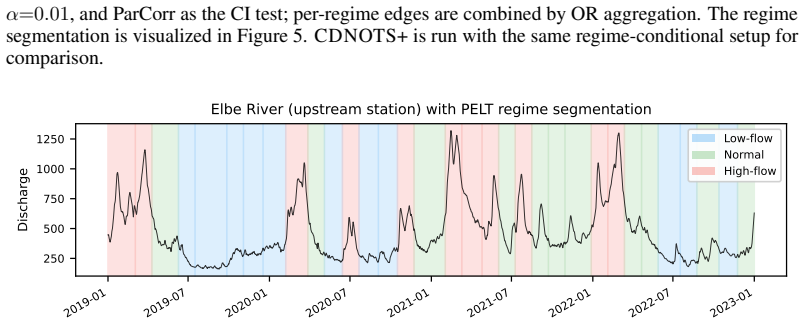
- Segmenting a nonstationary system into regimes before discovery can expose clean causal signal, as shown by the river-network example.
Where Pith is reading between the lines
- The two-condition test suggests a general recipe: any marginal-association screening plus two targeted CI tests could be adapted to other data types, including discrete or event-based series.
- The one-lag-per-pair restriction could be relaxed by iteratively residualizing accepted lags and re-running screening, potentially recovering multiple true lags per pair.
- The path-blocking failure mode offers a diagnostic: when the deeper source remains conditionally dependent after the second test, that pair is precisely where a larger conditioning set is needed.
- Applying changepoint detection before discovery, as done on the river data, is a transferable recipe for any regime-switching system.
Editorial analysis
A structured set of objections, weighed in public.
Referee Report
Summary. The paper proposes CEDAR, a constraint-based lagged causal edge discovery method for sparse autoregressive time series. It combines AR(1)-residualized distance-correlation lag screening, SYPI-style two-condition CI tests per candidate pair, and an order-independent MCI pruning step, with optional deterministic C-nodes for trend nonstationarity. The paper reports broad experiments: synthetic SCPs up to d=75, ablations, assumption-violation stress tests, a real-world Elbe river benchmark, and an oracle exactness theorem in Appendix A under assumptions A1–A8. The central empirical claim is that CEDAR is competitive or best in low-sample regimes (T≤200) while remaining interpretable and cheap; the formal guarantee is explicitly conditional and the paper acknowledges its method-specific assumptions.
Significance. If the empirical results hold, CEDAR is a useful incremental contribution for scarce-data causal discovery in sparse AR(1)-like systems. The paper's strengths are concrete: reproducible code, independent synthetic ground truth with exact-lag evaluation, a thoughtful ablation that identifies MCI pruning and AR(1)-residualized dcor as load-bearing, honest t-test calibration (Appendix C), and a real benchmark with a clear nonstationarity story. However, the theoretical appendix does not provide a graph-theoretic characterization of when CEDAR succeeds: assumptions A6 and A7 are stated in terms of CEDAR's own intermediate outputs, making Theorem 1 close to a consistency statement rather than a substantive structural guarantee. The empirical core is sound enough to merit publication after the theoretical framing and one stress-test experiment are revised.
major comments (3)
- [Appendix A, Theorem 1 (A6/A7)] Theorem 1's guarantee is near-tautological as stated. A6 requires that every candidate before the true lag fails Conditions 1–2 under oracle CI, which is exactly the Phase-2 first-accept success condition the theorem claims to establish; A7's conditioning set Z2 in Eq. (A-CB) contains the Phase-1-selected lags \hat w_{k,e}, so whether a true edge is 'blockable' depends on lag choices made by CEDAR itself. The Appendix counterexample shows A1–A6 and A8 can hold with A7 failing, but it does not repair the issue: one incorrect lag choice for another pair can alter Z2 and destroy A7 for a true edge. The theorem should be re-framed as a conditional consistency statement, or A6/A7 should be replaced by sufficient conditions on the true graph (e.g., lag-alignment/order restrictions) that imply them.
- [Table 9 / Section 4.2, A7 bypass×5] The A7 bypass stress test is not presently informative. By Prop. 1(ii), a true edge whose deeper source is not d-separated by Z2 should be missed under oracle CI. Table 9 reports only 0.6 FNs after introducing five bypass paths, which is difficult to reconcile with the theorem's failure mode. The paper does not state how the five bypasses are constructed, how many true edges they affect, or whether they actually violate A-CB with the Phase-1-selected lags. Without this, the experiment cannot support the 'graceful degradation' claim in the A7 dimension. Please specify the construction, verify at oracle level that A7 is violated, and report per-seed TP/FP/FN, or replace with a graph from Appendix A's counterexample.
- [Algorithm 1 line 6 and Section 3.2] The meaning of \hat w_{k,e} is ambiguous and load-bearing. The main text and Appendix A use it to build S_c and Z2, but it is not specified whether \hat w_{k,e} is the Phase-1 screened lag (highest dcor), the first lag accepted after Phase 2, or the selected lag after BH screening. Since Phase 2 processes sources sequentially, the 'other candidate' lags may not yet be finalized when S_c is built. This ambiguity affects both the executability of Algorithm 1 and the well-posedness of Theorem 1. Please define a deterministic order and state explicitly which lag is used in S_c/Z2; the formal proof should be written against that definition.
minor comments (4)
- [Appendix C] The calibration table reports type-I error only under d=5 AR(1) nulls with no cross-links. A sentence noting that the analytic t-approximation is high-dimensional in origin and that calibration under cross-links or nonlinear nulls is future work would be helpful.
- [Section 3.6 / Abstract] The abstract says CEDAR requires O(d^2) CI tests after screening; the body correctly notes the worst case is O(d^2 L_sig). The abstract's 'in sparse regimes' qualifier should be repeated whenever the O(d^2) complexity is cited.
- [Section 4.4 / Appendix J] The Elbe result uses PELT segmented regimes with different lag bounds and an OR aggregation. It would help future readers to state whether the per-regime graphs are assumed to share the same variable set and how the union handles conflicting lags between regimes.
- [Appendix A, Sink-node relaxation paragraph] The claim that all Z1 variables are non-descendants of the target is correct, but the paragraph could note explicitly that conditioning on earlier variables that are colliders can still open paths; the text does say this, but a pointer to A7 would improve clarity.
Circularity Check
Theorem 1's true-edge guarantee is assumed via A6/A7 rather than derived: the 'correctly selected lag' conclusion restates the assumptions.
specific steps
-
self definitional
[Appendix A, Assumptions A6–A7, Propositions 1–2, Theorem 1]
"(A6) "every candidate appearing before w fails at least one of Conditions 1–2 under oracle CI, so the first-accept rule reaches w. This is an algorithm-dependent oracle success condition, not a consequence of A1–A3." (A7) requires "X_c^{t-w-1} ⊥_G* X_e^t | Z_2 (A-CB)"; Prop 1(ii) states "Condition 2 passes under oracle CI if and only if (A-CB) holds." Prop 2: "By A6, the true lag w appears in the candidate list and no earlier candidate passes both conditions, so the first-accept rule reaches w... By A7 and Proposition 1(ii), Condition 2 passes. Hence Phase 2 accepts X_c^{t-w}→X_e^t.""
A6 is not a structural graph axiom: it says that for every true edge the algorithm's own first-accept scan reaches the true lag because earlier candidates fail CEDAR's Conditions 1-2. A7 is made equivalent to 'Condition 2 passes' by Prop 1(ii), while Prop 1(i) gives Condition 1. Thus Proposition 2's conclusion that Phase 2 accepts the true edge at the correct lag is the conjunction of A6 and A7 restated, not a derivation from A1-A5 or from graph structure alone. The block-set Z2 in A7 also contains Phase-1 selected lags \hat w_{k,e}, so the d-separation condition is evaluated using CEDAR's own intermediate outputs. Theorem 1 then relies on Proposition 2 for the true-positive half of exact recovery; only the false-positive-removal argument via Proposition 3 is independently proved. The pape
full rationale
The empirical claims in the paper are genuinely independent: F1 numbers on synthetic random SCPs are measured against known ground-truth graphs, and the Elbe River result is evaluated against a published benchmark chain; no α, lag bound, or C-node basis is fitted to the reported F1. There is also no load-bearing self-citation: the SYPI ancestry is external, and the co-authored CDNOTS citation is used only as a design inspiration and baseline, not as a uniqueness theorem. The circularity is confined to the oracle analysis: A6 and A7 are algorithm-success conditions expressed in terms of CEDAR's own Conditions 1-2 and Phase-1 selected lags, so Proposition 2's completeness result is close to a tautology. The paper is transparent about this limitation (A6 is labeled an algorithm-dependent success condition), and the MCI false-positive removal result plus the A7 counterexample give the appendix some non-vacuous content. Because the central theoretical guarantee partially reduces by construction to its own assumptions, but the empirical evaluation remains self-contained, the appropriate score is 6 rather than 0-2.
Axiom & Free-Parameter Ledger
free parameters (5)
- CI significance level alpha =
0.01 in main experiments
- Lag-screening threshold alpha_lag =
0.05 default; 0.97 in Elbe setup
- Maximum lag L =
3-8 depending on benchmark
- C-node basis g(t/T) =
linear+quad on confounded-trends; step/linear presets
- AR(1) residualization coefficient beta_e =
OLS estimate per target (Eq. 1)
axioms (9)
- domain assumption A1 observed Markovian sufficiency / no latent common causes
- domain assumption A2 faithfulness
- domain assumption A3 strictly AR(1) self-dynamics
- domain assumption A4 stationarity up to specified trend terms
- domain assumption A5 at most one true direct lag per ordered pair
- ad hoc to paper A6 oracle candidate reachability and ordering
- ad hoc to paper A7 CEDAR path-blocking (Eq. A-CB)
- ad hoc to paper A8 eligible-parent closure
- standard math U-centered distance covariance has zero expectation under independence and the Szekely-Rizzo analytic t null
invented entities (1)
-
C-node(s): deterministic trend variables C_r(t)=g_r(t/T)
no independent evidence
read the original abstract
We propose CEDAR (Causal Edge Discovery for Autoregressive Processes), a constraint-based method for lagged causal edge discovery in sparse autoregressive time series. CEDAR screens candidate cross-variable lags using AR(1)-residualized, U-centered distance correlation, then applies two targeted conditional-independence tests per significant cross-variable lag candidate and accepts at most one lag per ordered pair. A stable MCI pruning step removes indirect edges, and optional deterministic C-nodes adjust for specified trend-like nonstationarity. In sparse regimes where few lags survive screening, CEDAR requires $O(d^2)$ CI tests after screening while retaining edge-level interpretability. CEDAR is most effective when data are scarce and variables exhibit lag-1 self-dynamics; methods with richer conditioning sets become preferable as $T$ grows or when higher-order autoregressive or simultaneous multi-lag effects are common.
Figures


Reference graph
Works this paper leans on
-
[1]
2017 , publisher =
Elements of Causal Inference: Foundations and Learning Algorithms , author =. 2017 , publisher =
2017
-
[2]
Science Advances , volume =
Detecting and Quantifying Causal Associations in Large Nonlinear Time Series Datasets , author =. Science Advances , volume =. 2019 , publisher =
2019
-
[3]
2000 , publisher =
Causation, Prediction, and Search , author =. 2000 , publisher =
2000
-
[4]
2020 , organization =
Pamfil, Roxana and Sriwattanaworachai, Nisara and Desai, Shaan and Pilgerstorfer, Philip and Georgatzis, Konstantinos and Beaumont, Paul and Aragam, Bryon , booktitle =. 2020 , organization =
2020
-
[5]
Journal of Machine Learning Research , volume =
Estimation of a Structural Vector Autoregression Model Using Non-Gaussianity , author =. Journal of Machine Learning Research , volume =
-
[6]
Tank, Alex and Covert, Ian and Foti, Nicholas and Shojaie, Ali and Fox, Emily B , journal =. Neural. 2021 , publisher =
2021
-
[7]
Cheng, Yuxiao and Li, Lianglong and Xiao, Tingxiong and Li, Zongren and Suo, Jinli and He, Kunlun and Zhong, Qin , booktitle =
-
[8]
Proceedings of the 36th Conference on Uncertainty in Artificial Intelligence (UAI) , pages =
Discovering Contemporaneous and Lagged Causal Relations in Autocorrelated Nonlinear Time Series Datasets , author =. Proceedings of the 36th Conference on Uncertainty in Artificial Intelligence (UAI) , pages =. 2020 , organization =
2020
-
[9]
Advances in Neural Information Processing Systems , volume =
High-Recall Causal Discovery for Autocorrelated Time Series with Latent Confounders , author =. Advances in Neural Information Processing Systems , volume =
-
[10]
International Journal of Data Science and Analytics , volume =
Causal Discovery from Nonstationary Time Series , author =. International Journal of Data Science and Analytics , volume =. 2025 , publisher =
2025
-
[11]
International Conference on Machine Learning , pages =
Necessary and Sufficient Conditions for Causal Feature Selection in Time Series with Latent Common Causes , author =. International Conference on Machine Learning , pages =. 2021 , organization =
2021
-
[12]
The Annals of Statistics , volume =
Partial Distance Correlation with Methods for Dissimilarities , author =. The Annals of Statistics , volume =. 2014 , publisher =
2014
-
[13]
Journal of Multivariate Analysis , volume =
The Distance Correlation t -Test of Independence in High Dimension , author =. Journal of Multivariate Analysis , volume =. 2013 , publisher =
2013
-
[14]
Journal of the Royal Statistical Society: Series B (Methodological) , volume =
Controlling the False Discovery Rate: A Practical and Powerful Approach to Multiple Testing , author =. Journal of the Royal Statistical Society: Series B (Methodological) , volume =
-
[15]
Journal of Machine Learning Research , volume =
Causal Discovery from Heterogeneous/Nonstationary Data , author =. Journal of Machine Learning Research , volume =
-
[16]
Technometrics , volume =
Fast Computing for Distance Covariance , author =. Technometrics , volume =
-
[17]
2025 , url =
Stein, Gideon and Shadaydeh, Maha and Blunk, Jan and Penzel, Niklas and Denzler, Joachim , booktitle =. 2025 , url =
2025
-
[18]
Science , volume=
Causal protein-signaling networks derived from multiparameter single-cell data , author=. Science , volume=. 2005 , publisher=
2005
discussion (0)
Sign in with ORCID, Apple, or X to comment. Anyone can read and Pith papers without signing in.