REVIEW 3 major objections 5 minor 93 references
The paper claims that current multimodal large language models, despite strong general video understanding, remain far below human performance at qualitative spatial-temporal reasoning from continuous visual cues, with the best model scorin
Reviewed by Pith at T0; open to challenge. T0 means a machine referee read the full paper against a public rubric. the ladder, T0–T4 →
T0 review · deepseek-v4-flash
2026-08-01 09:05 UTC pith:EKWVLUF5
load-bearing objection A carefully built dynamic-spatial-reasoning benchmark whose useful diagnostic numbers are undercut by an undocumented human baseline. the 3 major comments →
ViSTR-Bench: Can MLLMs Reason from Continuous Visual Cues in Dynamic Scenes?
The pith
A machine-rendered reading of the paper's core claim, the machinery that carries it, and where it could break.
Core claim
ViSTR-Bench is a 1,340-item video question-answer benchmark organized into four reasoning dimensions—Motion Perception, Spatial Relations, Outcome Prediction, and Physical Dynamics—spanning 15 binary-choice subtasks. All items are qualitative (Yes/No or two-option choices), and for outcome tasks the videos are truncated at a manually chosen decision point so the answer cannot be read off the final frame. Evaluations across proprietary, open-source, and specialized spatial MLLMs show that the best model, GPT-5.4-thinking, reaches 62.0%, only 4.1 points above the frequency-based chance baseline and 29.0 points below the 91.0% human score. Error analysis of 600 incorrect predictions attributes
What carries the argument
The load-bearing instrument is the benchmark's construction pipeline: event localization to isolate single reasoning episodes, visual prompting (bounding boxes) to ground targets, outcome truncation at manually chosen decision points, and a four-criteria human quality control (visibility, temporal sufficiency, objectivity, non-triviality). This pipeline converts raw videos into binary qualitative questions that can only be answered by aggregating temporal evidence, and it defines the error taxonomy used to diagnose failures.
Load-bearing premise
The benchmark's central gap claim rests on the assumption that every truncated outcome-prediction and physical-dynamics clip has an unambiguous ground-truth answer that can be inferred from the retained pre-outcome footage; the paper does not report inter-annotator agreement, discarded-sample counts, or independent checks against label leakage (Sec. III-B, 'Outcome Truncation' and 'Human Quality Control').
What would settle it
Re-annotate a random sample of the outcome-prediction items by showing only the truncated pre-outcome clips to a fresh set of annotators and measuring agreement with the published labels; if agreement is below roughly 95% or if annotators cannot confidently infer the answers, the benchmark's 29-point human-model gap would be an artifact of label construction rather than a measure of reasoning ability.
If this is right
- If the reported gap is accurate, current MLLMs cannot be relied upon for tasks that require anticipating physical outcomes from partial observations, such as driving or manipulation planning.
- The failure distribution implies that improving target tracking and motion-state estimation is a more urgent bottleneck than improving object recognition.
- Because specialized spatial MLLMs do not outperform general-purpose ones on ViSTR-Bench, static or geometry-centric spatial training does not transfer to dynamic reasoning.
- Text-based chain-of-thought prompting is not sufficient to close the gap; gains are small and task-dependent.
- Providing explicit task-relevant evidence (novel views, optical flow summaries) improves accuracy on specific tasks, suggesting input-centric and tool-augmented directions are promising.
Where Pith is reading between the lines
- If the 29-point gap is real, then a model that couples a low-level tracker (optical flow, object permanence) with a language model might approach human performance on this benchmark without any new reasoning architecture—implying the bottleneck is perceptual evidence, not inference.
- The benchmark's binary format may underestimate models that have partial knowledge; converting it to graded confidence or open-ended justification could separate 'knows the gist' from 'commits to the right answer.'
- The truncation protocol suggests a natural training scheme: sample videos, truncate before outcomes, and supervise the model to predict the truncated outcome—this could produce a scalable self-supervised objective for temporal reasoning.
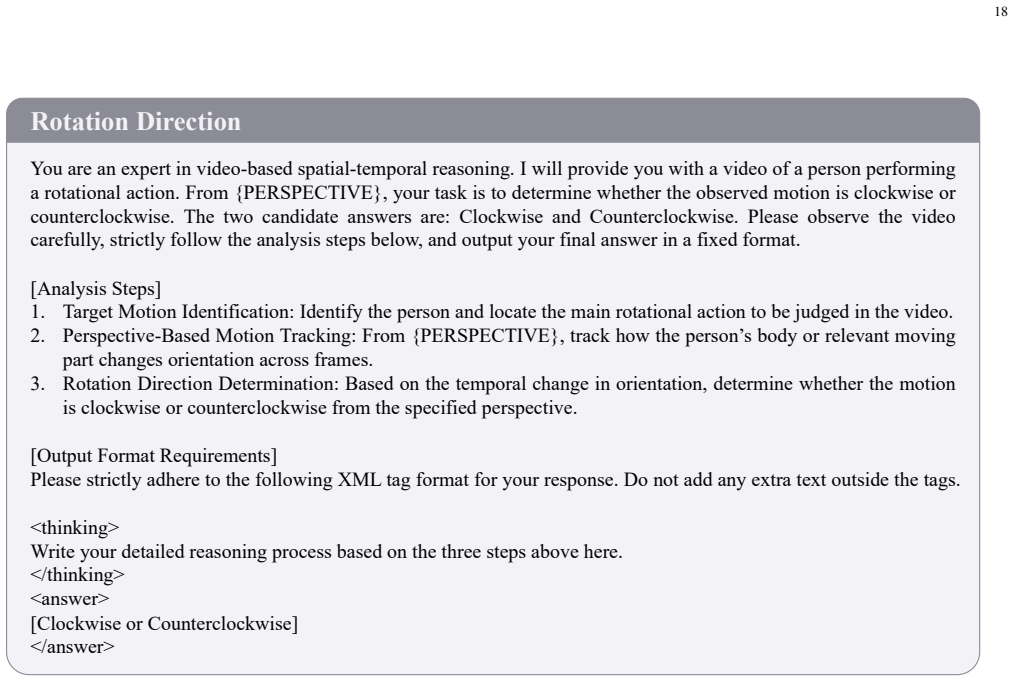
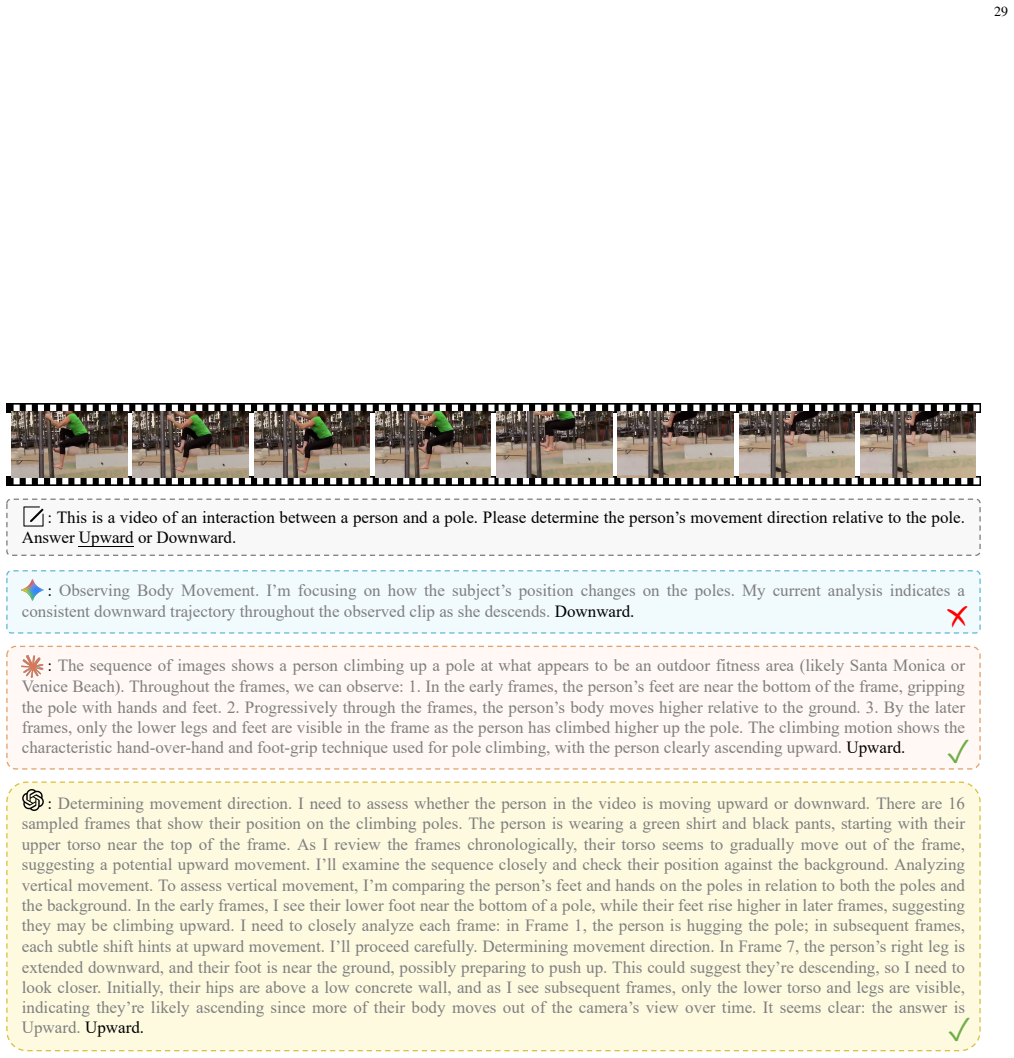
- Because human accuracy reaches 100% on several subtasks (e.g., Rotation Direction, Interaction Direction, Fall Direction), those items may be easier than the average; a per-subtask analysis of where humans are also imperfect could refine the benchmark's difficulty calibration.
Editorial analysis
A structured set of objections, weighed in public.
Referee Report
Summary. This paper introduces ViSTR-Bench, a video question-answering benchmark with 1,340 binary-choice items across 15 subtasks organized into four dimensions: Motion Perception, Spatial Relations, Outcome Prediction, and Physical Dynamics. The authors collect videos from public datasets, web sources, and self-recorded clips; apply event localization, visual prompting, and outcome truncation; and then evaluate a broad set of proprietary, open-source, and specialized spatial MLLMs. The headline result is that the best model, GPT-5.4-thinking, achieves 62.0% overall accuracy versus 57.9% for the frequency-based chance baseline and 91.0% for human performance, yielding a 29.0-point human-model gap. The paper also studies text-based chain-of-thought prompting, visual input formats, a six-way error taxonomy, and pilot input/tool augmentation strategies.
Significance. If the benchmark and the human baseline are valid, ViSTR-Bench fills a real gap by focusing on qualitative, reasoning-oriented spatial-temporal understanding rather than static spatial attributes or quantitative prediction. The paper has several concrete strengths: the subtask counts sum exactly to 1,340; the reported weighted human mean matches the stated 91.0%; the inclusion of both random and frequency baselines is helpful; the benchmark is externally constructed with no fitted parameters; and the error analysis and pilot studies provide useful diagnostic signal. The central claim, however, depends critically on two pieces of evidence that are currently under-reported: the human evaluation protocol and the reliability of the outcome-truncation labels. Without those, the 29-point gap could be an artifact of information leakage rather than a measure of spatial-temporal reasoning ability.
major comments (3)
- [Sec. IV-A and Sec. IV-B (Table II)] The human evaluation is described in a single sentence: 'we conduct human evaluation to estimate human-level performance.' There is no annotator count, no description of instructions, no statement about whether evaluators saw the same truncated clips as the models, no blinding procedure, and no inter-annotator agreement. The headline 29.0-point gap (62.0% vs. 91.0%) is load-bearing for the paper's main claim. If the human evaluators saw full videos, or were the same expert annotators who selected the truncation points with knowledge of the outcome, the 91.0% figure is inflated and the gap is not a fair measure. The authors should report a full protocol and inter-annotator agreement, and ideally run a blind evaluation on the identical truncated inputs.
- [Sec. III-B, 'Outcome Truncation' and 'Human Quality Control'] The manual decision point for truncation is chosen by annotators who know the full-video outcome, and the quality-control stage reports no count of discarded samples, no inter-annotator agreement, and no independent check that the retained pre-outcome clip makes the ground-truth answer unambiguous. For outcome-prediction and physical-dynamics tasks, subtle outcome-revealing cues (e.g., a player's reaction, a ball's curve, a Jenga tower's tilt) may leak into the retained prefix. This is not circularity, but it is a label-validity risk. The authors should report the discard rate, have a separate group of annotators label the truncated clips blind to the outcome, and quantify agreement.
- [Table II and Sec. IV-B] No confidence intervals or significance tests are reported. Several subtasks have very small sample sizes (Knot Type n=29, Golf Shot n=53, Fall Direction n=46, Passage Feasibility n=55), and many per-subtask model accuracies are within a few points of 50%, so the per-subtask ranking claims are not statistically distinguishable. Even the overall claim that 'only three evaluated models outperform the frequency-based baseline' needs interval estimates; with n=1,340 the top-model difference of 4.1 points is likely significant, but the paper should demonstrate this rather than assert it. At minimum, report Clopper-Pearson intervals or bootstrap CIs for overall and per-subtask accuracy, and test against the frequency baseline.
minor comments (5)
- [Fig. 1] The figure panel labels 'Human Gap: 36.0%' and 'X' are confusing, and the 36.0% value does not match the 29.0-point gap quoted in Sec. IV-B. Please clarify whether the figure refers to a per-example illustration and correct the inconsistency.
- [Sec. III-B] The term 'expert annotators' is used without defining who they are, how many participated, or what expertise they had. Please provide this information, especially given the emphasis on 'objectivity' and 'sufficiency.'
- [Sec. IV-D] The diagnostic study on 20 Basketball Shot samples is labeled 'small,' which is appropriate, but the numbers should be presented with uncertainty (e.g., exact binomial CIs) and framed as anecdotal rather than as evidence of a general pattern.
- [Sec. III-B, 'Release and Leaderboard Protocol'] The paper reports results on the complete 1,340-item set while planning to release only 50% publicly. Please clarify that no model selection or hyperparameter tuning was performed on the private held-out portion, so that the leaderboard protocol cannot be gamed by information leakage from the public split.
- [Abstract] Minor grammar: 'a comprehensive four-dimensional evaluations' should be 'a comprehensive four-dimensional evaluation framework'; 'VisualSpatial-TemporalReasoningBenchmark' also needs spacing in the introduction.
Circularity Check
No significant circularity: ViSTR-Bench is an external benchmark with no fitted parameters or derivation chain; the 62.0% vs. 91.0% gap is an empirical measurement, not a result reduced from its own inputs.
full rationale
This paper introduces a new benchmark and reports measured performance of many third-party MLLMs against a human baseline. There is no derivation chain, no fitted parameter subsequently called a prediction, and no uniqueness theorem imported from the authors' prior work. The central claim (best model 62.0% vs. human 91.0%) is an empirical measurement over 1,340 manually annotated QA pairs and a large set of external models; the claim is not used to construct the labels. The only author-overlap items, GeoThinker and SpatialLadder, are evaluated as test subjects and perform poorly (52.8% and 47.8%), which is the opposite of what a self-serving construction would produce; they provide no evidence for the benchmark's validity. The legitimate concerns raised by the paper — undocumented human evaluation protocol, no inter-annotator agreement, no count of discarded samples, truncation decision points chosen by annotators who knew the full-video outcome, and no explicit leakage check for 'Outcome Truncation' samples — are measurement-validity and correctness risks, not circularity as defined here. To flag circularity I would need to exhibit a specific reduction (e.g., the human figure being derived from the construction criterion or the same annotators being re-used as the human baseline), which the paper's text does not establish. The paper even reports a small diagnostic study in Sec. IV-D where human accuracy rises monotonically with more video exposure while the tested model does not, which is consistent with the benchmark measuring information usage rather than a self-confirming loop. Under the hard rule that non-findings are expected and appropriate for benchmark/evaluation papers, I assign score 0.
Axiom & Free-Parameter Ledger
axioms (4)
- domain assumption Ground-truth labels for truncated outcome-prediction and physical-dynamics tasks are unambiguous and inferable from the retained pre-outcome clip.
- domain assumption Expert annotators' non-triviality filtering reliably removes samples solvable from a single static frame or language priors.
- ad hoc to paper Uniform 16-frame sampling for image-only models preserves enough temporal evidence for fair comparison with native video models.
- domain assumption The reported human evaluation (91.0%) is a representative upper bound on the benchmark.
read the original abstract
Multimodal Large Language Models (MLLMs) have achieved remarkable success across diverse expert-level tasks, but they still struggle with fundamental abilities that humans naturally develop through continuous observation of the real world, such as spatial perception and dynamic reasoning. Recent studies have recognized this gap and introduced dedicated benchmarks to evaluate the spatial-temporal capabilities of MLLMs. However, existing benchmarks mostly focus on static scenes or require exact quantitative predictions, leaving intuitive reasoning from temporal cues largely underexplored. In this paper, we introduce the Visual Spatial-Temporal Reasoning Benchmark (ViSTR-Bench), a novel evaluation suite designed to systematically assess whether MLLMs can perform qualitative reasoning from continuous visual cues in dynamic scenes. Guided by the principles of temporal emphasis, reasoning orientation, and qualitative evaluation, ViSTR-Bench establishes a comprehensive four-dimensional evaluations covering Motion Perception, Spatial Relations, Outcome Prediction, and Physical Dynamics. The benchmark comprises 15 distinct subtasks and 1,340 high-quality video question-answer pairs spanning diverse tabletop, indoor, and outdoor scenarios. Extensive evaluations of a broad spectrum of state-of-the-art proprietary, open-source, and specialized spatial MLLMs reveal that, despite their strong general video understanding capabilities, current models still face substantial bottlenecks in complex spatial-temporal reasoning and remain far below human performance.
Figures






Reference graph
Works this paper leans on
-
[1]
Anthropic Model System Cards,
Anthropic, “Anthropic Model System Cards,” https://www.anthropic.co m/system-cards, 2026
2026
-
[2]
MathVista: Evaluating Mathematical Reasoning of Foundation Models in Visual Contexts,
P. Lu, H. Bansal, T. Xia, J. Liu, C. Li, H. Hajishirzi, H. Cheng, K.-W. Chang, M. Galley, and J. Gao, “MathVista: Evaluating Mathematical Reasoning of Foundation Models in Visual Contexts,” inInternational Conference on Learning Representations, vol. 2024, 2024, pp. 23 439– 23 554
2024
-
[3]
Measuring Multimodal Mathematical Reasoning with MATH-Vision Dataset,
K. Wang, J. Pan, W. Shi, Z. Lu, H. Ren, A. Zhou, M. Zhan, and H. Li, “Measuring Multimodal Mathematical Reasoning with MATH-Vision Dataset,”Advances in Neural Information Processing Systems, vol. 37, pp. 95 095–95 169, 2024
2024
-
[4]
MATHVERSE: Does Your Multi-modal LLM Truly See the Diagrams in Visual Math Problems?
R. Zhang, D. Jiang, Y . Zhang, H. Lin, Z. Guo, P. Qiu, A. Zhou, P. Lu, K.-W. Chang, Y . Qiaoet al., “MATHVERSE: Does Your Multi-modal LLM Truly See the Diagrams in Visual Math Problems?” inEuropean Conference on Computer Vision, 2024, pp. 169–186
2024
-
[5]
MMCode: Bench- marking Multimodal Large Language Models for Code Generation with Visually Rich Programming Problems,
K. Li, Y . Tian, Q. Hu, Z. Luo, Z. Huang, and J. Ma, “MMCode: Bench- marking Multimodal Large Language Models for Code Generation with Visually Rich Programming Problems,” inFindings of the Association for Computational Linguistics: EMNLP 2024, 2024, pp. 736–783
2024
-
[6]
Design2Code: Benchmarking Multimodal Code Generation for Automated Front-End Engineering,
C. Si, Y . Zhang, R. Li, Z. Yang, R. Liu, and D. Yang, “Design2Code: Benchmarking Multimodal Code Generation for Automated Front-End Engineering,” inProceedings of the 2025 Conference of the Nations of the Americas Chapter of the Association for Computational Linguistics: Human Language Technologies (Volume 1: Long Papers), 2025, pp. 3956–3974
2025
-
[7]
Emu3: Next-Token Prediction is All You Need,
X. Wang, X. Zhang, Z. Luo, Q. Sun, Y . Cui, J. Wang, F. Zhang, Y . Wang, Z. Li, Q. Yuet al., “Emu3: Next-Token Prediction is All You Need,” arXiv preprint arXiv:2409.18869, 2024
Pith/arXiv arXiv 2024
-
[8]
NExT-GPT: Any-to-Any Multimodal LLM,
S. Wu, H. Fei, L. Qu, W. Ji, and T.-S. Chua, “NExT-GPT: Any-to-Any Multimodal LLM,” inForty-first International Conference on Machine Learning, 2024
2024
-
[9]
MiniGPT-5: Interleaved Vision- and-Language Generation via Generative V okens,
K. Zheng, X. He, and X. E. Wang, “MiniGPT-5: Interleaved Vision- and-Language Generation via Generative V okens,”arXiv preprint arXiv:2310.02239, 2023
arXiv 2023
-
[10]
Introducing GPT-5,
OpenAI, “Introducing GPT-5,” https://openai.com/index/introducing-g pt-5, 2025
2025
-
[11]
GPQA: A Graduate-Level Google- Proof Q&A Benchmark,
D. Rein, B. L. Hou, A. C. Stickland, J. Petty, R. Y . Pang, J. Dirani, J. Michael, and S. R. Bowman, “GPQA: A Graduate-Level Google- Proof Q&A Benchmark,”arXiv preprint arXiv:2311.12022, 2023
Pith/arXiv arXiv 2023
-
[12]
Gemini Achieves Gold-Medal Level at the Interna- tional Collegiate Programming Contest World Finals,
Google DeepMind, “Gemini Achieves Gold-Medal Level at the Interna- tional Collegiate Programming Contest World Finals,” https://deepmind .google/blog/gemini-achieves-gold-medal-level-at-the-international-col legiate-programming-contest-world-finals, 2025
2025
-
[13]
LMDrive: Closed-Loop End-to-End Driving with Large Language Models,
H. Shao, Y . Hu, L. Wang, G. Song, S. L. Waslander, Y . Liu, and H. Li, “LMDrive: Closed-Loop End-to-End Driving with Large Language Models,” inProceedings of the IEEE/CVF Conference on Computer Vision and Pattern Recognition, 2024, pp. 15 120–15 130
2024
-
[14]
DriveLM: Driving with Graph Visual Question Answering,
C. Sima, K. Renz, K. Chitta, L. Chen, H. Zhang, C. Xie, J. Beißwenger, P. Luo, A. Geiger, and H. Li, “DriveLM: Driving with Graph Visual Question Answering,” inEuropean Conference on Computer Vision, 2024, pp. 256–274
2024
-
[15]
DriveGPT4: Interpretable End-to-End Autonomous Driving Via Large Language Model,
Z. Xu, Y . Zhang, E. Xie, Z. Zhao, Y . Guo, K.-Y . K. Wong, Z. Li, and H. Zhao, “DriveGPT4: Interpretable End-to-End Autonomous Driving Via Large Language Model,”IEEE Robotics and Automation Letters, vol. 9, no. 10, pp. 8186–8193, 2024
2024
-
[16]
Open- VLA: An Open-Source Vision-Language-Action Model,
M. J. Kim, K. Pertsch, S. Karamcheti, T. Xiao, A. Balakrishna, S. Nair, R. Rafailov, E. Foster, G. Lam, P. Sanketiet al., “Open- VLA: An Open-Source Vision-Language-Action Model,”arXiv preprint arXiv:2406.09246, 2024
Pith/arXiv arXiv 2024
-
[17]
RT-2: Vision-Language-Action Models Transfer Web Knowledge to Robotic Control,
B. Zitkovich, T. Yu, S. Xu, P. Xu, T. Xiao, F. Xia, J. Wu, P. Wohlhart, S. Welker, A. Wahidet al., “RT-2: Vision-Language-Action Models Transfer Web Knowledge to Robotic Control,” inConference on Robot Learning, 2023, pp. 2165–2183
2023
-
[18]
Do As I Can, Not As I Say: Grounding Language in Robotic Affordances,
M. Ahn, A. Brohan, N. Brown, Y . Chebotar, O. Cortes, B. David, C. Finn, C. Fu, K. Gopalakrishnan, K. Hausmanet al., “Do As I Can, Not As I Say: Grounding Language in Robotic Affordances,”arXiv preprint arXiv:2204.01691, 2022
Pith/arXiv arXiv 2022
-
[19]
PaLM-E: An Embodied Multimodal Language Model,
D. Driess, F. Xia, M. S. Sajjadi, C. Lynch, A. Chowdhery, B. Ichter, A. Wahid, J. Tompson, Q. Vuong, T. Yuet al., “PaLM-E: An Embodied Multimodal Language Model,”arXiv preprint arXiv:2303.03378, 2023
Pith/arXiv arXiv 2023
-
[20]
OmniSpatial: Towards Comprehensive Spatial Reasoning Benchmark for Vision Language Models,
M. Jia, Z. Qi, S. Zhang, W. Zhang, X. Yu, J. He, H. Wang, and L. Yi, “OmniSpatial: Towards Comprehensive Spatial Reasoning Benchmark for Vision Language Models,”arXiv preprint arXiv:2506.03135, 2025
arXiv 2025
-
[21]
MMSI-Video-Bench: A Holistic Benchmark for Video- Based Spatial Intelligence,
J. Lin, R. Xu, S. Zhu, S. Yang, P. Cao, Y . Ran, M. Hu, C. Zhu, Y . Xie, Y . Longet al., “MMSI-Video-Bench: A Holistic Benchmark for Video- Based Spatial Intelligence,”arXiv preprint arXiv:2512.10863, 2025
arXiv 2025
-
[22]
SpaceR: Reinforcing MLLMs in Video Spatial Reasoning,
K. Ouyang, Y . Liu, H. Wu, Y . Liu, H. Zhou, J. Zhou, F. Meng, and X. Sun, “SpaceR: Reinforcing MLLMs in Video Spatial Reasoning,” arXiv preprint arXiv:2504.01805, 2025
Pith/arXiv arXiv 2025
-
[23]
Thinking in Space: How Multimodal Large Language Models See, Remember, and Recall Spaces,
J. Yang, S. Yang, A. W. Gupta, R. Han, L. Fei-Fei, and S. Xie, “Thinking in Space: How Multimodal Large Language Models See, Remember, and Recall Spaces,” inProceedings of the IEEE/CVF Conference on Computer Vision and Pattern Recognition, 2025, pp. 10 632–10 643
2025
-
[24]
Cambrian-S: Towards Spatial Supersensing in Video,
S. Yang, J. Yang, P. Huang, E. L. Brown II, Z. Yang, Y . Yu, S. Tong, Z. Zheng, Y . Xu, M. Wanget al., “Cambrian-S: Towards Spatial Supersensing in Video,” inThe Fourteenth International Conference on Learning Representations, 2025. 13
2025
-
[25]
From Flatland to Space: Teaching Vision-Language Models to Perceive and Reason in 3D,
J. Zhang, Y . Chen, Y . Zhou, Y . Xu, Z. Huang, J. Mei, J. Chen, Y .- J. Yuan, X. Cai, G. Huanget al., “From Flatland to Space: Teaching Vision-Language Models to Perceive and Reason in 3D,”arXiv preprint arXiv:2503.22976, 2025
arXiv 2025
-
[26]
Y . Huang, K. Wen, R. Gao, D. Liu, Y . Lou, J. Wu, J. Xu, J. Zhang, Z. Yang, Y . Linet al., “Thinking in Dynamics: How Multimodal Large Language Models Perceive, Track, and Reason Dynamics in Physical 4D World,”arXiv preprint arXiv:2603.12746, 2026
arXiv 2026
-
[27]
STI- Bench: Are MLLMs Ready for Precise Spatial-Temporal World Under- standing?
Y . Li, Y . Zhang, T. Lin, X. Liu, W. Cai, Z. Liu, and B. Zhao, “STI- Bench: Are MLLMs Ready for Precise Spatial-Temporal World Under- standing?” inProceedings of the IEEE/CVF International Conference on Computer Vision, 2025, pp. 5622–5632
2025
-
[28]
OST- Bench: Evaluating the Capabilities of MLLMs in Online Spatio-temporal Scene Understanding,
J. Lin, C. Zhu, R. Xu, X. Mao, X. Liu, T. Wang, and J. Pang, “OST- Bench: Evaluating the Capabilities of MLLMs in Online Spatio-temporal Scene Understanding,”arXiv preprint arXiv:2507.07984, 2025
arXiv 2025
-
[29]
VideoLoom: A Video Large Language Model for Joint Spatial-Temporal Understanding,
J. Shi, J. Wang, Z. You, B. He, and Z. Wu, “VideoLoom: A Video Large Language Model for Joint Spatial-Temporal Understanding,” arXiv preprint arXiv:2601.07290, 2026
arXiv 2026
-
[30]
MLLM-4D: Towards Visual-based Spatial-Temporal Intelligence,
X. Yin, C. Li, J. Chang, C.-M. Pun, and X. Cun, “MLLM-4D: Towards Visual-based Spatial-Temporal Intelligence,”arXiv preprint arXiv:2603.00515, 2026
arXiv 2026
-
[31]
DSI-Bench: A Benchmark for Dynamic Spatial Intelligence,
Z. Zhang, Z. Wang, G. Zhang, W. Dai, Y . Xia, Z. Yan, M. Hong, and Z. Zhao, “DSI-Bench: A Benchmark for Dynamic Spatial Intelligence,” arXiv preprint arXiv:2510.18873, 2025
arXiv 2025
-
[32]
Learning to Reason in 4D: Dynamic Spatial Understanding for Vision Language Models,
S. Zhou, Y . Chen, Y . Ge, W. Huang, J. Lin, Y . Shan, and X. Qi, “Learning to Reason in 4D: Dynamic Spatial Understanding for Vision Language Models,”arXiv preprint arXiv:2512.20557, 2025
arXiv 2025
-
[33]
VLM4D: Towards Spatiotemporal Awareness in Vision Language Models,
S. Zhou, A. Vilesov, X. He, Z. Wan, S. Zhang, A. Nagachandra, D. Chang, D. Chen, X. E. Wang, and A. Kadambi, “VLM4D: Towards Spatiotemporal Awareness in Vision Language Models,” inProceedings of the IEEE/CVF International Conference on Computer Vision, 2025, pp. 8600–8612
2025
-
[34]
Ego4D: Around the World in 3,000 Hours of Egocentric Video,
K. Grauman, A. Westbury, E. Byrne, Z. Chavis, A. Furnari, R. Girdhar, J. Hamburger, H. Jiang, M. Liu, X. Liuet al., “Ego4D: Around the World in 3,000 Hours of Egocentric Video,” inProceedings of the IEEE/CVF Conference on Computer Vision and Pattern Recognition, 2022, pp. 18 995–19 012
2022
-
[35]
ScanNet: Richly-Annotated 3D Reconstructions of Indoor Scenes,
A. Dai, A. X. Chang, M. Savva, M. Halber, T. Funkhouser, and M. Nießner, “ScanNet: Richly-Annotated 3D Reconstructions of Indoor Scenes,” inProceedings of the IEEE/CVF Conference on Computer Vision and Pattern Recognition, 2017, pp. 5828–5839
2017
-
[36]
ScanNet++: A High- Fidelity Dataset of 3D Indoor Scenes,
C. Yeshwanth, Y .-C. Liu, M. Nießner, and A. Dai, “ScanNet++: A High- Fidelity Dataset of 3D Indoor Scenes,” inProceedings of the IEEE/CVF International Conference on Computer Vision, 2023, pp. 12–22
2023
-
[37]
G. Baruch, Z. Chen, A. Dehghan, T. Dimry, Y . Feigin, P. Fu, T. Gebauer, B. Joffe, D. Kurz, A. Schwartzet al., “ARKitScenes: A Diverse Real- World Dataset For 3D Indoor Scene Understanding Using Mobile RGB- D Data,”arXiv preprint arXiv:2111.08897, 2021
Pith/arXiv arXiv 2021
-
[38]
Scalability in Perception for Autonomous Driving: Waymo Open Dataset,
P. Sun, H. Kretzschmar, X. Dotiwalla, A. Chouard, V . Patnaik, P. Tsui, J. Guo, Y . Zhou, Y . Chai, B. Caineet al., “Scalability in Perception for Autonomous Driving: Waymo Open Dataset,” inProceedings of the IEEE/CVF Conference on Computer Vision and Pattern Recognition, 2020, pp. 2446–2454
2020
-
[39]
Motion-X: A Large-scale 3D Expressive Whole-body Human Motion Dataset,
J. Lin, A. Zeng, S. Lu, Y . Cai, R. Zhang, H. Wang, and L. Zhang, “Motion-X: A Large-scale 3D Expressive Whole-body Human Motion Dataset,”Advances in Neural Information Processing Systems, vol. 36, pp. 25 268–25 280, 2023
2023
-
[40]
A. Singh, A. Fry, A. Perelman, A. Tart, A. Ganesh, A. El-Kishky, A. McLaughlin, A. Low, A. Ostrow, A. Ananthramet al., “OpenAI GPT-5 System Card,”arXiv preprint arXiv:2601.03267, 2025
Pith/arXiv arXiv 2025
-
[41]
Google DeepMind Model Cards,
Google DeepMind, “Google DeepMind Model Cards,” https://deepmi nd.google/models/model-cards, 2026
2026
-
[42]
Seed2.0 Model Card: Towards Intelligence Frontier for Real-World Complexity,
ByteDance Seed Team, “Seed2.0 Model Card: Towards Intelligence Frontier for Real-World Complexity,” https://seed.bytedance.com/en/ seed2, 2026
2026
-
[43]
Xiaomi MiMo-V2.5: A Leap in Agency and Multimodality,
Xiaomi MiMo Team, “Xiaomi MiMo-V2.5: A Leap in Agency and Multimodality,” https://mimo.xiaomi.com/mimo-v2-5, 2026
2026
-
[44]
LLaV A-OneVision-1.5: Fully Open Framework for Democratized Multimodal Training,
X. An, Y . Xie, K. Yang, W. Zhang, X. Zhao, Z. Cheng, Y . Wang, S. Xu, C. Chen, D. Zhuet al., “LLaV A-OneVision-1.5: Fully Open Framework for Democratized Multimodal Training,”arXiv preprint arXiv:2509.23661, 2025
Pith/arXiv arXiv 2025
-
[45]
Qwen3.5: Towards Native Multimodal Agents,
Qwen Team, “Qwen3.5: Towards Native Multimodal Agents,” https: //qwen.ai/blog?id=qwen3.5, 2026
2026
-
[46]
InternVL3.5: Advancing Open-Source Multi- modal Models in Versatility, Reasoning, and Efficiency,
W. Wang, Z. Gao, L. Gu, H. Pu, L. Cui, X. Wei, Z. Liu, L. Jing, S. Ye, J. Shaoet al., “InternVL3.5: Advancing Open-Source Multi- modal Models in Versatility, Reasoning, and Efficiency,”arXiv preprint arXiv:2508.18265, 2025
Pith/arXiv arXiv 2025
-
[47]
GLM-4.6V: Open Source Multimodal Models with Native Multi- modal Tool Use,
Z.ai, “GLM-4.6V: Open Source Multimodal Models with Native Multi- modal Tool Use,” https://docs.z.ai/guides/vlm/glm-4.6v, 2025
2025
-
[48]
Learning from Videos for 3D World: Enhancing MLLMs with 3D Vision Geometry Priors,
D. Zheng, Y . Li, L. Wanget al., “Learning from Videos for 3D World: Enhancing MLLMs with 3D Vision Geometry Priors,”Advances in Neural Information Processing Systems, vol. 38, pp. 20 560–20 586, 2026
2026
-
[49]
Spatial-MLLM: Boosting MLLM Capabilities in Visual-based Spatial Intelligence,
D. Wu, F. Liu, Y .-H. Hung, and Y . Duan, “Spatial-MLLM: Boosting MLLM Capabilities in Visual-based Spatial Intelligence,”arXiv preprint arXiv:2505.23747, 2025
Pith/arXiv arXiv 2025
-
[50]
Spatial-SSRL: Enhancing Spatial Understanding via Self- Supervised Reinforcement Learning,
Y . Liu, B. Zhang, Y . Zang, Y . Cao, L. Xing, X. Dong, H. Duan, D. Lin, and J. Wang, “Spatial-SSRL: Enhancing Spatial Understanding via Self- Supervised Reinforcement Learning,”arXiv preprint arXiv:2510.27606, 2025
arXiv 2025
-
[51]
Thinking with Geometry: Active Geometry Integration for Spatial Reasoning,
H. Li, Q. Cao, T. Tang, K. Xiang, Z. Guo, J. Han, H. Xu, and X. Liang, “Thinking with Geometry: Active Geometry Integration for Spatial Reasoning,”arXiv preprint arXiv:2602.06037, 2026
Pith/arXiv arXiv 2026
-
[52]
SEED-Bench: Benchmarking Multimodal Large Language Models,
B. Li, Y . Ge, Y . Ge, G. Wang, R. Wang, R. Zhang, and Y . Shan, “SEED-Bench: Benchmarking Multimodal Large Language Models,” inProceedings of the IEEE/CVF Conference on Computer Vision and Pattern Recognition, 2024, pp. 13 299–13 308
2024
-
[53]
MMBench: Is Your Multi-modal Model an All- around Player?
Y . Liu, H. Duan, Y . Zhang, B. Li, S. Zhang, W. Zhao, Y . Yuan, J. Wang, C. He, Z. Liuet al., “MMBench: Is Your Multi-modal Model an All- around Player?” inEuropean Conference on Computer Vision, 2024, pp. 216–233
2024
-
[54]
MM-Vet: Evaluating Large Multimodal Models for Integrated Capabilities,
W. Yu, Z. Yang, L. Li, J. Wang, K. Lin, Z. Liu, X. Wang, and L. Wang, “MM-Vet: Evaluating Large Multimodal Models for Integrated Capabilities,” inProceedings of the 41st International Conference on Machine Learning, 2024, pp. 57 730–57 754
2024
-
[55]
MMMU: A Massive Multi-discipline Multimodal Understanding and Reasoning Benchmark for Expert AGI,
X. Yue, Y . Ni, K. Zhang, T. Zheng, R. Liu, G. Zhang, S. Stevens, D. Jiang, W. Ren, Y . Sunet al., “MMMU: A Massive Multi-discipline Multimodal Understanding and Reasoning Benchmark for Expert AGI,” inProceedings of the IEEE/CVF Conference on Computer Vision and Pattern Recognition, 2024, pp. 9556–9567
2024
-
[56]
MMBench-Video: A Long-Form Multi-Shot Benchmark for Holistic Video Understanding,
X. Fang, K. Mao, H. Duan, X. Zhao, Y . Li, D. Lin, and K. Chen, “MMBench-Video: A Long-Form Multi-Shot Benchmark for Holistic Video Understanding,”Advances in Neural Information Processing Systems, vol. 37, pp. 89 098–89 124, 2024
2024
-
[57]
Video-MME: The First-Ever Comprehensive Evaluation Benchmark of Multi-modal LLMs in Video Analysis,
C. Fu, Y . Dai, Y . Luo, L. Li, S. Ren, R. Zhang, Z. Wang, C. Zhou, Y . Shen, M. Zhanget al., “Video-MME: The First-Ever Comprehensive Evaluation Benchmark of Multi-modal LLMs in Video Analysis,” in Proceedings of the IEEE/CVF Conference on Computer Vision and Pattern Recognition, 2025, pp. 24 108–24 118
2025
-
[58]
MVBench: A Comprehensive Multi-modal Video Understanding Benchmark,
K. Li, Y . Wang, Y . He, Y . Li, Y . Wang, Y . Liu, Z. Wang, J. Xu, G. Chen, P. Luoet al., “MVBench: A Comprehensive Multi-modal Video Understanding Benchmark,” inProceedings of the IEEE/CVF Conference on Computer Vision and Pattern Recognition, 2024, pp. 22 195–22 206
2024
-
[59]
VI- TATECS: A Diagnostic Dataset for Temporal Concept Understanding of Video-Language Models,
S. Li, L. Li, Y . Liu, S. Ren, Y . Liu, R. Gao, X. Sun, and L. Hou, “VI- TATECS: A Diagnostic Dataset for Temporal Concept Understanding of Video-Language Models,” inEuropean Conference on Computer Vision, 2024, pp. 331–348
2024
-
[60]
Multi-modal Situated Reasoning in 3D Scenes,
X. Linghu, J. Huang, X. Niu, X. Ma, B. Jia, and S. Huang, “Multi-modal Situated Reasoning in 3D Scenes,”Advances in Neural Information Processing Systems, vol. 37, pp. 140 903–140 936, 2024
2024
-
[61]
TempCompass: Do Video LLMs Really Understand Videos?
Y . Liu, S. Li, Y . Liu, Y . Wang, S. Ren, L. Li, S. Chen, X. Sun, and L. Hou, “TempCompass: Do Video LLMs Really Understand Videos?” inFindings of the Association for Computational Linguistics: ACL 2024, 2024, pp. 8731–8772
2024
-
[62]
OpenEQA: Embodied Question Answering in the Era of Foundation Models,
A. Majumdar, A. Ajay, X. Zhang, P. Putta, S. Yenamandra, M. Henaff, S. Silwal, P. Mcvay, O. Maksymets, S. Arnaudet al., “OpenEQA: Embodied Question Answering in the Era of Foundation Models,” in Proceedings of the IEEE/CVF Conference on Computer Vision and Pattern Recognition, 2024, pp. 16 488–16 498
2024
-
[63]
EgoSchema: A Diagnostic Benchmark for Very Long-form Video Language Understanding,
K. Mangalam, R. Akshulakov, and J. Malik, “EgoSchema: A Diagnostic Benchmark for Very Long-form Video Language Understanding,”Ad- vances in Neural Information Processing Systems, vol. 36, pp. 46 212– 46 244, 2023
2023
-
[64]
Video-Bench: A Comprehensive Benchmark and Toolkit for Evaluating Video-based Large Language Models,
M. Ning, B. Zhu, Y . Xie, B. Lin, J. Cui, L. Yuan, D. Chen, and L. Yuan, “Video-Bench: A Comprehensive Benchmark and Toolkit for Evaluating Video-based Large Language Models,”Computational Visual Media, 2025
2025
-
[65]
TOMATO: Assessing Visual Temporal Reasoning Capabili- ties in Multimodal Foundation Models,
Z. Shangguan, C. Li, Y . Ding, Y . Zheng, Y . Zhao, T. Fitzgerald, and A. Cohan, “TOMATO: Assessing Visual Temporal Reasoning Capabili- ties in Multimodal Foundation Models,” inThe Thirteenth International Conference on Learning Representations, 2024
2024
-
[66]
Is A Picture Worth A Thousand Words? Delving Into Spatial Reasoning for 14 Vision Language Models,
J. Wang, Y . Ming, Z. Shi, V . Vineet, X. Wang, Y . Li, and N. Joshi, “Is A Picture Worth A Thousand Words? Delving Into Spatial Reasoning for 14 Vision Language Models,”Advances in Neural Information Processing Systems, vol. 37, pp. 75 392–75 421, 2024
2024
-
[67]
MM-Ego: Towards Building Egocentric Multimodal LLMs for Video QA,
H. Ye, H. Zhang, E. Daxberger, L. Chen, Z. Lin, Y . Li, B. Zhang, H. You, D. Xu, Z. Ganet al., “MM-Ego: Towards Building Egocentric Multimodal LLMs for Video QA,” inThe Thirteenth International Conference on Learning Representations, 2024
2024
-
[68]
LongVILA: Scaling Long-Context Visual Language Models for Long Videos,
Y . Chen, F. Xue, D. Li, Q. Hu, L. Zhu, X. Li, Y . Fang, H. Tang, S. Yang, Z. Liuet al., “LongVILA: Scaling Long-Context Visual Language Models for Long Videos,”arXiv preprint arXiv:2408.10188, 2024
Pith/arXiv arXiv 2024
-
[69]
LLaV A-OneVision: Easy Visual Task Transfer,
B. Li, Y . Zhang, D. Guo, R. Zhang, F. Li, H. Zhang, K. Zhang, P. Zhang, Y . Li, Z. Liuet al., “LLaV A-OneVision: Easy Visual Task Transfer,” arXiv preprint arXiv:2408.03326, 2024
Pith/arXiv arXiv 2024
-
[70]
VILA: On Pre-training for Visual Language Models,
J. Lin, H. Yin, W. Ping, P. Molchanov, M. Shoeybi, and S. Han, “VILA: On Pre-training for Visual Language Models,” inProceedings of the IEEE/CVF Conference on Computer Vision and Pattern Recognition, 2024, pp. 26 689–26 699
2024
-
[71]
Long Context Transfer from Language to Vision,
P. Zhang, K. Zhang, B. Li, G. Zeng, J. Yang, Y . Zhang, Z. Wang, H. Tan, C. Li, and Z. Liu, “Long Context Transfer from Language to Vision,” arXiv preprint arXiv:2406.16852, 2024
Pith/arXiv arXiv 2024
-
[72]
LLaV A- Video: Video Instruction Tuning With Synthetic Data,
Y . Zhang, J. Wu, W. Li, B. Li, Z. Ma, Z. Liu, and C. Li, “LLaV A- Video: Video Instruction Tuning With Synthetic Data,”arXiv preprint arXiv:2410.02713, 2024
Pith/arXiv arXiv 2024
-
[73]
SpatialVLM: Endowing Vision-Language Models with Spatial Reasoning Capabilities,
B. Chen, Z. Xu, S. Kirmani, B. Ichter, D. Sadigh, L. Guibas, and F. Xia, “SpatialVLM: Endowing Vision-Language Models with Spatial Reasoning Capabilities,” inProceedings of the IEEE/CVF Conference on Computer Vision and Pattern Recognition, 2024, pp. 14 455–14 465
2024
-
[74]
VLM-3R: Vision-Language Models Aug- mented with Instruction-Aligned 3D Reconstruction,
Z. Fan, J. Zhang, R. Li, J. Zhang, R. Chen, H. Hu, K. Wang, H. Qu, S. Zhou, D. Wanget al., “VLM-3R: Vision-Language Models Aug- mented with Instruction-Aligned 3D Reconstruction,”arXiv preprint arXiv:2505.20279, 2025
Pith/arXiv arXiv 2025
-
[75]
3DRS: MLLMs Need 3D-Aware Representation Supervision for Scene Understanding,
X. Huang, J. Wu, Q. Xie, and K. Han, “3DRS: MLLMs Need 3D-Aware Representation Supervision for Scene Understanding,”arXiv preprint arXiv:2506.01946, 2025
arXiv 2025
-
[76]
SpatialLadder: Progressive Training for Spatial Rea- soning in Vision-Language Models,
H. Li, D. Li, Z. Wang, Y . Yan, H. Wu, W. Zhang, Y . Shen, W. Lu, J. Xiao, and Y . Zhuang, “SpatialLadder: Progressive Training for Spatial Rea- soning in Vision-Language Models,”arXiv preprint arXiv:2510.08531, 2025
arXiv 2025
-
[77]
Y . Liu, D. Chi, S. Wu, Z. Zhang, Y . Hu, L. Zhang, Y . Zhang, S. Wu, T. Cao, G. Huanget al., “SpatialCoT: Advancing Spatial Reasoning through Coordinate Alignment and Chain-of-Thought for Embodied Task Planning,”arXiv preprint arXiv:2501.10074, 2025
Pith/arXiv arXiv 2025
-
[78]
SoFar: Language-Grounded Orientation Bridges Spatial Reasoning and Object Manipulation,
Z. Qi, W. Zhang, Y . Ding, R. Dong, X. Yu, J. Li, L. Xu, B. Li, X. He, G. Fanet al., “SoFar: Language-Grounded Orientation Bridges Spatial Reasoning and Object Manipulation,”arXiv preprint arXiv:2502.13143, 2025
arXiv 2025
-
[79]
R. Yang, Z. Zhu, Y . Li, J. Huang, S. Yan, S. Zhou, Z. Liu, X. Li, S. Li, W. Wanget al., “Visual Spatial Tuning,”arXiv preprint arXiv:2511.05491, 2025
arXiv 2025
-
[80]
Make Geometry Matter for Spatial Reasoning,
S. Zhang, Q. Shen, S. Wang, T. Pan, and X. Wang, “Make Geometry Matter for Spatial Reasoning,”arXiv preprint arXiv:2603.26639, 2026
arXiv 2026
discussion (0)
Sign in with ORCID, Apple, or X to comment. Anyone can read and Pith papers without signing in.