REVIEW 4 major objections 5 minor 12 references
A new benchmark shows AI agents fail most realistic scientific research tasks, with the best scoring under half.
Reviewed by Pith at T0; open to challenge. T0 means a machine referee read the full paper against a public rubric. the ladder, T0–T4 →
A 103-task expert-curated benchmark shows that current LLMs and agents handle simple scientific lookup but mostly fail at ambiguous retrieval, citation grounding, and structured cross-source synthesis.
T0 review reviewed 2026-08-01 challenge →
load-bearing objection A genuinely useful agent benchmark whose headline numbers rest on an answer-uniqueness guarantee that is weakest exactly where the conclusions are strongest. the 4 major comments →
SciExplore: Evaluating Autonomous Agents from Scientific Navigation to Information Integration
The pith
A machine-rendered reading of the paper's core claim, the machinery that carries it, and where it could break.
The reading
Core claim
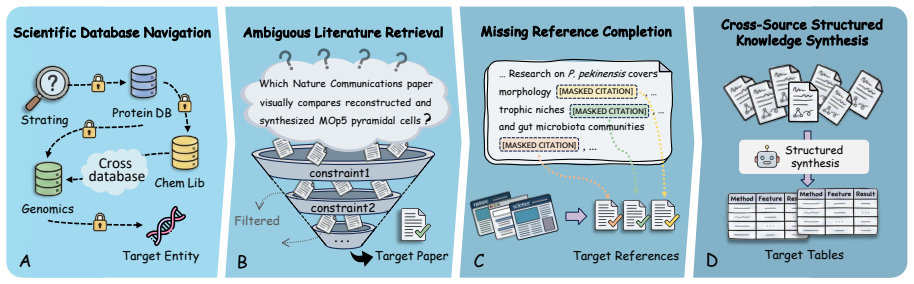
The central discovery is a measured capability gap: current LLMs and autonomous agents cannot reliably complete realistic scientific information-seeking workflows. SciExplore organizes this workflow into four hierarchical task types—scientific database navigation, ambiguous literature retrieval, missing reference completion, and cross-source structured knowledge synthesis—and evaluates twelve systems. The best-scoring deep research agent reaches only 49.39% overall; performance drops sharply with task complexity, and the highest-level synthesis task is almost unsolved, with even the top agent achieving 30.14% item-level recall and 18.59% row-level recall. The paper attributes these failures
What carries the argument
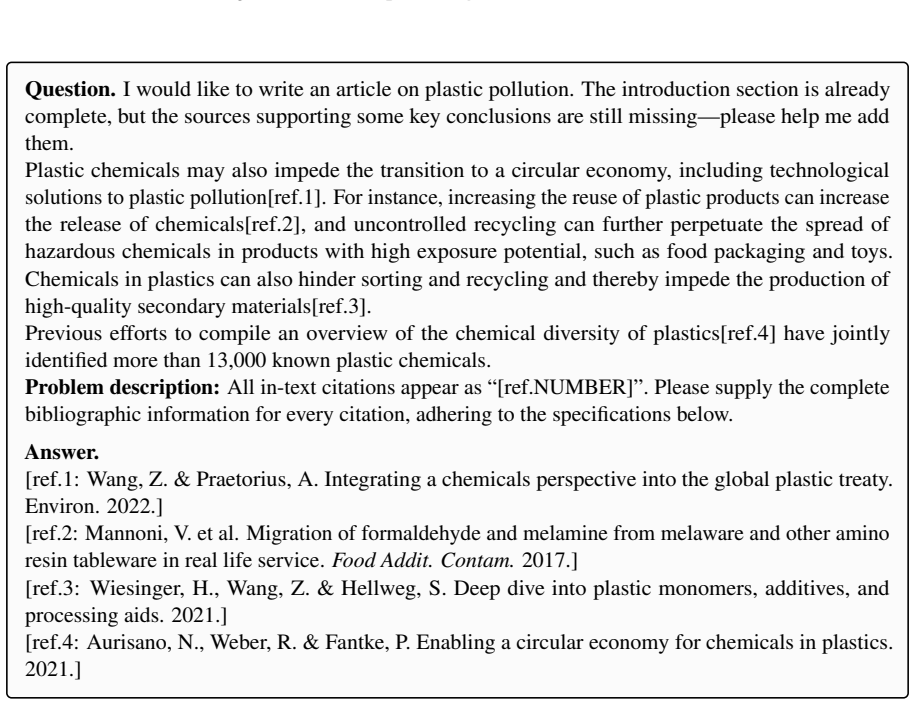
The central object is the SciExplore benchmark itself, with its expert-driven construction and three-stage quality control. Tasks are built by techniques such as Reverse Trajectory Construction for database navigation, Feature Denoising and Fuzzification with validation constraint injection for ambiguous retrieval, claim-evidence rewriting for missing references, and expert-curated comparison schemas for synthesis. Quality control retains tasks only if expert annotators cannot solve them in 10 minutes and if search-enabled LLMs plus human reviewers find no alternative answers, enforcing answer uniqueness and resistance to memorization.
Load-bearing premise
The benchmark's validity assumes that every task has exactly one correct answer that cannot be obtained by memorization or shortcut; if the 10-minute expert screen or LLM-based alternative-answer search misses ambiguous tasks, the reported failure rates would overstate model inability.
What would settle it
Re-running the benchmark with an independent set of expert annotators and an answer-uniqueness check would settle the central claim: if a substantial fraction of tasks admits multiple defensible answers or can be solved by experts in under 10 minutes, the benchmark's difficulty and uniqueness claims are undermined. Alternatively, a model that explicitly revises hypotheses and searches broadly could exceed the reported 49.39% ceiling, challenging the conclusion that current methods are fundamentally insufficient.
If this is right
- If the benchmark is valid, retrieval augmentation alone will not make agents into scientific assistants; they need search breadth, persistence, and schema-constrained synthesis.
- The task hierarchy offers a diagnostic: T4 row-level recall exposes that local correctness does not scale to global structured output.
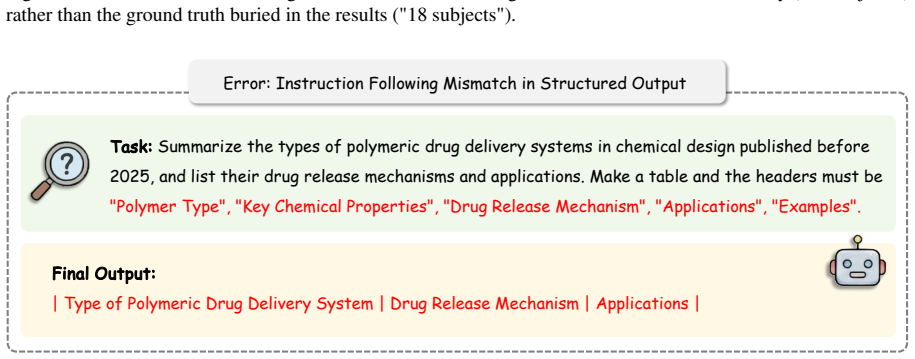
- The identified failure modes—premature abandonment, hallucination, long-context loss, and instruction mismatch—give concrete targets for model development.
- The correlation between search frequency and accuracy suggests agents should be designed to explore and verify repeatedly rather than relying on shallow retrieval.
Where Pith is reading between the lines
- The quality-control protocol implies tasks are screened against both human and LLM solvability; if that screen is imperfect, the reported failure rates may overstate model inability on realistic but easier variants.
- The finding that hop length does not predict difficulty suggests that benchmark designers should measure cognitive complexity rather than surface-level search depth.
- The very low row-level recall on T4 is a transferable warning: any automated pipeline that depends on strict schemas will likely fail unless agents are trained with explicit schema constraints.
Editorial analysis
A structured set of objections, weighed in public.
Referee Report
Summary. SciExplore is a new benchmark for evaluating LLMs and autonomous agents on scientific information-seeking. It consists of 103 expert-curated tasks distributed across four task types: T1 scientific database navigation, T2 ambiguous literature retrieval, T3 missing reference completion, and T4 cross-source structured knowledge synthesis. The tasks are claimed to form a progressive cognitive hierarchy from entity-level reasoning to domain-level synthesis. The authors evaluate 13 model/agent configurations, including foundation LLMs, search-augmented LLMs, and deep research agents. They report a sharp performance drop as task complexity increases: the best system, OpenAI Deep Research, attains 49.39% overall, while T4 row-level recall is only 18.59%. The paper concludes that current systems are far from reliable autonomous scientific assistants, especially for multi-source structured synthesis.
Significance. If the benchmark's validity is established, SciExplore addresses an important gap: most existing benchmarks evaluate either general-domain retrieval or static scientific QA, whereas SciExplore attempts to measure the full chain of database navigation, literature disambiguation, evidence grounding, and structured synthesis. The task design is ambitious, the domain coverage is broad, and the authors include useful appendix material such as prompt templates and a run-to-run variance analysis. The central empirical finding — that performance degrades markedly on synthesis tasks — is plausible and would be informative to the community. However, the benchmark's two most difficult task types (T3 and T4) depend on answer-uniqueness and LLM-based scoring assumptions that are not adequately validated, and the benchmark data are not released. These issues are load-bearing for the paper's central claim and prevent the current version from being accepted as a definitive benchmark.
major comments (4)
- [Section 3.3 / Fig. 17] The answer-uniqueness guarantee is not credible for T4, and only weakly for T3. The QC protocol screens tasks by an expert 10-minute search limit and by asking search-enabled LLMs plus human reviewers to find alternative answers. For T4, constructing a full comparison table typically takes far longer than 10 minutes, and the paper's own error analysis (§5.2) shows that these same LLMs prematurely abandon searches and hallucinate constraints, making them unlikely to surface valid alternatives. The T4 example in Fig. 17 asks for 'representative LLMs applied in bioinformatics in 2024' with no explicit selection criteria, yet the gold answer is a fixed 17-row table. Many defensible alternative tables exist. The paper does not report how many candidate tasks were discarded in Stage 3, nor any human verification specific to T3/T4. Without this, low T4 scores (Table 3) conflate model incomplete
- [Throughout] The benchmark data are not released. No URL, dataset download, license, or data card is provided. For a paper whose main contribution is a benchmark, this is a major omission: readers cannot inspect the 103 tasks, the gold answers, or the agent trajectories, and the LLM-judged T3/T4 scores cannot be reproduced. A benchmark paper should include a release plan and a detailed data card in the final version.
- [Appendix A.5.2 / A.5.3] T3 and T4 scores are produced entirely by LLM judges, with no validation of the judge itself. There is no human inter-annotator agreement study, no error analysis of the judge's decisions, and no calibration against expert judgments. Because the headline claim is 'extremely low accuracy' on T4, the judge's strictness is load-bearing: an overly strict judge lowers scores, an overly lenient judge inflates them. The authors should report a human-judge comparison on a random sample and release the judge prompts and outputs.
- [Table 6 / Section 4.2] Human baseline performance is only reported for T1 multi-hop subsets; no human experts are evaluated on T2, T3, or T4. The Stage 1 '10-minute limit' is a filtering criterion, not a performance baseline. Without human expert scores on T3 and T4, the claim that these tasks are 'PhD-level' and that models 'cannot reliably' solve them is not calibrated. At least a small human-expert study on T3/T4 should be reported.
minor comments (5)
- [Eq. (8)] The overall-score weights w1=0.2, w2=0.2, w3=0.3, w4=0.3 are set without justification or sensitivity analysis. The headline '49.39% overall' is weight-dependent; the authors should report a sensitivity range or justify the weights by task difficulty.
- [Table 6 / Section 5.1] The claim that 'increasing hop length does not consistently degrade performance' is based on very small per-bin sample sizes (e.g., 6-hop likely contains 4 tasks). The apparent non-monotonicity may be noise. Report per-bin task counts and a significance test.
- [Fig. 17] The gold T4 table includes 'RiNALMo' published on arXiv, while other rows are from Nature Methods or Science. The selection criterion for 'representative LLMs' is undefined, reinforcing the need for an explicit rubric in the task prompt and in the QC protocol.
- [Appendix A.7] The introduction to the error analysis refers to trajectories from 'Gemini-DeepResearch or GPT-4o', but GPT-4o is not among the evaluated systems listed in Table 3. Use one of the evaluated models or clarify that GPT-4o is used only for illustration.
- [A.6] The run-to-run variance analysis uses four repeated runs, but for T3 and T4 (14 and 18 tasks per run) the variance estimates themselves are noisy. Report confidence intervals or raw per-run scores.
Circularity Check
No significant circularity: SciExplore's claims are anchored in expert-curated tasks and direct measurement, not in fitted inputs or self-citations.
full rationale
The paper does not contain a derivation chain that reduces to its own inputs. The central claim—that current agents score 49.39% overall and 18.59% row recall on T4—is a measurement against expert-curated ground truth, not a quantity fitted from the evaluated models. T1/T2 use exact-match scoring against manually constructed gold answers; T3/T4 use LLM-assisted judging, but the gold references and gold tables come from expert curation and review-paper comparison schemas, not from the models being evaluated. The answer-uniqueness check in Section 3.3 uses search-enabled LLMs to propose candidate alternative answers, but those candidates are reviewed by human annotators before retention, and this procedure does not mathematically force the subsequently reported low scores. The fact that LLMs participate in both validation and scoring is a potential reliability concern, but it is not a circular step: the benchmark's correctness does not presuppose the truth of its conclusion. No self-citations are load-bearing, and no fitted parameter is renamed as a prediction. The acknowledged limitations (small scale, text-centric sources, manual maintenance) are external validity caveats, not evidence of circularity. The skeptical concern that T3/T4 may be under-specified is a benchmark-validity risk, which the instructions direct to correctness risk rather than circularity. Accordingly, no circular step is demonstrated.
Axiom & Free-Parameter Ledger
free parameters (2)
- Overall score weights w1-w4 =
0.2, 0.2, 0.3, 0.3
- QC difficulty screen time limit =
10 minutes
axioms (4)
- domain assumption The 103 expert-curated tasks and their ground-truth answers are correct and unambiguous.
- domain assumption Search engines and search-enabled LLMs used in Answer Uniqueness Verification can surface any plausible alternative answer.
- domain assumption The LLM judges used for T3 and T4 reliably distinguish correct from incorrect citations and table cells.
- ad hoc to paper The four-level hierarchy (entity, document, evidence, domain) reflects the cognitive structure of scientific information seeking.
Cite this review
Pith. "Pith review of SciExplore: Evaluating Autonomous Agents from Scientific Navigation to Information Integration." pith.science (2026). https://pith.science/paper/2SCLS3WT
@misc{pith2026260720926,
  author       = {Pith},
  title        = {Pith review of: SciExplore: Evaluating Autonomous Agents from Scientific Navigation to Information Integration},
  year         = {2026},
  howpublished = {\url{https://pith.science/paper/2SCLS3WT}},
  note         = {Machine review of arXiv:2607.20926}
}
read the original abstract
Scientific research involves complex information-seeking and reasoning workflows across heterogeneous sources. However, existing benchmarks primarily emphasize general-domain retrieval or static scientific question answering, and therefore fail to assess key capabilities required in realistic scientific research workflows. We introduce SciExplore, a benchmark designed to evaluate scientific information-seeking and reasoning capabilities of LLMs and agents. SciExplore comprises four task types covering 103 expert-curated tasks across more than ten scientific disciplines: scientific database navigation, ambiguous literature retrieval, missing reference completion, and cross-source structured knowledge synthesis, which probe progressively higher-level abilities from entity-level reasoning and document-level identification to evidence-level grounding and domain-level synthesis. We evaluate over ten state-of-the-art LLMs and autonomous agents on SciExplore, revealing substantial performance gaps with performance degrading sharply as task complexity increases and extremely low accuracy on the most challenging structured synthesis tasks. These results highlight significant limitations of current models and agents in realistic scientific information-seeking scenarios.
Figures





Reference graph
Works this paper leans on
-
[1]
2.Numeric tolerance: • Match if absolute diff≤10 −6 OR relative diff≤10 −3 (when|value|>10 −6)
Ignore case, extra whitespace, and trivial punctuation. 2.Numeric tolerance: • Match if absolute diff≤10 −6 OR relative diff≤10 −3 (when|value|>10 −6). • Treat0.25as equal to25%if clearly percentage-formatted. 3.Units: convert when unambiguous (e.g., g↔mg). If units conflict, treat as mismatch. 4.Aliases: allow common aliases if clearly the same entity. 5...
-
[2]
• If a gold column cannot be mapped, that item isnot recalled
semantic similarity of header names. • If a gold column cannot be mapped, that item isnot recalled. Matching Procedure (must follow)
-
[3]
Parse PREDICTION rows and build an index from normalized pk values to candidate rows
-
[4]
• Setitems_recalled= 0
Ifgold_pknot found in prediction index: • Setitems_totalas defined above. • Setitems_recalled= 0. • Setrecall= 0.0
-
[5]
recall
Ifgold_pkfound: • If multiple predicted rows share the same pk, choose the row that maximizes items_recalled. • For each eligible gold item cell: –Compare gold cell vs predicted mapped cell after normalization. –Count match as recalled; otherwise mismatch. Output Format (STRICT JSON ONLY) Return ONLY one JSON object: { " recall ": float , " items_recalled...
-
[6]
A Plasmonic Coupling Substrate
The agent successfully retrieved a candidate paper ("A Plasmonic Coupling Substrate...") that matched the topic and publication year. However, it failed to rigorously verify the fine-grained vi- sual and structural constraints. Instead of rejecting the paper or performing a specific "Ctrl+F" style verification for the reference count, the agent hallu- cin...
2020
-
[7]
exact header match after normalization, else
-
[8]
Parse ANSWER: extract headers and the single gold row
-
[9]
Identifypk_col=first header,gold_pk=normalized(value in pk_col)
-
[2023]
arXiv preprint arXiv:2307.10635
Scibench: Evaluating college-level scientific problem-solving abilities of large language models. arXiv preprint arXiv:2307.10635. Jason Wei, Zhiqing Sun, Spencer Papay, Scott McKin- ney, Jeffrey Han, Isa Fulford, Hyung Won Chung, Alex Tachard Passos, William Fedus, and Amelia Glaese. 2025. Browsecomp: A simple yet challeng- ing benchmark for browsing age...
Pith/arXiv arXiv 2025
-
[2024]
arXiv preprint arXiv:2401.14011
Cmmu: A benchmark for chinese multi-modal multi-type question understanding and reasoning. arXiv preprint arXiv:2401.14011. Dan Hendrycks, Collin Burns, Steven Basart, Andy Zou, Mantas Mazeika, Dawn Song, and Jacob Stein- hardt. 2020. Measuring massive multitask language understanding.arXiv preprint arXiv:2009.03300. Lisheng Huang, Yichen Liu, Jinhao Jian...
Pith/arXiv arXiv 2020
-
[2025]
Qwen3 technical report.arXiv preprint arXiv:2505.09388. Zhilin Yang, Peng Qi, Saizheng Zhang, Yoshua Bengio, William Cohen, Ruslan Salakhutdinov, and Christo- pher D Manning. 2018. Hotpotqa: A dataset for diverse, explainable multi-hop question answering. InProceedings of the 2018 conference on empiri- cal methods in natural language processing, pages 236...
Pith/arXiv arXiv 2018
This paper was first reviewed by deepseek-v4-flash on August 1, 2026.
discussion (0)
Sign in with ORCID, Apple, or X to comment. Anyone can read and Pith papers without signing in.