REVIEW 2 major objections 4 minor 53 references
Future lepton colliders can discover charged Higgs bosons with mass below half the collision energy at 5σ regardless of the Yukawa coupling, and very large neutrino telescopes extend the reach to heavier masses.
Reviewed by Pith at T0; open to challenge. T0 means a machine referee read the full paper against a public rubric. the ladder, T0–T4 →
T0 review · deepseek-v4-flash
2026-08-01 08:52 UTC pith:VGFMYF3O
load-bearing objection Solid phenomenological comparison, but the neutrino-telescope sensitivity curves sit in parameter space that low-energy data almost certainly exclude, so the complementarity claim is not supported as it stands. the 2 major comments →
Charged Higgs Search at Future Neutrino Telescope and Higgs Factory
The pith
A machine-rendered reading of the paper's core claim, the machinery that carries it, and where it could break.
Core claim
The central claim is that the charged Higgs boson can be searched for with high sensitivity at both future lepton colliders and future neutrino telescopes through two largely model-independent mechanisms. At a lepton collider with center-of-mass energy √s, charged Higgs pairs are produced via the gauge coupling γ/Z, so the production rate does not depend on the unknown Yukawa couplings; using double-sided reconstruction on the two decay chains (dijet and lepton-plus-missing-energy), the paper finds a statistical significance above 5σ for all masses below √s/2, provided the charged Higgs decays inside the detector. At a neutrino telescope, an incident ultra-high-energy electron antineutrino c
What carries the argument
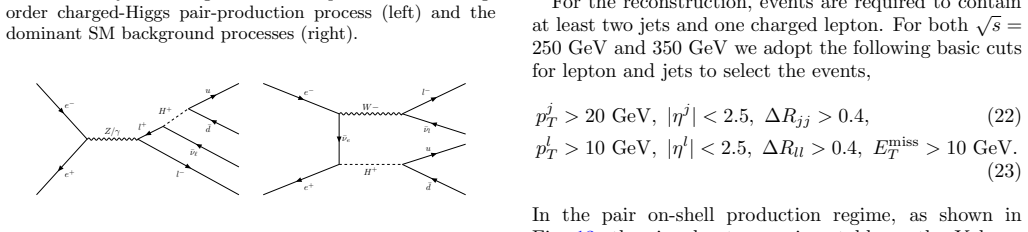
The resonant s-channel process \barν_e + e^- → H^- → f\bar{f}' at neutrino telescopes, with the resonance energy set by E_res = m_{H±}^2/(2m_e); the peak cross section is independent of the Yukawa coupling because the width in the numerator and denominator cancel. This is complemented at colliders by the gauge-interaction pair-production e^+e^- → H^+H^- via γ/Z, reconstructed with the double-sided invariant-mass technique (m_jj and m_{\barνl l}), which makes the signal rate insensitive to the Yukawa couplings and yields a guaranteed 5σ significance in the pair on-shell region.
Load-bearing premise
The benchmark models are assumed to be experimentally viable even though they assign O(0.1–1) Yukawa couplings to electrons, muons, and first/second-generation quarks; the paper checks only LEP and LHC τν bounds, not low-energy flavor/rare-decay constraints such as K→μν, π→eν, and μ→eγ that could exclude the very parameter space probed.
What would settle it
Show that existing low-energy flavor and rare-decay measurements (K→μν, π→eν, μ→eγ) exclude the benchmark Yukawa couplings for m_{H±} between 80 and 350 GeV; if so, the parameter space on which both the collider and neutrino-telescope discovery projections are drawn does not exist.
If this is right
- A future e+e- collider running at √s = 250–350 GeV can establish a 5σ charged Higgs discovery for any mass below roughly half the beam energy, independent of the Yukawa coupling, as long as the charged Higgs decays within roughly a meter of the interaction point.
- A neutrino telescope with ~1000 km^3 effective volume and 10 years of exposure can reach comparable sensitivity for charged Higgs masses near and above 300 GeV, especially in models where the charged Higgs couples to first-generation fermions.
- The muon-track channel at neutrino telescopes is the more powerful of the two event topologies, because the flat muon-energy spectrum creates a characteristic shoulder over the Standard Model background; the cascade channel is weaker but adds independent sensitivity.
- The astrophysical neutrino flux uncertainty shifts the telescope reach noticeably, with the conservative cosmogenic flux giving better sensitivity for heavier masses because of the flux crossing around 50 PeV.
- The collider and telescope strategies are complementary rather than redundant: the collider covers the light-mass region with high significance, while the telescope extends the probe to masses inaccessible to pair production.
Where Pith is reading between the lines
- The benchmark models assign O(0.1–1) Yukawa couplings to electrons, muons, and first/second-generation quarks; the paper applies only LEP and LHC τν bounds, but low-energy flavor and rare-decay measurements (such as K→μν, π→eν, and μ→eγ) could independently exclude exactly this parameter space, which would invalidate the projected discovery curves for those benchmarks.
- The 'guaranteed 5σ' at the collider is essentially an existence proof for a discovery channel, not a measurement of the charged Higgs properties; follow-up studies would be needed to extract the mass and couplings from the reconstructed invariant masses.
- The resonant scattering mechanism is not specific to the charged Higgs: the same s-channel technique could be applied to other new-physics resonances coupling to electron–antineutrino pairs, so the paper's sensitivity projections provide a template for a broader class of searches at large-volume neutrino telescopes.
- A combined analysis that includes the telescope's flux-model uncertainties and the collider's systematic uncertainties would likely strengthen the complementarity claim, since the two approaches are statistically independent (track vs. collider events).
Editorial analysis
A structured set of objections, weighed in public.
Referee Report
Summary. The paper studies the discovery potential of a charged Higgs boson in two simplified benchmark models (Models I and II) with a universal Yukawa coupling y, using two very different experimental settings: future neutrino telescopes (IceCube-Gen2, HUNT-like volumes) via resonant scattering of ultra-high-energy electron antineutrinos off electrons in the detector, and future lepton colliders (CEPC/FCC-ee) via charged-Higgs pair and associated production. For neutrino telescopes, the authors derive analytic cross sections for s-channel charged-Higgs production, include muon-track and cascade signatures, consider four astrophysical neutrino flux models and volumes from 100 to 5000 km^3, and obtain 3σ/5σ sensitivity contours in the (m_{H^±}, y) plane. For colliders, they perform LO MadGraph/Pythia/Delphes simulations for e+e− → ν̄_l l− + jets and study double-sided and single-sided reconstruction in the pair on-shell, single-resonant, and off-shell regions, including a 1% background systematic uncertainty. They conclude that future lepton colliders generally give better sensitivity over most of the considered parameter space, but that a neutrino telescope with very large volume can provide competitive and complementary sensitivity in the heavy-mass region.
Significance. If the central conclusion is accepted, the paper provides a useful quantitative comparison of two proposed discovery machines for charged scalars, with a transparent analytic treatment of the neutrino-telescope signal and a dedicated collider analysis. It goes beyond earlier IceCube charge-Higgs studies by combining track and cascade channels, scanning detector volume and flux models, and explicitly comparing with Higgs-factory projections. The analytic event-rate framework and the use of public generators for the collider part are strengths. The pair-production collider sensitivity is robust to the value of y as long as the scalar decays promptly in the detector, which is a clean and largely model-independent statement within the assumed fermionic-decay benchmark. However, the absolute neutrino-telescope sensitivities and the final comparison rest on two fragile assumptions: the benchmark models' viability under low-energy flavor constraints, and the omission of Earth attenuation, detector acceptance, and energy resolution. These issues must be addressed before the complementarity claim is established.
major comments (2)
- [Sec. II A (Eqs. (4)-(5)), Figs. 9-10 and 15-16] The benchmark Models I and II assign O(0.1-1) Yukawa couplings to electrons, muons, and first/second generation quarks. The paper applies only LEP and LHC τν constraints (Sec. III B). It does not apply low-energy flavor constraints, which are known to be severe for tree-level charged-scalar exchange. For example, a rough tree-level estimate for π→eν gives a deviation relative to the SM of order y^2 (v/m_H±)^2 m_π^2/(m_u+m_d); for y=0.3 and m_H±=200 GeV this is tens of percent, far above the measured precision. The 5σ neutrino-telescope curves in Fig. 10 require y>~0.3 for m_H±>~250 GeV. If such couplings are excluded by π/K/D decay data, the claimed heavy-mass complementarity corresponds to unphysical parameter space. This is a load-bearing external-validation gap: the authors should add the relevant low-energy constraints (or a conservative recasting) and show how much of the plotted re
- [Sec. II C (Eq. (16)), Figs. 9-10] The telescope sensitivity calculation assumes full-sky 4π acceptance, no Earth attenuation, and perfect detection efficiency and energy resolution. At the resonance energies relevant here (E_res ~ m_H±^2/(2m_e), e.g., ~50-120 PeV for m_H± ~250-350 GeV), Earth attenuation of upgoing neutrinos is not negligible; a 4π angular integral substantially overestimates the effective exposure. Since the 5σ thresholds in Fig. 10 are steep functions of y, a factor of a few in event rate can shift the inferred y sensitivity by a sizable amount, and the eventual collider-vs-telescope comparison in Figs. 15-16 is not demonstrated to be robust. A minimal bracketing (e.g., down-going-only or attenuation-corrected estimates) should be added.
minor comments (4)
- [Fig. 13 and Sec. III A] The text states that a decay-length cutoff of ~1 m is imposed, but Fig. 13 and Fig. 14 show flat cross sections and significances down to y=10^-6. For m_H±=100 GeV and y=10^-6, the decay length is O(20 m), so the acceptance would be strongly suppressed if the cutoff were applied. Please clarify whether the plotted points include the decay-length criterion or whether it is meant only to define the edge of the sensitivity region.
- [Fig. 2 and Sec. II A 1] The t-channel contribution is stated to be negligible near the s-channel resonance, and is then neglected throughout the analysis. For completeness, please state whether the t-channel was also checked at energies far below/above the resonance, since the flux-weighted event rate receives contributions from a broad energy range.
- [Sec. III C and Figs. 15-16] The phrase 'model-independent' for the collider claim should be qualified: the analysis assumes the charged Higgs decays only through the fermionic channels of Eqs. (4)-(5). If bosonic decays (e.g., H±→W±h) open up, the signal final state changes and the quoted 5σ reach does not directly apply.
- [References] Several bibliographic entries lack volume/page/year information (e.g., Refs. [17], [24], [25], [32], [35], [40]). Please bring the reference list to journal style.
Circularity Check
No circularity: benchmark Yukawas are scanned parameters, sensitivity curves solve the significance equation, and all external inputs are cited prior measurements.
full rationale
The derivation is self-contained in the sense relevant to circularity. Model I/II are defined by Lagrangians (Eqs. 1-5), with y an externally scanned parameter; widths and branching ratios in Eqs. (9)-(10) follow algebraically from those definitions, and the resonant cross sections (Eqs. 8, 11) are standard s-channel expressions. Sensitivity is defined in Eq. (20) as the y value for which the Poisson significance Z_A equals n; this is an inverse-significance projection, not a fitted-input prediction. Neutrino flux models (Eqs. 14-15 and IceCube-Gen2) are prior experimental fits imported as external inputs, not quantities derived from the charged-Higgs signal. Collider analyses use MadGraph/Pythia/Delphes with SM backgrounds and Cowan significance Eq. (27); the pair on-shell claim (>5σ whenever H± decays inside detector) is an MC output and is stated as being independent of y, so it does not reduce to an input. No load-bearing self-citations appear: refs. [17-20,23,24] are independent prior analyses, and no uniqueness theorem or ansatz is imported from the authors' own work. Limitations--extrapolated fluxes, omitted low-energy flavor constraints, and the phenomenological tau-decay kernels of Appendix A--are external-validity or modeling caveats, not circular steps.
Axiom & Free-Parameter Ledger
free parameters (5)
- Universal Yukawa coupling y (Models I and II) =
Benchmarks 0.14, 0.28; sensitivity thresholds up to ~1
- Charged Higgs mass m_H± =
150, 250, 350 GeV for telescope benchmarks; collider scans at sqrt(s)=250/350 GeV
- Collider background systematic uncertainty σ_B =
0.01
- Tau-energy response kernel parameters =
κ=8, ⟨z⟩_e=1/3, ⟨z⟩_had=2/3, ⟨z⟩_μ=1/3
- Energy binning choice =
N_bin=20, 30, 40; 0.1-200 PeV
axioms (6)
- ad hoc to paper Charged-Higgs benchmark Lagrangians, Eqs. (1)-(5), with universal Yukawa coupling y and no bosonic decays.
- domain assumption Astrophysical neutrino flux benchmark models are valid at Eν~10^7-10^8 GeV and can be extrapolated from lower energies.
- domain assumption Equal flavor ratio at Earth with ν:νbar = 1:1, so Φ_barν_e = Φ_νμ = Φ_total/6.
- domain assumption Full-sky coverage, no Earth attenuation, unit detector efficiency, and E_dep≈E_ν for hadronic cascades.
- ad hoc to paper Models I and II are not already excluded by low-energy flavor physics (only LEP and LHC τν constraints are considered).
- standard math SM background cross sections (Glashow W, NC/CC DIS, t-channel W) are taken from the cited literature and are accurate at these energies.
read the original abstract
We investigate the discovery potential of the charged Higgs boson at future lepton colliders and neutrino telescopes within two simplified benchmark scenarios with universal Yukawa couplings. We demonstrate that both the muon-track and cascade events at neutrino telescopes can be exploited to search for or constrain the charged Higgs boson through resonant neutrino scattering process, and we compare the sensitivities obtained under different astrophysical neutrino flux models. We study the effect of the detector volume of neutrino telescopes on the discovery potential of the charged Higgs boson. We study the signal of charged Higgs boson at future lepton colliders over different kinematic regimes using optimized reconstruction strategies. We compare the discovery potential of the two experimental approaches over the relevant parameter space and find that future lepton colliders generally provide better sensitivity in most of the parameter space, while neutrino telescopes with very large detector volume can offer competitive and complementary sensitivity in the heavy-mass region of the charged Higgs boson.
Figures




Reference graph
Works this paper leans on
-
[1]
Muon-track signals The coupling of charged Higgs boson to the leptonic sector allows UHE electron antineutrinos to scatter off electrons in the detector target and produce a muon and a muon antineutrino through ans-channel process ¯νe +e − →H − →µ − + ¯νµ.(6) These couplings also allow at-channel production process νµ +e − →µ − +ν e (7) as shown in Fig. 1...
-
[2]
Cascade signals The charged Higgs can also produce cascade-like final states through the resonants-channel processes ¯νe +e − →H − →e − + ¯νe,(12) and ¯νe +e − →H − →d i + ¯ui, i= 1,2,3,(13) as shown in Fig. 4. The electronic channel produces an electromagnetic cascade, while the quark final states give hadronic cascades. We combine them as the sec- ond s...
-
[3]
The differ- ential event rate as a function of the outgoing muon en- ergy,dN/dE µ, is shown in Fig
Event Rate We first consider the muon-track channel. The differ- ential event rate as a function of the outgoing muon en- ergy,dN/dE µ, is shown in Fig. 7. For the charged Higgs signals, the event rates are nearly flat at lowE µ and de- velop shoulders at largerE µ. This behavior can be un- derstood from the resonant enhancement of the charged Higgs cross...
-
[4]
Sensitivity Having established the signal and SM background event rates, we now estimate the discovery sensitivity of the charged Higgs at future neutrino telescopes. For each channel, the expected number of events in thei-th energy bin is obtained by integrating the corresponding differential event rate, NX,i = Z Emax i Emin i dErec dNX dErec ,(17) 8 whe...
-
[5]
G. Aadet al.(ATLAS), Observation of a new particle in the search for the Standard Model Higgs boson with the ATLAS detector at the LHC, Phys. Lett. B716, 1 (2012), arXiv:1207.7214 [hep-ex]
Pith/arXiv arXiv 2012
-
[6]
S. Chatrchyanet al.(CMS), Observation of a New Bo- son at a Mass of 125 GeV with the CMS Experiment at the LHC, Phys. Lett. B716, 30 (2012), arXiv:1207.7235 [hep-ex]
Pith/arXiv arXiv 2012
-
[7]
G. C. Branco, P. M. Ferreira, L. Lavoura, M. N. Rebelo, M. Sher, and J. P. Silva, Theory and phenomenology of two-Higgs-doublet models, Phys. Rept.516, 1 (2012), arXiv:1106.0034 [hep-ph]
Pith/arXiv arXiv 2012
-
[8]
U. Ellwanger, C. Hugonie, and A. M. Teixeira, The Next- to-Minimal Supersymmetric Standard Model, Phys. Rept.496, 1 (2010), arXiv:0910.1785 [hep-ph]
Pith/arXiv arXiv 2010
-
[9]
Donget al.(CEPC Study Group), CEPC Con- ceptual Design Report: Volume 2 - Physics & Detec- tor, Sci
M. Donget al.(CEPC Study Group), CEPC Con- ceptual Design Report: Volume 2 - Physics & Detec- tor, Sci. China Phys. Mech. Astron.63, 221001 (2020), arXiv:1811.10545 [hep-ex]
Pith/arXiv arXiv 2020
-
[10]
FCC Collaboration, FCC-ee: The Lepton Collider: Fu- ture Circular Collider Conceptual Design Report Volume 2, Eur. Phys. J. ST228, 261 (2019)
2019
-
[11]
Chenget al.(CEPC Physics Study Group), The Physics potential of the CEPC
H. Chenget al.(CEPC Physics Study Group), The Physics potential of the CEPC. Prepared for the US Snowmass Community Planning Exercise (Snowmass 2021), inSnowmass 2021(2022) arXiv:2205.08553 [hep- ph]
Pith/arXiv arXiv 2021
-
[12]
I. Agapovet al., Future Circular Lepton Collider FCC- ee: Overview and Status, inSnowmass 2021(2022) arXiv:2203.08310 [physics.acc-ph]
Pith/arXiv arXiv 2021
-
[13]
M. G. Aartsenet al.(IceCube), Detection of a parti- cle shower at the Glashow resonance with IceCube, Na- ture591, 220 (2021), [Erratum: Nature 592, E11 (2021)], arXiv:2110.15051 [hep-ex]
arXiv 2021
-
[14]
M. G. Aartsenet al.(IceCube), Observation of High- Energy Astrophysical Neutrinos in Three Years of Ice- Cube Data, Phys. Rev. Lett.113, 101101 (2014), arXiv:1405.5303 [astro-ph.HE]
Pith/arXiv arXiv 2014
-
[15]
A. Schneider (IceCube), Characterization of the As- trophysical Diffuse Neutrino Flux with IceCube High- Energy Starting Events, PoSICRC2019, 1004 (2020), arXiv:1907.11266 [astro-ph.HE]
Pith/arXiv arXiv 2020
-
[16]
Aielloet al.(KM3NeT), Observation of an ultra-high- energy cosmic neutrino with KM3NeT, Nature638, 376 (2025), [Erratum: Nature 640, E3 (2025)]
S. Aielloet al.(KM3NeT), Observation of an ultra-high- energy cosmic neutrino with KM3NeT, Nature638, 376 (2025), [Erratum: Nature 640, E3 (2025)]
2025
-
[17]
M. G. Aartsenet al.(IceCube-Gen2), IceCube-Gen2: the window to the extreme Universe, J. Phys. G48, 060501 (2021), arXiv:2008.04323 [astro-ph.HE]
arXiv 2021
-
[18]
M. Chen (on behalf of HUNT Collaboration), Hunt: An ultra-large-scale neutrino astronomy telescope, Nuclear Instruments and Methods in Physics Research Section A: Accelerators, Spectrometers, Detectors and Associated Equipment1086, 171374 (2026)
2026
-
[19]
Z. P. Yeet al.(TRIDENT), A multi-cubic-kilometre neu- trino telescope in the western Pacific Ocean, Nature As- tron.7, 1497 (2023), arXiv:2207.04519 [astro-ph.HE]
arXiv 2023
-
[20]
M. G. Aartsenet al.(IceCube), The IceCube Neu- trino Observatory: Instrumentation and Online Systems, JINST12(03), P03012, [Erratum: JINST 19, E05001 (2024)], arXiv:1612.05093 [astro-ph.IM]. 17 FIG. 19. Differential rates for muon-track(upper panel) and cascade(lower panel) events as functions of the visible energyE obs, whereE obs =E µ for the muon-track...
Pith/arXiv arXiv 2024
-
[21]
U. K. Dey, N. Nath, and S. Sadhukhan, Charged Higgs effects in IceCube: PeV events and NSIs, JHEP (09), 113, arXiv:2010.05797 [hep-ph]
Pith/arXiv arXiv 2010
-
[22]
K. S. Babu, P. S. Dev, S. Jana, and Y. Sui, Zee- Burst: A New Probe of Neutrino Nonstandard Interac- tions at IceCube, Phys. Rev. Lett.124, 041805 (2020), arXiv:1908.02779 [hep-ph]
Pith/arXiv arXiv 2020
-
[23]
K. S. Babu, P. S. B. Dev, and S. Jana, Probing neutrino mass models through resonances at neutrino telescopes, Int. J. Mod. Phys. A37, 2230003 (2022), arXiv:2202.06975 [hep-ph]
Pith/arXiv arXiv 2022
-
[24]
Y. Bai, K. Xie, and B. Zhou, Large Neutrino ”Collider” (2025), arXiv:2510.13948 [hep-ph]
arXiv 2025
-
[25]
M. G. Aartsenet al.(IceCube), Energy Reconstruction Methods in the IceCube Neutrino Telescope, JINST (9), P03009, arXiv:1311.4767 [physics.ins-det]
-
[26]
M. G. Aartsenet al.(IceCube), Characteristics of the diffuse astrophysical electron and tau neutrino flux with six years of IceCube high energy cascade data, Phys. Rev. Lett.125, 121104 (2020), arXiv:2001.09520 [astro- ph.HE]
arXiv 2020
-
[27]
S. L. Glashow, Resonant scattering of antineutrinos, Phys. Rev.118, 316 (1960)
1960
-
[28]
G.-y. Huang and Q. Liu, Hunting the Glashow Reso- nance with PeV Neutrino Telescopes, JCAP (03), 005, arXiv:1912.02976 [hep-ph]
Pith/arXiv arXiv 1912
-
[29]
R. Gandhi, C. Quigg, M. H. Reno, and I. Sarcevic, Ultrahigh-energy neutrino interactions, Astropart. Phys. 5, 81 (1996), arXiv:hep-ph/9512364
Pith/arXiv arXiv 1996
-
[30]
R. Abbasiet al.(IceCube), Evidence for a Spectral Break or Curvature in the Spectrum of Astrophysical Neutrinos from 5 TeV–10 PeV, Phys. Rev. Lett.136, 121002 (2026), arXiv:2507.22233 [astro-ph.HE]
arXiv 2026
-
[31]
K. M. Groth, Y. G´ enolini, and M. Ahlers, Improved Lim- its on Cosmogenic Fluxes from Ultra-High Energy Cos- mic Rays, PoSICRC2021, 1005 (2021)
2021
-
[32]
K.-H. Kampert (Pierre Auger), Ultra-High Energy Cos- mic Rays: Recent Results and Future Plans of Auger, AIP Conf. Proc.1852, 040001 (2017), arXiv:1612.08188 [astro-ph.HE]
Pith/arXiv arXiv 2017
-
[33]
Cowanet al., Asymptotic formulae for likelihood- based tests of new physics, Eur
G. Cowanet al., Asymptotic formulae for likelihood- based tests of new physics, Eur. Phys. J. C71, 1554 (2011), [Erratum: Eur.Phys.J.C 73, 2501 (2013)], arXiv:1007.1727 [physics.data-an]
Pith/arXiv arXiv 2011
-
[34]
J. Alwallet al., The automated computation of tree-level and next-to-leading order differential cross sections, and their matching to parton shower simulations, JHEP (07), 079, arXiv:1405.0301 [hep-ph]
-
[35]
Sj¨ ostrandet al., An introduction to PYTHIA 8.2, Comput
T. Sj¨ ostrandet al., An introduction to PYTHIA 8.2, Comput. Phys. Commun.191, 159 (2015), arXiv:1410.3012 [hep-ph]
Pith/arXiv arXiv 2015
-
[36]
J. de Favereauet al.(DELPHES 3), DELPHES 3, A modular framework for fast simulation of a generic col- lider experiment, JHEP (02), 057, arXiv:1307.6346 [hep- ex]
-
[37]
Achardet al.(L3), Search for charged Higgs bosons at LEP, Phys
P. Achardet al.(L3), Search for charged Higgs bosons at LEP, Phys. Lett. B575, 208 (2003), arXiv:hep- ex/0309056
arXiv 2003
-
[38]
G. Abbiendiet al.(ALEPH, DELPHI, L3, OPAL, LEP), Search for Charged Higgs bosons: Combined Results Using LEP Data, Eur. Phys. J. C73, 2463 (2013), arXiv:1301.6065 [hep-ex]
Pith/arXiv arXiv 2013
-
[39]
A. M. Sirunyanet al.(CMS), Search for charged Higgs bosons in the H ± →τ ±ντ decay channel in proton- proton collisions at √s= 13 TeV, JHEP (07), 142, arXiv:1903.04560 [hep-ex]
Pith/arXiv arXiv 1903
-
[40]
G. Aadet al.(ATLAS), Search for charged Higgs bosons produced in top-quark decays or in association with top quarks and decaying via H±→τ±ντin 13 TeV pp col- lisions with the ATLAS detector, Phys. Rev. D111, 072006 (2025), arXiv:2412.17584 [hep-ex]
Pith/arXiv arXiv 2025
-
[41]
G. Aadet al.(ATLAS), Search for charged Higgs bosons decaying into a top quark and a bottom quark at √s = 13 TeV with the ATLAS detector, JHEP (06), 145, arXiv:2102.10076 [hep-ex]
-
[42]
G. Aadet al.(ATLAS), Search for a light charged Higgs boson int→H ±bdecays, withH ± →cb, in the lep- ton+jets final state in proton-proton collisions at √s= 13 TeV with the ATLAS detector, JHEP (09), 004, arXiv:2302.11739 [hep-ex]
-
[43]
G. Aadet al.(ATLAS), Search for a light charged Higgs boson int→H ±bdecays, withH ± →cs, inppcollisions at √s= 13 TeV with the ATLAS detector, Eur. Phys. J. C85, 153 (2025), arXiv:2407.10096 [hep-ex]. 18
Pith/arXiv arXiv 2025
-
[44]
A. M. Sirunyanet al.(CMS), Search for charged Higgs bosons produced in vector boson fusion processes and decaying into vector boson pairs in proton–proton colli- sions at √s= 13 TeV, Eur. Phys. J. C81, 723 (2021), arXiv:2104.04762 [hep-ex]
Pith/arXiv arXiv 2021
-
[45]
G. Aadet al.(ATLAS), Combination of searches for singly and doubly charged Higgs bosons produced via vector-boson fusion in proton–proton collisions at s=13 TeV with the ATLAS detector, Phys. Lett. B860, 139137 (2025), arXiv:2407.10798 [hep-ex]
Pith/arXiv arXiv 2025
-
[46]
G. Aadet al.(ATLAS), Search for direct stau production in events with two hadronicτ-leptons in √s= 13 TeVpp collisions with the ATLAS detector, Phys. Rev. D101, 032009 (2020), arXiv:1911.06660 [hep-ex]
Pith/arXiv arXiv 2020
-
[47]
A. Tumasyanet al.(CMS), Search for direct pair pro- duction of supersymmetric partners ofτleptons in the final state with two hadronically decayingτleptons and missing transverse momentum in proton-proton collisions at √s= 13 TeV, Phys. Rev. D108, 012011 (2023), arXiv:2207.02254 [hep-ex]
Pith/arXiv arXiv 2023
-
[48]
G. Aadet al.(ATLAS), Search for a heavy charged Higgs boson decaying into a W boson and a Higgs boson in final states with leptons and b-jets in √s= 13 TeV pp collisions with the ATLAS detector, JHEP (02), 143, arXiv:2411.03969 [hep-ex]
-
[49]
A. M. Sirunyanet al.(CMS), Search for a light charged Higgs boson decaying to a W boson and a CP-odd Higgs boson in final states with eµµorµµµin proton-proton collisions at √s= 13 TeV, Phys. Rev. Lett.123, 131802 (2019), arXiv:1905.07453 [hep-ex]
Pith/arXiv arXiv 2019
-
[50]
A. Tumasyanet al.(CMS), Search for a charged Higgs boson decaying into a heavy neutral Higgs boson and a W boson in proton-proton collisions at √s= 13 TeV, JHEP (09), 032, arXiv:2207.01046 [hep-ex]
-
[51]
Zas, Neutrino detection with inclined air showers, New J
E. Zas, Neutrino detection with inclined air showers, New J. Phys.7, 130 (2005), arXiv:astro-ph/0504610
Pith/arXiv arXiv 2005
-
[52]
M. Bustamante and A. Connolly, Extracting the Energy- Dependent Neutrino-Nucleon Cross Section above 10 TeV Using IceCube Showers, Phys. Rev. Lett.122, 041101 (2019), arXiv:1711.11043 [astro-ph.HE]
Pith/arXiv arXiv 2019
-
[53]
Navaset al.(Particle Data Group), Review of particle physics, Phys
S. Navaset al.(Particle Data Group), Review of particle physics, Phys. Rev. D110, 030001 (2024)
2024
discussion (0)
Sign in with ORCID, Apple, or X to comment. Anyone can read and Pith papers without signing in.