REVIEW 3 major objections 4 minor 40 references
Agent-skill optimizers that first localize a failure to the right workflow node and mechanism, then patch only that spot, beat whole-document rewriting and transfer across backbones and benchmarks.
Reviewed by Pith at T0; open to challenge. T0 means a machine referee read the full paper against a public rubric. the ladder, T0–T4 →
T0 review · deepseek-v4-flash
2026-08-01 08:43 UTC pith:KT3DEZNE
load-bearing objection WML is a solid, honest step in agent-skill optimization; the core attribution idea is plausible but under-validated, and the compiler benchmark is partly circular. the 3 major comments →
Workflow-Localized Mechanism Learning: Attribution-Guided Repair and Knowledge Reuse for Structured Agent Skills
The pith
A machine-rendered reading of the paper's core claim, the machinery that carries it, and where it could break.
Core claim
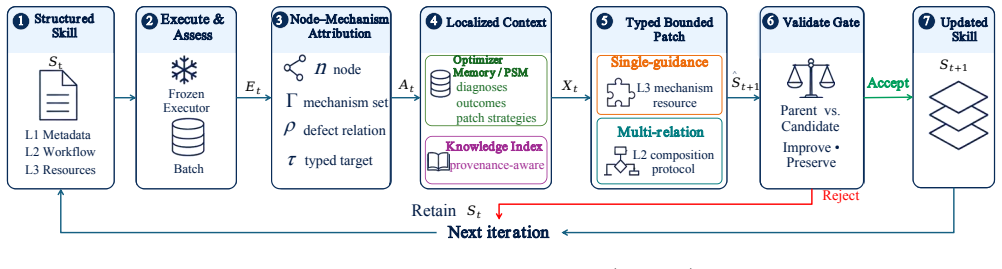
The paper claims that structured skill optimization is a localization problem: before editing an external skill, the optimizer must identify the failed workflow node, the implicated mechanisms, whether the defect is a missing rule inside one mechanism (single-guidance) or a coordination failure across several (multi-relation), and the smallest valid edit address. The Node-Mechanism Attribution tuple (n, Γ, ρ, τ) encodes this decision, and the Workflow-Guided Skill Optimization loop executes it with bounded patches gated by re-evaluation on the same batch. The ablation evidence is consistent with this claim: removing the attribution step costs 5.33 Hard / 7.89 Cell accuracy points, the larges
What carries the argument
The Node-Mechanism Attribution tuple (n, Γ, ρ, τ): the failed workflow node, the implicated reusable-mechanism set, the defect relation (single-guidance vs multi-relation), and a typed edit address. The routing contract maps single-mechanism defects to L3 resources — conditionally-loaded procedure documents — and multi-relation defects to L2 composition protocols — the always-loaded workflow body. A deterministic registry constrains free-form diagnoses to legal nodes and addresses, making the edit boundary mechanically inspectable.
Load-bearing premise
The whole repair strategy rests on the attribution step: if the diagnoser and registry misidentify the failed node, the implicated mechanism, or the smallest valid edit address, the patch is aimed at the wrong place and the reported accuracy gains would not follow.
What would settle it
Construct a failure-injection benchmark: take a working skill, break a known mechanism (e.g., delete a specific output-contract rule at the state-commit node), and run WML's attribution on the resulting failures. If the diagnoser fails to recover the injected node, mechanism, and address in, say, more than a third of cases, yet WML's end-task accuracy remains high, then the reported gains are not explained by correct localization. Conversely, if attribution recovers the injection but accuracy collapses when the routing contract is swapped, the gain comes from the routing contract, not the diag
If this is right
- Each failure produces a minimal, auditable edit: only the attributed L3 section or L2 protocol can change, and working behavior from successful trajectories is preserved by constraint.
- Third-party skill reuse becomes safe: external records are consulted only when local guidance is insufficient, are selected by mechanism and scope, and only reach the deployed artifact through a gated patch — never verbatim.
- Learned skills transfer: WML's SpreadsheetBench-optimized skills improve WikiTableQuestions accuracy by 3.00–7.00 points over the closest optimized baseline with zero additional training, suggesting the procedural knowledge is not benchmark-specific.
- Optimized skills are compiler-consumable: under a unified LLM workflow compiler, WML solves 40/50 tasks (17 more than the best alternative) while using 32.73% fewer tokens and 48.28% fewer calls per hard PASS, supporting a learn-once, compile-many operating model.
- Attribution is the load-bearing component: its removal produces the largest degradation in the ablations (−5.33 Hard, −7.89 Cell), placing locality at the center of the method's effectiveness.
Where Pith is reading between the lines
- Attribution is only ablated as a whole component; the paper reports no ground-truth check of whether the diagnoser recovers the true failed node and mechanism. A benchmark with failures deliberately injected at known nodes and mechanisms would settle whether localization or the broader gated loop drives the gains.
- The six-node ontology (context acquisition, target binding, operation selection, execution, state commit, verification) is described as domain-general; the same (n, Γ, ρ, τ) scheme could transfer to software maintenance or browser control, where edit targets would be files and selectors rather than L3/L2 documents.
- The compiler comparison suggests a learn-once, compile-many division of labor — covered tasks run under a restricted compiled executor, novel cases fall back to open-ended agents — but the paper does not specify how the routing between the two modes would be decided.
- Because the post-patch gate compares against the same training batch, an independent held-out regression set could determine whether accepted patches preserve behavior or only fit the batch; the paper lists such a set as future work.
Editorial analysis
A structured set of objections, weighed in public.
Referee Report
Summary. The paper proposes Workflow-Localized Mechanism Learning (WML), an optimizer for structured Agent Skills that attributes a failure to a workflow node, a reusable-mechanism set, a defect relation, and a typed L2/L3 edit address, then repairs the Skill through bounded patches, provenance-aware third-party knowledge reuse, and optimizer-side memory. The WGSO loop is evaluated on SpreadsheetBench and WikiTableQuestions with two backbones, and in a downstream LLM-compiler efficiency study. Headline results are 90.33±1.53 and 74.67±3.51 Hard Accuracy on SpreadsheetBench for DeepSeek and Qwen3.6-Flash, respectively, with zero-additional-training transfer to WikiTableQuestions at 84.00±2.00 and 83.00±2.00, and the best success-normalized cost on a 50-task compiler-supported slice.
Significance. WML addresses a genuine gap: existing Skill optimizers edit at document or layer level without determining which node/mechanism relation is defective. The typed attribution schema and dual L3/L2 repair paths are a principled way to constrain edits, and the experimental protocol controls for data scale, backbone, evaluator, and optimization data. The end-to-end results on external benchmarks are encouraging and the ablations degrade in the expected direction. The paper also ships a code/artifact link and a fairly detailed protocol, which aids reproducibility. The main weakness is that the central novelty—the correctness of Node–Mechanism Attribution—is never validated against ground truth, and the compiler benchmark is selected from WML's own development trajectories. If those issues are addressed, the work would be a solid contribution; currently the conceptual claims outrun the evidence.
major comments (3)
- [§4.2, §4.5, Table 2] The paper claims Node–Mechanism Attribution is the core novelty and that 'attribution-constrained locality' is a central mechanism, but there is no ground-truth evaluation of the attributed state (n, Γ, ρ, τ). Table 2's w/o-Attribution ablation removes 'this entire attribution-constrained repair path'; however, it still improves from 82.00 to 84.67 Hard Accuracy, so the condition is not 'no repair' and the substitute path is not described. As a result, the ablation cannot distinguish 'the diagnosed node/mechanism/relation/target is correct' from 'any bounded local edit at a registry-valid address helps.' Without precision/recall for the four attribution components, or an ablation that holds the patch mechanism fixed while varying attribution quality, the central explanatory claim is unsupported even if the end-to-end numbers stand.
- [§5.3, Table 3] Compiler-Supported50 is 'constructed once from WML development trajectories for which the compiler produced runnable artifacts' (§5.3). This is selection on the outcome: the 50-task slice is chosen because WML's development process produced runnable compiler artifacts, and the same slice is then used to compare all methods. The claim that WML has the highest hard-PASS rate and lowest cost per successful task is therefore partly circular. The authors should either sample the compiler-supported envelope without reference to WML, use the full SpreadsheetBench test set, or re-frame Table 3 as a demonstration of WML's compatibility with this compiler rather than as a head-to-head comparison.
- [§6.1, Table 1] The headline comparison rests on three seeds with no significance tests, and the manuscript explicitly declines to run them. For the two WikiTableQuestions transfer comparisons, the WML margins are only 2.33 and 3.00 percentage points with standard deviations around 2–3 points; with n=3 these would not reach conventional significance. The in-domain SpreadsheetBench margins are larger relative to the dispersion and are more convincing, but the cross-benchmark transfer claim—an explicitly stated contribution—is not statistically supported. Please add more seeds or significance testing, or temper the abstract/conclusion to describe the transfer result as suggestive.
minor comments (4)
- [Figure 1, Algorithm 1] The final PDF should render cleanly: several symbols and spacing artifacts appear in the figure caption and algorithm text (e.g., 'Parent vs. Candidate', 'V alidateAndGate', '�t').
- [Table 2] The text says cell values are rounded to four decimals before variance calculation, but Table 2 displays Cell Accuracies with two decimals. Align the precision between text and table.
- [§5.2, Figure 2] The five-round budget is justified by an extended diagnostic run, but the relationship between the diagnostic run and the main evaluation should be stated more explicitly: clarify that the tasks used to choose the budget did not overlap with the final evaluation tasks, so the operating point is not selected from the test set.
- [§4.2] The 'deterministic registry' is central to preventing arbitrary file selection, but the registry contents (allowed nodes, mechanisms, addresses) are not described or released in enough detail for replication. A short table or appendix entry would help.
Circularity Check
Main benchmark results are external and independent; the Compiler-Supported50 success claim is partly circular because the evaluation set is selected from WML's own development trajectories.
specific steps
-
fitted input called prediction
[Section 5.3 (Unified Compiler Protocol), Table 3; echoed in Abstract and Section 6.3]
"Compiler-Supported50 is a fixed capability slice constructed once from WML development trajectories for which the compiler produced runnable artifacts. ... On Compiler-Supported50, WML attains both the highest hard-PASS rate and the lowest cost per successful task."
The benchmark on which the compiler-consumability comparison is made is selected from WML's own development trajectories where WML's artifact already produced runnable compiled workflows. Reporting 'WML has the highest hard-PASS rate' on that selected subset is therefore partly a restatement of the inclusion criterion: tasks were chosen because WML's Skill was compiler-compatible. The head-to-head against other Skills is held fixed only after this WML-conditioned selection, so the claim that WML is the most compiler-consumable Skill inherits its advantage from the benchmark construction rather than from an independent task distribution. This does not affect the SpreadsheetBench/WikiTableQuestions main results, which use fixed external benchmarks.
full rationale
The SpreadsheetBench and WikiTableQuestions results are measured on fixed external benchmarks with a predefined five-round budget, so those gains are not forced by construction. The transfer test is a legitimate zero-additional-training evaluation. The component ablations are confounded (the w/o-Attribution ablation removes the entire constrained-repair path rather than validating the diagnosed (n, Γ, ρ, τ)), and the paper reports no ground-truth precision/recall for Node–Mechanism Attribution; that is a validity limitation, not a circularity. The one concrete circularity is the Compiler-Supported50 evaluation set, which is selected from WML's own development trajectories. Since only that secondary compiler claim is affected, the overall circularity score is 4, not higher.
Axiom & Free-Parameter Ledger
free parameters (1)
- five-round optimization budget =
5
axioms (4)
- domain assumption The six-node workflow decomposition (context acquisition, target binding, operation selection, execution/transformation, state commit, verification/termination) is sufficient and domain-general for locating agent failures.
- ad hoc to paper Single-mechanism defects are repairable at L3 addresses and multi-mechanism defects at L2 composition protocols.
- domain assumption The evaluator and trajectory evidence faithfully identify the failing node and implicated mechanisms.
- domain assumption The frozen executor, external Skill corpus, and optimizer memory together provide enough guidance to repair the diagnosed defect.
invented entities (3)
-
Six-node workflow ontology
no independent evidence
-
L2/L3 routing contract (single-guidance to L3, multi-relation to L2)
no independent evidence
-
Patch-Strategy Memory (PSM)
no independent evidence
read the original abstract
Agent Skills package reusable procedural knowledge as external artifacts for frozen language-model agents, yet existing optimizers do not jointly resolve where a failure occurs in a workflow, which mechanism caused it, and how relevant knowledge from third-party Skills should be reused locally. We introduce Workflow-Localized Mechanism Learning (WML). Its Node--Mechanism Attribution identifies the failed workflow node, implicated mechanisms, and smallest valid edit target, routing single-mechanism defects to L3 resources and relational defects across mechanisms to L2 composition protocols. A six-module Workflow-Guided Skill Optimization (WGSO) loop then selects provenance- and scope-aware third-party knowledge, applies bounded patches, evaluates candidates, and stores verified outcomes in optimizer-side memory. On SpreadsheetBench, WML reaches 90.33 +/- 1.53 and 74.67 +/- 3.51 Hard Accuracy with DeepSeek and Qwen3.6-Flash, respectively; without additional optimization, the learned Skills transfer to WikiTableQuestions with 84.00 +/- 2.00 and 83.00 +/- 2.00 Denotation Accuracy. On Compiler-Supported50, WML attains both the highest hard-PASS rate and the lowest cost per successful task; compiled execution sharply reduces tokens and calls relative to a direct SkillAgent while retaining most of its successful tasks. Code and artifacts are available at https://github.com/xiaolin9595/workflow-localized-mechanism-learning.
Figures

Reference graph
Works this paper leans on
-
[1]
Narasimhan and Yuan Cao , title =
Shunyu Yao and Jeffrey Zhao and Dian Yu and Nan Du and Izhak Shafran and Karthik R. Narasimhan and Yuan Cao , title =. International Conference on Learning Representations , year =
-
[2]
Toolformer: Language Models Can Teach Themselves to Use Tools , booktitle =
Timo Schick and Jane Dwivedi-Yu and Roberto Dess. Toolformer: Language Models Can Teach Themselves to Use Tools , booktitle =
-
[3]
Transactions on Machine Learning Research , year =
Guanzhi Wang and Yuqi Xie and Yunfan Jiang and Ajay Mandlekar and Chaowei Xiao and Yuke Zhu and Linxi Fan and Anima Anandkumar , title =. Transactions on Machine Learning Research , year =
-
[4]
Jimenez and Alexander Wettig and Kilian Lieret and Shunyu Yao and Karthik Narasimhan and Ofir Press , title =
John Yang and Carlos E. Jimenez and Alexander Wettig and Kilian Lieret and Shunyu Yao and Karthik Narasimhan and Ofir Press , title =. Advances in Neural Information Processing Systems , volume =
-
[5]
Joshi and Hanna Moazam and Heather Miller and Matei Zaharia and Christopher Potts , title =
Omar Khattab and Arnav Singhvi and Paridhi Maheshwari and Zhiyuan Zhang and Keshav Santhanam and Sri Vardhamanan and Saiful Haq and Ashutosh Sharma and Thomas T. Joshi and Hanna Moazam and Heather Miller and Matei Zaharia and Christopher Potts , title =. International Conference on Learning Representations , year =
-
[6]
Xiangyi Li and Yimin Liu and Wenbo Chen and others , title =
-
[7]
Yanna Jiang and Delong Li and Haiyu Deng and Baihe Ma and Xu Wang and Qin Wang and Guangsheng Yu , title =
-
[8]
Yifan Yang and Ziyang Gong and Weiquan Huang and Qihao Yang and Ziwei Zhou and Zisu Huang and Yan Li and Xuemei Gao and Qi Dai and Bei Liu and Kai Qiu and Yuqing Yang and Dongdong Chen and Xue Yang and Chong Luo , title =
-
[9]
Hanyu Wang and Yifan Lan and Bochuan Cao and Lu Lin and Jinghui Chen , title =
-
[10]
Jingwei Ni and Yihao Liu and Xinpeng Liu and Yutao Sun and Mengyu Zhou and Pengyu Cheng and Dexin Wang and Erchao Zhao and Xiaoxi Jiang and Guanjun Jiang , title =
-
[11]
Salaheddin Alzubi and Noah Provenzano and Jaydon Bingham and Weiyuan Chen and Tu Vu , title =
-
[12]
Agrawal and Shangyin Tan and Dilara Soylu and Noah Ziems and Rishi Khare and Krista Opsahl-Ong and Arnav Singhvi and Herumb Shandilya and Michael J
Lakshya A. Agrawal and Shangyin Tan and Dilara Soylu and Noah Ziems and Rishi Khare and Krista Opsahl-Ong and Arnav Singhvi and Herumb Shandilya and Michael J. Ryan and Meng Jiang and Christopher Potts and Koushik Sen and Alex Dimakis and Ion Stoica and Dan Klein and Matei Zaharia and Omar Khattab , title =. International Conference on Learning Representa...
-
[13]
Mert Yuksekgonul and Federico Bianchi and Joseph Boen and Sheng Liu and Pan Lu and Zhi Huang and Carlos Guestrin and James Zou , title =. Nature , volume =. doi:10.1038/s41586-025-08661-4 , year =
-
[14]
International Conference on Learning Representations , year =
Jiayi Zhang and Jinyu Xiang and Zhaoyang Yu and Fengwei Teng and XiongHui Chen and Jiaqi Chen and Mingchen Zhuge and Xin Cheng and Sirui Hong and Jinlin Wang and Bingnan Zheng and Bang Liu and Yuyu Luo and Chenglin Wu , title =. International Conference on Learning Representations , year =
-
[15]
International Conference on Learning Representations , year =
Shengda Fan and Xin Cong and Yuepeng Fu and Zhong Zhang and Shuyan Zhang and Yuanwei Liu and Yesai Wu and Yankai Lin and Zhiyuan Liu and Maosong Sun , title =. International Conference on Learning Representations , year =
-
[16]
Advances in Neural Information Processing Systems , volume =
Zeyao Ma and Bohan Zhang and Jing Zhang and Jifan Yu and Xiaokang Zhang and Xiaohan Zhang and Sijia Luo and Xi Wang and Jie Tang , title =. Advances in Neural Information Processing Systems , volume =. doi:10.52202/079017-3007 , year =
-
[17]
Panupong Pasupat and Percy Liang , title =. Proceedings of the 53rd Annual Meeting of the Association for Computational Linguistics and the 7th International Joint Conference on Natural Language Processing , pages =. doi:10.3115/v1/P15-1142 , year =
-
[18]
Agent Skills Specification , howpublished =
-
[19]
Shuaike Shen and Wenduo Cheng and Mingqian Ma and Alistair Turcan and Martin Jinye Zhang and Jian Ma , title =
-
[20]
Chenxi Wang and Zhuoyun Yu and Xin Xie and Wuguannan Yao and Runnan Fang and Shuofei Qiao and Kexin Cao and Guozhou Zheng and Xiang Qi and Peng Zhang and Shumin Deng , title =
-
[21]
Agent Skills . 2026. Agent Skills Specification. Online specification at https://agentskills.io/specification. Accessed July 15, 2026
2026
-
[22]
A.; Tan, S.; Soylu, D.; Ziems, N.; Khare, R.; Opsahl-Ong, K.; Singhvi, A.; Shandilya, H.; Ryan, M
Agrawal, L. A.; Tan, S.; Soylu, D.; Ziems, N.; Khare, R.; Opsahl-Ong, K.; Singhvi, A.; Shandilya, H.; Ryan, M. J.; Jiang, M.; Potts, C.; Sen, K.; Dimakis, A.; Stoica, I.; Klein, D.; Zaharia, M.; and Khattab, O. 2026. GEPA : Reflective Prompt Evolution Can Outperform Reinforcement Learning. In International Conference on Learning Representations
2026
-
[23]
Alzubi, S.; Provenzano, N.; Bingham, J.; Chen, W.; and Vu, T. 2026. EvoSkill : Automated Skill Discovery for Multi-Agent Systems. ArXiv preprint arXiv:2603.02766
Pith/arXiv arXiv 2026
-
[24]
Fan, S.; Cong, X.; Fu, Y.; Zhang, Z.; Zhang, S.; Liu, Y.; Wu, Y.; Lin, Y.; Liu, Z.; and Sun, M. 2025. WorkflowLLM : Enhancing Workflow Orchestration Capability of Large Language Models. In International Conference on Learning Representations
2025
-
[25]
Jiang, Y.; Li, D.; Deng, H.; Ma, B.; Wang, X.; Wang, Q.; and Yu, G. 2026. SoK : Agentic Skills---Beyond Tool Use in LLM Agents. ArXiv preprint arXiv:2602.20867
Pith/arXiv arXiv 2026
-
[26]
T.; Moazam, H.; Miller, H.; Zaharia, M.; and Potts, C
Khattab, O.; Singhvi, A.; Maheshwari, P.; Zhang, Z.; Santhanam, K.; Vardhamanan, S.; Haq, S.; Sharma, A.; Joshi, T. T.; Moazam, H.; Miller, H.; Zaharia, M.; and Potts, C. 2024. DSPy : Compiling Declarative Language Model Calls into State-of-the-Art Pipelines. In International Conference on Learning Representations
2024
-
[27]
Li, X.; Liu, Y.; Chen, W.; et al. 2026. SkillsBench : Benchmarking How Well Agent Skills Work Across Diverse Tasks. ArXiv preprint arXiv:2602.12670
Pith/arXiv arXiv 2026
-
[28]
Ma, Z.; Zhang, B.; Zhang, J.; Yu, J.; Zhang, X.; Zhang, X.; Luo, S.; Wang, X.; and Tang, J. 2024. SpreadsheetBench : Towards Challenging Real World Spreadsheet Manipulation. In Advances in Neural Information Processing Systems, volume 37. Datasets and Benchmarks Track
2024
-
[29]
Ni, J.; Liu, Y.; Liu, X.; Sun, Y.; Zhou, M.; Cheng, P.; Wang, D.; Zhao, E.; Jiang, X.; and Jiang, G. 2026. Trace2Skill : Distill Trajectory-Local Lessons into Transferable Agent Skills. ArXiv preprint arXiv:2603.25158
Pith/arXiv arXiv 2026
-
[30]
Pasupat, P.; and Liang, P. 2015. Compositional Semantic Parsing on Semi-Structured Tables. In Proceedings of the 53rd Annual Meeting of the Association for Computational Linguistics and the 7th International Joint Conference on Natural Language Processing, 1470--1480
2015
-
[31]
Schick, T.; Dwivedi-Yu, J.; Dess \`i , R.; Raileanu, R.; Lomeli, M.; Hambro, E.; Zettlemoyer, L.; Cancedda, N.; and Scialom, T. 2023. Toolformer: Language Models Can Teach Themselves to Use Tools. In Advances in Neural Information Processing Systems, volume 36
2023
-
[32]
Shen, S.; Cheng, W.; Ma, M.; Turcan, A.; Zhang, M. J.; and Ma, J. 2026. SkillFoundry : Building Self-Evolving Agent Skill Libraries from Heterogeneous Scientific Resources. ArXiv preprint arXiv:2604.03964
Pith/arXiv arXiv 2026
-
[33]
Wang, C.; Yu, Z.; Xie, X.; Yao, W.; Fang, R.; Qiao, S.; Cao, K.; Zheng, G.; Qi, X.; Zhang, P.; and Deng, S. 2026 a . SkillX : Automatically Constructing Skill Knowledge Bases for Agents. ArXiv preprint arXiv:2604.04804
Pith/arXiv arXiv 2026
-
[34]
Wang, G.; Xie, Y.; Jiang, Y.; Mandlekar, A.; Xiao, C.; Zhu, Y.; Fan, L.; and Anandkumar, A. 2024. Voyager: An Open-Ended Embodied Agent with Large Language Models. Transactions on Machine Learning Research
2024
-
[35]
Wang, H.; Lan, Y.; Cao, B.; Lin, L.; and Chen, J. 2026 b . SkillGrad : Optimizing Agent Skills Like Gradient Descent. ArXiv preprint arXiv:2605.27760
Pith/arXiv arXiv 2026
-
[36]
E.; Wettig, A.; Lieret, K.; Yao, S.; Narasimhan, K.; and Press, O
Yang, J.; Jimenez, C. E.; Wettig, A.; Lieret, K.; Yao, S.; Narasimhan, K.; and Press, O. 2024. SWE-agent : Agent-Computer Interfaces Enable Automated Software Engineering. In Advances in Neural Information Processing Systems, volume 37
2024
-
[37]
Yang, Y.; Gong, Z.; Huang, W.; Yang, Q.; Zhou, Z.; Huang, Z.; Li, Y.; Gao, X.; Dai, Q.; Liu, B.; Qiu, K.; Yang, Y.; Chen, D.; Yang, X.; and Luo, C. 2026. SkillOpt : Executive Strategy for Self-Evolving Agent Skills. ArXiv preprint arXiv:2605.23904v2
Pith/arXiv arXiv 2026
-
[38]
R.; and Cao, Y
Yao, S.; Zhao, J.; Yu, D.; Du, N.; Shafran, I.; Narasimhan, K. R.; and Cao, Y. 2023. ReAct : Synergizing Reasoning and Acting in Language Models. In International Conference on Learning Representations
2023
-
[39]
Yuksekgonul, M.; Bianchi, F.; Boen, J.; Liu, S.; Lu, P.; Huang, Z.; Guestrin, C.; and Zou, J. 2025. Optimizing Generative AI by Backpropagating Language Model Feedback. Nature, 639: 609--616
2025
-
[40]
Zhang, J.; Xiang, J.; Yu, Z.; Teng, F.; Chen, X.; Chen, J.; Zhuge, M.; Cheng, X.; Hong, S.; Wang, J.; Zheng, B.; Liu, B.; Luo, Y.; and Wu, C. 2025. AFlow : Automating Agentic Workflow Generation. In International Conference on Learning Representations
2025
discussion (0)
Sign in with ORCID, Apple, or X to comment. Anyone can read and Pith papers without signing in.