REVIEW 1 major objections 6 minor 54 references
LLM summarizers should be benchmarked on how consistently they reproduce summaries, not just on a single output's quality.
Reviewed by Pith at T0; open to challenge. T0 means a machine referee read the full paper against a public rubric. the ladder, T0–T4 →
T0 review · deepseek-v4-flash
2026-08-01 08:41 UTC pith:6U47AVX3
load-bearing objection The empirical run-to-run variability finding is credible, but the proposed stability coefficient is a range statistic that ranks Llama more stable than Gemma3 on AlignScore while the paper's own CV/Gini and text say otherwise — the trustworthiness proxy doesn't hold as stated. the 1 major comments →
Reexamining zero-shot summarization: Empirical investigation of trustworthiness of LLM-summarizers
The pith
A machine-rendered reading of the paper's core claim, the machinery that carries it, and where it could break.
Core claim
In the paper's own terms, the discovery is that generation-level variability in zero-shot LLM summarization is substantial, measurable, and metric-dependent, and that this variability can be quantified and used to rank summarizers. The authors define the stability coefficient for a document as one minus the maximum pairwise absolute difference of evaluation scores across k repetitions, then define the summarizer's stability index as the minimum such coefficient across a stratified sample of documents. Applied to 32 documents per genre with 100 summaries each per model, the protocol shows BERTScore to be the most stable metric, AlignScore the least, and Gemma3 the most consistently stable of
What carries the argument
The Stability Analysis Protocol (SAP): a two-level diagnostic that first characterizes the distribution of evaluation scores (BERTScore, AlignScore, Semantic Consistency) over k summaries of a single document using dispersion measures, the Gini coefficient, and the stability coefficient ε = 1 − max pairwise score difference, then consolidates document-level coefficients into a corpus-level stability index (the minimum over documents) along with bootstrap confidence intervals, Levene's test for variance homogeneity, and Friedman–Nemenyi tests for model ranking. The load-bearing move is measuring variability of scores and treating that variability as a direct indicator of the summarizer's trus
Load-bearing premise
The paper assumes that the difference in evaluation scores between two summaries reflects genuine variation in their content, and that stability of scores — not externally validated user trust — is a valid proxy for trustworthiness.
What would settle it
Give a degenerate summarizer that always emits the same generic low-quality summary for every document; if its stability index ranks it as trustworthy under the protocol, the equivalence between stability and trustworthiness fails. Likewise, a user study showing that readers trust a variable but high-quality summarizer more than a stable but low-quality one would contradict the proxy.
If this is right
- Single-summary evaluation can mislead: reporting a stability coefficient and confidence interval alongside quality scores gives users a realistic range of expected output quality.
- Benchmarking practice should move to multi-run, distribution-based evaluation; the paper's protocol produces reproducible, statistically grounded comparisons of summarizers.
- Not all evaluation metrics behave alike — BERTScore was stable across models and genres, while AlignScore varied widely, so conclusions about factual faithfulness from one run are especially fragile.
- For consumers, the stability index offers a concrete number to compare how much variation to expect from a summarizer on a given document genre.
- The empirical ranking (Gemma3 most stable; Llama least, especially on factual alignment) changes with document genre, so stability should be reported per genre, not globally.
Where Pith is reading between the lines
- Stability is blunt as a trust proxy: a model that always outputs the same poor summary scores as highly stable, so the index is best read together with quality averages rather than alone.
- The protocol's cost — 100 generations per document — could be reduced; testing how few runs are needed for a reliable stability estimate would make it practical for large-scale benchmarks.
- The large AlignScore instability may reflect properties of the metric as much as the models; re-running the protocol with other faithfulness metrics would show whether the finding is about factual variation or about AlignScore itself.
- For downstream tasks that consume summaries as inputs, run-to-run variability can cascade; a stability index could serve as a cheap pre-filter before a summary is used in a pipeline.
Editorial analysis
A structured set of objections, weighed in public.
Referee Report
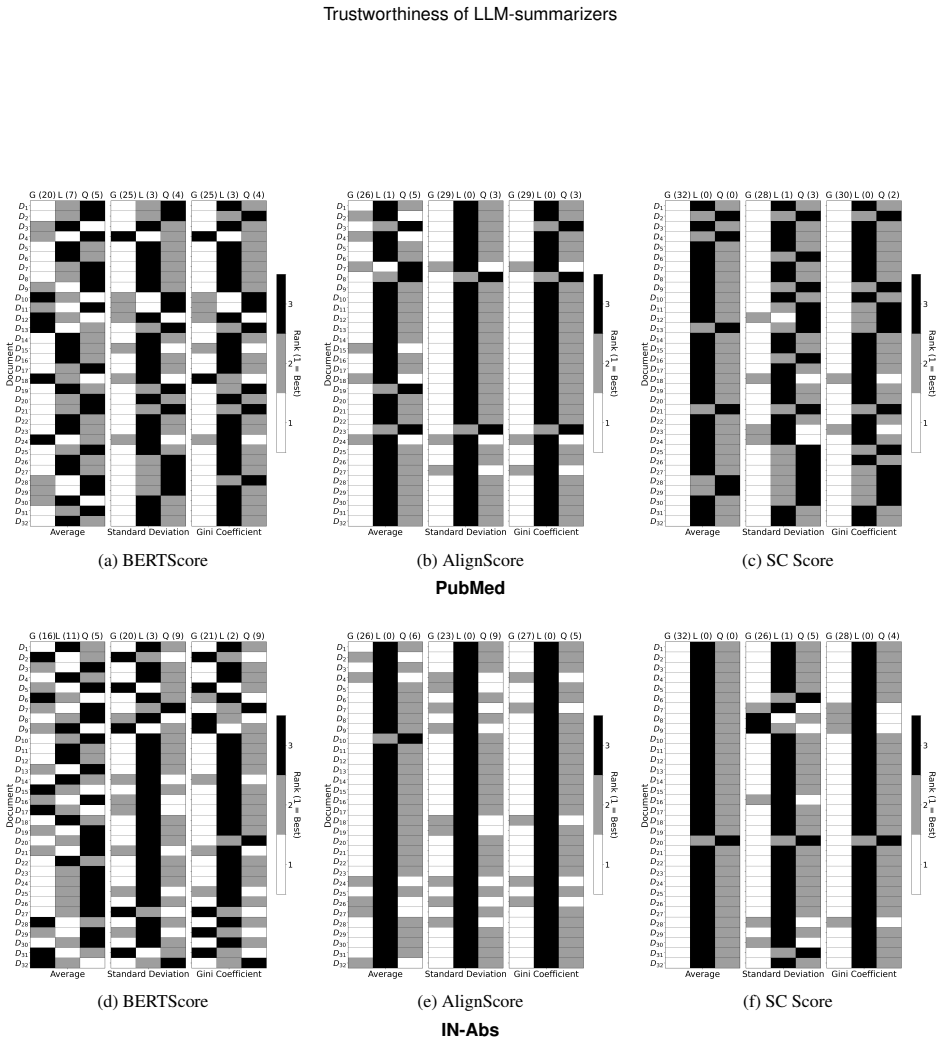
Summary. The paper argues that stochastic LLM decoding makes single-summary evaluation of zero-shot summarizers incomplete, and proposes a two-level Stability Analysis Protocol (SAP): at document level, a stability coefficient ε = 1 − max pairwise absolute metric-score difference (Def. 1, Sec. 2.1); at corpus level, a stability index defined as the minimum of document-level ε over a sample (Def. 2, Sec. 2.2). This index is proposed as a proxy for the trustworthiness of the summarizer. The authors run k = 100 generations per document over 32 sampled documents from CNN/DM, PubMed, and IN-Abs, for three LLMs (Gemma3-4B, Llama-3.2-3B, Qwen-2.5-3B), scoring summaries with BERTScore, AlignScore, and a pairwise Semantic Consistency (SC) score (Eq. 1). They report substantial metric-level and model-level variability, claim BERTScore is more stable than AlignScore, and conclude Gemma3 is the most stable/trustworthy summarizer.
Significance. The empirical finding that repeated generations of the same document under static prompts yield non-trivial score variability is credible and useful; the size of the experiment (≈28.8K summaries) is a genuine strength. If the proposed stability index were validated, SAP could complement conventional single-run benchmarks and provide a standardized way to report run-to-run variability. However, the central trustworthiness claim is currently not established: the proposed ε is a range statistic that can reward consistently poor outputs, it is aggregated by a min that is vulnerable to single outliers, and no external validation links the index to user trust, downstream reliability, or even the paper's own direct semantic-consistency measure. These issues affect the main conclusion, not just the presentation.
major comments (1)
- [Sec. 6.2, Table 10] The normality statement is inconsistent with the data. The text says 'the null hypotheses are rejected for large number of documents ... for all the score distributions and genres,' but Table 10 shows that for IN-Abs AlignScore, only 6/32 documents reject normality for every model, i.e., the majority of documents do not reject. Please rephrase to reflect the actual counts, or explain why the IN-Abs AlignScore distributions are treated as non-normal in the subsequent analysis.
minor comments (6)
- [Sec. 2.1] Typo: 'We define the the stability coefficient' should be 'the stability coefficient.'
- [Sec. 7.1] Typo: 'Llamma' should be 'Llama' in the summarizer-wise consolidation.
- [Sec. 6.1, Fig. 5] The density plots are informative, but adding the numerical ε values on the same figure or in the caption would make the contradiction between ε and CV/GC easier for readers to see.
- [Sec. 5.1, Table 3] The initial chi-square test for IN-Abs is significant, and only after removing outliers is it non-significant. This should be stated more explicitly in the main text, not only in Appendix B, because the sample representativeness claim relies on that post-hoc exclusion.
- [Sec. 2.2] The sentence 'Statistically large sample of documents (N) and summaries (k), may divulges the worst possible variations' contains an agreement error and is unclear; please rewrite.
- [Sec. 4.2] The derivation of the combined coefficient of variation is placed in Appendix A; consider a one-sentence intuition in the main text for readers who do not need the derivation.
Circularity Check
No significant circularity; stability statistics are direct empirical measurements, and the trustworthiness label is an explicitly stated proxy rather than a derived prediction.
full rationale
The paper's derivation chain is data-driven, not self-referential. Document-level stability (Def. 1, Sec. 2.1) and corpus-level stability (Def. 2, Sec. 2.2) are computed directly from observed metric scores over k generated summaries; no parameter is fitted to a target and then reported as a prediction. The supplementary statistics (CV, Gini, SC, bootstrap CIs) are also direct descriptive/confirmatory measurements. The empirical conclusion that Gemma3 is more stable than Llama and Qwen on BERTScore/SC and often AlignScore follows from Tables 4-9 and is open to falsification on the reported sample. The only conceptual shortcut is the paper's explicit operationalization of trustworthiness as stability: 'Lower value of ‰ indicates that the LLM-summarizer produces summaries that are not stable, and hence is not trustworthy' (Sec. 4.2) and 'stability index ... is the proxy for its trustworthiness' (Abstract). This is an unvalidated assumption/limitation rather than a circular derivation, and the paper itself acknowledges it in Limitations (iii): 'incorporating expert or user evaluations would complement the proposed protocol by validating the measured stability.' The stability measurements stand independently and would retain their empirical content even if the trustworthiness label were removed. There are no load-bearing self-citations or imported uniqueness/ansatz results.
Axiom & Free-Parameter Ledger
axioms (5)
- domain assumption The difference in metric scores of two text documents reflects variation in content.
- domain assumption Stability (consistency of scores) is a valid proxy for robustness and trustworthiness.
- domain assumption BERTScore and AlignScore validly measure semantic alignment and factual consistency.
- domain assumption Static default parameters ensure observed variations arise solely from stochasticity.
- domain assumption A stratified 32-document sample is representative of each corpus.
invented entities (2)
-
Stability coefficient epsilon
no independent evidence
-
Corpus-level stability index
no independent evidence
read the original abstract
Zero-shot summarization using Large Language Models (LLMs) has significantly advanced the abstractive summarization task by producing coherent and fluent summaries. However, underlying stochasticity of the large language models raises concerns about the stability and trustworthiness of the LLM-generated summaries. This issue has become increasingly important due to proliferation of LLM-generated summaries in educational settings, where students and researchers summarize complex academic materials in zero-shot manner. We propose a novel two-level diagnostic protocol for benchmarking LLM-summarizers based on the stability of the generated summaries. At the lower level, document-level stability analysis is performed over multiple LLM-summaries generated under controlled environment, and the stability coefficient is computed. Each generated summary is scored for semantic and factual alignment with the original document, enabling estimation of stability along more than one dimensions. At the next level, observations from a stratified sample of documents drawn from the corpus are consolidated to estimate the stability index of the LLM-summarizer, which is the proxy for its trustworthiness. Our empirical investigation of three LLM-summarizers across three genres of documents reveals statistically significant differences in the generation-level variability among LLMs across summary evaluation metrics. This study advances the LLM-summarization research by evidential recognition of the stability problem in LLM-summaries and motivates further research towards development of robust, reliable and trustworthy LLM-summarizers.
Figures



Reference graph
Works this paper leans on
-
[1]
A comprehensive survey on legal summarization: Challenges and future directions
Akter, M., Çano, E., Weber, E., Dobler, D., Habernal, I., 2025. A comprehensive survey on legal summarization: Challenges and future directions. ACM Computing Surveys
2025
-
[2]
Large language models robustness against perturbation: S
Alahmari, S.S., Hall, L., Mouton, P.R., Goldgof, D., 2025. Large language models robustness against perturbation: S. alahmari et al. Scientific Reports
2025
-
[3]
Using llm (large language model) to improve efficiency in literature review for undergraduate research
Antu, S.A., Chen, H., Richards, C.K., 2023. Using llm (large language model) to improve efficiency in literature review for undergraduate research. Llm@ Aied , 8–16
2023
-
[4]
Robust tests for the equality of variances
Brown, M.B., Forsythe, A.B., 1974. Robust tests for the equality of variances. Journal of the American statistical association 69, 364–367
1974
-
[5]
Efficient inference for noisy llm-as-a-judge evaluation
Chen, Y .T., Lu, S., Li, S., Guo, M., Li, S., 2026. Efficient inference for noisy llm-as-a-judge evaluation. arXiv preprint arXiv:2601.05420
arXiv 2026
-
[6]
Cohan, A., Dernoncourt, F., Kim, D.S., Bui, T., Kim, S., Chang, W., Goharian, N., 2018. A discourse-aware attention model for abstractive summarization of long documents, in: Proceedings of the 2018 Conference of the North American Chapter of the Association for Computational Linguistics: Human Language Technologies, V olume 2 (Short Papers), pp. 615–621
2018
-
[7]
Statistical comparisons of classifiers over multiple data sets
Demšar, J., 2006. Statistical comparisons of classifiers over multiple data sets. Journal of Machine learning research 7, 1–30
2006
-
[8]
Applicability of large language models and generative models for legal case judgement summarization
Deroy, A., Ghosh, K., Ghosh, S., 2024. Applicability of large language models and generative models for legal case judgement summarization. Artificial Intelligence and Law , 1–44
2024
-
[9]
Explainability meets text summarization: A survey, in: Proceedings of the 17th International Natural Language Generation Conference, pp
Dhaini, M., Erdogan, E., Bakshi, S., Kasneci, G., 2024. Explainability meets text summarization: A survey, in: Proceedings of the 17th International Natural Language Generation Conference, pp. 631–645
2024
-
[10]
Consistency evaluation of news article summaries generated by large (and small) language models
Gilhuly, C., Shahzad, H., 2025. Consistency evaluation of news article summaries generated by large (and small) language models. arXiv preprint arXiv:2502.20647
Pith/arXiv arXiv 2025
-
[11]
Gupta, A., Singh, D., Cowan, G.A., Kadhiresan, N., Srivastava, S., Sriraja, Y ., Mantri, Y .K., 2025. Autosumm: A comprehensive framework for llm-based conversation summarization, in: Proceedings of the 63rd Annual Meeting of the Association for Computational Linguistics (V olume 6: Industry Track), pp. 500–509
2025
-
[12]
Hakim, Y ., Bhardwaj, S., Mulla, R., 2024. Case summarization using llm model for supreme court judgments of an indian judiciary system, in: International Conference on Information and Communication Technology for Competitive Strategies, Springer. pp. 79–89
2024
-
[13]
Trustllm: Trustworthiness in large language models
Huang, Y ., Sun, L., Wang, H., Wu, S., Zhang, Q., Li, Y ., Gao, C., Huang, Y ., Lyu, W., Zhang, Y ., et al., 2024. Trustllm: Trustworthiness in large language models. arXiv preprint arXiv:2401.05561
Pith/arXiv arXiv 2024
-
[14]
Huidrom, R., Belz, A., 2025. Using llm judgements for sanity checking results and reproducibility of human evaluations in nlp, in: Proceedings of the Fourth Workshop on Generation, Evaluation and Metrics (GEM2), pp. 354–365
2025
-
[15]
Consistency analysis of chatgpt, in: Proceedings of the 2023 Conference on Empirical Methods in Natural Language Processing, pp
Jang, M., Lukasiewicz, T., 2023. Consistency analysis of chatgpt, in: Proceedings of the 2023 Conference on Empirical Methods in Natural Language Processing, pp. 15970–15985
2023
-
[16]
Context-Aware Sports Highlight Generation Leveraging Large Language Models
Kang, J., 2024. Context-Aware Sports Highlight Generation Leveraging Large Language Models. Ph.D. thesis. Ulsan National Institute of Science and Technology
2024
-
[17]
Keya, F., Jaradeh, M.Y ., Auer, S., 2024. Leveraging llms for scientific abstract summarization: Unearthing the essence of research in a single sentence, in: Proceedings of the 24th ACM/IEEE Joint Conference on Digital Libraries, pp. 1–7
2024
-
[18]
Llms cannot reliably judge (yet?): A comprehensive assessment on the robustness of llm-as-a-judge
Li, S., Xu, C., Wang, J., Gong, X., Chen, C., Zhang, J., Wang, J., Lam, K.Y ., Ji, S., 2025. Llms cannot reliably judge (yet?): A comprehensive assessment on the robustness of llm-as-a-judge. arXiv preprint arXiv:2506.09443
arXiv 2025
-
[19]
Do not abstain! identify and solve the uncertainty, in: Proceedings of the 63rd Annual Meeting of the Association for Computational Linguistics (V olume 1: Long Papers), pp
Liu, J., JingquanPeng, J., Wu, X., Li, X., Ge, T., Zheng, B., Liu, Y ., 2025. Do not abstain! identify and solve the uncertainty, in: Proceedings of the 63rd Annual Meeting of the Association for Computational Linguistics (V olume 1: Long Papers), pp. 17177–17197
2025
-
[20]
Sumsurvey: An abstractive dataset of scientific survey papers for long document summarization, in: Findings of the ACL 2024, pp
Liu, R., Liu, M., Yu, M., Zhang, H., Jiang, J., Li, G., Huang, W., 2024a. Sumsurvey: An abstractive dataset of scientific survey papers for long document summarization, in: Findings of the ACL 2024, pp. 9632–9651
2024
-
[21]
Low-resource court judgment summarization for common law systems
Liu, S., Cao, J., Li, Y ., Yang, R., Wen, Z., 2024b. Low-resource court judgment summarization for common law systems. Information Processing & Management 61, 103796
-
[22]
Lupart, S., van Dijk, D., Langezaal, E., van Dort, I., Aliannejadi, M., 2025. Investigating llm variability in personalized conversational information retrieval, in: Proceedings of the 2025 Annual International ACM SIGIR Conference on Research and Development in Information Retrieval in the Asia Pacific Region, pp. 353–363
2025
-
[23]
Tools in the loop: Quantifying uncertainty of llm question answering systems that use tools
Lymperopoulos, P., Sarathy, V ., 2025. Tools in the loop: Quantifying uncertainty of llm question answering systems that use tools. arXiv preprint arXiv:2505.16113
Pith/arXiv arXiv 2025
-
[24]
Effectiveness in retrieving legal precedents: exploring text summarization and cutting-edge language models toward a cost-efficient approach
Mentzingen, H., António, N., Bacao, F., 2025. Effectiveness in retrieving legal precedents: exploring text summarization and cutting-edge language models toward a cost-efficient approach. Artificial Intelligence and Law , 1–21
2025
-
[25]
State of what art? a call for multi-prompt llm evaluation
Mizrahi, M., Kaplan, G., Malkin, D., Dror, R., Shahaf, D., Stanovsky, G., 2024. State of what art? a call for multi-prompt llm evaluation. Transactions of the Association for Computational Linguistics 12, 933–949
2024
-
[26]
Abstractive text summarization using sequence-to-sequence rnns and beyond, in: Proceedings of the 20th SIGNLL conference on computational natural language learning, pp
Nallapati, R., Zhou, B., Dos Santos, C., Gulçehre, Ç., Xiang, B., 2016. Abstractive text summarization using sequence-to-sequence rnns and beyond, in: Proceedings of the 20th SIGNLL conference on computational natural language learning, pp. 280–290
2016
-
[27]
Evaluating variance in visual question answering benchmarks
Nikitha, S., 2025. Evaluating variance in visual question answering benchmarks. arXiv preprint arXiv:2508.02645
Pith/arXiv arXiv 2025
-
[28]
Oved, N., Levy, R., 2021. Pass: Perturb-and-select summarizer for product reviews, in: Proceedings of the 59th Annual Meeting of the ACL and the 11th International Joint Conference on Natural Language Processing (V olume 1: Long Papers), pp. 351–365
2021
-
[29]
Efficient multi-prompt evaluation of llms, in: Proceedings of the 38th International Conference on Neural Information Processing Systems, pp
Polo, F.M., Xu, R., Weber, L., Silva, M., Bhardwaj, O., Choshen, L., de Oliveira, A.F.M., Sun, Y ., Yurochkin, M., 2024. Efficient multi-prompt evaluation of llms, in: Proceedings of the 38th International Conference on Neural Information Processing Systems, pp. 22483–22512
2024
-
[30]
Premnath, P., Yenumulapalli, V .O., Mohankumar, P., Sivanaiah, R., et al., 2025. Techssn at semeval-2025 task 10: A comparative analysis of transformer models for dominant narrative-based news summarization, in: Proceedings of the 19th International Workshop on Semantic Evaluation (SemEval-2025), pp. 2205–2212
2025
-
[31]
Leveraging large language models on the traditional scientific writing workflow, in: 2024 Conference on AI, Science, Engineering, and Technology (AIxSET), IEEE
Procko, T.T., Davidoff, A., Elvira, T., Ochoa, O., 2024. Leveraging large language models on the traditional scientific writing workflow, in: 2024 Conference on AI, Science, Engineering, and Technology (AIxSET), IEEE. pp. 154–161. Page 27 of 28 Trustworthiness of LLM-summarizers
2024
-
[32]
Ramprasad, S., Ferracane, E., Lipton, Z.C., 2024. Analyzing llm behavior in dialogue summarization: Unveiling circumstantial hallucination trends, in: Proceedings of the 62nd Annual Meeting of the Association for Computational Linguistics (V olume 1: Long Papers), pp. 12549– 12561
2024
-
[33]
How resilient are language models to text perturbations?, in: International Conference on Intelligent Data Engineering and Automated Learning, Springer
Romero-Alvarado, D., Hernández-Orallo, J., Martínez-Plumed, F., 2024. How resilient are language models to text perturbations?, in: International Conference on Intelligent Data Engineering and Automated Learning, Springer. pp. 85–96
2024
-
[34]
Can you trust llm judgments? reliability of llm-as-a-judge
Schroeder, K., Wood-Doughty, Z., 2024. Can you trust llm judgments? reliability of llm-as-a-judge. arXiv preprint arXiv:2412.12509
Pith/arXiv arXiv 2024
-
[35]
A coin flip for safety: Llm judges fail to reliably measure adversarial robustness
Schwinn, L., Ladenburger, M., Beyer, T., Mofakhami, M., Gidel, G., Günnemann, S., 2026. A coin flip for safety: Llm judges fail to reliably measure adversarial robustness. arXiv preprint arXiv:2603.06594
arXiv 2026
-
[36]
Sclar, M., Choi, Y ., Tsvetkov, Y ., Suhr, A., 2023. Quantifying Language Models’ Sensitivity to Spurious Features in Prompt Design or: How I learned to start worrying about prompt formatting. arXiv preprint arXiv:2310.11324
Pith/arXiv arXiv 2023
-
[37]
Shukla, A., Bhattacharya, P., Poddar, S., Mukherjee, R., Ghosh, K., Goyal, P., Ghosh, S., 2022. Legal case document summarization: Extractive and abstractive methods and their evaluation, in: Proceedings of the 2nd Conference of the Asia-Pacific Chapter of the Association for Computational Linguistics and the 12th International Joint Conference on Natural...
2022
-
[38]
Robustness of large language models to perturbations in text
Singh, A., Singh, N., Vatsal, S., 2024. Robustness of large language models to perturbations in text. arXiv preprint arXiv:2407.08989
arXiv 2024
-
[39]
Legal text summarization via judicial syllogism with large language models
Song, Y ., Qin, Y ., Huang, R., Chen, Y ., Lin, C., 2025. Legal text summarization via judicial syllogism with large language models. Journal of King Saud University Computer and Information Sciences 37, 111
2025
-
[40]
Artificial intelligence risk management framework (ai rmf 1.0).(2023)
Tabassi, E., 2023. Artificial intelligence risk management framework (ai rmf 1.0).(2023). URL: http://nvlpubs. nist. gov/nistpubs/ai/NIST. AI , 100–1
2023
-
[41]
Evaluating the factual consistency of large language models through news summarization, in: Findings of the Association for Computational Linguistics: ACL 2023, pp
Tam, D., Mascarenhas, A., Zhang, S., Kwan, S., Bansal, M., Raffel, C., 2023. Evaluating the factual consistency of large language models through news summarization, in: Findings of the Association for Computational Linguistics: ACL 2023, pp. 5220–5255
2023
-
[42]
Van Schaik, T.A., Pugh, B., 2024. A field guide to automatic evaluation of llm-generated summaries, in: Proceedings of the 47th International ACM SIGIR Conference on Research and Development in Information Retrieval, pp. 2832–2836
2024
-
[43]
Prompt engineering in consistency and reliability with the evidence-based guideline for llms
Wang, L., Chen, X., Deng, X., Wen, H., You, M., Liu, W., Li, Q., Li, J., 2024. Prompt engineering in consistency and reliability with the evidence-based guideline for llms. NPJ digital medicine 7, 41
2024
-
[44]
Using llm-supported lecture summarization system to improve knowledge recall and student satisfaction
Xie, T., Kuang, Y ., Tang, Y ., Liao, J., Yang, Y ., 2025. Using llm-supported lecture summarization system to improve knowledge recall and student satisfaction. Expert Systems with Applications 269, 126371
2025
-
[45]
Comparisons of various types of normality tests
Yap, B.W., Sim, C.H., 2011. Comparisons of various types of normality tests. Journal of Statistical Computation and Simulation 81, 2141–2155
2011
-
[46]
Event-based evaluation of abstractive news summarization, in: Proceedings of the Fourth Workshop on Generation, Evaluation and Metrics (GEM2), pp
You, H., Touileb, S., Øvrelid, L., Velldal, E., 2025. Event-based evaluation of abstractive news summarization, in: Proceedings of the Fourth Workshop on Generation, Evaluation and Metrics (GEM2), pp. 504–510
2025
-
[47]
Alignscore: Evaluating factual consistency with a unified alignment function, in: Proceedings of the 61st Annual Meeting of the ACL (V olume 1: Long Papers), pp
Zha, Y ., Yang, Y ., Li, R., Hu, Z., 2023. Alignscore: Evaluating factual consistency with a unified alignment function, in: Proceedings of the 61st Annual Meeting of the ACL (V olume 1: Long Papers), pp. 11328–11348
2023
-
[48]
A systematic survey of text summarization: From statistical methods to large language models
Zhang, H., Yu, P.S., Zhang, J., 2025. A systematic survey of text summarization: From statistical methods to large language models. ACM Computing Surveys 57, 1–41
2025
-
[49]
Bertscore: Evaluating text generation with bert
Zhang, T., Kishore, V ., Wu, F., Weinberger, K.Q., Artzi, Y ., 2019. Bertscore: Evaluating text generation with bert. arXiv preprint arXiv:1904.09675
Pith/arXiv arXiv 2019
-
[50]
Benchmarking large language models for news summarization
Zhang, T., Ladhak, F., Durmus, E., Liang, P., McKeown, K., Hashimoto, T.B., 2024a. Benchmarking large language models for news summarization. Transactions of the Association for Computational Linguistics 12, 39–57
-
[51]
Trustworthy evaluation of large language models
Zhang, X.Y ., Ye, H.J., Zhan, D.C., 2026a. Trustworthy evaluation of large language models. Frontiers of Computer Science 20, 1–3
-
[52]
Zhang, Y ., Jin, H., Meng, D., Wang, J., Tan, J., 2024b. A comprehensive survey on process-oriented automatic text summarization with exploration of llm-based methods. arXiv preprint arXiv:2403.02901
-
[53]
Assessing the accuracy of artificial intelligence-generated clinical summaries from ambulatory glaucoma subspecialty clinical encounters
Zhang, Y ., Shi, M., Chung, I.Y ., Liebman, D.L., Barna, L.E., Pasquale, L.R., Friedman, D.S., Boland, M.V ., Shen, L.Q., Wang, M., 2026b. Assessing the accuracy of artificial intelligence-generated clinical summaries from ambulatory glaucoma subspecialty clinical encounters. Translational Vision Science & Technology 15, 22–22
-
[54]
Zhong, Y ., Litman, D., 2025. From information to insight: Leveraging llms for open aspect-based educational summarization, in: Proceedings of the 63rd Annual Meeting of the Association for Computational Linguistics (V olume 1: Long Papers), pp. 1914–1947. Page 28 of 28
2025
discussion (0)
Sign in with ORCID, Apple, or X to comment. Anyone can read and Pith papers without signing in.