REVIEW 4 major objections 6 minor 24 references
A zero-shot object-navigation robot that climbs stairs, verifies targets with a vision-language model, and dodges pedestrians achieves state-of-the-art success rates without any task-specific training.
Reviewed by Pith at T0; open to challenge. T0 means a machine referee read the full paper against a public rubric. the ladder, T0–T4 →
2026-08-01 08:39 UTC pith:F23FRB4Y
load-bearing objection A competent integration of known modules with solid MP3D numbers, but the cross-floor/control-independence claim rests on simulation stairs and a single-floor real demo. the 4 major comments →
ZONDA: Zero-shot Object Navigation with Dynamic Avoidance in Multi-floor Environments
The pith
A machine-rendered reading of the paper's core claim, the machinery that carries it, and where it could break.
Core claim
ZONDA's central claim is that cross-floor navigation, robust target confirmation, and dynamic obstacle avoidance can all be achieved with zero task-specific training, provided the robot's world model is built from three complementary maps: an object instance map, a semantic heatmap, and a height-difference traversable map. The traversable map is the load-bearing piece: it stores a single ground height per cell, computes the maximum vertical difference to its eight neighbors, and labels any cell as traversable if that difference is below H_agent, the robot's maximum step height. This lets stairs and ramps be treated as normal ground, so the system's A* planning and frontier exploration never
What carries the argument
The height-difference traversable map is the central object: a per-cell ground height estimate whose 8-neighbor maximum vertical difference, compared to a robot-specific threshold H_agent, decides traversability. This single geometric abstraction removes the need for a learned stair-climbing controller, because stairs and ramps appear as smooth height gradients. The multi-view target verification is the second mechanism: a vision-language model jointly reasons over near and far views from an observation buffer, rejecting lookalikes that would pass a single detector. The third mechanism is a Kalman-filter pedestrian track with constant-velocity extrapolation, whose predicted footprints are in
Load-bearing premise
The cross-floor claim rests on the height-difference map faithfully representing stairs and ramps as smooth height gradients below the robot-specific threshold H_agent; if noisy depth, steep or narrow stairs, or landings with gaps larger than that threshold appear, the robot has no learned controller to fall back on and the multi-floor performance collapses.
What would settle it
Run the full system on a staircase whose step rise exceeds the robot-specific threshold H_agent by 1–2 cm, or add depth noise that erases step edges; if the robot cannot climb or gets stuck, the height-difference traversability abstraction—the core of the cross-floor claim—would be falsified as the universal mechanism.
If this is right
- Because stair traversability is reduced to a single geometric threshold, the same planner transfers to a different robot by changing H_agent and the safety radius, eliminating platform-specific policy retraining.
- False-positive termination, a known failure mode in single-view object search, can be substantially reduced by cross-checking multiple scale-scaled views through a VLM; the ablation shows SR drops by about 25 points when this module is removed.
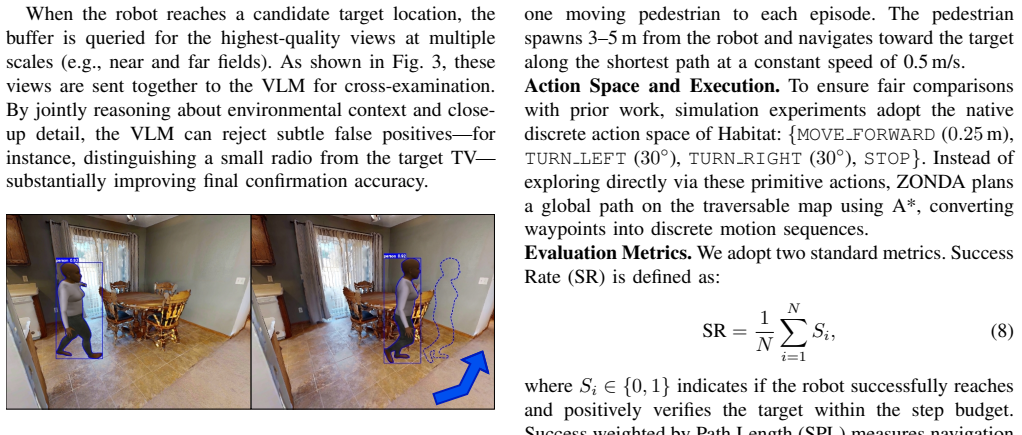
- Dynamic pedestrians no longer force the robot to stop or re-plan from scratch; explicit prediction of their trajectories lets the robot plan around them before they block the path, and the dynamic benchmark shows the method retains a success rate close to its static one.
- Cross-floor exploration can be handled online by archiving per-floor maps and linking them through a topological graph, so returning to a previously seen floor requires no re-exploration.
- The framework runs on a single consumer GPU and shares its non-platform-specific parameters between simulation and a real biped robot, indicating that zero-shot ObjectNav can be run on modest hardware.
Where Pith is reading between the lines
- Editorial inference: the height-difference criterion suggests a unifying abstraction: any robot whose climbing ability can be summarized by a single step height can reuse ZONDA's planner; 'cross-floor competence' becomes a one-parameter hardware specification, which might make multi-floor benchmarks a quick proxy for robot mobility.
- Editorial inference: the multi-view verification module could be detached from navigation and applied as a general false-positive filter for any open-vocabulary object detector, which could be tested independently of the planner.
- Editorial inference: the pedestrian-avoidance pipeline treats all moving agents as point objects with constant velocity; a natural extension would be to model articulated or interacting pedestrians (e.g., groups, doors opening) and to test whether the same anticipating inflation handles them.
- Editorial inference: the paper's zero-shot claim is about task-specific training, but the system still depends on pretrained perception components; an interesting test would be swapping the detector and VLM to see how much of the reported success comes from the planner versus the perception stack, an experiment the authors did not report.
Editorial analysis
A structured set of objections, weighed in public.
Referee Report
Summary. ZONDA is a zero-shot object-goal navigation system that combines a heuristic multi-floor planner built from height-difference traversable maps, a multi-view VLM-based target verification module, and a decoupled dynamic pedestrian avoidance pipeline. The system is evaluated on the HM3D and MP3D static benchmarks, on an author-created dynamic benchmark HM3D-DYNA, and on a Direct Drive Tech TITA biped robot in a real-world office setting. The paper reports state-of-the-art zero-shot results on static multi-floor benchmarks (HM3D SR 66.5%, SPL 33.0%; MP3D SR 48.2%, SPL 21.5%), strong performance on HM3D-DYNA (SR 48.8% vs ASCENT 30.9%), and a successful single-floor real-world deployment. The central claim is that ZONDA enables stair traversal and cross-floor exploration without a platform-specific learned controller, using only geometric traversability constraints and a heuristic planner.
Significance. If the claims hold, ZONDA would be a meaningful step toward hardware-agnostic zero-shot ObjectNav in multi-floor, human-inhabited environments. The paper explicitly targets three real limitations of prior work: single-floor assumptions, single-view false positives, and static-only benchmarks. The multi-view verification module is a sensible idea and the ablation in Table III suggests a large effect. The use of standard HM3D/MP3D benchmarks and a real-robot demo are positive features. However, the headline contributions are currently weakened by the absence of physical multi-floor validation, by comparison methodology that quotes baselines from different papers without error bars, and by a dynamic benchmark that is author-constructed and compared with only one baseline. The strongest conceptual novelty, removing the platform-specific learned low-level controller, is not empirically demonstrated outside of a simulator whose navigation mesh already solves stair traversal.
major comments (4)
- [Sec. III-B and Sec. IV-D] The central claim that ZONDA 'enables stair traversal and cross-floor exploration without a platform-specific learned controller' (Abstract, Sec. I) is not supported by the experiments. The real-world deployment in Sec. IV-D is explicitly single-floor: 'the traversable map is omitted for this single-floor setup.' No physical stair climbing is demonstrated. In simulation, Habitat executes discrete actions on the scene navigation mesh, which already encodes stair connectivity and adjusts the agent's height during traversal; the planner only labels stair cells as traversable. Thus the simulator bypasses the low-level balance and stepping control that a physical biped such as TITA must solve. The paper's key differentiation over ASCENT therefore remains a logical claim, not an empirical result. I recommend either adding a multi-floor physical trial or a simulation setting in which stair asce
- [Table I and Sec. IV-B1] The comparison against state-of-the-art methods is a system-level comparison with baselines quoted from original papers, using different perception stacks, detectors, and possibly different evaluation protocols. No confidence intervals, multiple seeds, or paired statistical tests are reported. On HM3D, ZONDA's SR gain over ASCENT is 1.1 percentage points (66.5 vs 65.4) while its SPL is lower (33.0 vs 33.5). The text calls this 'significantly improved' and 'state-of-the-art,' but such claims require a matched evaluation or statistical support. I request that the authors either run the baselines under the same codebase/evaluation harness or provide error bars and significance tests, and temper the wording to reflect the magnitude of the observed differences.
- [Table II and Table III] HM3D-DYNA is an author-constructed benchmark with a single pedestrian moving at constant speed, and it is compared only against ASCENT. The ablation study in Table III does not include an ablation of the dynamic avoidance module; therefore the 17.9-point SR improvement over ASCENT on HM3D-DYNA cannot be attributed specifically to the avoidance pipeline rather than to ZONDA's stronger static exploration. I recommend ablating avoidance on/off, including additional baselines (e.g., a static-mapping method with reactive stopping), varying pedestrian density/speed, and reporting collision or safety-related metrics in addition to SR/SPL.
- [Sec. III-A3, Sec. III-C, Implementation Details] Several free parameters that materially affect behavior are not specified: w1 and w2 in Eq. (6), tau_sem, delta_stair, DBSCAN eps/min_samples, H_agent, a_min, K, and the f_edge threshold. Eq. (5) treats any height difference below H_agent as traversable, which assumes stairs and ramps appear as smooth gradients in the height-difference map; this may not hold for noisy depth, steep/narrow stairs, or landings with gaps. No sensitivity analysis or parameter values are given. Provide a full parameter table or release code; otherwise the results are difficult to reproduce or transfer to other platforms.
minor comments (6)
- [Eq. (6)] The reward R_sem is described verbally but never formally defined. Please specify exactly when it is added and how it scales with the semantic similarity.
- [Eq. (1)] The terms f_FOV and f_dist are named but not concretely defined. Provide explicit functional forms or reference to the implementation.
- [Sec. IV-A] The statements that 'achieving an SPL over 30% demonstrates strong navigation efficiency on HM3D' and 'an SPL above 20% is widely regarded as a highly competitive result' are presented without citation. Add references or remove the unsupported normative thresholds.
- [Sec. IV-D] The real-world experiment is described with a single representative episode and no quantitative metrics. Please report number of trials, success rate, episode lengths, or at least a table of repeated runs.
- [References] Reference [4] is listed as 'IEEE Robotics and Automation Letters, 2026' without volume/article number; update if a final version exists. Some other references lack DOIs/arXiv identifiers; please standardize.
- [Fig. 1] The overview figure is small and the text labels are difficult to read at normal journal scale. Please enlarge or provide a vector version.
Circularity Check
No significant circularity: ZONDA's benchmark results are measured against external environments and are not derived from its own definitions or fitted parameters.
full rationale
The paper contains no derivation chain that reduces a predicted quantity to its own inputs. The traversability condition in Eq. (5) defines which cells are traversable, and the Heuristic Multi-Floor Planner subsequently uses that map, but the reported SR/SPL numbers are empirical outcomes from Habitat episodes on HM3D and MP3D, not consequences of the definition itself. The multi-view VLM verification and dynamic pedestrian avoidance modules are pipeline components whose contributions are assessed by ablations against the full system, and no parameter is fitted to the benchmark metrics. No load-bearing self-citation is present: references to VLFM, ASCENT, MPPI, and Qwen3-VL are standard external works, and no uniqueness theorem or prior result from the authors is invoked to force the framework's design. The author-created HM3D-DYNA benchmark is a test set rather than a training signal, so using it for evaluation is not circular. The manuscript does contain an explicit limitation in Sec. IV-D: 'the traversable map is omitted for this single-floor setup,' which means real-world evidence for cross-floor stair traversal on the TITA robot is missing, and several heuristic thresholds (H_agent, w1, w2, tau_sem, delta_stair, a_min) are unspecified. These are legitimate correctness, reproducibility, and empirical-support concerns, but they are not circularity. Therefore the circularity score is 0.
Axiom & Free-Parameter Ledger
free parameters (6)
- w1, w2 (frontier block scoring weights)
- tau_sem, delta_stair, DBSCAN eps/min_samples
- H_agent (max traversable height) =
platform-dependent, value not reported
- alpha (semantic map EMA smoothing) =
0.9
- a_min, K, f_edge thresholds (verification quality)
- T_pred, safety inflation radius =
3.0 s; 0.50 m
axioms (6)
- domain assumption Pretrained object detectors and VLMs provide reliable open-vocabulary semantics in unseen scenes
- domain assumption Height-difference criterion (Eq. 5) with threshold H_agent is sufficient to identify traversable stairs/ramps without a learned controller
- domain assumption Constant-velocity Kalman extrapolation predicts pedestrian trajectories well enough over 3 s for avoidance as obstacles
- domain assumption HM3D-DYNA's single moving pedestrian model is representative of dynamic ObjectNav
- domain assumption Cross-paper baseline comparison with native perception stacks is valid
- standard math A*, DBSCAN, greedy TSP, and MPPI are standard and used correctly
invented entities (1)
-
HM3D-DYNA benchmark
no independent evidence
Cite this review
Pith. "Pith review of ZONDA: Zero-shot Object Navigation with Dynamic Avoidance in Multi-floor Environments." pith.science (2026). https://pith.science/paper/F23FRB4Y
@misc{pith2026260721025,
  author       = {Pith},
  title        = {Pith review of: ZONDA: Zero-shot Object Navigation with Dynamic Avoidance in Multi-floor Environments},
  year         = {2026},
  howpublished = {\url{https://pith.science/paper/F23FRB4Y}},
  note         = {Machine review of arXiv:2607.21025}
}
read the original abstract
In Object Goal Navigation task, existing methods are typically restricted to static and single-floor environments, ignoring cross-floor topologies and dynamic pedestrian, which limits their real-world deployment. To address these limitations, we propose ZONDA, a zero-shot object navigation with dynamic avoidance framework. In particular, ZONDA integrates three core components: (i) Heuristic multi-floor planning: from height-difference traversable maps, enables stair traversal and cross-floor exploration without a platform-specific learned controller; (ii) Multi-view target verification: cross-checks multi-scale observations with a vision-language model, significantly reducing false positives; and (iii) Dynamic pedestrian avoidance: explicitly tracks and predicts moving pedestrians to generate anticipatory behaviors. Evaluated on a real Direct Drive Tech TITA biped robot and extensive simulations on HM3D and MP3D, ZONDA achieves significantly improved results. Moreover, ZONDA can maintain robust navigation on the dynamic benchmark HM3D-DYNA compared to the existing baseline.
Figures



Reference graph
Works this paper leans on
-
[1]
Efficient robotic object search via hiem: Hierar- chical policy learning with intrinsic-extrinsic modeling,
X. Ye and Y . Yang, “Efficient robotic object search via hiem: Hierar- chical policy learning with intrinsic-extrinsic modeling,”IEEE robotics and automation letters, vol. 6, no. 3, pp. 4425–4432, 2021
2021
-
[2]
Vlfm: Vision- language frontier maps for zero-shot semantic navigation,
N. Yokoyama, S. Ha, D. Batra, J. Wang, and B. Bucher, “Vlfm: Vision- language frontier maps for zero-shot semantic navigation,” in2024 IEEE International Conference on Robotics and Automation (ICRA). IEEE, 2024, pp. 42–48
2024
-
[3]
Apex- nav: An adaptive exploration strategy for zero-shot object navigation with target-centric semantic fusion,
M. Zhang, Y . Du, C. Wu, J. Zhou, Z. Qi, J. Ma, and B. Zhou, “Apex- nav: An adaptive exploration strategy for zero-shot object navigation with target-centric semantic fusion,”IEEE Robotics and Automation Letters, 2025
2025
-
[4]
Stairway to success: An online floor-aware zero- shot object-goal navigation framework via llm-driven coarse-to-fine exploration,
Z. Gong, R. Li, T. Hu, R. Qiu, L. Kong, L. Zhang, G. Zhao, Y . Ding, and J. Liang, “Stairway to success: An online floor-aware zero- shot object-goal navigation framework via llm-driven coarse-to-fine exploration,”IEEE Robotics and Automation Letters, 2026
2026
-
[5]
Matterport3d: Learning from rgb-d data in indoor environments,
A. Chang, A. Dai, T. Funkhouser, M. Halber, M. Niessner, M. Savva, S. Song, A. Zeng, and Y . Zhang, “Matterport3d: Learning from rgb-d data in indoor environments,”arXiv preprint arXiv:1709.06158, 2017
Pith/arXiv arXiv 2017
-
[6]
Habitat-matterport 3d dataset (hm3d): 1000 large-scale 3d environments for embodied ai,
S. K. Ramakrishnan, A. Gokaslan, E. Wijmans, O. Maksymets, A. Clegg, J. Turner, E. Undersander, W. Galuba, A. Westbury, A. X. Chang,et al., “Habitat-matterport 3d dataset (hm3d): 1000 large-scale 3d environments for embodied ai,”arXiv preprint arXiv:2109.08238, 2021
Pith/arXiv arXiv 2021
-
[7]
Ovrl-v2: A simple state-of-art baseline for imagenav and objectnav,
K. Yadav, A. Majumdar, R. Ramrakhya, N. Yokoyama, A. Baevski, Z. Kira, O. Maksymets, and D. Batra, “Ovrl-v2: A simple state-of-art baseline for imagenav and objectnav,”arXiv preprint arXiv:2303.07798, 2023
Pith/arXiv arXiv 2023
-
[8]
Objectnav revisited: On evaluation of embodied agents navigating to objects,
D. Batra, A. Gokaslan, A. Kembhavi, O. Maksymets, R. Mottaghi, M. Savva, A. Toshev, and E. Wijmans, “Objectnav revisited: On evaluation of embodied agents navigating to objects,”arXiv preprint arXiv:2006.13171, 2020
Pith/arXiv arXiv 2006
-
[9]
Zson: Zero-shot object-goal navigation using multimodal goal embed- dings,
A. Majumdar, G. Aggarwal, B. Devnani, J. Hoffman, and D. Batra, “Zson: Zero-shot object-goal navigation using multimodal goal embed- dings,”Advances in Neural Information Processing Systems, vol. 35, pp. 32 340–32 352, 2022
2022
-
[10]
Learning transferable visual models from natural language supervision,
A. Radford, J. W. Kim, C. Hallacy, A. Ramesh, G. Goh, S. Agarwal, G. Sastry, A. Askell, P. Mishkin, J. Clark,et al., “Learning transferable visual models from natural language supervision,” inInternational conference on machine learning. PmLR, 2021, pp. 8748–8763
2021
-
[11]
Blip-2: Bootstrapping language- image pre-training with frozen image encoders and large language models,
J. Li, D. Li, S. Savarese, and S. Hoi, “Blip-2: Bootstrapping language- image pre-training with frozen image encoders and large language models,” inInternational conference on machine learning. PMLR, 2023, pp. 19 730–19 742
2023
-
[12]
Aggressive driving with model predictive path integral control,
G. Williams, P. Drews, B. Goldfain, J. M. Rehg, and E. A. Theodorou, “Aggressive driving with model predictive path integral control,” in2016 IEEE international conference on robotics and automation (ICRA). IEEE, 2016, pp. 1433–1440
2016
-
[13]
Habitat: A platform for embodied ai research,
M. Savva, A. Kadian, O. Maksymets, Y . Zhao, E. Wijmans, B. Jain, J. Straub, J. Liu, V . Koltun, J. Malik,et al., “Habitat: A platform for embodied ai research,” inProceedings of the IEEE/CVF international conference on computer vision, 2019, pp. 9339–9347
2019
-
[14]
Segformer: Simple and efficient design for semantic segmentation with transformers,
E. Xie, W. Wang, Z. Yu, A. Anandkumar, J. M. Alvarez, and P. Luo, “Segformer: Simple and efficient design for semantic segmentation with transformers,”Advances in neural information processing sys- tems, vol. 34, pp. 12 077–12 090, 2021
2021
-
[15]
Sam 2: Segment anything in images and videos,
N. Ravi, V . Gabeur, Y .-T. Hu, R. Hu, C. Ryali, T. Ma, H. Khedr, R. R¨adle, C. Rolland, L. Gustafson,et al., “Sam 2: Segment anything in images and videos,” inInternational Conference on Learning Representations, vol. 2025, 2025, pp. 28 085–28 128
2025
-
[16]
Detrs beat yolos on real-time object detection,
Y . Zhao, W. Lv, S. Xu, J. Wei, G. Wang, Q. Dang, Y . Liu, and J. Chen, “Detrs beat yolos on real-time object detection,” inProceedings of the IEEE/CVF conference on computer vision and pattern recognition, 2024, pp. 16 965–16 974
2024
-
[17]
Grounding dino: Marrying dino with grounded pre-training for open-set object detection,
S. Liu, Z. Zeng, T. Ren, F. Li, H. Zhang, J. Yang, Q. Jiang, C. Li, J. Yang, H. Su,et al., “Grounding dino: Marrying dino with grounded pre-training for open-set object detection,” inEuropean conference on computer vision. Springer, 2024, pp. 38–55
2024
-
[18]
Scaling open-vocabulary object detection,
M. Minderer, A. Gritsenko, and N. Houlsby, “Scaling open-vocabulary object detection,”Advances in Neural Information Processing Systems, vol. 36, pp. 72 983–73 007, 2023
2023
-
[19]
S. Bai, Y . Cai, R. Chen, K. Chen, X. Chen, Z. Cheng, L. Deng, W. Ding, C. Gao, C. Ge,et al., “Qwen3-vl technical report,”arXiv preprint arXiv:2511.21631, 2025
Pith/arXiv arXiv 2025
-
[20]
Poni: Potential functions for objectgoal navigation with interaction-free learning,
S. K. Ramakrishnan, D. S. Chaplot, Z. Al-Halah, J. Malik, and K. Grauman, “Poni: Potential functions for objectgoal navigation with interaction-free learning,” inProceedings of the IEEE/CVF Conference on Computer Vision and Pattern Recognition, 2022, pp. 18 890–18 900
2022
-
[21]
Object goal navigation using goal-oriented semantic exploration,
D. S. Chaplot, D. P. Gandhi, A. Gupta, and R. R. Salakhutdinov, “Object goal navigation using goal-oriented semantic exploration,” Advances in Neural Information Processing Systems, vol. 33, pp. 4247–4258, 2020
2020
-
[22]
Pirlnav: Pretraining with imitation and rl finetuning for objectnav,
R. Ramrakhya, D. Batra, E. Wijmans, and A. Das, “Pirlnav: Pretraining with imitation and rl finetuning for objectnav,” inProceedings of the IEEE/CVF Conference on Computer Vision and Pattern Recognition, 2023, pp. 17 896–17 906
2023
-
[23]
Sg-nav: Online 3d scene graph prompting for llm-based zero-shot object navigation,
H. Yin, X. Xu, Z. Wu, J. Zhou, and J. Lu, “Sg-nav: Online 3d scene graph prompting for llm-based zero-shot object navigation,”Advances in neural information processing systems, vol. 37, pp. 5285–5307, 2024
2024
-
[24]
Openfmnav: Towards open-set zero-shot object navigation via vision-language foundation models,
Y . Kuang, H. Lin, and M. Jiang, “Openfmnav: Towards open-set zero-shot object navigation via vision-language foundation models,” inFindings of the Association for Computational Linguistics: NAACL 2024, 2024, pp. 338–351
2024
This paper was first reviewed by deepseek-v4-flash on August 1, 2026.
discussion (0)
Sign in with ORCID, Apple, or X to comment. Anyone can read and Pith papers without signing in.