REVIEW 3 major objections 4 minor 99 references
This paper claims that multimodal AI models fix far more of their own hallucinations when each error is pinpointed, named by type, and explained—and that detecting, classifying, and explaining are best optimized together.
Reviewed by Pith at T0; open to challenge. T0 means a machine referee read the full paper against a public rubric. the ladder, T0–T4 →
T0 review · deepseek-v4-flash
2026-08-01 08:26 UTC pith:2YQSVRO3
load-bearing objection A solid fine-grained hallucination diagnosis system with real OOD evidence, but the in-distribution benchmark shares its annotation pipeline and the human verification is thin. the 3 major comments →
HalluScope: Fine-grained Hallucination Diagnosis for Multimodal Large Language Models
The pith
A machine-rendered reading of the paper's core claim, the machinery that carries it, and where it could break.
Core claim
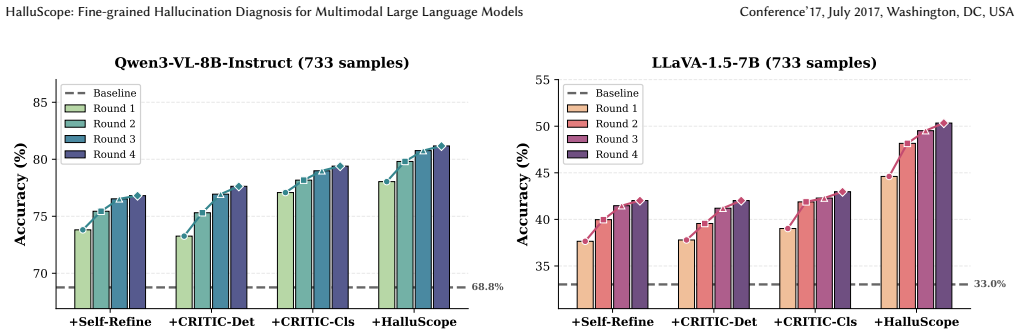
The paper's central discovery is that hallucination detection, classification, and explanation are best treated as one joint task, and that a model trained this way outperforms both general-purpose multimodal models and specialized detectors. On the public MHALO benchmark, HalluScope-8B reaches average F1M of 64.03 and F1IoU of 57.57, ahead of all baselines including the closed models that generated its training labels; on the authors' 733-sample classification benchmark it reaches F1Macro of 51.66 and F1Micro of 59.60. In mitigation experiments, full diagnosis—spans, types, and explanations—raises accuracy over four feedback rounds from 68.76% to 81.17% on one 8-billion-parameter target mod
What carries the argument
The central object is the multi-granular joint reward function used in reinforcement learning. It combines a binary format gate (output must be XML-tagged and valid), a detection reward that multiplies average token IoU between matched hallucinated spans by a Gaussian penalty for miscounting spans, and a classification reward that weights each span match by IoU and by whether the predicted type matches the ground-truth type. The pipeline that produces HalluScope-30K is also load-bearing: a closed model both injects hallucinations into correct answers and annotates real hallucinations in wrong answers, with three-stage quality control. The multiplicative detection term and the classification
Load-bearing premise
The load-bearing premise is that the single closed model's hallucination labels are correct enough to serve as ground truth, even though the only direct human check covers 100 test samples and annotators disagree on type labels in 24–34% of pairwise comparisons.
What would settle it
Train HalluScope-8B on a human-corrected subset of HalluScope-30K and compare its detection and classification scores, or have human judges score the target models' answers after HalluScope feedback instead of using a closed-model semantic-equivalence judge. If either set of scores drops substantially, the paper's claims rest on unreliable ground truth or unreliable evaluation.
If this is right
- HalluScope-4B and HalluScope-8B set new state-of-the-art scores on both the MHALO detection benchmark and the authors' classification benchmark among all compared models.
- Full diagnosis improves downstream answer accuracy more than detection-only feedback, type-labeled feedback, or no feedback, across two target models of different architectures.
- Removing either the detection or classification reward degrades the other objective, so detection and classification are mutually beneficial under joint training.
- Diagnostic feedback also reduces hallucination on an independent benchmark not produced by the authors' pipeline, while self-correction without diagnosis can sometimes increase hallucination.
- The diagnosis models beat the closed model that produced their training labels on the external MHALO benchmark, which the authors take as evidence that they learn genuine diagnostic ability rather than replicating annotation patterns.
Where Pith is reading between the lines
- A likely but unstated consequence is that classification and explanation objectives act as a regularizer on span detection, so detection should be evaluated and trained as part of a joint task rather than as a standalone pre-step; this could be tested by training detection-only models on the same data with and without auxiliary type classification across other backbones.
- Because all labels come from a single closed model, further gains may come from ensembling multiple annotators or from using the diagnostic explanations themselves as training signal for the target model, which the paper does not explore.
- The 12-type taxonomy is mapped onto other taxonomies in the paper, and the largest classification gaps are in rare types such as Query_Misunderstanding; rebalancing or augmenting those types is a testable way to see whether the mutual-benefit effect grows.
- The mitigation gains on free-form answers are measured by a closed-model judge, so a natural next step is to re-evaluate the feedback experiments with human judges to check whether the accuracy improvements persist under human standards.
Editorial analysis
A structured set of objections, weighed in public.
Referee Report
Summary. The paper introduces fine-grained hallucination diagnosis for MLLMs, a unified task combining hallucinated-span detection, 12-type classification, and explanation generation. The authors construct HalluScope-30K using a Gemini-3-Pro-based pipeline that injects or annotates hallucinations, train HalluScope-4B/8B with SFT followed by GRPO under a multi-granular joint reward, and report state-of-the-art span detection on MHALO, state-of-the-art 12-type classification on a new benchmark built from the same pipeline, improved out-of-distribution coarse classification on HalLoc, and mitigation gains on Qwen3-VL-8B-Instruct and LLaVA-1.5-7B when their diagnostic feedback is used in iterative self-correction.
Significance. If the results hold, the task formulation, the dataset, and the multi-granular reward design are useful contributions to hallucination diagnosis and mitigation. The paper has several strengths: evaluation on the external MHALO benchmark, an OOD check on HalLoc, rule-based AMBER mitigation results, ablation studies showing mutual benefit of detection and classification, and human spot-checks on labels and explanations. However, the central 12-type classification claim rests heavily on labels produced by a single closed-source model, Gemini-3-Pro, with limited human verification. Independent evaluation of the full 12-type taxonomy is not yet provided, and the mitigation experiment uses the same model as a judge for free-form correctness. The paper is therefore a promising contribution whose headline classification claims need stronger independent validation.
major comments (3)
- [§5.1.2, Table 2; §4.1.2] The classification benchmark used for the headline SOTA is generated by the same Gemini-3-Pro pipeline that produced HalluScope-30K training labels. Training on those labels and then evaluating on a benchmark built by the same annotator measures fidelity to Gemini-3-Pro's label distribution as much as genuine diagnostic skill. The HalLoc evaluation in §5.3 is independent, but it collapses the taxonomy into three coarse categories and therefore does not validate the fine-grained 12-type classification that is the paper's central claim. The remark in §5.2 that MHALO outperformance 'suggests genuine diagnostic capabilities' applies to detection, not classification. Please provide an independent, fine-grained evaluation of the 12-type classification, for example by substantially enlarging the human-adjudicated test set or by using a separate annotation protocol on an existing benchmark.
- [Appendix A.5, Figure 6] The only human verification of HalluScope-30K labels is 100 test samples. The reported pairwise agreement of 66–76% and per-annotator accuracy of 76–80% are low for a benchmark used as ground truth in span-level detection and 12-type classification. The majority-vote accuracy of 86% is not an independent anchor: all three annotators could share systematic biases, especially since the task uses a fine-grained taxonomy with subtle type boundaries. Because the dataset labels are the supervision for all trained models and the benchmark for Tables 2, 4, and 5, this label uncertainty is load-bearing. Please report per-type annotator agreement, a confusion matrix between annotator labels and Gemini-3-Pro labels, and, ideally, a larger adjudicated human evaluation on both training and test splits.
- [Appendix D.2, Figure 3] The mitigation experiment measures free-form answer correctness with a Gemini-3-Pro semantic-equivalence judge, the same model that generated the HalluScope-30K labels. This introduces a potential circularity: HalluScope feedback may be favored by the judge because both share annotation patterns, inflating the reported accuracy gains over baseline feedback modes. The AMBER results in Table 6 are rule-based and helpful, but they cover only object-level and sentence-level hallucination rates, not the full free-form QA correctness claim. Please report mitigation accuracy using a human judge on a sample, or a rule-based/metric-based evaluation on all 733 benchmark samples, to separate the effect of diagnostic feedback from judge bias.
minor comments (4)
- [Table 1] Several table cells have formatting errors, e.g., '50.7140.68 100.048.3741.61 100.0' in the Gemini-3-Pro row. The table should be regenerated with proper spacing and alignment.
- [Figure 1] The caption contains concatenated legend items ('ObjectKnowledgeColorSpatialLogicalMacaoManila') that are not readable. Please format the caption and legend cleanly.
- [Appendix C] The LLM-as-Judge stages are not fully specified: it is unclear which model is used for quality assessment and consistency verification, what temperature/decoding settings are used, and whether the judge is the same Gemini-3-Pro used for label generation. Reporting these details would help assess potential bias in data filtering.
- [§5.1.1, Eq. (7)] The notation for F1IoU is slightly confusing: F1IoU is defined as 2|M_hat|/(|P|+|G|), which is the F1 score for matched spans, not a true 'token-aware IoU' in the usual sense. Clarify the relationship between the matching criterion and the reported score.
Circularity Check
Partial circularity: Gemini-3-Pro is simultaneously the labeler of HalluScope-30K, the builder of the 733-sample classification benchmark, and the judge of free-form mitigation accuracy; external anchors (MHALO, HalLoc, AMBER) keep the central claims from being fully self-referential.
specific steps
-
fitted input called prediction
[Section 5.1.2 and Appendix A.5 (hallucination classification benchmark)]
"Since there is currently no public benchmark dedicated to fine-grained hallucination classification, we further construct a benchmark containing 733 samples. ... The hallucination classification benchmark consists of 733 samples drawn from the same data generation pipeline as the training split, with strict deduplication to ensure no overlap between the two splits."
HalluScope-30K's hallucination labels are generated by Gemini-3-Pro (§4.1.2: 'we employ a closed-source model (Gemini-3-Pro) to perform hallucination injection ... hallucination annotation'), and the 733-sample classification benchmark is produced by the same pipeline. HalluScope is therefore fit to Gemini-3-Pro's annotation distribution and then evaluated on a held-out slice of the same distribution; the Table 2 F1Macro/F1Micro numbers quantify in-distribution agreement with the annotator rather than an independent 12-type ground truth. The external HalLoc check (Section 5.3) maps the 12 types into 3 coarse categories, so the fine-grained 12-type SOTA is not independently verified.
-
self definitional
[Appendix D.2 (Mitigation Experiment Setup)]
"For free-form questions, correctness is determined by Gemini-3-Pro judge through semantic equivalence; for MCQs, the option letter is extracted and compared directly."
The free-form accuracy metric in Figure 3 is, by construction, agreement with Gemini-3-Pro's semantic-equivalence judgment. The same closed-source model generated the injection/annotation labels on which HalluScope was trained (§4.1.2), so HalluScope's feedback steers target models toward the very correctness notion that the judge then measures. This makes the absolute 733-sample mitigation gains partly a self-consistency loop. The relative ordering across feedback modes is less affected (same judge for all arms), and the AMBER rule-based results independently corroborate mitigation, so this is partial, not total, circularity.
full rationale
The detection claim is anchored by MHALO, an external benchmark not built by the authors' pipeline, so detection SOTA is not circular. The 12-type classification SOTA is partially circular because both training and test labels come from the same Gemini-3-Pro pipeline (Appendix A.5); the paper itself acknowledges this in Section 5.3 and responds with HalLoc, but HalLoc collapses the taxonomy to three coarse classes, leaving the fine-grained claim in-distribution. The mitigation claim on the 733-sample benchmark is also partially circular because free-form correctness is judged by Gemini-3-Pro, the same model that produced the training labels (Appendix D.2); however, the independent AMBER evaluation with rule-based metrics shows consistent gains, and the comparison across feedback modes uses the same judge for all arms. HalluScope's outperformance of Gemini-3-Pro on both the external and in-pipeline benchmarks suggests it is not a pure clone, which limits the circularity. No self-citation chain or imported uniqueness theorem is load-bearing, and the authors explicitly flag the closed-source reliance in Section 6. Weighing these, the loop is real but partial; external anchors keep the central contributions from reducing entirely to the annotator, so a moderate score of 4 is appropriate rather than 6+.
Axiom & Free-Parameter Ledger
free parameters (3)
- lambda (reward weight) =
0.3
- delta (IoU match threshold) =
0.5
- Quality-control score thresholds =
>=4 on clarity/fluency/coherence
axioms (5)
- domain assumption Gemini-3-Pro's hallucination injection/annotation and LLM-judge verification produce accurate fine-grained labels.
- domain assumption The MHALO 12-type taxonomy is the correct and sufficient way to characterize MLLM hallucinations.
- domain assumption Responses generated by Qwen3-VL-8B-Instruct under the Stage 1a prompt are representative of real MLLM hallucination behavior.
- domain assumption Gemini-3-Pro is a reliable judge of semantic equivalence for free-form answers in the mitigation experiments.
- domain assumption Mapping the 12 HalluScope types to HalLoc's three categories preserves the meaning needed for OOD evaluation.
read the original abstract
Although Multimodal Large Language Models have achieved strong performance across a wide range of vision-language tasks, they still suffer from hallucinations, where model outputs become inconsistent with the visual content, textual context, or commonsense knowledge. Existing studies primarily address this problem through coarse-grained detection. However, these approaches often provide insufficient diagnostic information for understanding hallucination types and supporting downstream hallucination mitigation. To bridge this gap, we propose fine-grained hallucination diagnosis for MLLMs, a new unified task that jointly performs hallucination detection, classification, and interpretable explanation generation. We develop an automated data generation pipeline and construct HalluScope-30K, a large-scale diagnostic dataset covering eight sources and five task categories. Based on this dataset, we design a multi-granular joint reward function and train two diagnosis models, HalluScope-4B and HalluScope-8B, which achieve state-of-the-art performance on both the MHALO benchmark and our fine-grained hallucination classification benchmark. Notably, detection and classification are mutually beneficial under joint optimization. Furthermore, diagnosis-driven feedback experiments show that the fine-grained diagnostic explanations produced by our model effectively guide target models to correct their hallucinations, with full diagnosis substantially outperforming all baselines on both Qwen3-VL-8B-Instruct and LLaVA-1.5-7B.
Figures




Reference graph
Works this paper leans on
-
[1]
Stanislaw Antol, Aishwarya Agrawal, Jiasen Lu, Margaret Mitchell, Dhruv Batra, C Lawrence Zitnick, and Devi Parikh. 2015. Vqa: Visual question answering. In Proceedings of the IEEE international conference on computer vision. 2425–2433
2015
-
[2]
Shuai Bai, Yuxuan Cai, Ruizhe Chen, Keqin Chen, Xionghui Chen, Zesen Cheng, Lianghao Deng, Wei Ding, Chang Gao, Chunjiang Ge, et al . 2025. Qwen3-vl technical report.arXiv preprint arXiv:2511.21631(2025)
Pith/arXiv arXiv 2025
-
[3]
Zechen Bai, Pichao Wang, Tianjun Xiao, Tong He, Zongbo Han, Zheng Zhang, and Mike Zheng Shou. 2024. Hallucination of multimodal large language models: A survey.arXiv preprint arXiv:2404.18930(2024)
Pith/arXiv arXiv 2024
-
[4]
Yishuo Cai, Renjie Gu, Jiaxu Li, Xuancheng Huang, Junzhe Chen, Xiaotao Gu, and Minlie Huang. 2025. MHALO: Evaluating MLLMs as Fine-grained Hallucination Detectors. InFindings of the Association for Computational Linguistics: ACL 2025. 9197–9222
2025
-
[5]
Lin Chen, Jinsong Li, Xiaoyi Dong, Pan Zhang, Yuhang Zang, Zehui Chen, Haodong Duan, Jiaqi Wang, Yu Qiao, Dahua Lin, et al . 2024. Are we on the right way for evaluating large vision-language models?Advances in Neural Information Processing Systems37 (2024), 27056–27087
2024
-
[6]
Xinlei Chen, Hao Fang, Tsung-Yi Lin, Ramakrishna Vedantam, Saurabh Gupta, Pi- otr Dollár, and C Lawrence Zitnick. 2015. Microsoft coco captions: Data collection and evaluation server.arXiv preprint arXiv:1504.00325(2015)
Pith/arXiv arXiv 2015
-
[7]
Xiang Chen, Chenxi Wang, Yida Xue, Ningyu Zhang, Xiaoyan Yang, Qiang Li, Yue Shen, Lei Liang, Jinjie Gu, and Huajun Chen. 2024. Unified hallucination detection for multimodal large language models. InProceedings of the 62nd Annual Meeting of the Association for Computational Linguistics (Volume 1: Long Papers). 3235–3252
2024
-
[8]
Zhiyuan Chen, Yuecong Min, Jie Zhang, Bei Yan, Jiahao Wang, Xiaozhen Wang, and Shiguang Shan. 2026. A survey of multimodal hallucination evaluation and detection.International Journal of Computer Vision134, 3 (2026), 131
2026
-
[9]
Yun-Wei Chu, Kai Zhang, Christopher Malon, and Martin Renqiang Min. 2025. Reducing hallucinations of medical multimodal large language models with visual retrieval-augmented generation.arXiv preprint arXiv:2502.15040(2025)
Pith/arXiv arXiv 2025
-
[10]
Laura Fieback, Nishilkumar Balar, Jakob Spiegelberg, and Hanno Gottschalk
-
[11]
Laura Fieback, Jakob Spiegelberg, and Hanno Gottschalk. 2024. Metatoken: Detecting hallucination in image descriptions by meta classification.arXiv preprint arXiv:2405.19186(2024)
Pith/arXiv arXiv 2024
-
[12]
Deqing Fu, Tong Xiao, Rui Wang, Wang Zhu, Pengchuan Zhang, Guan Pang, Robin Jia, and Lawrence Chen. 2024. Tldr: Token-level detective reward model for large vision language models.arXiv preprint arXiv:2410.04734(2024)
Pith/arXiv arXiv 2024
-
[13]
Jiahui Gao, Renjie Pi, Jipeng Zhang, Jiacheng Ye, Wanjun Zhong, Yufei Wang, Lanqing Hong, Jianhua Han, Hang Xu, Zhenguo Li, et al. 2023. G-llava: Solving geometric problem with multi-modal large language model.arXiv preprint arXiv:2312.11370(2023)
Pith/arXiv arXiv 2023
-
[14]
Team Glm, Aohan Zeng, Bin Xu, Bowen Wang, Chenhui Zhang, Da Yin, Dan Zhang, Diego Rojas, Guanyu Feng, Hanlin Zhao, et al. 2024. Chatglm: A fam- ily of large language models from glm-130b to glm-4 all tools.arXiv preprint arXiv:2406.12793(2024)
Pith/arXiv arXiv 2024
-
[15]
Zhibin Gou, Zhihong Shao, Yeyun Gong, Yelong Shen, Yujiu Yang, Nan Duan, and Weizhu Chen. 2023. Critic: Large language models can self-correct with tool-interactive critiquing.arXiv preprint arXiv:2305.11738(2023)
Pith/arXiv arXiv 2023
-
[16]
Anisha Gunjal, Jihan Yin, and Erhan Bas. 2024. Detecting and preventing halluci- nations in large vision language models. InProceedings of the AAAI Conference on Artificial Intelligence, Vol. 38. 18135–18143
2024
-
[17]
Daya Guo, Dejian Yang, Haowei Zhang, Junxiao Song, Peiyi Wang, Qihao Zhu, Runxin Xu, Ruoyu Zhang, Shirong Ma, Xiao Bi, et al . 2025. DeepSeek-R1 in- centivizes reasoning in LLMs through reinforcement learning.Nature645, 8081 (2025), 633–638
2025
-
[18]
Edward J Hu, Yelong Shen, Phillip Wallis, Zeyuan Allen-Zhu, Yuanzhi Li, Shean Wang, Liang Wang, Weizhu Chen, et al. 2022. Lora: Low-rank adaptation of large language models.Iclr1, 2 (2022), 3
2022
-
[19]
Aaron Hurst, Adam Lerer, Adam P Goucher, Adam Perelman, Aditya Ramesh, Aidan Clark, AJ Ostrow, Akila Welihinda, Alan Hayes, Alec Radford, et al. 2024. Gpt-4o system card.arXiv preprint arXiv:2410.21276(2024)
Pith/arXiv arXiv 2024
-
[20]
Nazanin Jafari, James Allan, and Sheikh Muhammad Sarwar. 2024. Target span detection for implicit harmful content. InProceedings of the 2024 ACM SIGIR International Conference on Theory of Information Retrieval. 117–122
2024
-
[21]
Jiayi Kuang, Ying Shen, Jingyou Xie, Haohao Luo, Zhe Xu, Ronghao Li, Yinghui Li, Xianfeng Cheng, Xika Lin, and Yu Han. 2025. Natural language understanding and inference with mllm in visual question answering: A survey.Comput. Surveys 57, 8 (2025), 1–36
2025
-
[22]
Harold W Kuhn. 1955. The Hungarian method for the assignment problem.Naval research logistics quarterly2, 1-2 (1955), 83–97
1955
-
[23]
Sicong Leng, Hang Zhang, Guanzheng Chen, Xin Li, Shijian Lu, Chunyan Miao, and Lidong Bing. 2024. Mitigating object hallucinations in large vision-language models through visual contrastive decoding. InProceedings of the IEEE/CVF Conference on Computer Vision and Pattern Recognition. 13872–13882
2024
-
[24]
Chunyuan Li, Cliff Wong, Sheng Zhang, Naoto Usuyama, Haotian Liu, Jianwei Yang, Tristan Naumann, Hoifung Poon, and Jianfeng Gao. 2023. Llava-med: Train- ing a large language-and-vision assistant for biomedicine in one day.Advances in Neural Information Processing Systems36 (2023), 28541–28564
2023
-
[25]
Junnan Li, Dongxu Li, Silvio Savarese, and Steven Hoi. 2023. Blip-2: Bootstrapping language-image pre-training with frozen image encoders and large language models. InInternational conference on machine learning. PMLR, 19730–19742
2023
-
[26]
Hanchao Liu, Wenyuan Xue, Yifei Chen, Dapeng Chen, Xiutian Zhao, Ke Wang, Liping Hou, Rongjun Li, and Wei Peng. 2024. A survey on hallucination in large vision-language models.arXiv preprint arXiv:2402.00253(2024)
Pith/arXiv arXiv 2024
-
[27]
Sheng Liu, Haotian Ye, and James Zou. 2025. Reducing hallucinations in large vision-language models via latent space steering. InThe Thirteenth International Conference on Learning Representations
2025
-
[28]
Yuan Liu, Haodong Duan, Yuanhan Zhang, Bo Li, Songyang Zhang, Wangbo Zhao, Yike Yuan, Jiaqi Wang, Conghui He, Ziwei Liu, et al . 2024. Mmbench: Is your multi-modal model an all-around player?. InEuropean conference on computer vision. Springer, 216–233
2024
-
[29]
Yuliang Liu, Zhang Li, Mingxin Huang, Biao Yang, Wenwen Yu, Chunyuan Li, Xu-Cheng Yin, Cheng-Lin Liu, Lianwen Jin, and Xiang Bai. 2024. Ocrbench: on the hidden mystery of ocr in large multimodal models.Science China Information Sciences67, 12 (2024), 220102
2024
-
[30]
Aman Madaan, Niket Tandon, Prakhar Gupta, Skyler Hallinan, Luyu Gao, Sarah Wiegreffe, Uri Alon, Nouha Dziri, Shrimai Prabhumoye, Yiming Yang, et al
-
[31]
Abhika Mishra, Akari Asai, Vidhisha Balachandran, Yizhong Wang, Graham Neubig, Yulia Tsvetkov, and Hannaneh Hajishirzi. 2024. Fine-grained hallucina- tion detection and editing for language models.arXiv preprint arXiv:2401.06855 (2024)
Pith/arXiv arXiv 2024
-
[32]
Eunkyu Park, Minyeong Kim, and Gunhee Kim. 2025. Halloc: Token-level lo- calization of hallucinations for vision language models. InProceedings of the IEEE/CVF Conference on Computer Vision and Pattern Recognition. 29893–29903
2025
-
[33]
Zhiliang Peng, Wenhui Wang, Li Dong, Yaru Hao, Shaohan Huang, Shuming Ma, and Furu Wei. 2023. Kosmos-2: Grounding multimodal large language models to the world.arXiv preprint arXiv:2306.14824(2023)
Pith/arXiv arXiv 2023
-
[34]
Pranab Sahoo, Prabhash Meharia, Akash Ghosh, Sriparna Saha, Vinija Jain, and Aman Chadha. 2024. A comprehensive survey of hallucination in large lan- guage, image, video and audio foundation models.Findings of the Association for Computational Linguistics: EMNLP 2024(2024), 11709–11724
2024
-
[35]
Pritish Sahu, Karan Sikka, and Ajay Divakaran. 2024. Pelican: Correcting hal- lucination in vision-llms via claim decomposition and program of thought veri- fication. InProceedings of the 2024 Conference on Empirical Methods in Natural Language Processing. 8228–8248
2024
-
[36]
Wenhao Shi, Zhiqiang Hu, Yi Bin, Junhua Liu, Yang Yang, See Kiong Ng, Lidong Bing, and Roy Ka-Wei Lee. 2024. Math-llava: Bootstrapping mathematical rea- soning for multimodal large language models. InFindings of the Association for Computational Linguistics: EMNLP 2024. 4663–4680
2024
-
[37]
Aaditya Singh, Adam Fry, Adam Perelman, Adam Tart, Adi Ganesh, Ahmed El-Kishky, Aidan McLaughlin, Aiden Low, AJ Ostrow, Akhila Ananthram, et al
-
[38]
Zhiqing Sun, Sheng Shen, Shengcao Cao, Haotian Liu, Chunyuan Li, Yikang Shen, Chuang Gan, Liangyan Gui, Yu-Xiong Wang, Yiming Yang, et al . 2024. Aligning large multimodal models with factually augmented rlhf. InFindings of the Association for Computational Linguistics: ACL 2024. 13088–13110
2024
-
[39]
Gemini Team, Rohan Anil, Sebastian Borgeaud, Jean-Baptiste Alayrac, Jiahui Yu, Radu Soricut, Johan Schalkwyk, Andrew M Dai, Anja Hauth, Katie Millican, et al. 2023. Gemini: a family of highly capable multimodal models.arXiv preprint arXiv:2312.11805(2023)
Pith/arXiv arXiv 2023
-
[40]
Openai gpt-5 system card.arXiv preprint arXiv:2601.03267(2025)
Pith/arXiv arXiv 2025
-
[41]
Junyang Wang, Yiyang Zhou, Guohai Xu, Pengcheng Shi, Chenlin Zhao, Haiyang Xu, Qinghao Ye, Ming Yan, Ji Zhang, Jihua Zhu, et al. 2023. Evaluation and analysis of hallucination in large vision-language models.arXiv preprint arXiv:2308.15126 (2023)
Pith/arXiv arXiv 2023
-
[42]
Xintong Wang, Jingheng Pan, Liang Ding, and Chris Biemann. 2024. Mitigat- ing hallucinations in large vision-language models with instruction contrastive decoding. InFindings of the Association for Computational Linguistics: ACL 2024. 15840–15853
2024
-
[43]
Junyang Wang, Yuhang Wang, Guohai Xu, Jing Zhang, Yukai Gu, Haitao Jia, Jiaqi Wang, Haiyang Xu, Ming Yan, Ji Zhang, et al. 2023. Amber: An llm-free multi-dimensional benchmark for mllms hallucination evaluation.arXiv preprint arXiv:2311.07397(2023)
Pith/arXiv arXiv 2023
-
[44]
Spencer Whitehead, Jacob Phillips, and Sean Hendryx. 2024. Pre-Training Multi- modal Hallucination Detectors with Corrupted Grounding Data.arXiv preprint arXiv:2409.00238(2024)
Pith/arXiv arXiv 2024
-
[45]
xAI. 2024. Grok-1.5V: Multimodal Understanding with Grok. https://x.ai/blog/ grok-1.5v
2024
-
[46]
Yiqi Wang, Wentao Chen, Xiaotian Han, Xudong Lin, Haiteng Zhao, Yongfei Liu, Bohan Zhai, Jianbo Yuan, Quanzeng You, and Hongxia Yang. 2024. Exploring the reasoning abilities of multimodal large language models (mllms): A com- prehensive survey on emerging trends in multimodal reasoning.arXiv preprint arXiv:2401.06805(2024). HalluScope: Fine-grained Halluc...
Pith/arXiv arXiv 2024
-
[47]
Le Yang, Ziwei Zheng, Boxu Chen, Zhengyu Zhao, Chenhao Lin, and Chao Shen
-
[48]
Shukang Yin, Chaoyou Fu, Sirui Zhao, Tong Xu, Hao Wang, Dianbo Sui, Yunhang Shen, Ke Li, Xing Sun, and Enhong Chen. 2024. Woodpecker: Hallucination correction for multimodal large language models.Science China Information Sciences67, 12 (2024), 220105
2024
-
[49]
Wenyi Xiao, Ziwei Huang, Leilei Gan, Wanggui He, Haoyuan Li, Zhelun Yu, Fangxun Shu, Hao Jiang, and Linchao Zhu. 2025. Detecting and mitigating hallucination in large vision language models via fine-grained ai feedback. In Proceedings of the AAAI Conference on Artificial Intelligence, Vol. 39. 25543–25551
2025
-
[50]
Bohan Zhai, Shijia Yang, Chenfeng Xu, Sheng Shen, Kurt Keutzer, Chunyuan Li, and Manling Li. 2023. HallE-Control: controlling object hallucination in large multimodal models.arXiv preprint arXiv:2310.01779(2023)
Pith/arXiv arXiv 2023
-
[51]
InProceedings of the Computer Vision and Pattern Recognition Conference
Nullu: Mitigating object hallucinations in large vision-language models via halluspace projection. InProceedings of the Computer Vision and Pattern Recognition Conference. 14635–14645
-
[52]
Ruiyang Zhang, Hu Zhang, and Zhedong Zheng. 2024. Vl-uncertainty: Detecting hallucination in large vision-language model via uncertainty estimation.arXiv preprint arXiv:2411.11919(2024)
Pith/arXiv arXiv 2024
-
[53]
Tianyu Yu, Yuan Yao, Haoye Zhang, Taiwen He, Yifeng Han, Ganqu Cui, Jinyi Hu, Zhiyuan Liu, Hai-Tao Zheng, Maosong Sun, et al . 2024. Rlhf-v: Towards trustworthy mllms via behavior alignment from fine-grained correctional human feedback. InProceedings of the IEEE/CVF Conference on Computer Vision and Pattern Recognition. 13807–13816
2024
-
[54]
Zhiyuan Zhao, Bin Wang, Linke Ouyang, Xiaoyi Dong, Jiaqi Wang, and Conghui He. 2023. Beyond hallucinations: Enhancing lvlms through hallucination-aware direct preference optimization.arXiv preprint arXiv:2311.16839(2023)
Pith/arXiv arXiv 2023
-
[55]
Kaichen Zhang, Keming Wu, Zuhao Yang, Bo Li, Kairui Hu, Bin Wang, Zi- wei Liu, Xingxuan Li, and Lidong Bing. 2025. OpenMMReasoner: Pushing the Frontiers for Multimodal Reasoning with an Open and General Recipe. arXiv:2511.16334 [cs.AI] https://arxiv.org/abs/2511.16334
arXiv 2025
-
[56]
Lanyun Zhu, Deyi Ji, Tianrun Chen, Peng Xu, Jieping Ye, and Jun Liu. 2025. Ibd: Alleviating hallucinations in large vision-language models via image-biased decoding. InProceedings of the Computer Vision and Pattern Recognition Conference. 1624–1633
2025
-
[57]
Yudong Zhang, Ruobing Xie, Xingwu Sun, Yiqing Huang, Jiansheng Chen, Zhan- hui Kang, Di Wang, and Yu Wang. 2025. Dhcp: Detecting hallucinations by cross-modal attention pattern in large vision-language models. InProceedings of the 33rd ACM International Conference on Multimedia. 3555–3564
2025
-
[59]
Deyao Zhu, Jun Chen, Xiaoqian Shen, Xiang Li, and Mohamed Elhoseiny. 2023. Minigpt-4: Enhancing vision-language understanding with advanced large lan- guage models.arXiv preprint arXiv:2304.10592(2023)
Pith/arXiv arXiv 2023
-
[61]
Geigh Zollicoffer, Minh Vu, and Manish Bhattarai. 2025. MTRE: Multi-Token Reliability Estimation for Hallucination Detection in VLMs.arXiv preprint arXiv:2505.11741(2025). Conference’17, July 2017, Washington, DC, USA Weilin Jin, Mingyu Wang, Wenbo Li, Haoyang Huang, Yifan Wu, Ying Li, Gang Huang, and Zhonghai Wu A Dataset Details A.1 Dataset Composition ...
arXiv 2025
-
[62]
Generate a step-by-step reasoning process that naturally leads to the correct answer
-
[63]
Show your complete thought process and analysis
-
[64]
Make sure your reasoning is logical, coherent, and educational
-
[65]
Stage 1b: Answer Correctness Judge Determine if the model’s answer is semantically correct compared to the ground truth
Finally, conclude with the provided correct answer Important: – Be thorough in your reasoning and analysis – Consider all relevant information from the question – Your reasoning should naturally lead to the answer – Make the reasoning process natural and instructive Please provide your reasoning and answer. Stage 1b: Answer Correctness Judge Determine if ...
-
[66]
The core meaning/result should be the same
-
[67]
Numerical answers should match exactly
-
[68]
CORRECT” or “INCORRECT
For multiple choice, the selected option should match Respond with ONLY one of the following: “CORRECT” or “INCORRECT” HalluScope: Fine-grained Hallucination Diagnosis for Multimodal Large Language Models Conference’17, July 2017, Washington, DC, USA Stage 2a: Hallucination Injection (for correct samples) You are an expert at injecting hallucinations into...
2017
-
[69]
Total tags can be more than 5
Inject 3–5 different hallucination types. Total tags can be more than 5
-
[72]
Make hallucinations plausible and natural
-
[73]
Each tag should cover a natural semantic unit — single word, short phrase (2–3 words), or medium phrase (4–5 words)
-
[77]
Output:The complete modified answer with all hallucination tags
Only merge adjacent hallucinated words when they belong to the same type. Output:The complete modified answer with all hallucination tags. Stage 2b: Hallucination Annotation (for incorrect samples) You are an expert at identifying and annotating hallucinations in visual question answering responses. Task:The model gave an INCORRECT answer. Identify and an...
-
[78]
Identify parts that differ from the ground truth
-
[79]
Use format:<hallucination type="TYPE">hallucinated content</hallucination>
-
[80]
Adjacent tags with the SAME type MUST be merged
Tags must not be nested or overlapping. Adjacent tags with the SAME type MUST be merged. Adjacent tags with DIFFERENT types are allowed
-
[81]
Do not over-split
Each tag should cover a natural semantic unit — single word, short phrase (2–3 words), or medium phrase (4–5 words). Do not over-split
-
[82]
Maintain text consistency after tag insertion
-
[83]
Diversify hallucination types; do not use a single type throughout
-
[84]
Vary tag lengths; mix single-word and short-phrase tags
-
[85]
Output:The model answer with hallucination annotations
Only merge adjacent hallucinated words when they belong to the same type. Output:The model answer with hallucination annotations. Stage 3: Quality Assessment You are an expert linguistic quality evaluator. Your task is to evaluate the quality of a generated answer for a Visual Question Answering (VQA) task. Important:The answer contains hallucination tags...
-
[86]
Analyze the answer based on the three dimensions above
-
[87]
Ignore the factual correctness of content inside hallucination tags — those are intentionally wrong
discussion (0)
Sign in with ORCID, Apple, or X to comment. Anyone can read and Pith papers without signing in.