REVIEW 3 major objections 4 minor 46 references
For superconformal RG interfaces between N=4 SYM and the Leigh-Strassler SCFT, the defect contribution to sphere entanglement entropy is cutoff-independent, changes sign twice as a function of the mass-deformation source, and diverges quadr
Reviewed by Pith at T0; open to challenge. T0 means a machine referee read the full paper against a public rubric. the ladder, T0–T4 →
T0 review · deepseek-v4-flash
2026-08-01 07:58 UTC pith:EOM5TWDV
load-bearing objection A careful, honest computation of a new defect entanglement entropy for backreacted RG interfaces; the quantitative curve is scheme-dependent and the large-|phi| scaling rests partly on a proxy, but it deserves refereeing. the 3 major comments →
Defect entanglement entropy for superconformal RG Interfaces
The pith
A machine-rendered reading of the paper's core claim, the machinery that carries it, and where it could break.
Core claim
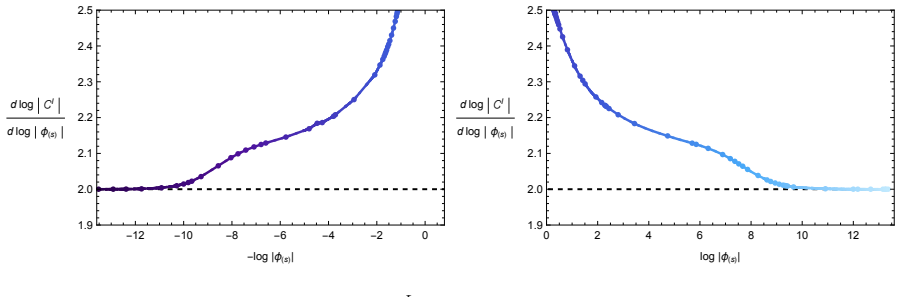
The central claim, on the paper's own terms: for the one-parameter family of holographic superconformal RG interfaces between N=4 SYM and the Leigh-Strassler SCFT, the interface contribution C^I to the sphere entanglement entropy is a cutoff-independent quantity, defined by eq. (4.16) as the finite remainder of the minimal-surface area after subtracting the ambient theories' quadratic and logarithmic divergences and their finite Fefferman-Graham terms. In the fully backreacted numerical solutions, C^I changes sign, vanishes twice as a function of the mass-deformation source phi(s), and diverges as C^I ~ |phi(s)|^gamma with gamma roughly 2 for large |phi(s)|. The paper further shows that the
What carries the argument
The central object is C^I, defined in eq. (4.16) as the finite, cutoff-independent remainder of the holographic minimal-surface area once the ambient theories' quadratic and logarithmic divergences and their finite Fefferman-Graham terms are subtracted. Its evaluation is carried by a semi-analytic split: the near-boundary integrals are performed with the analytic Fefferman-Graham expansion of the solution, while the interior radial integral is done numerically, and the r0-independence of the resulting sum is checked by rerunning over many cut-off locations. The argument is completed by a second identity, derived from Wald's formalism for the on-shell action, that rewrites the bulk action in
Load-bearing premise
The load-bearing premise is the subtraction scheme: assigning the finite Fefferman-Graham terms of (4.13) to the ambient theories rather than to the interface, a choice the paper's own appendix D shows is not unique and whose alternatives shift the quantitative curve.
What would settle it
A boundary-theory computation of the defect contribution to sphere entanglement entropy for the same one-parameter family, or a high-precision re-evaluation of (4.16) with reported error bars, that produces a different functional form - in particular a scaling exponent clearly different from 2 at large |phi(s)|, or a different number of zeroes - would settle against the paper's central quantitative claim.
If this is right
- C^I is a universal, cutoff-independent observable of these RG interface theories, computable even when the dual bulk solution is known only numerically.
- As |phi(s)| grows, C^I diverges as |phi(s)|^2, and the scaling is traced to a parametrically growing region of the bulk geometry that tracks the Poincare-invariant RG flow between N=4 SYM and the Leigh-Strassler fixed point (appendix C).
- The renormalized on-shell action can be written as vol(AdS4)[3/(4 pi^2) C^I - (a_T^{N=4} + a_T^{LS})] under a permitted choice of finite counterterms, placing C^I alongside the stress-tensor one-point data.
- The scheme-independent combination C^I = I_D + (4 pi^2 / 3) a_D connects the defect entropy to a defect free energy plus an energy term; in the undeformed case a_D vanishes and C^I reduces to I_D.
- Alternative subtraction schemes change the quantitative curve but not the qualitative features - two zeroes, extrema, and quadratic divergence - so those qualitative features are the robust predictions (appendix D).
Where Pith is reading between the lines
- Editorial inference: if a future principle fixes the subtraction scheme by requiring, say, a specific defect Weyl anomaly or a monotone defect C-function, the quantitative curve C^I(phi(s)) shown in Fig. 3 may shift; only the sign changes and quadratic growth should be expected to survive.
- Editorial inference: the observed scaling exponent gamma near 2 suggests the large-deformation limit may be amenable to analytic control via the junction geometries the solutions approach; if so, the exponent could be derived exactly rather than read off numerically.
- Editorial inference: a field-theory (boundary) computation of the same sphere-entanglement defect coefficient in the large-N limit would provide a direct test of both the sign structure and the quadratic scaling, since C^I is expressed in field-theory units in eq. (4.19).
Editorial analysis
A structured set of objections, weighed in public.
Referee Report
Summary. The paper computes the defect contribution C^I to the sphere entanglement entropy for a one-parameter family of supersymmetric RG interfaces separating the Leigh-Strassler SCFT and mass-deformed N=4 SYM, using the fully backreacted holographic duals of [11]. The authors develop a semi-analytic Fefferman-Graham subtraction to extract a cutoff-independent piece from the minimal-area integral (3.5), obtaining (4.16). They find C^I(phi_s) changes sign twice and diverges as |phi_s|^gamma with gamma approx 2 for large sources (Figs. 3-4). They also derive a relation between the renormalized on-shell action, C^I, and the stress-tensor coefficients a_T (Eq. (5.8)), and a scheme-independent combination C^I = I_D + (4 pi^2/3) a_D (Eq. (5.12)).
Significance. If the results hold, this is the first fully backreacted holographic computation of interface entanglement entropy for superconformal RG interfaces in d>2, and it provides a nontrivial check of the relationship between defect entropy, on-shell action, and stress-tensor data. The FG-based subtraction is careful: the r^+-_0 independence is verified, and the algebra leading to (5.8) and (5.12) is internally consistent (I confirmed the cited steps). However, the significance is tempered by the scheme-dependence of C^I acknowledged in Appendix D and by the fact that the large-|phi_s| scaling is inferred from a proxy rather than directly from Eq. (4.16).
major comments (3)
- [Appendix C / Sec. 4.2 (Eqs. (4.16), (4.20), (C.1)-(C.5))] The claimed scaling C^I ~ |phi_s|^gamma with gamma approx 2 (Eq. (4.20), Fig. 4) is not directly established. For large |phi_s| the defining expression (4.16) is not evaluated; instead, the support comes from the proxy C^I_flow = integral_{r_IR}^{r_UV} e^{2A} dr (C.4), with r_IR, r_UV defined by the arbitrary threshold (C.2). This proxy is only one term in the full combination C^I = pi/(2G_N)(J^+ - J^- - integral_{r^-_0}^{r^+_0} e^{2A} dr); it ignores J^+ which contains a term -(1/3) phi_s^2 r^+_0 e^{2A^+_0} (4.17) that could cancel the large positive integral. No bound is given for the complementary intervals or for J^pm. The paper acknowledges this 'numerical delicacy', but the conclusion (4.20) requires either a direct evaluation with error control or an argument that the proxy is proportional to C^I.
- [Sec. 4.1 / Eq. (4.16) and Appendix D] C^I as defined in (4.16) is scheme-dependent: the subtraction of the finite 'second line' terms of (4.13) is a choice about what belongs to the ambient theory. Appendix D shows that two equally natural alternatives, (D.1) and (D.4), yield different quantitative C^I(phi_s) curves (Figs. 7, 8), with only qualitative features (zeroes, extrema, quadratic divergence) robust. The abstract's phrase 'the cutoff-independent interface contribution' is therefore too strong; the paper should state in the abstract/outlook that C^I is defined within a specific subtraction scheme and that only scheme-independent statements are being made.
- [Secs. 4.1-4.2 (Eq. (4.16), Fig. 3, footnote 6)] The numerical evaluation of (4.16) involves a cancellation between large terms at large |phi_s|. No error bars, convergence tests, or tolerances are reported for the shooting/integration; the r^+-_0 independence is stated to hold 'over many values' without a quantitative tolerance. Given that C^I is a small difference of O(phi_s^2) quantities (Figs. 3, 4), the reported sign changes and the exponent gamma approx 2 could be sensitive to numerical precision. Please include error estimates (e.g., from varying the shooting tolerance and FG gluing points) or at least report the residual r^+-_0 dependence of C^I.
minor comments (4)
- [Appendix B] Typo: 'counterm action' should read 'counterterm action'.
- [Fig. 4 and Eq. (4.20)] The two panels of Fig. 4 use different x-axis conventions (negative vs. positive log|phi_s|); consider plotting against |phi_s| on a log scale for easier comparison of the asymptotic exponent.
- [Sec. 4.2, Eq. (4.19)] The normalization C^I_0 approx 0.040 * (2/pi) N^2 would be clearer if also expressed in units of L^3/G_N, and if the numerical uncertainty in the 0.040 is stated.
- [Appendix C, Eq. (C.2)] The threshold 10^{-5} used to define r_IR and r_UV is arbitrary; a sentence on sensitivity to this choice would help assess the robustness of the proxy scaling.
Circularity Check
No significant circularity: C^I is evaluated from a BPS solution rather than fitted; self-citations are parameter-free inputs.
full rationale
The central quantity C^I is defined in (4.16) as a deterministic functional of the already-constructed numerical BPS solutions of [11] and their Fefferman-Graham expansions; no parameter is fitted to reproduce C^I or its φ(s)-dependence. The divergence and scaling claims are read from the computed ratio (Figs. 3–4), not from a fitted model. Appendix C introduces C_flow^I only as a separate diagnostic: the paper states it "sidesteps the numerical delicacy involved in forming the r0±-independent sum of (4.16)" and offers it as evidence that the full-C^I scaling is robust, not as the definition of C^I. This is a numerical-support limitation, not a circular reduction. Section 5's relations (5.8) and (5.12) are scheme-dependent and partly algebraic identities after the stated counterterm choice (5.7) and the definitions (5.9); the paper explicitly labels these as choices, and the abstract's main entanglement result does not rest on them. The reliance on [9], [11], [33], [41], [42] is substantial, but those are published, parameter-free BPS/consistent-truncation constructions with stated assumptions that do not include the target entanglement entropy; co-authorship alone does not make the citations circular. Scheme ambiguity is acknowledged in Appendix D and in the Discussion; ambiguity is not circularity.
Axiom & Free-Parameter Ledger
free parameters (5)
- φ(s) (supersymmetric mass source; family label ζ)
- δ_R², δ_ΔR², δ_Rφ²(1), δ_α, δ_β, δ̃_R², δ̃_ΔR² (finite counterterm coefficients)
- Subtraction scheme defining C^I
- r±_0 (FG gluing points)
- γ (scaling exponent of C^I ~ |φ(s)|^γ) =
≈2
axioms (5)
- domain assumption The 5d theory (2.1) is a consistent truncation of N=8 SO(6) gauged supergravity and oxidizes to type IIB supergravity.
- domain assumption AdS/CFT correspondence, the Ryu-Takayanagi prescription (3.3), and its defect extension [17,18], including the minimal surface being x² = R² − r²_|| (3.4) for a sphere centered on the defect.
- domain assumption The BPS equations generate the full one-parameter family of interface solutions from the single growing mode (2.9) around the LS vacuum.
- domain assumption Holographic renormalization with the counterterm actions (B.7)-(B.11), and that supersymmetry fixes only some of the finite counterterm coefficients.
- ad hoc to paper Ambient-theory subtraction: the finite terms on the second line of (4.13) are attributed to the ambient theories on either side of the interface rather than to the defect.
read the original abstract
We study the defect contribution to the entanglement entropy of a spherical region centred on four-dimensional superconformal RG interfaces. These interfaces are supersymmetric codimension one defects separating the Leigh--Strassler SCFT vacuum and the $\mathcal{N}=4$ SYM theory deformed by spatially varying mass terms. Exploiting the holographic dual to these interfaces, we extract a cutoff-independent interface contribution to the entanglement entropy, $\mathcal{C}^I$. We quantify the non-trivial dependence of $\mathcal{C}^I$ on the supersymmetric mass deformation, and observe a scaling regime for large deformations. We further relate $\mathcal{C}^I$ to the renormalized on-shell action and the stress-tensor one-point function of the interface theory. Our results provide the first fully backreacted holographic computation of this entanglement quantity for superconformal RG interfaces in more than two dimensions.
Figures




Reference graph
Works this paper leans on
-
[1]
A Dilatonic deformation of AdS(5) and its field theory dual,
D. Bak, M. Gutperle, and S. Hirano, “A Dilatonic deformation of AdS(5) and its field theory dual,”JHEP05(2003) 072,arXiv:hep-th/0304129
Pith/arXiv arXiv 2003
-
[2]
Dual of the Janus solution: An interface conformal field theory,
A. B. Clark, D. Z. Freedman, A. Karch, and M. Schnabl, “Dual of the Janus solution: An interface conformal field theory,”Phys. Rev. D71(2005) 066003, arXiv:hep-th/0407073. 30
Pith/arXiv arXiv 2005
-
[3]
A. Clark and A. Karch, “Super Janus,”JHEP10(2005) 094,arXiv:hep-th/0506265
Pith/arXiv arXiv 2005
-
[4]
Ten-dimensional supersymmetric Janus solutions,
E. D’Hoker, J. Estes, and M. Gutperle, “Ten-dimensional supersymmetric Janus solutions,”Nucl. Phys. B757(2006) 79–116,arXiv:hep-th/0603012
Pith/arXiv arXiv 2006
-
[5]
Janus Configurations, Chern-Simons Couplings, And The theta-Angle in N=4 Super Yang-Mills Theory,
D. Gaiotto and E. Witten, “Janus Configurations, Chern-Simons Couplings, And The theta-Angle in N=4 Super Yang-Mills Theory,”JHEP06(2010) 097, arXiv:0804.2907 [hep-th]
Pith/arXiv arXiv 2010
-
[6]
On Marginal Operators in Boundary Conformal Field Theory,
C. P. Herzog and I. Shamir, “On Marginal Operators in Boundary Conformal Field Theory,”JHEP10(2019) 088,arXiv:1906.11281 [hep-th]
Pith/arXiv arXiv 2019
-
[7]
How a-type anomalies can depend on marginal couplings,
C. P. Herzog and I. Shamir, “How a-type anomalies can depend on marginal couplings,”Phys. Rev. Lett.124no. 1, (2020) 011601,arXiv:1907.04952 [hep-th]
Pith/arXiv arXiv 2020
-
[8]
Marginal deformations and defect anomalies,
L. Bianchi, “Marginal deformations and defect anomalies,”Phys. Rev. D100no. 12, (2019) 126018,arXiv:1907.06193 [hep-th]
Pith/arXiv arXiv 2019
-
[9]
Spatially modulated and supersymmetric mass deformations ofN= 4 SYM,
I. Arav, K. C. M. Cheung, J. P. Gauntlett, M. M. Roberts, and C. Rosen, “Spatially modulated and supersymmetric mass deformations ofN= 4 SYM,”JHEP11(2020) 156,arXiv:2007.15095 [hep-th]
Pith/arXiv arXiv 2020
-
[10]
Rigid Supersymmetric Theories in Curved Superspace,
G. Festuccia and N. Seiberg, “Rigid Supersymmetric Theories in Curved Superspace,” JHEP06(2011) 114,arXiv:1105.0689 [hep-th]
Pith/arXiv arXiv 2011
-
[11]
Superconformal RG interfaces in holography,
I. Arav, K. C. M. Cheung, J. P. Gauntlett, M. M. Roberts, and C. Rosen, “Superconformal RG interfaces in holography,”JHEP11(2020) 168, arXiv:2007.07891 [hep-th]
Pith/arXiv arXiv 2020
-
[12]
Exactly marginal operators and duality in four-dimensional N=1 supersymmetric gauge theory,
R. G. Leigh and M. J. Strassler, “Exactly marginal operators and duality in four-dimensional N=1 supersymmetric gauge theory,”Nucl. Phys. B447(1995) 95–136,arXiv:hep-th/9503121
Pith/arXiv arXiv 1995
-
[13]
Boundary and Defect CFT: Open Problems and Applications,
N. Andreiet al., “Boundary and Defect CFT: Open Problems and Applications,”J. Phys. A53no. 45, (2020) 453002,arXiv:1810.05697 [hep-th]
Pith/arXiv arXiv 2020
-
[14]
Defects and bulk perturbations of boundary Landau-Ginzburg orbifolds,
I. Brunner and D. Roggenkamp, “Defects and bulk perturbations of boundary Landau-Ginzburg orbifolds,”JHEP04(2008) 001,arXiv:0712.0188 [hep-th]
Pith/arXiv arXiv 2008
-
[15]
Domain Walls for Two-Dimensional Renormalization Group Flows,
D. Gaiotto, “Domain Walls for Two-Dimensional Renormalization Group Flows,” JHEP12(2012) 103,arXiv:1201.0767 [hep-th]
Pith/arXiv arXiv 2012
-
[16]
Irreversibility, QNEC, and defects,
H. Casini, I. Salazar Landea, and G. Torroba, “Irreversibility, QNEC, and defects,” JHEP07(2023) 004,arXiv:2303.16935 [hep-th]
Pith/arXiv arXiv 2023
-
[17]
Holography, Entanglement Entropy, and Conformal Field Theories with Boundaries or Defects,
K. Jensen and A. O’Bannon, “Holography, Entanglement Entropy, and Conformal Field Theories with Boundaries or Defects,”Phys. Rev. D88no. 10, (2013) 106006, arXiv:1309.4523 [hep-th]. 31
Pith/arXiv arXiv 2013
-
[18]
On Holographic Defect Entropy,
J. Estes, K. Jensen, A. O’Bannon, E. Tsatis, and T. Wrase, “On Holographic Defect Entropy,”JHEP05(2014) 084,arXiv:1403.6475 [hep-th]
Pith/arXiv arXiv 2014
-
[19]
Permeable conformal walls and holography,
C. Bachas, J. de Boer, R. Dijkgraaf, and H. Ooguri, “Permeable conformal walls and holography,”JHEP06(2002) 027,arXiv:hep-th/0111210
Pith/arXiv arXiv 2002
-
[20]
Holographic calculation of boundary entropy,
T. Azeyanagi, A. Karch, T. Takayanagi, and E. G. Thompson, “Holographic calculation of boundary entropy,”JHEP03(2008) 054,arXiv:0712.1850 [hep-th]
Pith/arXiv arXiv 2008
-
[21]
Entanglement Entropy at Large Central Charge,
T. Hartman, “Entanglement Entropy at Large Central Charge,”arXiv:1303.6955 [hep-th]
-
[22]
Entanglement entropy at holographic interfaces,
M. Gutperle and J. D. Miller, “Entanglement entropy at holographic interfaces,” Phys. Rev. D93no. 2, (2016) 026006,arXiv:1511.08955 [hep-th]
Pith/arXiv arXiv 2016
-
[23]
From the Weyl Anomaly to Entropy of Two-Dimensional Boundaries and Defects,
K. Jensen, A. O’Bannon, B. Robinson, and R. Rodgers, “From the Weyl Anomaly to Entropy of Two-Dimensional Boundaries and Defects,”Phys. Rev. Lett.122no. 24, (2019) 241602,arXiv:1812.08745 [hep-th]
Pith/arXiv arXiv 2019
-
[24]
Janus and RG-flow interfaces in three-dimensional gauged supergravity,
K. Chen, M. Gutperle, and C. Hultgreen-Mena, “Janus and RG-flow interfaces in three-dimensional gauged supergravity,”JHEP03(2022) 057,arXiv:2111.01839 [hep-th]
Pith/arXiv arXiv 2022
-
[25]
Splitting interfaces in 4dN= 4 SYM,
C. F. Uhlemann and M. Wang, “Splitting interfaces in 4dN= 4 SYM,”JHEP12 (2023) 053,arXiv:2307.08740 [hep-th]
Pith/arXiv arXiv 2023
-
[26]
Universality of effective central charge in interface CFTs,
A. Karch, Y. Kusuki, H. Ooguri, H.-Y. Sun, and M. Wang, “Universality of effective central charge in interface CFTs,”JHEP11(2023) 126,arXiv:2308.05436 [hep-th]
Pith/arXiv arXiv 2023
-
[27]
RG Interfaces from Double-Trace Deformations,
S. Giombi, E. Helfenberger, and H. Khanchandani, “RG Interfaces from Double-Trace Deformations,”arXiv:2407.07856 [hep-th]
-
[28]
Entanglement C-functions of defects and interfaces inN= 4 supersymmetric Yang-Mills theory,
N. Jokela, J. Kastikainen, J. M. Pen ´ ın, R. Rodgers, and H. Ruotsalainen, “Entanglement C-functions of defects and interfaces inN= 4 supersymmetric Yang-Mills theory,”arXiv:2510.00123 [hep-th]
-
[29]
C. Melby-Thompson and C. Schmidt-Colinet, “Double Trace Interfaces,”JHEP11 (2017) 110,arXiv:1707.03418 [hep-th]
Pith/arXiv arXiv 2017
-
[30]
Entanglement Entropy in a Holographic Kondo Model,
J. Erdmenger, M. Flory, C. Hoyos, M.-N. Newrzella, and J. M. S. Wu, “Entanglement Entropy in a Holographic Kondo Model,”Fortsch. Phys.64(2016) 109–130, arXiv:1511.03666 [hep-th]
Pith/arXiv arXiv 2016
-
[31]
Towards aC-theorem in defect CFT,
N. Kobayashi, T. Nishioka, Y. Sato, and K. Watanabe, “Towards aC-theorem in defect CFT,”JHEP01(2019) 039,arXiv:1810.06995 [hep-th]. 32
Pith/arXiv arXiv 2019
-
[32]
Weyl anomalies of four dimensional conformal boundaries and defects,
A. Chalabi, C. P. Herzog, A. O’Bannon, B. Robinson, and J. Sisti, “Weyl anomalies of four dimensional conformal boundaries and defects,”JHEP02(2022) 166, arXiv:2111.14713 [hep-th]
Pith/arXiv arXiv 2022
-
[33]
Defect entanglement entropy for superconformal monodromy defects,
A. Conti, Y. Lozano, F. Rogdakis, and C. Rosen, “Defect entanglement entropy for superconformal monodromy defects,”JHEP05(2026) 036,arXiv:2511.22695 [hep-th]
arXiv 2026
-
[34]
Holographic reconstruction of space-time and renormalization in the AdS / CFT correspondence,
S. de Haro, S. N. Solodukhin, and K. Skenderis, “Holographic reconstruction of space-time and renormalization in the AdS / CFT correspondence,”Commun. Math. Phys.217(2001) 595–622,arXiv:hep-th/0002230
Pith/arXiv arXiv 2001
-
[35]
M. Bianchi, D. Z. Freedman, and K. Skenderis, “Holographic renormalization,”Nucl. Phys. B631(2002) 159–194,arXiv:hep-th/0112119
Pith/arXiv arXiv 2002
-
[36]
N. Bobev, H. Elvang, U. Kol, T. Olson, and S. S. Pufu, “Holography forN= 1 ? on S4,”JHEP10(2016) 095,arXiv:1605.00656 [hep-th]
Pith/arXiv arXiv 2016
-
[37]
Holographic RG-flows and Boundary CFTs,
M. Gutperle and J. Samani, “Holographic RG-flows and Boundary CFTs,”Phys. Rev. D86(2012) 106007,arXiv:1207.7325 [hep-th]
Pith/arXiv arXiv 2012
-
[38]
Aspects of Holographic Entanglement Entropy,
S. Ryu and T. Takayanagi, “Aspects of Holographic Entanglement Entropy,”JHEP 08(2006) 045,arXiv:hep-th/0605073
Pith/arXiv arXiv 2006
-
[39]
Holographic derivation of entanglement entropy from AdS/CFT,
S. Ryu and T. Takayanagi, “Holographic derivation of entanglement entropy from AdS/CFT,”Phys. Rev. Lett.96(2006) 181602,arXiv:hep-th/0603001
Pith/arXiv arXiv 2006
-
[40]
Holographic QFTs on AdSd, wormholes and holographic interfaces,
A. Ghodsi, J. K. Ghosh, E. Kiritsis, F. Nitti, and V. Nourry, “Holographic QFTs on AdSd, wormholes and holographic interfaces,”JHEP01(2023) 121, arXiv:2209.12094 [hep-th]
Pith/arXiv arXiv 2023
-
[41]
Superconformal monodromy defects inN=4 SYM and LS theory,
I. Arav, J. P. Gauntlett, Y. Jiao, M. M. Roberts, and C. Rosen, “Superconformal monodromy defects inN=4 SYM and LS theory,”JHEP08(2024) 177, arXiv:2405.06014 [hep-th]
Pith/arXiv arXiv 2024
-
[42]
Monodromy defects in massive Type IIA,
A. Conti, Y. Lozano, and C. Rosen, “Monodromy defects in massive Type IIA,”JHEP 04(2026) 173,arXiv:2512.10006 [hep-th]
arXiv 2026
-
[43]
Defects in conformal field theory,
M. Bill` o, V. Gon¸ calves, E. Lauria, and M. Meineri, “Defects in conformal field theory,”JHEP04(2016) 091,arXiv:1601.02883 [hep-th]
Pith/arXiv arXiv 2016
-
[44]
Towards a derivation of holographic entanglement entropy,
H. Casini, M. Huerta, and R. C. Myers, “Towards a derivation of holographic entanglement entropy,”JHEP05(2011) 036,arXiv:1102.0440 [hep-th]
Pith/arXiv arXiv 2011
-
[45]
Holographic Weyl anomalies for 4d defects in 6d SCFTs,
P. Capuozzo, J. Estes, B. Robinson, and B. Suzzoni, “Holographic Weyl anomalies for 4d defects in 6d SCFTs,”JHEP04(2024) 120,arXiv:2310.17447 [hep-th]. 33
Pith/arXiv arXiv 2024
-
[46]
The defect b-theorem under bulk RG flows,
T. Shachar, R. Sinha, and M. Smolkin, “The defect b-theorem under bulk RG flows,” JHEP09(2024) 057,arXiv:2404.18403 [hep-th]. 34
Pith/arXiv arXiv 2024
discussion (0)
Sign in with ORCID, Apple, or X to comment. Anyone can read and Pith papers without signing in.