REVIEW 3 major objections 5 minor 37 references
The energy of any single-layer unitary cluster Jastrow circuit can be computed exactly on a classical computer in O(N^7) time.
Reviewed by Pith at T0; open to challenge. T0 means a machine referee read the full paper against a public rubric. the ladder, T0–T4 →
T0 review · deepseek-v4-flash
2026-08-01 07:45 UTC pith:GSZN7CGS
load-bearing objection Genuinely new polynomial-time energy algorithm for single-layer UCJ circuits, with strong numerics and one load-bearing formula left unproved — worth refereeing, but the two-body update and the code need to be checked. the 3 major comments →
Efficient classical simulation of large-scale unitary cluster Jastrow circuits
The pith
A machine-rendered reading of the paper's core claim, the machinery that carries it, and where it could break.
Core claim
The central claim is Theorem 1: for a single-layer UCJ ansatz written as |ψ> = e^K e^{iJ} e^{-K} |φ0>, the energy <ψ|H|ψ> for any second-quantized Hamiltonian can be computed exactly in O(N^7) classical time. The derivation splits into three parts: (Lemma 1) the final orbital rotations are conjugated through the Hamiltonian by updating the one- and two-electron integrals, costing O(N^3) and O(N^5) respectively; (Lemma 2) the Jastrow factor is conjugated through by giving each one- and two-body term a scalar phase and a vector phase, preserving the O(N^2) and O(N^4) term counts and costing O(N^5); (Lemma 3) the remaining expectation value over the single-determinant reference is evaluated by
What carries the argument
The key mechanism is Hamiltonian backpropagation in second quantization. Rather than growing the operator algebra, the algorithm exactly updates the tensors of the Hamiltonian: orbital rotations transform the one- and two-body integrals via matrix products (Lemma 1), and the Jastrow operator attaches a per-term scalar phase c and an N-dimensional vector phase φ, so the number of terms is preserved exactly (Lemma 2). The remaining expectation value is computed by the determinant formula of Lemma 3, which reduces it to the determinant and inverse of an N_occ × N_occ overlap matrix S. This three-step combination — exact tensor updates, term-count preservation, and a closed-form non-orthogonal o
Load-bearing premise
The load-bearing premise is that the two-body Jastrow backpropagation formula — equations (15)–(18) in Lemma 2 — is correct and complete; the paper explicitly proves only the one-body case and states the two-body update 'can be derived similarly', so an undetected sign or index error in that unproven formula would invalidate the O(N^7) theorem and every numerical result.
What would settle it
Compute the UCJ1 energy for a small system (say N = 4) with a random Hamiltonian and random K and J parameters, using both full state-vector simulation and the paper's O(N^7) algorithm; any discrepancy between the two energies would directly falsify Lemma 2's two-body update. Alternatively, symbolically carry out the commutator expansion for the two-body term and check whether the scalar and vector phase factors in equations (15)–(18) are reproduced.
If this is right
- Every single-layer UCJ circuit, local or non-local, has an efficiently computable energy, so this ansatz family cannot deliver a quantum advantage on its own.
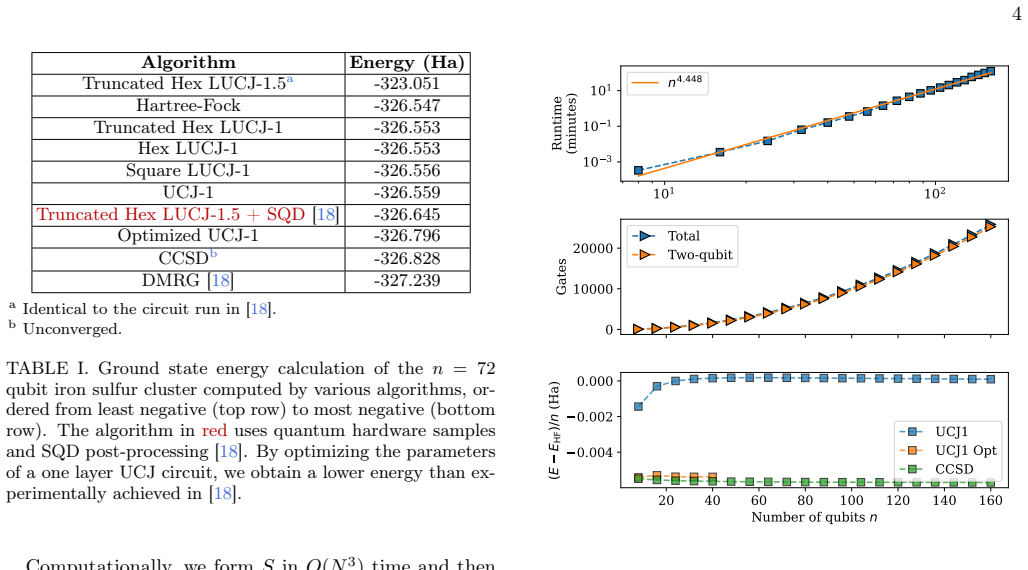
- The 77-qubit, 10,570-gate iron-sulfur quantum experiment can be simulated exactly in under a minute on ordinary hardware; fast energy evaluation also enables parameter optimization that improves on the quantum-computer result.
- Because backpropagation preserves the Hamiltonian's term count, no truncation heuristic is needed, in contrast to operator backpropagation in a fixed basis, which the paper tests and finds non-convergent.
- At least two UCJ layers (L ≥ 2) are necessary for a UCJ-based circuit to have any chance of escaping classical simulation, since alternating layers of orbital rotations and diagonal phase gates are known to be universal.
Where Pith is reading between the lines
- The paper proves the one-body Jastrow backpropagation explicitly, but the two-body formula (15)–(18) is only stated as 'can be derived similarly'; an independent derivation or a small-system brute-force check would be needed to fully secure Theorem 1.
- The same backpropagation idea might extend to other fermionic circuits whose gates act as orbital rotations or diagonal phase operators, as long as term-count preservation holds; a natural next target is multi-layer circuits with commuting Jastrow factors.
- The observed N^4.4 effective scaling (well below the worst-case N^7) suggests further engineering could push exact weak simulation to hundreds of qubits, though worst-case runtime remains a practical ceiling.
- The paper's weak-simulation result does not cover bitstring sampling, so tasks like sample-based post-processing remain outside its classical reach; quantum experiments that rely on sampling (and not just energy estimation) may still have a role.
Editorial analysis
A structured set of objections, weighed in public.
Referee Report
Summary. The paper presents a classical algorithm for computing the exact energy expectation value of a single-layer unitary cluster Jastrow (UCJ) circuit in O(N^7) time, where N is the number of spatial orbitals. The algorithm works by backpropagating the fermionic Hamiltonian through the orbital rotations (Lemma 1) and the Jastrow exponent (Lemma 2), then evaluating the resulting expectation value over a Slater determinant using Löwdin's formula (Lemma 3). The authors apply the algorithm to an iron-sulfur cluster experiment with 10,570 gates and claim to reproduce its energy in under a minute on a laptop, as well as to hydrogen chains up to 160 qubits. They also demonstrate that optimizing the single-layer UCJ parameters yields an energy below the experimentally reported SQD result, and argue that L≥2 layers are necessary for any beyond-classical computation.
Significance. If the two-body update formula (15)-(18) is correct, this is a significant result: it would show that single-layer (L)UCJ circuits, which are widely used in current quantum chemistry experiments, have classically tractable energy estimation. The algorithm's preservation of term count and use of non-orthogonal Slater determinant matrix elements is elegant. The numerical results, if reproducible, would constitute a strong demonstration that recent large-scale LUCJ experiments do not provide quantum advantage for ground-state energy estimation. However, the paper's central theorem rests on an unproved two-body update, and the qubit count inconsistency must be resolved before the claims can be fully accepted.
major comments (3)
- [Appendix, 'Proof of Lemma 2', Eqs. (15)-(18)] The two-body Jastrow backpropagation update (15)-(18) is the critical step supporting Theorem 1's O(N^7) runtime and all numerical results. The appendix proves only the one-body case (Eqs. 53-69) and then states that the two-body update 'can be derived similarly.' Given the many signs and index permutations in the scalar phase c[2] and vector phase φ[2], an error there would invalidate the theorem and the numerics. Please provide a complete derivation or a machine-checked verification (e.g., symbolic comparison for small N) before the claim can be considered sound.
- [Abstract, Introduction, and Table I] The abstract and introduction describe the experiment as having 77 qubits and 10,570 gates, while Table I and the section on hardness of other simulation algorithms refer to an 'n=72 qubit iron sulfur cluster.' This discrepancy is not explained. The claim to reproduce 'the same circuit' and 'the largest experiment' in under a minute depends on the actual number of qubits simulated. Please clarify whether the simulated circuit matches the 77-qubit experiment or a reduced 72-qubit version, and if the latter, justify why this is equivalent.
- [Code and data availability] Reference [37] states that an implementation is available, but no URL is provided. Since the main theorem relies on an unproved formula, independent verification of the numerical results (Tables I and Figure 2) is impossible without access to the code. Please provide a working link and version information, or a detailed pseudocode listing with all update formulas.
minor comments (5)
- [Introduction, first paragraph] Typo: 'non-local interactions in the UCJ ansatz are are challenging' should read 'are challenging.'
- [Conclusion] The statement that 'L≥2 layers ... is necessary to achieve any beyond-classical computation' is too strong. The result applies to energy/observable estimation (weak simulation); the paper itself notes that strong simulation (sampling) of single-layer UCJ circuits may remain hard [26]. Please scope the claim accordingly.
- [Figure 3] The cumulative energy plot is stated to be not yet converged and over 500 mHa from Hartree-Fock. Consider clarifying in the caption that this is an illustrative failure of Majorana propagation and not a claim about convergence of the method.
- [Reference [37]] The reference 'Simulate UCJ1 GitHub' lacks a URL and year details. Please provide a full citation with a working link.
- [Eq. (23)] The two-particle matrix element formula uses ρ_rp ρ_sq - ρ_sp ρ_rq. It would be helpful to add a brief derivation or a reference to the non-orthogonal Wick theorem with this exact index ordering, to avoid ambiguity in the signs.
Circularity Check
No circularity: the O(N^7) UCJ1 energy algorithm is a direct fermionic derivation with external benchmarks; the unproved two-body update in Lemma 2 is a proof gap, not circular reasoning.
full rationale
The paper's central derivation is self-contained rather than circular. Theorem 1 is obtained by backpropagating the second-quantized Hamiltonian through the UCJ1 circuit: Lemma 1 proves the orbital-rotation update, Lemma 2 gives the Jastrow update via nested commutators, and Lemma 3 uses Löwdin's standard non-orthogonal Slater-determinant formula. Each step is an algebraic identity applied to the Hamiltonian and ansatz; no fitted parameter is renamed as a prediction, and no output of the algorithm is used to construct its own inputs. The numerical results are variational optimizations and independent comparisons against Hartree-Fock, CCSD, DMRG, and the experimental SQD result, so they are externally benchmarked rather than self-confirming. The conclusion that L≥2 layers are necessary for beyond-classical computation is not derived from a self-citation; it is an argument based on the known universality of alternating Givens rotations and CZ gates, with citations to Lloyd and Leimkuhler & Whaley, and it is explicitly qualified as 'unlikely' and 'necessary, but perhaps not sufficient.' The only notable weakness is that Lemma 2's two-body update, Eq. (15)-(18), is stated without a full derivation, the appendix saying only that 'The update to the two-body part of the Hamiltonian (15) can be derived similarly.' That is an omitted proof or possible error risk, not a circularity: the claimed formula is not assumed equivalent to the theorem's conclusion, and no equation is defined in terms of the target result. The self-citations in the reference list (e.g., [10], [37]) are background and code-availability citations, not load-bearing premises of the derivation. Therefore, by the stated criteria, there is no significant circularity.
Axiom & Free-Parameter Ledger
axioms (5)
- standard math Fermionic anticommutation relations and the Campbell-Hadamard identity justify Lemma 1 and the one-body part of Lemma 2.
- standard math Löwdin's formula for matrix elements between non-orthogonal Slater determinants (Lemma 3, Eq. 20/23) and its singular-case SVD extension give the final energy.
- domain assumption The UCJ circuit exactly implements e^{-K} e^{iJ} e^{K} on a fermionic Hamiltonian via Jordan-Wigner, and 'single-layer' includes any final orbital rotations (half layer).
- ad hoc to paper The two-body Jastrow backpropagation formula (15)-(18) is correct; the paper says it 'can be derived similarly' but does not prove it.
- ad hoc to paper For the concluding claim that L≥2 is necessary for any beyond-classical computation, the task is energy/observable estimation; single-layer sampling may still be hard (paper's own weak-vs-strong caveat).
read the original abstract
Recent experiments on quantum computers have challenged the limits of classical computation in chemistry, simulating ground states of strongly correlated molecules. Many of these experiments have utilized the unitary cluster Jastrow ansatz, a quantum circuit inspired by the unitary coupled cluster ansatz that can be tailored to current quantum hardware. Notably, the largest experiment in Sci. Adv. 11, 25 (2025) executed a quantum circuit with 77 qubits and 10,570 gates on an IBM quantum computer and performed classical post-processing with up to 6400 nodes on Fugaku to compute ground state energies better than Hartree-Fock. In this work, we present a polynomial time classical algorithm to compute the energy of any single-layer unitary cluster Jastrow circuit, independent of locality constraints for quantum hardware. Our algorithm can reproduce the largest experiment from Sci. Adv. 11, 25 (2025) in less than a minute on a laptop, and through circuit optimization enabled by fast simulation we achieve a lower ground state energy than the experiment.
Figures



Reference graph
Works this paper leans on
-
[1]
Aruteet al., Nature574, 505–510 (2019)
F. Aruteet al., Nature574, 505–510 (2019)
2019
-
[2]
Zhonget al., Science370, 1460–1463 (2020)
H.-S. Zhonget al., Science370, 1460–1463 (2020)
2020
-
[3]
Wuet al., Physical Review Letters127, 180501 (2021), arXiv:2106.14734 [quant-ph]
Y. Wuet al., Physical Review Letters127, 180501 (2021), arXiv:2106.14734 [quant-ph]
Pith/arXiv arXiv 2021
-
[4]
Zhonget al., Physical Review Letters127, 180502 (2021)
H.-S. Zhonget al., Physical Review Letters127, 180502 (2021)
2021
-
[5]
Zhuet al., Science Bulletin67, 240–245 (2022)
Q. Zhuet al., Science Bulletin67, 240–245 (2022)
2022
-
[6]
L. S. Madsenet al., Nature606, 75–81 (2022)
2022
-
[7]
Denget al., Physical Review Letters131, 150601 (2023)
Y.-H. Denget al., Physical Review Letters131, 150601 (2023)
2023
-
[8]
Y. Kim, A. Eddins, S. Anand, K. X. Wei, E. van den Berg, S. Rosenblatt, H. Nayfeh, Y. Wu, M. Zaletel, K. Temme, and A. Kandala, Nature618, 500–505 (2023)
2023
-
[9]
A. D. Kinget al., (2024), 10.48550/arXiv.2403.00910, arXiv:2403.00910 [cond-mat, physics:quant-ph]
-
[10]
A brief history of quantum vs classical com- putational advantage,
R. LaRose, “A brief history of quantum vs classical com- putational advantage,” (2024), arXiv:2412.14703 [quant- ph]
Pith/arXiv arXiv 2024
-
[11]
Leapfrogging Sycamore: Harnessing 1432 GPUs for 7$\times$ Faster Quantum Random Circuit Sampling
X.-H. Zhao, H.-S. Zhong, F. Pan, Z.-H. Chen, R. Fu, Z. Su, X. Xie, C. Zhao, P. Zhang, W. Ouyang, C.-Y. Lu, J.-W. Pan, and M.-C. Chen, (2024), 10.48550/arXiv.2406.18889, arXiv:2406.18889 [quant- ph]
work page internal anchor Pith review Pith/arXiv arXiv doi:10.48550/arxiv.2406.18889 2024
-
[12]
C. Oh, M. Liu, Y. Alexeev, B. Fefferman, and L. Jiang, Nature Physics20, 1461–1468 (2024)
2024
-
[13]
J. Tindall, M. Fishman, M. Stoudenmire, and D. Sels, (2023), 10.48550/arXiv.2306.14887, arXiv:2306.14887 [quant-ph]
-
[14]
E. G. D. Torre and M. M. Roses, (2023), 10.48550/arXiv.2308.01339, arXiv:2308.01339 [quant- ph]
work page internal anchor Pith review Pith/arXiv arXiv doi:10.48550/arxiv.2308.01339 2023
-
[15]
H.-J.Liao, K.Wang, Z.-S.Zhou, P.Zhang, andT.Xiang, (2023), 10.48550/arXiv.2308.03082, arXiv:2308.03082 [cond-mat, physics:quant-ph]
-
[16]
S. Anand, K. Temme, A. Kandala, and M. Zaletel, (2023), 10.48550/arXiv.2306.17839, arXiv:2306.17839 [quant-ph]
-
[17]
T. Begušić, J. Gray, and G. K.-L. Chan, Science Ad- vances10, eadk4321 (2024), arXiv:2308.05077 [quant- ph]
Pith/arXiv arXiv 2024
-
[18]
Robledo-Moreno, M
J. Robledo-Moreno, M. Motta, H. Haas, A. Javadi- 6 Abhari, P. Jurcevic, W. Kirby, S. Martiel, K. Sharma, S. Sharma, T. Shirakawa, I. Sitdikov, R.-Y. Sun, K. J. Sung, M. Takita, M. C. Tran, S. Yunoki, and A. Mezza- capo, Science Advances11, eadu9991 (2025)
2025
-
[19]
Matsuzawa and Y
Y. Matsuzawa and Y. Kurashige, Journal of Chemical Theory and Computation16, 944–952 (2020)
2020
-
[20]
Motta, K
M. Motta, K. J. Sung, K. Birgitta Whaley, M. Head- Gordon, and J. Shee, Chemical Science14, 11213 (2023)
2023
-
[21]
K. M. Merzet al., “Crossing the 12,000-atom barrier with heterogeneous quantum-classical supercomputing: quantumchemistryofprotein-ligandcomplexes,” (2026), arXiv:2605.01138 [quant-ph]
Pith/arXiv arXiv 2026
-
[22]
Protein-Ligand Free Energy Perturbation on Quantum Hardware,
Z. Li, M. Bazayeva, T. Pellegrini, S. Bhowmik, S. Das, D. Kaliakin, F. Liang, A. Shajan, and K. M. Merz, “Protein-Ligand Free Energy Perturbation on Quantum Hardware,” (2026), arXiv:2604.09857 [quant-ph]
Pith/arXiv arXiv 2026
-
[23]
T. Shirakawaet al., “Closed-loop calculations of elec- tronic structure on a quantum processor and a classical supercomputer at full scale,” (2025), arXiv:2511.00224 [quant-ph]
arXiv 2025
-
[24]
Shajan, D
A. Shajan, D. Kaliakin, F. Liang, T. Pellegrini, H. Doga, S. Bhowmik, S. Das, A. Mezzacapo, M. Motta, and K. M. J. Merz, Journal of Chemical Theory and Com- putation22, 6041 (2026)
2026
-
[25]
Distribution complexity of electronic structure simulations on quantum supercom- puters,
J. Necaise, N. Anand, G. Gyawali, K. G. Johnson, J. D. Whitfield, and M. Mohseni, “Distribution complexity of electronic structure simulations on quantum supercom- puters,” (2026), arXiv:2606.20805 [quant-ph]
Pith/arXiv arXiv 2026
-
[26]
Hardness of classically sampling quantum chemistry circuits,
A. Hafid, H. Iwakiri, K. Tsubouchi, N. Yoshioka, and M. Kohda, “Hardness of classically sampling quantum chemistry circuits,” (2025)
2025
-
[27]
Z. Hassman, O. Reardon-Smith, G. S. Ravi, F. T. Chong, and K. J. Sung, (2025), 10.48550/arXiv.2511.12416, arXiv:2511.12416 [quant-ph]
-
[28]
T. Begušić and G. K.-L. Chan, PRX Quantum6, 020302 (2025), arXiv:2409.03097 [quant-ph]
Pith/arXiv arXiv 2025
-
[29]
S. Lee, J. Lee, H. Zhai, Y. Tong, A. M. Dalzell, A. Ku- mar, P. Helms, J. Gray, Z.-H. Cui, W. Liu, M. Kasto- ryano, R. Babbush, J. Preskill, D. R. Reichman, E. T. Campbell, E. F. Valeev, L. Lin, and G. K.-L. Chan, Nature Communications14, 1952 (2023)
1952
-
[30]
Anand, P
A. Anand, P. Schleich, S. Alperin-Lea, P. W. K. Jensen, S. Sim, M. Díaz-Tinoco, J. S. Kottmann, M. Degroote, A. F. Izmaylov, and A. Aspuru-Guzik, Chemical Society Reviews51, 1659–1684 (2022)
2022
-
[31]
Jiang, K
Z. Jiang, K. J. Sung, K. Kechedzhi, V. N. Smelyanskiy, and S. Boixo, Physical Review Applied9, 044036 (2018)
2018
-
[32]
Löwdin, Physical Review97, 1474–1489 (1955)
P.-O. Löwdin, Physical Review97, 1474–1489 (1955)
1955
-
[33]
H. G. A. Burton, The Journal of Chemical Physics154, 144109 (2021)
2021
-
[34]
D. C. Liu and J. Nocedal, Mathematical Programming 45, 503–528 (1989)
1989
-
[35]
Lloyd, Physical Review Letters75, 346–349 (1995)
S. Lloyd, Physical Review Letters75, 346–349 (1995)
1995
-
[36]
O. Leimkuhler and K. B. Whaley, (2026), 10.48550/arXiv.2503.21041, arXiv:2503.21041 [quant- ph]
-
[37]
Simulate UCJ1 GitHub,
R. LaRose, “Simulate UCJ1 GitHub,” (2026). Proof of Lemma 1 Proof.We want to compute H 7→e−Kα e−Kβ HeKα eKβ .(24) For simplicity let us consider one spin sector and, for brevity, drop the spin variable so that we have H 7→e−K HeK (25) with K= X pq kpqa† paq.(26) Note that this is the same as (4) with the spin indexσ dropped and the final layer indexµ=Lsup...
2026
discussion (0)
Sign in with ORCID, Apple, or X to comment. Anyone can read and Pith papers without signing in.