REVIEW 3 major objections 5 minor 1 cited by
Neutral-atom quantum computers could reach practical quantum advantage within a decade, if recent scaling trends continue.
Reviewed by Pith at T0; open to challenge. T0 means a machine referee read the full paper against a public rubric. the ladder, T0–T4 →
T0 review · deepseek-v4-flash
2026-08-01 07:05 UTC pith:PDKWN4OJ
load-bearing objection Useful, well-organized strategic roadmap for neutral atom quantum computing, but the decade-scale timeline claim rests on a fragile exponential fit and an unpublished self-cited milestone. the 3 major comments →
Strategic Plan for Neutral Atom Quantum Computation
The pith
A machine-rendered reading of the paper's core claim, the machinery that carries it, and where it could break.
Core claim
The paper's central claim is that neutral-atom quantum computers can reach what it calls practical quantum advantage within the next decade, provided the field keeps scaling at the rates of the past decade. It defines practical quantum advantage by four criteria: correctness, advantage over available classical hardware, a scaling advantage in the algorithm, and relevance to a community external to the hardware builders. It introduces a unit, the quop—a one- or two-qubit operation executable within one error-correction cycle—and proposes that early practical advantage will come at 10^6–10^9 quops, with broad advantage at 10^9–10^12 quops. The roadmap spans hardware (arrays of 10^5–10^6 atoms,
What carries the argument
The load-bearing objects are the two empirical scaling laws—qubit count growing roughly 1.8x per year and two-qubit gate errors falling roughly 0.62x per year—fit to best-in-class neutral-atom results, and the 'quop' unit, defined as a one- or two-qubit operation that fits in one error-correction cycle. The quop links hardware performance to algorithm resource estimates: a processor's maximum quops is roughly the inverse logical error rate per syndrome-extraction cycle. The four-part definition of practical quantum advantage supplies the yardstick that turns the roadmap into a testable claim, while high-rate qLDPC codes and reconfigurable atom transport lower the physical-qubit cost of fault
Load-bearing premise
The load-bearing premise is that the field's recent exponential trends continue for roughly another decade—qubit counts rising about 1.8x per year and two-qubit gate errors falling about 0.62x per year—and that the cited below-threshold error-correction demonstration is valid.
What would settle it
If, over the next three to five years, best-in-class neutral-atom arrays do not keep adding qubits at roughly the historical rate, or if two-qubit gate errors stop falling by about 0.6x per year, the 'within a decade' conclusion loses its empirical basis. A more direct check: the timeline leans on an unpublished below-threshold error-correction demonstration; if that result cannot be independently reproduced, the central projection is unsupported even if the survey of research directions remains useful.
If this is right
- If the scaling trends continue, a neutral-atom device with 10^5–10^6 physical qubits and gate fidelities around 99.9% could run fault-tolerant circuits of 10^6–10^9 quops, entering the early practical advantage regime.
- High-rate qLDPC codes could shrink the physical-qubit cost of algorithms such as factoring by up to an order of magnitude compared with surface codes, making serious cryptanalytic or simulation problems plausible on tens of thousands of atoms.
- Continuous reloading and loss-detecting readout let circuits run long enough to reach the megaquop regime; loss detection alone can push surface-code operation more than 2x below threshold.
- Fast integrated photonic control, with per-channel modulators and on-chip drivers, is proposed as the route to individually address and calibrate 10,000–100,000 qubits.
- If single-device scaling saturates, networking many modules via atom-photon entanglement offers a second growth path, with logical distillation tolerating inter-module infidelity an order of magnitude worse than local gates.
Where Pith is reading between the lines
- The quop metric could outlive this roadmap as a cross-platform measure of what a quantum computer can actually execute, similar to how classical machines are compared by operations per second.
- Because the definition of practical advantage requires the task to be unsolvable on current classical hardware, any demonstration is a moving target: a later classical algorithm improvement can retroactively erase a claimed advantage, so advantage claims should be time-stamped.
- The exponential fits only use best-in-class points at each time and exclude early pioneering results, so a reader should expect field-average progress to be slower; the 'within a decade' timeline is sensitive to which historical points are included.
- The emphasis on community standards, challenge problems, and competitions implies that the bottleneck to practical quantum advantage may be as much organizational as technical.
Editorial analysis
A structured set of objections, weighed in public.
Referee Report
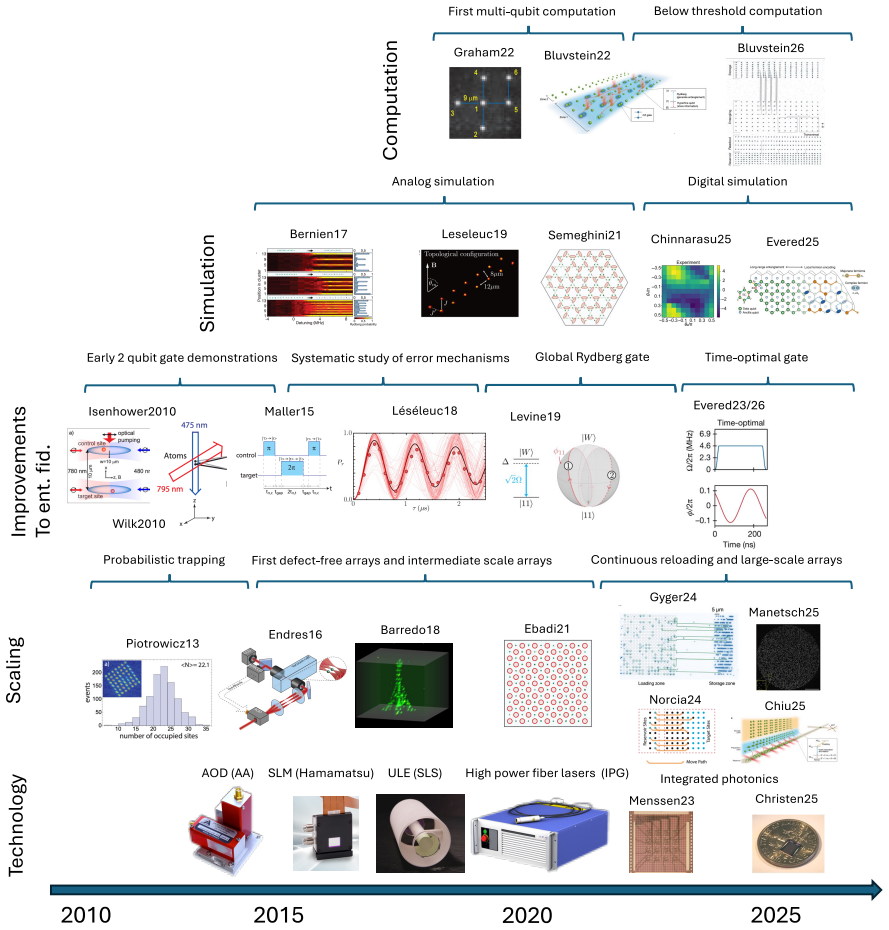
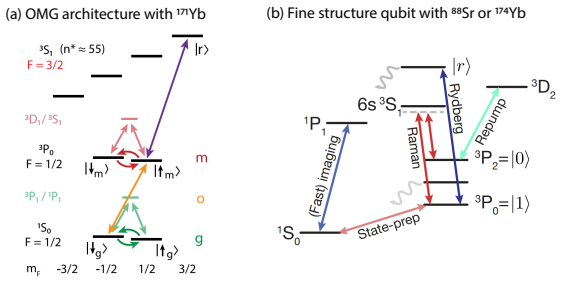
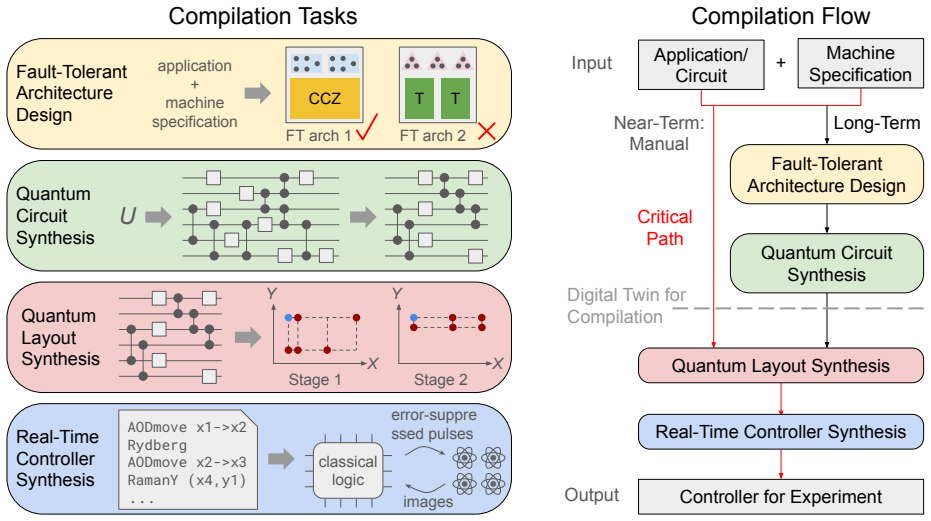
Summary. This paper is a community-led strategic plan for neutral-atom quantum computing. It opens with a definition of "practical quantum advantage" (correctness, advantage, scaling, practicality), proposes a "quop" as a unit of quantum operation, and maps a roadmap across six areas: hardware scaling (tweezer/lattice arrays, atomic species, gates, reloading, readout), integrated photonic control, quantum error correction (qLDPC codes, decoders, modular architectures), circuit compilation, and networking. The central quantitative claim is that, extrapolating Fig. 2's exponential fits to qubit count and gate fidelity, neutral atoms "could reach quantum utility within the next decade." The paper explicitly cautions that the fit is coarse and that the timeline depends on scaling to the ~10^5–10^6 qubit regime, but this projection nonetheless anchors the ordering of the roadmap. Later sections also lean on the authors' own unpublished results ([600], [23]) for below-threshold error correction and continuous reloading.
Significance. If the roadmap is realized, it would constitute a coherent path to fault-tolerant neutral-atom computing with practical advantage. The paper's main organizational value is its four-criterion definition of practical quantum advantage, the quop-oriented framing of computation regimes, and its compilation of current hardware and QEC resource estimates (e.g., qLDPC overhead reductions and the RSA/ECC anchors in Fig. 3). It also makes a falsifiable prediction—the "within the next decade" timeline—which is a strength as long as its inputs are transparent. The survey appears broadly consistent with the cited literature: the cited 99.5%+ fidelities, >3,000-atom arrays, and qLDPC overhead reductions are independently checkable. No machine-checked proofs or code are supplied; the paper's contribution is a roadmap, not a proof. The main weakness is that the roadmap's quantitative center is an unvalidated exponential fit through selected data and unpublished co-authored milestones, so the significance of the projection is currently conditional. The paper would be strengthened by presenting the projection as one scenario among several, with explicit sensitivity.
major comments (3)
- [§1 (p.8) and Fig. 2] The central claim "Under the scaling rates of the past decade, neutral atoms could reach quantum utility within the next decade" rests on exponential fits that are explicitly "only fit to the best results for each category at each point in time" with early results excluded, without uncertainty bounds or a mechanistic model. The paper's caveats ("coarse estimate", "Whether this timeline can be maintained will depend crucially...") do not remove the load: the roadmap's priority ordering and the 10^5–10^6 target follow from this fit. The target is also inconsistent: §1 says ~10^5–10^6, while §3 (p.39) and §2.1 say 10,000–100,000 physical qubits; at the fitted 1.8x/yr rate this factor of 10 changes the crossing time by several years. Please add a sensitivity analysis over data selection and model form, report fit uncertainty, and reconcile the target or make the decade claim explicitly condi
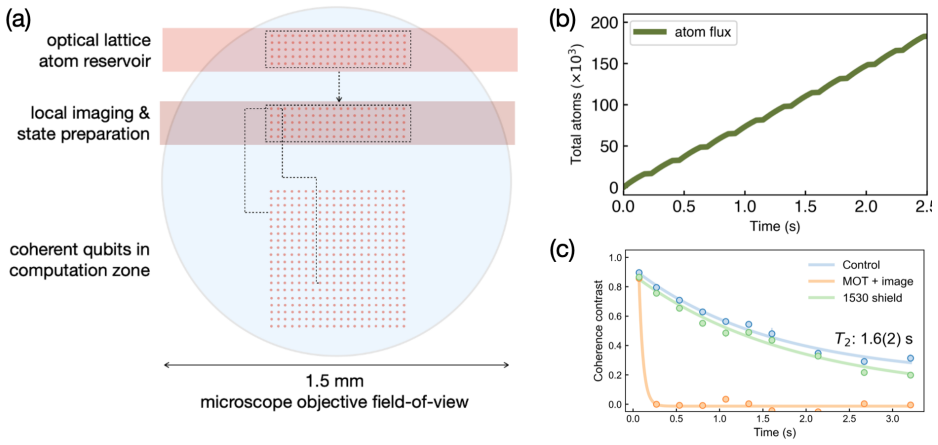
- [Intro, §2.2.3, §2.2.5, Fig. 8] Load-bearing feasibility milestones are attributed to unpublished work by author groups: below-threshold error correction [600]; "surface code operating at >2x below threshold when including detection of atom loss" (Sec. 2.2.3, Fig. 8); and continuous reloading while maintaining coherence of ~3000 atoms (Sec. 2.2.4, [23]). These points sit at the right edge of Fig. 2 and underlie statements such as "all the ingredients are in place" (Sec. 2.2.4). An external reader cannot assess them; the manuscript should either make the results publicly available or clearly separate author-provided data from the peer-reviewed record, excluding them from the extrapolation if not independently verified. As written, the feasibility case is not independently checkable at its most critical points.
- [§1 (quop), Fig. 3] The quop unit is defined inconsistently. A quop is first "an operation which can be done on a single or two qubits within one error-correction cycle," but its maximum count is then "the inverse of the logical error rate per syndrome extraction cycle and qubit"—mixing an operation count with a reliability measure and leaving multi-qubit operations outside the definition. Fig. 3 uses quop=10×Toffoli although the text states the overhead is "typically a factor of 10-100" and architecture-dependent; the stated MQuop/GQuop/TQuop regime boundaries are therefore movable by an order of magnitude. Please give a formal definition, or state the regimes directly in terms of Toffoli counts and logical error rates without the extra conversion.
minor comments (5)
- [§2.1] The phrase "10.000 - 100.000 physical neutral-atom qubits" uses periods as decimal separators; use commas or spaces consistently with "10,000–100,000" elsewhere.
- [Fig. 2(b)] The caption says "Two-qubit gate fidelity" but the text fits "gate errors" (factor 0.62/yr). Clarify whether F or 1-F is plotted/fitted, and state the fitted functional form.
- [Fig. 3 caption] The stated "estimated quop=10×Toffoli" is inconsistent with the text's "10 to 100" range; at minimum, state the sensitivity of the regime labels to this choice.
- [§2.2.5] Minor typo: "Stamper-Kurn group" should be "Stamper-Kurn"; use proper diacritics throughout (e.g., Vuletić).
- [§1.2.1] The definition's "cannot be solved on available classical hardware at the time" and "scaling advantage" clauses need clarification; as written the former makes the latter hard to interpret.
Circularity Check
Timeline claim is an extrapolation of a selected best-results fit, and its below-threshold anchor is an unpublished self-citation.
specific steps
-
fitted input called prediction
[Introduction / Fig. 2 discussion (p. 8)]
"In the spirit of Moore’s law, we fit the increase in qubit count (a) and two-qubit fidelity (b) to exponential scaling laws through a set of hallmark experimental demonstrations. We only fit to the best results for each category (size and fidelity) at each point in time. ... Under the scaling rates of the past decade, neutral atoms could reach quantum utility within the next decade."
The 'prediction' that neutral atoms could reach quantum utility within the next decade is not a separately derived result; it is the same exponential model fitted to selected past 'best results' (with early results excluded) evaluated at a utility target. The crossing time is forced by the fitted exponents (≈1.8x/yr qubits, ≈0.62x/yr gate errors) and by whichever target is chosen—the paper variously says '~10^5–10^6' physical qubits and, in Sec. 3, '10,000 – 100,000 physical qubits.' The paper itself calls the fit 'only a coarse estimate,' so the headline timeline adds no information beyond the fit; it is the fit relabeled as a prediction.
-
self citation load bearing
[Intro (p. 5) and Sec. 2.2.3 (p. 31)]
"Recent experiments have demonstrated below-threshold error correction in neutral atoms for the first time [600]. ... Recent logical qubit benchmarking from the Lukin group (Harvard) has already demonstrated the surface code operating at >2× below threshold when including detection of atom loss (Fig. 8) [600]."
The roadmap's central premise that neutral atoms are already in the below-threshold regime rests on reference [600], which is presented as the Lukin group's own result (Fig. 2 lists 'Bluvstein ’26 [600]' as a full-system demonstration; multiple authors of the present paper are in that group). No independent, externally verified implementation is cited for this load-bearing milestone. The same unpublished result is then used to support the 'quantum utility within the next decade' projection and the '>10,000 physical qubits' continuous-reloading claim. Thus the main evidence for the roadmap's feasibility is an unverified self-citation rather than an independent check.
full rationale
The paper is largely a strategic survey; its reviews of QEC theory, compilation, networking, and hardware options are self-contained and frequently cite independent prior work. However, the forward-looking central claim has two circular/self-supporting features. First, the 'within the next decade' timeline is an extrapolation of a fit to best-in-class historical data, with the paper itself cautioning that it is 'only a coarse estimate'; the utility target shifts between sections (10^4–10^5 vs. 10^5–10^6 physical qubits), so the crossing time is construction-dependent rather than derived from independent evidence. Second, the anchor 'below-threshold' demonstration is cited only to unpublished [600] from the authors' own Harvard/Lukin group, making the roadmap's feasibility case partially self-referential. The paper's own caveats ('Whether this timeline can be maintained will depend crucially...') are acknowledged and reduce the claim to a conditional estimate, but they do not remove the construction dependence. No uniqueness theorem is imported, no ansatz is smuggled via citation, and no known result is merely renamed. On balance, the headline timeline reduces to its fitted inputs and an unverified self-citation, while most of the document's substantive content remains independently grounded; hence a moderate circularity score of 4.
Axiom & Free-Parameter Ledger
free parameters (5)
- Qubit-count growth rate =
~1.8x/yr (1.85/yr in Fig. 2a)
- Gate-error reduction factor =
~0.62/yr
- Toffoli-to-quop conversion factor =
10 (authors note true overhead is 10–100)
- Fig. 3 author-estimated qubit counts =
1000 (proofs of quantumness); 2000 (U(1) lattice gauge theory); 150 (single-ancilla FeMoCo)
- Utility-scale physical qubit target =
10^5–10^6 (Sec. 1); 10^4–10^5 (Sec. 3)
axioms (5)
- domain assumption Recent exponential scaling rates (qubits ~1.8x/yr, gate error ~0.62x/yr) continue for the next decade
- domain assumption Best-in-class demonstrations represent the field trajectory
- domain assumption Unpublished below-threshold demonstration [600] is valid
- domain assumption 99.9% two-qubit gate fidelity reachable via <0.5% light-shift homogeneity
- domain assumption Classical simulation methods will not erode the advantage claim within the decade
invented entities (1)
-
quop (quantum operation)
no independent evidence
read the original abstract
We present a strategic plan for neutral atom quantum computation, bringing together hardware development and theory advancements to achieve the goal of practical quantum advantage. The concept of practical quantum advantage is defined, along with how to verify claims of advantage, and approaches to designing quantum algorithms that deliver practical advantage. Future directions for neutral atom quantum processor hardware are described: scaling-up system size, Qubit encodings and atomic platforms, going further below threshold with neutral-atom logical-qubit performance, continuous reloading of qubits, and fast readout. We also explore opportunities for scalable integrated photonic control technologies. Alongside hardware advancements, new developments in quantum error correction and compilation of quantum circuits are proposed. Finally, we examine the opportunity of networking multiple neutral atom quantum processors together to perform distributed quantum computing and overcome possible limitations of a single system.
Figures








Forward citations
Cited by 1 Pith paper
-
Lowering the implementation barrier of neutral-atom quantum computing with agentic workflows
An LLM-agent workflow turned published quantum protocols and a patent into overnight neutral-atom QPU runs, and classified 49% of readable Rydberg-array theory papers as implementable on current hardware.
Reference graph
Works this paper leans on
-
[1]
High-fidelity parallel entangling gates on a neutral-atom quantum computer
S. J. Evered, D. Bluvstein, M. Kalinowski, S. Ebadi, T. Manovitz, H. Zhou, S. H. Li, A. A. Geim, T. T. Wang, N. Maskara, H. Levine, G. Semeghini, M. Greiner, V. Vuletić, and M. D. Lukin, “High-fidelity parallel entangling gates on a neutral-atom quantum computer”, Nature622, 268–272 (2023)
2023
-
[2]
Benchmarking and fidelity response theory of high-fidelity rydberg entangling gates
R. B.-S. Tsai, X. Sun, A. L. Shaw, R. Finkelstein, and M. Endres, “Benchmarking and fidelity response theory of high-fidelity rydberg entangling gates”, PRX Quantum6, 010331 (2025)
2025
-
[3]
High-fidelity entangling gates and nonlocal circuits with neutral atoms
S. J. Evered et al., “High-fidelity entangling gates and nonlocal circuits with neutral atoms”, (2026), arXiv:2604.25987 [quant-ph]. 85
Pith/arXiv arXiv 2026
-
[4]
A quan- tum processor based on coherent transport of entangled atom arrays
D. Bluvstein, H. Levine, G. Semeghini, T. T. Wang, S. Ebadi, M. Kalinowski, A. Keesling, N. Maskara, H. Pichler, M. Greiner, V. Vuletić, and M. D. Lukin, “A quan- tum processor based on coherent transport of entangled atom arrays”, Nature 2022 604:7906604, 451–456 (2022), arXiv:2112.03923
Pith/arXiv arXiv 2022
-
[5]
Constant-overheadfault-tolerantquantum computation with reconfigurable atom arrays
Q. Xu, J. P. B. Ataides, C. A. Pattison, N. Raveendran, D. Bluvstein, J. Wurtz, B. Vasić,M.D.Lukin,L.Jiang,andH.Zhou,“Constant-overheadfault-tolerantquantum computation with reconfigurable atom arrays”, Nature Physics20, 1084–1090 (2024)
2024
-
[6]
The Pinnacle Architecture: Reducing the cost of breaking RSA-2048to100000physicalqubitsusingquantumLDPCcodes
P. Webster, L. Berent, O. Chandra, E. T. Hockings, N. Baspin, F. Thomsen, S. C. Smith, and L. Z. Cohen, “The Pinnacle Architecture: Reducing the cost of breaking RSA-2048to100000physicalqubitsusingquantumLDPCcodes”,(2026),arXiv:2602. 11457 [quant-ph]
2026
-
[7]
Multi-qubit entanglement and algorithms on a neutral-atom quantum computer
T. M. Graham, Y. Song, J. Scott, C. Poole, L. Phuttitarn, K. Jooya, P. Eichler, X. Jiang, A. Marra, B. Grinkemeyer, M. Kwon, M. Ebert, J. Cherek, M. T. Lichtman, M. Gillette, J. Gilbert, D. Bowman, T. Ballance, C. Campbell, E. D. Dahl, O. Crawford, N. S. Blunt, B. Rogers, T. Noel, and M. Saffman, “Multi-qubit entanglement and algorithms on a neutral-atom ...
2022
-
[8]
Observation of a symmetry-protected topological phase of interacting bosons with rydberg atoms
S. de Léséleuc, V. Lienhard, P. Scholl, D. Barredo, S. Weber, N. Lang, H. P. Büchler, T. Lahaye, and A. Browaeys, “Observation of a symmetry-protected topological phase of interacting bosons with rydberg atoms”, Science365, 775–780 (2019)
2019
-
[9]
Probing topological spin liquids on a pro- grammable quantum simulator
G. Semeghini, H. Levine, A. Keesling, S. Ebadi, T. T. Wang, D. Bluvstein, R. Verre- sen, H. Pichler, M. Kalinowski, R. Samajdar, A. Omran, S. Sachdev, A. Vishwanath, M. Greiner, V. Vuletić, and M. D. Lukin, “Probing topological spin liquids on a pro- grammable quantum simulator”, Science374, 1242–1247 (2021)
2021
-
[10]
Variational simulation of the Lipkin-Meshkov- Glick model on a neutral atom quantum computer
R. Chinnarasu, C. Poole, L. Phuttitarn, A. Noori, T. M. Graham, S. N. Coppersmith, A. B. Balantekin, and M. Saffman, “Variational simulation of the Lipkin-Meshkov- Glick model on a neutral atom quantum computer”, PRX Quantum6, 020350 (2025)
2025
-
[11]
Probing the kitaev honeycomb model on a neutral-atom quantum computer
S. J. Evered, M. Kalinowski, A. A. Geim, T. Manovitz, D. Bluvstein, S. H. Li, N. Maskara, H. Zhou, S. Ebadi, M. Xu, J. Campo, M. Cain, S. Ostermann, S. F. Yelin, S. Sachdev, M. Greiner, V. Vuletić, and M. D. Lukin, “Probing the kitaev honeycomb model on a neutral-atom quantum computer”, Nature645, 341–347 (2025)
2025
-
[12]
Demonstration of a neutral atom controlled-not quantum gate
L. Isenhower, E. Urban, X. L. Zhang, A. T. Gill, T. Henage, T. A. Johnson, T. G. Walker, and M. Saffman, “Demonstration of a neutral atom controlled-not quantum gate”, Physical Review Letters104,10.1103/physrevlett.104.010503(2010)
-
[13]
Entanglement of two individual neutral atoms using rydberg blockade
T. Wilk, A. Gaëtan, C. Evellin, J. Wolters, Y. Miroshnychenko, P. Grangier, and A. Browaeys, “Entanglement of two individual neutral atoms using rydberg blockade”, Physical Review Letters104,10.1103/physrevlett.104.010502(2010)
-
[14]
Rydberg-blockade controlled-not gate and entanglement in a two-dimensional array of neutral-atom qubits
K. M. Maller, M. T. Lichtman, T. Xia, Y. Sun, M. J. Piotrowicz, A. W. Carr, L. Isenhower, and M. Saffman, “Rydberg-blockade controlled-not gate and entanglement in a two-dimensional array of neutral-atom qubits”, Physical Review A92,10.1103/ physreva.92.022336(2015). 86
2015
-
[15]
Analysis of imperfections in the coherent optical excitation of single atoms to rydberg states
S. de Léséleuc, D. Barredo, V. Lienhard, A. Browaeys, and T. Lahaye, “Analysis of imperfections in the coherent optical excitation of single atoms to rydberg states”, Phys. Rev. A97, 053803 (2018)
2018
-
[16]
Parallel implementation of high-fidelity multiqubit gates with neutral atoms
H. Levine, A. Keesling, G. Semeghini, A. Omran, T. T. Wang, S. Ebadi, H. Bernien, M. Greiner, V. Vuletić, H. Pichler, and M. D. Lukin, “Parallel implementation of high-fidelity multiqubit gates with neutral atoms”, Physical Review Letters123,10. 1103/physrevlett.123.170503(2019)
2019
-
[17]
Two-dimensional lattice of blue-detuned atom traps using a projected gaus- sian beam array
M. J. Piotrowicz, M. Lichtman, K. Maller, G. Li, S. Zhang, L. Isenhower, and M. Saffman, “Two-dimensional lattice of blue-detuned atom traps using a projected gaus- sian beam array”, Physical Review A88,10.1103/physreva.88.013420(2013)
-
[18]
Atom-by-atom assembly of defect- free one-dimensional cold atom arrays
M. Endres, H. Bernien, A. Keesling, H. Levine, E. R. Anschuetz, A. Krajenbrink, C. Senko, V. Vuletic, M. Greiner, and M. D. Lukin, “Atom-by-atom assembly of defect- free one-dimensional cold atom arrays”, Science354, 1024–1027 (2016)
2016
-
[19]
Synthetic three-dimensional atomic structures assembled atom by atom
D. Barredo, V. Lienhard, S. de Léséleuc, T. Lahaye, and A. Browaeys, “Synthetic three-dimensional atomic structures assembled atom by atom”, Nature561, 79–82 (2018)
2018
-
[20]
Quantum phases of matter on a 256-atom programmable quantum simulator
S. Ebadi, T. T. Wang, H. Levine, A. Keesling, G. Semeghini, A. Omran, D. Bluvstein, R. Samajdar, H. Pichler, W. W. Ho, S. Choi, S. Sachdev, M. Greiner, V. Vuletić, and M. D. Lukin, “Quantum phases of matter on a 256-atom programmable quantum simulator”, Nature595, 227–232 (2021)
2021
-
[21]
Continuous operation of large-scale atom arrays in optical lattices
F. Gyger, M. Ammenwerth, R. Tao, H. Timme, S. Snigirev, I. Bloch, and J. Zeiher, “Continuous operation of large-scale atom arrays in optical lattices”, Physical Review Research6,10.1103/physrevresearch.6.033104(2024)
-
[22]
A tweezer array with 6,100 highly coherent atomic qubits
H. J. Manetsch, G. Nomura, E. Bataille, X. Lv, K. H. Leung, and M. Endres, “A tweezer array with 6,100 highly coherent atomic qubits”, Nature647, 60–67 (2025)
2025
-
[23]
Continuous operation of a coherent 3,000-qubit system
N.-C. Chiu, E. C. Trapp, J. Guo, M. H. Abobeih, L. M. Stewart, S. Hollerith, P. L. Stroganov, M. Kalinowski, A. A. Geim, S. J. Evered, S. H. Li, X. Lyu, L. M. Peters, D. Bluvstein, T. T. Wang, M. Greiner, V. Vuletić, and M. D. Lukin, “Continuous operation of a coherent 3,000-qubit system”, Nature646, 1075–1080 (2025)
2025
-
[24]
Scalable photonic integrated circuits for high-fidelity light control
A. J. Menssen, A. Hermans, I. Christen, T. Propson, C. Li, A. J. Leenheer, M. Zim- mermann, M. Dong, H. Larocque, H. Raniwala, G. Gilbert, M. Eichenfield, and D. R. Englund, “Scalable photonic integrated circuits for high-fidelity light control”, Optica 10, 1366–1372 (2023)
2023
-
[25]
An integrated photonic engine for programmable atomic control
I. Christen, T. Propson, M. Sutula, H. Sattari, G. Choong, C. Panuski, A. Melville, J. Mallek, C. Brabec, S. Hamilton, P. B. Dixon, A. J. Menssen, D. Braje, A. H. Ghadimi, and D. Englund, “An integrated photonic engine for programmable atomic control”, Nature Communications16, 82 (2025)
2025
-
[26]
Surface codes: Towards practical large-scale quantum computation
A. G. Fowler, M. Mariantoni, J. M. Martinis, and A. N. Cleland, “Surface codes: Towards practical large-scale quantum computation”, Physical Review A86, 032324 (2012). 87
2012
-
[27]
Single-atom trapping in holographic 2d arrays of microtraps with arbitrary geometries
F. Nogrette, H. Labuhn, S. Ravets, D. Barredo, L. Béguin, A. Vernier, T. Lahaye, and A. Browaeys, “Single-atom trapping in holographic 2d arrays of microtraps with arbitrary geometries”, Physical Review X4,10.1103/physrevx.4.021034(2014)
-
[28]
Probing many-body dynamics on a 51-atom quantum simulator
H. Bernien, S. Schwartz, A. Keesling, H. Levine, A. Omran, H. Pichler, S. Choi, A. S. Zibrov, M. Endres, M. Greiner, V. Vuletić, and M. D. Lukin, “Probing many-body dynamics on a 51-atom quantum simulator”, Nature551, 579–584 (2017)
2017
-
[29]
Simple, passive design for large optical trap arrays for single atoms
P. Huft, Y. Song, T. M. Graham, K. Jooya, S. Deshpande, C. Fang, M. Kats, and M. Saffman, “Simple, passive design for large optical trap arrays for single atoms”, Physical Review A105,10.1103/physreva.105.063111(2022)
-
[30]
Supercharged two-dimensional tweezer array with more than 1000 atomic qubits
L. Pause, L. Sturm, M. Mittenbühler, S. Amann, T. Preuschoff, D. Schäffner, M. Schlosser, and G. Birkl, “Supercharged two-dimensional tweezer array with more than 1000 atomic qubits”, Optica11, 222 (2024)
2024
-
[31]
High-fidelity detection of large-scale atom arrays in an optical lattice
R. Tao, M. Ammenwerth, F. Gyger, I. Bloch, and J. Zeiher, “High-fidelity detection of large-scale atom arrays in an optical lattice”, Physical Review Letters133, 013401 (2024)
2024
-
[32]
Rearrangement of individual atoms in a 2000-site optical-tweezer array at cryogenic temperatures
G. Pichard, D. Lim, É. Bloch, J. Vaneecloo, L. Bourachot, G.-J. Both, G. Mériaux, S. Dutartre, R. Hostein, J. Paris, B. Ximenez, A. Signoles, A. Browaeys, T. Lahaye, and D. Dreon, “Rearrangement of individual atoms in a 2000-site optical-tweezer array at cryogenic temperatures”, Physical Review Applied22,10.1103/physrevapplied. 22.024073(2024)
-
[33]
Iterative assembly of atom arrays with cavity-enhanced optical lattices
M. A. Norcia, H. Kim, W. B. Cairncross, M. Stone, A. Ryou, M. Jaffe, M. O. Brown, K. Barnes, P. Battaglino, T. C. Bohdanowicz, A. Brown, K. Cassella, C.-A. Chen, R. Coxe, D. Crow, J. Epstein, C. Griger, E. Halperin, F. Hummel, A. M. W. Jones, J. M. Kindem, J. King, K. Kotru, J. Lauigan, M. Li, M. Lu, E. Megidish, J. Marjanovic, M. McDonald, T. Mittiga, J....
2024
-
[34]
Ai-enabled parallel assembly of thousands of defect-free neutral atom arrays
R.Lin,H.-S.Zhong,Y.Li,Z.-R.Zhao,L.-T.Zheng,T.-R.Hu,H.-M.Wu,Z.Wu,W.-J. Ma, Y. Gao, Y.-K. Zhu, Z.-F. Su, W.-L. Ouyang, Y.-C. Zhang, J. Rui, M.-C. Chen, C.-Y. Lu, and J.-W. Pan, “Ai-enabled parallel assembly of thousands of defect-free neutral atom arrays”, Phys. Rev. Lett.135, 060602 (2025)
2025
-
[35]
High-efficiency loading of 2,400 Ytterbium atoms in optical tweezer arrays
J. Zhu et al., “High-efficiency loading of 2,400 Ytterbium atoms in optical tweezer arrays”, (2025), arXiv:2512.19795 [quant-ph]
arXiv 2025
-
[36]
Deterministic entanglement of two neutral atoms via rydberg blockade
X. L. Zhang, L. Isenhower, A. T. Gill, T. G. Walker, and M. Saffman, “Deterministic entanglement of two neutral atoms via rydberg blockade”, Physical Review A82, 10.1103/physreva.82.030306(2010). 88
-
[37]
High-fidelity control and entanglement of rydberg-atom qubits
H. Levine, A. Keesling, A. Omran, H. Bernien, S. Schwartz, A. S. Zibrov, M. Endres, M. Greiner, V. Vuletić, and M. D. Lukin, “High-fidelity control and entanglement of rydberg-atom qubits”, Physical Review Letters121,10 . 1103 / physrevlett . 121 . 123603(2018)
2018
-
[38]
C. Gidney,How to factor 2048 bit RSA integers with less than a million noisy qubits, 2025, arXiv:2505.15917 [quant-ph]
Pith/arXiv arXiv 2048
-
[39]
How to factor 2048 bit rsa integers in 8 hours using 20 million noisy qubits
C. Gidney and M. Ekerå, “How to factor 2048 bit rsa integers in 8 hours using 20 million noisy qubits”, Quantum5, 433 (2021)
2048
-
[40]
Resource analysis of low-overhead transversal architectures for recon- figurable atom arrays
H. Zhou, C. Duckering, C. Zhao, D. Bluvstein, M. Cain, A. Kubica, S.-T. Wang, and M. D. Lukin, “Resource analysis of low-overhead transversal architectures for recon- figurable atom arrays”, in Proceedings of the 52nd annual international symposium on computer architecture, SIGARCH ’25 (June 2025), pp. 1432–1448
2025
-
[41]
Logical quantum processor based on reconfigurable atom arrays
D. Bluvstein, S. J. Evered, A. A. Geim, S. H. Li, H. Zhou, T. Manovitz, S. Ebadi, M. Cain, M. Kalinowski, D. Hangleiter, J. P. Bonilla Ataides, N. Maskara, I. Cong, X. Gao, P. Sales Rodriguez, T. Karolyshyn, G. Semeghini, M. J. Gullans, M. Greiner, V. Vuletić, and M. D. Lukin, “Logical quantum processor based on reconfigurable atom arrays”, Nature626, 58–...
2023
-
[42]
Exploring the many-body localization transition in two dimensions
J.-y. Choi, S. Hild, J. Zeiher, P. Schauß, A. Rubio-Abadal, T. Yefsah, V. Khemani, D. A. Huse, I. Bloch, and C. Gross, “Exploring the many-body localization transition in two dimensions”, Science352, 1547–1552 (2016)
2016
-
[43]
Benchmarking highly entangled states on a 60-atom analogue quantum simulator
A. L. Shaw, Z. Chen, J. Choi, D. K. Mark, P. Scholl, R. Finkelstein, A. Elben, S. Choi, and M. Endres, “Benchmarking highly entangled states on a 60-atom analogue quantum simulator”, Nature628, 71–77 (2024), arXiv:2308.07914
Pith/arXiv arXiv 2024
-
[44]
Beyond-classical computation in quantum simulation
A. D. King, A. Nocera, M. M. Rams, J. Dziarmaga, R. Wiersema, W. Bernoudy, J. Raymond, N. Kaushal, N. Heinsdorf, R. Harris, K. Boothby, F. Altomare, M. Asad, A. J. Berkley, M. Boschnak, K. Chern, H. Christiani, S. Cibere, J. Connor, M. H. Dehn, R. Deshpande, S. Ejtemaee, P. Farre, K. Hamer, E. Hoskinson, S. Huang, M. W. Johnson, S. Kortas, E. Ladizinsky, ...
2025
-
[45]
Thermalization and criticality on an analogue–digital quantum simulator
T. I. Andersen, N. Astrakhantsev, A. H. Karamlou, J. Berndtsson, J. Motruk, A. Szasz, J. A. Gross, A. Schuckert, T. Westerhout, Y. Zhang, E. Forati, D. Rossi, B. Kobrin, A. D. Paolo, A. R. Klots, I. Drozdov, V. Kurilovich, A. Petukhov, L. B. Ioffe, A. Elben, A. Rath, V. Vitale, B. Vermersch, R. Acharya, L. A. Beni, K. Anderson, M. Ansmann, F. Arute, K. Ar...
2025
-
[46]
Spectroscopy of elementary excitations from quench dynamics in a dipolar XY Ryd- berg simulator
C. Chen, G. Emperauger, G. Bornet, F. Caleca, B. Gély, M. Bintz, S. Chatterjee, V. Liu, D. Barredo, N. Y. Yao, T. Lahaye, F. Mezzacapo, T. Roscilde, and A. Browaeys, “Spectroscopy of elementary excitations from quench dynamics in a dipolar XY Ryd- berg simulator”, Science389, 483–487 (2025)
2025
-
[47]
Strong Quantum Computational Advantage Using a Superconducting Quantum Processor
Y. Wu, W.-S. Bao, S. Cao, F. Chen, M.-C. Chen, X. Chen, T.-H. Chung, H. Deng, Y. Du, D. Fan, M. Gong, C. Guo, C. Guo, S. Guo, L. Han, L. Hong, H.-L. Huang, Y.-H. Huo, L. Li, N. Li, S. Li, Y. Li, F. Liang, C. Lin, J. Lin, H. Qian, D. Qiao, H. Rong, H. Su, L. Sun, L. Wang, S. Wang, D. Wu, Y. Xu, K. Yan, W. Yang, Y. Yang, Y. Ye, J. Yin, C. Ying, J. Yu, C. Zh...
2021
-
[48]
Computational power of random quantum circuits in arbitrary geometries
M. DeCross, R. Haghshenas, M. Liu, E. Rinaldi, J. Gray, Y. Alexeev, C. H. Baldwin, J. P. Bartolotta, M. Bohn, E. Chertkov, J. Cline, J. Colina, D. DelVento, J. M. Dreiling, C. Foltz, J. P. Gaebler, T. M. Gatterman, C. N. Gilbreth, J. Giles, D. Gresh, A. Hall, A. Hankin, A. Hansen, N. Hewitt, I. Hoffman, C. Holliman, R. B. Hutson, T. Jacobs, J. Johansen, P...
2025
-
[49]
Phase transitions in random circuit sampling
A. Morvan, B. Villalonga, X. Mi, S. Mandrà, A. Bengtsson, P. V. Klimov, Z. Chen, S. Hong, C. Erickson, I. K. Drozdov, J. Chau, G. Laun, R. Movassagh, A. Asfaw, L. T. a. N. Brandão, R. Peralta, D. Abanin, R. Acharya, R. Allen, T. I. Andersen, K. Anderson, M. Ansmann, F. Arute, K. Arya, J. Atalaya, J. C. Bardin, A. Bilmes, G. Bortoli, A. Bourassa, J. Bovair...
2024
-
[50]
Establishing a New Benchmark in Quantum Computational Advantage with 105-qubit Zuchongzhi 3.0 Processor
D. Gao, D. Fan, C. Zha, J. Bei, G. Cai, J. Cai, S. Cao, F. Chen, J. Chen, K. Chen, X. Chen, X. Chen, Z. Chen, Z. Chen, Z. Chen, W. Chu, H. Deng, Z. Deng, P. Ding, X. Ding, Z. Ding, S. Dong, Y. Dong, B. Fan, Y. Fu, S. Gao, L. Ge, M. Gong, J. Gui, C. Guo, S. Guo, X. Guo, L. Han, T. He, L. Hong, Y. Hu, H.-L. Huang, Y.-H. Huo, T. Jiang, Z. Jiang, H. Jin, Y. L...
2025
-
[51]
A cryptographic testofquantumnessandcertifiablerandomnessfromasinglequantumdevice
Z. Brakerski, P. Christiano, U. Mahadev, U. Vazirani, and T. Vidick, “A cryptographic testofquantumnessandcertifiablerandomnessfromasinglequantumdevice”,Journal of the ACM (JACM)68, 1–47 (2021), arXiv:2018.00038
arXiv 2021
-
[52]
Certified Randomness from Quantum Supremacy
S. Aaronson and S.-H. Hung, “Certified Randomness from Quantum Supremacy”, in Proceedings of the 55th Annual ACM Symposium on Theory of Computing, STOC 2023 (June 2023), pp. 933–944
2023
-
[53]
Certified randomness using a trapped-ion quantum processor
M. Liu, R. Shaydulin, P. Niroula, M. DeCross, S.-H. Hung, W. Y. Kon, E. Cervero- Martín, K. Chakraborty, O. Amer, S. Aaronson, A. Acharya, Y. Alexeev, K. J. Berg, S. Chakrabarti, F. J. Curchod, J. M. Dreiling, N. Erickson, C. Foltz, M. Foss-Feig, D. Hayes, T. S. Humble, N. Kumar, J. Larson, D. Lykov, M. Mills, S. A. Moses, B. Neyenhuis, S. Eloul, P. Siegf...
2025
-
[54]
Digital quantum magnetism at the frontier of classical simulations
R. Haghshenas, E. Chertkov, M. Mills, W. Kadow, S.-H. Lin, Y.-H. Chen, C. Cade, I. Niesen, T. Begušić, M. S. Rudolph, C. Cirstoiu, K. Hemery, C. M. Keever, M. Lubasch, E. Granet, C. H. Baldwin, J. P. Bartolotta, M. Bohn, J. Cline, M. DeCross, J. M. Dreiling, C. Foltz, D. Francois, J. P. Gaebler, C. N. Gilbreth, J. Gray, D. Gresh, A. Hall, A. Hankin, A. Ha...
Pith/arXiv arXiv 2025
-
[55]
Fermionic dynamics on a trapped-ion quantum computer beyond exact classical simulation
F. Alam, J. L. Bosse, I. Čepait˙ e, A. Chapman, L. Clinton, M. Crichigno, E. Crosson, T. Cubitt, C. Derby, O. Dowinton, P. K. Faehrmann, S. Flammia, B. Flynn, F. M. Gambetta, R. García-Patrón, M. Hunter-Gordon, G. Jones, A. Khedkar, J. Klassen, M. Kreshchuk, E. H. McMullan, L. Mineh, A. Montanaro, C. Mora, J. J. L. Morton, D. Patel, P. Rolph, R. A. Santos...
arXiv 2025
-
[56]
Programmable digital quantum simulation of 92 2D Fermi-Hubbard dynamics using 72 superconducting qubits
F. Alam, J. L. Bosse, I. Čepait˙ e, A. Chapman, L. Clinton, M. Crichigno, E. Crosson, T. Cubitt, C. Derby, O. Dowinton, P. K. Faehrmann, S. Flammia, B. Flynn, F. M. Gambetta, R. García-Patrón, M. Hunter-Gordon, G. Jones, A. Khedkar, J. Klassen, M. Kreshchuk, E. H. McMullan, L. Mineh, A. Montanaro, C. Mora, J. J. L. Morton, D. Patel, P. Rolph, R. A. Santos...
2025
-
[57]
Superconductingpairingcorrelationsonatrapped-ionquantum computer
E. Granet, S.-H. Lin, K. Hémery, R. Hagshenas, P. Andres-Martinez, D. T. Stephen, A. Ransford, J. Arkinstall, M. S. Allman, P. Campora, S. F. Cooper, R. D. Delaney, J. M. Dreiling, B. Estey, C. Figgatt, C. Foltz, J. P. Gaebler, A. Hall, A. Husain, A. Isanaka, C. J. Kennedy, N. Kotibhaskar, M. Mills, A. R. Milne, A. J. Park, A. P. Reed, B. Neyenhuis, J. G....
arXiv 2025
-
[58]
Simpler Proofs of Quantum- ness
Z. Brakerski, V. Koppula, U. Vazirani, and T. Vidick, “Simpler Proofs of Quantum- ness”, Leibniz Int. Proc. Inf.158, 8:1–8:14 (2020), arXiv:2005.04826 [quant-ph]
Pith/arXiv arXiv 2020
-
[59]
Classically ver- ifiable quantum advantage from a computational Bell test
G. D. Kahanamoku-Meyer, S. Choi, U. V. Vazirani, and N. Y. Yao, “Classically ver- ifiable quantum advantage from a computational Bell test”, Nat. Phys.18, 918–924 (2022)
2022
-
[60]
Depth-efficient proofs of quantumness
Z. Liu and A. Gheorghiu, “Depth-efficient proofs of quantumness”, Quantum6, 807 (2022)
2022
-
[61]
Interactive Protocols for Classically-Verifiable Quantum Advantage
D.Zhu,G.D.Kahanamoku-Meyer,L.Lewis,C.Noel,O.Katz,B.Harraz,Q.Wang,A. Risinger, L. Feng, D. Biswas, L. Egan, A. Gheorghiu, Y. Nam, T. Vidick, U. Vazirani, N. Y. Yao, M. Cetina, and C. Monroe, “Interactive Protocols for Classically-Verifiable Quantum Advantage”, (2021), arXiv:2112.05156
Pith/arXiv arXiv 2021
-
[62]
The Jacobi Factoring Circuit: Quantum Factoring with Near-Linear Gates and Sublinear SpaceandDepth
G. D. Kahanamoku-Meyer, S. Ragavan, V. Vaikuntanathan, and K. V. Kirk, “The Jacobi Factoring Circuit: Quantum Factoring with Near-Linear Gates and Sublinear SpaceandDepth”,10.1145/3717823.3718273(2024),arXiv:2412.12558 [quant-ph]
arXiv 2024
-
[63]
Simulation of many-body fermi systems on a universal quantum computer
D. S. Abrams and S. Lloyd, “Simulation of many-body fermi systems on a universal quantum computer”, Phys. Rev. Lett.79, 2586–2589 (1997)
1997
-
[64]
Simulated Quantum Computation of Molecular Energies
A. Aspuru-Guzik, A. D. Dutoi, P. J. Love, and M. Head-Gordon, “Simulated Quantum Computation of Molecular Energies”, Science309, 1704–1707 (2005)
2005
-
[65]
Quantum computational chemistry
S. McArdle, S. Endo, A. Aspuru-Guzik, S. C. Benjamin, and X. Yuan, “Quantum computational chemistry”, Reviews of Modern Physics92, 015003 (2020)
2020
-
[66]
Low- depth quantum simulation of materials
R. Babbush, N. Wiebe, J. McClean, J. McClain, H. Neven, and G. K.-L. Chan, “Low- depth quantum simulation of materials”, Phys. Rev. X8, 011044 (2018)
2018
-
[67]
Quantum algorithms for quantum chemistry and quantum materials science
B. Bauer, S. Bravyi, M. Motta, and G. K.-L. Chan, “Quantum algorithms for quantum chemistry and quantum materials science”, Chemical Reviews120, PMID: 33090772, 12685–12717 (2020)
2020
-
[68]
Quantum Algorithms for Simulating Nuclear Effective Field Theories
J. D. Watson, J. Bringewatt, A. F. Shaw, A. M. Childs, A. V. Gorshkov, and Z. Davoudi, “Quantum Algorithms for Simulating Nuclear Effective Field Theories”, (2023), arXiv:2312.05344 [quant-ph]
Pith/arXiv arXiv 2023
-
[69]
How to compute a 256-bit elliptic curve private key with only 50 million Toffoli gates
D. Litinski, “How to compute a 256-bit elliptic curve private key with only 50 million Toffoli gates”, (2023), arXiv:2306.08585 [quant-ph]. 93
Pith/arXiv arXiv 2023
-
[70]
A Quan- tum Adiabatic Evolution Algorithm Applied to Random Instances of an NP-Complete Problem
E. Farhi, J. Goldstone, S. Gutmann, J. Lapan, A. Lundgren, and D. Preda, “A Quan- tum Adiabatic Evolution Algorithm Applied to Random Instances of an NP-Complete Problem”, Science292, 472–475 (2001)
2001
-
[71]
Optimization by Decoded Quantum Interfer- ometry
S. P. Jordan, N. Shutty, M. Wootters, A. Zalcman, A. Schmidhuber, R. King, S. V. Isakov, T. Khattar, and R. Babbush, “Optimization by Decoded Quantum Interfer- ometry”, Nature646, 831–836 (2024), arXiv:2408.08292 [quant-ph]
arXiv 2024
-
[72]
Simulating Quantum Computation by Contracting Tensor Networks
I. L. Markov and Y. Shi, “Simulating Quantum Computation by Contracting Tensor Networks”, SIAM J. Comput.38, 963–981 (2008)
2008
-
[73]
Simulatingquantumcomputerswithprobabilisticmethods
M.VandenNest,“Simulatingquantumcomputerswithprobabilisticmethods”,Quant. Inf. Comp.11, 784–812 (2011)
2011
-
[74]
Improved Classical Simulation of Quantum Circuits Dom- inated by Clifford Gates
S. Bravyi and D. Gosset, “Improved Classical Simulation of Quantum Circuits Dom- inated by Clifford Gates”, Phys. Rev. Lett.116, 250501 (2016), arXiv:1601.07601
Pith/arXiv arXiv 2016
-
[75]
What Limits the Simulation of Quan- tum Computers?
Y. Zhou, E. M. Stoudenmire, and X. Waintal, “What Limits the Simulation of Quan- tum Computers?”, Phys. Rev. X10, 041038 (2020)
2020
-
[76]
Simulation of Quantum Circuits Using the Big-Batch Tensor Network Method
F. Pan and P. Zhang, “Simulation of Quantum Circuits Using the Big-Batch Tensor Network Method”, Phys. Rev. Lett.128, 030501 (2022), arXiv:2103.03074
Pith/arXiv arXiv 2022
-
[77]
Solving the sampling problem of the Sycamore quantum circuits
F. Pan, K. Chen, and P. Zhang, “Solving the sampling problem of the Sycamore quantum circuits”, Phys. Rev. Lett.129, 090502 (2022), arXiv:2111.03011
Pith/arXiv arXiv 2022
-
[78]
Classical Sampling of Random Quantum Circuits with Bounded Fidelity
G. Kalachev, P. Panteleev, P. Zhou, and M.-H. Yung, “Classical Sampling of Random Quantum Circuits with Bounded Fidelity”, (2021), arXiv:2112.15083 [quant-ph]
Pith/arXiv arXiv 2021
-
[79]
Recursive Multi-Tensor Contraction for XEB Verification of Quantum Circuits
G. Kalachev, P. Panteleev, and M.-H. Yung, “Recursive Multi-Tensor Contraction for XEB Verification of Quantum Circuits”, (2021), arXiv:2108.05665 [quant-ph]
Pith/arXiv arXiv 2021
-
[80]
Hyperoptimized Approximate Contraction of Tensor Networks with Arbitrary Geometry
J. Gray and G. K.-L. Chan, “Hyperoptimized Approximate Contraction of Tensor Networks with Arbitrary Geometry”, Phys. Rev. X14, 011009 (2024)
2024
discussion (0)
Sign in with ORCID, Apple, or X to comment. Anyone can read and Pith papers without signing in.