REVIEW 4 major objections 3 minor 58 references
Progressive Seed Pruning scores half-denoised images and prunes low-ranked seeds early, outperforming best-of-N and search baselines at matched compute.
Reviewed by Pith at T0; open to challenge. T0 means a machine referee read the full paper against a public rubric. the ladder, T0–T4 →
T0 review · deepseek-v4-flash
2026-08-01 06:59 UTC pith:BNKR3ALQ
load-bearing objection A simple, clearly-tested idea—prune seeds early using intermediate rewards—that mostly delivers, but the headline claims outrun the error bars. the 4 major comments →
Inference-Time Scaling of Diffusion Models via Progressive Seed Pruning
The pith
A machine-rendered reading of the paper's core claim, the machinery that carries it, and where it could break.
Core claim
PSP's claim is that intermediate rewards computed on predicted clean images x̂0 are informative early enough that a fixed geometric halving schedule—start with 2N seeds, prune to N at 25% progress, prune to N/2 at 50%—lets a fixed budget of N·T denoising steps behave like a best-of-2N search. The paper shows survival probabilities of the final best seed near 80–90% at the two prune points and regret near 0.01 relative to the 2N-seed upper bound, and that this regret decreases as the compute multiplier grows. On all three backbones PSP reports the best GenEval and human alignment scores among matched-compute baselines, and the authors argue PSP is less prone to reward hacking because it only
What carries the argument
The central object is the one-step denoised estimate x̂0(x_t, t, c), a predicted clean image that the generator's noise/velocity prediction already implies and that costs no extra model evaluations to compute. PSP scores this estimate with a black-box reward (ImageReward), prunes trajectories to the top-k by that score at predetermined progress points, and advances only survivors. The identity that carries the argument is the compute bookkeeping C = Σ k_t: front-loading the pool multiplies the number of evaluated seeds while keeping the total step count fixed, and the geometric schedule k_t = 2N → N → N/2 turns an N-fold budget into a 2N-fold seed pool.
Load-bearing premise
The method's gain rests on the assumption that a reward score computed on a half-denoised image ranks candidates almost as well as the reward on the final image, so that halving the pool at 25% and 50% progress rarely discards the eventual best seed.
What would settle it
Run the matched-compute comparison on a task whose decisive features are generated late, such as fine-grained texture or aesthetic detail: if the survival rate of the final-best seed under top-half pruning at 25%/50% progress falls toward chance, PSP's advantage over best-of-N should shrink or reverse. This can be measured directly from cached trajectories by computing the survival curve of Fig. S1 on such a reward.
If this is right
- Relaxing constant memory during diffusion inference is a legitimate scaling axis: a fixed halving schedule outperforms constant-memory baselines at matched compute on prompt alignment.
- Deterministic samplers suffice; resampling-based methods need stochasticity that can degrade flow-matching generation, while PSP does not.
- PSP's quality continues to increase as the compute multiplier grows from 2 to 16, with pruning regret shrinking relative to the upper bound set by all initial seeds.
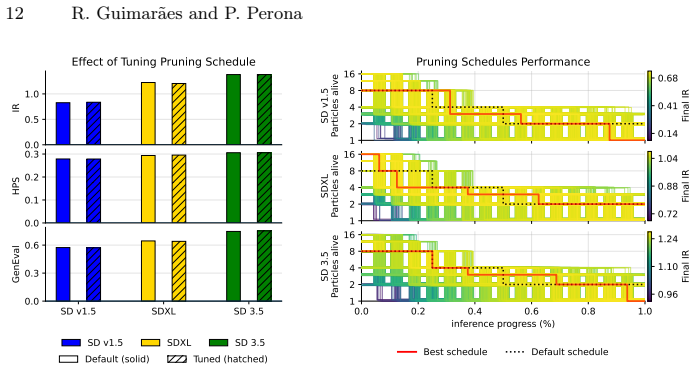
- Because sampling is deterministic, pruning schedules can be tuned offline by replaying cached intermediate rewards, without rerunning the generator.
- The method generalizes to selecting among prompt rewrites for a fixed noise seed, and it remains beneficial on top of DPO-finetuned backbones.
Where Pith is reading between the lines
- Editorial inference: the principle generalizes to any iterative generative process with a cheap intermediate proxy for the final sample; the same front-loading-then-prune allocation could be tested on autoregressive token generation or video generation.
- Editorial inference: the measured correlation curves suggest an adaptive schedule guided by the reward's information profile could outperform a fixed geometric schedule when the informativeness of intermediate scores varies across tasks; this is a direct testable extension.
- Editorial inference: the bandit-style connection to successive halving implies PSP's advantage is largest when the reward surface is seed-dominated and the best seed is rare; in domains where many seeds are nearly equivalent, the extra exploration buys little and BoN may match it.
- Editorial inference: the reward-hacking argument—PSP never modifies trajectories—implies a testable prediction: on adversarial rewards that reward early-image artifacts, PSP should show lower reward-vs-alignment divergence than resampling methods.
Editorial analysis
A structured set of objections, weighed in public.
Referee Report
Summary. The paper proposes Progressive Seed Pruning (PSP), an inference-time scaling method for diffusion and flow-matching text-to-image models. Under a fixed compute budget measured in denoiser forward calls, PSP initializes 2N noise seeds, denoises all seeds to a first pruning point, scores one-step denoised estimates with a black-box reward (ImageReward), prunes to N, later prunes to N/2, and fully denoises the survivors. Compute is matched to Best-of-N through C = Σ k_t (Eq. 4). Experiments on Stable Diffusion v1.5, SDXL, and Stable Diffusion 3.5 compare PSP with Best-of-N, FK-Steering, DSearch, NTS, RBF, BFS, and SVDD, reporting ImageReward, HPS v2, GenEval, and human prompt-alignment scores. The central claim is that PSP consistently improves reward-guided selection and achieves higher GenEval and human-evaluation scores than these baselines at matched compute, and that performance continues to scale with compute.
Significance. If the empirical claims hold, the paper identifies a simple and practical design principle—variable particle counts with early reward-based pruning—that can improve over constant-memory seed-search methods at a fixed denoiser budget. The strengths include transparent compute accounting via Eq. (4), the use of deterministic solvers with cached intermediate rewards, which enables cheap offline schedule search, comparisons against six baselines, and a human evaluation whose protocol is validated against prior work. The paper also states its limitations honestly in Section 5. However, the decisive evidence needs strengthening: Table 1 has no variance or significance information, several headline numbers are ties or not best, and the core pruning assumption is supported only by per-prune statistics rather than the full sequential schedule. These gaps are fixable and the method is likely useful, but the current support is weaker than the abstract implies.
major comments (4)
- [§4.2, Table 1] The abstract and the text in §4.2/§5 state that PSP "consistently improves reward-guided selection" and "achieves higher GenEval scores" than baselines at matched compute. Table 1 does not support these statements as written: on SD 3.5, GenEval for PSP is 0.747, identical to BoN's 0.747 and BFS's 0.747; on SDXL, BFS obtains a higher ImageReward (1.247 vs 1.224) and NTS/RBF/DSearch obtain higher HPS. Results are averaged over 3 random seeds but no error bars, confidence intervals, or significance tests are reported. Please either correct the claims or provide paired significance tests and variances for the near-tie SD 3.5 GenEval comparisons and the SDXL IR/HPS comparisons.
- [§4.2, Fig. S1] The core mechanism is that pruning at 25% and 50% progress discards the eventual best seed rarely enough. Fig. S1 reports only per-prune statistics: survival of the final best sample for a single K→K/2 prune (~80% at 25% for K=8, ~90% at 50% for K=4) and per-prune regret. The actual default schedule is sequential 8→4→2, so the quantity that determines the output is the joint probability that the best of the initial 8 seeds survives both prunes, and the cumulative regret after both prunes. If the two pruning events were independent, joint survival would be at most 0.72; correlation could make it lower. Report end-to-end survival and cumulative regret for the full default schedule, and for the scaled schedules used in §4.4.
- [§4.2, Algorithm 1] There is no ablation that replaces reward-based pruning with random pruning at the same 8→4→2 schedule and the same initial seed pool. Such a control is necessary to isolate the contribution of the intermediate reward signal from the effect of starting with a larger pool and using a variable-particle-count schedule. Without it, the comparison to BoN, FK-Steering, and DSearch does not establish that the informativeness of early x̂0 rewards drives the gains, which is the stated mechanism of Algorithm 1. Given the cached trajectories used in §4.6, this ablation is cheap and directly tests the paper's central mechanism.
- [§4.4, Fig. 3] The scaling claim ('performance scales with compute') is demonstrated only on ImageReward. Fig. S2 (right) shows that IR saturates with respect to GenEval, and Table 1 already shows no GenEval improvement for SD 3.5 at N=4. To substantiate that scaling transfers to prompt alignment, report GenEval or another reward-agnostic metric for the ¯N=2,4,8,16 sweeps, not only IR. Otherwise the scaling conclusion applies only to the guidance reward, which is weaker than the claim in the abstract.
minor comments (3)
- [§4.3] Human evaluation uses a single seed per prompt/method/backbone triplet while automated metrics are averaged over 3 seeds. Please report whether the same seed is used across methods for each prompt and provide per-method confidence intervals or a significance test for the human alignment differences; the differences between PSP and BoN/FK-Steering on SD 3.5 are small (0.841 vs 0.831/0.837).
- [§4.1] For SD 3.5, FK-Steering uses a tuned stochasticity γ=0.005, selected as the largest value that does not degrade baseline quality. Since PSP is deterministic, this hyperparameter choice affects the fairness of the comparison; a brief sensitivity analysis of γ (e.g., 0 vs 0.005 vs 0.01) would help.
- [§4.6] The claim that tuned schedules show 'little to no improvement' is based on Table S2, but the default schedule is itself a tuned choice (halving with two prune points). Consider rephrasing to 'the simple default is competitive with the best schedule found by grid search on this benchmark' to avoid implying the default was not selected with knowledge of its performance.
Circularity Check
No significant circularity; only minor self-referential reporting, no load-bearing reduction.
full rationale
PSP's central claim is empirical and is evaluated against metrics external to the selection signal: GenEval detector-based checks, HPSv2, and human prompt-alignment ratings, in addition to the ImageReward (IR) used for pruning. Using IR both as the selection reward and as one reported metric is self-referential as a sanity check, but it is not the basis of the claim; notably, BFS exceeds PSP on IR for SDXL while PSP wins on GenEval, so the IR column is not forced by construction. The default schedule (8 -> 4 at 25% progress, 4 -> 2 at 50%) is fixed a priori by geometric halving and compute matching (Sec. 4.6), not fitted to the test set; schedule tuning is performed on a separate Benchmark IR split and transferred to GenEval via offline replay (Sec. S5), which is standard held-out validation. The core assumption that intermediate xhat0 rewards rank candidates well is supported directly by correlation, survival, and regret measurements (Fig. S1), not assumed by definition. The only self-citation ([15], Guimaraes et al.) appears in related work to note that coarse early features are exploited in perception tasks; the property itself is attributed to external [31] and is not load-bearing for the main result. No equation in the paper reduces a prediction to a fitted constant or to a self-citation chain.
Axiom & Free-Parameter Ledger
free parameters (4)
- PSP default pruning schedule =
SD1.5/SDXL: k_init=8, t=(16,32), k=(4,2), T=64; SD3.5: k_init=8, t=(8,16), k=(4,2), T=32
- PSP tuned schedules per model/reward =
e.g. SDXL(IR): k_init=16,t=(4,8,24,40),k=(8,4,3,2); SD3.5: k_init=8,t=(8,12,22,30),k=(4,3,2,1)
- SD3.5 baseline stochasticity gamma =
0.005 (clamped to [0, sqrt(2)-1])
- Baseline hyperparameter choices =
FK-Steering lambda=10,K=4; DSearch w=2, oversample_rate=2; NTS eps=0.4,lambda=0.15; RBF max_nfe=256; SVDD num_particles=
axioms (5)
- domain assumption Intermediate denoised estimates x̂0, scored by the reward r, rank-order final outputs well enough that early pruning to top half at 25%/50% progress discards the eventual best seed only rarely.
- domain assumption All randomness for PSP arises from the initial noise seed because deterministic solvers (DDIM eta=0, Euler discrete) are used.
- domain assumption ImageReward is a valid black-box reward for prompt alignment, and its scores on intermediate x̂0 estimates are meaningful.
- domain assumption Total inference compute is adequately measured by the number of denoising steps C = Σ k_t.
- domain assumption The public implementations and chosen hyperparameters of FK-Steering, DSearch, NTS, RBF, BFS, SVDD are faithful and fairly configured.
Cite this review
Pith. "Pith review of Inference-Time Scaling of Diffusion Models via Progressive Seed Pruning." pith.science (2026). https://pith.science/paper/BNKR3ALQ
@misc{pith2026260721591,
  author       = {Pith},
  title        = {Pith review of: Inference-Time Scaling of Diffusion Models via Progressive Seed Pruning},
  year         = {2026},
  howpublished = {\url{https://pith.science/paper/BNKR3ALQ}},
  note         = {Machine review of arXiv:2607.21591}
}
read the original abstract
Diffusion and flow-matching models dominate conditional image generation, yet inference-time scaling for these models is far less developed than for autoregressive language models. Because final quality is highly sensitive to the initial noise seed, many approaches spend extra compute on seed search or resampling under a black-box reward, but typically maintaining a constant memory footprint throughout inference. We show that relaxing this constraint enables an underexplored inference-time scaling axis: by front-loading exploration, evaluating many seeds early, and pruning aggressively, we can use a fixed compute budget more effectively. \emph{Progressive Seed Pruning} (\PSP) scores intermediate denoised estimates and progressively narrows the candidate set so that only promising trajectories are fully denoised, while keeping the total number of model evaluations fixed. Across diffusion and flow-matching backbones, \PSP \ consistently improves reward-guided selection and achieves higher GenEval scores (automated) and better human evaluation on prompt-alignment than best-of-$N$, importance-sampling, and tree-search baselines at matched compute. Project page: https://www.vision.caltech.edu/psp. Code: https://github.com/rogerioagjr/psp.
Figures


Reference graph
Works this paper leans on
-
[1]
In: International Conference on Learning Representations
Bansal,A.,Chu,H.M.,Schwarzschild,A.,Sengupta,R.,Goldblum,M.,Geiping,J., Goldstein, T.: Universal guidance for diffusion models. In: International Conference on Learning Representations. vol. 2024, pp. 51304–51323 (2024)
2024
-
[2]
In: Proceed- ings of the AAAI conference on artificial intelligence
Besta, M., Blach, N., Kubicek, A., Gerstenberger, R., Podstawski, M., Giani- nazzi, L., Gajda, J., Lehmann, T., Niewiadomski, H., Nyczyk, P., et al.: Graph of thoughts: Solving elaborate problems with large language models. In: Proceed- ings of the AAAI conference on artificial intelligence. vol. 38, pp. 17682–17690 (2024)
2024
-
[3]
com/papers/dall-e-3.pdf, accessed: July 22, 2026
Betker, J., Goh, G., Jing, L., Brooks, T., Wang, J., Li, L., Ouyang, L., Zhuang, J., Lee, J., Guo, Y., Manassra, W., Dhariwal, P., Chu, C., Jiao, Y., Ramesh, A.: Improving image generation with better captions (2023),https://cdn.openai. com/papers/dall-e-3.pdf, accessed: July 22, 2026
2023
-
[4]
In: International Conference on Learning Represen- tations
Black, K., Janner, M., Du, Y., Kostrikov, I., Levine, S.: Training diffusion models with reinforcement learning. In: International Conference on Learning Represen- tations. vol. 2024, pp. 4965–4987 (2024)
2024
-
[5]
Carmona, R., Fouque, J.P., Vestal, D.: Interacting particle systems for the compu- tation of rare credit portfolio losses. Finance and Stochastics13(4), 613–633 (Sep 2009).https://doi.org/10.1007/s00780-009-0098-8,http://link.springer. com/10.1007/s00780-009-0098-8
-
[6]
In: The Eleventh International Con- ference on Learning Representations, ICLR 2023, Kigali, Rwanda, May 1-5, 2023
Chung, H., Kim, J., McCann, M.T., Klasky, M.L., Ye, J.C.: Diffusion posterior sampling for general noisy inverse problems. In: The Eleventh International Con- ference on Learning Representations, ICLR 2023, Kigali, Rwanda, May 1-5, 2023. OpenReview.net (2023),https://openreview.net/forum?id=OnD9zGAGT0k
2023
-
[7]
CoRRabs/2110.14168(2021),https://arxiv
Cobbe, K., Kosaraju, V., Bavarian, M., Chen, M., Jun, H., Kaiser, L., Plappert, M., Tworek, J., Hilton, J., Nakano, R., Hesse, C., Schulman, J.: Training verifiers to solve math word problems. CoRRabs/2110.14168(2021),https://arxiv. org/abs/2110.14168
Pith/arXiv arXiv 2021
-
[8]
Del Moral, P.: Feynman-Kac Formulae. Probability and its Applications, Springer New York, New York, NY (2004).https://doi.org/10.1007/978-1-4684-9393- 1,http://link.springer.com/10.1007/978-1-4684-9393-1
-
[9]
CoRRabs/2505.14683(2025).https://doi.org/10.48550/ARXIV.2505
Deng, C., Zhu, D., Li, K., Gou, C., Li, F., Wang, Z., Zhong, S., Yu, W., Nie, X., Song, Z., Guang, S., Fan, H.: Emerging properties in unified multimodal pretrain- ing. CoRRabs/2505.14683(2025).https://doi.org/10.48550/ARXIV.2505. 14683,https://doi.org/10.48550/arXiv.2505.14683
-
[10]
Statistics and Computing31(6), 81 (2021)
Elvira, V., Miguez, J., Djurić, P.M.: On the performance of particle filters with adaptive number of particles. Statistics and Computing31(6), 81 (2021)
2021
-
[11]
In: Forty-first international conference on machine learning (2024) Inference-Time Scaling of Diffusion Models via Progressive Seed Pruning 17
Esser, P., Kulal, S., Blattmann, A., Entezari, R., Müller, J., Saini, H., Levi, Y., Lorenz, D., Sauer, A., Boesel, F., et al.: Scaling rectified flow transformers for high-resolution image synthesis. In: Forty-first international conference on machine learning (2024) Inference-Time Scaling of Diffusion Models via Progressive Seed Pruning 17
2024
-
[12]
Euler, L.: Institutiones calculi integralis, vol. 1. impensis Academiae imperialis scientiarum (1792)
-
[13]
Advances in neural information processing systems14(2001)
Fox, D.: KLD-sampling: Adaptive particle filters. Advances in neural information processing systems14(2001)
2001
-
[14]
Advances in Neural Information Processing Systems36, 52132–52152 (2023)
Ghosh, D., Hajishirzi, H., Schmidt, L.: Geneval: An object-focused framework for evaluating text-to-image alignment. Advances in Neural Information Processing Systems36, 52132–52152 (2023)
2023
-
[15]
Guimarães, R., Xiao, F., Perona, P., Marks, M.: Diffusion-based action recognition generalizes to untrained domains. In: IEEE/CVF Winter Conference on Appli- cations of Computer Vision, WACV 2026, Tucson, AZ, USA, March 6-10, 2026. pp. 5919–5933. IEEE (2026).https://doi.org/10.1109/WACV61042.2026.00573, https://doi.org/10.1109/WACV61042.2026.00573
arXiv 2026
-
[16]
Advances in neural information processing systems33, 6840–6851 (2020)
Ho, J., Jain, A., Abbeel, P.: Denoising diffusion probabilistic models. Advances in neural information processing systems33, 6840–6851 (2020)
2020
-
[17]
In: Artificial intelligence and statistics
Jamieson, K., Talwalkar, A.: Non-stochastic best arm identification and hyperpa- rameter optimization. In: Artificial intelligence and statistics. pp. 240–248. PMLR (2016)
2016
-
[18]
Kamath, A., Chang, K., Krishna, R., Zettlemoyer, L., Hu, Y., Ghazvinine- jad, M.: Geneval 2: Addressing benchmark drift in text-to-image evaluation. CoRRabs/2512.16853(2025).https://doi.org/10.48550/ARXIV.2512.16853, https://doi.org/10.48550/arXiv.2512.16853
-
[19]
In: Dasgupta, S., McAllester, D
Karnin, Z., Koren, T., Somekh, O.: Almost optimal exploration in multi-armed bandits. In: Dasgupta, S., McAllester, D. (eds.) Proceedings of the 30th inter- national conference on machine learning. Proceedings of machine learning re- search, vol. 28, pp. 1238–1246. PMLR, Atlanta, Georgia, USA (Jun 2013),https: //proceedings.mlr.press/v28/karnin13.html, number: 3
2013
-
[20]
Advances in Neural Information Processing Systems38, 30830–30864 (2026)
Kim, J., Yoon, T., Hwang, J., Sung, M.: Inference-time scaling for flow models via stochastic generation and rollover budget forcing. Advances in Neural Information Processing Systems38, 30830–30864 (2026)
2026
-
[21]
Advances in neural information processing systems36, 36652–36663 (2023)
Kirstain,Y.,Polyak,A.,Singer,U.,Matiana,S.,Penna,J.,Levy,O.:Pick-a-pic:An open dataset of user preferences for text-to-image generation. Advances in neural information processing systems36, 36652–36663 (2023)
2023
-
[22]
Lee, G., Bao, T.N.N., Yoon, J., Lee, D., Kim, M., Bengio, Y., Ahn, S.: Adap- tive Inference-Time Scaling via Cyclic Diffusion Search (Oct 2025).https:// doi.org/10.48550/arXiv.2505.14036,http://arxiv.org/abs/2505.14036, arXiv:2505.14036 [cs]
-
[23]
Li, X., Uehara, M., Su, X., Scalia, G., Biancalani, T., Regev, A., Levine, S., Ji, S.: Dynamic search for inference-time alignment in diffusion models. CoRRabs/2503.02039(2025).https://doi.org/10.48550/ARXIV.2503.02039, https://doi.org/10.48550/arXiv.2503.02039
-
[24]
In: Belgrave, D., Zhang, C., Montoya, L.N., Lin, H., Pascanu, R., Koniusz, P., Ghassemi, M., Chen, N., Ruíz, I.V.M., Loaiza-Bonilla, A
Li, X., Zhao, Y., Wang, C., Scalia, G., Eraslan, G., Nair, S., Biancalani, T., Ji, S., Regev, A., Levine, S., Uehara, M.: Derivative-free guidance in continuous and discrete diffusion models with soft value-based decoding. In: Belgrave, D., Zhang, C., Montoya, L.N., Lin, H., Pascanu, R., Koniusz, P., Ghassemi, M., Chen, N., Ruíz, I.V.M., Loaiza-Bonilla, A...
2025
-
[25]
In: The Eleventh International Conference on Learning Rep- resentations, ICLR 2023, Kigali, Rwanda, May 1-5, 2023
Lipman, Y., Chen, R.T.Q., Ben-Hamu, H., Nickel, M., Le, M.: Flow matching for generative modeling. In: The Eleventh International Conference on Learning Rep- resentations, ICLR 2023, Kigali, Rwanda, May 1-5, 2023. OpenReview.net (2023), https://openreview.net/forum?id=PqvMRDCJT9t
2023
-
[26]
In: The Eleventh International Conference on Learn- ing Representations, ICLR 2023, Kigali, Rwanda, May 1-5, 2023
Liu, X., Gong, C., Liu, Q.: Flow straight and fast: Learning to generate and trans- fer data with rectified flow. In: The Eleventh International Conference on Learn- ing Representations, ICLR 2023, Kigali, Rwanda, May 1-5, 2023. OpenReview.net (2023),https://openreview.net/forum?id=XVjTT1nw5z
2023
-
[27]
In: Oh, A., Naumann, T., Globerson, A., Saenko, K., Hardt, M., Levine, S
Luo, G., Dunlap, L., Park, D.H., Holynski, A., Darrell, T.: Diffusion hyperfea- tures: Searching through time and space for semantic correspondence. In: Oh, A., Naumann, T., Globerson, A., Saenko, K., Hardt, M., Levine, S. (eds.) Advances in Neural Information Processing Systems 36: Annual Conference on Neural Informa- tion Processing Systems 2023, NeurIP...
2023
-
[28]
Ma, N., Tong, S., Jia, H., Hu, H., Su, Y., Zhang, M., Yang, X., Li, Y., Jaakkola, T.S., Jia, X., Xie, S.: Inference-time scaling for diffusion models beyond scaling denoising steps. CoRRabs/2501.09732(2025).https://doi.org/10.48550/ ARXIV.2501.09732,https://doi.org/10.48550/arXiv.2501.09732
-
[29]
CoRRabs/2601.03267(2026).https: //doi.org/10.48550/ARXIV.2601.03267,https://doi.org/10.48550/arXiv
OpenAI: Openai GPT-5 system card. CoRRabs/2601.03267(2026).https: //doi.org/10.48550/ARXIV.2601.03267,https://doi.org/10.48550/arXiv. 2601.03267
-
[30]
Advances in Neural Information Processing Systems38, 13170–13216 (2026)
Oshima, Y., Suzuki, M., Matsuo, Y., Furuta, H.: Inference-time text-to-video align- ment with diffusion latent beam search. Advances in Neural Information Processing Systems38, 13170–13216 (2026)
2026
-
[31]
In: Oh, A., Naumann, T., Globerson, A., Saenko, K., Hardt, M., Levine, S
Park, Y., Kwon, M., Choi, J., Jo, J., Uh, Y.: Understanding the latent space of diffusion models through the lens of riemannian geometry. In: Oh, A., Naumann, T., Globerson, A., Saenko, K., Hardt, M., Levine, S. (eds.) Advances in Neu- ral Information Processing Systems 36: Annual Conference on Neural Informa- tion Processing Systems 2023, NeurIPS 2023, N...
2023
-
[32]
In: The Twelfth International Conference on Learning Represen- tations, ICLR 2024, Vienna, Austria, May 7-11, 2024
Podell, D., English, Z., Lacey, K., Blattmann, A., Dockhorn, T., Müller, J., Penna, J., Rombach, R.: SDXL: improving latent diffusion models for high-resolution im- age synthesis. In: The Twelfth International Conference on Learning Represen- tations, ICLR 2024, Vienna, Austria, May 7-11, 2024. OpenReview.net (2024), https://openreview.net/forum?id=di52zR8xgf
2024
-
[33]
Qi, Z., Bai, L., Xiong, H., Xie, Z.: Not all noises are created equally:diffusion noise selection and optimization. CoRRabs/2407.14041(2024).https://doi.org/ 10.48550/ARXIV.2407.14041,https://doi.org/10.48550/arXiv.2407.14041
-
[34]
Advances in Neural Information Processing Systems38, 87284–87317 (2026)
Ramesh, V., Mardani, M.: Test-time scaling of diffusion models via noise trajec- tory search. Advances in Neural Information Processing Systems38, 87284–87317 (2026)
2026
-
[35]
In: Proceedings of the IEEE/CVF conference on computer vision and pattern recognition
Rombach, R., Blattmann, A., Lorenz, D., Esser, P., Ommer, B.: High-resolution image synthesis with latent diffusion models. In: Proceedings of the IEEE/CVF conference on computer vision and pattern recognition. pp. 10684–10695 (2022)
2022
-
[36]
In: Singh, A., Fazel, M., Hsu, D., Lacoste-Julien, S., Berkenkamp, F., Maharaj, T., Wagstaff, K., Zhu, J
Singhal, R., Horvitz, Z., Teehan, R., Ren, M., Yu, Z., Mckeown, K., Ranganath, R.: A general framework for inference-time scaling and steering of diffusion models. In: Singh, A., Fazel, M., Hsu, D., Lacoste-Julien, S., Berkenkamp, F., Maharaj, T., Wagstaff, K., Zhu, J. (eds.) Proceedings of the 42nd international conference on Inference-Time Scaling of Di...
2025
-
[37]
Advances in Neural Information Processing Systems35, 9460–9471 (2022)
Skalse, J., Howe, N., Krasheninnikov, D., Krueger, D.: Defining and characterizing reward gaming. Advances in Neural Information Processing Systems35, 9460–9471 (2022)
2022
-
[38]
In: International conference on machine learning
Sohl-Dickstein, J., Weiss, E., Maheswaranathan, N., Ganguli, S.: Deep unsuper- vised learning using nonequilibrium thermodynamics. In: International conference on machine learning. pp. 2256–2265. pmlr (2015)
2015
-
[39]
In: 9th Inter- national Conference on Learning Representations, ICLR 2021, Virtual Event, Aus- tria, May 3-7, 2021
Song, J., Meng, C., Ermon, S.: Denoising diffusion implicit models. In: 9th Inter- national Conference on Learning Representations, ICLR 2021, Virtual Event, Aus- tria, May 3-7, 2021. OpenReview.net (2021),https://openreview.net/forum? id=St1giarCHLP
2021
-
[40]
In: 9th Inter- national Conference on Learning Representations, ICLR 2021, Virtual Event, Aus- tria, May 3-7, 2021
Song, Y., Sohl-Dickstein, J., Kingma, D.P., Kumar, A., Ermon, S., Poole, B.: Score- based generative modeling through stochastic differential equations. In: 9th Inter- national Conference on Learning Representations, ICLR 2021, Virtual Event, Aus- tria, May 3-7, 2021. OpenReview.net (2021),https://openreview.net/forum? id=PxTIG12RRHS
2021
-
[41]
In: Singh, A., Fazel, M., Hsu, D., Lacoste-Julien, S., Berkenkamp, F., Maharaj, T., Wagstaff, K., Zhu, J
Tang, Z., Peng, J., Tang, J., Hong, M., Wang, F., Chang, T.: Inference-time align- ment of diffusion models with direct noise optimization. In: Singh, A., Fazel, M., Hsu, D., Lacoste-Julien, S., Berkenkamp, F., Maharaj, T., Wagstaff, K., Zhu, J. (eds.) Forty-second International Conference on Machine Learning, ICML 2025, Vancouver, BC, Canada, July 13-19,...
2025
-
[42]
Advances in neural information processing systems36, 75993–76005 (2023)
Valmeekam, K., Marquez, M., Sreedharan, S., Kambhampati, S.: On the plan- ning abilities of large language models-a critical investigation. Advances in neural information processing systems36, 75993–76005 (2023)
2023
-
[43]
In: Proceedings of the IEEE/CVF Conference on Computer Vision and Pattern Recognition
Wallace, B., Dang, M., Rafailov, R., Zhou, L., Lou, A., Purushwalkam, S., Ermon, S., Xiong, C., Joty, S., Naik, N.: Diffusion model alignment using direct preference optimization. In: Proceedings of the IEEE/CVF Conference on Computer Vision and Pattern Recognition. pp. 8228–8238 (2024)
2024
-
[44]
Advances in Neural Infor- mation Processing Systems36, 31372–31403 (2023)
Wu, L., Trippe, B., Naesseth, C., Blei, D., Cunningham, J.P.: Practical and asymp- totically exact conditional sampling in diffusion models. Advances in Neural Infor- mation Processing Systems36, 31372–31403 (2023)
2023
-
[45]
CoRRabs/2306.09341(2023).https://doi.org/10.48550/ARXIV
Wu, X., Hao, Y., Sun, K., Chen, Y., Zhu, F., Zhao, R., Li, H.: Human preference score v2: A solid benchmark for evaluating human preferences of text-to-image synthesis. CoRRabs/2306.09341(2023).https://doi.org/10.48550/ARXIV. 2306.09341,https://doi.org/10.48550/arXiv.2306.09341
-
[46]
Advances in Neural Information Processing Systems36, 15903–15935 (2023)
Xu, J., Liu, X., Wu, Y., Tong, Y., Li, Q., Ding, M., Tang, J., Dong, Y.: Imagere- ward: Learning and evaluating human preferences for text-to-image generation. Advances in Neural Information Processing Systems36, 15903–15935 (2023)
2023
-
[47]
In: 2025 IEEE/CVF Winter Conference on Ap- plications of Computer Vision (WACV)
Xu, K., Zhang, L., Shi, J.: Good seed makes a good crop: Discovering secret seeds in text-to-image diffusion models. In: 2025 IEEE/CVF Winter Conference on Ap- plications of Computer Vision (WACV). pp. 3024–3034. IEEE (2025)
2025
-
[48]
In: Proceedings of the IEEE/CVF Conference on Computer Vision and Pattern Recognition
Yang, K., Tao, J., Lyu, J., Ge, C., Chen, J., Shen, W., Zhu, X., Li, X.: Using human feedback to fine-tune diffusion models without any reward model. In: Proceedings of the IEEE/CVF Conference on Computer Vision and Pattern Recognition. pp. 8941–8951 (2024) 20 R. Guimarães and P. Perona
2024
-
[49]
Advances in Neural Information Processing Systems35, 20744–20757 (2022)
Yao, S., Chen, H., Yang, J., Narasimhan, K.: Webshop: Towards scalable real-world web interaction with grounded language agents. Advances in Neural Information Processing Systems35, 20744–20757 (2022)
2022
-
[50]
Advances in neural information processing systems36, 11809–11822 (2023)
Yao, S., Yu, D., Zhao, J., Shafran, I., Griffiths, T., Cao, Y., Narasimhan, K.: Tree of thoughts: Deliberate problem solving with large language models. Advances in neural information processing systems36, 11809–11822 (2023)
2023
-
[51]
In: Proceedings of the IEEE/CVF international conference on computer vision
Zhang, L., Rao, A., Agrawala, M.: Adding conditional control to text-to-image diffusion models. In: Proceedings of the IEEE/CVF international conference on computer vision. pp. 3836–3847 (2023)
2023
-
[52]
Zhang, X., Lin, H., Ye, H., Zou, J.Y., Ma, J., Liang, Y., Du, Y.: Inference-time scal- ing of diffusion models through classical search. CoRRabs/2505.23614(2025). https://doi.org/10.48550/ARXIV.2505.23614,https://doi.org/10.48550/ arXiv.2505.23614 Inference-Time Scaling of Diffusion Models via Progressive Seed Pruning 21 Supplemental Material S1 Analysis ...
-
[53]
Keep constraints identical to original entry: - same object classes - same counts - same color requirements - same positional relations (left/right/above/below) when present - never add contradictory constraints
-
[54]
Create exactly 24 expansions for each prompt_id
-
[55]
Use unique prompt_expansion_id values 0..23
-
[56]
Make expansions meaningfully different from each other: - vary composition, camera framing, distance, angle, lighting, scene context, background style - do NOT change required semantic constraints
-
[57]
Prompt length: - target 35-45 words - hard cap 50 words per expanded prompt
-
[58]
a photo of a cow left of a stop sign
Output strictly valid JSON only (no markdown, no commentary). Diversity guidance: - Mix close-up, medium, wide shots. - Vary environment (studio, outdoor, indoor, urban, natural) where compatible. - Vary lighting (soft daylight, overcast, warm indoor, dramatic side light), without changing semantics. - Vary descriptive style while preserving all required ...
discussion (0)
Sign in with ORCID, Apple, or X to comment. Anyone can read and Pith papers without signing in.