REVIEW 4 major objections 4 minor 39 references
Text-to-image models can be steered toward compositional faithfulness at inference time by reward-aligning the sampling distribution to the model's own concept likelihoods.
Reviewed by Pith at T0; open to challenge. T0 means a machine referee read the full paper against a public rubric. the ladder, T0–T4 →
T0 review · deepseek-v4-flash
2026-08-02 13:50 UTC pith:DQUCZZNN
load-bearing objection Useful framework, but the 1/K weights in the guidance (Eqs. 16–17) don't match the stated reward (Eq. 13/18), so the rigorous-derivation claim fails as written. the 4 major comments →
TILT: Improving Compositional Generation in Diffusion Models with a Model-Intrinsic Reward
The pith
A machine-rendered reading of the paper's core claim, the machinery that carries it, and where it could break.
Core claim
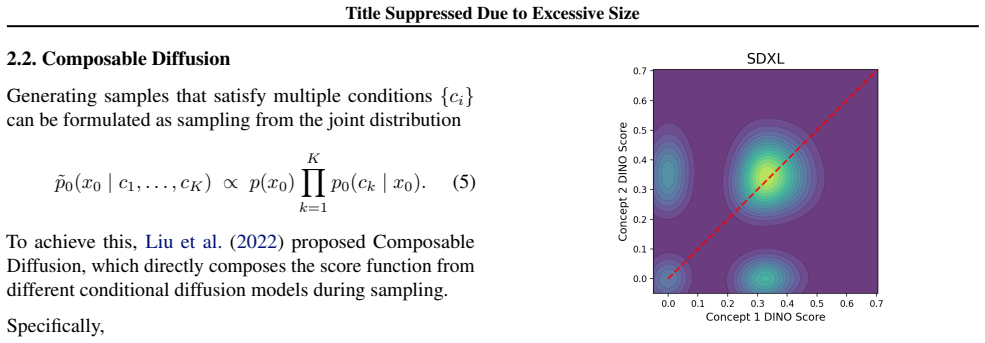
The central claim is that pure-mode compositional sampling—samples where all concepts coexist with balanced likelihood—is a constrained reward-alignment problem whose solution is the tilted distribution p*(x0) ∝ pθ(x0|C) exp(β(log pθ(x0|C) − Σ_i log pθ(x0|ci))). Guidance rules follow via diffusion posterior sampling: the intractable reward gradient becomes a Jacobian-vector product through the Tweedie estimate, yielding shared-Jacobian and per-concept updates plus a hybrid schedule. A prior heuristic corrector is recovered from the shared-Jacobian update with identity Jacobian and time-frozen scores, grounding that heuristic in the same objective.
What carries the argument
The central object is the reward-tilted target p*(x0) ∝ pθ(x0|C) exp(βR(x0)), with R(x0)=log pθ(x0|C) − Σ_i log pθ(x0|ci). The load-bearing identity is the Bayes decomposition showing that, up to constants, this reward equals the pointwise conditional total correlation ιC(x)=log pθ(C|x)/∏pθ(ci|x), and that its expectation over a prompt distribution aggregates to the conditional Total Correlation of the concepts given the image. The guidance machinery is DPS-style posterior sampling: a binary observation O=1 for high reward, a likelihood p(O=1|x0,C)∝exp(−L(x0)) with L=−R, and a chain rule that translates the reward gradient into a Jacobian-vector product applied to t=0 score evaluations on th
Load-bearing premise
The argument hinges on treating the score network evaluated at the Tweedie estimate with time index 0 as the true gradient of an image's log-likelihood under the joint and per-concept conditionals (the replacement made in §3.3); if those time-0 scores are biased or off the data manifold, the sampler is no longer targeting the tilted distribution, and the paper's own limitation section acknowledges that such model-likelihood gradient optimization can be unstable.
What would settle it
Run TILT-H and a standard classifier-free guidance baseline on a set of prompts with known concept composition, and measure whether the predicted reward signal sθ(ˆx0,0,C) − (1/K)Σ_i sθ(ˆx0,0,ci) is positive for images that contain all concepts and negative for images missing one. If the sign or magnitude of this t=0 score difference does not correlate with actual concept presence, the reward is not measuring what the paper claims, and the resulting guidance cannot be the one that induces p*.
If this is right
- If the paper is right, compositional failure is a mode-overlap problem: samples that honor only one concept live where the joint distribution overlaps a per-concept marginal, and suppressing those modes should reduce concept omission.
- A training-free, model-intrinsic reward is sufficient: no retraining, no external reward models, and no access to cross-attention internals, so the method transfers across architectures that expose conditional scores.
- The derived guidance steps, rather than the heuristic corrector, can be credited with the improvements on the Shape and Complex prompt categories, where multi-concept reasoning dominates.
- The recovery of a prior corrector as a special case explains that method's empirical success and gives future test-time samplers a single objective to optimize.
- Because the derivation is modality-agnostic and only needs factorizable conditioning variables, the same pure-mode reward alignment applies to text-to-audio, molecular generation, and multi-attribute editing—the future work the paper proposes.
Where Pith is reading between the lines
- Editorial inference: Because the reward signal is read off the score network at t=0, whether the framework truly induces p* is testable in isolation: replace sθ(ˆx0,0,·) with a clean-image likelihood proxy (e.g., an off-the-shelf concept classifier) and compare guidance quality; a divergence would localize the error to this approximation.
- Editorial inference: The prompt parser strips adjectives and articles to noun-only sub-prompts; the paper's weaker Color-category results are consistent with this choice, and an attribute-aware decomposition (e.g., 'a black cat' as concept 'black cat') would test whether the marginal definition, not the reward, limits attribute binding.
- Editorial inference: The total-correlation interpretation implies the reward is only informative when the model couples concepts through shared visual structure; on a model whose per-concept posteriors are nearly independent given an image, the reward collapses and the method should produce no gains—a testable diagnostic of the model's compositional coupling.
- Editorial inference: The closed-form target suggests that any training-free composition heuristic that can be written as a reweighting of the joint can be compared to p*, offering a way to benchmark correction schemes without running them.
Editorial analysis
A structured set of objections, weighed in public.
Referee Report
Summary. The paper presents TILT, a training-free method for compositional text-to-image generation. It formalizes concept dominance as overlap between joint and per-concept conditionals, defines an intrinsic pure-mode reward R(x0)=log pθ(x0|C)−Σ_i log pθ(x0|ci), and proposes to sample from a KL-tilted target p*(x0)∝pθ(x0|C) exp(βR(x0)). From this target it derives DPS-style guidance updates (TILT-S and TILT-C) and a hybrid schedule. Experiments on T2ICompBench with SDXL compare against CFG, Composable Diffusion, R2F, CFG++, and CO3, reporting ImageReward, CLIP, DINO, and BLIP-VQA. The paper also claims that CO3 emerges as a special case of the framework, providing theoretical grounding for that prior method.
Significance. If the derivation were correct, this would be a valuable contribution: a principled, training-free, model-intrinsic reward-alignment framework that unifies existing correction methods and offers a general test-time alignment recipe. The empirical study is broad, uses external baselines, and the method is fully training-free. However, the manuscript contains a systematic mismatch between the stated reward and the implemented guidance, together with an unvalidated score-at-t=0 extrapolation. These issues directly affect the central theoretical claim and must be resolved before the paper's main contribution can be accepted.
major comments (4)
- [§3.3, Eqs. 16–17; §3.2, Eq. 13; Appendix C] The stated reward R(x0)=log pθ(x0|C)−Σ_i log pθ(x0|ci) has gradient sθ(·,0,C)−Σ_i sθ(·,0,ci). Substituting this into the DPS-style chain rule gives a guidance term with −Σ_i, not −(β/K)Σ_i. Equations 16 and 17 therefore implement guidance for the different reward R_K(x0)=log pθ(x0|C)−(1/K)Σ_i log pθ(x0|ci), i.e., a geometric-mean inverse-marginal reward, with tilted target p*_K(x0)∝pθ(x0|C) exp(βR_K(x0)). Appendix C makes the same −β/K choice when recovering CO3, so the issue is not an isolated typo. As written, the central claim that TILT-S/TILT-C are rigorously derived from Eq. 13 fails; the paper must either redefine the reward to be R_K (updating Prop. 3.1, Eq. 18, and the interpretation) or change the guidance to use −βΣ_i.
- [§3.3, Eq. 16] The derivation replaces ∇_{x0} log pθ(x0|·) with sθ(x̂0,0,·), evaluating the score network at time t=0 on a Tweedie estimate. Score networks are trained for t>0; t=0 is the data manifold where the score is not defined by the training objective, and x̂0 may lie off it. This is not a minor detail: the reward gradient is the entire steering signal, and the claim that the sampler targets p* depends on this being an accurate surrogate. The paper should either provide a formal justification (e.g., the relationship between sθ(x̂0,t,·) and the likelihood gradient) or empirical validation (e.g., comparing the t=0 score with a finite-difference/actual log-likelihood gradient on relevant samples).
- [§4.1 / Appendix E] The concept parser strips adjectives and articles, so for a prompt 'a black cat and a brown dog' the per-concept prompts are 'cat' and 'dog'. The reward actually optimized is therefore log pθ(x|C)−log pθ(x|'cat')−log pθ(x|'dog'), not the reward in Eq. 13 for the concept conditionals appearing in C. This mismatch is consequential for attribute-binding categories (Color, Shape, Texture), where the denominator does not contain the attribute information that the joint-conditioned numerator is trying to enforce. The weak Color/BLIP-VQA results in Table 1 are consistent with this. The manuscript should either parse full noun phrases (or otherwise define ci consistently with C) and report the corresponding results, or explicitly reframe the method as a noun-level composition corrector.
- [§3.1 / Appendix B] Proposition 3.1 states that the reward decomposes into pointwise conditional Total Correlation 'modulo x-independent terms', but Eq. 20 contains (1−K) log pθ(x), which is x-dependent. Equation 24 then treats this term as 'constant in any optimization that varies x', which is not correct: varying x changes log pθ(x). The equality can only hold approximately, for a sufficiently small KL radius ε (or if pθ(x) is uniform). The proposition and Appendix B should state this approximation explicitly; the current wording overstates the information-theoretic identity.
minor comments (4)
- [Throughout] Typos: 'braod' in §3.3, 'mathmatically' in §6, 'promtps' in the Figure 1 caption. Please proofread.
- [Table 1 / Abstract] The abstract's claim of 'improves compositional alignment' is stronger than the table supports. TILT does not consistently beat CO3 or CFG++; e.g., Color BLIP-VQA: TILT 0.5770 vs CO3 0.6326; Texture ImageReward: TILT 0.5929 vs CFG++ 0.6053. The text should qualify this claim.
- [Algorithm 1] The stopping index M is not defined in the main text; clarify how it is set in the experiments (the text mentions the first 5 denoising steps).
- [§4.2] The statement 'our method achieves the best ImageReward score on the Shape and Complex categories' is correct, but the reader may also note that CFG++ has the highest Texture ImageReward; consider reporting all best entries explicitly.
Circularity Check
The implemented guidance uses a −1/K per-concept weight absent from the stated reward and imported from the authors' prior CO3, so Algorithm 1 targets a different tilted distribution than Eq. 13.
specific steps
-
other
[§3.3, Eq. 13 vs Eqs. 16–17]
"p∗(x0) = 1/Z pθ(x0|C) exp(β R(x0)) (13), where R(x0) := log pθ(x0|C)QK i=1 pθ(x0|ci) ... Eq. 16: ≈sθ(ˆx0, t|C) + Jxt(ˆx0)⊤{β sθ(ˆx0,0,C) − β/K ΣK i=1 sθ(ˆx0,0,ci)}"
Differentiating the stated reward R(x0) = log pθ(x0|C) − Σ_i log pθ(x0|ci) gives ∇R = sθ(·,0,C) − Σ_i sθ(·,0,ci), with weight −1 on each per-concept score. Equations 16–17 instead place weight −β/K on each per-concept score. Thus the implemented guidance does not steer toward the tilted target p* of Eq. 13; it steers toward a different target with reward log pθ(x0|C) − (1/K)Σ_i log pθ(x0|ci). The −1/K is not obtained by differentiating R; it appears only later in Appendix C as CO3's heuristic weight. The derivation from the announced reward therefore breaks at this step by construction.
-
ansatz smuggled in via citation
[§3.3 'Comparison with CO3' and Appendix C]
"Appendix C shows that CO3’s update is recovered from TILT-S by setting the diffusion Jacobian to identity and freezing score evaluation at (xt, t). Thus, CO3 appears as a special case of the proposed framework. ... CO3 forms a weighted Tweedie-mean composition ... with weights w0 = 1+β and wk =−β/K"
The −β/K coefficient in Eq. 16 is exactly CO3's wk from Appendix C, so CO3 is not independently recovered from the reward formulation: the coefficient is chosen to match CO3, and then the match is presented as theoretical grounding. Because CO3 is the same group's prior work, the chain 'CO3 heuristic → TILT-S coefficient → CO3 as special case' closes through a self-citation. The claim that this provides a principled justification for CO3's empirical success is therefore not independent evidence; the special-case relationship is baked into the chosen per-concept weight rather than following from the stated reward.
full rationale
The construction up to Eq. 13 is self-contained: the KL-constrained optimization and exponential tilting of pθ(x0|C) are standard, and the evaluation is anchored to external benchmarks (CFG, Comp-Diff, CFG++, etc.). However, the load-bearing step from the stated reward to the implemented Eqs. 16–17 is not a faithful differentiation of R. The per-concept coefficient should be −1 if the target is Eq. 13, but the paper uses −β/K, the same coefficient appearing in CO3's heuristic weights (Appendix C). The paper then advertises CO3's recovery as theoretical grounding. This is partial circularity: the central claim that the guidance objectives are rigorously derived from the reward formulation is weakened because the implemented update is constructed to match the authors' prior method, and the resulting target distribution differs from the announced p*. The empirical results themselves are not circular, but the derivation of the algorithm from the stated objective is.
Axiom & Free-Parameter Ledger
free parameters (6)
- β (reward alignment strength) =
β=0.05 (TILT-S), β=0.004 (TILT-C)
- Switching threshold τ (TILT-H) =
unreported
- Correction window and iterations =
first 5 denoising steps; 10 iterations at step 1, 5 at steps 2–5
- Per-concept weight 1/K in Eqs. 16–17 =
1/K
- Noun-only concept parsing =
sub-prompts with attributes stripped
- CFG / CFG++ guidance scales =
5.0 (CFG), 0.8 (CFG++)
axioms (6)
- domain assumption Score network evaluated at t=0 on the Tweedie estimate equals the gradient of the clean-data log-likelihood: sθ(ˆx0, 0, c) ≈ ∇_{x0} log pθ(x0|c)
- domain assumption DPS approximation for the reward posterior: ∇xt log p(O=1|xt, C) ≈ −∇xt L(ˆx0(xt)) via the one-step Tweedie estimate
- ad hoc to paper Postulated likelihood p(O=1|x0, C) ∝ exp(R(x0)) defines the 'event of observing a high-reward sample'
- domain assumption Mode-overlap hypothesis: compositional failures are dominated by samples from regions where the joint conditional overlaps a single-concept marginal
- domain assumption Noun-only concept marginals are the correct divisors: pθ(x|'cat') should suppress overlap for 'a black cat and a brown dog'
- domain assumption KL-smallness implies expectation closeness: |E_{p*}[R] − E_{pθ(·|C)}[R]| = O(ε)
invented entities (1)
-
Binary observation event O=1 ('sample has high reward')
no independent evidence
read the original abstract
Recent advances in powerful text-to-image generation models have made it increasingly important to develop test-time methods that modify the sampling trajectory to produce images more faithful to complex compositional prompts. We present TILT, a training-free framework for compositional text-to-image generation via test-time reward alignment. We interpret compositional failures as overlap modes between joint and single-concept distributions, and define a reward that favors samples where all concepts are jointly present. This reward is intrinsic to the base model and does not require any external supervision or reward models. This yields a KL-constrained objective with a closed-form tilted target distribution and principled guiding steps for diffusion sampling. The interaction of concept distributions together with the above reward naturally leads to two different guidance strategies while a hybrid approach that balances their respective benefits produces stronger performance. Experiments on prompts from T2ICompBench show that our method improves compositional alignment while preserving image quality compared to previous baselines.
Figures


Reference graph
Works this paper leans on
-
[1]
Attend-and-excite: Attention-based semantic guidance for text-to-image diffusion models
Chefer, H., Ratzon, O., Paiss, R., and Wolf, L. Attend-and-excite: Attention-based semantic guidance for text-to-image diffusion models. In ACM SIGGRAPH Conference on Computer Graphics and Interactive Techniques, 2023
2023
-
[2]
Chung, H., Kim, J., Mccann, M. T., Klasky, M. L., and Ye, J. C. Diffusion posterior sampling for general noisy inverse problems. arXiv preprint arXiv:2209.14687, 2022
Pith/arXiv arXiv 2022
-
[3]
Chung, H., Kim, J., Park, G. Y., Nam, H., and Ye, J. C. Cfg++: Manifold-constrained classifier free guidance for diffusion models. arXiv preprint arXiv:2406.08070, 2024 a
Pith/arXiv arXiv 2024
-
[4]
Chung, H., Lee, S., and Ye, J. C. Decomposed diffusion sampler for accelerating large-scale inverse problems. In The Twelfth International Conference on Learning Representations, 2024 b . URL https://openreview.net/forum?id=DsEhqQtfAG
2024
-
[5]
B., Dieleman, S., Fergus, R., Sohl-Dickstein, J., Doucet, A., and Grathwohl, W
Du, Y., Durkan, C., Strudel, R., Tenenbaum, J. B., Dieleman, S., Fergus, R., Sohl-Dickstein, J., Doucet, A., and Grathwohl, W. Reduce, reuse, recycle: Compositional generation with energy-based diffusion models and mcmc, 2024. URL https://arxiv.org/abs/2302.11552
Pith/arXiv arXiv 2024
-
[6]
Dutta, D., Chen, J., Rajagopalan, R., Wei, Y.-L., and Choudhury, R. R. Steer away from mode collisions: Improving composition in diffusion models. In The Fourteenth International Conference on Learning Representations, 2026
2026
-
[7]
Feng, W., He, X., Fu, T.-J., Jampani, V., Akula, A., Narayana, P., Basu, S., Wang, X. E., and Wang, W. Y. Training-free structured diffusion guidance for compositional text-to-image synthesis. In Advances in Neural Information Processing Systems (NeurIPS) Workshops, 2022. arXiv:2212.05032
Pith/arXiv arXiv 2022
-
[8]
Z., Salakhutdinov, R., and Ermon, S
He, Y., Murata, N., Lai, C.-H., Takida, Y., Uesaka, T., Kim, D., Liao, W.-H., Mitsufuji, Y., Kolter, J. Z., Salakhutdinov, R., and Ermon, S. Manifold preserving guided diffusion, 2023. URL https://arxiv.org/abs/2311.16424
Pith/arXiv arXiv 2023
-
[9]
and Salimans, T
Ho, J. and Salimans, T. Classifier-free diffusion guidance. In Advances in Neural Information Processing Systems (NeurIPS) Workshop on Deep Generative Models and Downstream Applications, 2022
2022
-
[10]
Denoising diffusion probabilistic models
Ho, J., Jain, A., and Abbeel, P. Denoising diffusion probabilistic models. arXiv preprint arXiv:2006.11239, 2020. URL https://arxiv.org/abs/2006.11239. v2
Pith/arXiv arXiv 2006
-
[11]
Ella: Equip diffusion models with llm for enhanced semantic alignment
Hu, X., Wang, R., Fang, Y., Fu, B., Cheng, P., and Yu, G. Ella: Equip diffusion models with llm for enhanced semantic alignment. arXiv preprint arXiv:2403.05135, 2024. URL https://arxiv.org/abs/2403.05135
Pith/arXiv arXiv 2024
-
[12]
T2i-compbench: A comprehensive benchmark for open-world compositional text-to-image generation
Huang, K., Sun, K., Xie, E., Li, Z., and Liu, X. T2i-compbench: A comprehensive benchmark for open-world compositional text-to-image generation. Advances in Neural Information Processing Systems, 36: 0 78723--78747, 2023
2023
-
[13]
Dense text-to-image generation with attention modulation
Kim, Y., Lee, J., Kim, J.-H., Ha, J.-W., and Zhu, J.-Y. Dense text-to-image generation with attention modulation. In Proceedings of the IEEE/CVF International Conference on Computer Vision (ICCV), 2023. URL https://openaccess.thecvf.com/content/ICCV2023/papers/Kim_Dense_Text-to-Image_Generation_with_Attention_Modulation_ICCV_2023_paper.pdf
2023
-
[14]
Kwon, G. and Ye, J. C. Tweediemix: Improving multi-concept fusion for diffusion-based image/video generation, 2025. URL https://arxiv.org/abs/2410.05591
Pith/arXiv arXiv 2025
-
[15]
Blip: Bootstrapping language-image pre-training for unified vision-language understanding and generation
Li, J., Li, D., Xiong, C., and Hoi, S. Blip: Bootstrapping language-image pre-training for unified vision-language understanding and generation. In International conference on machine learning, pp.\ 12888--12900. PMLR, 2022
2022
-
[16]
Li, Y., Liu, H., Wu, Q., Mu, F., Yang, J., Gao, J., Li, C., and Lee, Y. J. Gligen: Open-set grounded text-to-image generation. In Proceedings of the IEEE/CVF Conference on Computer Vision and Pattern Recognition (CVPR), 2023. URL https://openaccess.thecvf.com/content/CVPR2023/papers/Li_GLIGEN_Open-Set_Grounded_Text-to-Image_Generation_CVPR_2023_paper.pdf
2023
-
[17]
Liu, N., Li, S., Du, Y., Torralba, A., and Tenenbaum, J. B. Compositional visual generation with composable diffusion models. In Computer Vision -- ECCV 2022, volume 13677 of Lecture Notes in Computer Science, pp.\ 325--343. Springer, 2022. doi:10.1007/978-3-031-19790-1\_26
-
[18]
Mou, C., Wang, X., Xie, L., Wu, Y., Zhang, J., Qi, Z., Shan, Y., and Qie, X. T2i-adapter: Learning adapters to dig out more controllable ability for text-to-image diffusion models. arXiv preprint arXiv:2302.08453, 2023. URL https://arxiv.org/abs/2302.08453
Pith/arXiv arXiv 2023
-
[19]
Dinov2: Learning robust visual features without supervision
Oquab, M., Darcet, T., Moutakanni, T., Vo, H., Szafraniec, M., Khalidov, V., Fernandez, P., Haziza, D., Massa, F., El-Nouby, A., et al. Dinov2: Learning robust visual features without supervision. arXiv preprint arXiv:2304.07193, 2023
Pith/arXiv arXiv 2023
-
[20]
Park, D., Kim, S., Moon, T., Kim, M., Lee, K., and Cho, J. Rare-to-frequent: Unlocking compositional generation power of diffusion models on rare concepts with llm guidance. arXiv preprint arXiv:2410.22376, 2024
arXiv 2024
-
[21]
Grounded text-to-image synthesis with attention refocusing
Phung, Q., Ge, S., and Huang, J.-B. Grounded text-to-image synthesis with attention refocusing. In Proceedings of the IEEE/CVF Conference on Computer Vision and Pattern Recognition (CVPR), 2024. URL https://openaccess.thecvf.com/content/CVPR2024/papers/Phung_Grounded_Text-to-Image_Synthesis_with_Attention_Refocusing_CVPR_2024_paper.pdf
2024
-
[22]
Sdxl: Improving latent diffusion models for high-resolution image synthesis
Podell, D., English, Z., Lacey, K., Blattmann, A., Dockhorn, T., Müller, J., Penna, J., and Rombach, R. Sdxl: Improving latent diffusion models for high-resolution image synthesis. arXiv preprint arXiv:2307.01952, 2023
Pith/arXiv arXiv 2023
-
[23]
Qi, P., Zhang, Y., Zhang, Y., Bolton, J., and Manning, C. D. S tanza: A Python natural language processing toolkit for many human languages. In Celikyilmaz, A. and Wen, T.-H. (eds.), Proceedings of the 58th Annual Meeting of the Association for Computational Linguistics: System Demonstrations, pp.\ 101--108, Online, July 2020. Association for Computationa...
-
[24]
Layoutllm-t2i: Eliciting layout guidance from llm for text-to-image generation
Qu, L., Wu, S., Fei, H., Nie, L., and Chua, T.-S. Layoutllm-t2i: Eliciting layout guidance from llm for text-to-image generation. arXiv preprint arXiv:2308.05095, 2023. URL https://arxiv.org/abs/2308.05095
Pith/arXiv arXiv 2023
-
[25]
W., Hallacy, C., Ramesh, A., Goh, G., Agarwal, S., Sastry, G., Askell, A., Mishkin, P., Clark, J., et al
Radford, A., Kim, J. W., Hallacy, C., Ramesh, A., Goh, G., Agarwal, S., Sastry, G., Askell, A., Mishkin, P., Clark, J., et al. Learning transferable visual models from natural language supervision. In International conference on machine learning, pp.\ 8748--8763. PmLR, 2021
2021
-
[26]
Hierarchical text-conditional image generation with clip latents
Ramesh, A., Dhariwal, P., Nichol, A., Chu, C., and Chen, M. Hierarchical text-conditional image generation with clip latents. In Advances in Neural Information Processing Systems (NeurIPS), 2022
2022
-
[27]
High-resolution image synthesis with latent diffusion models
Rombach, R., Blattmann, A., Lorenz, D., Esser, P., and Ommer, B. High-resolution image synthesis with latent diffusion models. In Proceedings of the IEEE/CVF Conference on Computer Vision and Pattern Recognition (CVPR), pp.\ 10684--10695, 2022
2022
-
[28]
Saharia, C., Chan, W., Saxena, S., Li, L., Whang, J., Denton, E., Ghasemipour, S. K. S., Gontijo Lopes, R., Karagol Ayan, B., Salimans, T., et al. Photorealistic text-to-image diffusion models with deep language understanding. In Advances in Neural Information Processing Systems (NeurIPS), 2022 a
2022
-
[29]
K., Karagol Ayan, B., Mahdavi, S
Saharia, C., Chan, W., Saxena, S., Li, L., Whang, J., Denton, E., Seyed Ghasemipour, S. K., Karagol Ayan, B., Mahdavi, S. S., Gontijo-Lopes, R., Salimans, T., Ho, J., Fleet, D. J., and Norouzi, M. Photorealistic text-to-image diffusion models with deep language understanding. In Advances in Neural Information Processing Systems (NeurIPS), 2022 b
2022
-
[30]
The superposition of diffusion models using the it\^o density estimator
Skreta, M., Atanackovic, L., Bose, J., Tong, A., and Neklyudov, K. The superposition of diffusion models using the it\^o density estimator. In The Thirteenth International Conference on Learning Representations, 2025. URL https://openreview.net/forum?id=2o58Mbqkd2
2025
-
[31]
Denoising diffusion implicit models
Song, J., Meng, C., and Ermon, S. Denoising diffusion implicit models. In International Conference on Learning Representations (ICLR), 2021
2021
-
[32]
S., Girdhar, R., Misra, I., and Darrell, T
Wang, X., Rambhatla, S. S., Girdhar, R., Misra, I., and Darrell, T. Instancediffusion: Instance-level control for image generation. In Proceedings of the IEEE/CVF Conference on Computer Vision and Pattern Recognition (CVPR), 2024. URL https://arxiv.org/abs/2402.03290
Pith/arXiv arXiv 2024
-
[33]
Information theoretical analysis of multivariate correlation
Watanabe, S. Information theoretical analysis of multivariate correlation. IBM J. Res. Dev., 4 0 (1): 0 66–82, January 1960. ISSN 0018-8646. doi:10.1147/rd.41.0066. URL https://doi.org/10.1147/rd.41.0066
-
[34]
Xie, J., Li, Y., Huang, Y., Liu, H., Zhang, W., Zheng, Y., and Shou, M. Z. Boxdiff: Text-to-image synthesis with training-free box-constrained diffusion. In Proceedings of the IEEE/CVF International Conference on Computer Vision (ICCV), 2023. URL https://arxiv.org/abs/2307.10816
Pith/arXiv arXiv 2023
-
[35]
Imagereward: Learning and evaluating human preferences for text-to-image generation
Xu, J., Liu, X., Wu, Y., Tong, Y., Li, Q., Ding, M., Tang, J., and Dong, Y. Imagereward: Learning and evaluating human preferences for text-to-image generation. Advances in Neural Information Processing Systems, 36: 0 15903--15935, 2023
2023
-
[36]
Mastering text-to-image diffusion: Recaptioning, planning, and generating with multimodal llms
Yang, L., Yu, Z., Meng, C., Xu, M., Ermon, S., and Cui, B. Mastering text-to-image diffusion: Recaptioning, planning, and generating with multimodal llms. In Proceedings of the 41st International Conference on Machine Learning (ICML), 2024. URL https://arxiv.org/abs/2401.11708
Pith/arXiv arXiv 2024
-
[37]
Training-free diffusion model alignment with sampling demons, 2025
Yeh, P.-H., Lee, K.-H., and Chen, J.-C. Training-free diffusion model alignment with sampling demons, 2025. URL https://arxiv.org/abs/2410.05760
Pith/arXiv arXiv 2025
-
[38]
Adding conditional control to text-to-image diffusion models
Zhang, L., Rao, A., and Agrawala, M. Adding conditional control to text-to-image diffusion models. In Proceedings of the IEEE/CVF International Conference on Computer Vision (ICCV), 2023. URL https://openaccess.thecvf.com/content/ICCV2023/papers/Zhang_Adding_Conditional_Control_to_Text-to-Image_Diffusion_Models_ICCV_2023_paper.pdf
2023
-
[39]
Zhao, P., Li, H., Jin, R., and Zhou, S. K. Loco: Locally constrained training-free layout-to-image synthesis. arXiv preprint arXiv:2311.12342, 2023. URL https://arxiv.org/abs/2311.12342
Pith/arXiv arXiv 2023
discussion (0)
Sign in with ORCID, Apple, or X to comment. Anyone can read and Pith papers without signing in.