REVIEW 4 major objections 5 minor 34 references
CARNet claims that injecting learned cycles into linear-complexity core aggregation outperforms attention-based multivariate forecasters on most benchmark settings.
Reviewed by Pith at T0; open to challenge. T0 means a machine referee read the full paper against a public rubric. the ladder, T0–T4 →
T0 review · deepseek-v4-flash
2026-08-01 07:47 UTC pith:QNTJZ4PO
load-bearing objection CARNet is a legitimate architectural combination, but the paper's central SOTA claim is undercut by its own budget-controlled comparison; it deserves a serious referee, not a desk reject. the 4 major comments →
CARNet Cycle-Conditioned Core Aggregation and Redistribution for Multivariate Time Series Forecasting
The pith
A machine-rendered reading of the paper's core claim, the machinery that carries it, and where it could break.
Core claim
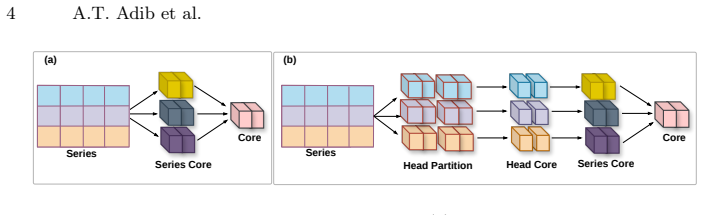
The central discovery claimed is that conditioning cross-variate core interactions on a phase-aligned recurrent cycle, rather than simply subtracting the cycle as a residual, lets a linear-complexity, attention-free model capture periodic structure and inter-variable dependencies jointly. CARNet learns a cycle matrix per channel, aligns it with the input window, fuses it into variate embeddings, extracts a shared core through Multihead Core Aggregation by partitioning the feature dimension into h subspaces, pools across variates, and then redistributes the core together with the cycle projection back into each variate. The paper argues that removing any of these stages degrades performance,
What carries the argument
Multihead Core Aggregation (MHCA) with cycle-conditioned redistribution. MHCA splits the variate embedding into h heads, transforms each head with a grouped 1x1 convolution, merges head-wise cores, and pools across variates to form a global core; the learned recurrent cycle Z, phase-aligned by the estimated stable cycle length W via autocorrelation analysis, is injected both before aggregation and during redistribution. This carries the argument because it turns the global periodic pattern into a conditioning signal for cross-variate interaction while keeping per-layer complexity linear in both the number of variates and the sequence length.
Load-bearing premise
The comparison assumes that the baseline numbers taken from earlier papers were produced under the same training and evaluation protocol as CARNet's own runs, so the reported win counts reflect a fair race.
What would settle it
Rerun every baseline under CARNet's exact training recipe, including the same number of epochs, one-cycle learning-rate schedule, look-back length, and random seed, then count wins on the same 48 settings; if the 38-of-48 MSE margin shrinks or reverses, the claimed superiority is not established.
If this is right
- On strongly periodic benchmarks such as Electricity and PEMS, CARNet reports the best error in a majority of settings, implying that cycle-conditioned core interaction can match or beat attention-based channel modeling.
- Ablations indicate that cycle-conditioned redistribution is the most valuable component, so future core-based designs should inject periodicity at redistribution, not only at input decomposition.
- The per-layer complexity is linear in both variates and time, so if the claims hold, the architecture scales to high-dimensional multivariate problems more cheaply than quadratic attention.
- The cycle-length ablation shows milder degradation than a comparison model when W is misspecified, suggesting the mechanism tolerates imperfect periodicity estimates.
Where Pith is reading between the lines
- The cycle-conditioning idea is not inherently tied to this particular core design; a fair test would be porting the same conditioning mechanism into other linear channel-mixing architectures and measuring whether similar gains appear.
- Because the paper fixes W at the dataset level, an extension to per-sample or adaptively estimated cycle lengths is natural, and the reported robustness to harmonic values of W suggests that such adaptivity could work without retuning.
- The fixed-epoch and multi-seed results suggest the cycle prior accelerates convergence, but the paper does not directly convert this into an accuracy-per-training-epoch comparison; that trade-off is worth quantifying for deployment decisions.
Editorial analysis
A structured set of objections, weighed in public.
Referee Report
Summary. The paper proposes CARNet, an attention-free multivariate time series forecasting model that extends SOFTS-style core aggregation with learnable cycle conditioning and a multi-head core aggregation mechanism. The authors claim that CARNet consistently outperforms strong transformer and non-attention baselines across 12 benchmarks with linear complexity. The paper reports MSE/MAE results, ablations, efficiency analyses, and a fixed-epoch comparison. The central contribution is empirical: the architecture is presented as a new state-of-the-art for periodic multivariate forecasting.
Significance. If the empirical claims were supported, CARNet would be a useful efficient alternative to attention-based channel-dependent models, and the combination of periodic conditioning with core aggregation is a plausible design direction. The complexity analysis and the ablation study provide useful evidence about the contribution of individual components. However, the core empirical claim is not established by the reported experiments, and the paper's own controlled experiments undermine the headline message.
major comments (4)
- [Table 2 / §4.2] The claimed 'best performance in 38 out of 48 settings' is not reproducible from the printed table. Examples where CARNet is not best: Traffic H=96 (SOFTS 0.376 vs CARNet 0.430), ETTh2 H=96 (TimeXer 0.286 vs CARNet 0.295), ETTm2 H=96 (CycleNet 0.163 vs CARNet 0.171). In fact, CARNet has no best MSE on ETTh2, ETTm2, or Traffic average. The count in §4.2 is therefore contradicted by the paper's own data.
- [§4.3, Table 4] The main comparisons in Table 2 are uncontrolled: CARNet was trained for 30 epochs (7 for ETTm), while baseline numbers were adopted from TQNet/SOFTS, with TimeXer and iTransformer originally trained for only 10 epochs. The authors' own fixed-budget experiment (Table 4) shows that at 10 epochs CARNet loses to TQNet on ETTm1 avg MSE (0.378 vs 0.377) and to TimeXer on Weather avg MSE (0.243 vs 0.241). This directly undercuts the claim that gains come from the architecture rather than from longer optimization.
- [§4.1, §4.3, Appendix F] No error bars or significance tests are provided for any baseline. Baseline results are adopted from prior papers rather than rerun under CARNet's training protocol. Appendix F reports seed variance only for CARNet, not for baselines. The claimed 'consistent outperformance' is therefore not statistically established, and the comparisons are not controlled.
- [Table 2, ECL row] The ECL average row appears corrupted: SOFTS avg MSE is printed as 0.270 and iTransformer as 0.365, while the individual horizon values for these models are around 0.14–0.22. This is likely a formatting/alignment error, but because the win count is derived from this table, the error further undermines the reliability of the headline result.
minor comments (5)
- [References and notation] TimeXer is cited as [4] in the text but appears as [19] in the Table 2 header. 'TQNet' is inconsistently rendered as 'TQnet' in Table 2. The '1st Count' row in Table 2 is a summary rather than a model column and should be clearly separated.
- [Algorithm 1, Eq. (2)] Algorithm 1 line 4 writes V' ← ψ(L_V(ψ(V))), whereas Eq. (2) defines V' = ψ(L_V(F_A(X',Z'))). The extra ψ in the pseudocode appears inconsistent and should be corrected.
- [Figure 5] The parameter counts listed in Figure 5 (124k, 1.04M, etc.) are not clearly mapped to model names in the caption. It is ambiguous which count corresponds to which model.
- [Figure 7 caption] 'produces predictions that are more accurate with the ground-truth series' should be worded as 'more aligned with the ground-truth series.'
- [Appendix B] Appendix C states a 6:2:2 train/validation/test split, but the split sizes in Table 5 (e.g., ETTh1 8545/2881/2881 of 14,400) correspond to approximately 12:4:4. The text and table should be reconciled.
Circularity Check
No circular dependency found; CARNet's empirical claims rest on external benchmarks rather than on its own assumptions.
full rationale
CARNet is an empirical architecture paper. The model equations (1)-(5) define a forward pass (cycle projection, attention-free core aggregation, redistribution, output projection) and the training loss (6) is standard MSE; no output quantity is defined in terms of the target it purports to predict, and no fitted parameter is renamed as a prediction. The cycle length W is taken from prior external work (CycleNet/TQNet) via ACF, and the cycle matrix is jointly trained, but the forecasting targets are future observations, not the cycle representation, so this is not circular. The main comparison adopts baseline numbers from TQNet and SOFTS (Table 2 caption), and Section 4.3 later introduces a fixed 10-epoch comparison; this is a comparison-protocol/fairness issue, not a circularity. There is no self-citation chain: all load-bearing references are to external authors (Lin et al., Zhang et al., Woo et al.), not to the present authors. No equation reduces to another by construction, and the complexity analysis is independent. The skeptical concern about mismatched training budgets and non-reproducible win counts is a correctness/evidence concern, which is outside the circularity definition and should not raise the circularity score.
Axiom & Free-Parameter Ledger
free parameters (3)
- Cycle length W per dataset =
ETTh1/2: 24; ETTm1/2: 96; ECL/Traffic: 168; Weather/Solar: 144; PEMS: 288
- Learning rate per dataset =
1e-4 for ETT, Weather, Solar; 1e-3 for ECL, Traffic, PEMS
- Model hyperparameters (d, d', d_ff, e_layers, batch size, heads) =
d, d_ff in {128,256,512}; d' <= d; layers {1,2,3,4}; batch {16,32}; head count not specified in main text
axioms (3)
- domain assumption Autocorrelation analysis identifies a stable dominant cycle length shared across all variates in a dataset
- domain assumption Mean squared error is the appropriate training and evaluation objective
- domain assumption Instance normalization statistics computed over the look-back window generalize to the forecast horizon
read the original abstract
Accurately modeling cross-variate dependencies remains a key challenge in multivariate time series forecasting, particularly in the presence of strong periodic patterns. Many existing approaches rely on attention-based mechanisms that incur quadratic complexity and scale poorly with increasing numbers of variates. Recent attention-free aggregation models address this issue through linear-complexity core-based interactions, but they do not explicitly leverage the global periodic structure present in the data. To overcome this limitation, we propose CARNet, a Cycle-Conditioned Core Aggregation and Redistribution framework that integrates global recurrent cycle information into efficient core based interaction modeling via Multihead Core Aggregation. Extensive experiments on multiple real-world multivariate forecasting benchmarks demonstrate that CARNet consistently outperforms strong transformer and non-attention baselines across diverse prediction horizons while preserving linear-complexity modeling of cross-variate dependencies.
Figures


Reference graph
Works this paper leans on
-
[1]
In: Proc
Nie, Y., Ma, Q., Zhang, Q., Xu, Y., Wang, X.: A Time Series is Worth 64 Words: Long-term Forecasting with Transformers. In: Proc. Int. Conf. on Learning Rep- resentations (ICLR) (2023)
2023
-
[2]
In: Proc
Liu, H., Lin, Z., Zhang, Y.: iTransformer: Inverted Transformers Are Effective for Time Series Forecasting. In: Proc. Int. Conf. on Learning Representations (ICLR) (2024)
2024
-
[3]
arXiv preprint arXiv:1607.08022 (2016)
Ulyanov, D., Vedaldi, A., Lempitsky, V.: Instance Normalization: The Missing Ingredient for Fast Stylization. arXiv preprint arXiv:1607.08022 (2016)
Pith/arXiv arXiv 2016
-
[4]
In: Proc
Woo, G., Kim, S., Song, H.O.: TimeXer: Learning Multi-scale Temporal Represen- tations for Long-term Forecasting. In: Proc. Int. Conf. on Learning Representations (ICLR) (2024)
2024
-
[5]
et al.: BigBird: Transformers for Longer Sequences
Zaheer, M. et al.: BigBird: Transformers for Longer Sequences. In: Proc. Advances in Neural Information Processing Systems (NeurIPS) (2020)
2020
-
[6]
et al.: Informer: Beyond Efficient Transformer for Long Sequence Time- Series Forecasting
Zhou, H. et al.: Informer: Beyond Efficient Transformer for Long Sequence Time- Series Forecasting. In: Proc. AAAI Conf. on Artificial Intelligence (AAAI) (2021)
2021
-
[7]
In: Proc
Gu, A., Dao, T.: Mamba: Selective State Space Models. In: Proc. Int. Conf. on Learning Representations (ICLR) (2024)
2024
-
[8]
et al.: Is Mamba Effective for Time Series Forecasting? Neurocomputing (2025)
Wang, Z. et al.: Is Mamba Effective for Time Series Forecasting? Neurocomputing (2025)
2025
-
[9]
et al.: TimePro: Efficient Multivariate Long-term Time Series Forecast- ing with Variable- and Time-Aware Hyper-state
Ma, X. et al.: TimePro: Efficient Multivariate Long-term Time Series Forecast- ing with Variable- and Time-Aware Hyper-state. In: Proc. Int. Conf. on Machine Learning (ICML) (2025)
2025
-
[10]
et al.: Autoformer: Decomposition Transformers with Auto-Correlation for Long-Term Series Forecasting
Wu, H. et al.: Autoformer: Decomposition Transformers with Auto-Correlation for Long-Term Series Forecasting. In: Proc. NeurIPS (2021)
2021
-
[11]
et al.: FEDformer: Frequency Enhanced Decomposed Transformer for Long-term Series Forecasting
Zhou, T. et al.: FEDformer: Frequency Enhanced Decomposed Transformer for Long-term Series Forecasting. In: Proc. ICML (2022)
2022
-
[12]
et al.: TSMixer: An All-MLP Architecture for Time Series Forecasting
Liu, Y. et al.: TSMixer: An All-MLP Architecture for Time Series Forecasting. arXiv preprint arXiv:2306.09364 (2023)
Pith/arXiv arXiv 2023
-
[13]
et al.: SOFTS: Series-Core Fusion Transformer for Multivariate Time Series Forecasting
Zhang, X. et al.: SOFTS: Series-Core Fusion Transformer for Multivariate Time Series Forecasting. In: Proc. NeurIPS (2024)
2024
-
[14]
et al.: Graph WaveNet for Deep Spatial-Temporal Graph Modeling
Wu, Z. et al.: Graph WaveNet for Deep Spatial-Temporal Graph Modeling. In: Proc. IJCAI (2019)
2019
-
[15]
et al.: SparseTSF: Modeling Long-term Time Series Forecasting with 1k Parameters
Lin, S. et al.: SparseTSF: Modeling Long-term Time Series Forecasting with 1k Parameters. In: Proc. ICML (2024)
2024
-
[16]
et al.: CycleNet: Enhancing Time Series Forecasting through Modeling Periodic Patterns
Lin, S. et al.: CycleNet: Enhancing Time Series Forecasting through Modeling Periodic Patterns. In: Proc. NeurIPS (2024)
2024
-
[17]
et al.: Temporal Query Network for Efficient Multivariate Time Series Forecasting
Lin, S. et al.: Temporal Query Network for Efficient Multivariate Time Series Forecasting. In: Proc. ICML (2025)
2025
-
[18]
et al.: Are Transformers Effective for Time Series Forecasting? In: Proc
Zeng, A. et al.: Are Transformers Effective for Time Series Forecasting? In: Proc. AAAI (2023)
2023
-
[19]
et al.: TimeMixer: Decomposable Multiscale Mixing for Time Series Fore- casting
Liu, Y. et al.: TimeMixer: Decomposable Multiscale Mixing for Time Series Fore- casting. In: Proc. ICLR (2024)
2024
-
[20]
et al.: TimesNet: Temporal 2D-Variation Modeling for General Time Series Analysis
Wu, H. et al.: TimesNet: Temporal 2D-Variation Modeling for General Time Series Analysis. In: Proc. AAAI (2023)
2023
-
[21]
et al.: PyTorch: An Imperative Style, High-Performance Deep Learning Library
Paszke, A. et al.: PyTorch: An Imperative Style, High-Performance Deep Learning Library. In: Proc. NeurIPS (2019)
2019
-
[22]
In: Proc
Kingma, D.P., Ba, J.: Adam: A Method for Stochastic Optimization. In: Proc. ICLR (2015) 18 A.T. Adib et al
2015
-
[23]
et al.: Crossformer: Transformer Utilizing Cross-Dimension Dependency for Multivariate Time Series Forecasting
Zhang, Y. et al.: Crossformer: Transformer Utilizing Cross-Dimension Dependency for Multivariate Time Series Forecasting. In: Proc. NeurIPS (2023)
2023
-
[24]
et al.: TiDE: Long-term Forecasting with Time-series Dense Encoder
Das, A. et al.: TiDE: Long-term Forecasting with Time-series Dense Encoder. In: Proc. ICML (2023)
2023
-
[25]
et al.: SCINet: Time Series Modeling and Forecasting with Sample Convo- lution and Interaction
Liu, Z. et al.: SCINet: Time Series Modeling and Forecasting with Sample Convo- lution and Interaction. In: Proc. NeurIPS (2021)
2021
-
[26]
et al.: Modeling Long- and Short-Term Temporal Patterns with Deep Neu- ral Networks
Lai, G. et al.: Modeling Long- and Short-Term Temporal Patterns with Deep Neu- ral Networks. In: Proc. SIGIR (2018)
2018
-
[27]
et al.: TFB: Towards Comprehensive and Fair Benchmarking of Time Series Forecasting Methods
Qiu, X. et al.: TFB: Towards Comprehensive and Fair Benchmarking of Time Series Forecasting Methods. PVLDB (2024)
2024
-
[28]
et al.: Deep Time Series Models: A Comprehensive Survey and Bench- mark
Wang, Y. et al.: Deep Time Series Models: A Comprehensive Survey and Bench- mark. arXiv:2407.13278 (2024)
Pith/arXiv arXiv 2024
-
[29]
et al.: Transformers in Time Series: A Survey
Li, C. et al.: Transformers in Time Series: A Survey. In: Proc. IJCAI (2023)
2023
-
[30]
et al.: Knowledge-Empowered Dynamic Graph Network for Irregularly Sampled Medical Time Series
Zhang, J. et al.: Knowledge-Empowered Dynamic Graph Network for Irregularly Sampled Medical Time Series. In: Proc. NeurIPS (2024)
2024
-
[31]
et al.: Transformers are RNNs: Fast Autoregressive Transform- ers with Linear Attention
Katharopoulos, A. et al.: Transformers are RNNs: Fast Autoregressive Transform- ers with Linear Attention. In: Proc. NeurIPS (2020)
2020
-
[32]
Stochastic Pooling for Regularization of Deep Con- volutional Neural Networks,
Zeiler, M. D. and Fergus, R., “Stochastic Pooling for Regularization of Deep Con- volutional Neural Networks,” inProceedings of the International Conference on Learning Representations (ICLR), 2013
2013
-
[33]
CRC Press (2007)
Madsen, H.: Time Series Analysis. CRC Press (2007)
2007
-
[34]
Hendrycks, D., Gimpel, K.: Gaussian Error Linear Units (GELUs). arXiv:1606.08415 (2016) CARNet: Cycle-Conditioned Core Aggregation and Redistribution 19 A More Details on CARNet The overall architecture of CARNet is described in Algorithm 1, while the proposed Multihead core aggregation mechanism is detailed in Algorithm 2. The pseudocode formalizes the f...
Pith/arXiv arXiv 2016
discussion (0)
Sign in with ORCID, Apple, or X to comment. Anyone can read and Pith papers without signing in.