REVIEW 2 major objections 4 minor 95 references
This paper establishes that a four-photon search for non-resonant axion-like-particle pair production at the LHC could already at 300 fb^-1 probe the dimension-6 ALP-gluon coupling down to 10^-3 TeV^-2, while no single such search can ever
Reviewed by Pith at T0; open to challenge. T0 means a machine referee read the full paper against a public rubric. the ladder, T0–T4 →
T0 review · deepseek-v4-flash
2026-08-01 06:53 UTC pith:YFHJZWQ6
load-bearing objection First solid projection for non-resonant gg→aa→4γ at the LHC; the headline CG2 reach is conditional on a best-case ALP branching ratio, but the paper is transparent about that. the 2 major comments →
ALP pair production at the LHC
The pith
A machine-rendered reading of the paper's core claim, the machinery that carries it, and where it could break.
Core claim
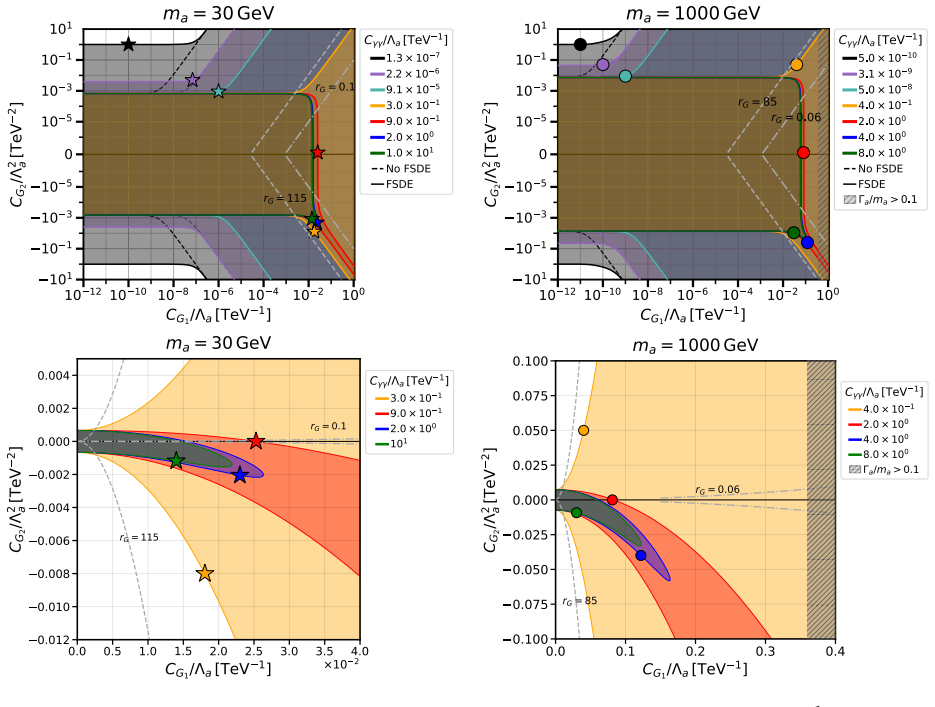
Double-ALP production at the LHC is a viable and competitive probe of ALP interactions beyond dimension-5. Focusing on gg→aa→4γ, the paper analyzes for the first time the non-resonant mode, whose rate is a polynomial in the couplings — pure C_G1⁴, pure C_G2², and an interference term C_G1²C_G2 — so different regimes test different operators, including the sign of C_G2. Because the same C_G1 that boosts production also suppresses Br(a→γγ) by opening gluonic decays, the signal is not monotonic: it contains regions where the coupling dependence cancels exactly, a valley of destructive interference for C_G2<0, and a long-lived-ALP regime where the pair escapes the detector before converting to p
What carries the argument
The engine of the analysis is an amplitude identity and a cancellation: the non-resonant gg→aa cross section factorizes as σ = C_G1⁴σ11 + C_G2²σ22 + C_G1²C_G2σ12, where the interference term σ12 is comparable to the pure terms and changes sign with C_G2; meanwhile the branching ratio Br(a→γγ) = [1 + F(m_a) + k²(m_a) r_γ²]^-1 depends only on the ratio r_γ = C_G1/C_γγ. Combining them, C_G1⁴ production growth cancels against the C_G1^-4 suppression of the branching ratio, creating a flat direction, and Br saturates for C_γγ ≳ 250 C_G1, creating another. Finite-size detector effects — the probability that both ALPs decay within the 1.08 m detector radius, which scales as (Γ_tot^a)² in the low-wi
Load-bearing premise
The projected reach assumes a best-case ALP whose electroweak decay couplings are tuned to maximize the photon branching ratio; if the real ALP decays more readily into W/Z pairs or fermions, the four-photon signal shrinks as Br(a→γγ)² and the quoted bounds weaken, in some regions by orders of magnitude.
What would settle it
Measure the ALP's photon branching ratio or any additional decay width: since the projected reach scales as Br(a→γγ)², detecting a non-negligible a→Zγ, a→W⁺W⁻, or fermionic channel (allowed by gauge invariance above 2m_W) would push the 10^-3 TeV^-2 sensitivity out of reach, directly testing the best-case assumption. Running the four-photon search itself at 300 fb^-1 also settles it: the predicted SM background is ~0.2 events, so a null result places the bound and a 4γ excess whose kinematic distributions disagree with the gg→aa prediction would falsify the EFT interpretation.
If this is right
- A 300 fb^-1 four-photon search would set the first direct bound on the dimension-6 ALP-gluon contact operator, C_G2/Λ²a ≲ 10^-3 TeV^-2 for ma ≲ 300 GeV (10^-2 at 1 TeV), about an order of magnitude tighter than the Higgs-resonant channel's C_ah/Λ²a ≲ 10^-2 TeV^-2.
- No 4γ search alone closes the parameter space: allowed regions stay unbounded along four directions — C_G1 cancellation, C_γγ saturation, the C_G2<0 interference valley, and small-coupling long-lived escape.
- The same-coupling cancellation is generic, so cusps, thin allowed bands, and open regions should appear in any ALP search where one coupling controls both production and decay; interpreting such bounds requires a global fit.
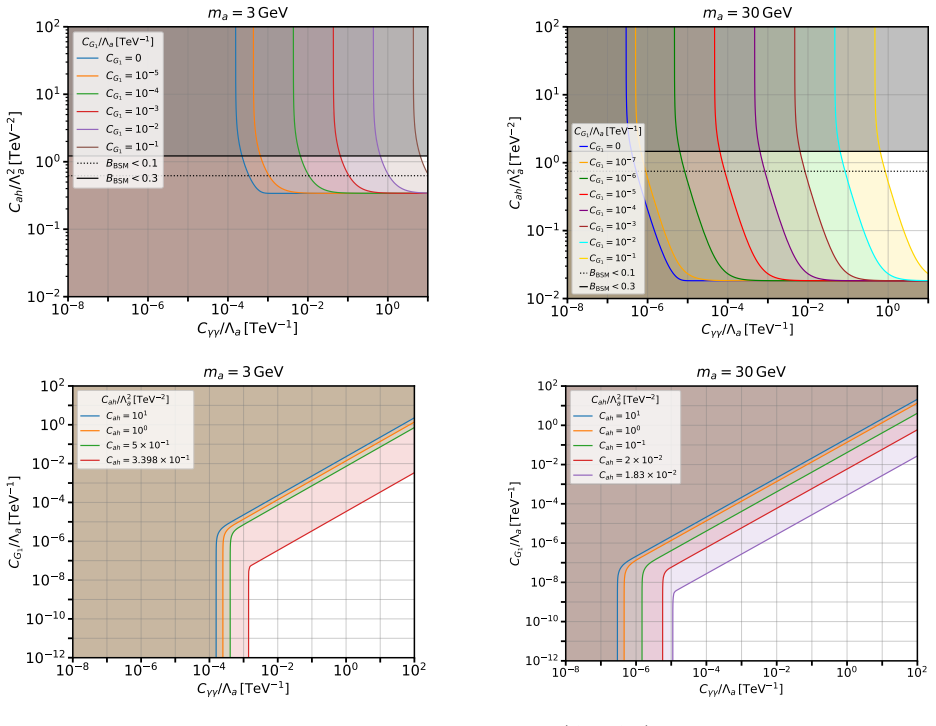
- In the Higgs-resonant recast, a non-zero C_G1 weakens the inferred limits on C_γγ by 3–5 orders of magnitude (e.g. for C_G1/Λa = 10^-3 TeV^-1), and meaningful C_γγ bounds exist only for C_ah inside a narrow, mass-dependent window.
- Sensitivity to the sign of C_G2 is possible only where interference matters (large C_G1); elsewhere the search probes |C_G2| alone, and the best-case Br assumption caps the photon branching ratio at 1/(1+F(ma)) ≈ 0.6 for ma ≫ 2m_W.
Where Pith is reading between the lines
- The strongest apparent C_γγ exclusions (down to ~10^-9 TeV^-1 non-resonant, 10^-5–10^-7 TeV^-1 Higgs-resonant) live where a dimension-6 coefficient vastly exceeds dimension-5 ones; a global fit with EFT-power-counting priors would likely discard those points, reframing these as lifetime exclusions of long-lived ALPs rather than coupling bounds.
- Because the cancellation mechanism is structural, a quick cross-check of existing single-ALP limits for the same saturation direction (C_γγ → large, Br saturating) would reveal which published bounds are slices of open regions.
- A testable extension: push below ma = 30 GeV with merged-photon topologies for boosted ALPs; the paper's own efficiency curve (ϵ_cuts ≈ 0.002 at 10 GeV) predicts exactly where the non-resonant channel loses sensitivity.
- The LO-only gg→aa prediction leaves the σ11/σ12/σ22 ratios vulnerable to NLO QCD corrections; given K-factors of order 5 in the Higgs channel, the 10^-3 TeV^-2 number could move by a comparable factor once the calculation exists.
Editorial analysis
A structured set of objections, weighed in public.
Referee Report
Summary. The manuscript proposes and analyzes pp→aa→4γ searches at the LHC as a probe of the ALP EFT, focusing on the first study of non-resonant gg→aa production with dimension-5 (O_G1) and dimension-6 (O_G2) gluon couplings. The production amplitude is decomposed into σ11, σ22, σ12, computed with MadGraph and reweighting; ALP decays are treated in the NWA with Br(a→γγ) normalized to a 'best-case' total width (C_WW minimized, C_ψ=0). Detector effects are modeled with selection cuts, flat 95% photon efficiency, and finite-size detector effects with Ldet=1.08 m calibrated on the ATLAS f_aa. Under a background-free Poisson assumption, 95% CL projections are given for 300 fb^-1 at 13 TeV in two-dimensional slices, and the ATLAS h→aa→4γ search [46] is recast in (Cγγ, CG1, Cah). The main results are a projected reach on C_G2/Λ_a^2 down to ~10^-3 TeV^-2 and the observation that a pp→aa→4γ measurement alone leaves the parameter space unbounded in certain directions.
Significance. This is the first quantitative treatment of non-resonant ALP pair production through O_G2 and provides a clear analytic parameterization (Eqs. 4.3–4.8), a transparent Monte-Carlo reweighting procedure, and an explicit handling of the three components σ11/σ22/σ12 and their interference. The multidimensional presentation of allowed regions, including the sign dependence of C_G2 and finite-size detector effects, is a useful contribution. The central caveat — that the quoted reach assumes the maximal Br(a→γγ) by construction — is acknowledged internally but is not carried into the headline numbers in the abstract and conclusions.
major comments (2)
- [§4.2, Eqs. (4.30)–(4.32); §5.1, Eq. (5.1); §6] The headline reach C_G2/Λ_a^2 ≲ 10^-3 TeV^-2 is computed in the 'best-case' decay scenario: C_WW is fixed to the value minimizing Γ_a→EW (Appendix A) and all fermionic couplings C_ψ are set to zero, maximizing Br(a→γγ). These are independent ALP EFT parameters, not measured inputs. Since N_signal ∝ σ(pp→aa) Br(a→γγ)^2 and, in the C_G2-dominated region, σ(pp→aa) ∝ C_G2^2, a reduction of Br by a factor x weakens the projected bound on C_G2 by the same factor x. For m_a ≥ 2m_W, even the minimized EW width is nonzero (F(m_a) > 0, Eq. 4.29), and for a generic C_WW or non-vanishing fermionic couplings the maximum Br is smaller. The authors list this dependence as a future extension in Sec. 6, but the abstract and the conclusion quote the 10^-3 TeV^-2 value without this qualifier. Please quantify the degradation for representative non-minimal choices (e.g., C_WW=0 and a fermionic benchmark) and
- [§4.4, Eq. (4.48); lower panels of Fig. 9] The extreme bounds on C_γγ in the FSDE-dominated corners (values down to ~10^-9 TeV^-1 at m_a=1 TeV in the lower-right panel of Fig. 9) are sensitive to the modeling of the detector size. The parameter L_det=1.08 m is calibrated to reproduce the ATLAS f_aa, which is a reasonable choice, but the paper does not provide an uncertainty band. Since the bound in this regime is set by the exponential factor in P_aa and by Γ_tot^a, a factor-of-order-unity change in L_det can shift the contour. This does not affect the main C_G2 reach, but it is load-bearing for the statement that C_γγ can be constrained down to 10^-9 TeV^-1; a short scan over L_det (e.g., 0.9–1.5 m) would make the claim robust.
minor comments (4)
- [Eq. (5.7)] The symbol C_γγ is used both as the parameter being constrained and as the upper-limit value taken from Ref. [46]. Rename the latter, e.g. C_γγ^lim, to avoid ambiguity in the recast inequality.
- [Fig. 7] The three efficiency curves ε_cuts,11, ε_cuts,22, ε_cuts,12 are stated to completely overlap. The caption should state this explicitly; if the few-percent differences matter at m_a=30 GeV, they could be shown in a small inset.
- [§4.3, Eq. (4.41)] The flat 95% photon reconstruction efficiency is a useful approximation, but it neglects p_T/η dependence and possible merging of photons from boosted ALPs. The restriction m_a ≥ 30 GeV mitigates the latter; a sentence quantifying the residual uncertainty would be helpful.
- [§3.1] Typographical issue: 'can also be extracted from by di-photon resonance searches' should be 'can also be extracted from di-photon resonance searches'.
Circularity Check
No significant circularity: the projected C_G2/Λ_a^2 sensitivity follows from first-principles matrix elements and a disclosed best-case Br choice; self-citations are not load-bearing.
full rationale
Walking the derivation chain, the central non-resonant sensitivity claim is self-contained. The signal count is N_signal = L ε_reco σ_FSDE,cuts (Br(a→γγ))^2 (Eqs. 4.1 and 5.1), with σ(pp→aa) decomposed into components σ11, σ22, σ12 computed from the tree-level amplitudes in Eqs. (4.3)–(4.8) and Tab. 1, and Br(a→γγ) obtained from the partial-width ratios in Eqs. (4.23)–(4.32). None of these inputs is fitted to the reported 95% CL reach; the reach is obtained by setting the background-free Poisson bound N_signal≤3. The fixed value C_WW = C̄_WW in Sec. 4.2 is explicitly a disclosed best-case benchmark that minimizes Γ_a→EW and maximizes Br(a→γγ); it is a modeling assumption, acknowledged in the Conclusions, and it weakens but does not determine the final bound by construction. The detector-scale parameter L_det=1.08 m is calibrated to reproduce the ATLAS f_aa function (Sec. 4.4) and then used to recast the ATLAS h→aa→4γ limits (Sec. 5.2); this is an external-data validation/calibration, and the recast outputs are transformations of the ATLAS limits, not an independently predicted quantity recycled from the fit. Self-citations (e.g. Refs. [26,33,140,142]) are contextual—EFT formulation, running, NDA/unitarity remarks—and are not load-bearing for the projected reach; the unitarity bounds of Ref. [140] enter only the theoretical-context Table 3, not the derivation of the sensitivity. The unbounded-directions conclusion follows algebraically from cancellations and saturation (Sec. 5.3), not from a self-referential construction. Thus no step reduces to its own input; the score of 2 reflects only minor non-load-bearing self-citations and the disclosed optimistic Br assumption, not circularity.
Axiom & Free-Parameter Ledger
free parameters (4)
- C_WW (best-case EW ALP-decay coefficient) =
Piecewise: s_w^2 for mZ≤ma<2mW; s_w^4 λ^(3/2)_Zγ/(c_w^2 λ^(3/2)_WW + s_w^2 λ^(3/2)_Zγ) for 2mW≤ma<2mZ; etc. (Eq. A.1)
- Ldet (detector radius for finite-size detector effects) =
1.08 m
- ϵreco (flat photon reconstruction efficiency) =
(0.95)^4 ≈ 0.81
- K-factor for pp→h =
K ≈ 5
axioms (5)
- domain assumption ALP EFT truncated at dimension 6 with CP-even operators and no fermionic couplings
- domain assumption Narrow-width approximation factorizes production and decay
- domain assumption SM background is negligible and nobs=0, so 95% CL is Nsignal≤3
- ad hoc to paper OG2 is retained while dimension-6 fermionic operators are discarded
- domain assumption Interference between Higgs-resonant and non-resonant amplitudes is neglected
read the original abstract
We study axion-like particle (ALP) pair production at the LHC, investigating its sensitivity to the simultaneous presence of dimension-5 and dimension-6 ALP interactions. Focusing on the signature with four isolated photons, we analyze for the first time the non-resonant process $gg\to aa$, finding that it can constrain significantly ALP interactions, already at an integrated luminosity of 300 fb$^{-1}$. Particular attention is paid to the multidimensional nature of the ALP parameter space. To this end, we present a re-interpretation of a search for the Higgs-resonant process $gg\to h\to aa$ by the ATLAS Collaboration, recasting their results within a three-parameter space. We find that the multi-dimensional constraints resulting from both non-resonant and Higgs-resonant ALP pair production exhibit non-trivial features, that are expected to extend to other searches in which the ALPs decay into Standard Model particles.
Figures






Reference graph
Works this paper leans on
-
[1]
L. Di Luzio, M. Giannotti, E. Nardi and L. Visinelli,The landscape of QCD axion models,Phys. Rept.870(2020) 1–117, [2003.01100]
Pith/arXiv arXiv 2020
-
[2]
K. Choi, S. H. Im and C. Sub Shin,Recent Progress in the Physics of Axions and Axion-Like Particles,Ann. Rev. Nucl. Part. Sci.71(2021) 225–252, [2012.05029]
Pith/arXiv arXiv 2021
-
[3]
L. Di Luzio, H. Gisbert, G. Levati, P. Paradisi and P. Sørensen,CP-Violating Axions: A Theory Review,2312.17310
-
[4]
A. Biek¨ otter and K. Mimasu,Axions and Axion-like particles: collider searches,2508.19358
-
[5]
A. Arza et al.,The COSMIC WISPers White Paper: The physics case for Weakly Interacting Slim Particles,2603.03433
-
[6]
R. D. Peccei and H. R. Quinn,CP Conservation in the Presence of Instantons,Phys. Rev. Lett.38 (1977) 1440–1443
1977
-
[7]
R. D. Peccei and H. R. Quinn,Constraints Imposed by CP Conservation in the Presence of Instantons,Phys. Rev. D16(1977) 1791–1797
1977
-
[8]
Weinberg,A New Light Boson?,Phys
S. Weinberg,A New Light Boson?,Phys. Rev. Lett.40(1978) 223–226
1978
-
[9]
Wilczek,Problem of StrongPandTInvariance in the Presence of Instantons,Phys
F. Wilczek,Problem of StrongPandTInvariance in the Presence of Instantons,Phys. Rev. Lett. 40(1978) 279–282
1978
-
[10]
P. W. Graham, D. E. Kaplan and S. Rajendran,Cosmological Relaxation of the Electroweak Scale, Phys. Rev. Lett.115(2015) 221801, [1504.07551]
Pith/arXiv arXiv 2015
-
[11]
G. B. Gelmini and M. Roncadelli,Left-Handed Neutrino Mass Scale and Spontaneously Broken Lepton Number,Phys. Lett. B99(1981) 411–415. – 56 –
1981
-
[12]
Chikashige, R
Y. Chikashige, R. N. Mohapatra and R. D. Peccei,Spontaneously Broken Lepton Number and Cosmological Constraints on the Neutrino Mass Spectrum,Phys. Rev. Lett.45(1980) 1926
1980
-
[13]
Chikashige, R
Y. Chikashige, R. N. Mohapatra and R. D. Peccei,Are There Real Goldstone Bosons Associated with Broken Lepton Number?,Phys. Lett. B98(1981) 265–268
1981
-
[14]
Schechter and J
J. Schechter and J. W. F. Valle,Neutrino Decay and Spontaneous Violation of Lepton Number, Phys. Rev. D25(1982) 774
1982
-
[15]
L. Calibbi, F. Goertz, D. Redigolo, R. Ziegler and J. Zupan,Minimal axion model from flavor, Phys. Rev. D95(2017) 095009, [1612.08040]
Pith/arXiv arXiv 2017
-
[16]
Y. Ema, K. Hamaguchi, T. Moroi and K. Nakayama,Flaxion: a minimal extension to solve puzzles in the standard model,JHEP01(2017) 096, [1612.05492]
Pith/arXiv arXiv 2017
-
[17]
Davidson and K
A. Davidson and K. C. Wali,Minimal flavor unification via multigenerational Peccei-Quinn symmetry,Phys. Rev. Lett.48(1982) 11
1982
-
[18]
Wilczek,Axions and Family Symmetry Breaking,Phys
F. Wilczek,Axions and Family Symmetry Breaking,Phys. Rev. Lett.49(1982) 1549–1552
1982
-
[19]
E. Katz, A. E. Nelson and D. G. E. Walker,The Intermediate Higgs,JHEP08(2005) 074, [hep-ph/0504252]
Pith/arXiv arXiv 2005
-
[20]
R. Contino, D. Marzocca, D. Pappadopulo and R. Rattazzi,On the effect of resonances in composite Higgs phenomenology,JHEP10(2011) 081, [1109.1570]
Pith/arXiv arXiv 2011
-
[21]
Witten,Some Properties of O(32) Superstrings,Phys
E. Witten,Some Properties of O(32) Superstrings,Phys. Lett. B149(1984) 351–356
1984
-
[22]
P. Svrcek and E. Witten,Axions In String Theory,JHEP06(2006) 051, [hep-th/0605206]
Pith/arXiv arXiv 2006
-
[23]
Georgi, D
H. Georgi, D. B. Kaplan and L. Randall,Manifesting the Invisible Axion at Low-energies,Phys. Lett. B169(1986) 73–78
1986
-
[24]
Buchmuller and D
W. Buchmuller and D. Wyler,Effective Lagrangian Analysis of New Interactions and Flavor Conservation,Nucl. Phys. B268(1986) 621–653
1986
-
[25]
B. Grzadkowski, M. Iskrzynski, M. Misiak and J. Rosiek,Dimension-Six Terms in the Standard Model Lagrangian,JHEP10(2010) 085, [1008.4884]
Pith/arXiv arXiv 2010
-
[26]
I. Brivio, M. B. Gavela, L. Merlo, K. Mimasu, J. M. No, R. del Rey et al.,ALPs Effective Field Theory and Collider Signatures,Eur. Phys. J. C77(2017) 572, [1701.05379]
Pith/arXiv arXiv 2017
-
[27]
G. Buchalla, O. Cat` a and C. Krause,Complete Electroweak Chiral Lagrangian with a Light Higgs at NLO,Nucl. Phys. B880(2014) 552–573, [1307.5017]. [Erratum: Nucl.Phys.B 913, 475–478 (2016)]
Pith/arXiv arXiv 2014
-
[28]
I. Brivio, J. Gonzalez-Fraile, M. C. Gonzalez-Garcia and L. Merlo,The complete HEFT Lagrangian after the LHC Run I,Eur. Phys. J. C76(2016) 416, [1604.06801]
Pith/arXiv arXiv 2016
-
[29]
G. Buchalla, A. J. Buras and M. E. Lautenbacher,Weak Decays beyond Leading Logarithms,Rev. Mod. Phys.68(1996) 1125–1144, [hep-ph/9512380]
Pith/arXiv arXiv 1996
-
[30]
E. E. Jenkins, A. V. Manohar and P. Stoffer,Low-Energy Effective Field Theory below the Electroweak Scale: Operators and Matching,JHEP03(2018) 016, [1709.04486]. [Erratum: JHEP 12, 043 (2023)]
Pith/arXiv arXiv 2018
-
[31]
M. Bauer, M. Neubert, S. Renner, M. Schnubel and A. Thamm,The Low-Energy Effective Theory of Axions and ALPs,JHEP04(2021) 063, [2012.12272]
Pith/arXiv arXiv 2021
-
[32]
M. Chala, G. Guedes, M. Ramos and J. Santiago,Running in the ALPs,Eur. Phys. J. C81(2021) 181, [2012.09017]. – 57 –
Pith/arXiv arXiv 2021
-
[33]
J. Bonilla, I. Brivio, M. B. Gavela and V. Sanz,One-loop corrections to ALP couplings,JHEP11 (2021) 168, [2107.11392]
Pith/arXiv arXiv 2021
-
[34]
M. Bauer, M. Neubert, S. Renner, M. Schnubel and A. Thamm,Consistent Treatment of Axions in the Weak Chiral Lagrangian,Phys. Rev. Lett.127(2021) 081803, [2102.13112]
Pith/arXiv arXiv 2021
-
[35]
M. Bauer, M. Neubert, S. Renner, M. Schnubel and A. Thamm,Flavor probes of axion-like particles,JHEP09(2022) 056, [2110.10698]
Pith/arXiv arXiv 2022
-
[36]
L. Di Luzio, G. Levati and P. Paradisi,The chiral Lagrangian of CP-violating axion-like particles, JHEP02(2024) 020, [2311.12158]
Pith/arXiv arXiv 2024
-
[37]
S. Das Bakshi, J. Machado-Rodr ´ ıguez and M. Ramos,Running beyond ALPs: shift-breaking and CP-violating effects,JHEP11(2023) 133, [2306.08036]
Pith/arXiv arXiv 2023
-
[38]
L. C. Bresciani, G. Brunello, G. Levati, P. Mastrolia and P. Paradisi,Renormalization of effective field theories via on-shell methods: the case of axion-like particles,JHEP10(2025) 190, [2412.04160]
Pith/arXiv arXiv 2025
-
[39]
cajohare/axionlimits: Axionlimits
C. O’Hare, “cajohare/axionlimits: Axionlimits.”https://cajohare.github.io/AxionLimits/, July, 2020. 10.5281/zenodo.3932430
-
[40]
M. Bauer, M. Neubert and A. Thamm,Collider Probes of Axion-Like Particles,JHEP12(2017) 044, [1708.00443]. [41]ATLAScollaboration, M. Aaboud et al.,Search for Higgs boson decays into pairs of light (pseudo)scalar particles in theγγjjfinal state inppcollisions at √s= 13TeV with the ATLAS detector,Phys. Lett. B782(2018) 750–767, [1803.11145]. [42]ATLAScollab...
Pith/arXiv arXiv 2017
-
[53]
J. Bonilla, I. Brivio, J. Machado-Rodr ´ ıguez and J. F. de Troc´ oniz,Nonresonant searches for axion-like particles in vector boson scattering processes at the LHC,JHEP06(2022) 113, [2202.03450]
Pith/arXiv arXiv 2022
-
[54]
F. Esser, A. Salas-Bernardez, M. Ubiali and V. Sanz,A global analysis of ALP-mediated multiboson production at the LHC,2510.24873
-
[55]
S. Bruggisser, L. Grabitz and S. Westhoff,Global analysis of the ALP effective theory,JHEP01 (2024) 092, [2308.11703]
Pith/arXiv arXiv 2024
-
[56]
A. Biek¨ otter, J. Fuentes-Mart ´ ın, A. M. Galda and M. Neubert,A global analysis of axion-like particle interactions using SMEFT fits,JHEP09(2023) 120, [2307.10372]
Pith/arXiv arXiv 2023
-
[57]
A. M. Galda and M. Neubert,ALP-LEFT Interference and the Muon(g−2),JHEP11(2023) 015, [2308.01338]
Pith/arXiv arXiv 2023
-
[58]
Q. Bonnefoy, C. Grojean and J. Kley,Shift-Invariant Orders of an Axionlike Particle,Phys. Rev. Lett.130(2023) 111803, [2206.04182]
Pith/arXiv arXiv 2023
-
[59]
C. Grojean, J. Kley and C.-Y. Yao,Hilbert series for ALP EFTs,JHEP11(2023) 196, [2307.08563]
Pith/arXiv arXiv 2023
-
[60]
E. Bertuzzo, C. Grojean and G. M. Salla,ALPs, the on-shell way,JHEP05(2024) 175, [2311.16253]
Pith/arXiv arXiv 2024
-
[61]
L. C. Bresciani, G. Levati and P. Paradisi,Positivity and partial wave unitarity bounds on ALP theories via amplitude methods,2510.13953
-
[62]
C. Beadle, S. A. R. Ellis, J. Quevillon and P. N. Hoa Vuong,Quadratic coupling of the axion to photons,Phys. Rev. D110(2024) 035019, [2307.10362]
Pith/arXiv arXiv 2024
-
[63]
H. Kim, A. Lenoci, G. Perez and W. Ratzinger,Probing an ultralight QCD axion with electromagnetic quadratic interaction,Phys. Rev. D109(2024) 015030, [2307.14962]
Pith/arXiv arXiv 2024
-
[64]
P. Draper and D. McKeen,Diphotons from Tetraphotons in the Decay of a 125 GeV Higgs at the LHC,Phys. Rev. D85(2012) 115023, [1204.1061]
Pith/arXiv arXiv 2012
-
[65]
M. Bauer, M. Heiles, M. Neubert and A. Thamm,Axion-Like Particles at Future Colliders,Eur. Phys. J. C79(2019) 74, [1808.10323]
Pith/arXiv arXiv 2019
-
[66]
M. Bauer, G. Rostagni and J. Spinner,Axion-Higgs portal,Phys. Rev. D107(2023) 015007, [2207.05762]
Pith/arXiv arXiv 2023
-
[67]
N. Craig, A. Hook and S. Kasko,The Photophobic ALP,JHEP09(2018) 028, [1805.06538]. – 59 – [68]ATLAScollaboration, G. Aad et al.,Search for new phenomena in events with at least three photons collected inppcollisions at √s= 8 TeV with the ATLAS detector,Eur. Phys. J. C76 (2016) 210, [1509.05051]. [69]CMScollaboration, A. Tumasyan et al.,Search for the exot...
Pith/arXiv arXiv 2018
-
[70]
D. Aloni, Y. Soreq and M. Williams,Coupling QCD-Scale Axionlike Particles to Gluons,Phys. Rev. Lett.123(2019) 031803, [1811.03474]
Pith/arXiv arXiv 2019
-
[71]
K. Choi, K. Kang and J. E. Kim,Effects ofη ′ in Low-energy Axion Physics,Phys. Lett. B181 (1986) 145–149
1986
-
[72]
J. Jaeckel and M. Spannowsky,Probing MeV to 90 GeV axion-like particles with LEP and LHC, Phys. Lett. B753(2016) 482–487, [1509.00476]
Pith/arXiv arXiv 2016
-
[73]
K. Mimasu and V. Sanz,ALPs at Colliders,JHEP06(2015) 173, [1409.4792]. [74]OPALcollaboration, G. Abbiendi et al.,Multiphoton production in e+ e- collisions at s**(1/2) = 181-GeV to 209-GeV,Eur. Phys. J. C26(2003) 331–344, [hep-ex/0210016]
Pith/arXiv arXiv 2015
-
[75]
S. Knapen, T. Lin, H. K. Lou and T. Melia,Searching for Axionlike Particles with Ultraperipheral Heavy-Ion Collisions,Phys. Rev. Lett.118(2017) 171801, [1607.06083]. [76]Belle-IIcollaboration, F. Abudin´ en et al.,Search for Axion-Like Particles produced ine +e− collisions at Belle II,Phys. Rev. Lett.125(2020) 161806, [2007.13071]. [77]CMScollaboration, A...
Pith/arXiv arXiv 2017
-
[80]
C. Baldenegro, S. Fichet, G. von Gersdorff and C. Royon,Searching for axion-like particles with proton tagging at the LHC,JHEP06(2018) 131, [1803.10835]. [81]TOTEM, CMScollaboration, A. Tumasyan et al.,Search for high-mass exclusive diphoton production with tagged protons in proton-proton collisions at s=13 TeV,Phys. Rev. D110(2024) 012010, [2311.02725]. ...
Pith/arXiv arXiv 2018
-
[83]
V. P. Goncalves and W. K. Sauter,Exclusive axionlike particle production by gluon – induced interactions in hadronic collisions,Phys. Lett. B811(2020) 135981, [2006.16716]. [84]ATLAScollaboration, M. Aaboud et al.,Search for new phenomena in high-mass diphoton final states using 37 fb −1 of proton–proton collisions collected at √s= 13TeV with the ATLAS de...
Pith/arXiv arXiv 2020
-
[88]
A. Mariotti, D. Redigolo, F. Sala and K. Tobioka,New LHC bound on low-mass diphoton resonances,Phys. Lett. B783(2018) 13–18, [1710.01743]. [89]CMScollaboration, A. Hayrapetyan et al.,Search for a standard model-like Higgs boson in the mass range between 70 and 110 GeV in the diphoton final state in proton-proton collisions at s=13TeV, Phys. Lett. B860(202...
Pith/arXiv arXiv 2018
-
[93]
D. d’Enterria,Collider constraints on axion-like particles, inWorkshop on Feebly Interacting Particles, 2, 2021.2102.08971
arXiv 2021
-
[94]
M. B. Gavela, J. M. No, V. Sanz and J. F. de Troc´ oniz,Nonresonant Searches for Axionlike Particles at the LHC,Phys. Rev. Lett.124(2020) 051802, [1905.12953]
Pith/arXiv arXiv 2020
-
[95]
S. Carra, V. Goumarre, R. Gupta, S. Heim, B. Heinemann, J. Kuechler et al.,Constraining off-shell production of axionlike particles with Zγand WW differential cross-section measurements,Phys. Rev. D104(2021) 092005, [2106.10085]. [96]CMScollaboration, A. Tumasyan et al.,Search for heavy resonances decaying to ZZ or ZW and axion-like particles mediating no...
Pith/arXiv arXiv 2021
-
[97]
T. Biswas,Probing the interactions of axion-like particles with electroweak bosons and the Higgs boson in the high energy regime at LHC,JHEP05(2024) 081, [2312.05992]
Pith/arXiv arXiv 2024
-
[98]
G. Alonso- ´Alvarez, M. B. Gavela and P. Quilez,Axion couplings to electroweak gauge bosons,Eur. Phys. J. C79(2019) 223, [1811.05466]
Pith/arXiv arXiv 2019
-
[99]
K. Cheung, W. Hsiao, C. J. Ouseph and C. Wang,Probing the gauge-boson couplings of axion-like particle at the LHC and high-luminosity LHC,JHEP05(2024) 324, [2402.10550]
Pith/arXiv arXiv 2024
-
[100]
J. Sun, Z.-P. Xing and S. Yun,Revisiting axion-like particle couplings to electroweak gauge bosons, Chin. Phys. C49(2025) 113109, [2501.15250]
Pith/arXiv arXiv 2025
-
[101]
A. M. Galda, M. Neubert and S. Renner,ALP — SMEFT interference,JHEP06(2021) 135, [2105.01078]
Pith/arXiv arXiv 2021
-
[102]
E. Arganda, A. D. Medina, N. I. Mileo, R. A. Morales and A. Szynkman,Constraining R-axion models through dijet searches at the LHC,Phys. Lett. B789(2019) 575–581, [1808.01292]. – 61 –
Pith/arXiv arXiv 2019
-
[103]
F. A. Ghebretinsaea, Z. S. Wang and K. Wang,Probing axion-like particles coupling to gluons at the LHC,JHEP07(2022) 070, [2203.01734]
Pith/arXiv arXiv 2022
-
[104]
G. Haghighat, D. Haji Raissi and M. Mohammadi Najafabadi,New collider searches for axionlike particles coupling to gluons,Phys. Rev. D102(2020) 115010, [2006.05302]. [105]ATLAScollaboration, G. Aad et al.,Search for new phenomena in events with an energetic jet and missing transverse momentum inppcollisions at √s=13 TeV with the ATLAS detector,Phys. Rev. ...
Pith/arXiv arXiv 2020
-
[106]
A. Anuar, A. Biek¨ otter, T. Biek¨ otter, A. Grohsjean, S. Heinemeyer, L. Jeppe et al.,ALP-ine quests at the LHC: hunting axion-like particles via peaks and dips int tproduction,JHEP12(2024) 197, [2404.19014]
Pith/arXiv arXiv 2024
-
[107]
F. Esser, M. Madigan, V. Sanz and M. Ubiali,On the coupling of axion-like particles to the top quark,JHEP09(2023) 063, [2303.17634]. [108]CMScollaboration, A. Gevorgyan et al.,Measurement of dijet angular distributions and search for beyond the standard model physics in proton-proton collisions at √s= 13 TeV,2603.25458
Pith/arXiv arXiv 2023
-
[109]
J. Ebadi, S. Khatibi and M. Mohammadi Najafabadi,New probes for axionlike particles at hadron colliders,Phys. Rev. D100(2019) 015016, [1901.03061]
Pith/arXiv arXiv 2019
-
[110]
L. Rygaard, J. Niedziela, R. Sch¨ afer, S. Bruggisser, J. Alimena, S. Westhoff et al.,Top Secrets: long-lived ALPs in top production,JHEP10(2023) 138, [2306.08686]
Pith/arXiv arXiv 2023
-
[111]
Y. Hosseini and M. Mohammadi Najafabadi,Exploring axionlike particle couplings through single top tW-channel and top pair production at the LHC,Phys. Rev. D110(2024) 055026, [2408.11588]
Pith/arXiv arXiv 2024
-
[112]
J. Butterworth, M. Cullingworth, J. Egan, F. Esser, V. Sanz and M. Ubiali,Probing the coupling of axions to tops and gluons with LHC measurements,JHEP02(2026) 073, [2508.21660]
Pith/arXiv arXiv 2026
discussion (0)
Sign in with ORCID, Apple, or X to comment. Anyone can read and Pith papers without signing in.