REVIEW 4 minor 125 references
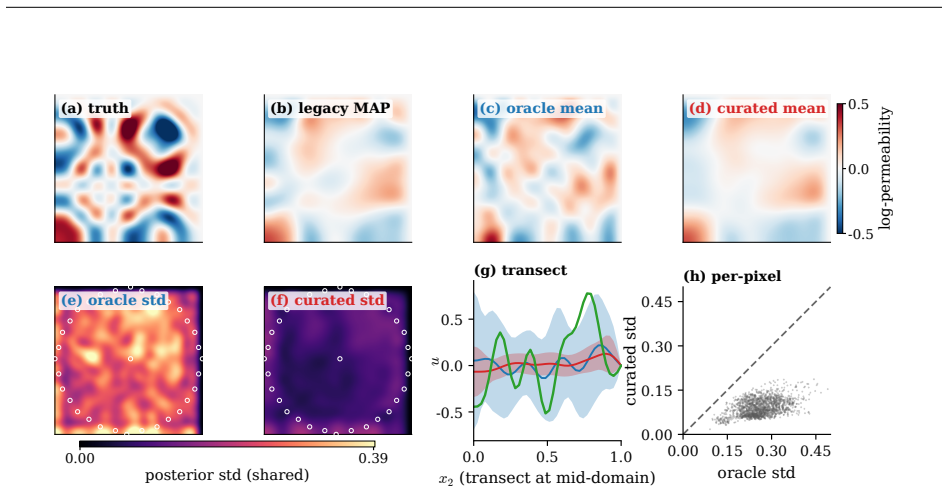
Training a learned prior on an archive of past reconstructions—prior laundering—freezes the old method's assumptions on the directions a survey cannot resolve, and the resulting overconfidence cannot be detected from the measurements.
Reviewed by Pith at T0; open to challenge. T0 means a machine referee read the full paper against a public rubric. the ladder, T0–T4 →
T0 review · deepseek-v4-flash
2026-08-01 06:54 UTC pith:LFUEKQZ5
load-bearing objection A solid, honest paper that identifies a real mechanism for overconfidence in archive-trained priors; the exact identity is population-level, and the paper is worth a serious referee.
Prior laundering: learned priors with inherited, undetectable overconfidence
The pith
A machine-rendered reading of the paper's core claim, the machinery that carries it, and where it could break.
Core claim
An archive of legacy reconstructions is, in the population limit, exactly one expectation–maximization step of the old regularizer toward the truth (Theorem 4.1). Because the likelihood reaches the unknown only through the forward operator, the step's reweight is constant along every blind fiber, so the curated prior's blind conditional equals the regularizer's—frozen no matter how much curation data (Theorem 4.2). Blind credible intervals then follow C = Φ(δ + z s_ρ/s_⋆) − Φ(δ − z s_ρ/s_⋆), under-covering whenever the inherited spread s_ρ is tighter than the truth's s_⋆ (Theorem 4.3); two truths differing only there induce identical data laws, so no measurement-side statistic can detect or
What carries the argument
The load-bearing object is the data-averaged posterior map T[ρ](x) = E_{y∼p⋆}[π(x|y)] = ρ(x) E_{y∼p⋆}[p(y|x)/ρ(y)] — the classical EM/NPMLE multiplicative update (Vardi–Lucy–Richardson) — applied to the legacy regularizer ρ. Curating on a posterior-sample archive computes exactly this map (Theorem 4.1). The update's reweight depends on x only through the forward image F(x), which makes it constant on each blind fiber; that fiber-constancy is the mechanism behind the freeze (Theorem 4.2), the closed-form coverage law (Theorem 4.3), the non-identifiability of the shortfall (Theorem 4.4), and the zero-width collapse under single-best archives, where flatness of the data term on each fiber leave
Load-bearing premise
The central theorems assume the archive behaves like an exact i.i.d. sample from the legacy regularizer's own posterior under the deployment measurements, so that the empirical archive converges to the one-EM-step population law; real archives hold approximate, heuristic, or single-best reconstructions, and the paper itself flags this as a population idealization (Section 4.1).
What would settle it
Build a linear–Gaussian inverse problem with a nontrivial null space, construct an archive by exact posterior sampling from a legacy Gaussian regularizer under the true measurement law, refit the curated prior nonparametrically to convergence, and score its blind-fiber credible intervals against a truth that is tighter along the null space. The paper predicts the blind conditional is exactly the regularizer's and coverage equals C = Φ(δ + z s_ρ/s_⋆) − Φ(δ − z s_ρ/s_⋆); observing a moved blind conditional, or nominal coverage while s_ρ < s_⋆, refutes the mechanism. Separately, any statistic of
If this is right
- A credible interval an archive-trained prior reports on any direction the operator leaves unresolved is the old method's belief in new clothing: its coverage is fixed by whether that belief is tighter than the truth, not by anything the data say.
- No goodness-of-fit test, held-out check against recorded data, or simulation-based calibration can certify an archive-trained prior's blind-subspace uncertainty—a clean calibration report does not mean the uncertainty was earned from data.
- Archives that store a single best reconstruction per survey—the common practice in seismic and medical imaging—produce zero-width credible intervals on blind directions; the estimator has nothing to say about them, and reporting that honestly would require discarding the uncertainty readout.
- The repair the theory licenses is structural rather than statistical: compute the resolved/blind split from the operator alone, flag blind-subspace intervals as prior-supplied, and add a genuinely new measurement channel (e.g., well logs) to de-freeze exactly the directions it resolves.
Where Pith is reading between the lines
- The one-EM-step identification suggests a concrete diagnostic the authors do not state: compare an archive-trained prior's blind-fiber spread with the legacy regularizer's—a close match is direct evidence the freeze is operating, while a mismatch reflects model capacity or sampling error rather than data support.
- The coverage law is monotone in the ratio of inherited to true spread, which implies a testable ordering: sparse or smoothness-regularized archives (which suppress variation everywhere) should produce sharper under-coverage than conservative or over-regularized ones; the paper's two experiments follow this ordering but do not claim it as a universal law.
- The undetectability result transfers to any amortized Bayesian pipeline whose training targets are outputs of a surrogate—not just imaging—so the audit (report which directions the measurements resolve) carries over to other non-identified inverse problems where 'ground truth' is itself a reconstruction.
Editorial analysis
A structured set of objections, weighed in public.
Referee Report
Summary. This paper studies the practice of training a generative prior for an inverse problem on an archive of legacy reconstructions rather than on true images ("prior laundering"). In the population limit of an exact posterior-sample archive and a nonparametric refit, the curated prior is shown to equal the old regularizer advanced by one EM step (Theorem 4.1); on the operator's blind subspace, the curated prior's conditional is frozen at the regularizer's (Theorem 4.2). In the linear-Gaussian case the paper derives a closed-form coverage shortfall (Theorem 4.3), proves that no measurement-side statistic can detect or correct it when the likelihood factors through the forward operator (Theorem 4.4), and shows that single-best archives collapse the blind credible interval to zero width (Theorem 4.6). A new measurement channel de-freezes exactly the directions it resolves (Corollary 4.7). The statements are carried to near-null and nonlinear operators, and demonstrated on seismic Born imaging and groundwater flow with diffusion and normalizing-flow priors, comparing a truth-trained oracle with a legacy-trained curated prior.
Significance. If the results hold, the paper provides a structural, provable mechanism for a widely suspected data crime: handcrafted regularizer assumptions re-emerge with the epistemic authority of data and cannot be detected from the measurements themselves. Strengths include a core derivation that is simple enough to be checked by hand and is additionally claimed machine-checked in Lean 4, released code for all experiments, explicit near-null bounds, and a numerical protocol that gates on model capacity, so the deployed undercoverage is attributed to the training target rather than underfitting. The practical recommendation—a blind-subspace report card computed from the operator alone—is cheap and operational. The main limitation is the acknowledged population idealization behind Theorem 4.1, but it is stated as a scope condition, and the empirical effect survives in finite, approximate deployments.
minor comments (4)
- [§4.2, Eq. (4.3)] The phrase "a frozen mean error δ≠0 only worsens it" following (4.4) is not true for r = sρ/s⋆ > 1: C is maximized at δ = 0 for any fixed r, so a large mean error can push coverage below nominal even when the prior is wider than the truth. This is a miss-centering failure rather than the width-type overconfidence of main interest, and (4.3) already covers it; I suggest rewording.
- [§4.1 and §5.3] The paper does not quantify the finite-archive/architecture deviation from the population identity (4.1). It is honest about the idealization, but adding an explicit open-problem sentence in §4.1 would sharpen the scope, especially because the experiments are protocol-matched comparisons rather than direct estimates of Eq. (4.1).
- [Theorem 4.6] The zero-width collapse is proven for deterministic variational maps. Real MAP pipelines using stochastic or randomized optimizers are not exactly deterministic; conditioning on the algorithmic randomness preserves the absence of within-y posterior spread, but the statement could say this explicitly to avoid an over-literal reading.
- [Abstract and §4.2] The abstract's undetectability claim is correct for a genuine blind subspace, but in the near-null regime Theorem A.3 makes the shortfall detectable in principle above n⋆ surveys. The body is careful about this distinction; an abstract-level qualifier such as "on exactly blind directions" would prevent overquoting.
Circularity Check
No significant circularity: the core theorems are derived from explicit assumptions; self-citations are contextual and non-load-bearing.
full rationale
The derivation chain is self-contained. Theorem 4.1 is not an assumption: q_ρ is defined in Eq. (3.3) as the data-averaged posterior map T[ρ], and the proof in (A.1) derives q_ρ(x)=ρ(x) E_{y∼p⋆} [p(y|x)/ρ(y)] directly from Bayes' rule; the identification with one EM step is an algebraic consequence, and the paper explicitly credits the multiplicative update to Vardi et al. (1985) rather than claiming it as new. Theorem 4.2 derives the blind-fiber freeze from the fiber-constancy of the reweight g(x)=g(x_R) in (A.2), which follows from the likelihood factoring through F(x); the linear-Gaussian precision identity (4.2) is then a coordinate computation, not a restatement of the conclusion. Theorem 4.3's closed-form coverage follows from the freeze plus Gaussian conditioning; Theorem 4.4's undetectability follows from p(y|x)=p(y|F(x)) and the explicit annihilator AN=0 in (4.5) and (A.10). Theorem 4.6's zero-width collapse follows from the deterministic MAP map and flatness of the data term along fibers; Theorem 4.7 follows from the stacked operator. None of these reduces to its inputs by construction. Self-citations (Siahkoohi et al.; Alemohammad et al.) appear as context or related work and carry no load-bearing uniqueness or ansatz claim; the proofs are additionally machine-checked in Lean 4 with no sorry, which is independent support. The paper itself flags two limitations: Section 4.1 scopes Theorem 4.1 to the population idealization ("The identity is a population idealization: it assumes an exact E-step, exact posterior sampling, and a nonparametric refit"), and Section 6 notes that scoring coverage requires constructed truths when the only field reference is a legacy reconstruction ("any field modality whose only reference is a legacy reconstruction faces the same circularity"). These are explicitly acknowledged scope/benchmark limitations, not hidden circular steps. The empirical protocol compares curated vs oracle priors on held-out truths and gates on capacity, so the experiments do not define the predicted effect into existence. Score 2 reflects only the presence of minor non-load-bearing self-citations; there is no circular derivation.
Axiom & Free-Parameter Ledger
free parameters (3)
- source-calibration scalar κ
- seismic blind-subspace illumination cutoff =
∥Av∥ below 1% of resolved median
- groundwater near-null singular-value cutoff =
below the noise level
axioms (6)
- domain assumption The likelihood reaches the unknown only through the forward operator: p(y|x) = p(y|F(x)), with Gaussian N(F(x), Γ) as the special case used for closed forms.
- domain assumption The archive is an i.i.d. sample from the legacy posterior under the regularizer ρ (posterior-sample archive) or from a deterministic variational/MAP map (single-best archive).
- domain assumption The truth distribution p⋆ is Gaussian in the linear-Gaussian closed forms and has Gaussian fiber-conditional in Theorem A.2.
- domain assumption The forward operator has a genuine null space B = ker A for the exact theorems; near-null operators are treated via cutoffs and Theorems A.3/A.4.
- standard math For Theorem 4.6: existence of a minimizer and a measurable selection where the arg min is not unique.
- standard math In the Lean 4 formalization, a few analytic steps (e.g., Φ integrals, spectral identities) are taken as explicit hypotheses, proved in the paper alone.
read the original abstract
Learned generative priors now supply the regularization in ill-posed imaging inverse problems, and the uncertainty read from their posterior samples is taken as evidence earned from data. When examples of the true image are scarce, as in seismic and medical imaging, the widely adopted recourse is to train such a prior not on truths but on an archive of past reconstructions---prior laundering. We show that the uncertainty it then reports can be overconfident, and that no measurement-side check can reveal it. On the directions a forward operator leaves unresolved, this prior reports not what the data support but the assumption built into the older reconstruction method. More specifically, when the archive holds posterior samples, its population law---averaged over the measurements---is exactly the old regularizer advanced a single expectation--maximization step, frozen on the operator's blind subspace. The freeze leaves no signature in the data. Two truths differing only there induce identical data laws, so no goodness-of-fit test separates them, and self-consistency diagnostics, simulation-based calibration among them, pass whatever the prior believes. In the more realistic case, where the archive keeps a single-best reconstruction rather than posterior samples, the blind credible interval collapses to zero width. We prove these statements and demonstrate the inherited overconfidence on deployed seismic and groundwater imaging against a truth-trained control. We recommend reporting which directions the operator resolves---separating the confidence the data support from belief inherited through the pipeline.
Figures


Reference graph
Works this paper leans on
-
[1]
, title =
Alemohammad, Sina and Casco-Rodriguez, Josue and Luzi, Lorenzo and Humayun, Ahmed Imtiaz and Babaei, Hossein and LeJeune, Daniel and Siahkoohi, Ali and Baraniuk, Richard G. , title =. International Conference on Learning Representations , year =
-
[2]
Nature , volume =
Shumailov, Ilia and Shumaylov, Zakhar and Zhao, Yiren and Papernot, Nicolas and Anderson, Ross and Gal, Yarin , title =. Nature , volume =
-
[3]
International Meeting for Applied Geoscience and Energy Expanded Abstracts , year =
Siahkoohi, Ali and Sabeddu, Davide , title =. International Meeting for Applied Geoscience and Energy Expanded Abstracts , year =
-
[4]
and Kumar, Abhishek and Ermon, Stefano and Poole, Ben , title =
Song, Yang and Sohl-Dickstein, Jascha and Kingma, Diederik P. and Kumar, Abhishek and Ermon, Stefano and Poole, Ben , title =. International Conference on Learning Representations , year =
-
[5]
International Conference on Learning Representations , year =
Li, Zongyi and Kovachki, Nikola and Azizzadenesheli, Kamyar and Liu, Burigede and Bhattacharya, Kaushik and Stuart, Andrew and Anandkumar, Anima , title =. International Conference on Learning Representations , year =
-
[6]
and Klasky, Marc L
Chung, Hyungjin and Kim, Jeongsol and McCann, Michael T. and Klasky, Marc L. and Ye, Jong Chul , title =. International Conference on Learning Representations , year =
-
[7]
Conditional score-based diffusion models for
Baldassari, Lorenzo and Siahkoohi, Ali and Garnier, Josselin and S. Conditional score-based diffusion models for. Advances in Neural Information Processing Systems , year =
-
[8]
, title =
Siahkoohi, Ali and Rizzuti, Gabrio and Orozco, Rafael and Herrmann, Felix J. , title =. Geophysics , volume =
-
[9]
, title =
Orozco, Rafael and Siahkoohi, Ali and Louboutin, Mathias and Herrmann, Felix J. , title =. Inverse Problems , volume =
-
[10]
Cotter, S. L. and Roberts, G. O. and Stuart, A. M. and White, D. , title =. Statist. Sci. , volume =
-
[11]
, title =
Sokal, Alan D. , title =. Functional Integration: Basics and Applications , pages =. 1997 , publisher =
1997
-
[12]
and Langmore, Ian and Tran, Dustin and Vasudevan, Srinivas , title =
Hoffman, Matthew and Sountsov, Pavel and Dillon, Joshua V. and Langmore, Ian and Tran, Dustin and Vasudevan, Srinivas , title =. Symposium on Advances in Approximate Bayesian Inference , year =
-
[13]
, title =
Erdinc, Huseyin Tuna and Bhar, Ipsita and Orozco, Rafael and Souza, Thales and Herrmann, Felix J. , title =. International Meeting for Applied Geoscience and Energy Expanded Abstracts , year =
-
[14]
and Solonen, Antti and Spantini, Alessio , title =
Cui, Tiangang and Martin, James and Marzouk, Youssef M. and Solonen, Antti and Spantini, Alessio , title =. Inverse Problems , volume =
-
[15]
, title =
Spantini, Alessio and Solonen, Antti and Cui, Tiangang and Martin, James and Tenorio, Luis and Marzouk, Youssef M. , title =. SIAM J. Sci. Comput. , volume =
-
[16]
and Laird, Nan M
Dempster, Arthur P. and Laird, Nan M. and Rubin, Donald B. , title =. J. R. Stat. Soc. Ser. B , volume =
-
[17]
Richardson, William Hadley , title =. J. Opt. Soc. Amer. , volume =
-
[18]
, title =
Lucy, Leon B. , title =. Astron. J. , volume =
-
[19]
, title =
Lindsay, Bruce G. , title =. Ann. Statist. , volume =
-
[20]
Kiefer, Jack and Wolfowitz, Jacob , title =. Ann. Math. Statist. , volume =
-
[21]
and Kaufman, Linda , title =
Vardi, Yehuda and Shepp, Larry A. and Kaufman, Linda , title =. J. Amer. Statist. Assoc. , volume =
-
[22]
Extracting training data from diffusion models , booktitle =
Carlini, Nicholas and Hayes, Jamie and Nasr, Milad and Jagielski, Matthew and Sehwag, Vikash and Tram. Extracting training data from diffusion models , booktitle =
-
[23]
and Bouman, Charles A
Venkatakrishnan, Singanallur V. and Bouman, Charles A. and Wohlberg, Brendt , title =. IEEE Global Conference on Signal and Information Processing , year =
-
[24]
Romano, Yaniv and Elad, Michael and Milanfar, Peyman , title =. SIAM J. Imaging Sci. , volume =
-
[25]
, title =
Kadkhodaie, Zahra and Simoncelli, Eero P. , title =. Advances in Neural Information Processing Systems , year =
-
[26]
Beylkin, Gregory , title =. J. Math. Phys. , volume =
-
[27]
, title =
Nemeth, Tamas and Wu, Chengjun and Schuster, Gerard T. , title =. Geophysics , volume =
-
[28]
, title =
Schuster, Gerard T. , title =
-
[29]
Natterer, Frank , title =
-
[30]
International Conference on Machine Learning , year =
Rezende, Danilo Jimenez and Mohamed, Shakir , title =. International Conference on Machine Learning , year =
-
[31]
Papamakarios, George and Nalisnick, Eric and Rezende, Danilo Jimenez and Mohamed, Shakir and Lakshminarayanan, Balaji , title =. J. Mach. Learn. Res. , volume =
-
[32]
International Conference on Learning Representations , year =
Dinh, Laurent and Sohl-Dickstein, Jascha and Bengio, Samy , title =. International Conference on Learning Representations , year =
-
[33]
and Dhariwal, Prafulla , title =
Kingma, Durk P. and Dhariwal, Prafulla , title =. Advances in Neural Information Processing Systems , year =
-
[34]
International Conference on Artificial Intelligence and Statistics , year =
Kong, Zhifeng and Chaudhuri, Kamalika , title =. International Conference on Artificial Intelligence and Statistics , year =
-
[35]
International Conference on Machine Learning , year =
Koehler, Frederic and Mehta, Viraj and Risteski, Andrej , title =. International Conference on Machine Learning , year =
-
[36]
Advances in Neural Information Processing Systems , year =
Ho, Jonathan and Jain, Ajay and Abbeel, Pieter , title =. Advances in Neural Information Processing Systems , year =
-
[37]
Laird, Nan , title =. J. Amer. Statist. Assoc. , volume =
-
[38]
, title =
Stuart, Andrew M. , title =. Acta Numer. , volume =
-
[39]
Kaipio, Jari and Somersalo, Erkki , title =
-
[40]
and Hanke, Martin and Neubauer, Andreas , title =
Engl, Heinz W. and Hanke, Martin and Neubauer, Andreas , title =
-
[41]
Tarantola, Albert , title =
-
[42]
SIAM/ASA J
Hosseini, Bamdad , title =. SIAM/ASA J. Uncertain. Quantif. , volume =
-
[43]
Robust uncertainty principles: Exact signal reconstruction from highly incomplete frequency information , journal =
Cand. Robust uncertainty principles: Exact signal reconstruction from highly incomplete frequency information , journal =
-
[44]
, title =
Donoho, David L. , title =. IEEE Trans. Inform. Theory , volume =
-
[45]
arXiv preprint arXiv:1804.06788 , year =
Talts, Sean and Betancourt, Michael and Simpson, Daniel and Vehtari, Aki and Gelman, Andrew , title =. arXiv preprint arXiv:1804.06788 , year =
-
[46]
and Gelman, Andrew and Rubin, Donald B
Cook, Samantha R. and Gelman, Andrew and Rubin, Donald B. , title =. J. Comput. Graph. Statist. , volume =
-
[47]
, title =
Bora, Ashish and Jalal, Ajil and Price, Eric and Dimakis, Alexandros G. , title =. International Conference on Machine Learning , year =
-
[48]
, title =
Antun, Vegard and Renna, Francesco and Poon, Clarice and Adcock, Ben and Hansen, Anders C. , title =. Proc. Natl. Acad. Sci. USA , volume =
-
[49]
and Antun, Vegard and Hansen, Anders C
Gottschling, Nina M. and Antun, Vegard and Hansen, Anders C. and Adcock, Ben , title =. SIAM Review , volume =
-
[50]
and Brooks, Frank J
Bhadra, Sayantan and Kelkar, Varun A. and Brooks, Frank J. and Anastasio, Mark A. , title =. IEEE Trans. Med. Imaging , volume =
-
[51]
International Conference on Machine Learning , year =
Asim, Muhammad and Daniels, Max and Leong, Oscar and Ahmed, Ali and Hand, Paul , title =. International Conference on Machine Learning , year =
-
[52]
International Conference on Learning Representations , year =
Wang, Yinhuai and Yu, Jiwen and Zhang, Jian , title =. International Conference on Learning Representations , year =
-
[53]
Inverse Problems , volume =
Schwab, Johannes and Antholzer, Stephan and Haltmeier, Markus , title =. Inverse Problems , volume =
-
[54]
Astrophys
Barco, Gabriel Missael and Adam, Alexandre and Stone, Connor and Hezaveh, Yashar and Perreault-Levasseur, Laurence , title =. Astrophys. J. , volume =
-
[55]
A trust crisis in simulation-based inference?
Hermans, Joeri and Delaunoy, Arnaud and Rozet, Fran. A trust crisis in simulation-based inference?. Trans. Mach. Learn. Res. , year =
-
[56]
and Tamir, Jonathan I
Jalal, Ajil and Arvinte, Marius and Daras, Giannis and Price, Eric and Dimakis, Alexandros G. and Tamir, Jonathan I. , title =. Advances in Neural Information Processing Systems , year =
-
[57]
, title =
Korkmaz, Yilmaz and Cukur, Tolga and Patel, Vishal M. , title =. Medical Image Computing and Computer Assisted Intervention , year =
-
[58]
, title =
Mosser, Lukas and Dubrule, Olivier and Blunt, Martin J. , title =. Math. Geosci. , volume =
-
[59]
IEEE Trans
Shi, Xingchen and Cheng, Shijun and Mao, Weijian and Ouyang, Wei , title =. IEEE Trans. Geosci. Remote Sens. , year =
-
[60]
, title =
Siahkoohi, Ali and Rizzuti, Gabrio and Herrmann, Felix J. , title =. Geophysics , volume =
-
[61]
, title =
Siahkoohi, Ali and Herrmann, Felix J. , title =. Society of Exploration Geophysicists Technical Program Expanded Abstracts , year =
-
[62]
and Herrmann, Felix J
Siahkoohi, Ali and Rizzuti, Gabrio and Louboutin, Mathias and Witte, Philipp A. and Herrmann, Felix J. , title =. Symposium on Advances in Approximate Bayesian Inference , year =
-
[63]
, title =
Halko, Nathan and Martinsson, Per-Gunnar and Tropp, Joel A. , title =. SIAM Review , volume =
-
[64]
Zbontar, Jure and Knoll, Florian and Sriram, Anuroop and others , journal=
-
[65]
Score-based diffusion models for accelerated
Chung, Hyungjin and Ye, Jong Chul , journal=. Score-based diffusion models for accelerated
-
[66]
Luo, Guanxiong and Blumenthal, Moritz and Heide, Martin and Uecker, Martin , journal=
-
[67]
, journal=
Bhar, Ipsita and Erdinc, Huseyin Tuna and Souza, Thales and Jones, Charles and Herrmann, Felix J. , journal=
-
[68]
IEEE Trans
Edupuganti, Vineet and Mardani, Morteza and Vasanawala, Shreyas and Pauly, John , title =. IEEE Trans. Med. Imaging , volume =
-
[69]
and Schmidt, Andrew M
Desai, Arjun D. and Schmidt, Andrew M. and Rubin, Elka B. and Sandino, Christopher M. and Black, Marianne S. and Mazzoli, Valentina and Stevens, Kathryn J. and Boutin, Robert and R. Advances in Neural Information Processing Systems Datasets and Benchmarks Track , year =
-
[70]
International Conference on Learning Representations , year =
Song, Yang and Shen, Liyue and Xing, Lei and Ermon, Stefano , title =. International Conference on Learning Representations , year =
-
[71]
Advances in Neural Information Processing Systems , year =
Chung, Hyungjin and Sim, Byeongsu and Ryu, Dohoon and Ye, Jong Chul , title =. Advances in Neural Information Processing Systems , year =
-
[72]
Leuschner, Johannes and Schmidt, Maximilian and Otero Baguer, Daniel and Maass, Peter , title =. Sci. Data , volume =
-
[73]
and Bartley, Adam C
McCollough, Cynthia H. and Bartley, Adam C. and Carter, Rickey E. and Chen, Baiyu and Drees, Tammy A. and Edwards, Phillip and Holmes III, David R. and Huang, Alice E. and Khan, Farhana and Leng, Shuai and McMillan, Kyle L. and Michalak, Gregory J. and Nunez, Kristina M. and Yu, Lifeng and Fletcher, Joel G. , title =. Med. Phys. , volume =
-
[74]
Diffusion Reconstruction of Ultrasound Images with Informative Uncertainty , journal =
Zhang, Yuxin and Huneau, Cl. Diffusion Reconstruction of Ultrasound Images with Informative Uncertainty , journal =
-
[75]
and Pauly, Kim Butts , title =
Naftchi-Ardebili, Kasra and Singh, Karanpartap and Pourabolghasem, Reza and Ghanouni, Pejman and Popelka, Gerald R. and Pauly, Kim Butts , title =. arXiv preprint arXiv:2308.00206 , year =
-
[76]
and Pauly, Kim Butts , title =
Naftchi-Ardebili, Kasra and Singh, Karanpartap and Popelka, Gerald R. and Pauly, Kim Butts , title =. Med. Phys. , volume =
-
[77]
Fan, Jianqing , title =. Ann. Statist. , volume =
-
[78]
and Hall, Peter , title =
Carroll, Raymond J. and Hall, Peter , title =. J. Amer. Statist. Assoc. , volume =
-
[79]
Should penalized least squares regression be interpreted as maximum a posteriori estimation? , journal =
Gribonval, R. Should penalized least squares regression be interpreted as maximum a posteriori estimation? , journal =
-
[80]
Inverse Problems , volume =
Burger, Martin and Lucka, Felix , title =. Inverse Problems , volume =
discussion (0)
Sign in with ORCID, Apple, or X to comment. Anyone can read and Pith papers without signing in.